R. Paranthaman
Technical Officer (Laboratory),
Department of Food safety & quality Testing, Indian Institute of Crop Processing Technology,
Ministry of food Processing Industries, Government of India, Thanjavur- 613 005, Tamil Nadu, India
Email ; [email protected]
Address for correspondence
Access this article online www.japer.in
Optimization of digestion methods for mineral in spirullina by
Inductively Coupled Plasma-Optical Emission Spectrometry
(ICP-OES
)
1. INTRODUCTION
Blue-green algae have been attracting the most
attention as potential, indeed actual, sources of
proteins and other human and natural nutrients (fatty
acids, macro- and trace minerals). Among these algae,
the filamentous cyanobacterium Spirulina appears to
be a ubiquitous component of the phytoplankton
growing in ocean and seawaters (from tropical
lagoons to Arctic waters, thermal springs, alcaline
lakes etc.) [1–3]. Further, the presence of an
anti-oxidizing agent as β- carotene and the rare linolenic
acids [4-6] suggests a beneficial therapeutic effect
(first of all anti-cancer) of this algae. Spirulina is a
nutrient rich super food for super health. Super foods
can be defined as foods that have health promoting
benefits and disease preventing properties over and
above their usual nutritional value. Spirulina is the
common name for human and animal food
supplements produced primarily from two species of
Cynobacteria, that is, Arthrospireaplatensis and
Arthrospira maxima. Spirulina has many
therapeuticproperties such as hypocholestrolemic,
immunological, antiviral and antiglutagenic effects
[7].Spirulina is an excellent source of protein. Today,
food is lower in essential nutrients than foods
produced 50 years ago. Farming practices have
depleted our soil fertility
(http://www.spirulinasource.com). Stress from
environmental pollutants and lifestyle demands have
increased our dietary requirements for certain
essential nutrients. To overcome these problems,
some super foods like aloe vera, garlic, tomato,
walnut, blue green algae (spirulina) have been
introduced. Spirulina, Blue green algae (fusiformis) is
being used as nutrient dense food materials in natural
and health foods. It also has some potent nutrients
and probiotic compounds that enhance health
condition [8]. The objective of the present study was
the analysis of trace element Potassium (K) ,
Magnesium (Mg) ,Phosphorous (P) ,Iron (Fe) ,Calcium
(Ca), Sodium (Na), Manganese (Mn) ,Lead (Pb) &
Cadmium (Cd) levels in spirullina powder of dry, wet
Research ResearchResearch
Research ArticleArticleArticleArticle
Determination of elements from the spirullina powder by inductively coupled plasma-optical emission spectrometry (ICP-OES) and to report efficient, reliable, receptive method of microwave digestion for better recovery of the elements. The three digestion methods are studied included, dry ashing method and microwave digestion. ICP-OES The method has been validated using RF power of 1450 watts, plasma flow of 15L/min, Nebulizer flow of 0.7 L/min and plasma view at radial mode for all elements. As, Hg, Se, Zn, P, Pb, Cd, Fe, Mn, Cr, Mg, Cu, Ca, Na and K). The results of the elemental quantification were analyzed and the microwave digestion method shows exhibits good quantity of minerals like Mg, Ca , P, K and Fe. The microwave digestion method is found to more reliable as compare to wet digestion & dry ashing method and hence recommended for better recovery. The element Potassium (K),Magnesium (Mg), Phosphorous (P), Iron (Fe),Calcium (Ca) gives better recovery by ash and microwave digestion method as compare to wet digestion method. All the elements are quantified successfully by ICPOES technique by all methods of digestion. Dry and wet digestion methods are tedious and time consuming compare to microwave digestion method, which is greener and simpler. The spirullina popwder can be used as supplementary food for deficiency of minerals like Fe, Mg and Ca.
Keywords: spirullina powder, ICP-OES, Minerals, food quality, Microwave digestion
ABSTRACT ABSTRACT ABSTRACT ABSTRACT
R. Paranthaman, R.Vidyalakshmi, S.Kumaravel
Department of Food Safety & Quality Testing Indian Institute of Crop Processing Technology, Ministry of Food Processing Industries Thanjavur- 613 005, Tamil Nadu,
India
and microwave digested using inductively coupled
plasma optical emission spectrometry (ICP-OES).
2. MATERIAL & METHODS
The analysis of minerals in spirullina powder samples
by using ICP-OES method [9-12]. All minerals and
heavy metals measurements were carried out using
the Perkin-Elmer optima ICP- OES (Model:
OPTIMA2000DV, seial number: 080N3041701) and
the ICP-OES operating conditions are listed in table 1.
2.1 ICP-OES (Inductively Coupled Plasma-Optical
Emission Spectrometry) Analysis of Samples
All samples were analyzed in triplicates by ICP-OES
Perkin-Elmer; model Optima™ 2000 DV, using
winLab32 software for the analysis. The analytical
measurements were made with a simultaneous
perkin–Elmer ICP OES, model optima 2000DV,
winLab32™, version 7.0 software equipped with a
peristaltic pump, a cross-flow nebulizer (coupled to a
ryton double pass spray chamber) and a ceramic
central torch tube injector with an internal diameter
of 2 mm. The operating parameters are listed in Table
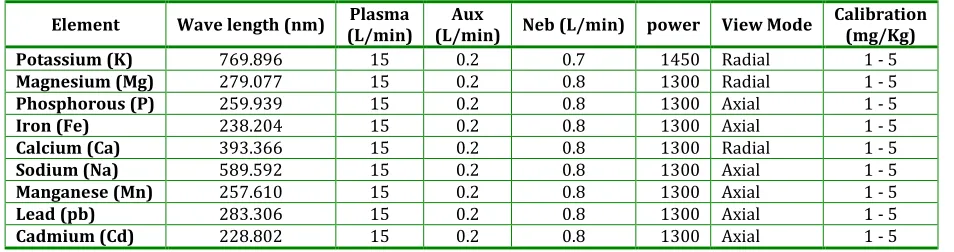
1 . The wavelengths, measurement parameters and
standards for each element are given in Table 2.
Table 1: Instrumental Conditions and Parameters Parameter Setting
Injector Alumina 2 mm i.d. Sample tubing Standard 0.76 mm i.d.
Drain tubing Standard 1.14 mm i.d. Quartz torch Single slot Sample capillary PTFE 1 mm i.d.
Sample vials Polypropylene Source equilibrium delay 15 sec
Plasma aerosol type Wet Nebulizer start up Instant
RF power: 1450
Nebulizer flow 0.7 L/min Auxiliary flow 0.2 L/min
Plasma flow 15 L/min
Sample pump rate 1.5 mL/min Plasma viewing: Axial, radial Processing mode Peak area Auto integration (min-max): 0.1-0.5 sec
Replicates 2
Background correction 1 or 2-point, manual
Table 2: Wavelengths, Measurement Parameters and Standards for each Element
Element Wave length (nm) Plasma (L/min)
Aux
(L/min) Neb (L/min) power View Mode
Calibration (mg/Kg)
Potassium (K) 769.896 15 0.2 0.7 1450 Radial 1 - 5
Magnesium (Mg) 279.077 15 0.2 0.8 1300 Radial 1 - 5
Phosphorous (P) 259.939 15 0.2 0.8 1300 Axial 1 - 5
Iron (Fe) 238.204 15 0.2 0.8 1300 Axial 1 - 5
Calcium (Ca) 393.366 15 0.2 0.8 1300 Radial 1 - 5
Sodium (Na) 589.592 15 0.2 0.8 1300 Axial 1 - 5
Manganese (Mn) 257.610 15 0.2 0.8 1300 Axial 1 - 5
Lead (pb) 283.306 15 0.2 0.8 1300 Axial 1 - 5
Cadmium (Cd) 228.802 15 0.2 0.8 1300 Axial 1 - 5
2.2 Analysis of certified reference material (CRM)
of Minerals and calibration
A liquots of an ICP multielement standard solution (10
to 50 mg/L Merck) containing the analyzed elements
(As, Hg, Se, Zn, P, Pb, Cd, Fe, Mn, Cr, Mg, Cu, Ca, Na and
K) were used in the preparation of calibration
solutions. Working standard solutions were prepared
by dilution of the stock standard solutions to desired
concentration in 1% HNO3.
2.3Sample Preparation
The determination of metal contents was carried out
using dry, wet and microwave digestions by
inductively coupled plasma-optical emission
spectrometry (ICP-OES).
2.3.1 Reagents and chemicals
All chemicals used throughout the experiments were
of analytical- reagent grade (Merck, Darmstadt,
Germany). HNO3 (65%), H2O2 (30%) and HCI (37%)
were of analytical grade (E. Merck, India). All
glassware and polyethylene bottles were kept
rinsing five times with distilled de-ionized Ultra High
Quality water (Millipore, India)
2.3.2. Dry digestion
Spirullina powder samples (1.0 g) were placed into a
high-form porcelain crucible. The furnace
temperature was slowly increased to 450ºC. The
samples were ashed for about 16 h until a white ash
residue was obtained. The ashed sample was treated
with 5 ml HNO3 (25% v/v) and the mixture, where
necessary, was heated slowly to dissolve the residue.
The solution filtered through whatman filter paper
and then the sample was transferred to a 10 ml
volumetric flask and made up to volume. Blanks were
prepared in the same way as the sample, but omitting
the sample. The determination of metal contents in
this clear solution was carried out by ICP-OES. Three
replicates (acid digests) were performed for each
sample.
2.3.2. Wet digestion
For the digestion of Spirullina powder , the
temperature was maintained at 130 ºC for 4 h during
digestion of 1.0 g of sample with 6 ml HNO3 (65%)
and 2 ml H2O2 (30%) mixtures on the hot plate until
the solubilization of the sample was completed and
then diluted to 10 ml with distilled water. The residue
was filtered through whatman filter paper and then
the sample was diluted to 10 mL with distilled water.
Element contents of final solution were determined by
ICP-OES. Blanks were prepared in the same way as the
sample, but omitting the sample.
2.3.3. Microwave digestion
The Spirullina powder was digested using microwave
digestor (Model: ETHOS One, Make – Millestone). A
microwave assisted digestion procedure was carried
out, in order to achieve a shorter digestion time.
Weighed triplicate 0.25 g of certified samples and 1.0
g of real samples in reaction vessels (100 mL in
capacity) directly, added to each flasks 8 mL of a
freshly prepared mixture of concentrated HNO3–
H2O2 (6:2, v/v) and stood for 10 min. Digestion
conditions for the microwave system were applied as
2 min for 250 W, 2 min for 0W, 6 min for 250 W, 5 min
for 400 W, 8 min for 550 W, vent: 8 min. After cooling,
the resulting solutions were diluted up to 10 mL in
volumetric flasks with 1 M HNO3.
3. RESULT AND DISCUSSIONS
The certified reference material (CRM) of Potassium
(766.490) , Magnesium (280.271) ,Phosphorous
(213.617) ,Iron (238.204) ,Calcium (393.366), Sodium
(589.592), Manganese (257.610) ,Lead (220.353) &
Cadmium (228.802) was analysed and calibrated.
The ranges of the calibration curves (5 points) were
selected to match the expected concentrations for all
the elements of the sample studied by ICP-OES. The
correlation coefficient r2 obtained for all cases was
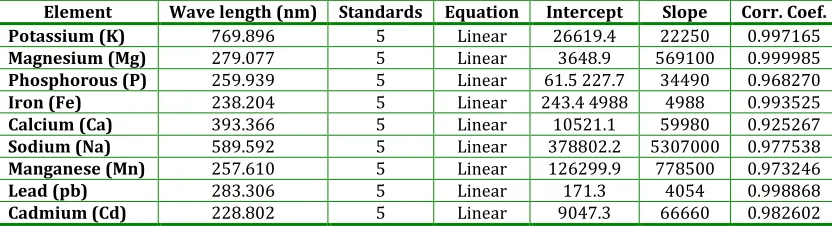
0.9999 and the calibration summary was given in
table.3.
Table 3: Calibration summary
Element Wave length (nm) Standards Equation Intercept Slope Corr. Coef.
Potassium (K) 769.896 5 Linear 26619.4 22250 0.997165
Magnesium (Mg) 279.077 5 Linear 3648.9 569100 0.999985
Phosphorous (P) 259.939 5 Linear 61.5 227.7 34490 0.968270
Iron (Fe) 238.204 5 Linear 243.4 4988 4988 0.993525
Calcium (Ca) 393.366 5 Linear 10521.1 59980 0.925267
Sodium (Na) 589.592 5 Linear 378802.2 5307000 0.977538
Manganese (Mn) 257.610 5 Linear 126299.9 778500 0.973246
Lead (pb) 283.306 5 Linear 171.3 4054 0.998868
Cadmium (Cd) 228.802 5 Linear 9047.3 66660 0.982602
The wet, dry ashing and microwave digestion methods
were performed for determination of minerals in
spirullina powder samples given in table 4,5 & 6).
diluted with 1 % nitric acid to 50 mL. These samples
were analyzed in duplicates and calculated using
certified reference material mineral standards.. The
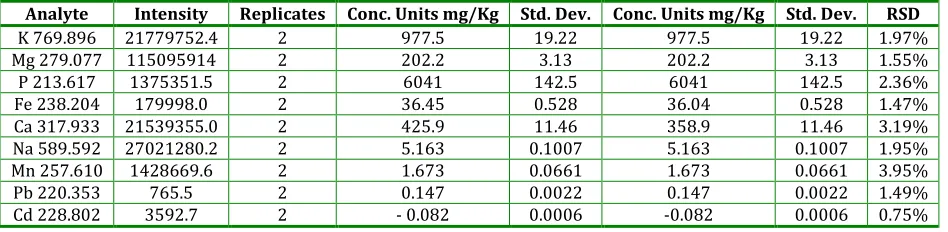
microwave digestion results showed that Potassium
(977.5 mg/Kg) , Magnesium (202.2 mg/Kg)
,Phosphorous (6041 mg/Kg) ,Iron (36.45 mg/Kg) and
Calcium (425.9 mg/Kg) and yield also higher than wet
and dry ash digestion methods (Table 7). The
achieved results are in good conformity with certified
values. The accuracy of the method was evaluated by
means of trace element determination in the standard
reference material. Relative standard deviations (RSD)
were found below 5%.
Table 4: Mean Data of elements in spirullina powder using microwave digestion method
Analyte Intensity Replicates Conc. Units mg/Kg Std. Dev. Conc. Units mg/Kg Std. Dev. RSD
K 769.896 21779752.4 2 977.5 19.22 977.5 19.22 1.97%
Mg 279.077 115095914 2 202.2 3.13 202.2 3.13 1.55%
P 213.617 1375351.5 2 6041 142.5 6041 142.5 2.36%
Fe 238.204 179998.0 2 36.45 0.528 36.04 0.528 1.47%
Ca 317.933 21539355.0 2 425.9 11.46 358.9 11.46 3.19%
Na 589.592 27021280.2 2 5.163 0.1007 5.163 0.1007 1.95%
Mn 257.610 1428669.6 2 1.673 0.0661 1.673 0.0661 3.95%
Pb 220.353 765.5 2 0.147 0.0022 0.147 0.0022 1.49%
Cd 228.802 3592.7 2 - 0.082 0.0006 -0.082 0.0006 0.75%
Table 5: Mean Data of elements in spirullina powder using wet ashing method
Analyte Intensity Replicates Conc. Units mg/Kg Std.Dev. Conc. Units mg/Kg Std.Dev. RSD%
K 766.490 3076912.3 2 137.1 3.32 137.1 3.32 2.42%
Mg 285.213 1459124.4 2 2.570 0.0780 2.570 0.0780 3.03%
P 213.617 229483.5 2 1008 24.3 1008 24.3 2.41%
Fe 238.204 59435.5 2 11.87 0.249 11.87 0.249 2.10%
Ca 317.933 7439172.7 2 123.8 6.16 123.8 6.16 4.98%
Na 589.592 5191450.6 2 1.050 0.0204 1.050 0.0204 1.94%
Mn 257.610 472062.2 2 0.444 0.0221 0.444 0.0221 4.98%
Pb 220.353 978.6 2 0.199 0.0045 0.199 0.0045 2.24%
Cd 228.802 1506.2 2 -0.113 0.0011 -0.113 0.0011 0.95%
Table 6: Mean Data of elements in spirullina powder using dry ashing method
Analyte Intensity Replicates Conc. Units mg/L Std.Dev. Conc. Units mg/Kg Std.Dev. RSD%
K 766.490 11898752.5 2 533.5 13.73 533.5 13.73 2.57%
Mg 285.213 4804445.2 2 8.448 0.0522 8.448 0.0522 0.62%
P 213.617 686353.5 2 3015 62.3 3015 62.3 2.07%
Fe 238.204 182047.6 2 36.04 0.159 36.45 0.159 0.44%
Ca 317.933 25557693.9 2 358.9 1.85 425.9 1.85 0.43%
Na 589.592 18538487.1 2 3.565 0.0791 3.565 0.0791 2.22%
Mn 257.610 1523327.9 2 1.795 0.0259 1.795 0.0259 1.44%
Pb 220.353 1258.8 2 0.268 0.0101 0.268 0.0101 3.78%
Cd 228.802 2420.5 2 -0.099 0.0004 -0.099 0.0004 0.40%
Table 7: Result Summary
Elements Wave Length Mean Data Concentrations (mg/Kg) (dry basis) Microwave Wet Ashing Dry Ashing
Potassium (K) 766.490 977.5 137.1 533.5
Magnesium (Mg) 280.271 202.2 2.570 8.448
Phosphorous (P) 213.617 6041 1008 3015
Iron (Fe) 238.204 36.45 11.87 36.04
Calcium (Ca) 393.366 425.9 123.8 358.9
Sodium (Na) 589.592 BDL BDL BDL
Manganese (Mn) 257.610 5.163 1.050 3.565
Lead (pb) 220.353 1.673 0.444 1.795
Cadmium (Cd) 228.802 0.199 0.147 0.268
*Below Detection Limit
4. CONCLUSION
The comparison of dry wet and microwave digestion
methods showed no statistically significant
differences in results obtained with these three
methods. The results showed that dry and wet ashing
procedures were slow and time consuming, so
microwave digestion procedure was preferred.
Microwave sample digestion is an accurate, simple
and fast method for the ICP-OES determination of
Potassium (K) , Magnesium (Mg) ,Phosphorous (P)
,Iron (Fe) ,Calcium (Ca), Sodium (Na), Manganese
(Mn) ,Lead (Pb) & Cadmium (Cd) in spirullina powder
samples. Spirullina powder was a very important
human nutrient since their consumption has
increased in recent years. Reviews clearly show that
Spirulina has many therapeutic uses and great
nutritional value. Therefore, results suggest that there
good nutritive value and it can be concluded that
Spirulina has a great scope in the field of human
health and can be utilized for achieving food and
nutritional security for nation.
5. Funding
This work was supported by Indian Institute of crop
processing technology, Pudukottai Road, Thanjavur,
Tamilnadu.
6. ACKNOWLEDGEMENTS
The authors would like to special thank Dr. K.
SINGARAVADIVEL (K. S. Vel), Director, Indian
Institute of Crop Processing Technology (IICPT),
Ministry of Food Processing Industries, Govt. of India,
Thanjavur-613 005 Tamil Nadu, for their support of
this study.
7. REFERENCE
1. Henrikson, R. Earth Food Spirulina. How this remarkable
blue-green algae can transform your health and our planet,
Ronore Enterprises Inc., Laguna Beach, California;, 1989.
pp 180.
2. Ciferri, O. Microbiol. Rev. 1983, 47, 551-578.
3. Richmond, A. Spirulina. In Micro-Algal Biotechnology,Borowitzka, M. A. and Borowitzka, L. J. Eds., Cambridge University Press (1988).,
4. Schwartz, J.; Scklar, G.; Suda, D. Cancer Nutrition 1988, June. 5. Roughan, P. G. J. Sci. Food Agric. 1989, 47, 85.
6. Cohen, Z.; Vonshak, A.; Richmond, A. Phytochem. 1987,
26,2255-2258.
7. Mark F Mc Carty Clinical. Potential of Spirulinaas: A source of phycocyanobilin. Journal of Medicinal Food, (2007). 10(4): 566-570.
8. Srilakshmi B (2001). Food Science. 2nd Edition. Delhi: New Age International Limited Publishers.
9. Huseyin Altundag and Mustafa Tuzen . Comparison of dry,
wet and microwave digestion methods for the
multielement determination in some dried fruit samples by
ICP-OES. Food and Chemical Toxicology, 2011. 49, 2800–
2807
10. U.S. EPA Method 200.7: “Determination of metals and trace
elements in water and wastes by Inductively Coupled
Plasma Optical Emission Spectrometry”, Cincinnati, Ohio,
U.S.
11. IS 3025 (part 2): 2004, ISO 11885:1996. “Water
Quality-Determination of 33 Elements by Inductively Coupled
Plasma Optical Emission Spectrometry”.
12. PerkinElmer Application Library for ICP-OES.
How to cite this article: R. Paranthaman, R.Vidyalakshmi, S.Kumaravel; Optimization of digestion methods for mineral in spirullina by Inductively Coupled Plasma-Optical Emission Spectrometry (ICP-OES); J. Adv. Pharm. Edu. & Res. 2014: 4(4): 417-421.