Dr. Jayaprakasam. R, M.Pharm, Ph.D.,
Assistant Professor, Department of Pharmaceutical Analysis, College of Pharmacy, Sri Ramakrishna Institute of Paramedical Sciences, Coimbatore- 641 044. India Mob.No : (0) 9677751349.
Email: [email protected]
Address for correspondence
Access this article online www.japer.in
Simultaneous determination of berberine and β- sitosterol in the
leaf extracts of
Naravelia zeylanica
by analytical methods and
their
in vitro
Anti diabetic activity
INTRODUCTION
Herbal medicines are those containing active ingredients as complex chemical mixtures developed as crude fractions extracted from aerial or underground parts of plant or other plant material which are widely used in health-care or as dietary supplements. [1]
According to an estimate of the World Health Organization (WHO), about 85-90% of the world’s population still uses herbal medicines for fulfilling their primary health care needs. [2] Herbal drug standardization is a much needed public and private initiative that will help in elevating traditional medicine to the levels it probably deserves internationally.[3] It is very important that a system of standardization is established for every plant medicine in the market because the scope for variation in different batches of medicines is
enormous. [4]
Diabetes mellitus (DM) is a group of syndromes characterized by hyperglycemia resulting from defects in insulin secretion, activity of insulin, or both. Chronic hyperglycemia leads to various macro and micro vascular complications leading to damage, dysfunction, and failure of various organs, especially the eyes, kidneys, nerves, heart, and blood vessels. [5] It is estimated that 366 million people worldwide (8.3% of adults) suffered from diabetes in 2011. It is predicted that the number of diabetes may to go upto 552 million people (one adult in 10) by the year 2030 as predicted by International Diabetes Federation 2011. [6] In the present study an attempt is made to develop HPTLC and HPLC methods for the simultaneous analysis of the respective active constituents present in the plant extract using standard markers and also to carry out the evaluation of their anti diabetic activity. [6]
MATERIALS AND METHODS Chemicals:
Berberine, β- siotosterol and α- amylase were purchased from Sigma Aldrich, India. AR/HPLC grade methanol, water, acetonitrile, petroleum ether, The intension of the present work is to perform the simultaneous analysis of marker compounds (berberine and β- sitosterol) in Naravelia zeylanica by HPTLC and HPLC methods and evaluation of their in vitro antidiabetic activity. The successive extraction of leaves of Naravelia zeylanica was carried out by using soxhlet apparartus. In HPTLC, the separation was achieved using toluene: chloroform: methanol (3:4:3%v/v/v) as mobile phase and detection at 345nm. Linearity was observed in the concentration range of 300-400ng/spot for berberine and β- sitosterol. In HPLC, the separation was achieved by using acetonitrile : water (80:20%v/v) and photodiode array detection was done at 266nm. Linearity was observed in the concentration range of 40-80µg/ml for berberine and β- sitosterol. The proposed methods were validated as per ICH guidelines. The antidiabetic activity was confirmed by α- amylase inhibitory activity at concentrations of 25-400µg/ml.
Key words: Naravelia zeylanica, HPTLC, HPLC, Anti diabetic activity, Acarbose.
ABSTRACT
Jayaprakasam Rajendran* Asha Jyothi
Liji Jacob Sruthi Vinod Ravi Thengungal Kochupappy
Department of Pharmaceutical Analysis, College of Pharmacy, Sri Ramakrishna Institute of Paramedical Sciences, New Siddhapudur, Coimbatore-641044, Tamil Nadu, India.
chloroform, toluene, n-butanol, formic acid, glacial acetic acid, ethyl acetate and n-propanol were supplied by S.D. Fine Chemicals Ltd., and Merck Pvt. Ltd., Mumbai.
Instruments:
The analysis was performed on the Camag HPTLC system with Linomat 5 applicator, Camag TLC scanner 3 and WinCATS software. Shimadzu HPLC system with LC AT10 VP Pump, SPD M 10 AT VP Detector and CLASS M 10A software. Jasco V-560 UV/Vis-Spectrophotometer.
METHODS Plant collection:
The plant material collected was confirmed as
Naravelia zeylanica by Dr. C. Kunhikannan, Scientist E, Biodiversity division, Institute of Forest Genetics and Tree Breeding, Coimbatore, Tamil Nadu, India.
Extraction:
The leaves of Naravelia zeylanica were ground well for the extraction process for a period of 5 days with 500g of powdered drug. Extraction was carried out successively by continuous hot percolation method using soxhlet apparatus using solvents of increasing polarity such as petroleum ether, chloroform and methanol at a temperature of 30-45°C. Volume of solvent used was 1000ml.
HPTLC method HPTLC Conditions:
The optimized solvent system used for the separation of active markers berberine and β- sitosterol present in the extracts of plant was toluene: chloroform: methanol, (3:4:3%v/v/v). The stationary phase was pre-coated plates containing silica gel 60F254 on aluminium sheets and detection was done at 345nm. The derivatizing agent, anisaldehyde sulphuric acid, was used for detecting β- sitosterol in the mixture. The fixed parameters were the chamber saturation time of 25 minutes, migration distance of 80 mm, band width of 6 mm and slit dimension of 5 × 0.45 mm.
a) Preparation of standard stock solution of markers
Berberine:
10mg of berberine was transferred into 10ml standard flask, dissolved in a small quantity of methanol and the volume was made up with methanol to 10ml to get a concentration of 1000μg/ml.
β - sitosterol:
10mg of β - sitosterol was transferred into 10ml standard flask dissolved in a small quantity of methanol and the volume was made up with methanol to 10ml to get a concentration of 1000μg/ml.
Marker mixture:
From the above stock solution,5ml each of berberine solution and β - sitosterol solution were transferred into separate10ml standard flasks and the volumes were made up with methanol to 10ml to get a concentration of 500μg/ml of each. The literature review shows that no work has been done so far on HPTLC analysis by using methanol as a solvent. [7, 8] Validation of HPTLC method
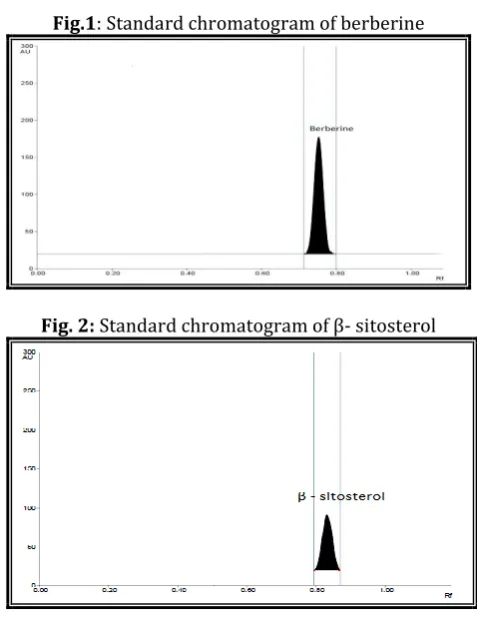
The validation of the developed method was carried out as per ICH guidelines in terms of linearity, limit of detection (LOD), limit of quantification (LOQ), inter and intraday precision, repeatability of sample application and measurement and stability studies. Standard chromatograms of berberine and β- sitosterol are shown in Fig. 1
Analysis of Naravelia zeylanica extracts
Preparation of stock solution of the petroleum ether extract of Naravelia zeylanica:
10mg of the extract was weighed, dissolved in a small quantity of petroleum ether in a 10ml standard flask and the volume was made up to 10ml with petroleum ether to get a concentration of 1000μg/ml solution. The solution was filtered through Whatmann filter paper. 10μl/spot of the filtrate was applied on the TLC plate.
Preparation of stock solution of the chloroform extract of Naravelia zeylanica:
10mg of the extract was weighed, dissolved in a small quantity of chloroform in a 10ml standard flask and the volume was made up to 10ml with chloroform to get a concentration of 1000μg/ml solution.The solution was filtered through Whatmann filter paper. 10μl/spot of the filtrate was applied on the TLC plate. Preparation of stock solution of the methanol extract of Naravelia zeylanica:
10mg of the extract was weighed, dissolved in a small quantity of methanol in a 10ml standard flask and the volume was made up to 10ml with methanol to get a concentration of 1000μg/ml solution. The mixture was filtered through Whatmann filter paper. 10μl/spot of each filtrare was applied on the TLC plate.
Recording of the chromatogram:
Peak areas of the chromatograms of the extracts were compared with that of standard chromatograms and amount of berberine and β-sitosterol present in the extracts were calculated from the calibration graph. The fingerprints of each extracts are shown in Fig. 3 – 5.
HPLC method HPLC Conditions:
The optimized solvent system used for the separation of active markers berberine and β- sitosterol present in the extracts of the plant was acetonitrile : water, (80:20%v/v). The stationary phase was lichrosphere 100, RP 18e (5µm) column and detection was done at 266nm at a flow rate of 1ml/min. [9, 10]
a) Preparation of standard stock solution of markers
Berberine:
10mg of berberine was transferred into 10ml standard flask, dissolved in a small quantity of methanol and the volume was made up with methanol to 10ml to get a concentration of 1000μg/ml.
β – sitosterol:
10mg of β - sitosterol was transferred into 10ml standard flask dissolved in a small quantity of
methanol and the volume was made up with methanol to 10ml to get a concentration of 1000μg/ml.
Marker mixture:
10mg each of berberine and β- sitosterol were transferred separately into 10ml standard flask and dissolved in 1ml of methanol and the volume was made up with methanol to 10ml to get each concentration of 1000µg/ml (1:1 ratio) of each. The literature review shows that there is no work done on HPTLC analysis by using methanol as a solvent. Validation of HPLC method
The validation of the developed method was carried out as per ICH guidelines in terms of linearity, limit of detection (LOD), limit of quantification (LOQ), inter and intraday precision, repeatability of injection, robustness, stability and system suitability studies. Standard chromatograms of berberine and β- sitosterol are shown in Fig. 6.
Analysis of extract of Naravelia zeylanica
Preparation of sample solution for chloroform extract:
10mg of chloroform extract was weighed and dissolved in a small quantity of methanol and the volume was made to 10ml with methanol. The mixture was filtered through Whatman filter paper to remove the solid particles. 10µl of the filtrate was injected into the column.
Recording of the chromatogram:
A steady baseline was recorded with the fixed chromatographic conditions. The extract was injected and chromatogram was recorded (Fig. 7). The amounts of berberine and β- sitosterol present in the chloroform extract were calculated.
Study of biological activity of Naravelia zeylanica by in vitro method
In vitro antidiabetic potential of the selected plant was studied by performing the enzyme inhibition assay of the extracts by using carbohydrate digesting enzyme α-amylase.[9-12]
In vitro inhibition of α-amylase
amylase with starch as substrate. Acarbose was selected as the standard drug for comparison of results. Plant extracts were prepared in dimethylsulfoxide.
Principle:
Alpha amylase digests the starch in the reaction mixture to yield maltose which will reduce the 3, 5-dinitrosalicylic acid colouring agent to 3-amino-5-nitrosalicylic acid. This reaction will produce a colour change from orange to red. The intensity of red colour produced will be directly proportional to the amount of maltose formed. When an enzyme inhibitor is present in the reaction mixture, digestion of starch, production of maltose and intensity of red colour produced will be less.
Reagents:
20 mM phosphate buffer of pH 6.9 in dimethylsulfoxide (prepared with sodium phosphate and sodium chloride).
% starch solution (prepared by boiling starch in phosphate buffer).
Colour reagent (prepared by adding a solution of 12g of potassium tartarate in 8ml of 2M sodium hydroxide to 20ml of 96mM 3, 5 dinitrosalicylic acid in distilled water and diluting the the mixture to 40ml with distilled water
Enzyme solution (0.5mg/ml) prepared in phosphate buffer.
Procedure:
From 1mg/ml stock solution, different concentrations (25-400µg/ml) of plant extracts were prepared in dimethylsulfoxide. About 500µl of test/standard was added to 500µl of α-amylase (0.5mg/ml) and the mixture was incubated for 10 minutes at room temperature. Then added 500µl of 1.0% starch solution was added and incubated for another 10 minutes. After that, 1ml of the colouring reagent was added to the reaction mixture and it was heated in a boiling water bath for 5 minutes. After cooling, the volume was made upto 10ml with distilled water and the absorbance was measured. Blank was used for each set of concentration of test sample by replacing
the enzyme solution with buffer. The absorbance was then measured at 540nm. The α-amylase inhibition was expressed as percentage of inhibition and the IC50 values were determined by linear regression plots with varying concentration of plant extract against percentage inhibition. All the determinations were carried out in triplicate and acarbose was used as the standard. The percentage inhibition was calculated by using the formula:
Percentage inhibition = 100-[(absorbance of control – absorbance of test)/ absorbance of control]×100.
RESULTS AND DISCUSSION
The leaves of Naravelia zeylanica contain significant amounts of alkaloids and also phytosterols like stigmasterol, β - sitosterol, which have pharmacological actions like anti arthritic, anti gout, anti inflammatory, anti ulcer, anti helmintic activity, etc. Hence this plant was selected for the present study. A system comprising of toluene: chloroform: methanol (3:4:3:%v/v/v) was selected for the determination of berberine and β- sitosterol by HPTLC. The system gave symmetric peaks with Rf values: 0.76±0.02 for berberine and 0.84±0.03 for β- sitosterol at the selected wavelength of 345nm. (The symmetric peaks for β - sitosterol are observed after derivatization with anisaldehyde- sulphuric acid reagent). The concentration range of 300-700ng/spot was found to be linear (r=0.9976 for berberine and 0.9970 for β- sitosterol). The validation parameters were carried out for marker mixture and they are tabulated in table. 1.
In RP-HPLC method, a mobile phase system containing acetonitrile : water (80:20%v/v) was employed for the determination of berberine and β- sitosterol because this system gave symmetric peak shape and minimum of tailing with a retention time of 1.67 and 2.4minutes. Linearity was found over the range of 40-80μg/mL. The correlation coefficient values for the mixture of berberine and β - sitosterol were found to be 0.9993 and 0.9978 showing good correlation between concentration and peak area
response. The validation parameters were carried out for marker mixtures and these are tabulated in table. 1. The results showed that the HPTLC and RP-HPLC methods were highly suitable for the simultaneous determination of berberine and β- sitosterol.
The biological activity of the extract was confirmed by carrying out in vitro anti diabetic activity studies. The anti diabetic activity was confirmed by α- amylase inhibitory activity and the details of which are shown in Fig. 8 and 9. The plant extracts were compared with the standard acarbose for inhibition of amylase and good activity was observed (Table. 2). The α-amylase inhibitory effect of chloroform and methanol extracts was found to be 25.80 to 77.0 and 14.66 to 51.1 respectively when studied at concentrations of 25-400µg/ml. In the case of petroleum ether extract, the activity decreased with increase in concentration. The activity was found to be proportionally increasing with increase in concentration in the case of chloroform and methanol extracts of the plant
Naravelia zeylanica.
CONCLUSION
Investigation, standardization and biological activity of the leaf extracts of Naravelia zeylanica were carried out. The simultaneous determinations of berberine and β - sitosterol in the extracts by HPTLC and HPLC were performed and also the evaluation of anti diabetic activity of the extracts was carried out. The proposed HPTLC and HPLC methods can be used as an analytical tool for the evaluation of the quality of plants and formulations containing phytochemical markers. A very high percentage of antidiabetic activity was found (nearly 70%) based on inhibition of α-amylase activity. The present study is a forerunner for the development of newer herbal preparations for the treatment of diabetes.
ACKNOWLEDGEMENT
The authors are thankful to SNR Sons Charitable Trust, Coimbatore-641044, Tamilnadu, India for
providing adequate facilities in our institution for carrying out this work.
Fig.1: Standard chromatogram of berberine
Fig. 2: Standard chromatogram of β- sitosterol
Fig. 3: HPTLC Fingerprinting of petroleum ether extract of Naravelia zeylanica
Fig.4: HPTLC fingerprinting of chloroform extract of
Naravelia zeylanica
Fig.5: HPTLC fingerprinting of methanol extract of
Naravelia zeylanica
Fig. 6: HPLC chromatogram of berberine and β- sitosterol
Fig. 7: HPLC chromatogram of chloroform extract of
Naravelia zeylanica
Fig. 8: α- amylase inhibitory activity of N. zeylanica
chloroform extract
Fig. 9: α- amylase inhibitory activity of N. zeylanica
methanol extract
Table 1: Validation parameters of HPTLC and HPLC methods in mixture
Parameters
HPTLC HPLC
Berberine sitosterol Berberine β- sitosterol β–
Linearity 300-700ng/spot 40-80µg/mL Correlation
coefficient 0.99767 0.99705 0.99937 0.99786 LOD 100ng/spot 150ng/spot 20 µg/mL 10 µg/mL LOQ 300ng/spot 300ng/spot 40 µg/mL 20 µg/mL Precision
a) Intraday b) Interday c) Repeatability
0.066 0.017 0.019
0.272 0.189 0.084
0.0857 0.3985 0.2812
0.0840 0.2887 0.1493 Stability 3 hours 4 hours
Rs _ _ 2.175 6.700
N _ _ 2440.7 7962.2
Tf _ _ 1.075 1.091
Table 2: In vitro α-amylase inhibitory activity of extracts Naravelia z eylanica
Test substance
%Inhibition concentration (µg/mL)
IC50
(µg/mL)
25 50 100 200 400
NZCE ±0.200 25.80 28.66 ±1.33 33.01 ±1.15 60.33 ±0.33 ±3.51 77.0 ±3.46 143
NZME 14.66 ±0.33 23.31 ±0.33 26.77 ±0.23 31.33 ±0.33 ±0.5774 51.1 398.66 ±2.63
Standard
(Acarbose) 19.23 ±4.33 ±4.061 35.11 ±5.802 48.76 ±0.64 61.0 72.75 ±1.35 120.33 ±0.66
IC50 = µg/ml values are mean ± SEM in replicate, NZCE-
Naravelia zeylanica chloroform extract, NZME-
Naravelia zeylanica methanol extract.
REFERENCES
1. Arun R, Sravya B, Roja C. Standardization of herbal formulation- An overview. Int J of Phytotherapy. 2012; 2(2): 74-78.
2. Pravin H, Joseph K, Aruna Jadhav and Vilasrao K. Future trends in standardization herbal drugs. JAPS. 2012; 2(6): 38-44.
3. Joshi U, Jagtap M, Diwakar A. Standardization and evaluation of articulin forte tablets. IJRAP. 2012; 3(3): 407-409.
4. Kunle, F.O., Egharevba, Henry O., Peter O. Standardization of herbal medicines- An overview. Intl J Biodiv & Conserv. 2012; 4(3): 101-7.
5. Sivashanmugam AT, Catterjee TK. In vitro and in vivo antidiabetic activity of Polyalthia longifolia (sonner.) Thw. Leaves. Orient Pharm Exp Med. 2013.
6. Swarnalatha L, Christina R, Shruti R, Payas B. Evaluation of In vitro Antidiabetic Activity of
Sphaeranthus amaranthoides Silver nanoparticles.
IJNB. 2012; 2(3): 25-29.
7. Shin Shankar S, Swarnlata S, Shailendra S. TLC densitometric fingerprint development and validation of berberine as markers in polyherbal unani formulations. Der Pharma Chemica. 2010; 2(3): 8-18.
8. Shreeda A., Vidya D., Kanchan T. Quantification of β-sitosterol from Celastrus paniculatus Wild. Using validated HPTLC method. IJPBS. 2011; 2(2): 117-123.
9. Sujatha K, Chitra K, Polisetti H, Sarika K, Umamaheswara C. Standardization of Coscinium
fenestratum with reference to berberine by HPLC.
RJPBCS. 2011; 2(2): 226229.
10. Srinivasan GV, Unnikrishnan KP, Rema AB, Indira B. HPLC estimation of berberine in Tinospora cordifolia
and Tinospora sinensis. Indian J Pharm Sci. 2008;
70(1): 96-99.
11. Narkhede MB, Ajimire, Wagh AE, Manoj M, Shivashanmugam AT. In vitro antidiabetic activity of
Caesalpina digyna (R.) methanol root extract. Asian J
Plant Sci Res. 2011; 1(12): 101-106.
12. Parvathi A, Rekha S. Phytochemical analysis and antioxidant activity of three ethno medicinal plants of Pachaimalais, Tiruchurapalli district, Tamil nadu. Global J Res. Med. Plants & Indigen. Med. 2012; 1(11): 599-611.
How to cite this article: Jayaprakasam Rajendran*, Asha Jyothi, Liji Jacob, Sruthi Vinod, Ravi Thengungal Kochupappy; Simultaneous determination of berberine and β- sitosterol in the leaf extracts of Naravelia zeylanica by analytical methods and their in vitro Anti diabetic activity; J. Adv. Pharm. Edu. & Res. 2014: 4(3): 365-371.
Source of Support: Nil, Conflict of Interest: Nil