Copyright © 2013 IJECCE, All right reserved
Genetic Algorithms: Basic Concept and Applications
Ms. Amninder Kaur, Dr. B. K. Sawhney, Er. Harpreet Kaur
School of Electrical Engineering & ITCollege of Agricultural Engineering & Technology Punjab Agricultural University, Ludhiana
Abstract – Genetic algorithms are a part of evolutionary computing, which is a rapidly growing area of artificial intelligence. Genetic algorithms have been applied to a wide range of practical problems often with valuable results. Genetic algorithms are often viewed as function optimizer, although the range of problems to which genetic algorithms have been applied are quite broad. This paper covers the basic concepts of genetic algorithms and their applications to a variety of fields. It also tries to give a solution to the problem of economic load dispatch using Genetic Algorithms. An attempt has been made to explain when and why GA should be used as an optimization tool. Finally, the paper points to future directions.
Keywords – Artificial Intelligence, Artificial Neural Networks, Genetic Algorithm, MATLAB.
I. INTRODUCTION
Genetic Algorithms are computer programs that evolve in ways that resemble natural selection and can be applied to solve complex problems. Genetic Algorithms are inspired by Darwin's theory about evolution. Living organisms are consummate problem solvers. They exhibit a versatility that puts the best computer programs to shame. This observation is especially important for computer experts, who may spend months or years of intellectual effort on an algorithm, whereas organisms come by their abilities through the apparently undirected mechanism of evolution and natural selection. Genetic Algorithms were invented by John Holland and developed by him and his students and colleagues in early 1970s. Since then they have been used extensively for problem solving. Genetic Algorithms belong to the larger class of evolutionary algorithms (EA), which generate solutions to optimization problems using techniques inspired by natural evolution, such as inheritance, mutation, selection and crossover.
As a result of the continuous efforts made in the last few years by academics and engineers all over the world, Genetic Algorithms have blossomed rapidly due to the easy availability of low-cost but fast speed small computers. Those problems once considered to be “hard” or even “impossible,” in the past are no longer a problem as far as computation is concerned. Therefore, complex and conflicting problems that require simultaneous solutions, which in the past were considered deadlocked problems, can now be solved using GA.
The important thing about Genetic Algorithms is they are not mathematically guided. The optimum obtained is evolved from generation to generation without stringent mathematical formulation such as the traditional gradient-type of optimizing procedure. It is a nonlinear process. The obtained optimum is an end product containing the
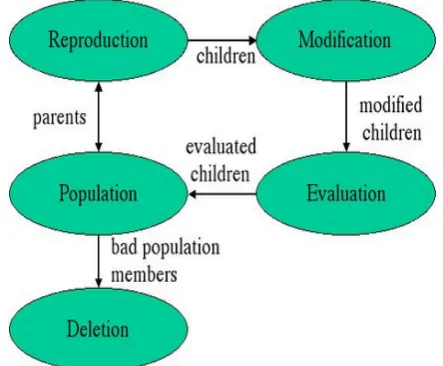
best elements of previous generations where the attributes of a stronger individual tend to be carried forward into the following generation. Hence GA works on the principle of “Survival of the Fittest”. That means better individuals have better chance of reproducing. GAs are stochastic in nature, i.e., they yield different results from different runs. Fig. 1 depicts a simple Genetic Algorithm.
Fig.1. Anatomy of a Genetic Algorithm
Genetic Algorithms find applications in a variety of fields. In 1992, John Koza used genetic algorithm to evolve programs to perform certain tasks. He called his method "genetic programming" (GP). LISP programs were used, because programs in this language can expressed in the form of a "parse tree", which is the object the GA works on.
II. BASIC
CONCEPT
GA is inspired by the mechanism of natural selection, a biological process in which stronger individuals are likely be the winners in a competing environment. The algorithm uses a direct analogy of natural evolution whereby the fitness of an organism is measured by success of the organism in its life.
A.
GA Operators
:Copyright © 2013 IJECCE, All right reserved Fig.2. GA Operators
i) Encoding:
The chromosome should in some way contain information about solution, which it represents. The most used way of encoding is a binary string. The chromosome then could look like this (Fig. 3):Chromosome 1 1101100100110110 Chromosome 2 1101111000011110 Fig.3. Encoding in Genetic Algorithms
Each chromosome has one binary string. Each bit in this string can represent some characteristic of the solution or the whole string can represent a number. Of course, there are many other ways of encoding. This depends mainly on the solved problem. For example, one can encode directly integer or real numbers, sometimes it is useful to encode some permutations and so on.
ii) Selection:
This operator selects chromosomes in the population for reproduction. The fitter the chromosome, the more times it is likely to be selected for reproduction. There are many methods how to select the best chromosomes, for example Roulette Wheel Selection, Boltzman Selection, Tournament Selection, Rank Selection, Steady State Selection and some others. Of these, Roulette Wheel Selection is the most commonly used technique in which parents are selected according to their fitness. The better the chromosomes are, the more chances to be selected they have. Imagine a roulette wheel, where all chromosomes have been placed in the population, each chromosome has its place accordingly to its fitness function, like on the following picture (Fig. 4):Fig.4. Roulette Wheel Selection
Then a marble is thrown there and selects the chromosome. Chromosome with bigger fitness will obviously be selected more times. This can be simulated by following algorithm:
1. [Sum] Calculate sum of fitness of all chromosomes in population - sum S.
2. [Select] Generate random number from interval (0,S) -r.
3. [Loop] Return the first chromosome whose fitness added to the fitness of the preceding chromosome, is greater than or equal to r.
iii) Crossover:
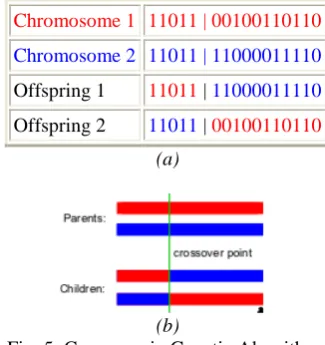
This operator randomly chooses a locus and exchanges the subsequences before and after that locus between two chromosomes to create two offspring (Fig. 5). Crossover can then look like this ( | is the crossover point):Chromosome 1 11011 | 00100110110
Chromosome 2 11011 | 11000011110
Offspring 1 11011|11000011110
Offspring 2 11011|00100110110 (a)
(b)
Fig. 5: Crossover in Genetic Algorithms Different types of crossovers are discussed below:
(a) Single Point Crossover:
One crossover point is selected, binary string from beginning of chromosome to the crossover point is copied from one parent, and the rest is copied from the second parent as shown in Fig. 6(a).11001011+11011111=11001111
Fig. 6(a). Single Point Crossover
(b)Multipoint Crossover:
Although Single Point Crossover was inspired by biological processes, it has one major drawback that certain combinations of schema cannot be combined in some situations. A Multipoint Crossover can be used in such situations whereby the crossover is driven by a variable, i.e., no. of crossover points selected, say m. As a result, the performance of generating offspring is greatly improved. An example of this operation is depicted below in Fig. 6(b) where multiple crossover points (m = 3) are randomly selected:Fig. 6(b). Multipoint Crossover
Copyright © 2013 IJECCE, All right reserved the first to the second crossover point is copied from the
second parent and the rest is copied from the first parent as depicted in Fig. 6(c).
11001011+ 11011111
=
11011111 Fig.6(c). Two Point Crossover(c) Uniform Crossover:
Bits are randomly copied from the first and second parent as shown in Fig. 6(d).11001011+11011101=11011111 Fig.6(d). Uniform Crossover
(d) Arithmetic Crossover:
Some arithmetic operation is performed to make a new offspring as shown in Fig. 6(e).11001011+ 11011111= 11001011 (AND) Fig.6(e). Arithmetic Crossover
iv) Mutation:
After a crossover is performed, mutation takes place as shown in Fig. 7. This is to prevent falling all solutions in population into a local optimum of solved problem. Mutation operator randomly flips some of the bits in a chromosome. For binary encoding we can switch a few randomly chosen bits from 1 to 0 or from 0 to 1. Mutation alters each bit randomly with a small probability (pm), with a typical value of less than 0.1.Original Chromosome 1101111000011110 New Chromosome 1100111000011110
Fig.7. Mutation on fourth bit
B. Parameters of GA
There are two basic parameters of GA - Crossover Probability and Mutation Probability and another important parameter, i.e., Population Size.
i) Crossover Probability (pc)
says how often will be crossover performed. If there is no crossover, offspring is exact copy of parents. If there is a crossover, offspring is made from parts of parents' chromosome. If crossover probability is 100%, then all offspring is made by crossover. If it is 0%, whole new generation is made from exact copies of chromosomes from old population. Crossover is made in hope that new chromosomes will have good parts of old chromosomes and maybe the new chromosomes will be better. However it is good to leave some part of population survive to next generation.ii) Mutation Probability (pm)
says how often will be parts of chromosome mutated. If there is no mutation, offspring is taken after crossover (or copy) without any change. If mutation is performed, part of chromosome is changed. If mutation probability is 100%, wholechromosome is changed, if it is 0%, nothing is changed. Mutation is made to prevent falling GA into local extreme, but it should not occur very often, because then GA will in fact change to random search.
iii) Population Size (s)
says how many chromosomes are in population (in one generation). If there are too few chromosomes, GA has a few possibilities to perform crossover and only a small part of search space is explored. On the other hand, if there are too many chromosomes, GA slows down. Research shows that after some limit (which depends mainly on encoding and the problem) it is not useful to increase population size, because it does not make solving the problem faster.The choice of pm& pc as control parameters can be a complex problem. Furthermore, their settings are critically dependent upon the nature of the objective function. Certain guidelines have been introduced by [6] and [4] in this regard:
• For large population size (say s = 100) Crossover Probability, pc= 0.6 Mutation Probability, pm= 0.001 • For small population size (say s = 30)
Crossover Probability, pc= 0.9 Mutation Probability, pm= 0.01
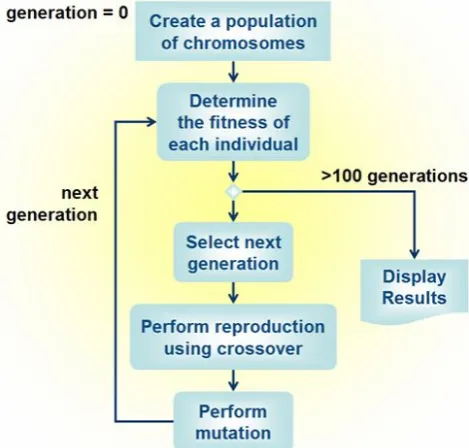
A formal Genetic Algorithm has been depicted below in Fig. 8:
Fig.8. Formal Genetic Algorithm
Copyright © 2013 IJECCE, All right reserved value of fitness. To summarize, following are the steps
followed in Genetic Algorithm:
1. [Start] Start with a randomly generated population of n bit chromosomes (candidate solutions to a problem). 2. [Fitness] Calculate the fitness ƒ(x) of each
chromosome x in the population.
3. [New Population] Create a new population by repeating following steps until the new population is complete:
a) [Selection] Select a pair of parent chromosomes from the current population, the probability of selection being an increasing function of fitness. Selection is done "with replacement," meaning that the same chromosome can be selected more than once to become a parent.
b) [Crossover] With a crossover probability pccross over the parents to form a new offspring (children). If no crossover was performed, offspring is an exact copy of parents.
c) [Mutation] With a mutation probability pmmutate new offspring at each locus (position in chromosome). d) [Accepting] Place new offspring in a new population. 4. [Replace] Use new generated population for a further
run of algorithm.
5. [Test] If the end condition is satisfied, stop and return the best solution in current population.
6. [Loop] Go to step 2.
III. APPLICATIONS
Genetic algorithms have been used for difficult problems (such as NP-hard problems), for machine learning and also for evolving simple programs. Davis [10] tried to explain how to apply GAs to real-world problems. Like other computational systems inspired by natural systems, Genetic Algorithms have been used in two ways: as techniques for solving technological problems, and as simplified scientific models that can answer questions about nature. They have been also used for some art, for evolving pictures and music. It has been suggested by [19] to use Genetic Algorithms in following scenarios:
• When an acceptable solution representation is available.
• When a good fitness function is available.
• When it is feasible to evaluate each potential solution. • When a near-optimal, but not optimal solution is
acceptable.
• When the state-space is too large for other methods. Some of the applications of Genetic Algorithms have been discussed below:
(a) Parametric Optimization
The thermodynamic parameters such as turbine inlet pressure, turbine inlet temperature and environment temperature have significant effects on the performance of the supercritical CO2power cycle and are optimized with
energy efficiency as an objective function by means of Genetic Algorithm. Another example is a multi parameter mapping that can be done using Artificial Neural
Networks, Genetic Algorithm and Parametric Finite Element Analysis to research thoroughly on the problems of technological parametric optimization of sheet metal forming. Research shows that optimization offers a good new way in die design and sheet metal forming scheme.
(b) Controller Structure Selection
Cascade control is used extensively in chemical industry processes such as chemical reactors, distillation columns, fire heaters and heat exchangers. A simple Genetic Algorithm is applied for tuning of Proportional Integral Derivative Controllers for the cascade control systems. The sum of integral absolute error values of the regulatory response is used as objective function. Binary Alphabet and Gray Coding is used for the encoding of controller parameters.
(c) Fault Identification
Genetic Algorithm can also be applied to the problem of system-level fault diagnosis. Consider a system composed of n independent units, each of which tests a subset of the others. It is assumed that at most t of these units are permanently faulty .The set of faulty units can be uniquely identified. The representation of the search space used is in the form of a binary vector of length n. Each bit indicates the status (faulty or fault-free) of its corresponding unit. Genetic operators are adapted to the context of system-level diagnosis. A Genetic Algorithm was implemented and tested on random test graphs. The simulation results demonstrate the efficiency of the proposed diagnosis algorithm.
(d) Antenna Design
GA can change conventional designs of antenna, using them with unusual parameters, to solve unconventional problems. GAs are able to optimize wire antennas for diverse and difficult applications. The inherent power of GA makes it an ideal method of automated design for antennas.
e) Robotics
Application of GA in robotics has found a use in robot navigating systems. The navigation scheme should be designed in such a way to cope with restricted environment, so that the robot is capable of reaching its desired destination without getting lost or crashing into any objects.
(f) Speech Recognition
In an automatic speech recognition system, the spoken speech patterns (test pattern) are usually identified with the presorted speech patterns (reference patterns). Dynamic Time Warping, the earliest platform, uses the variation in frame's time for adjustment and further recognition. Later, Artificial Neural Networks replaced Dynamic Time Warping. GA has a higher level of confidence in identifying confused input utterances and confusable words than the conventional approach of Dynamic Time Warping.
(g) Pattern Recognition
Copyright © 2013 IJECCE, All right reserved
Extraction:
GA is applied to generate the image filtersfor two-stage target recognition in such a way that the target image from background clutter is vividly classified from the imaging data. A linear filter is found in the first stage (screener) to select sub images while a filter bank (a set of filters) is being generated in the last stage (classifier) for class decision.
Recognition:
The factors of different environments, different apparatus, occlusion, noise interference and distortions would lead to insufficient resolution which, at the end, causes a dramatic change in the number and distributions of the dominant points. A Face print system was designed at New Mexico State University for reproducing the feature of a suspected criminal’s face. A binary chromosome is used to code the five facial features (mouth, hair, eyes, nose and chin) of a face. Initially, 20 suspects’ faces are generated on a computer screen. A witness can then rate each face on a 10-point subjective scale. GA takes that information and follows the evolution cycle to obtain the optimal solution.(h) Evolving LISP programs
Generating programs using Genetic Algorithms is called Genetic Programming. John Koza (1992,1994) has used a form of the genetic algorithm to evolve LISP programs to perform various tasks. Koza claims that his method -"Genetic Programming" - has the potential to produce programs of the necessary complexity and robustness for general automatic programming. Programs in LISP can easily be expressed in the form of a "Parse Tree", the object GA will work on.
IV. APPLICATION TO
ECONOMIC
LOAD
DISPATCH
Genetic Algorithms in MATLAB are one of the best methods to solve certain optimization problems. GA is a robust stochastic search method that can handle common characteristics of economic load dispatch, which cannot be handled by other optimization techniques. GA offers a strong means to facilitate the search and get optimized values. A power load optimization problem has been taken to describe how cost curve varies when no constraints are applied. Mathematical optimization techniques have been used over the years for operations, planning and control problems of economic load dispatch. Mathematical formulations of real-world problems are derived under certain assumptions and even with these assumptions; the solution of modern power systems is not simple. On the other hand, there are many uncertainties in power system problems because of their large, complex and geographically widely distributed nature. It is desirable that the solution of such problems should be optimum globally, but solution searched by mathematical optimization techniques, in general, is optimum locally. These facts make it complicated to deal effectively with many problems in this area through strict mathematical formulation alone. Therefore, artificial intelligence techniques, which guarantee a global optimum or nearly so, such as Expert Systems, Genetic Algorithms, Fuzzy
Logic and Artificial Neural Networks, have emerged in recent years as a complement tool to conventional mathematical techniques.
Genetic Algorithm is a class of search techniques that use the mechanisms of natural selection and genetics to conduct a global search of the solution space and this method can handle the common characteristics of economic load dispatch which cannot be handled by other optimization techniques like hill climbing method, indirect and direct calculus based methods, random search methods etc. Chen [16] studied that to solve hydro plant dispatch problem, Artificial Neural Network and Genetic Algorithm provides a more optimal solution than the conventional dynamic programming method. So much work has already been done to optimize cost of electricity of thermal power plants and many efforts have been made to apply GA to economic load dispatch problems. Through this paper, we try to apply GA to optimize cost of electricity in hydro power plants (Fig. 9 & 10) without any constraints. Current research shows how the cost curve varies in non-linear manner when no constraints are considered.
Fig.9. Hydroelectric Dam
Fig.10. Working of Hydroelectric Power Plant Our hydroelectric power plant model includes the inlet flow into the reservoir from the canal and the storage level of the reservoir. Water can leave the reservoir either through the spillway or via the turbine. Water that leaves through the turbine is used to generate electricity.
Copyright © 2013 IJECCE, All right reserved system. The first is the empirical equation for the turbine,
and relates the electricity produced to the turbine flow and reservoir level. The second gives the reservoir storage level as a function of the flow into and out of the reservoir. Electricity(t) = TurbineFlow(t-1) * [½ k1(Storage(t) + Storage(t-1)) + k2] Storage(t) = Storage(t-1) + Δt * [inFlow(t-1)–spillFlow
(t-1)–turbineFlow(t-1)] where t: time
Δt: change in time k1: constant k2: constant
The amount of electricity produced is a function of the amount of water flowing to the turbine and the storage level in the reservoir. This means that the higher the water level in the reservoir, the more power will be produced for a given turbine flow. Practically certain constraints need to be taken into consideration. But in the current problem we are studying the problem without constraints, that how the cost curve changes without constraints. Results are displayed in Fig. 11.
(a) Power Consumption Estimation vs Time Period
(b) Reservoir Storage vs Time Period
(c) Electricity Generated vs Time Period Fig.11. MATLAB Results
We run the optimization problem for an increasing number of decision variables and compare the performance of the different solution methods.
V. CONCLUSIONS
Because GAs provide a fairly comprehensible way to address a wide range of difficult engineering and optimization problems producing good results, they are easily finding their way into the real world and are being applied to many practical scenarios. The extensiveness with which these algorithms are applied in so many areas is no less than astonishing. These applications, be they commercial, educational and scientific, are increasingly dependent on Genetic Algorithms. Its usefulness and gracefulness of solving problems has made it a more favorite choice among other traditional methods.
Genetic Algorithms are easy to apply to a wide range of problems, from optimization problems like the traveling salesperson problem, to inductive concept learning, scheduling, and layout problems. The results can be very good on some problems, and rather poor on others. If only mutation is used, the algorithm is very slow. Crossover makes the algorithm significantly faster. There is a problem of local maxima with GA. Local maxima in a genetic problem are those individuals that get stuck with a pretty good, but not optimal, fitness measure. Any small mutation gives worse fitness. Fortunately, crossover can help them get out of a local maximum.
However, the obvious obstacle that may drive engineers away from using GA is the intrinsic nature of randomness that leads to a problem of performance assurance. Another disadvantage is their computational time. They can be slower than some other methods. But in today’s age of supercomputers it is not so big problem.
Copyright © 2013 IJECCE, All right reserved two, but could result in the emerging technologies being
able to assist GA applications. Different combinations may offer us a fruitful result in intelligent system design. Talking about current context, present load dispatch problem can be taken up considering certain practical constraints in order to optimize the cost of electricity generated.
REFERENCES
[1] D.S.Linden, "Antenna Design Using Genetic
Algorithm." GECCO. Vol. 2. 2002.
[2] G.Roth and M.D.Levine “Geometric Primitive extraction uasing Genetic Algorithm” Pattern Analysis and Machine Intelligence, IEEE TRANSACTIONS ON 16.9(1994):901-905 [3] “Hydroelectric power plants stock photos and images”,
fotosearch.com. Retrived May 31, 2013, from http://www.fotosearch.com/photos-images/hydroelectric-power-plants_4.html
[4] J.H.Holland, "Genetic algorithms." Scientific American 267(1): 66-72 (1992)
[5] J.J.Grefenstette, “Optimization of control parameters for genetic algorithms,”IEEE Trans. Syst., Man, Cybern., vol. SMC-16, pp. 122-128, (Jan./Feb. 1986)
[6] J.Rafiee, F.Arvani, A.Harifi, M.H.Sadeghi "A GA-Based
optimized fault identification system using neural
networks." Tehran International Congress on Manufacturing Engineering, December. 2005
[7] K.A.DeJong and W.M.Spears, “An analysis of the interacting roles of population size and crossover in genetic algorithms,” in Proc. First Workshop Parallel Problem Solving from Nature. Berlin: Springer Verlag, pp. 38-47, (1990)
[8] K.F.Man, Member, IEEE, K. S. Tang, and S. Kwong, Member, IEEE, Genetic Algorithms: Concepts and Applications
[9] L.Davis, “Genetic Algorithms and their applications”, informatics.indiana.edu. Retrieved May 21, 2013, from http://www.informatics.indiana.edu/fil/CAS/PPT/Davis/ [10] L.Davis, Handbook of Genetic Algorithms. New York: Van
Nostrand Reinhold (1991)
[11] M.Lan, S.Pan and C.Lai. "Using genetic algorithm to improve the performance of speech recognition based on artificial neural network." Innovative Computing, Information and Control, 2006. ICICIC'06. First International Conference on. Vol. 2. IEEE, 2006
[12] M.Melanie. "An introduction to genetic algorithms." Cambridge, Massachusetts London, England, Fifth printing 3 (1999). [13] M.Obitko,“Genetic Algorithms”obitko.com. Retrieved Apr. 14,
2013, from http://www.obitko.com/tutorials/genetic-algorithms/index.php (Aug./Sep. 1998)
[14] M.V.Sadasivarao and M.Chidambaram. "PID controller tuning of cascade control systems using genetic algorithm." J. Indian Inst. Sci 86 (2006): 343-354
[15] N.Chattoraj and J.S.Roy, "Application of genetic algorithm to the optimization of gain of magnetized ferrite microstrip antenna." Engineering Letters 14.2 (2007)
[16] P.H.Chen “Hydro plant dispatch using ANN & GN.”Proc of 4th
international Symp. on neural networks.springer-verlag Berlin.Heideberg (2007)
[17] P.Ross and D.Corne, "Applications of genetic algorithms." AISB Quaterly on Evolutionary Computation 89: 23-30 (1994) [18] R.C.Chakorborty, “Fundamental of Genetic Algorithms”,
myreaders.info. Retrived May 27, 2013, from http://www.myreaders.info/09_Genetic_Algorithms.pdf
[19] R.L.Wainwright, "Introduction to genetic algorithms theory and
applications." Tutorial Session, In The Seventh Oklahoma Symposium on Artificial Intelligence, Oklahoma State University, Stillwater, (Nov. 1993)
[20] S.DeLand, “Optimization of Hydroelectric Flow with MATLAB”, mathworks.com. Retrived May 31, 2013, from http://www.mathworks.com/tagteam/74042_92061v00_optimiza tion-of-hydroelectric-flow-with-matlab.pdf
[21] T.V.Mathew, "Genetic Algorithm." Indian Institute of Technology Bombay, Mumbai (1996)
[22] Y.Davidor "A genetic algorithm applied to robot trajectory
generation." Handbook of Genetic Algorithms (1991): 144-165
AUTHOR
’
SPROFILE
Er. Amninder Kaur
received B.Tech. degree in Computer Science and Engineering from Baba Banda Singh Bahadur Engineering College Fatehgarh Sahib, India in 2011 and is currently pursuing M.Tech. degree in Computer Science and Electrical Engineering from Punjab Agricultural University, Ludhiana, India. Email: [email protected]
Dr. B. K. Sawhney
is working as an Associate Professor in the School of Elect. Engg. & Information Technology, Punjab Agricultural University. Her qualifications are B.Sc. (Non Medical), B.Tech. (Electrical Engg.), M.Tech. (Instrumentation) and Ph.D in the field of Electronics Technology. She has twenty five years experience of teaching Under-Graduate and Post-Graduate students. She has published many research papers in National and International Journals and Conferences. Email: [email protected]