J
ANUSZP
ICHURSKI1, J
ERZYR
UDNICKI2, M
ACIEJS
EBASTIAN2, A
NILK. A
GRAWAL3The Causes of Formation
and the Surgical Treatment of Recurrent Goiter
Przyczyny powstawania oraz leczenie chirurgiczne wola nawrotowego
1County Hospital in Opole, Department of General Surgery, Opole, Poland
2Department of Minimally Invasive Surgery and Proctology, Wroclaw Medical University, Poland 3Department of General and Oncological Surgery, Wroclaw Medical University, Poland
Adv Clin Exp Med 2009, 18, 6, 595–599 ISSN 1230−025X
ORIGINAL PAPERS
© Copyright by Wroclaw Medical University
Abstract
Background.Recurrent goiter is the regrowth of thyroid tissue after strumectomy. Its causes include the strategy
of surgical treatment and the kind of substitution therapy after operation.
Objectives.The aim of this study was to analyze the causes of recurrent goiter formation.
Material and Methods.Fifty−six patients with recurrent goiter were operated on in 1991–2000. In accordance with
the procedures and terminology of the Bayes methods for data analysis, three types of statistical model were used: the binomial−beta hierarchical model, the Cox proportional hazard model, and the Weibull regression model. Significant results are reported.
Results.In the patients who received substitution therapy after the primary operation, the percentage of recurrences
was one sixth of that of the group who received no substitution therapy. Recurrence was faster in patients who were older at the time of the primary operation. The risk of recurrence increased with time after the primary operation. The percentage of true recurrent goiter in this material was 73% and pseudo−recurrent 27%. Pseudo−recurrence was mostly in a non−operated lobe (67%), rarely in the pyramidal lobe (20%) and isthmus (13%). The mean time of true recurrence was 19 and of pseudo−recurrence 11 years.
Conclusions.Because of the high percentage of pseudo−recurrences after strumectomy and the short time of their
formation, the primary operation should be based on pyramidal lobe removal and be bilateral and sufficiently com− plete, with excision of both lobes. Postoperative substitution therapy reduces the rate of goiter recurrence. The pri− mary operation for goiter should be performed promptly after its diagnosis because recurrence is faster in older people. After the primary operation the patients should be monitored for several years to diagnose recurrence as early as possible (Adv Clin Exp Med 2009, 18, 6, 595–599).
Key words:recurrent goiter, strumectomy.
Streszczenie
Wprowadzenie.Wole nawrotowe jest odrostem tkanki tarczycowej powstającym po operacji wycięcia wola. Za
przyczynę nawrotu uznaje się między innymi strategię postępowania chirurgicznego oraz rodzaj terapii substy− tucyjnej po zabiegu usunięcia tarczycy.
Cel pracy.Analiza przyczyn odrostów wola u chorych operowanych wtórnie.
Materiał i metody. Do badań włączono 56 chorych z nawrotem wola, którzy byli leczeni operacyjnie w latach
1991–2000. W pracy zgodnie z procedurami obliczeniowymi i terminologią założeń pełnego modelowania bayesowskiego zostały zaadoptowane następujące typy kompleksowych modeli statystycznych: hierarchiczny model beta−dwumianowy, model proporcjonalnego ryzyka Coxa, model regresji Weibulla. Po dokonaniu obliczeń statystycznych podano wartości oczekiwane będące wynikami istotnymi.
Wyniki. W grupie chorych, u których zastosowano substytucję po operacji pierwotnej odsetek nawrotów był
The mechanisms of recurrent goiter formation are not completely explained [1–3]. The most prob− able causes are the same which lead to the forma− tion of endemic or sporadic goiter. These are iodine deficiency and genetic, autoimmunological, and enzymatic factors. Elevated thyroid−stimulating hormone (TSH) level, increased number of TSH receptors, and defects in thyroid hormone synthesis are also mentioned. A well−performed primary operation can successfully prevent recurrence. One of the causes of recurrent goiter formation is the insufficient extent of strumectomy (excision of a goiter) during the first operation [1, 7–11]. Excision of only one lobe or solitary adenoma and leaving the second lobe intact can lead to pseudo− recurrence (recurrence in the previously non−oper− ated lobe), which should be distinguished from true recurrence, which occurs after excision of two lobes with the isthmus and pyramidal lobe [4, 6, 10, 12–14]. The other very important factor which is stressed by many authors as a cause of recur− rence is a lack of substitution therapy after the first operation. Postoperative prophylaxis with L−thy− roxine (levothyroxine) can effectively prevent recurrence and reduce the size of recurrent goiter [1, 2, 4, 10, 11, 14–21]. There is also a group of authors who are against substitution therapy because they do not find a connection between it and the recurrence of goiter [22–26].
Material and Methods
Fifty−six patients who had primary operations in 1945–1955 were investigated. They were oper− ated on for recurrent goiter in the County Hospital in Opole in 1991–2000. In this group were 54 (96.4%) women and 2 (3.6%) men (Fig. 1). The youngest patient was 19 and the oldest 71 years old. The mean age was 53 years. The mean age of the women with recurrent goiter was 53.5 and of the men 50.5 years. The primary operation was performed in twenty patients in another hospital. The postoperative efficacy of substitution therapy after the primary operation was evaluated.
According to the procedures and terminology of Bayes’ methods of data analysis, three types of statistical model were used. The binomial−beta
hierarchical model was used to determine the probability of goiter recurrence in relation to risk factors and study group [27]. The Cox proportion− al hazard model was used to determine the hazard curves of disease incidence in relation to patient age [28]. The Weibull regression model was used to determine the mean age of disease incidence [29]. Significant results are reported here.
Results
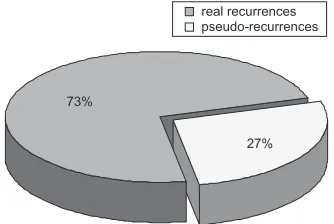
The largest groups of patients were aged 41–50 (mean: 19) and 61–70 (mean: 17) years. The interval between the primary and secondary operation was between 1 and 47 years. The mean time of recurrence was 17 years. The recurrence of goiter mostly occurred 11–20 years after the pri− mary operation. According to the statistical analy− sis, the risk of recurrence increased with time after the primary operation. Ten years after the primary operation the risk of recurrence was 30%, after 20 years 60%, and after 40 years 90% (Fig. 2). Recurrence was slower in patients who had the primary operation when younger. The percentage of real recurrent goiter was 73% and of pseudo− recurrent 27% (Fig. 3). Pseudo−recurrence occurred mostly in a non−operated lobe (67%), rarely in pyramidal lobe (20%) and isthmus (13%) (Fig. 4). Pseudo−recurrence was four times more frequent than real recurrence in the first 5 years and was also more frequent 6–10 years after the primary operation (Fig. 5). The mean time of real recurrence was 19 years and of pseudo−recurrence was 11 years (Fig. 6).
The patients who had their primary operation at the County Hospital in Opole were divided into three subgroups according to their substitution therapy after the primary operation: those operated on in 1958–1970 (no substitution), those operated on in 1971–1985 (Thyroideum, Polfa), and those operated on in 1986–2000 (L−thyroxine). Accor− ding to the statistical analysis, the percentage of recurrence in the subgroup treated with L−thyrox− ine was four times lower than in the subgroup treated with Thyroideum and six times lower than in the subgroup in which no substitution was used (Fig. 7).
Wnioski. W związku ze znaczącym odsetkiem nawrotów rzekomych po operacjach wola i krótkim czasem ich
powstawania operacja pierwotna powinna polegać na usunięciu płata piramidowego oraz obustronnym, dostate− cznie doszczętnym, wycięciu obu płatów w granicach zdrowych tkanek. Stosowanie substytucji w pooperacyjnej profilaktyce hormonalnej zmniejsza odsetek nawrotów wola. Podczas zdiagnozowania wola należy odpowiednio szybko przeprowadzić zabieg operacyjny, gdyż u osób starszych szybciej dochodzi do nawrotu choroby. Pacjenci po zabiegu operacyjnym przez kilkanaście lat powinni pozostawać pod kontrolą lekarską, aby jak najszybciej uchwycić nawrót choroby (Adv Clin Exp Med 2009, 18, 6, 595–599).
Discussion
In the country’s leading centers which special− ize in goiter surgery, the percentage of recurrence does not exceed 1%. Barczyński found 0.6% recurrence in his material and Stajgis 0.8% [2,4]. Because of the high percentage of pseudo−recur− rences and the short time of their formation, the primary operation should be based on pyramidal
lobe removal and be bilateral, with sufficiently complete excision of both lobes even if one lobe is not enlarged. In the County Hospital in Opole in
0 5 10 15 20
women 1 0 5 18 12 17 1
men 0 0 0 1 1 0 0
< 20 years
21–30 years
31 40– years
41 50– years
51 60– years
61 70– years
> 70 years
Fig. 1.The ages of the women and men operated on
for recurrent goiter
Ryc. 1. Wiek kobiet i mężczyzn operowanych
z powodu nawrotu wola
0 0.1 0.2 0.3 0.4 0.5 0.6 0.7 0.8 0.9 1
0 3 8 14 28 36 45
time until recurrence (years) czas do nawrotu (lata)
proportional risk of recurrence proporcjonalne ryzyko nawrotu
Fig. 2.The proportional risk of goiter recurrence with
time (Cox model)
Ryc. 2. Proporcjonalne ryzyko nawrotu wola w czasie
(model Coxa)
27% 73%
real recurrences pseudo-recurrences
Fig. 3.Percentages of real and pseudo−recurrences
Ryc. 3. Odsetek nawrotów prawdziwych i rzekomych
67%
20% 13%
non-operated lobe pyramidal lobe isthmus
Fig. 4.The distribution of recurrences in pseudo−
recurrent goiter
Ryc. 4. Umiejscowienie zmian w nawrotach
rzekomych wola
0 10 20 30
time until recurrence czas do nawrotu number of patients liczba pacjentów real recurrence
1 4 21 15
pseudo- 4 5 5 1
< 5 years 6–10 years 11–20 years > 20 years recurrence
Fig. 5.Time intervals after which real and pseudo−
recurrence occurred
Ryc. 5. Odstępy czasu, po których następował nawrót
wola prawdziwy i rzekomy
0 2 4 6 8 10 12 14 16 18 20 pseudo-recurrence nawrót rzekomy real recurrence nawrót prawdziwy
the mean time of recurrence (years)
œredni czas nawrotu (lata)
Fig. 6.The mean time interval after which real and
pseudo−recurrence occurred (Weibull regression)
Ryc. 6. Średni odstęp czasu, po którym następował
the 1970s and mid 1980s, dried thyroid gland (Thyroideum, Polfa) was used as substitution ther− apy. Research, however, indicated that it does not fully block pituitary thyrotropic function after strumectomy, but only mildly decreases TSH secretion [1, 4, 11, 14]. Because of this, synthetic L−thyroxine was used in subsequent years. Most authors think that treatment with L−thyroxine dis− tinctly decreases the number of recurrences main− ly due to its effective reduction of TSH level, which is the key pathogenic factor [1, 2, 4, 10, 11, 14–21]. Treatment with L−thyroxine is well estab− lished because TSH levels are elevated after the operation and many other growth factors which
contribute to recurrence can be stimulated by TSH [14]. There are also some authors who think that recurrence is unavoidable no matter what form of prophylaxis is used except when total strumecto− my is performed [19, 30].
The authors concluded that treatment with L−thy− roxine after the primary operation decreased the number of recurrences. As soon as the diagnosis of goiter is established and there are indications for surgery, the operation should be performed promptly because recurrence is faster in older peo− ple. Monitoring after the primary operation should be continued for several years to diagnose recur− rence as early as possible.
0 0.5 1 1.5 2 2.5
1956–1960 no substitution
1966 1970–
no substitution
1976 1980– Thyroideum – Polfa
1986 1990– L-thyroxine
1996 2000– L-thyroxine
percentage of recurrences [%]
odsetek nawrotów
Fig. 7.The percentage of recurrences after
primary operations in 1958–2000 depend− ing on the form of substitution therapy (binomial−beta hierarchical model)
Ryc. 7. Odsetek nawrotów własnych po
strumektomiach wykonanych w latach 1958–2000 w zależności od stosowanej pooperacyjnej profilaktyki farmakolo− gicznej (model dwumianowy−beta)
References
[1] Gembicki M: Wole nawrotowe. Mechanizmy powstawania – postępowanie lecznicze, zapobieganie i leczenie.
Pozn Rocz Med 1993, supl., 15–16.
[2] Stajgis P:Wole nawrotowe – problem chirurgiczny. Endokrynol Pol 1995, suppl. 2, 46, 23–28.
[3] Widala E, Zych F: Obraz ultrasonograficzny oraz poziomy tyreotropiny i przeciwciał tarczycowych u chorych
z nawrotem wola obojętnego po strumektomii subtotalnej. Przegl Lek 1997, 54, 7–8.
[4] Barczyński M, Jamski J, Silczuk J:Współczesne możliwości zapobiegania pooperacyjnemu nawrotowi wola.
Wiad Lek 1994, t. XLVII, 13–14, 484–486.
[5] Huszno B: Rozpoznawanie, zapobieganie i leczenie wola obojętnego. Nowa Klin 1997, 4, 5, 241–248.
[6] Moalem J, Suh I, Duh Q−Y: Treatment and Prevention of Recurrence of Multinodular Goiter: An Evidence−based
Review of the Literature. World J Surg 2008, 32, 1301–1312.
[7] Lubańska Z, Stajgis P:Wole nawrotowe. Pol Przegl Chir 1975, 5, 555–558.
[8] Snook KL, Stalberg P, Sidhu SB, Sywak MS, Edhouse P, Delbridge L:Recurrence after Total Thyroidectomy
for Benign Multinodular Goiter. World J Surg 2007, 31, 593–598.
[9] Lefevre JH, Tresallet Ch, Leenhardt L, Jublanc Ch, Chigot J−P, Menegaux F:Reoperative surgery for thy−
roid disease. Langenbecks Arch Surg 2007, 392, 685–691.
[10] Skrzypek J, Podwiński A, Arendt J, Jarząb B:O wolu nawrotowym. Pol Przegl Chir 1994, 66, 7, 661–668.
[11] Stajgis P, Drews M, Ben Rafe H, Stawny B: Ocena wyników chirurgicznego leczenia wola nawrotowego. Pol
Przegl Chir 1998, 70, 12, 1206–1214.
[12] Muller PE, Jakoby R, Heinert G, Spelsberg F:Surgery for recurrent goitre: its complications and their risk fac−
tors. Eur J Surg 2001, 167(11), 816–821.
[13] Vaiman M, Nagibin A, Hagag P, Buyankin A, Olevson J, Shlamkovich N:Subtotal and Near Total Versus Total
Thyroidectomy for the Management of Multinodular Goiter. World J Surg 2008, 32, 1546–1551.
[14] Widala E, Kozera J:Udział czynników wzrostowych w patogenezie wola nawrotowego. Przegl Lek 1997, 54,
7–8.
[15] Barczyński M, Jamski J:Zapobieganie i leczenie wola nawrotowego. Nowa Klin 1997, 4, 5, 249–251.
[16] Fritzsche H:Die resezierte Struma: Diagnose, Rezidivprophylaxe, Therapie. Acta Med Austr 1982, 34, 33–38.
[17] Goretzki P, Roecher HD, Horeyseck G:Prophylaxis of recurrent goiter by high dose L−tyroxine. World J Surg
[18] Kologlu S, Bascal N, Kologlu LB:The value of L−thyroxine in the suppressive therapy of euthyroid nodules and in the prevention of post thyroidectomy recurrences. Rom J Med 1988, 26, 89–98.
[19] Kraimps JL, Marechaud R, Gineste D:Analysis and prevention of recurrent goiter. Surg Gynecol Obstet 1993,
176, 319.
[20] Miccoli P, Antonelli A, Iaccono P, Alberti B, Gambucca C, Basschieri L:Prospective, randomized, double−
blind study about effectiveness of levothyroxine suppressive therapy in prevention of recurrence after operation: result at the third year of follow−up. Surgery 1993, 6, 1097–1102.
[21] Stajgis P, Drews M, Smoczkiewicz M, Stawny B, Biczysko M:Wyniki chirurgicznego leczenia wola nawro−
towego. Pozn Rocz Med 1993, supl., 18–19.
[22] Berghout A, Wiersinga WM, Drexhage HA, Van Trotsenburg P, Smits NJ, Van der Gaag RD, Touber JL:
The long term outcome of thyroidectomy for sporadic nontoxic goitre. Clin Endocrinol 1989, 31, 193–199.
[23] Bistrup C, Nielsen JD, Gregersen G, Franch P:Preventive effect of levothyroxine in patients for nontoxic
goitre: a randomized trial of one hundred patients with nine years follow−up. Clin Endocrinol 1994, 40, 323–327.
[24] Geerdsen JP, Hee P:Nontoxic goitre. Surgical complications and long term prognosis. Acta Chir Scand 1982,
148, 221–224.
[25] Hegedus L, Hansen JM, Veiergang D, Kastrup S:Does prophylactic thyroxine treatment after operation for
nontoxic goitre influence thyroid size? Br Med J 1987, 294, 801–803.
[26] Kuznetsov NS, Vanushko VE, Voskoboijnikov VV, Artemova AM, Soldatova TV:Long−term results of the
surgical treatment of patients with multinodular euthyroid goiter. Khirurgiia (Mosk) 2001, 4, 4–9.
[27] Carlin BP, Louis TA: Bayes and Empirical Bayes Methods for Data Analysis (Second edition). Chapman &
Hall/CRC, Boca Raton 2000.
[28] Cox DR:Regression models and life−tables. J Royal Stat Soc 1972, 34, 187–220.
[29] Armitage P, Doll R:The age distribution of cancer and a multistage theory of carcinogenesis. Br J Cancer 1954,
8, 1–13.
[30] Khadra M, Delbridge L, Reeve TS, Poole AG:Total thyroidectomy: its role in the management of thyroid dis−
ease. Aust Surg 1992, 62, 91.
Address for correspondence:
Maciej SebastianDepartment of Minimally Invasive Surgery and Proctology Wroclaw Medical University
ul. Borowska 213 50−556 Wrocław Poland
Tel.: +48 607 868 096 E−mail: [email protected]
Conflict of interest: None declared