© 2016 Ebaa M. El-Hossary et al. This is an open access article distributed under the terms of the Creative Commons Attribution License -NonCommercial-ShareAlikeUnported License (http://creativecommons.org/licenses/by-nc-sa/3.0/).
Journal of Applied Pharmaceutical Science Vol. 6 (05), pp. 007-017, May, 2016 Available online at http://www.japsonline.com
DOI: 10.7324/JAPS.2016.60502 ISSN 2231-3354
Synthesis and antibacterial activity of novel
2-(arylimino)thiazolidin-4-one and 2-(benzylidenehydrazono)-3-arylthiazolidin-2-(arylimino)thiazolidin-4-one
derivatives
Ebaa M. El-Hossary
1,2,*, Yassin M. Nissan
3, Katharina Edkins
4, Heike Bruhn
5 1Institute of Pharmacy & Food Chemistry, University of Würzburg, Am Hubland, 97074 Würzburg, Germany. 2Permanent address: National Centre for Radiation Research & Technology, Egyptian Atomic Energy Authority, Ahmed El-Zomor St. 3, El-Zohoor Dist., Cairo, Egypt. 3Department of
Pharmaceutical Chemistry, Faculty of Pharmacy, Cairo University, Cairo 11562, Egypt. 4School of Medicine, Pharmacy and Health, Durham University, Stockton-on-Tees, United Kingdom. 5Institute for Molecular Infection Biology, SFB 630, Würzburg University, Josef-Schneider-Str. 2, Bau 15, 97080 Würzburg, Germany.
ARTICLE INFO ABSTRACT
Article history: Received on: 31/12/2015 Revised on: 09/03/2016 Accepted on: 08/04/2016 Available online: 28/05/2016
The ongoing spread of multidrug-resistant bacteria demands an intensive search for new antibacterial agents. In the present study, a series of new 1,3-thiazolidin-4-ones has been synthesized and investigated for its in vitro antibacterial activity. The most potent antibacterial compound 4c was found to be active, at low micromolar range, against Staphylococcus aureus, Staphylococcus epidermidis, Enterococcus faecalis and the pneumonic plague causative agent Yersinia pestis with minimum inhibitory concentrations of 5 µM, 2.5 µM, 2.5 µM and 5 µM, respectively. Compound 4c showed the ability to kill E. faecalis JH212 strain with a minimum bactericidal concentration of 5 µM. Furthermore, compounds 9b and 10a inhibited the biofilm formation in S. epidermidis, where they showed 70% to 80% inhibition at a concentration of 40 µM.
Key words:
1,3-Thiazolidin-4-one Antibacterial activity Minimum inhibitory concentration Minimum bactericidal concentration Biofilm formation.
INTRODUCTION
Currently, infectious diseases are the second leading cause of death worldwide. Bacterial resistance against antibiotics is an increasing health problem in both community and hospital setting. It has a note worthy impact on the mortality rates, morbidity rates and the financial burden associated. Although various novel antibacterial drugs had been introduced into the market in the past decades, the prevalence of multidrug-resistant
* Corresponding Author
Ebaa Mostafa El-Hossary, Institute of Pharmacy & Food Chemistry, University of Würzburg, Am Hubland, 97074 Würzburg, Germany.
2
Permanent address: National Centre for Radiation Research & Technology, Egyptian Atomic Energy Authority, Ahmed El-Zomor St. 3, El-Zohoor Dist., Cairo, Egypt. Email: [email protected]
pathogens remains among the major health problems which raises
severe concern around the globe(Bassetti et al., 2013; Butler et al.,
2013; Kumarasamy et al., 2010; Lewis, 2013; Pendleton et al.,
2013). Staphylococci and Enterococci are Gram-positive bacteria that are responsible for several community and hospital acquired
infections. Staphylococcus aureus causes a wide range of infections
from simple skin and soft tissue infections to serious illnesses like
pneumonia, infective endocarditis and sepsis (Tong et al., 2015;
Valour et al., 2013).
Staphylococcus epidermidis is regarded as the most frequent cause of nosocomial and indwelling medical device-associated infections. It causes more persistent infections due to its high ability to resist antibiotic treatments through biofilm formation
Since the beginning of the antibiotic era, the isolation of multidrug resistant enterococci has become increasingly common
in hospital setting. Enterococcus faecalis and Enterococcus
faecium are the most predominant species, cultured from humans,
representing more than 90% of clinical isolates. E. faecalis
infective endocarditis is still a very serious disease, associated with the presence of highly gentamicin-resistant strains and in-hospital mortality rates around 20% (Courvalin, 2006; Dahl and Bruun,
2013; de Perio et al., 2006; Deshpande et al., 2007). On the other
hand, the gram-negative bacterium Yersinia pestis is the causative
agent of pneumonic plague; which is the most severe manifestation of plague. The mortality rates of pneumonic plague
are approximately 100% in untreated cases (Pechous et al., 2015).
1,3-Thiazolidin-4-ones are a class of compounds that
have shown potential as antibacterials (Aridoss et al., 2009;
Gopalakrishnan et al., 2009; Jain et al., 2012; Poyraz et al., 2013;
Sayyed et al., 2006; Verma and Saraf, 2008; Vicini et al., 2006;
Vicini et al., 2008). Thiazolidin-4-ones have been found as
inhibitors of the bacterial enzyme MurB; a key enzyme
responsible for the synthesis of peptidoglycan (Andres et al.,
2000). In this study, a series of 2-(arylimino)thiazolidin-4-ones
and 2-(benzylidenehydrazono)-3-arylthiazolidin-4-ones was
synthesized. The synthesized compounds were tested for their in
vitro antibacterial activity against selected clinically important pathogenic microbes.
RESULTS AND DISCUSSION
Chemistry
The synthesis of the target 1,3-thiazolidin-4-one derivatives started with the conversion of the commercially
available sulfanilamide 1 into the corresponding thioureido
derivatives 2a-c (Roth and Degering, 1945) when sulfanilamide
1reactedwith the appropriate isothiocyanate derivative (Scheme
1).The thioureido derivatives 2a-c were then refluxed with an
equimolar amount of chloroacetic acid in glacial acid to give the
respective 4-(4-oxo-3-substitutedthiazolidin-2-ylideneamino)
benzenesulfonamide derivatives 3a-c (Scheme 1).IR spectra of
compounds 3a-c revealed strong characteristic intense bands at
1712-1724 cm-1 which correspond to the carbonyl group of the
1,3-thiazolidin-4-one ring. 1H-NMR spectra of compounds 3a-c
displayed singlets at 4.04-4.16 ppm for the two protons of the
methylene (-CH2-) of the 1,3-thiazolidin-4-one nucleus.
13 C-NMR
spectra of compounds 3a-c exhibited new signals at 29.07-32.74
ppm, ascribed to the methylene group, confirming the intramolecular cyclization and formation of the
1,3-thiazolidin-4-one ring. Similarly, compounds 4a-c were synthesized by
refluxing the thioureido derivatives 2a-c with an equimolar
amount of diethyl bromomalonate in glacial acid (Scheme 1). IR
spectra of the compounds 4a-c were characterized by the presence
of two strong bands corresponding to the carbonyl group of the ethylester moiety and the carbonyl group of the
1.3-thiazolidin-4-one ring at 1689-1751 cm-1. 1H-NMR spectra of compounds 4a-c
exhibited triplets and quartets corresponding to the ethylester
substituent at position 5. The synthesis of compounds 5a-c was
attained by refluxing the corresponding thioureido derivatives 2a-c
with an equimolar amount of maleic anhydride in glacial acid (Scheme 1). IR spectra of the 2-(4-oxothiazolidin-5-yl)acetic acid
derivatives 5a-c showed two bands representing the carbonyl
group of the 1,3-thiazolidin-4-one nucleus and the carbonyl group
of the acetic acid moiety at 1660-1708 cm-1.
Scheme. 1: Synthesis of compounds 3a-c, 4a-c and 5a-c.
Reagents and conditions: (i) R-NCS / EtOH / TEA / reflux 24 h. (ii) ClCH2COOH / AcOH / anhydrous CH3COONa / reflux 24 hr. (iii) Diethylbromomalonate / AcOH / anhydrous CH3COONa / reflux 24 h. (iv) Maleic anhydride / AcOH / reflux 24 h.
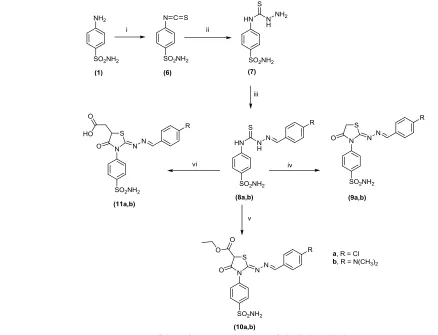
The 4-isothiocyanatobenzenesulfonamide 6 was obtained
by stirring a solution of sulfanilamide 1 in distilled water
containing an equimolar amount of thiophosgen (El-Gaby et al.,
2009). Compound 6 was then stirred with an excess amount of
hydrazine hydrate to give N
-(4-sulfamoylphenyl)-hydrazinecarbothioamide 7 (Sriram et al., 2009). The Schiff’s
bases 8a,b were prepared by refluxing compound7 with an
equimolar amount of the appropriate aldehyde in methanol
(Scheme 2).1H-NMR spectrum of compound 8a displayed
signals at 10.32 and 12.05 ppm, which were exchangeable in D2O,
confirming the presence of two NH groups of the
hydrazinecarbothioamide. The 13C-NMR spectrum of compound
8b was characterized by the appearance of a new signal at 39.66
ppm ascribed to the two carbon atoms of the N(CH3)2 group.
Additionally, 1H-NMR spectra of compounds 8a,b
exhibited signals at 8.15 and 8.06 ppm, respectively, for the imine proton of (N=CH). In a similar way to the synthetic pathway of the target 1,3-thiazolidin-4-ones outlined in Scheme 1, the
2-(4-(substituted)benzylidene)-N-(4-sulfamoylphenyl)-hydrazinecarbo
thioamides 8a,b were cyclized into the corresponding
1,3-thiazolidin-4-one derivatives 9a,b by reaction with an equimolar
IR spectra of compounds 9a,b revealed characteristic
bands at 1732, 1697 cm-1, respectively, which correspond to the
carbonyl group of the 1,3-thiazolidin-4-one ring. 1H-NMR spectra
of compounds 9a,b displayed signals at 4.13 and 4.09 ppm,
respectively, for the two protons of the methylene group of the
1,3-thiazolidin-4-one ring. In addition, 1H-NMR spectrum of
compound 9b revealed a singlet at 2.97 ppm representing the 6
protons of the dimethylamino group. The Schiff’s bases 8a,b were
also cyclized into the corresponding 1,3-thiazolidin-4-one
derivatives 10a,b, by refluxing with an equimolar amount of
diethyl bromomalonate in glacial acetic acid (Scheme 2). IR
spectra of compounds 10a,b showed two bands for the two
carbonyl groups; the ethyl ester moiety and the
1,3-thiazolidin-4-one ring at 1612-1739 cm-1. 1H-NMR spectra of compounds 10a,b
exhibited triplets and quartets representing the ethyl group of the ethyl ester substituent at position 5. Finally, the synthesis of the
1,3-thaizolidin-4-one derivatives 11a,b was attained by refluxing
the corresponding Schiff’s bases 8a,b, with an equimolar amount
of maleic anhydride in glacial acetic acid (Scheme 2). 1H-NMR
spectra of compounds 11a,b revealed new signals at 10.86 and
10.75 ppm, respectively, corresponding to the one proton of the carboxylic OH group. To confirm the cyclization pattern of
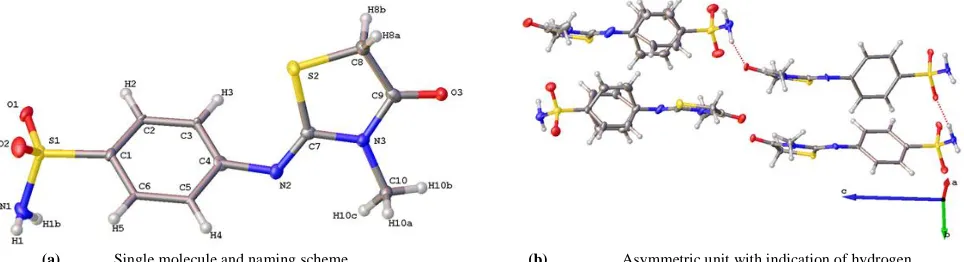
the 1,3-thiazolidin-4-onering, compound 3a was subjected to x-ray
crystallography measurement. Crystals suitable for X-ray diffraction were grown from dichloromethane solution by slow cooling. The structure could be determined in the triclinic space group P-1 with four symmetric independent molecules in the
asymmetric unit (Z’ = 4). This is due to a break in symmetry by
the disorder of the central phenyl rings. The bond lengths and
angles are all within normal ranges (Allen et al., 1987). The
molecules of 3a adopted two different conformations in this
structure, with the angle between the thiazolidinone and the phenyl
ring either 60° or -50° (Figure 1a). This has no influence on the
overall packing and it is assumed that due to the comparable size of the phenyl ring and the sulfonamide terminal group, the phenyl ring can rotate rather freely. The crystal packing consists of
pseudo-centrosymmetric dimers of 3a stabilized through weak
C-H∙∙∙O hydrogen bonds (Figure 1b). These dimmers are connected
to the next dimer through N-H∙∙∙O hydrogen bonds, between the terminal amide group and the C=O group of the thiazolidinone
rings, linking the structure together along the crystallographic b
-axis. An additional N-H∙∙∙O hydrogen bond between the terminal amide group and the S=O group of the sulfonamide links the
molecules along b. This packing results in the formation of stacks
along the crystallographic a-axis which consist of alternate
disordered and non-disordered molecules.
Scheme. 2: Synthesis of compounds 9a,b, 10a,b and 11a,b.
Reagents and conditions: (i) CSCl2 / H2O / HCl / stirring RT / 2 h. (ii) NH2NH2.H2O / isopropanol / stirring RT / 2 h. (iii) Ar-CHO / MeOH / reflux 5 h. (iv) ClCH2COOH / AcOH / anhydrous CH3COONa / reflux 24 hr. (v) Diethylbromomalonate / AcOH / anhydrous CH3COONa / reflux 24 h. (vi) Maleic anhydride /
Antibacterial activity
All of the newly synthesized final compounds have been
screened at a highest concentration of 40 µM, for their in vitro
antibacterial activity against selected clinically important pathogenic bacteria. These bacteria include the Gram-positive
bacteria; S. aureus (Strains; 8325, HG001, MA12, RN1 and
Xen29), S. epidermidis (Strains; RP62A, 195 and 047),
E.faecalisJH212, E. faecium6413 and the Gram-negative bacteria;
Escherichia coli 536, Pseudomonas aeruginosa, Y. pestis KUMA
and Yersinia pseudotuberculosis 252 01A. Staphylococci,
Enterococci and P. aeruginosa belong to the so called “ESKAPE”
pathogens; pathogenic bacteria that are responsible for
the highest impact in bacterial resistance (Pendleton et al., 2013).
Moreover, S. aureus, S. epidermidis, P. aeruginosa, and
E. coli can cause persistent infections that are resistant to antibiotic treatments due to their ability to form biofilm (Romling and Balsalobre, 2012).
All the tested compounds have been evaluated for their in
vitro antibacterial activity by measuring the minimum inhibitory concentration (MIC) and the minimum bactericidal concentration (MBC). MIC is the lowest concentration of the tested compound that inhibits the visible growth of the tested bacterial strain after overnight incubation while MBC is the lowest concentration of the tested compound required to kill the tested bacterium. Antibacterial agents are usually considered bactericidal if the MBC value doesn’t exceed four folds the MIC value (French,
(a) Single molecule and naming scheme. (b) Asymmetric unit with indication of hydrogen.
Fig. 1: Molecular structure of compound 3a as determined by X-ray single crystal diffraction: a) molecule and naming scheme and b) assymetric unit with hydrogen bonds. Element (colour): Carbon (grey), oxygen (red), nitrogen (blue), sulfur (yellow), hydrogen (light grey). Atomi c displacement parameters are
drawn at 50% probability.
Table 1: Antibacterial activity of the tested compounds 4a and 4c. Tested bacterial strain
Compound 4a Compound 4c Gentamycin Tetracycline
MIC* (µM)
MBC** (µM)
MIC (µM)
MBC (µM)
MIC (µM)
MIC (µM)
Gram-positive
S. aureus 8325 10 >40 5 >40 0.21 NT***
S. aureus HG001 10 >40 5 >40 NT NT
S. aureus MA12 10 >40 5 >40 NT NT
S. aureus RN1 40 >40 20 >40 NT NT
S. aureus Xen29 10 >40 5 >40 NT NT
S. epidermidis RP62A 5 >40 5 >40 NT 0.83
S. epidermidis 195 10 >40 10 >40 NT NT
S. epidermidis 047 5 >40 2.5 >40 NT NT
E. faecalis JH212 5 10 2.5 5 26.2 NT
E. faecium 6413 >40 >40 >40 >40 NT 0.83
Gram-negative
E. coli 536 >40 >40 >40 >40 0.83 NT
P. aeruginosa >40 >40 >40 >40 3.4 NT
Y. pestis KUMA 10 >40 5 >40 1.7 NT
Y. pseudotuberculosis 252 01A >40 >40 >40 >40 1.7 NT
2006). All the tested compounds showed MIC values higher than
40 µM except compounds 4a and 4c. Gentamicin and tetracycline
were used in the test as reference drugs. The antibacterial activities
of compounds 4a and 4c are presented in Table 1.
Based on the results, mentioned in Table 1, it was found that the presence of ethylester at position 5 on the 1,3-thiazolidin-4-one ring is an essential feature for activity whereas the other
congeners with 5-unsubstituted (compounds 3a-c) or 5-acetic acid
side chain (compounds 5a-c) are devoid of activity. However, the
nature of the substituent at position 3 was also critical for keeping compound activity as only the methyl and the phenyl substituents
(compounds 4a and 4c, respectively) were able to maintain the
antibacterial activity. This was evidenced by compound 4b in
which extending the methyl into ethyl led to complete loss of
activity (compound 4a compared to compound 4b). Generally;
compound 4c, with a phenyl substitution at position 3 of the
1,3-thiazolidin-4-one nucleus, showed lower MIC values when
compared with the MIC values of compound 4a with the 3-methyl
substituent. In fact, in most cases, compound 4c showed a double
potency compared to compound 4a. The higher activity of the
more lipophilic ethylester derivatives 4a and 4c compared to the
carboxylic acid derivatives 5a and 5c might be due to their higher
ability to penetrate the bacterial outer membrane. Additionally, these ethylester derivatives might act as prodrugs which enhance the penetration of their carboxylic acid counterparts. However, this requires further investigations by testing the major form of the compounds existing in the bacterial cells after penetration of the compounds.
Compound 4c exhibited MIC values ranging from 5 to 20
µM against five different S. aureus strains and MIC values ranging
from 2.5 to 10 µM against three differentS. epidermidis strains.
Compound 4calso showed an antibacterial activity against E.
faecalis with MIC value of 2.5 µM and MBC value of 5 µM. The
potency of compound 4c against E. faecalisis significantly high
when compared to the reference drug gentamicin, MIC value of
gentamicin= 26.2 µM, showing that this compound is a potent
bactericidal.
Most importantly, compounds 4a and 4c revealed
antibacterial activity, not only against different Gram-positive
pathogens, but also against the Gram-negative bacterium Y. pestis
KUMA with MIC values of 10 µM and 5 µM, respectively. On the
other hand, none of the
2-(benzylidenehydrazono)-3-arylthiazolidin-4-one derivatives, described in Scheme 2, showed antibacterial activity.
Inhibition of biofilm formation
Many microbes form biofilm in response to many factors in which cells stick to each other on a surface. These adherent cells are frequently embedded within a self-produced matrix of extracellular polymeric substance. The factors, by which biofilm is formed, may include cellular recognition of specific or non-specific attachment sites on a surface. In some cases, the factors include the exposure of planktonic cells to sub-inhibitory concentrations of antibiotics. Biofilms are a serious problem for
public health because of the increased resistance of biofilm-associated microorganisms to antimicrobial agents and the potential for these microorganisms to cause infections in patients
with indwelling medical devices (Hoffman et al., 2005; Karatan
and Watnick, 2009).
Unlike the antibacterial activity, the
2-(benzylidenehydrazono)-3-arylthiazolidin-4-one derivatives 9b
and 10a were able to inhibit the biofilm formation in S.
epidermidis, where they showed 70% to 80% inhibition at a
concentration of 40 µM. This highlighted the fact that this
structure feature was crucial for biofilm inhibition activity. However, this was limited by the type of the substitution at position 4 of the 1,3-thiazolidin-one ring; where only the
4-unsubstituted derivative 9b and the 4-ethoxycarbonyl derivative
10a were active as biofilm formation inhibitors. Generally, the
presence of the acetic acid side chain at position 5 of the
thiazolidinone ring (compounds 5a-c and 11a,b) resulted in
analogues, lacking both antibacterial and biofilm inhibition activity.
CONCLUSION
We report herein the synthesis of new
1,3-thiazolidin-4-one derivatives and their in vitro antibacterial activity. Based on
the previous biological results, we can suggest that 1,3-thiazolidin-4-one derivatives with an ethylester moiety at position 5
(compounds 4a and 4c) are good lead compounds for further
biological evaluation as antibacterial agents. Compounds 4a and
4c were not only active against different Gram-positive pathogens,
but also against the Gram-negative bacterium Y. pestis. The
antibacterial activity of compounds 4a and 4c can be due to the
potential MurB inhibition activity of the thiazolidin-4-one nucleus.
In addition, compounds 9b and 10a revealed biofilm inhibition
activity against S. epidermidis biofilm formation. These obtained
results are encouraging for further synthesis of new 1,3-thiazolidin-4-one derivatives with different substitutions at positions 3 and 5, as potential antibacterial agents.
EXPERIMENTAL
Chemical syntheses
Materials and methods
1
H-NMR and 13C-NMR spectra were recorded on an
Avance 400 nuclear magnetic resonance spectrometer, Bruker
Biospin GmbH Rheinstetten, Germany (1H 400.123 MHz, 13C
100.613 MHz). As an internal standard, the signals of the
deuterated solvents were used (DMSO-d6:
1
H 2.5 ppm, 13C 39.43
chromatography (TLC) was carried out on TLC aluminum sheets,
silica gel F254, (Merck KGaA, Darmstadt, Germany), and
visualized in ultraviolet (UV) chamber. All chemicals were
purchased from Sigma-Aldrich Chemicals (Deisenhofen,
Germany), Acros Organics (Geel, Belgium) and VWR International (Darmstadt, Germany), and were used without further purification.
General procedures for the synthesis of 4-(3-substitutedthioureido)benzenesulfonamides (2a-c)
The appropriate isothiocyanate (12 mmol) was added to a
solution of sulfanilamide 1(10 mmol) in absolute ethanol (20 mL)
then few drops of triethylamine were added to the solution and refluxed for 24 h. A white precipitate was formed, filtered off,
dried and recrystallized from ethanol to give compounds 2a-c.
4-(3-Methylthioureido)benzenesulfonamide (2a)
Yield, 88%; m.p. 222-224 ˚C; IR, cm-1: 3313, 3294, 3132
(NH, NH2), 3055 (CH arom.), 2943, 2870 (CH aliph.), 1249
(C=S), 1369, 1161 (SO2).
1
H-NMR (DMSO-d6, ppm) δ: 2.94 (d,
3H, CH3), 7.25 (s, 2H, SO2NH2, exchangeable with D2O), 7.62 (d,
2H,J= 8.51 Hz,CHarom.), 7.74 (d, 2H, J= 8.95 Hz, CHarom.), 7.97 (s,
1H, NH, exchangeable with D2O), 9.84 (s, 1H, NH, exchangeable
with D2O).
13
C-NMR (DMSO-d6, ppm) δ: 31.07 (CH3), 121.46,
126.21, 138.36, 142.59 (CHarom.), 180.98 (C=S).
4-(3-Ethylthioureido)benzenesulfonamide (2b)
Yield, 92%; m.p. 209-211 ˚C; IR, cm-1: 3352, 3298, 3155
(NH, NH2), 3062 (CH arom.), 2974, 2890 (CH aliph.), 1249
(C=S), 1377, 1165 (SO2).
1
H-NMR (DMSO-d6, ppm) δ: 1.19 (t,
3H, J= 7.91 Hz, CH3), 3.45 (q, 2H, J= 7.09 Hz, CH2), 7.23 (s, 2H,
SO2NH2), 7.61 (d, 2H, J= 8.62 Hz,CHarom.), 7.73 (d, 2H, J= 8.9
Hz,CHarom.), 7.95 (s, 1H, NH), 9.82 (s, 1H, NH).
13 C-NMR
(DMSO-d6, ppm) δ: 13.92 (CH3), 25.46 (CH2), 121.50, 126.21,
138.38, 142.69 (CHarom.), 179.99 (C=S).
4-(3-Phenylthioureido)benzenesulfonamide (2c)
Yield, 86%; m.p. 204-206 ˚C; IR, cm-1: 3344, 3240, 3165
(NH, NH2), 3008 (CH arom.), 1242 (C=S), 1334, 1157 (SO2).
1
H-NMR (DMSO-d6, ppm) δ: 7.15 (dd, 1H, CHarom.), 7.28 (s, 2H,
SO2NH2), 7.35 (dd, 2H, CHarom.), 7.49 (d, 2H, CHarom.), 7.70 (d,
2H, J= 8.73 Hz, CHarom.) 7.75 (d, 2H, J= 8.61 Hz, CHarom.), 10.02
(s, 1H, NH), 10.05 (s, 1H, NH). 13C-NMR (DMSO-d6, ppm) δ:
122.30, 122.49, 123.60, 124.63, 126.03, 128.43, 139.07, 142.57 (CHarom.), 179.48 (C=S).
General procedures for the synthesis of 4-(4-oxo-3-substituted-thiazolidin-2-ylideneamino)benzenesulfonamides (3a-c)
10 mmol of monochloroacetic acid and a catalytic amount of anhydrous sodium acetate were added to a solution of
compound 2a, 2b or 2c (10 mmol) in glacial acetic acid (20 mL).
The mixture was refluxed for 24 h and left to cool then poured into
crushed ice. The formed precipitate was filtered off and crystallized from ethanol to give the corresponding
1,3-thiazolidin-4-one derivatives 3a-c.
4-(3-Methyl-4-oxo- thiazolidin- 2-ylideneamino )benzenesulfonamide (3a)
Yield, 58%; m.p. 183-185 ˚C; IR, cm-1: 3332, 3221
(NH2), 3097 (CH arom.), 2943, 2851 (CH aliph.), 1712 (C=O),
1620 (C=N), 1377, 1153 (SO2).
1
H-NMR (DMSO-d6, ppm) δ: 3.17
(s, 3H, N-CH3), 4.06 (s, 2H, CH2), 7.09 (d, 2H, J= 8.51 Hz,
CHarom.), 7.31 (s. 2H, SO2NH2, exchangeable with D2O), 7.80 (d,
2H, J= 8.82 Hz, CHarom.).
13
C-NMR (DMSO-d6, ppm) δ: 29.07
(CH2), 32.74 (CH3), 121.16, 127.06, 139.62, 151.12 (CHarom.),
156.89 (N=C), 171.80 (C=O). Anal. Calcd. For C10H11N3O3S2
(285.34): C, 42.09; H, 3.89; N, 14.73. Found: C, 42.21; H, 3.93; N, 14.90.
4-(3-Ethyl-4-oxo-thiazolidin-2-ylideneamino) benzenesulfonamide
(3b)
Yield, 64%; m.p. 169-171 ˚C; IR, cm-1: 3329, 3255
(NH2), 3080 (CH arom.), 2983, 2860 (CH aliph.), 1732 (C=O),
1643 (C=N), 1373, 1168 (SO2).
1
H-NMR (DMSO-d6, ppm) δ: 1.21
(t, 3H, J= 7.11 Hz,CH3), 3.81 (q, 2H, J= 7.17 Hz, CH3), 4.04 (s,
2H, CH2), 7.09 (d, 2H, J= 8.49 Hz, CHarom.), 7.31 (s. 2H, SO2NH2),
7.81 (d, 2H, J= 8.91 Hz, CHarom.).
13
C-NMR (DMSO-d6, ppm) δ:
12.21 (CH2CH3), 32.73 (CH2-C=O), 37.42 (CH2CH3), 121.25,
127.13, 139.71, 151.19 (CHarom.), 156.11 (N=C), 171.64 (C=O).
Anal. Calcd. For C11H13N3O3S2 (299.37): C, 44.13; H, 4.38; N,
14.04. Found: C, 44.22; H, 4.39; N, 14.15.
4-(4-Oxo-3 -phenylthiazolidin- 2-ylideneamino) benzenesulfonamide (3c)
Yield, 60%; m.p. 190-192 ˚C; IR, cm-1: 3363, 3204 (NH2), 3051
(CH arom.), 1724 (C=O), 1635 (C=N), 1373, 1153 (SO2).
1
H-NMR (DMSO-d6, ppm) δ: 4.16 (s, 2H, CH2), 6.88 (d, 2H, CHarom.),
7.09 (dd, 1H, CHarom.), 7.34 (dd, 2H, CHarom.), 7.42 (d, 2H, J= 8.88
Hz, CHarom.), 7.45 (s, 2H, SO2NH2), 7.53 (d, 2H, J= 8.97 Hz,
CHarom.). 13
C-NMR (DMSO-d6, ppm) δ: 32.74 (CH2), 122.55,
124.09, 128.36, 128.89, 129.13, 135.19, 148.06, 155.78 (CHarom.),
171.54 (N=C), 172.57 (C=O). Anal. Calcd. For C15H13N3O3S2
(347.41): C, 51.86; H, 3.77; N, 12.10. Found: C, 51.98; H, 3.75; N, 12.27.
General procedures for the synthesis of ethyl 4-oxo-3-substituted-2-(4-sulfamoylphenylimino)thiazolidine-5-carboxylates (4a-c)
10 mmol of diethylbromomalonate and a
catalytic amount of anhydrous sodium acetate were added to a
solution of compound 2a, 2b or 2c (10 mmol) in glacial acetic acid
(20 mL). The mixture was refluxed for 24 h and left to cool then poured into crushed ice. The formed precipitate was filtered off and crystallized from ethanol to give the corresponding
Ethyl 3-methyl-4-oxo-2-(4-sulfamoylphenylimino)thiazolidine-5-carboxylate (4a)
Yield, 46%; m.p. 106-108 ˚C; IR, cm-1: 3356, 3255
(NH2), 3070 (CH arom.), 2978, 2870 (CH aliph.), 1724, 1698
(2C=O), 1369, 1157 (SO2).
1
H-NMR (DMSO-d6, ppm) δ: 1.25 (t,
3H, J= 7.21 Hz, CH3), 3.19 (s, 3H, CH3), 3.72 (q, 2H, J= 7.03 Hz,
CH2), 4.10 (s, 1H, CH), 7.09 (d, 2H, J= 8.63 Hz, CHarom.), 7.32 (s,
2H, SO2NH2), 7.82 (d, 2H, J= 8.72 Hz, CHarom.).
13 C-NMR
(DMSO-d6, ppm) δ: 13.52 (COOCH2CH3), 21.90 (N-CH3), 29.15
(HC-C=O), 32.81 (COOCH2CH3), 121.24, 127.14, 139.70, 151.20
(CHarom.), 155.51 (N=C), 171.05 (COOCH2CH3), 171.89 (N-C=O).
Anal. Calcd. For C13H15N3O5S2 (357.41): C, 43.69; H, 4.23; N,
11.76. Found: C, 43.77; H, 4.25; N, 11.85.
Ethyl 3-ethyl-4-oxo-2-(4-sulfamoylphenylimino)thiazolidine-5-carboxylate (4b)
Yield, 40%; m.p. 159-161 ˚C; IR, cm-1: 3544, 3461
(NH2), 3070 (CH arom.), 2989, 2877 (CH aliph.), 1751, 1721
(2C=O), 1390, 1198 (SO2).
1
H-NMR (DMSO-d6, ppm) δ: 1.13 (t,
3H, J= 7.18 Hz, CH3), 1.19 (t, 3H, J= 7.34 Hz, CH3), 3.74 (q, 2H,
J= 7.51 Hz, CH2), 3.84 (q, 2H, J= 7.42 Hz, CH2), 4.05 (s, 1H, CH),
7.09 (d, 2H, J= 8.59 Hz, CHarom.), 7.79 (s, 2H, SO2NH2), 7.84 (d,
2H, J= 8.79 Hz, CHarom.).
13
C-NMR (DMSO-d6, ppm) δ: 11.24
(CH3CH2), 13.41 (COOCH2CH3), 34.96 (CH3CH2), 56.42
(HC-C=O), 64.21 (COOCH2CH3), 121.22, 127.44, 133.57, 140.57
(CHarom.), 155.29 (N=C), 164.78 (COOCH2CH3), 168.96 (N-C=O).
Anal. Calcd. For C14H17N3O5S2 (371.43): C, 45.27; H, 4.61; N,
11.31. Found: C, 45.39; H, 4.69; N, 11.46.
Ethyl 4-oxo-3-phenyl-2-(4-sulfamoylphenylimino)thiazolidine-5-carboxylate (4c)
Yield, 53%; m.p. 126-128 ˚C; IR, cm-1: 3356, 3259
(NH2), 3062 (CH arom.), 2981, 2871 (CH aliph.), 1728, 1701
(2C=O), 1369, 1153 (SO2).
1
H-NMR (DMSO-d6, ppm) δ: 1.23 (t,
3H, J= 7.65 Hz, CH3), 4.21 (q, 2H, J= 7.71 Hz, CH2), 4.32 (s, 1H,
CH), 6.87 (dd, 1H, CHarom.), 7.04 (dd, 2H, CHarom.), 7.29 (d, 2H,
CHarom.), 7.41 (d, 2H, J= 8.80 Hz, CHarom.), 7.52 (s, 2H, SO2NH2),
7.76 (d, 2H, J= 8.91 Hz, CHarom.).
13
C-NMR (DMSO-d6, ppm) δ:
13.86 (COOCH2CH3), 28.62 (HC-C=O), 32.75 (COOCH2CH3),
120.55, 120.94, 124.10, 127.02, 128.37, 128.90, 129.15, 129.54
(CHarom.), 154.95 (N=C), 170.91 (COOCH2CH3), 171.50 (N-C=O).
Anal. Calcd. For C18H17N3O5S2 (419.47): C, 51.54; H, 4.08; N,
10.02. Found: C, 51.63; H, 4.11; N, 10.09.
General procedures for the synthesis of 2-(4-oxo-3-substituted-2-(4-sulfamoylphenylimino)thiazolidin-5-yl)acetic acids (5a-c)
10 mmol of maleic anhydride was added to a
solution of compound 2a, 2b or 2c (10 mmol) in glacial acetic acid
(20 mL), The mixture was refluxed for 24 h and left to cool then poured into crushed ice. The formed precipitate was filtered off and crystallized from ethanol to give the corresponding
1,3-thiazolidin-4-one derivatives 5a-c.
2-(3-Methyl-4-oxo-2-(4-sulfamoylphenylimino)thiazolidin-5-yl)acetic acid (5a)
Yield, 61%; m.p. 160-162 ˚C; IR, cm-1: 3356, 3205
(NH2), 3100 (OH), 3052 (CH arom.), 2985, 2878 (CH aliph.),
1697, 1674 (2C=O), 1370, 1157 (SO2).
1
H-NMR (DMSO-d6, ppm)
δ: 1.95 (d, 2H, J= 6.52 Hz, CH2), 3.21 (s, 3H, CH3), 4.54 (t, 1H, J=
6.79 Hz, CH), 7.05 (d, 2H, J= 8.69 Hz, CHarom.), 7.71 (s, 2H,
SO2NH2), 7.80 (d, 2H, J= 8.99 Hz, CHarom.), 10.56 (s, 1H, OH).
13
C-NMR (DMSO-d6, ppm) δ: 21.03 (N-CH3), 29.19 (CH2), 43. 58
(HC-C=O), 118.39, 126.71, 138.53, 151.32 (CHarom.), 156.89
(-N=C), 168.45 (COOH), 173.72 (C=O). Anal. Calcd. For
C12H13N3O5S2 (343.38): C, 41.97; H, 3.82; N, 12.24. Found: C,
42.08; H, 3.80; N, 12.38.
2-(3-Ethyl-4-oxo-2-(4-sulfamoylphenylimino) thiazolidin-5-yl)acetic acid (5b)
Yield, 61%; m.p. 188-190 ˚C; IR, cm-1: 3352, 3263
(NH2), 3113 (OH), 3052 (CH arom.), 2997, 2865 (CH aliph.),
1701, 1658 (2C=O), 1334, 1157 (SO2).
1
H-NMR (DMSO-d6, ppm)
δ: 1.21 (t, 3H, J= 7.33 Hz, CH3), 1.81 (d, 2H, J= 7.01 Hz, CH2),
3.80 (q, 2H, J= 7.64 Hz, CH2), 4.29 (t, 1H, J= 6.91 Hz, CH), 7.09
(d, 2H, J= 8.90 Hz, CHarom.), 7.72 (s, 2H, SO2NH2), 7.78 (d, 2H, J=
9.0 Hz, CHarom.), 10.49 (s, 1H, OH).
13
C-NMR (DMSO-d6, ppm) δ:
12.14 (CH3CH2), 22.36 (CH2), 38.45 (CH3CH2), 43.50 (HC-C=O),
121.30, 127.07, 139.63, 141.52 (CHarom.), 155.93 (-N=C), 168.40
(COOH), 172.97 (C=O). Anal. Calcd. For C13H15N3O5S2
(357.41): C, 43.69; H, 4.23; N, 11.76. Found: C, 43.77; H, 4.27; N, 11.83.
2-(4-Oxo- 3-phenyl-2-(4-sulfamoylphenylimino)thiazolidin-5-yl)acetic acid (5c)
Yield, 63%; m.p. 171-173 ˚C; IR, cm-1: 3348, 3300
(NH2), 3215 (OH), 3066 (CH arom.), 2931, 2875 (CH aliph.),
1708, 1660 (2C=O), 1388, 1161 (SO2).
1
H-NMR (DMSO-d6, ppm)
δ: 1.91 (d, 2H, J= 6.64 Hz, CH2), 4.49 (t, 1H, J= 6.75 Hz, CH),
6.87 (dd, 1H, CHarom.), 7.03 (dd, 2H, CHarom.), 7.29 (d, 2H,
CHarom.), 7.46 (d, 2H, J= 8.92 Hz, CHarom.), 7.74 (s, 2H, SO2NH2),
7.95 (d, 2H, J= 8.83 Hz, CHarom.), 10.35 (s, 1H, OH).
13 C-NMR
(DMSO-d6, ppm) δ: 21.02 (CH2), 43.62 (HC-C=O), 120.71,
121.09, 122.93, 127.05, 128.47, 128.92, 129.18, 139.54 (CHarom.),
155.82 (-N=C), 168.86 (COOH), 171.97 (C=O). Anal. Calcd. For
C17H15N3O5S2 (405.45): C, 50.36; H, 3.73; N, 10.36. Found: C,
50.49; H, 3.71; N, 10.44.
Synthesis of 4-isothiocyanatobenzenesulfonamide (6)
A solution of sulfanilamide 1 in water was prepared by
stirring sulfanilamide 1 (10 mmol) in distilled water (40 mL),
containing hydrochloric acid (10 mmol), for 5 min. Thiophosgen (10 mmol) was added to the prepared solution and the mixture was stirred at room temperature for 2 h. The formed precipitate
was filtered off and dried to give compounds 6 (El-Gaby et al.,
Synthesis of N-(4-sulfamoylphenyl)hydrazinecarbothioamide (7)
A mixture, of compound 6 (10 mmol) and excess
amount of hydrazine hydrate in isopropanol (40 mL), was stirred
at room temperature for 4 hours. The formed precipitate
was filtered off and dried to give compound 7 (Sriram et al.,
2009).
General procedures for the synthesis of 2-(4-(substituted) benzylidene)-N- (4-sulfamoylphenyl) hydrazinecarbothioamides
(8a,b)
A mixture, of compound 7 (10 mmol) and the appropriate
aldehyde (10 mmol) in methanol (30 mL),was refluxed for 5 h. The formed precipitate was filtered, while hot, and the obtained
solid was dried to give compounds 8a,b.
2-(4-Chorobenzylidene)-N-(4-sulfamoylphenyl) hydrazinecarbothioamide (8a)
Yield, 59%; m.p. 240-242 ˚C; IR, cm-1: 3288, 3245, 3131
(NH, NH2), 3089 (CH arom.), 2978, 2873 (CH aliph.), 1587
(C=N), 1278 (C=S), 1393, 1158 (SO2).
1
H-NMR (DMSO-d6, ppm)
δ: 6.70 (d, 2H, J= 8.48 Hz, CHarom.), 7.25 (s, 2H, SO2NH2,
exchangeable with D2O), 7.56 (d, 2H, J= 8.84 Hz, CHarom.), 7.82
(d, 2H, J= 8.74 Hz, CHarom.), 7.98 (d, 2H, J= 8.72 Hz, CHarom.),
8.15 (s, 1H, -N=CH), 10.32 (s, 1H, NH, exchangeable with D2O),
12.05 (s, 1H, NH, exchangeable with D2O).
13
C-NMR (DMSO-d6,
ppm) δ: 125.42, 125.63, 129.07, 130.00, 132.82, 134.63, 140.35,
142.01 (CHarom.), 142.15 (N=CH), 175.93 (C=S). Anal. Calcd. For
C14H13ClN4O2S2 (368.86): C, 45.59; H, 3.55; N, 15.19. Found: C,
45.65; H, 3.58; N, 15.32.
2-(4-(Dimethylamino)benzylidene)- N-(4-sulfamoylphenyl) hydrazinecarbothioamide (8b)
Yield, 55%; m.p. 225-227 ˚C; IR, cm-1: 3333, 3245, 3135
(NH, NH2), 3090 (CH arom.), 2974, 2899 (CH aliph.), 1587
(C=N), 1268 (C=S), 1364, 1154 (SO2).
1
H-NMR (DMSO-d6, ppm)
δ: 2.98 (s, 6H, N(CH3)2), 6.73 (d, 2H, J= 8.51 Hz, CHarom.), 7.32 (s,
2H, SO2NH2), 7.70 (d, 2H, J= 8.56 Hz, CHarom.), 7.78 (d, 2H, J=
8.81 Hz, CHarom.), 7.86 (d, 2H, J= 8.89 Hz, CHarom.), 8.06 (s, 1H,
-N=CH), 10.10 (s, 1H, NH), 11.76 (s, 1H, NH). 13C-NMR
(DMSO-d6, ppm) δ: 39.66 (N(CH3)2), 111.50, 120.82, 124.67, 125.50,
129.08, 139.77, 142.15, 151.55 (CHarom.), 144.55 (N=CH), 174.47
(C=S). Anal. Calcd. For C16H19N5O2S2 (377.48): C, 50.91; H, 5.07;
N, 18.55. Found: C, 50.99; H, 5.12; N, 18.71.
General procedures for the synthesis of
4-(2-(4-(substituted)benzylidene)hydrazono )-4-oxothiazolidin-3-yl)benzenesulfonamides (9a,b)
10 mmol of monochloroacetic acid and a catalytic amount of anhydrous sodium acetate were added to a solution of
compound 8a or 8b (10 mmol) in glacial acetic acid (20 mL). The
mixture was refluxed for 24 h and left to cool then poured into crushed ice. The formed precipitate was filtered off and crystallized from ethanol to give the corresponding
4-thiazolidinone derivatives 9a,b.
4-(2-(4-Chlorobenzylidene)hydrazono )-4-oxothiazolidin-3-yl)benzenesulfonamide (9a)
Yield, 53%; m.p. 288-290 ˚C; IR, cm-1: 3346, 3261 (NH2), 3062
(CH arom.), 2969, 2885 (CH aliph.), 1732 (C=O), 1620 (C=N),
1393, 1156 (SO2).
1
H-NMR (DMSO-d6, ppm) δ: 4.13 (s, 2H, CH2),
7.39 (d, 2H, J= 8.78 Hz, CHarom.), 7.50 (s, 2H, SO2NH2,
exchangeable with D2O), 7.54 (d, 2H, J= 8.66 Hz, CHarom.), 7.72
(d, 2H, J= 8.94 Hz, CHarom.), 7.89 (d, 2H, J= 8.52 Hz, CHarom.),
8.30 (s, 1H, N=CH). 13C-NMR (DMSO-d6, ppm) δ: 32.50 (CH2),
126.53, 128.84, 129.07, 130.00, 132.87, 135.39, 137.69, 144.13
(CHarom.), 156.96 (N=CH), 165.49 (N-C=N), 171.79 (C=O). Anal.
Calcd. For C16H13ClN4O3S2 (408.88): C, 47.00; H, 3.20; N, 13.70.
Found: C, 47.08; H, 3.22; N, 13.83.
4-(2-(4-(Dimethylamino)benzylidene)hydrazono)-4-oxothiazolidin-3-yl)benzenesulfonamide (9b)
Yield, 46%; m.p. 218-220 ˚C; IR, cm-1: 3317, 3263
(NH2), 3050 (CH arom.), 2920, 2895 (CH aliph.), 1697 (C=O),
1596 (C=N), 1370, 1162 (SO2).
1
H-NMR (DMSO-d6, ppm) δ: 2.97
(s, 6H, N(CH3)2), 4.09 (s, 2H, CH2), 7.21 (d, 2H, J= 8.63 Hz,
CHarom.), 7.50 (s, 2H, SO2NH2), 7.56 (d, 2H, J= 8.71 Hz, CHarom.),
7.79 (d, 2H, J= 8.99 Hz, CHarom.), 7.94 (d, 2H, J= 9.21 Hz,
CHarom.), 8.15 (s, 1H, N=CH). 13
C-NMR (DMSO-d6, ppm) δ: 30.57
(CH2), 39.92 (N(CH3)2), 110.96, 112.96, 121.17, 126.39, 128.89,
134.08, 136.75, 151.26 (CHarom.), 144.09 (N=CH), 165.80
(N-C=N), 174.79 (C=O). Anal. Calcd. For C18H19N5O3S2 (417.51): C,
51.78; H, 4.59; N, 16.77. Found: C, 51.89; H, 4.62; N, 16.89.
General procedures for the synthesis of ethyl 2-(4-(substituted)benzylidene)hydrazono) -4-oxo-3-(4-sulfamoylphenyl)thiazolidine-5-carboxylates (10a,b)
10 mmol of diethylbromomalonate and a catalytic amount of anhydrous sodium acetate were added to a solution of
compound 8a or 8b (10 mmol) in glacial acetic acid (20 mL). The
mixture was refluxed for 24 h and left to cool then poured into crushed ice. The formed precipitate was filtered off and crystallized from ethanol to give the corresponding
1,3-thiazolidin-4-one derivatives 10a,b.
Ethyl 2-(4-chlorobenzylidene)hydrazono)-4-oxo-3-(4-sulfamoylphenyl)thiazolidine-5-carboxylate (10a)
Yield, 48%; m.p. 159-161 ˚C; IR, cm-1: 3359, 3265
(NH2), 3092 (CH arom.), 2980, 2890 (CH aliph.), 1739, 1619
(2C=O), 1580 (C=N), 1380, 1162 (SO2).
1
H-NMR (DMSO-d6,
ppm) δ: 1.23 (t, 3H, J= 7.22 Hz, CH3), 4.21 (q, 2H, J= 7.16 Hz,
CH2), 4.33 (s, 1H, CH), 7.64 (d, 2H, J= 8.71 Hz, CHarom.), 7.66 (s,
2H, SO2NH2, exchangeable with D2O), 7.81 (d, 2H, J= 8.69 Hz,
CHarom.), 7.97 (d, 2H, J= 8.98 Hz, CHarom.), 8.07 (d, 2H, J= 8.95
Hz, CHarom.), 8.50 (s, 1H, N=CH).
13
C-NMR (DMSO-d6, ppm) δ:
13.56 (CH3), 25.46 (HC-C=O), 62.01 (CH2), 126.58, 128.89,
129.12, 130.12, 132.93, 135.45, 137.73, 144.18 (CHarom.), 148.03
(N=CH), 155.21 (N-C=N), 164.21 (COOCH2CH3), 171.89 (C=O).
Anal. Calcd. For C19H17ClN4O5S2 (480.95): C, 47.45; H, 3.56; N,
Ethyl 2-(4-(dimethylamino)benzylidene)hydrazono)-4-oxo-3-(4-sulfamoylphenyl)-thiazolidine-5-carboxylate (10b)
Yield, 40%; m.p. 180-182 ˚C; IR, cm-1: 3352, 3260
(NH2), 3075 (CH arom.), 2980, 2891 (CH aliph.), 1725, 1612
(2C=O), 1592 (C=N), 1368, 1196 (SO2).
1
H-NMR (DMSO-d6,
ppm) δ: 1.18 (t, 3H, J= 7.51 Hz, CH3), 2.86 (s, 6H, N(CH3)2), 4.11
(q, 2H, J= 7.49 Hz, CH2), 4.29 (s, 1H, CH), 7.07 (d, 2H, J= 8.80
Hz, CHarom.), 7.31 (s, 2H, SO2NH2), 7.53 (d, 2H, J= 8.90 Hz,
CHarom.), 7.62 (d, 2H, J= 9.10 Hz, CHarom.), 7.93 (d, 2H, J= 8.68
Hz, CHarom.), 8.18 (s, 1H, N=CH).
13
C-NMR (DMSO-d6, ppm) δ:
13.93 (CH3), 29.90 (N(CH3)2), 39.96 (HC-C=O), 60.71 (CH2),
106.88, 107.70, 110.01, 125.87, 127.44, 129.49, 132.08, 148.14
(CHarom.), 145.85 (N=CH), 188.66 (COOCH2CH3), 189.20 (C=O).
Anal. Calcd. For C21H23N5O5S2 (489.57): C, 51.52; H, 4.74; N,
14.31. Found: C, 51.63; H, 4.79; N, 14.42.
General procedures for the synthesis of 2-(2-(4-(substituted)benzylidene)hydrazono)- 4-oxo-3-(4-sulfamoylphenyl)thiazolidin-5-yl)acetic acids (11a,b)
10 mmol of maleic anhydride was added to a solution of
compound 8a or 8b (10 mmol) in glacial acetic acid (20 mL). The
mixture was refluxed for 24 h and left to cool then poured into crushed ice. The formed precipitate was filtered off and crystallized from ethanol to give the corresponding
1,3-thiazolidin-4-one derivatives 11a,b.
2-(-2-(4-Chlorobenzylidene) hydrazono)-4-oxo-3-(4-sulfamoylphenyl)thiazolidin-5-yl)acetic acid (11a)
Yield, 39%; m.p. 229-231 ˚C; IR, cm-1: 3353, 3256
(NH2), 3111 (OH), 3061 (CH arom.), 2933, 2860 (CH aliph.),
1705, 1699 (2C=O), 1617 (C=N), 1385, 1160 (SO2).
1 H-NMR
(DMSO-d6, ppm) δ: 3.10 (d, 2H, J= 6.50 Hz, CH2), 4.58 (t, 1H, J=
6.87 Hz, CH), 7.45 (d, 2H, J= 8.88 Hz, CHarom.), 7.57 (s, 2H,
SO2NH2, exchangeable with D2O), 7.61 (d, 2H, J= 8.92 Hz,
CHarom.), 7.76 (d, 2H, J= 8.51 Hz, CHarom.), 7.98 (d, 2H, J= 8.59
Hz, CHarom.), 8.36 (s, 1H, N=CH), 10.86 (s, 1H, OH).
13 C-NMR
(DMSO-d6, ppm) δ: 21.03 (CH2), 42.50 (CH), 126.43, 128.96,
129.32, 130.00, 132.89, 135.35, 137.82, 144.13 (CHarom.), 156.83
(N=CH), 171.97 (N-C=N), 173.65 (C=O), 173.90 (C=O). Anal.
Calcd. For C18H15ClN4O5S2 (466.92): C, 46.30; H, 3.24; N, 12.00.
Found: C, 46.42; H, 3.26; N, 12.14.
2-(2-(4-(Dimethylamino)benzylidene)hydrazono)-4-oxo-3-(4-sulfamoylphenyl)thiazolidin-5-yl)acetic acid (11b)
Yield, 32%; m.p. 159-161 ˚C; IR, cm-1: 3362, 3226
(NH2), 3120 (OH), 3052 (CH arom.), 2914, 2865 (CH aliph.),
1709, 1695 (2C=O), 1593 (C=N), 1371, 1154 (SO2).
1 H-NMR
(DMSO-d6, ppm) δ: 2.96 (s, 6H, N(CH3)2), 3.11 (d, 2H, J= 6.59
Hz, CH2), 4.55 (t, 1H, J= 6.88 Hz, CH), 6.72 (d, 2H, J= 8.61 Hz,
CHarom.), 7.52 (s, 2H, SO2NH2), 7.56 (d, 2H, J= 8.99 Hz, CHarom.),
7.74 (d, 2H, J= 9.01 Hz, CHarom.), 7.96 (d, 2H, J= 8.70 Hz,
CHarom.), 8.15 (s, 1H, N=CH), 10.75 (s, 1H, OH). 13
C-NMR
(DMSO-d6, ppm) δ: 36.74 (CH2), 39.76 (N(CH3)2), 42.45 (CH),
111.53, 121.08, 126.41, 128.80, 137.90, 143.91, 151.94 161.04
(CHarom.), 158.14 (N=CH), 171.65 (N-C=N), 173.34 (C=O), 173.86
(C=O). Anal. Calcd. For C20H21N5O5S2 (475.54): C, 50.51; H,
4.45; N, 14.73. Found: C, 50.63; H, 4.49; N, 14.86.
X-ray crystallography
Suitable crystals for X-ray single crystal diffraction were selected, coated in perfluoropolyether oil, and mounted on MiTeGen sample holders. Diffraction data of the sample were collected on a Nonius Kappa three circle diffractometer utilizing
mirror monochromated MoKα radiation (λ = 0.71073 Å) from a
rotating anode tube run at 50 V and 30 mA. The diffractometer is
equipped with a Bruker ApexII area detector and an open flow N2
Cryoflex II (Bruker) device. Measurements were performed at 100 K. For data reduction, the Bruker Apex2 software suite (Bruker
AXS), was used. Using Olex2 (Dolomanov et al., 2009), the
structure was solved with the ShelXS-97 (Sheldrick,
2008)structure solution program using direct methods solution
method. The model was refined with XL (Sheldrick, 2008)using
Least Squares minimization. All non-hydrogen atom positions were located from the Fourier maps and refined anisotropically. Hydrogen atom positions were calculated using a riding model in geometric positions and refined isotropically.
Cambridge Structural Database (CSD) number: CCDC 1004668.
Crystal Data: C10H11N3O3S2, Mr = 285.34, triclinic, P-1, a =
9.8121(4) Å, b = 10.2076(5) Å, c = 24.6210(10) Å, α = 83.992(2)°,
β = 82.035(2)°, γ = 77.674(2)°
, V = 2378.71(18) Å3, T = 100 K,
Z = 8, Z' = 4, µ (MoKα) = 0.451, 21120 reflections measured, 9859
unique (Rint = 0.0337) which were used in all calculations. The
final wR2 was 0.2419 (all data) and R1 was 0.0747 (I≥2σ(I)).
Antibacterial activity
Pure compounds were dissolved in sufficient volume of dimethylsulfoxide (DMSO) to make a final concentration of 20
mM. Bacterial strains (S. aureus NCTC 8325, S. aureus HG001, S.
aureus MA12, S. aureus RN1, S. aureus Xen29, S. epidermidis
RP62A, S. epidermidis 195, S. epidermidis 047, E. faecalis JH212,
E.faecium 6413, E.coli 536, P. aeruginosa, Y. pestis KUMA, and
Y. pseudotuberculosis 252 01A) were cultivated overnight at 37°C
(30°C for Yersinia) in Luria-Bertani medium (per liter: 5 g NaCl, 5
g yeast extract, 10 g tryptone) in a shaking incubator.
On the next day, the overnight culture was diluted 1:100 in Müller-Hinton broth (23 g per Liter) and again incubated until the cells reached the exponential growth phase. Approximately,
1x10⁵ cells/mL were incubated with various concentrations of the
compounds (40, 20, 10, 5, 2.5, 1.25, 0.625, and 0.3125 µM) at
37°C for 18 h (30°C for 48 h for Yersinia) to make a final volume
of 200 µL in a 96-well plate. The final concentration of DMSO
was 0.8% in each well.
determined as minimum inhibitory concentration (MIC). From
substances whose MIC is less than 20 µM, the overnight cultures
from the wells where no bacterial growth was detected were plated on LB agar plates and incubated again overnight. The compound concentration, at which no growth of the bacteria was detectable, was determined as the minimum bactericidal concentration (MBC).
Inhibition of biofilm formation
Quantitative biofilm of S. epidermidis RP62A (ATCC
32984) measurement was done in a microtiter assay. Bacteria were grown overnight in Trypticase Soy Broth / 0.25% glucose (Becton
Dickinson). 100 µL of a 1:200 dilution of the overnight culture,
with fresh medium, was transferred to 96-well tissue culture plates
(Greiner, Nürtingen, Germany) added to 100 µL of a serial dilution
of the test compounds in medium. Each compound concentration was measured in five replicates. The DMSO concentration in all wells was 0.8%. Following overnight incubation at 37°C, the
optical density at 550 nm (OD600) of the bacteria was measured
and the cultures were poured out. The plates were washed three times with phosphate-buffered saline and the remaining bacteria were fixed by air drying at 60 °C. After staining with 0.4% crystal violet solution, the optical density of the adherent biofilm was determined at 490 nm. Values >0.120 at compound concentrations, with no effect on the bacterial growth in culture, were regarded as biofilm positive.
ACKNOWLEDGEMENTS
We thank Elena Katzowitsch and Tobias Ölschläger (Institute for Molecular Infection Biology, University of Würzburg) for the antibacterial screening, which was funded by the Deutsche Forschungsgemeinschaft (SFB 630, Z1). We also thank the Institute of Inorganic Chemistry, University of Würzburg, for performing the X-ray measurement.
The authors declare that they have no conflicts of interest.
REFERENCES
Allen, F.H., Kennard, O., Watson, D.G., Brammer, L., Orpen, A.G., and Taylor, R. Tables of bond lengths determined by X-ray and neutron diffraction. Part 1. Bond lengths in organic compounds. Journal of the Chemical Society, Perkin Transactions, 1987; 2: S1-S19.
Andres, C.J., Bronson, J.J., D'Andrea, S.V., Deshpande, M.S., Falk, P.J., Grant-Young, K.A., Harte, W.E., Ho, H.T., Misco, P.F., Robertson, J.G., et al. 4-Thiazolidinones: novel inhibitors of the bacterial enzyme MurB. Bioorg Med Chem Lett, 2000; 10: 715-717.
Aridoss, G., Amirthaganesan, S., Kim, M.S., Kim, J.T., and Jeong, Y.T. Synthesis, spectral and biological evaluation of some new thiazolidinones and thiazoles based on t-3-alkyl-r-2,c-6-diarylpiperidin-4-ones. Eur J Med Chem, 2009; 44: 4199-4210.
Bassetti, M., Merelli, M., Temperoni, C., and Astilean, A. New antibiotics for bad bugs: where are we? Ann Clin Microbiol Antimicrob, 2013;12: 22.
Butler, M.S., Blaskovich, M.A., and Cooper, M.A. Antibiotics in the clinical pipeline in 2013. J Antibiot (Tokyo), 2013;66: 571-591.
Courvalin, P. Vancomycin resistance in gram-positive cocci. Clin Infect Dis, 2006;42 (Suppl 1), S25-34.
Dahl, A., and Bruun, N.E. Enterococcus faecalis infective endocarditis: focus on clinical aspects. Expert Rev Cardiovasc Ther, 2013; 11: 1247-1257.
de Perio, M.A., Yarnold, P.R., Warren, J., and Noskin, G.A. Risk factors and outcomes associated with non-Enterococcus faecalis, non-Enterococcus faecium enterococcal bacteremia. Infect Control Hosp Epidemiol, 2006; 27: 28-33.
Deshpande, L.M., Fritsche, T.R., Moet, G.J., Biedenbach, D.J., and Jones, R.N. Antimicrobial resistance and molecular epidemiology of vancomycin-resistant enterococci from North America and Europe: a report from the SENTRY antimicrobial surveillance program. Diagn Microbiol Infect Dis, 2007; 58: 163-170.
Dolomanov, O.V., Bourhis, L.J., Gildea, R.J., Howard, J.A.K., and Puschmann, H. OLEX2: a complete structure solution, refinement and analysis program. Journal of Applied Crystallography, 2009; 42: 339-341.
Gaby, M.S., Hag Ali, G.A., Maghraby, A.A., Abd El-Rahman, M.T., and Helal, M.H. Synthesis, characterization and in vitro antimicrobial activity of novel 2-thioxo-4-thiazolidinones and 4,4'-bis(2-thioxo-4-thiazolidinone-3-yl)diphenylsulfones. Eur J Med Chem, 2009; 44: 4148-4152.
French, G.L. Bactericidal agents in the treatment of MRSA infections--the potential role of daptomycin. The Journal of antimicrobial chemotherapy, 2006; 58: 1107-1117.
Gomes, F., Teixeira, P., and Oliveira, R. Mini-review: Staphylococcus epidermidis as the most frequent cause of nosocomial infections: old and new fighting strategies. Biofouling, 2014; 30: 131-141.
Gopalakrishnan, M., Thanusu, J., and Kanagarajan, V. Design, synthesis, spectral analysis and in vitro microbiological evaluation of 2-phenyl-3-(4,6-diarylpyrimidin-2-yl)thiazolidin-4-ones. J Enzyme Inhib Med Chem, 2009; 24: 1088-1094.
Hoffman, L.R., D'Argenio, D.A., MacCoss, M.J., Zhang, Z., Jones, R.A., and Miller, S.I. Aminoglycoside antibiotics induce bacterial biofilm formation. Nature, 2005; 436: 1171-1175.
Jain, A.K., Vaidya, A., Ravichandran, V., Kashaw, S.K., and Agrawal, R.K. Recent developments and biological activities of thiazolidinone derivatives: a review. Bioorg Med Chem, 2012; 20: 3378-3395.
Karatan, E., and Watnick, P. Signals, regulatory networks, and materials that build and break bacterial biofilms. Microbiol Mol Biol Rev, 2009; 73: 310-347.
Kumarasamy, K.K., Toleman, M.A., Walsh, T.R., Bagaria, J., Butt, F., Balakrishnan, R., Chaudhary, U., Doumith, M., Giske, C.G., Irfan, S., et al. Emergence of a new antibiotic resistance mechanism in India, Pakistan, and the UK: a molecular, biological, and epidemiological study. Lancet Infect Dis, 2010; 10: 597-602.
Lewis, K. Platforms for antibiotic discovery. Nat Rev Drug Discov, 2013; 12: 371-387.
Namvar, A.E., Bastarahang, S., Abbasi, N., Ghehi, G.S., Farhadbakhtiarian, S., Arezi, P., Hosseini, M., Baravati, S.Z., Jokar, Z., and Chermahin, S.G. Clinical characteristics of Staphylococcus epidermidis: a systematic review. GMS Hyg Infect Control, 2014; 9: Doc23.
Otto, M. Staphylococcus epidermidis--the 'accidental' pathogen. Nat Rev Microbiol, 2009; 7: 555-567.
Pechous, R.D., Sivaraman, V., Stasulli, N.M., and Goldman, W.E. Pneumonic Plague: The Darker Side of Yersinia pestis. Trends Microbiol, 2015.
Pendleton, J.N., Gorman, S.P., and Gilmore, B.F. Clinical relevance of the ESKAPE pathogens. Expert Rev Anti Infect Ther, 2013; 11: 297-308.
Romling, U., and Balsalobre, C. Biofilm infections, their resilience to therapy and innovative treatment strategies. J Intern Med, 2012; 272: 541-561.
Roth, J.S., and Degering, E.F. The Preparation of Sulfanilamide Derivatives Containing a Urea or Thiourea Grouping. Journal of the American Chemical Society, 1945; 67: 126–128.
Sayyed, M., Mokle, S., Bokhare, M., Mankar, A., Surwase, S., Bhusare, S., and Vibhute, Y. Synthesis of some new 2, diaryl-1, 3-thiazolidin-4-ones as antibacterial agents. ARKIVOC, 2006; 187-192.
Sheldrick, G.M. A short history of SHELX. Acta Crystallogr A, 2008; 64, 112-122.
Sriram, D., Yogeeswari, P., Dhakla, P., Senthilkumar, P., Banerjee, D., and Manjashetty, T.H. 5-Nitrofuran-2-yl derivatives: synthesis and inhibitory activities against growing and dormant mycobacterium species. Bioorg Med Chem Lett, 2009; 19: 1152-1154.
Tong, S.Y., Davis, J.S., Eichenberger, E., Holland, T.L., and Fowler, V.G., Jr. Staphylococcus aureus infections: epidemiology, pathophysiology, clinical manifestations, and management. Clin Microbiol Rev, 2015; 28: 603-661.
Valour, F., Chebib, N., Gillet, Y., Reix, P., Laurent, F., Chidiac, C., and Ferry, T. [Staphylococcus aureus broncho-pulmonary infections]. Rev Pneumol Clin, 2013; 69: 368-382.
Verma, A., and Saraf, S.K. 4-thiazolidinone--a biologically active scaffold. Eur J Med Chem, 2008; 43: 897-905.
Vicini, P., Geronikaki, A., Anastasia, K., Incerti, M., and Zani, F. Synthesis and antimicrobial activity of novel 2-thiazolylimino-5-arylidene-4-thiazolidinones. Bioorg Med Chem, 2006; 14: 3859-3864.
Vicini, P., Geronikaki, A., Incerti, M., Zani, F., Dearden, J., and Hewitt, M. 2-Heteroarylimino-5-benzylidene-4-thiazolidinones analogues of 2-thiazolylimino-5-benzylidene-4-thiazolidinones with antimicrobial activity: synthesis and structure-activity relationship. Bioorg Med Chem, 2008; 16: 3714-3724.
How to cite this article: