Output Feedback H
Infinity
Optimal Control of
Macro-Micro-Flexible Link Manipulators
Nahid Soltani
Department of Electrical Engineering, Faculty of Engineering and Technology Imam Khomeini
International University Qazvin, Iran. Email: [email protected]
Aref Shahmansoorian
Department of Electrical Engineering, Faculty of Engineering and Technology Imam Khomeini
International University Qazvin, Iran. Email: [email protected]
Abstract – In this paper, H∞ optimal control of a 3-link
macro-micro manipulator whose the first link is flexible is studied. It is supposed that the robot is subject to measure-ment noises and unknown coulomb and viscous frictions. The main contribution of the paper is to consider the flexible modes of the robot as sources of uncertainties while only the positions of the joints are measurable. Hence, by minimize-tion of the effects of these sources of uncertainties on a regu-lated output, achieving a desired H∞performance is
guaran-teed for the robot. Simulation results for a 3-link macro-micro flexible link manipulator confirm the efficiency of the proposed approach.
Keywords – H∞ Optimal Control, Flexible Link,
Macro-Micro, Manipulator, Tracking.
I.
I
NTRODUCTIONRecent developments in various fields of science and technology have increased the applications of robotic systems in various categories such as tele-surgery, space mission, automation manufacturing systems, etc. Indeed, robotic systems are more reliable, safe, and robust compared with human operators, and especially are useful in doing tasks in hazardous environments where are dangerous for human operators [1]–[7].
In general, the robotic systems can be categorized in two classes, namely, mobile robots and manipulator robots. Mobile robots are a class of robots which are able to move in an environment in order to accomplish tasks. Unmanned ground vehicles [8], [9], unmanned underwater vehicles [10], [11], and unmanned air vehicles [12], [13] are various types of mobile robots. On the other hand, a manipulator is a set of jointed arms attached to a fixed surface with an end-effector at the bottom of the links [1], [2]. However, in many applications, a manipulator can be attached to a mobile platform which has the advantages of both mobile and manipulator robots. In other words, the manipulator can accomplish tasks while moving in an environment [14], [15].
In many practical applications, such as space missions, tele surgery, etc., in order to low mass and low dimension design, it is necessary to consider robotic structures with flexibility in the links [16]–[18]. Hence, research on control of manipulator robots with flexible links due to their complex models is worth to study. One of main problems in control of manipulator robots with flexible links is vibration of links which affects the tracking performance of the manipulator robots. There are a lot of techniques to damp the flexible modes of this class of robots such as
[22], etc. One of popular techniques to cope with the mentioned problem is using robots with macro-micro structure. A macro-micro robot is consisting of a set of large and rigid links carrying out a small link with high performance. For instance, in [23]–[25], macro-micro structures were considered to cope with the problem of link flexibility in robots, and in [26], the output redefinition and singular perturbation techniques were employed for macro-micro manipulators, and a PD controller was employed to control the micro link.
In this paper, tracking control of a 3-link macro-micro manipulator whose the first link is flexible is studied. Hence, to attenuate the effects of measurement noises and coulomb and viscous frictions, the H∞ controller is
proposed. The main contribution of the paper compared with similar approaches in the literature can be listed as follows:
- It is supposed that only the information of the robot joints positions is available.
- The H∞ optimal controller is formulated such that
attenuates the effect of the flexible modes on the performance of the robot.
To achieve this goal, by considering measurement noises, frictions, and the flexible modes as sources of uncertainties in the robot model, and by designing a proper regulated output, the problem is stated via a standard H∞formulation.
Then, by numerical solution of an optimi-zation problem, the parameters of a dynamic output fee-dback controller are designed to achieve a desired H∞per-formance.
We use the following notation in the paper. R is the set of
real numbers. In is an 𝑛 × 𝑛 identity matrix. 0𝑛×𝑚 is an 𝑛 ×
𝑚 zeros matrix. L2[0,∞) is the space of signals with
bounded energy, and ‖. ‖ and ‖. ‖∞ denote L2 and H∞
norms, respectively.
Fig.1. The macro-micro robot configuration.
control system will be designed in Section III. In Section IV, numerical solution of the optimization prob-lem is presented and the numerical simulations are pro-vided. Finally, the paper ends with conclusions in Section V.
II.
R
OBOTM
ODELD
EFINITIONWe consider a macro-micro manipulator depicted in Fig.1 whose dynamical equations are described as follows:
(1) where 𝜃 ∈ 𝑅3
denotes the joints vector, 𝑞 ∈ 𝑅2 is the vector of flexible modes, 𝑀𝑠𝑠(𝜃, 𝑞) ∈ 𝑅5×5 denotes the inertia matrix, 𝐶𝑚 (𝜃, 𝜃̇, 𝑞, 𝑞̇) ∈ 𝑅5×5 stands for the coriolis effects, EI is the Young’s modulus, 𝐾𝑒∈ 𝑅2×2 presents the stiffness, 𝜏 ∈ 𝑅3is the input torque vector, 𝐾
𝜃∈ 𝑅3×3 and
𝐾𝑞 ∈ 𝑅2×2stand for the viscous frictions coefficients, and
𝐹𝜃∈ 𝑅3 and 𝐹𝑞∈ 𝑅2 are the coulomb frictions.
To design an H∞ controller, it is necessary to linearize the
robot model (1) about its equilibrium point. In this condition, without considering the friction terms, if we define
in which 𝑛 ∈ 𝑅2 is the measurement noises, the linearized form of the robot can be considered as follows:
(2) Where AL , BL ,CL , and DL are the parameters of the
linearized system with compatible dimensions. The robot
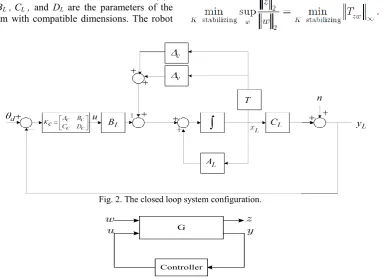
closed loop system configuration is depicted in Fig. 2 in which 𝜃𝑑is the desired value of 𝜃, and Ac , Bc , Cc ,and Dc
are the parameters of a dynamic output feedback con-troller defined as follows:
(3) Where y(t) denotes the measurement output to be defined later, and 𝑥𝑐 is the states of the dynamic output feedback controller system. Moreover, in Fig. 2, ∆𝑢and ∆𝑐 denote the effects of viscous and coulomb frictions, respectively, where
𝑇𝐿= [05×5 𝐼5]. (4)
Therefore, the objective is to design a control strategy for the manipulator robot described in (2) in order to attenuate the effects of uncertainties such as noise, frictions, and flexible modes on the performance of the robot to track a desired trajectory which is studied in the following section.
III.
H
∞C
ONTROLS
YSTEMD
ESIGNOne of popular strategies to cope with uncertainties in dynamical systems is H∞ control whose standard
configuration is depicted in Fig. 3. The main objective in
H∞ control is to design the control input u from a
stat-ic/dynamic controller K based on the measurement y in order to attenuate the effects of the uncertainties vector w
(exogenous signals) on a desired performance which will be defined via the regulated output z [27], [28]. Therefore, the objective is to design the controller such that the effect of the L2 norm of w on the L2 norm of z is minimized. In other
words, the H∞ norm of the transfer function from w to z
should be minimized as follows:
Fig. 2. The closed loop system configuration.
G
Controller
z w
y u
To design the H∞ controller, at first a state space
re-presentation of the system should be obtained as follows:
(5) To obtain these parameters, it is necessary to modify the system configuration depicted in Fig. 2 by considering the effects of flexible modes as source of uncertainties instead of the states of the system. At first, let us state AL , BL and CLby their block entries as follows:
Now, if we define
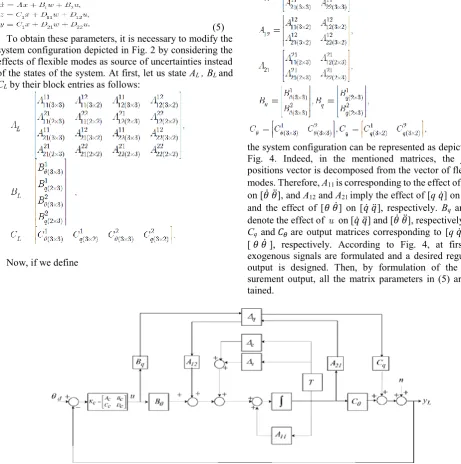
(6) the system configuration can be represented as depicted in Fig. 4. Indeed, in the mentioned matrices, the joints positions vector is decomposed from the vector of flexible modes. Therefore, A11 is corresponding to the effect of [𝜃 𝜃̇]
on [𝜃̇ 𝜃̈], and A12 and A21 imply the effect of [q𝑞̇]on [𝜃̇ 𝜃̈]
and the effect of [𝜃 𝜃̇] on [𝑞̇ 𝑞̈], respectively. Bq and 𝐵𝜃 denote the effect of u on [𝑞̇ 𝑞̈] and [𝜃̇ 𝜃̈], respectively, and
Cq and 𝐶𝜃 are output matrices corresponding to [q𝑞̇] and [𝜃 𝜃̇], respectively. According to Fig. 4, at first the exogenous signals are formulated and a desired regulated output is designed. Then, by formulation of the mea-surement output, all the matrix parameters in (5) are ob-tained.
Fig. 4. The closed loop system configuration while considering the flexible modes as sources of uncertainties.
A. Exogenous Signals Formulations
According to the sources of uncertainties, an exogenous signals vector should be designed. There are four sources of uncertainties in the system listed below:
- The effect of the viscous frictions on the robot: v d
w .
- The effect of the coulomb frictions on the robot: c d
w .
- The effect of the flexible modes on the robot: q d
w .
- The measurement noises vector: n.
On the other hand, the reference signal 𝑞𝑑 also should be considered as an exogenous signal. Therefore, considering all the above-mentioned issues, the exogenous signals vector can be defined as follows:
Accordingly, considering Fig. 4, one can observe that
(7)
and therefore, the matrix parameters A, B1, and B2can be
(8)
B. Regulated Output Formulation
The next step is to design a regulated output such that minimizes effects of the source of uncertainties in the system while guaranteeing a desired tracking performance. Moreover, it should guarantee tracking of the reference signal with reasonable control efforts. Therefore, we can design a regulated output as follows:
where ydv, ydc, and ydqare the sources of the viscous friction, the coulomb friction, and the flexible modes, respectively, and
e
is the tracking error which by considering Fig. 4, it can be stated as follows:(9)
Therefore, by considering v,
d
y c
d
y , and q d
y in Fig. 4, the regulated output can be restated as follows:
in which
(10) which implies that the matrix parameters C1, D11 and D12
are as follows:
(11)
C. State Space Representation of the H
∞Control
Problem
The measurement output of the robot will be studied. According to Fig. 4, the measurement output is a function of 𝜃 and uncertainties as follows:
(12)
and therefore, the matrix parameters C2, D21, and D22 are
as follows:
(13)
Therefore, considering all the mentioned issues in (8), (11), and (13), all the matrix parameters in (5) were obtained, and the system G can be formulated in the following standard form:
(14)
In this condition, it is sufficient to numerically solve an optimization problem to find the controller parametersAc,
c
B , Cc, and Dc such that the H norm of the transfer function from w to z is minimized.
Remark 1: It is worth mentioning that although the problem was formulated for a macro-micro three link manipulator, the proposed strategy can be extended for every manipulator robot with any number of flexible links.
IV.
S
IMULATIONR
ESULTSThe performance of the proposed H∞ optimal controller
is studied in this section. By considering the obtained standard H∞ formulation in (14), we have employed the
robust H∞optimization toolbox in MATLAB to obtain the
parameters of a dynamic output feedback controller defined in (3) while satisfying a desired H∞ performance.
We consider a scenario where the desired trajectories of the joints are considered as follows:
Fig.5. The trajectories of the robot joints..
Fig.6. The trajectories of the flexible modes.
For simulation, we have considered a measurement noise with noise power of 10-5 and sample time of 0.1. Moreover,
the robot parameters are supposed to be as giv-en in Table I.
Table I. The Robot Parameters
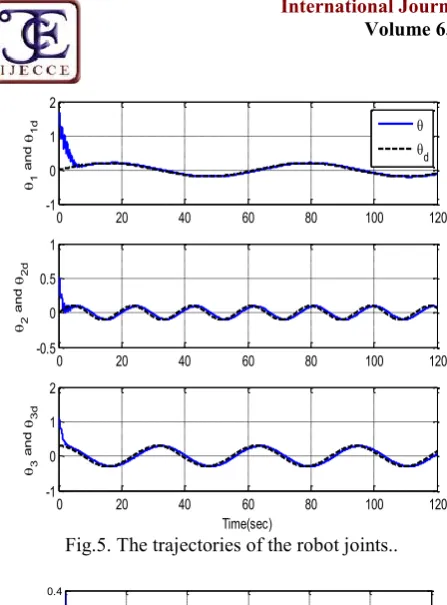
In this condition, the robot joints trajectories are depicted in Fig. 5. According to the figure, the robot tracks the
depicted in Fig. 6, the flexible modes are damped to zero. Furthermore, the input torques to the robot joints are shown in Fig. 7 confirming that the desired performance is achieved by reasonable control efforts.
Fig.7. The input torques to the robot joints.
V.
C
ONCLUSION ANDF
UTUREW
ORKH∞ optimal control of 3-link macro-micro manipulators
was studied in this paper. It was supposed that the first link of the robot is flexible, and the robot is subject to measurement noises and unknown frictions. Then, by considering the flexible modes, measurement noises, and the frictions as sources of uncertainties, and by designing a proper regulated output, a standard H∞ optimal control
problem was formulated. Hence, by using only the infor-mation of the robot joints positions, a dynamic output-feedback controller guaranteeing a desired H∞ performance
was obtained. H∞optimal impedance control of the robot in
the presence of aforementioned uncertainties is another challenging issue to be studied as future work.
R
EFERENCES[1] S. Datta, R. Ray, and D. Banerji, “Development of autonomous mobile robot with manipulator for manufacturing environment,”
The International Journal of Advanced Manufacturing Technology, vol. 38, no. 5-6, pp. 536–542, 2008.
[2] X. Dun, J. Yuan, and L. Chen, “The auto-docking system design for the fuel loading robot used in hazardous environment,” in
Proceedings of the IEEE International Conference on Robotics and Biomimetics, December 2006, pp. 485–490.
[3] R. Olfati-Saber, “Nonlinear control of under actuated mechanical systems with application to robotics and aerospace vehicles,” Ph.D. Dissertation, Massachusetts Institute of Technology, USA, February 2000.
[4] S. Park, Y. Lee, and G. Kim, “Implementation of spatial visualization for a tele-operated robot in a complex and hazardous environment,” in Proceedings of the IEEE International Conference on Automation Science and Engineering, August 2014, pp. 285–289.
[5] M. L. Leuschen, I. D. Walker, and J. R. Cavallaro, “Investigation of reliability of hydraulic-robots for hazardous environments using analytic redundancy,” in Proceedings of the Annual Reliability and Maintainability Symposium, January 1999, pp. 122–128.
[6] E. Bauzano, B. Estebanez, I. Garcia-Morales, and V. F. Munoz, “Collaborative human-robot system for hals suture procedures,”
0 20 40 60 80 100 120
-1 0 1 2 1 a n d 1d d
0 20 40 60 80 100 120
-0.5 0 0.5 1 2 a n d 2d
0 20 40 60 80 100 120
-1 0 1 2 Time(sec) 3 a n d 3d
0 20 40 60 80 100 120 -0.4 -0.2 0 0.2 0.4 q1
0 20 40 60 80 100 120 -0.2 -0.1 0 0.1 0.2 Time(sec) q2
0 20 40 60 80 100 120
-4 -2 0 2 1 (N .m )
0 20 40 60 80 100 120
-0.5 0 0.5 2 (N .m )
0 20 40 60 80 100 120
[7] T. Kato, I. Okumura, S. Song, A. J. Golby, and N. Hata, “Tendon-driven continuum robot for endoscopic surgery: Preclinical development and validation of a tension propagation model,”
IEEE/ASME Transactions on Mechatronics, DOI:10.1109/TMECH. 2014.2372635, 2015.
[8] H. Rezaee and F. Abdollahi, “Pursuit formation of double-integrator dynamics using consensus control approach,” IEEE Transactions on Industrial Electronics, DOI: 10.1109/TIE. 2014. 2384479, 2015.
[9] H. Rezaee and F. Abdollahi, “Mobile robots cooperative control with obstacle avoidance for a team of mobile robots,” IEEE Transactions on Industrial Electronics, vol. 61, no. 1, pp. 347– 354, 2014.
[10] G. C. Bishop, “Gravitational field maps and navigational errors [unmanned underwater vehicles],” IEEE Journal of Oceanic Engineering, vol. 27, no. 3, pp. 726–737, 2002.
[11] F. G. Serchi, A. Arienti, and C. Laschi, “Biomimetic vortex propulsion: Toward the new paradigm of soft unmanned underwater vehicles,” IEEE/ASME Transactions on Mechatronics, vol. 18, no. 2, pp. 484–493, 2013.
[12] H. Rezaee and F. Abdollahi, “Synchronized cross coupled sliding mode controllers or cooperative UAVs with communication delays,” in Proceedings of the 51st IEEE Conference on Decision and Control, USA, December 2012, pp. 3116–3121.
[13] H. Rezaee and F. Abdollahi, “Adaptive artificial potential field approach for obstacle avoidance of unmanned aircrafts,” in
Proceedings of the IEEE/ASME International Conference on Advanced Intelligent Mechatronics, Taiwan, July 2012, pp. 1–6. [14] S. H. Murphy, J. T. Wen, and G. N. Saridis, “Simulation of
cooperating robot manipulators on a mobile platform,” IEEE Transactions on Robotics and Automation, vol. 7, no. 4, pp. 468– 478, 1991.
[15] J. Vannoy and J. Xiao, “Real-time adaptive motion planning (RAMP) of mobile manipulators in dynamic environments with unforeseen changes,” IEEE Transactions on Robotics, vol. 24, no. 5, pp. 1199– 1212, 2008.
[16] A. Rashidinejad, S. K. Y. Nikravesh, and H. A. Talebi, “Nonlinear disturbance observer for flexible-link manipulators based on flexural rate estimation,” in Proceedings of the 3rd International Conference on Control, Instrumentation, and Automation, December 2013, pp. 269– 273.
[17] M. Tavakoli and R. D. Howe, “Haptic effect of surgical teleoperator flexibility,” The international journal of robotics research, vol. 28, no. 10, pp. 1289–1302, 2009.
[18] H. A. Talebi, R. V. Patel, and K. Khorasani, Control of Flexible-link Manipulators Using Neural Networks. Springer, January 2001.
[19] P. R. V. Moallem, M. and K. Khorasani, “An inverse dynamics control strategy for tip position tracking of flexible multi-link manipulators,” Journal of Robotic Systems, vol. 14, no. 9, pp. 649–658, 1997.
[20] D. Wang and M. Vidyasagar, “Passive control of a stiff flexible link,” International Journal of Robotics Research, vol. 11, no. 6, pp. 572–578, 1992.
[21] Y. Aoustin and C. Chevallereau, “The singular perturbation control of a two-flexible-link robot,” in Proceedings of the IEEE International Conference on Robotics and Automation, May 1993, pp. 737–742.
[22] B. Siciliano and W. J. Book, “A singular perturbation approach to control of light weight flexible manipulator,” The International Journal of Robotics Research, vol. 7, no. 4, pp. 79–90, 1998. [23] I. Sharf, “Active damping of a large flexible manipulator with a
shortreach robot,” in Proceedings of the American Control Conference, June 1995, pp. 3329–3333.
[24] H. Jiang and A. A. Goldenberg, “Task space trajectory control of flexible micro macro robot in the presence of parametric uncertainty,” Mechanism and Machine Theory, vol. 34, no. 8, pp. 1281–1302, 1999.
[25] M. O. Tokhi and A. K. M. Azad, Flexible robot manipulators modeling, simulation and control. IET, 2001.
[26] X. W. L. Yang, T. W. and J. D. Han, “Dynamic compensation control of flexible macro micro manipulator systems,” IEEE Transactions on Control Systems Technology, vol. 18, no. 1, pp. 143–151, 2010.
[27] J. C. Doyle, K. Glover, P. Khargonekar, and B. A. Francis, “State-space solutions to standard H2 and H∞control problems,” IEEE
Transactions on Automatic Control, vol. 34, no. 8, pp. 831–847, 1989.
[28] H. Rezaee, F. Abdollahi, and H. A. Talebi, “H∞ based motion
synchronization in formation flight with delayed communications,” IEEE Transactions on Industrial Electronics, vol. 61, no. 11, pp. 6175–6182, 2014.
A
UTHOR'
SP
ROFILENahid Soltani
received his B.S. degree in Electrical Engineering from Islamic Azad University, Arak, Iran in 2004, and his M.S. degree from Imam Khomeini International University, Qazvin, Iran in 2015. His research interest includes nonlinear control, optimal control, robust control, and multivariable control.