© 2017 Ghazi Faisal Najmuldeen et al. This is an open access article distributed under the terms of the Creative Commons Attribution License -NonCommercial-ShareAlikeUnported License (http://creativecommons.org/licenses/by-nc-sa/3.0/).
Journal of Applied Pharmaceutical Science Vol. 7 (06), pp. 062-068, June, 2017 Available online at http://www.japsonline.com
DOI: 10.7324/JAPS.2017.70609 ISSN 2231-3354
Characterization of
Eurycoma longifolia
(Tongkat Ali) Essential Oils
Extracted by Microwave Assisted Extraction
Ghazi Faisal Najmuldeen1, Hariitaraan a/l Fatmanathan1, Ghasak Ghazi Faisal2*, Zulkafli bin Hassan1
1
Faculty of Chemical & Natural Resources Engineering,Universiti Malaysia Pahang, 26300 Gambang, Pahang, Malaysia.
2
Department of fundamental dental and medical sciences, Kulliyya of Dentistry, International Islamic University Malaysia.
ARTICLE INFO ABSTRACT
Article history: Received on: 28/03/2017 Accepted on: 03/05/2017 Available online: 30/06/2017
The main objective of this research is to extract and characterize the essential oils of Eurycoma longifolia jack (Tongkat Ali) root using microwave assisted extraction (MAE) The effect of various process parameters such as extraction time (5 min, 10 min, 15 min, 20 min, 30min, and 45 min), microwave power (200W, 225W, 250W, 275W, 300W and 400W) and raw material to solvent ratio (RMTSR) (1:6, 1:8, 1:10 and 1:12) on the yield and its major constituents were investigated in this study to obtain the optimum conditions for the extraction process. The pure essential oil obtained was characterized using gas chromatography mass spectroscopy (GCMS) techniques. The findings showed that the optimal conditions for the microwave assisted extraction of Eurycoma longifolia are 10 minutes extraction time, 225W microwave power and 1:10 for (RMTSR) with the maximum yield percentage of 1.91% .
Key words:
Microwave assisted extraction, Eurycoma longifolia root, Eurycoma longifolia essential oil, Tongkat Ali.
INTRODUCTION
In this study, the volatiles or essential oils from
Eurycoma longifolia or more commonly known as “Tongkat Ali”
are extracted using microwave assisted extraction. This plant is mostly found in South-East Asian countries such as Malaysia,
Indonesia, Thailand, Myanmar, and Vietnam (Rajeev et al.,
2010). The root extracts are used in local traditional medicines for its exclusive antimalarial, anti-pyretic, antiulcer, cytotoxic and aphrodisiac properties (Jagananth, 2000). Microwave assisted extraction of essential oils from plant material has become one of the famous and efficient way to extract out the volatiles. Soxhlet extraction is the most conventional method and
widely used in the field of extraction (Vivekananda et al., 2007).
However, soxhlet extraction has a major drawback of having longer extraction period, requires larger amount of heat energy for its process and could be a threat to the environment as it
.
* Corresponding Author E-mail: drghassak @ yahoo.com
consumes large amount of organic solvent in the evaporation and
concentration of the extract (Zuloaga et al., 1999). Microwave
assisted extraction provides the best solution because it requires less consumption of solvent and less extraction time as the process occurs in elevated temperature (Balunkeswar et al., 2015).
Although the thorough statistic demand in international
market is imprecise, the price of the dried Eurycoma longifolia
roots are expected to be rated in between 20 to 25 US dollars/kg. Nevertheless, the water extract seemed to have a better market
value with 26 US dollars per bottle of 60 capsules (Kaur et al.,
2003). The main objective of this study is to extract the essential
oils of Eurycoma longifolia’s root using Microwave assisted
Extraction (MAE) and to characterize the components of essential
oils extracted from the roots of Eurycoma longifolia. This study is
MATERIALS AND METHODS
Methanol of 98.99% was obtained from UMP Chemical Laboratory store.
The Tongkat Ali root was purchased from LCH Agriculture, Sungai Petani, Kedah, Malaysia, (the supplier did not indicate whether the root was collected from the wild or cultivated)
Experimental procedure
The Tongkat Ali root was cut into small pieces (1-2 cm) to increase the surface area of extraction. Then, the root was dried in the conventional oven to constant weight at 60-80 ºC for 2 hours in the interval of 30 minutes. The dried sample was sealed and stored under room temperature. The microwave assisted extraction was performed using Ethos Microwave Extractor. The weight of
sample (Eurycoma longifolia roots) was kept constant at 3 grams
throughout the experiment and was soaked with 10ml of methanol for 10 minutes. This was done to enhance the diffusion of the solvent into the sample and improves the mass transfer of active compounds into the solvent. Three parameters were studied in this study which were time of extraction, microwave power and raw material to solvent ratio. The time of extraction was the first parameter, the RMTSR ratio and microwave power were kept constant at 1:10 (g/ml) and 250W respectively. The time was varied at 5, 10, 15, 20, 30 and 45 minutes. The microwave power was the second parameter, the RMTSR ratio and time of extraction were kept constant at 1:10 (g/ml) and 10 minutes respectively and the microwave power was varied as 220W, 225W, 250W, 275W, 300W and 400W. Finally for raw material to solvent ratio, the extraction time and microwave power were kept constant at 10 minutes and 250W respectively. The RMTSR was varied as 1:6, 1:8, 1:10 and 1:12 (g/ml).
Separation of the mixture of solvent from extract
After the extraction process was completed, the mixture of essential oil and solvent were separated from the solid by decantation and filteration. Then, rotary evaporator was used to separate the mixture of essential oil from solvent. After the evaporation of the alcohol was completed, the pure essential oil was transferred into a sample bottle for characterization.
GC-MS Analysis
The main task for the characterization was to identify the components produced through the MAE in order to compare with the components of the Tongkat Ali root produced through other extraction techinques
The components of the essential oil were quantified using gas chromatography mass spectroscopy (GCMS) of the Agilent model. This instrument functions by separating chemical mixtures (the GC component) and identifying the compositions at a molecular extend (the MS component). It is based on the principle that a mixture will separate into individual components when heat is applied (Neoh et al., 2011). One microliter aliquot of sample
was injected at 1:100 split ratio into GCMS system consisting of an Agilent 6890N Gas Chromatograph coupled with an Agilent 5973i Mass Detector and 6890 series auto sampler. The separation was performed using capillary column with helium as the carrier gas. The oven programming was held initially at temperature of 60°C and later ramped at 5°C /min to 220°C and was held isothermally at this point for 20 minutes (Secilmis Canbay and Bardakc, 2011). As the separated components emerge from the column opening, they diverge into the MS. In order to identify the chemical constituents present in the extracted essential oil, their mass spectra was either compared with those of standard compounds from the National Institute of Standard and Technology (NIST) library data from GC-MS, database (Wiley/ NBS library) or with published mass spectra (Adams., 2001). Close similarity in retention time of the compound from both techniques were observed when the components were quantified.
Statistical analysis
Analysis of variance (ANOVA) was used to test the effects of extraction time, microwave power and raw material to solvent ratio (RMTSR) on the yield of essential oil extracted. The results of the two replicates for all the analysis done were expressed as mean and ANOVA. Significance is accepted at P<0.5.
RESULTS AND DISCUSSION
Effect of extraction time
The percentage yield of the Tongkat Ali essential oil was calculated at a constant microwave power of 250 W, and at raw material to solvent ratio of 1:10 based on average values obtained. The yield percentage was calculated using Equation 1.
Yield Percentage, % = x 100 Eq.1
Figure 1 illustrates the percentage yield of essential oil
extracted from Eurycoma longifolia (Tongkat Ali) at different
extraction time at a constant microwave power of 250 W, and at raw material to solvent ratio of 1:10. From the table and graph, it can be clearly seen that the amount of yield increases as the extraction time was increased from 5 min to 10 min. The yield obtained at 5 and 10 min are 1.5%, and 1.83% respectively. Apparently microwave assisted extraction was able to produce the highest yield of 1.83% when the extraction time is 10 min. Nevertheless, as the extraction time was increased beyond 10 min, the yield can be seen to be reduced. The same observation was reported for microwave assisted extraction of pectin from waste
Citrullus lanatus fruit rinds (Prakash Maran et al., 2014). The
initial increase in extraction yield supports the fact that the more the time the more the thermal accumulation within the solvent (methanol) due to the absorption of microwave energy enhanced
the dissolution process of essential oil into the solvent (Maran et
however be related with the possible degradation of the plant material as the extraction time increases (Chen et al., 2007).
Fig. 1: Percentage Yield against Extraction Time.
Effect of microwave Power
The percentage yield of the Tongkat Ali essential oil is calculated at a constant extraction time of 10 min, and at raw material to solvent ratio of 1:10 based on average values obtained. The percentage yield was calculated using Equation 1.
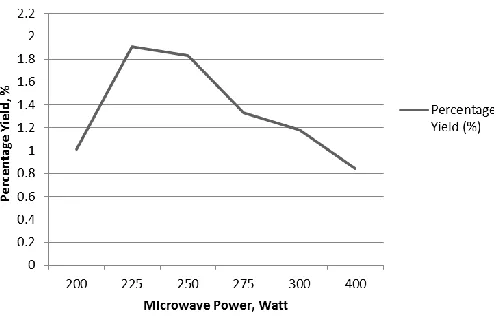
Fig. 2: Percentage Yield against Microwave Power.
Figure 2 illustrates the percentage yield of essential oil
extracted from Eurycoma longifolia (Tongkat Ali) at different
microwave power at a constant extraction time of 10 min, and at raw material to solvent ratio of 1:10. Six different microwave power levels were used in the extraction which were 200 W, 225 W, 250 W, 275 W, 300 W, 400 W. From Figure 2, it can be seen that when the microwave power increases, the percentage yield of extracted Tongkat Ali essential oil increased until 225W and started to decrease from 250W until 400W. It is observed that the highest yield of 1.91% which was obtained when Tongkat Ali essential oil extracted was conducted at 225 W for a period of 10 min. This is because higher microwave power would supply more energy to the immersed Tongkat Ali, produce rapid generation of heat, and subsequent formation of higher pressure gradient inside
of the Tongkat Ali and methanol (solvent) such that the extraction
is enhanced (Rezvanpanah et al., 2008). However, for the higher
microwave power, the yield of Tongkat Ali essential oil decreases. There is the possibility of a negative effect from higher microwave power, which might tend to overheat the product by elevating the temperature too high, leading to the compound breakdown or
product damage (Ma et al., 2009).
Effect of raw material to solvent ratio (RMTSR)
The Tongkat Ali essential oil was calculated at a constant extraction time of 10 min, and microwave power of 250 W based on average values obtained. The percentage yield is calculated according to Equation 1. Figure 3 illustrates the percentage yield
of essential oil extracted from Eurycoma longifolia (Tongkat Ali)
at different raw material to solvent ratio at a constant extraction time of 10 min, and microwave power of 250 W. Four different RMTSR were used in the extraction which are 1:6, 1:8, 1:10 and 1:12. From Figure 4.3 it can be clearly seen that the Tongkat Ali essential oil extraction increases as the RMTSR increases until it reached the maximum yield at 1:10 which is 1.83%. This is because the driving force during mass transfer within the solid is considered to be the concentration gradient, which is greater when the high solvent-to-solid ratio are used, resulting in an increase of the diffusion rate ( Khanal et al., 2006). However at RMTSR of 1:12 the yield started to decrease because the raw material could not take up more solvent than the equilibrium point resulting with low mass transfer and diffusivity (Cacace and Mazza 2003).
Fig. 3: Percentage Yield against RMTSR
GCMS Analysis
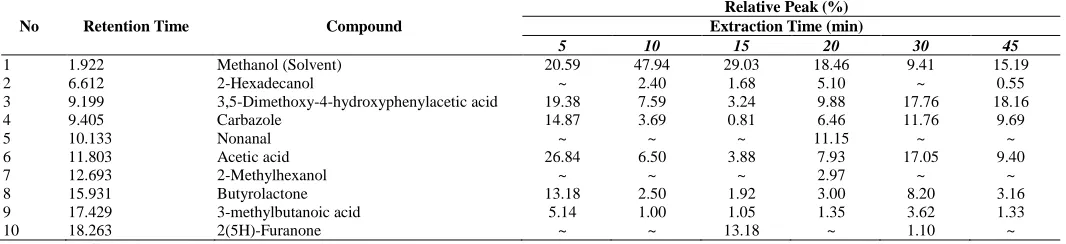
found in each of the samples for all the three parameters investigated in this study.
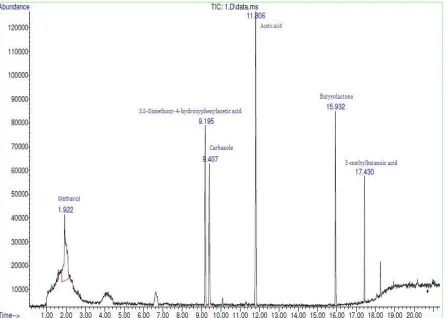
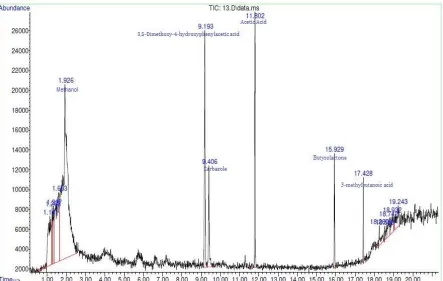
Table 1, 2 and 3 reveals the results and the components identified through GCMS. The components in the Tongkat Ali essential oil were detected at the retention time in the range from 1 to 20 minutes. The solvent, methanol was detected first at retention time of 1.922. There were 9 components detected in total.
Generally, the components such as
(3,5-Dimethoxy-4-hydroxyphenylacetic acid, Carbazole, Acetic acid, Butyrolactone and 3-methylbutanoic acid) were found in each and every samples of the parameters. The largest peak found is 3,5-Dimethoxy-4-hydroxyphenylacetic acid with retention time of 9.199. Some
components that were detected at retention time of 10.133, 12.693 and 18.263 and were identified as (Nonanal, 2-Methylhexanol, 2(5H)-Furanone) were the least found components.
Statistical analysis
Based on the statistical analysis done using single factor ANOVA (analysis of variance), the p value obtained for the extracted essential oil (g) based on extraction time, microwave power and RMTSR are 0.001469, 0.000057 and 0.001549 respectively. Thus, all the results are valid and significant at p<0.5.
Table 1: Components Identified in Tongkat Ali Extract at Extraction Time Parameter.
No Retention Time Compound
Relative Peak (%) Extraction Time (min)
5 10 15 20 30 45
1 1.922 Methanol (Solvent) 20.59 47.94 29.03 18.46 9.41 15.19
2 6.612 2-Hexadecanol ~ 2.40 1.68 5.10 ~ 0.55
3 9.199 3,5-Dimethoxy-4-hydroxyphenylacetic acid 19.38 7.59 3.24 9.88 17.76 18.16
4 9.405 Carbazole 14.87 3.69 0.81 6.46 11.76 9.69
5 10.133 Nonanal ~ ~ ~ 11.15 ~ ~
6 11.803 Acetic acid 26.84 6.50 3.88 7.93 17.05 9.40
7 12.693 2-Methylhexanol ~ ~ ~ 2.97 ~ ~
8 15.931 Butyrolactone 13.18 2.50 1.92 3.00 8.20 3.16
9 17.429 3-methylbutanoic acid 5.14 1.00 1.05 1.35 3.62 1.33
10 18.263 2(5H)-Furanone ~ ~ 13.18 ~ 1.10 ~
(Source: Shafiqul Islam et al., 2006 and Purwantiningsih et al., 2011).
Table 2: Components Identified in Tongkat Ali Extract at Microwave Power Parameter.
No Retention Time Compound
Relative Peak (%) Microwave Power (Watt)
200 225 250 275 300 400
1 1.922 Methanol (Solvent) 51.20 39.97 47.94 38.16 38.00 52.53
2 6.612 2-Hexadecanol ~ ~ 2.40 ~ ~ ~
3 9.199 3,5-Dimethoxy-4-hydroxyphenylacetic acid 6.15 6.99 7.59 16.09 3.67 7.63
4 9.405 Carbazole 3.60 6.06 3.69 8.79 3.17 5.32
5 10.133 Nonanal ~ ~ ~ ~ 1.01 ~
6 11.803 Acetic acid 4.41 5.11 6.50 23.97 6.74 3.19
7 12.693 2-Methylhexanol ~ ~ ~ ~ ~ ~
8 15.931 Butyrolactone 1.82 1.65 2.50 8.77 2.37 1.76
9 17.429 3-methylbutanoic acid 1.00 1.02 1.00 4.21 3.07 1.09
10 18.263 2(5H)-Furanone ~ ~ ~ ~ ~ ~
(Source: Shafiqul Islam et al., 2006 and Purwantiningsih et al., 2011).
Table 3: Components Identified in Tongkat Ali Extract at RMTSR Parameter.
No Retention Time Compound
Relative Peak (%) RMTSR (g/ml)
1:6 1:8 1:10 1:12
1 1.922 Methanol (Solvent) 41.59 4.25 47.94 4.13
2 6.612 2-Hexadecanol ~ ~ 2.40 0.93
3 9.199 3,5-Dimethoxy-4-hydroxyphenylacetic acid 8.83 18.04 7.59 4.61
4 9.405 Carbazole 4.80 9.67 3.69 2.52
5 10.133 Nonanal ~ 0.31 ~ 10.48
6 11.803 Acetic acid 7.98 24.56 6.50 3.58
7 12.693 2-Methylhexanol ~ ~ ~ 32.57
8 15.931 Butyrolactone 2.86 12.99 2.50 0.96
9 17.429 3-methylbutanoic acid 1.11 6.07 1.00 0.42
10 18.263 2(5H)-Furanone ~ 2.31 ~ ~
Fig. 4: GCMS of 5 minutes Extraction time.
CONCLUSION
The essential oil of Eurycoma longifolia has been
extracted using Microwave assisted Extraction (MAE) and the components of the extracted essential oil were characterized and quantified using GCMS, showing similarities to previous publication results .Three parameters were investigated in this study namely extraction time, microwave power and raw material to solvent ratio (RMTSR). The optimum conditions for the
microwave assisted extraction of Eurycoma longifolia are 10
minutes for extraction time, 225W for microwave power and 1:10 for RMTSR with the maximum yield percentage of 1.83%, 1.91% and 1.83% respectively.
ACKNOWLEDGMENTS
Financial support and sponsorship: The authors wishes to thank University Malaysia Pahang and International Islamic University Malaysia for providing research funding.
Conflict of Interests: There are no conflicts of interest.
REFERENCES
A.K.M. Shafiqul Islam, Z. Ismail, B. Saad, A.R. Othmanc, M.N. Ahmadd, A.Y.Md. Shakaff. .Correlation studies between electronic nose response and headspace volatiles of Eurycoma longifolia extracts. Sensors and Actuators B: Chemical. 2006;120(1):245-51.
Balunkeswar Nayak, Farid Dahmoune, Kamal Moussi, Hocine Remini, Sofiane Dairi, Omar Aoun, Madani Khodir. Comparison of microwave, ultrasound and accelerated-assisted solvent extraction for recovery of polyphenols from Citrus sinensis peels. Food Chemistry,2015; 187:507-516.
Cacace, J.E., Mazza, G. Mass transfer process during extraction of phenolic compounds form milled berries. Journal of Food Engineering, 2003;59: 379-389
Chen Y, Xie M.Y, and Gong, X.F. Microwave-assisted extraction used for the isolationof total triterpenoid saponins from Ganoderma atrum.Journal of Food Engineering, 2007;81(1):162-170.
Jaganath IB, Ng LT. Herbs. The Green Pharmacy of Malaysia. Kuala Lumpur, Vinpress and Malaysia Agricultural Research and Development Institute. 2000:95-9.
Kaur I, Kumaresan S, Sarmidi MR. A study into the effect of laboratory scale processing parameters and scale up on Eurycoma longifolia water extract yield. InProceedings of the 17th Symposium of Malaysian Chemical Engineers 2003 Dec 29 (pp. 294-299).
Khanal SK, Isik H, Sung S, Van Leeuwen J. Ultrasound pretreatment of waste activated sludge: evaluation of sludge disintegration and aerobic digestibility. InProceedings of IWA World Water Congress and Exhibition 2006 Sep 10 (pp. 10-14). Beijing, China: September.
Ma, W., Lu, Y., Dai, X., Liu, R., Hu, R., Pan, Y. Determination of anti-tumor constitute mollugin from traditional Chinese medicine Rubia cordifolia: Comparative study of classical and microwave extraction techniques. Separation Science and Technology,2009;44(4): 995-1006.
Maran JP, Sivakumar V, Thirgananasambandham K, Sridhar R. Optimization of microwave assisted extraction of pectin from orange peel. Car-bohydrate Polymers. 2013;97:703–709.
Maran JP, Sivakumar V, Thirugnanasambandham K, Sridhar R. Microwave assisted extraction of pectin from waste Citrullus lanatus fruit rinds. Carbohydrate polymers. 2014 Jan 30;101:786-91.
Neoh BK, Thang YM, Zain MZ, Junaidi A. Palm pressed fibre oil: A new opportunity for premium hardstock?. Int. Food Res. J. 2011 May 1;18(2):769-73.
Purwantiningsih HA, Chan KL. Free radical scavenging activity of the standardized ethanolic extract of Eurycoma longifolia (TAF-273). Int J Pharm Pharm Sci. 2011;3:343-7.
R. P. Adams. Identification of essential oils by gas chromatography quadrupole mass spectrometry.Allured Publishing Corporation, Carol Stream, 2001. USA.
Rajeev Bhat , A.A. Karim. Tongkat Ali (Eurycoma longifolia Jack): A review on its ethnobotany and pharmacological importance. Fitoterapia, 2010;81: 669-679.
Rezvanpanah S, Rezaei K, Razavi, S. H, and MoiniS. Use of Microwave assisted Hydrodistillation to Extract the Essential Oils from Satureja hortensis and Satureja montana. Food science and technology research., 2008;14(3): 311-314.
Seçilmiş Canbay H, and Bardakç B. Determination of Fatty Acid, C, H, N and Trace Element Composition in Grape Seed by GC/MS, FTIR, Elemental Analyzer and ICP/OES. Journal Of Science (E-Journal). 2011; 6 (2): 140-148, 142.
Vivekananda Mandal, Yogesh Mohan, S. Hemalatha. Review Article Microwave Assisted Extraction – An Innovative and Promising Extraction Tool for Medicinal Plant Research, 2007; Vol 1, Issue 1.
Zuloaga O, Etxebarria N, Fernández LA, Madariaga JM. Optimisation and comparison of microwave-assisted extraction and Soxhlet extraction for the determination of polychlorinated biphenyls in soil samples using an experimental design approach. Talanta. 1999 Sep 13;50(2):345-57.
How to cite this article: