The Journal of Threatened Taxa is dedicated to building evidence for conservation globally by publishing peer-reviewed articles online every month at a reasonably rapid rate at www.threatenedtaxa.org. All articles published in JoTT are registered under Creative Commons Attribution 4.0 International License unless otherwise mentioned. JoTT allows unrestricted use of articles in any medium, reproduction, and distribution by providing adequate credit to the authors and the source of publication.
OPEN ACCESS
For Focus, Scope, Aims, Policies and Guidelines visit http://threatenedtaxa.org/index.php/JoTT/about/editorialPolicies#custom-0 For Article Submission Guidelines visit http://threatenedtaxa.org/index.php/JoTT/about/submissions#onlineSubmissions For Policies against Scientific Misconduct visit http://threatenedtaxa.org/index.php/JoTT/about/editorialPolicies#custom-2 For reprints contact <[email protected]>
Journal of Threatened Taxa
Building evidence for conservation globallywww.threatenedtaxa.org
ISSN 0974-7907 (Online) | ISSN 0974-7893 (Print)
Communication
Investigating Sri Lanka’s human-monkey conflict and
developing a strategy to mitigate the problem
Surendranie Judith Cabral, Tharaka Prasad, Thulmini Pubudika Deeyagoda, Sanjaya Nuwan Weerakkody, Ashwika Nadarajah & Rasanayagam Rudran
26 March 2018 | Vol. 10 | No. 3 | Pages: 11391-11398 10.11609/jott.3657.10.3.11391-11398
11391
Communica
tion
DOI:http://doi.org/10.11609/jott.3657.10.3.11391-11398
Editor: Anonymity requested. Date of publication: 26 March 2018 (online & print)
Manuscript details: Ms # 3657 | Received 17 July 2017 | Finally accepted 27 February 2018
Citation:Cabral, S.J., T. Prasad, T.P. Deeyagoda, S.N. Weerakkody, A. Nadarajah & R. Rudran (2018). Investigating Sri Lanka’s human-monkey conflict and developing a strategy to mitigate the problem.Journal of Threatened Taxa 10(3): 11391–11398; http://doi.org/10.11609/jott.3657.10.3.11391-11398
Copyright: © Cabral et al. 2018. Creative Commons Attribution 4.0 International License. JoTT allows unrestricted use of this article in any medium, reproduction and distribution by providing adequate credit to the authors and the source of publication.
Funding: Margot Marsh Biodiversity Foundation and Disney Worldwide Conservation Fund through Conservation International, USA.
Competing interests:The authors declareno competing interests.
For Author Details and Author Contribution: see end of this article.
Acknowledgements: The authors thank the Wildlife Health Division of the Department of Wildlife Conservation and Prof. Sarath W Kotagama advisor to the Minister and Ministry of Sustainable Development and Wildlife for their support. This study and ongoing research by SPEARS Foundation is funded by Margot Marsh Biodiversity Foundation and Disney Worldwide Conservation Fund through Conservation International, USA.
Investigating Sri Lanka’s human-monkey conflict and
developing a strategy to mitigate the problem
Surendranie Judith Cabral 1, Tharaka Prasad 2, Thulmini Pubudika Deeyagoda 3,
Sanjaya Nuwan Weerakkody 4, Ashwika Nadarajah 5& Rasanayagam Rudran 6
1,5,6 SPEARS Foundation, 120, Vijaya Kumaratunga Mawatha, Colombo 5, Sri Lanka
2,3 811/A Jayanthipura Main Road, Department of Wildlife Conservation, Battaramulla 10120, Sri Lanka 4 Department of Zoology and Environment Sciences, University of Colombo, Kumaratunga Munidasa Mawatha,
Colombo 00300, Sri Lanka
6 Smithsonian Conservation Biology Institute, 1500 Remount Road, Front Royal, VA, 22630,USA
1 [email protected] (corresponding author), 2 [email protected], 3 [email protected], 4 [email protected], 5 [email protected], 6 [email protected]
ISSN 0974-7907 (Online) ISSN 0974-7893 (Print)
OPEN ACCESS
Journal of Threatened Taxa | www.threatenedtaxa.org | 26 March 2018 | 10(3): 11391–11398
Abstract: Human-monkey conflicts reached crisis proportions in Sri Lanka over the last 10 years due to extensive deforestation to promote
rapid economic growth and agricultural expansion. This resulted in complaints from the public with demands for Sri Lanka’s Department of Wildlife Conservation (DWC) to solve the problem without delay. Caught between political pressure and public outcry, the DWC’s efforts to deal with the crisis gradually fell into disarray. To overcome this, the SPEARS Foundation , offered to help the DWC to develop a strategic plan to deal with human-monkey conflicts. This plan was developed through a series of workshops and submitted to the Ministry of Sustainable Development and Wildlife in March 2016 for approval. During and after the development of the strategy, some of its key elements were implemented by the SPEARS Foundation. One of these elements was documenting details of human-monkey conflict from letters of complaint received by DWC. This information was used to initiate a series of field surveys to identify sites suitable for long-term protection of monkeys and other wildlife. When these areas are identified they would be designated as community conservation areas (CCAs), and managed by local stakeholders on a sustainable basis under the supervision of DWC. Establishing CCAs is a new paradigm for Sri Lanka to conserve wildlife while benefitting local communities. Its details were presented in the strategic plan submitted to the government. In this paper, we present the information obtained from the letters of complaint received by DWC and discuss its details. In subsequent reports, we will discuss the results of our field surveys to identify areas suitable for the establishment of CCAs.
Keywords: Conservation, human-monkey conflict, primates, strategic plan.
Abbreviations: DWC - Department of Wildlife Conservation; CCA - Community Conservation Areas; IUCN -International Union for
INTRODUCTION
Human-monkey conflicts in Sri Lanka reached crisis proportions, when the country’s 26-year ethnic war ended in 2009, and the pent-up desire for progress led to the extensive destruction of natural habitats for agricultural expansion and economic development. These conflicts resulted in complaints from the public with demands for Sri Lanka’s Department of Wildlife Conservation (DWC) to find an immediate solution to the problem. In response, DWC attempted to do what it could with the small number of staff and annual budget available to it. Caught between political pressure and public outcry the DWC’s efforts to deal with the human-monkey conflict gradually fell into disarray.
To overcome the disarray, the SPEARS Foundation (a conservation-oriented organization), offered to help DWC to develop a strategy to resolve the human-monkey conflict. A workshop was conducted in September 2014 to discuss details of the conflict, and to develop a strategy to deal with the problem. Two more workshops were held in February 2015 and March 2016 respectively, and at the end of the third workshop a strategic plan that included financial costs to conserve and coexist with Sri Lanka’s monkeys was submitted to the Ministry of Sustainable Development and Wildlife (Rudran & Kotagama 2016). A formal cabinet approval for the strategic plan is pending.
While developing the strategic plan, we implemented some of its key elements. One of these elements was to review the letters of complaint received by DWC and document details of human-monkey conflicts in the 25 districts of Sri Lanka. This information was then used to begin a series of field surveys, to augment the database on conflicts and people’s attitudes towards the problem. These on-going surveys are also collecting estimates of monkey populations and the size and quality of habitats available to them. The ultimate objective of these surveys is to identify areas that are suitable for the long-term protection of monkeys and other wildlife throughout the island. When these areas are identified, they would be designated as community conservation areas (CCAs), and managed by local stakeholders on a sustainable basis under the supervision of DWC. The details of this objective, which would be a new paradigm for conserving Sri Lanka’s wildlife while benefitting local communities, was presented in the strategic plan submitted to the government. In this paper, we present the information obtained from the letters of complaint received by DWC and discuss its details. In subsequent reports, we will discuss the results of our field surveys
to identify areas suitable for the establishment of CCAs.
METHODS
We reviewed the letters of complaints received by DWC from 2007–2015, and extracted information such as localities of conflict, species causing conflict, the type of problems they caused and human responses to the conflict. Localities of conflicts were mapped using QGIS (QGIS Development Team 2015), and the data were then analysed using Microsoft Excel.
RESULTS
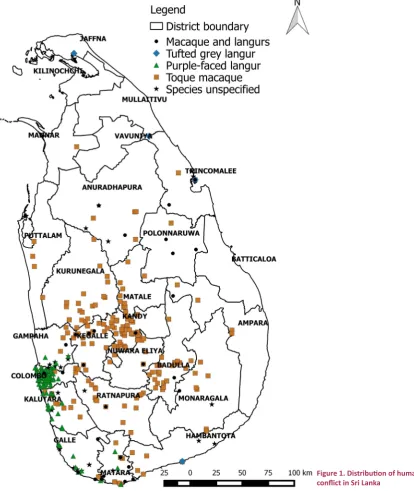
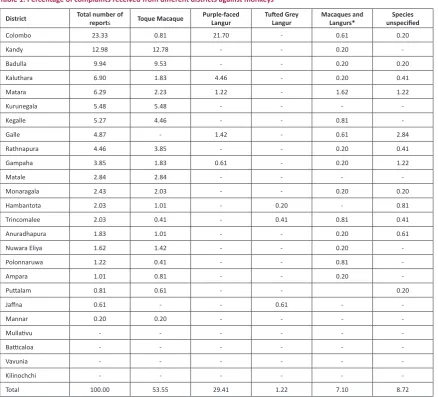
Distribution of Conflicts: From 2007 to 2015, DWC received 493 letters about human-monkey conflicts from 21 of 25 districts of the island (Table 1). These letters indicated that all three monkey species, the Purple-faced Langur Semnopithecus vetulus, the Tufted Grey Langur S. priam thersites, and Toque Macaque Macaca sinica were responsible for the conflicts in different parts of the country (Fig. 1).
Four districts (Colombo, Kandy, Badulla, and Kaluthara) contributed over 50% to the total number of complaints (Table 1). Macaques were responsible for 53.6% of the conflicts, while Purple-faced Langur accounted for 30%. Besides being most frequent, conflicts with macaques were also the most widespread, reported from 20 of 21 districts (Table 1). Some letters reported that macaque and a type of langur were responsible for conflicts, but did not specify which langur species was involved (macaques and langurs column in Table 1). Because the Tufted Grey Langur is found only in the dry zone, complaints about langurs from other climatic zones indicated that the Purple-faced Langur was responsible. When complaints were received from districts where both langur species occur it was not possible to say which was responsible for the conflicts. Thus from the information on the conflict and its location we estimated that the Purple-faced Langur was responsible for causing problems in at least eight districts (Colombo, Kaluthara, Matara, Galle, Gampaha, Rathnapura, Nuwara Eliya, Kegalle), and the Tufted Grey Langur was involved in conflicts in five districts (Hambantota, Trincomalee, Monaragala, Kandy and Jaffna) and possibly in four more (Anuradhapura, Polonnaruwa, Ampara, Badulla) as well.
Journal of Threatened Taxa | www.threatenedtaxa.org | 26 March 2018 | 10(3): 11391–11398
Sri Lanka’s human-monkey conflict Cabral et al.
11393 letters (Table 2). Damage to commercial and
non-commercial crops was the most frequent category of conflict (70%). Because of such damage, 9% of the complainants said they were unable to benefit from the agricultural programmes supported and encouraged by the government. Damage to infrastructure, like TV antennas, water pipes and electric and telephone wires was also reported at a fairly high frequency (35%). The frequency of monkeys damaging roofs, wounding humans or pets and being a general nuisance ranged from 20% to 25%. Reports of stealing food from public
places and houses contributed 14% to the sources of conflict.
Results of Conflict: Perhaps the most important result of human-monkey conflicts was financial loss incurred due to crop, infrastructure and roof damage. This loss was quite evident when reviewing the complaints, but it could not be quantified with the information provided in the letters. Nevertheless, financial losses are likely to create animosity towards monkeys especially when they occur frequently. Wounding of humans and pets may result in psychological fear of monkeys. Additionally, the
Table 1. Percentage of complaints received from different districts against monkeys
District Total number of reports Toque Macaque Purple-faced Langur Tufted Grey Langur Macaques and Langurs* unspecifiedSpecies
Colombo 23.33 0.81 21.70 - 0.61 0.20
Kandy 12.98 12.78 - - 0.20
-Badulla 9.94 9.53 - - 0.20 0.20
Kaluthara 6.90 1.83 4.46 - 0.20 0.41
Matara 6.29 2.23 1.22 - 1.62 1.22
Kurunegala 5.48 5.48 - - -
-Kegalle 5.27 4.46 - - 0.81
-Galle 4.87 - 1.42 - 0.61 2.84
Rathnapura 4.46 3.85 - - 0.20 0.41
Gampaha 3.85 1.83 0.61 - 0.20 1.22
Matale 2.84 2.84 - - -
-Monaragala 2.43 2.03 - - 0.20 0.20
Hambantota 2.03 1.01 - 0.20 - 0.81
Trincomalee 2.03 0.41 - 0.41 0.81 0.41
Anuradhapura 1.83 1.01 - - 0.20 0.61
Nuwara Eliya 1.62 1.42 - - 0.20
-Polonnaruwa 1.22 0.41 - - 0.81
-Ampara 1.01 0.81 - - 0.20
-Puttalam 0.81 0.61 - - 0.20
Jaffna 0.61 - - 0.61 -
-Mannar 0.20 0.20 - - -
-Mullativu - - -
-Batticaloa - - -
-Vavunia - - -
-Kilinochchi - - -
-Total 100.00 53.55 29.41 1.22 7.10 8.72
*Distribution of langurs: Out of the districts where complaints have been received both langur species (Purple-faced Langur and Tufted Grey Langur) are found in Badulla, Matara, Kurunegala, Anuradhapura, Pollonnaruwa, Ampara, Mannar districts either in sympatry or are found in different parts of the district. Only Purple-faced Langurs are found in Colombo, Kaluthara, Kegalle, Galle, Rathnapura, Gampaha, Matale, Nuwaraeliya districts and Tufted Grey Langurs are found in Kandy, Monaragala, Hambantota, Trincomalee, Puttalam and Jaffna.
Table 2. Types of conflict
Category Description %
Crop damage Damage to both commercial and non-commercial crops. (It was not possible to differentiate between commercial and non-commercial crops because most are subsistence farmers who would sell their excess
harvest to earn an income) 70.39
Infrastructure damage Damage to antennas, telephone wires, electric wires, pipes, bulbs, mirrors, vehicles, household equipment etc. 34.89
Roof damage Damage caused to roof tiles or sheets by jumping on them, lifting and shaking them. 25.76 Wounding humans/animals Monkeys injuring humans or pets by biting or scratching 20.49
Nuisance Aggressive behaviour of monkeys towards people, stealing clothes, urinating and defecating inside houses and water tanks, eating from garbage bins and general mention about monkeys as a nuisance without specifying a
problem 19.68
Food theft Stealing food in houses, public places such as schools and tourist sites; stealing food laid out in home gardens to dry 14.40
Journal of Threatened Taxa | www.threatenedtaxa.org | 26 March 2018 | 10(3): 11391–11398
Sri Lanka’s human-monkey conflict Cabral et al.
11395 action of one animal may be taken to represent typical
behaviour and create fear of all individuals of that species. Another fear reported in the complaint letters was the health hazard monkeys pose by urinating and defecating in open water, home gardens and sometimes inside houses. For reasons that were unclear, some letters indicated that monkeys target women and children more than they do adult men. Since monkeys are involved in many types of conflicts and they can instil fear and cause financial loss, human attitudes towards them can be expected to be more intolerant than against other animals like birds or giant squirrel that cause fewer problems to people.
Solutions suggested to resolve conflict: About 49% of the letters of complaint demanded that the monkeys be translocated from problem areas to localities like protected areas (n=243). There were also requests for air rifles (n=11) that could be used to frighten monkeys, and for a program to sterilize them (n=8) to prevent their populations from increasing. In addition to offering solutions to resolve the problem, some letters of complaint (n=17) mentioned that human monkey conflicts arose in their areas only after these animals were translocated into these localities from elsewhere. Hence, they felt that translocation was not a solution to deal with the conflict between humans and monkeys.
DISCUSSION
All three species of monkeys involved in conflicts with humans are endemic to Sri Lanka. Therefore, they make a unique contribution to global biological diversity, and for this reason, they should be considered on par with other national treasures and provided adequate protection. Furthermore, all of them are listed as endangered by the IUCN, and one of the Purple-faced Langur subspecies (S. v. nestor) is designated as Critically Endangered (Dittus et al. 2008). Additionally, S. vetulus is included among the world’s 25 most endangered primates (Rudran & Cabral 2017). The biological significance of the above-mentioned features of Sri Lanka’s monkeys is an important reason for conserving these species despite the conflict they have with humans. Moreover, since the wide distribution of the Toque Macaque and the Purple-faced Langur has resulted in their radiation into subspecies occupying different climatic zones (Dittus 2013a), all three subspecies of the Toque Macaque (M. s. sinica, M. s. aurifrons and M. s. opisthomelas) and the four subspecies of the Purple-faced Langur (S. v. nestor,
S. v. vetulus, S. v. monticola, and S. v. philbricki) must be
conserved, along with the Sri Lankan subspecies of the Tufted Grey Langur (S. priam thersites).
The Toque Macaques were responsible for complaints from the highest number of people and districts (Table 1). This may be because Toque Macaques have a wider distribution in Sri Lanka than the other two monkey species (Phillips 1981; Dittus 2013b). Despite being an endemic primate, the Toque Macaque is nationally listed as a species of Least Concern (Weerakoon 2012). It is also unprotected under the Fauna and Flora Protection Ordinance of Sri Lanka (Act No. 22 of 2009). This situation poses a serious problem to conserving the Toque Macaque.
Part of the reason for the Toque Macaque’s predicament is that it is typically a forest dwelling omnivore. Having lost its natural habitat to deforestation, it has readily adapted to eating human food discarded with garbage in urban areas. This habit has resulted in noticeable localised increases in macaque populations especially around tourist sites and other public places where food can be obtained from garbage dumps (Dittus 2012a,b, 2013b). In some of these areas the macaques are considered pests. Despite this situation,
M. s. opisthomelas the highland subspecies has a very restricted distribution in montane habitats (Dittus 2013b). Therefore, it is more threatened than the other two subspecies, and complaints of conflict with this subspecies suggests that special attention must be paid to its conservation.
The most numerous complaints were reported from Colombo District (Table 1). This district with the country’s capital has the highest human population density (Department of Census and Statistics 2012) on the island, and the complaints were mainly against the Critically Endangered S. v. nestor. The range of this subspecies extends across Colombo, Gampaha and parts of Kaluthara, Kurunegala, Ratnapura and Kegalle districts (Phillips 1981; Dela 2011). Compared to the distribution of the other three subspecies of Purple-faced Langurs, the western form inhabits an area of very high human density with extremely fragmented and sparsely distributed forest patches (Gunatilleke & Gunatilleke 1990). Hence its conflicts with humans severely undermine the future survival of this highly arboreal langur.
used to increase forest cover and enhance its long-term survival (Rudran et al. 2013). This investigation gradually evolved into a broader program that began to provide community development assistance to encourage people of all ages to participate in S. v. nestor’s conservation. The program included an environmental education program for school children, an income-generating initiative for youths and adults, and a service that provided free medical assistance to seniors with old-age problems like diabetes, hypertension, arthritis and visual impairments (Rudran 2015). Recently, this project launched an ecotourism project as an income-generating initiative that could also promote the conservation of monkeys and other wildlife. The effectiveness of community-based conservation has been widely discussed, and addressing its limitations and integrating cultural values and local needs is important for its success (Munthali 2007; DeCaro & Stokes 2008; Waylen et al. 2010). Educating people, especially the younger generation, can bring about a positive attitudinal change about wildlife and increase tolerance in people, which will help mitigate conflict in the long term (Distefano 2005; Hockings & Humle 2009).
Over the past eight years the project around Waga has evolved into a model for the establishment of CCAs recommended in the strategic plan to conserve and coexist with monkeys of Sri Lanka. It is expected that this model could be replicated in other areas that the on-going surveys identify as suitable for the establishment of CCAs. Establishing CCAs in several areas provides opportunities to conserve and coexist with all subspecies of monkeys as well as other wildlife.
Damage to crops and/or property can be a financial burden. More than 70% of complaints were the result of crop damage, which agrees with the information from other investigators (Dela 2011; Nahallage & Huffman 2013). Financial losses cannot be ignored in efforts to find a solution to human-monkey conflicts. Thus during the on-going field surveys detailed information on financial losses incurred due to conflict with monkeys is being collected. This information will be passed on to government authorities to develop an insurance or compensation scheme to minimize economic loss and mitigate the conflict (Mishra et al. 2003; Distefano 2005). Macaques acting aggressively towards people, and stealing or forcefully grabbing food from them appears to be a problem created by people (Dittus 2012b, 2013b). In a group of Toque macaques there is a strict dominance hierarchy, and subordinates offer food to dominant individuals. Thus, people giving food to macaques may be perceived as subordinates and evoke
aggressive behaviour from animals that receive food. Many complainants requested translocation of monkeys to other areas. Its effectiveness, however, is highly questionable (Singh et al. 2005; Dittus 2012b; Germano et al. 2015; Mendis & Dangolla 2016). Translocation of problem animals to mitigate conflict is merely movement of the problem from one place to another (Dittus 2012b), and several letters received by the DWC provide evidence for this. Translocation is also unsuccessful because it is only a temporary solution, as neighbouring monkey groups will quickly take over the vacated home range and the conflict will recur (Dittus 2012b; Hoffman & O’Rian 2014; Mendis & Dangolla 2016). There is also the issue of mixing of subspecies when translocation is done haphazardly with no knowledge of the adaptations shown by monkeys for their localities, and the importance of maintaining genetic diversity of subspecies (Dittus 2012b). An example of a success story of translocation of monkeys has been recorded from India for Macaca mulatta
(Imam et al. 2002). Mitigation-driven translocation, however, must be done cautiously with a scientific and conservation basis (Germano et al. 2015).
Journal of Threatened Taxa | www.threatenedtaxa.org | 26 March 2018 | 10(3): 11391–11398
Sri Lanka’s human-monkey conflict Cabral et al.
11397 conflict with monkeys (Distefano 2005; Dittus 2012b).
If capture of problem monkeys is essential it must be carried out by the DWC under very strict guidelines, as a mitigation effort. Captured animals, however, should not be released to any protected area or other forest, but should be relocated into a monkey shelter after sterilising all individuals as suggested in Singh et al. (2005).
It is important to look at the conflict as a whole, through the perspective of all stakeholders and all issues involved, to help transform the conflict into peaceful coexistence with monkeys (Lederach & Maiese 2009). Through implementation of our strategic plan we hope to minimise conflict and promote harmonious coexistence through attitudinal change among people about monkeys and other wildlife.
REFERENCES
DeCaro, D. & M. Stokes (2008). Social-psychological principles of
community-based conservation and conservancy motivation: attaining goals within an autonomy-supportive environment.
Conservation Biology 22(6): 1443–51; http://doi.org/10.1111/
j.1523-739.2008.00996.x
Dela, J.D.S. (2011). Impact of monkey-human relationships and
habitat change on Semnopithecus vetulus nestor in human modified habitats. Journal of the National Science Foundation of Sri Lanka
39(4): 365–82; http://doi.org/10.4038/jnsfsr.v39i4.4144
Department of Census and Statistics (2012). Census of population and
housing 2011. Department of Census and Statistics, P O Box 563, Colombo, Sri Lanka.
Distefano, E.(2005).Human-Wildlife Conflict Worldwide : Collection of Case Studies , Analysis of Management Strategies and Good
Practices. Sustainable Agriculture and Rural Development (SARD),
Food and Agricultural Organization of the United Nations (FAO), Rome, Italy. http://www.fao.org/SARD/COMMON/ecg/1357/en/ HWC_final.pdf.
Dittus, W.(2012a). An online forum for exchanging ideas for dealing
with issues of pest monkeys. Journal of Primatology 1: 1–2.
Dittus, W.(2012b). Problems with pest monkeys: myths and solutions. Loris 26(3&4): 18–23.
Dittus, W.(2013a). Subspecies of Sri Lankan mammals as units of
biodiversity conservation, with special reference to the primates.
Ceylon Journal of Science (Biological Sciences) 2(2): 1–27; http://doi. org/10.4038/cjsbs.v42i2.6606
Dittus, W.(2013b). Toque macaque , pp.170–86. In: Johnsingh, A.J.T.
& N. Manjrekar (eds.) Mammals of South Asia Volume 1, 1st Edition.
Universities Press (India) Private Limited.
Dittus, W., S. Molur & K.A.I. Nekaris(2008).Trachypithecus vetulus
ssp. nestor. The IUCN Red List of Threatened Species 2008: e.T39844A10276249. Downloaded on 24 November 2016. http:// doi.org/10.2305/IUCN.UK.2008.RLTS.T39844A10276249.en
Germano, J.M., K.J. Field, R.A. Griffiths, S. Clulow, J. Foster, G. Harding & R.R. Swaisgood(2015). Mitigation-driven translocations : are we
moving wildlife in the right direction? Frontiers in Ecology and the
Environment 13(2): 100–105; http://doi.org/10.1890/140137
Gunatilleke, A.I.A.U.N. & C.V.S. Gunatilleke(1990). Distribution of
floristic richness and its conservation in sri lanka. Conservation Biology 4(1): 21–31.
Hockings, K. & T. Humle (2009). Best Practice Guidelines for the Prevention and Mitigation of Conflict between Humans and Great
Apes. IUCN/SSC Primate Specialist Group (PSG), Gland, Switzerland, 40pp.
Hoffman, T.S. & M.J. O’Rian(2014). Monkey management : using
spatial ecology to understand the extent and severity of human- baboon conflict in the Cape Peninsula, South Africa. Ecology and
Society 17(3): 13; http://doi.org/10.5751/ES-04882-170313
Hsu, M.J., C. Kao & G. Agoramoorthy (2009). Interactions between
visitors and Formosan macaques ( Macaca cyclopis ) at Shou-Shan Nature Park, Taiwan. American Journal of Primatology 71: 214–22;
http://doi.org/10.1002/ajp.20638
Imam, E., H.S.A. Yahya & I. Malik (2002). A successful mass
translocation of commensal Rhesus monkeys Macaca mulatta
in Vrindaban, India. Oryx 36 (1): 87–93; http://doi.org/10.1017/ S0030605301000011
Lederach, J. & M. Maiese(2009). Conflict transformation: a circular
journey with a purpose. New Routes 14: 7–11.
Mckinney, T.(2015). Species-specific responses to tourist interactions
by White-faced Capuchins (Cebus imitator) and Mantled Howlers (Alouatta palliata) in a Costa Rican Wildlife Refuge. International
Journal of Primatology 35: 573–589; http://doi.org/10.1007/
s10764-014-9769-1
Mendis, B.C.G. & A. Dangolla(2016). Human-monkey (Macaca sinica) conflict in Sri Lanka. Sri Lanka Veterinary Journal 63 (2B): 35–37.
http://doi.org/10.4038/slvj.v63i2.15
Mishra, C., P. Allen, T. McCarthy, M.D. Madhusudan, A. Bayarjargal & H.H.T. Prins(2003). The role of incentive programs in conserving the
snow leopard. Conservation Biology 17(6): 1512–1520; http://doi. org/10.1111/j.1523-1739.2003.00092.x
Munthali, S.M.(2007). Transfrontier conservation areas : integrating
biodiversity and poverty alleviation in southern Africa. Natural
Resources Forum 31: 51–60.
Nahallage, C.A.D. & M.A. Huffman (2013). Macaque-human
interactions in past and present-day Sri Lanka, pp. 135–148. In: Radhakrishna, S., M.A. Huffman, & A. Sinha (eds.). The Macaque
Connection: Cooperation and Conflict Between Humans and
Macaques. Springer Science & Business Media.
Newsome, D. & K. Rodger(2008). To feed or not to feed : a contentious
issue in wildlife tourism, pp. 255–70. In: Lunney, D., A. Munn & W. Meikle (eds.). Too Close for Comfort: Contentious Issues in
Human-Wildlife Encounters. Royal Zoological Society of New South Wales,
Mosman, NSW, Australia.
Phillips, W.W.A.(1981).Mannual of the Mammals of Sri Lanka - 2nd
Revised Edition. Wildlife and Nature Protection Society, Colombo.
QGIS Development Team(2015). QGIS geographic information system.
Open Source Geospatial Foundation Project. http://qgis.osgeo.org.
Rudran, R. (2015). Western Purple-faced Langur Semnopithecus
vetulus nestor Bennett, 1833. pp. 63–66. In: Schwitzer, C., R.A.
Mittermeier, A.B. Rylands, F. Chiozza, E.A. Williamson & J. Wallis (eds.) Primates in Peril: The World’s 25 Most Endangered Primates
2014–2016. IUCN SSC Primate Specialist Group (PSG), International
Primatological Society (IPS), Conservation International, (CI), and Bristol Zoological Society, Arlington VA.
Rudran, R., H.G.S.K. Dayananda, D.D. Jayamanne & D.G.R. Sirimanne (2013). Food habits and habitat use patterns of sri lanka’s Western
Purple-faced langur. Primate Conservation 27(1): 99–108; http:// doi.org/10.1896/052.027.0111
Rudran, R. & S. Kotagama (2016). Strategy to conserve and coexist
with Sri Lanka’s monkeys [abstract], p. 17. In: 5th Asian Primate
Symposium. Sri Jayewardenepura, Sri Lanka: APS-2016 and Faculty of
Humanities and Social Sciences, University of Sri Jayewardenepura, Sri Lanka.
Rudran, R. & S.J. Cabral (2017). Semnopithecus vetulus Erxleben, 1777, pp. 40–43. In: Schwitzer, C., R.A. Mittermeier, A.B. Rylands, F. Chiozza, E.A Williamson, E.J. Macfie, J Wallis & A. Cotton (eds.).
Primates in Peril: The World’s 25 Most Endangered Primates
2016–2018. IUCN SSC Primate Specialist Group (PSG), International
Primatological Society (IPS), Conservation International (CI), and Bristol Zoological Society, Arlington, VA.
Threatened Taxa
Author Details: Surendranie Judith Cabral holds a Bachelor of Science in Zoology
and a Master of Research in Wildlife Conservation. She is currently the research coordinator of SPEARS Foundation and is conducting field surveys on human-monkey conflict in Sri Lanka. Dr. Tharaka Prasad holds a Bachelor of Veterinary Science and Master of Biodiversity Conservation and Management. He has been working in the Department of Wildlife Conservation, Sri Lanka since 1996 and is currently the Director of Wildlife Health Division of the Department of Wildlife Conservation, Sri Lanka. Dr. Thulmini Pubudika Deeyagoda holds a Bachelor of Veterinary Science and Master of Public Administration. She has 10 years’ experience as a wildlife veterinarian and 16 years’ experience as a veterinary surgeon. She currently works as a veterinary surgeon at the Department of Wildlife Conservation of Sri Lanka. Sanjaya Nuwan Weerakkody holds a Bachelor of Science in Zoology and worked as a research assistant for SPEARS Foundation. He is currently a PhD candidate at University of Colombo. Ashwika Nadaraja holds a Bachelor of Business Administration and worked as a research assistant for SPEARS Foundation. Currently she works as a Sales Executive for Corporate and M.I.C.E. segments at The Gateway Hotel Airport Garden Colombo. Dr. Rasanayagam Rudran holds a PhD from University of Maryland and is Scientist Emeritus of the Smithsonian Institution. He has trained nearly 2,500 students and professionals from about 80 developing countries in wildlife conservation and has studied primates in Asia, Africa and South America. He is the Executive Director of SPEARS Foundation.
Author Contribution: SJC and RR analysed data and wrote the manuscript with inputs from TP. TP, TPD, AN and SNW contributed in data collection and reviewing the manuscript.
Visalberghi (2006). Interactions between humans and Capuchin
monkeys ( Cebus libidinosus ) in the Parque Nacional de Brasília , Brazil. Applied Animal Behaviour Science 97: 272–283; http://doi. org/10.1016/j.applanim.2005.07.002
Singh, M., I. Malik, W. Dittus, A. Sinha, J. Kirkpatrick, A. Belsare, S.R. Walker, S. Molur, B. Wright, J. Lenin & S. Chaudhuri (2005). Action Plan for the Control of Commensal, Non-human Primates in Public
Places. Zoo Outreach Organisation, Coimbatore, India, 16pp
Waylen, K.A., A. Fischer, P.J.K. McGowan, S.J. Thirgood & E.J. Milner-Gulland (2010). Effect of local cultural context on the success
of community-based conservation interventions. Conservation
Biology 24(4): 1119–11129;
http://doi.org/10.1111/j.1523-1739.2010.01446.x
Weerakoon, D.K. (2012). The taxonomy and conservation status
of mammals in Sri Lanka, pp. 134–144. In: Weerakoon, D.K. & S. Wijesundara (eds.). The National Red List 2012 Sri Lanka;
Conservation Status of Fauna and Flora. Ministry of Environment,
ISSN 0974-7907 (Online); ISSN 0974-7893 (Print)
March 2018 | Vol. 10 | No. 3 | Pages: 11361–11494 Date of Publication: 26 March 2018 (Online & Print)
DOI: 10.11609/jott.2018.10.3.11361-11494
www.threatenedtaxa.org
The Journal of Threatened Taxa is dedicated to building evidence for conservation globally by publishing peer-reviewed articles online every month at a reasonably rapid rate at www.threatenedtaxa.org. All articles published in JoTT are registered under Creative Commons Attribution 4.0 International License
unless otherwise mentioned. JoTT allows unrestricted use of articles in any medium, reproduction, and distribution by providing adequate credit to the authors and the source of publication.
OPEN ACCESS
Communications
The status of Nepal’s mammals
-- Rajan Amin, Hem Sagar Baral, Babu Ram Lamichhane, Laxman Prasad
Poudyal, Samantha Lee, Shant Raj Jnawali, Krishna Prasad Acharya, Gopal Prasad Upadhyaya, Megh Bahadur Pandey, Rinjan Shrestha, Dipesh Joshi, Janine Griffiths, Ambika Prasad Khatiwada & Naresh Subedi,
Pp. 11361–11378
The bat fauna (Mammalia: Chiroptera) of the United Arab Emirates: a review of published records and museum specimens with conservation notes
-- J. Judas, Gabor Csorba & Petr Benda, Pp. 11379–11390
Investigating Sri Lanka’s human-monkey conflict and developing a strategy to mitigate the problem
-- Surendranie Judith Cabral, Tharaka Prasad, Thulmini Pubudika Deeyagoda, Sanjaya Nuwan Weerakkody, Ashwika Nadarajah & Rasanayagam Rudran, Pp. 11391–11398
A checklist of bird communities In Tamhini Wildlife Sanctuary, the northern Western Ghats, Maharashtra, India
-- Dhananjay Chavan Vinayak & Subhash Vitthal Mali, Pp. 11399–11409
Spatial and temporal patterns of stork sightings (Aves: Ciconiidae) in National Chambal Sanctuary of Gangetic River system
-- R.K. Sharma & L.A.K. Singh, Pp. 11410–11415
The Red-headed Falcon Falco chicquera Daudin, 1800 (Aves:
Falconiformes: Falconidae) breeding on Palmyra Palm at Bahour Lake, Puducherry (Pondicherry), India
-- Raveendran Lekshmi & Surendhar Boobalan, Pp. 11416–11422
Fish diversity and the conservation status of a wetland of Cooch Behar District, West Bengal, India
-- Ram Krishna Das, Pp. 11423–11431
Seasonal distribution and abundance of earthworms (Annelida: Oligochaeta) in relation to the edaphic factors around Udupi Power Corporation Limited (UPCL), Udupi District, southwestern coast of India
-- T.S. Harish Kumar, M. Siddaraju, C.H. Krishna Bhat & K.S. Sreepada, Pp. 11432–11442
Breeding behaviour of the Coromandel Marsh Dart Damselfly (Zygoptera: Coenagrionidae: Ceriagrion coromandelianum (Fabricius)) in central India
Nilesh R. Thaokar, Payal R. Verma & Raymond J. Andrew, Pp. 11443– 11449
Short Communications
A Babbler’s tale: assessing the distribution of Turdoides striata (Dumont, 1823) (Aves: Passeriformes: Leiothrichidae) in India
-- Nishikant Gupta & Gautam Talukdar, Pp. 11450–11453
Extension in its distribution range and a new record for the cicada genus Salvazana Distant, 1913 (Hemiptera: Cicadidae: Cryptotympanii) from India
-- Sudhanya Ray Hajong & Rodeson Thangkiew, Pp. 11454–11458
Umbrella Starwort Stellaria umbellata Turcz. (Caryophyllaceae): a new record to the flora of the western Himalaya, India
-- Satish Chandra & D.S. Rawat, Pp. 11459–11463
First record of fungus Cryptomarasmius T.S. Jenkinson & Desjardin (Physalacriaceae: Agaricales: Basidiomycota) from India
-- Arun Kumar Dutta & Krishnendu Acharya, Pp. 11464–11469
Foliicolous fungi on medicinal plants in Thiruvananthapuram District, Kerala, India
-- A. Sabeena, V.B. Hosagoudar & V. Divaharan, Pp. 11470–11479
Notes
Pternopetalum latipinnulatum (Apiaceae), a new record for the flora
of India
-- Licha Jeri, Nazir Ahmad Bhat & Yogendra Kumar, Pp. 11480–11483
Five new additions to the grass flora of Tripura State, India
-- Sampa Ghosh & Debjyoti Bhattacharyya, Pp. 11484–11492
Response
A preliminary but incomplete checklist of Gujarat spiders
-- R.V. Vyas & B.M. Parasharya, Pp. 11493–11494
Miscellaneous