Wioleta Umławska
1, A, C, D, F, Monika Krzyżanowska
1, C, D,
Anna Zielińska
2, B, Dorota Sands
3, C, DEffect of Selected Factors Associated
with the Clinical Course of the Disease
on Nutritional Status in Children with Cystic Fibrosis
1 Department of Human Biology, University of Wroclaw, Poland2 Anthropology Division, Institute of Mother and Child, Warszawa, Poland 3 Cystic Fibrosis Center, Institute of Mother and Child, Warszawa, Poland
A – research concept and design; B – collection and/or assembly of data; C – data analysis and interpretation; D – writing the article; E – critical revision of the article; F – final approval of article; G – other
Abstract
Background. Malnutrition and delayed growth are commonly seen in children with cystic fibrosis and are indi-cators of poor prognosis. Understanding the factors that affect growth and nutritional status may improve care, treatment and longevity.
Objectives. To determine how nutritional status, as estimated using anthropometric measurements, in children with cystic fibrosis is affected by 1) the type of CFTR mutation, 2) colonization by Pseudomonas aeruginosa, and 3) age at diagnosis. The relationship between nutritional status and pulmonary function was also investigated. Material and Methods. Anthropometric data on height, weight, circumferences and skinfold thicknesses were extracted from the medical histories of 41 boys and 48 girls diagnosed with cystic fibrosis who were treated at the Institute of Mother and Child in Warsaw, Poland. Muscle and fat tissue area were calculated from these measure-ments. The values for children with CF were compared to the Polish national growth reference charts. Multivariate linear regression tested the effect of three factors on nutritional status: colonization with P. aeruginosa, age at diagnosis, and the type of CFTR mutation.
Results. All values for children with CF were significantly lower than in the reference population. The results show that, in the children examined, nutritional status is more adversely affected than growth. Of the factors related to the clinical picture of the disease, only the presence of respiratory tract colonization by P. aeruginosa had an effect on physical development in the children examined. Neither the type of mutation present nor age at diagnosis had any significant effect.
Conclusions. Chronic colonization by P. aeruginosa interfered with growth and markedly worsened nutritional status, and was also associated with reductions in both total and lean body mass. Early nutritional intervention can improve nutritional state and pulmonary function in children with CF (Adv Clin Exp Med 2014, 23, 5, 775–783). Key words: cystic fibrosis, anthropometry, malnutrition, muscularity, Pseudomonas aeruginosa.
Adv Clin Exp Med 2014, 23, 5, 775–783 ISSN 1899–5276
ORIGINAL PAPERS
© Copyright by Wroclaw Medical University
Cystic fibrosis (CF) is the most common au-tosomal genetic disease in white children, and can lead to premature death. CF is a multi-system dis-ease that presents most often as bronchio-pulmo-nary disease and pancreatic enzymatic insuffi-ciency, accompanied by digestive and absorption disorders. It occurs in one in 4,400 live births [1]. The disease is caused by a mutation in the cystic fibrosis transmembrane conductance regulator (CFTR) gene on Chromosome 7, which codes for
a significant increase in the probability of death within the next five years [4]. Early intensive nu-tritional intervention improves the function of the respiratory system, thereby prolonging the lifespan of affected individuals [5, 6].
In spite of the enormous progress that has been made in the diagnosis and treatment of CF, poor nutrition is still a common consequence and significant problem [3]. Routine assessment of the nutritional status of affected individu-als is usually limited to indicators based on body height and body weight such as percentage of ideal body weight (% IBW) or body mass index (BMI). Weight/height ratio is not, however, a reliable in-dicator of nutritional status in individuals with CF because it masks deficits in body mass and cannot be used to estimate the tissue composition of the body [7, 8]. In fact, the weight/height ratio may in-dicate a normal nutritional state even in individu-als with a deficit of lean body mass. Body weight deficit is then masked by the presence of abdomi-nal ascites and peripheral edema [9, 10].
The course of the disease is also thought to be strongly influenced by several non-nutritional fac-tors. Among them are the type of CFTR mutation present, reoccurring respiratory tract infections, the age at the time of diagnosis, and familial socio-economic conditions [11–14].
The mutation most commonly seen in the pop-ulation of Poland is F508del, which is associated with a high risk of premature demise [1]. The pres-ence of this mutation in both alleles of the CFTR gene causes a severe course of the disease.
Individuals with more benign mutations are usually diagnosed later in life than individuals who are homozygous for F508del. They have a low-er concentration of chloride in their sweat, have better pulmonary efficiency, are better nourished, have a lower pancreatic exocrine deficiency index, and also suffer less often from respiratory tract in-fections caused by P. aeruginosa [15].
The aim of the present study was to determine how nutritional status in children with cystic fi-brosis is affected by 1) the type of CFTR mutation, 2) colonization by Pseudomonas aeruginosa, and 3) age at diagnosis. An expanded array of somat-ic measurements and indsomat-ices was used to estimate nutritional status and body composition. The rela-tionship between nutritional status and pulmonary function was also investigated.
Material and Methods
The patients included in the present study were those between 6 and 18 years of age seeking treat-ment from January through December, 2006, at
the Institute of Mother and Child in Warsaw, Po-land. All such children were invited into the study sample, and were included if their parents consent-ed. The study protocol was approved by the ethics committee of the Institute (No. 8/2010). Written informed consent for somatic measurements and participation in the survey was obtained from the parents of each subject.
All children were treated in accordance with current CF treatment standards [16]. Alimentary therapy included diet modification with vitamin and enzyme supplements. Other therapy includ-ed physiotherapy, nebulizer treatments for bron-chopulmonary complications, and antibiotics for chronic infection by Pseudomonas aeruginosa.
The sample consisted of 41 boys and 48 girls. The mean age of the children was 12.3 ± 3.5 years. Cystic fibrosis was confirmed by positive sweat tests. All subjects were Caucasian. 90% of the chil-dren suffered from secretory pancreatic enzymat-ic defenzymat-iciency. 6% suffered from diabetes, 4% from cirrhosis of the liver, and 3% from non-alcoholic steatohepatitis. The mean age at the time of CF di-agnosis was 3.0 ± 3.8 years. 29% were diagnosed immediately after birth. 36% were diagnosed when they were three months to three years old, 35% were diagnosed after they were three years old.
Anthropometric parameters were measured by trained anthropologists in accordance with the pro-cedures described by Martin and Knusmann [17]. The following data was recorded: height, weight, triceps skinfold thickness, subscapular skinfold thickness, abdominal skinfold thickness, the sum of the three skinfold thicknesses, and upper arm circumference. Height was measured to an accura-cy of 1 mm. Weight was measured to an accuraaccura-cy of 0.1 kg. Skinfold thicknesses were measured with an instrument produced by HOLTAIN to an accu-racy of 0.2 mm.
Nutritional status was estimated using lean muscle and fat mass. Weight/height ratio and body mass index (BMI) served as indicators of relative weight. BMI was calculated by dividing the weight in kilograms by the square of the height in meters. Children were classified as undernourished if they had a BMI less than the tenth percentile, properly nourished if they had a BMI between the 10th and
90th percentiles, and overweight if they had a BMI
greater than the ninetieth percentile.
Upper arm muscle circumference (AMC) was calculated using the following formula [18]:
AMC = AC – (π× TST),
where AC represents arm circumference and TST represents triceps skinfold thickness.
Upper arm muscle area (UAMA) was calculated using the following formula [18]:
UAMA = [AC – (π× TST)]2.
Upper arm fat tissue area (UAFTA) was calcu-lated using the following formula [18]:
UAFTA = UAA – UAMA, where UAA represents upper arm area.
DNA was analyzed in order to determine the type of CFTR gene mutation. The studies were car-ried out upon admission at the Medical Genetics Laboratory of the Institute of Mother and Child. Three groups were identified. 52% had the genotype F508del/F508del, 34% had the genotype F508del/ /Mt, and 15% had the genotype Mt/Mt, where Mt represents any mutation other than F508del.
Microbiological tests for colonization by P. ae-ruginosa were performed on sputum specimens. If negative, they were repeated on deep swabs of the throat. Colonization was classified in accor-dance with the diagnostic criterion proposed by Lee et al. [19]. In the twelve months prior to the study, 38% of the children showed no signs of colonization, 18% were positive for intermittent colonization and 44% were positive for chronic colonization.
Spirometric measurements were performed during routine check-up visits at three to six month intervals. The data recorded included Forced Vital Capacity (FVC), Forced Expiratory Volume in one second (FEV1) and Forced
Expi-ratory Flow (FEF25-75). All spirometric parameters
were measured using a MES JAEGER 100 spirom-eter in accordance with the procedures recom-mended by the Polish Phthisiopneumological So-ciety. All results were recorded as percentages of the predicted values, standardized for age, gender and height [20, 21].
Statistical Analysis
Anthropometric parameters were expressed in terms of standard deviations of the age-specific and sex-specific reference values published in Pol-ish national growth reference charts [18]. Differ-ences between the children and the reference pop-ulation were evaluated using Student’s t-test for single samples. The results for pulmonary function tests were differentiated according to nutrition-al status. Sex differences were nutrition-also evnutrition-aluated using Student’s t-test or, for asymmetrical distributions, the Mann Whitney test. Asymmetry of distribu-tions was evaluated using the Shapiro-Wilk test. The relationship between type of CFTR mutation and prevalence of colonization by P. aeruginosa
was compared using the χ2 test.
The effect of selected factors associated with the course of the disease on somatic development was determined using multi-variate regression analysis. Dependent variables describing the status of physical development included all of the somatic traits and indices. The independent values describ-ing the course of the disease included CFTR mu-tation type, respiratory tract colonization by Pseu-domonas aeruginosa, and age at time of diagnosis. Standardized beta cofactors were used to facilitate comparison of the strength of the correlation of in-dividual independent values with those dependent variables recorded using different units.
Differences were considered significant at p < 0.05. All analyses were carried out using the STATISTICA 10.0 software package.
Results
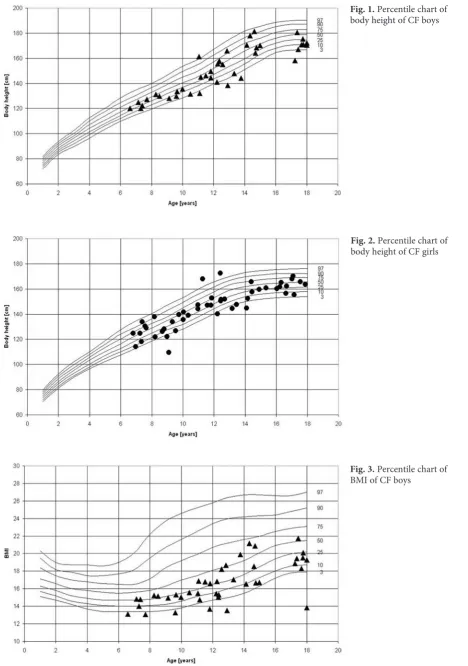
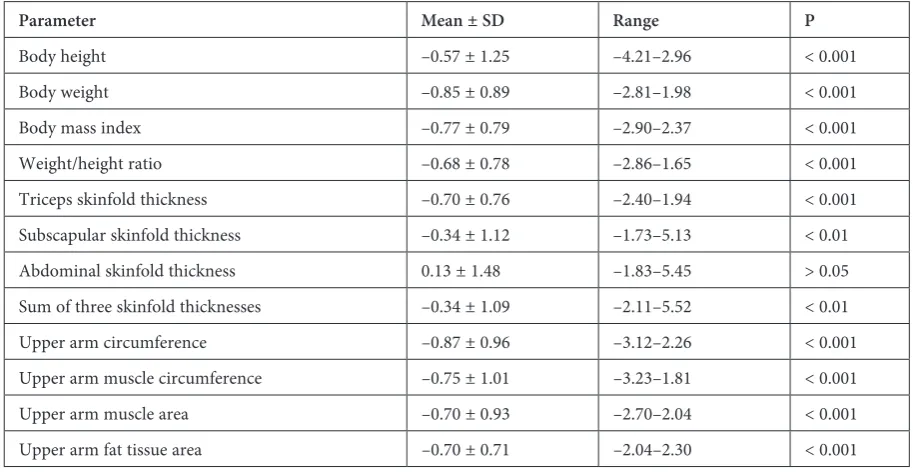
The mean standardized values for the anthro-pometric and spirometric parameters were calculat-ed using the values for the reference population (Ta-bles 1 and 2). All of the somatic traits, body mass indices, and body composition indicators differed significantly from the reference values, except for abdominal skinfold thickness. Mean weight, weight/ /height ratio and BMI were all significantly lower in the children than in the reference population. 33% of the children were undernourished, of which half were severely malnourished with a BMI less than the third percentile. One of the girls was obese with a BMI greater than the 97th percentile (Fig. 1–4).
In addition, the children studied were signif-icantly shorter than their healthy peers (Table 1). 11% were shorter than the third percentile. Pulmo-nary function parameters were significantly worse in undernourished individuals than in normally nourished ones (Table 3). There were no differ-ences in values for pulmonary function parame-ters between boys and girls (Table 2).
Deficits in body mass were related to both lim-ited body fat content and decreased development of lean body mass, or muscle tissue mass. This is indicated by the values for skinfold thickness, es-pecially the triceps and subscapular skinfold thick-ness, as well as upper arm circumference and up-per arm circumference without adipose tissue.
There was no significant relation between the type of CFTR mutation and prevalence of coloniza-tion by P. aeruginosa (χ2 = 6.203, df = 4, p = 0.184).
Fig. 1. Percentile chart of body height of CF boys
Fig. 2. Percentile chart of body height of CF girls
Fig. 4. Percentile chart of BMI of CF girls
Table 1. Anthropometric parameters in children and adolescents with cystic fibrosis, expressed in terms of standard
devia-tions away from the means of reference values for the population of Poland
Parameter Mean ± SD Range P
Body height –0.57 ± 1.25 –4.21–2.96 < 0.001 Body weight –0.85 ± 0.89 –2.81–1.98 < 0.001 Body mass index –0.77 ± 0.79 –2.90–2.37 < 0.001 Weight/height ratio –0.68 ± 0.78 –2.86–1.65 < 0.001 Triceps skinfold thickness –0.70 ± 0.76 –2.40–1.94 < 0.001 Subscapular skinfold thickness –0.34 ± 1.12 –1.73–5.13 < 0.01 Abdominal skinfold thickness 0.13 ± 1.48 –1.83–5.45 > 0.05 Sum of three skinfold thicknesses –0.34 ± 1.09 –2.11–5.52 < 0.01 Upper arm circumference –0.87 ± 0.96 –3.12–2.26 < 0.001 Upper arm muscle circumference –0.75 ± 1.01 –3.23–1.81 < 0.001 Upper arm muscle area –0.70 ± 0.93 –2.70–2.04 < 0.001 Upper arm fat tissue area –0.70 ± 0.71 –2.04–2.30 < 0.001
Table 2. Percent of predicted forced vital capacity (FVC), forced expiratory volume in one second (FEV1) and forced
expira-tory flow (FEF25-75), standardized for age and sex
Percent of predicted value Boys
(n = 41) Girls (n = 48) P value
FVC% 81.46 ± 19.32
(39 to 116) 80.71 ± 19.48(33 to 123) 0.866
a
FEV1% 79.91 ± 23.08
(31 to 114) 81.09 ± 23.67(32 to 119) 0.634
b
FEF25-75% 78.17 ± 37.81
(11 to 145) 68.54 ± 34.15(13 to 136) 0.307
b
nutritional status (Table 4). Negative val-ues for the beta coefficient indicate that the mean values for all of the somatic pa-rameters related to nutritional status con-sistently decreased with increasing prev-alence of colonization. Anthropometric parameters reflecting nutritional status and body tissue composition were strong-ly affected in colonized children, with the lowest values in chronically colonized chil-dren (Table 4, Fig. 5).
Table 3. Percent of predicted forced vital capacity (FVC), forced expiratory volume in one second (FEV1) and forced
expira-tory flow (FEF25-75) by nutritional status
Percent of predicted value Undernourished
(n = 29) Properly nourished and obese(n = 59 + 1) P value
FVC% 71.44 ± 19.68 85.43 ± 18.40 0.003a
FEV1% 69.04 ± 24.76 85.57 ± 21.13 0.006b
FEF25-75% 62.60 ± 38.82 78.63 ± 34.33 0.105b
a Student’s t-test. b Mann-Whitney test.
Table 4. Regression analysis for three selected factors related to the clinical picture of CF
Parameter Age at time
of diagnosisa Type of CFTR mutationb by Colonization P. aeruginosac
Beta p Beta p Beta p
Body height –0.211 0.0561 –0.006 0.9545 –0.216 0.0431 Body weight –0.058 0.5889 0.073 0.4904 –0.317 0.0031 Body Mass Index 0.077 0.4720 0.048 0.6511 –0.294 0.0059 Weight/height ratio 0.158 0.1468 0.065 0.5441 –0.211 0.0469 Triceps skinfold thickness –0.116 0.2746 –0.052 0.6164 –0.344 0.0012 Subscapular skinfold thickness 0.012 0.9125 0.005 0.9626 –0.215 0.0475 Abdominal skinfold thickness –0.118 0.2752 0.202 0.0607 –0.257 0.0151 Sum of three skinfold thicknesses –0.059 0.5843 –0.136 0.2098 –0.277 0.0100 Upper arm circumference 0.002 0.9876 –0.084 0.4217 –0.350 0.009 Upper arm muscle circumference 0.052 0.6296 –0.089 0.4048 –0.294 0.0059 Upper arm muscle area 0.066 0.5397 –0.076 0.4765 –0.286 0.0074 Upper arm fat tissue area –0.088 0.4012 –0.056 0.5945 –0.359 0.0007
a (more than 3 years old, 3 months to 3 years old, immediately after birth). b (F508del/F508del, F508del/Mt, Mt/Mt).
c (chronic colonization, intermittent colonization, no signs of colonization).
Discussion
Measurement of somatic traits and the indices calculated using them permit an accurate assess-ment of growth rate, nutritional status and body composition in children with CF. In the affected children in this study, nutritional status was more adversely affected than growth. Similar results were obtained in other studies conducted in the last ten years on children who were diagnosed and treated in clinics in Poland that specialize in treating pa-tients with CF [12, 22, 23]. Some researchers are of the opinion that the high prevalence of malnutri-tion in children with CF is largely because individ-uals with the most severe form of the disease are now surviving longer than ever before [24].
In the present study, 33% of the children with CF were underweight, whereas only about 1% were overweight. Malnutrition resulted in a thinning of the layer of subcutaneous adipose tissue and a re-duction in body musculature. Malnutrition was cor-related with worse results for FVC% and FEV1%.
Early effective nutritional intervention therefore significantly delays the development of pulmonary complications in children with CF. In one study, pulmonary function parameters and longer lifes-pan were correlated with body mass at age 4 [25]. In the present study, there was no correlation between the type of CFTR mutation and nutrition-al state. On the other hand, a previous study in Po-land found that nutritional status was significant-ly worse in children who were homozygous for CFTR mutation type than in heterozygous individ-uals. Children who were homozygous for F508del were diagnosed earlier than those who were ho-mozygous for other mutations [12]. Based on da-ta gathered by the CF Twin-Sibling Study and the Cystic Fibrosis Foundation Patient Registry in the United States, BMI is affected more by other genes on chromosomes 1 and 5 than by mutations in the CFTRgene, which is on chromosome 7 [26].
In the present study, physical development was most disordered in children with chronic re-spiratory tract colonization by P. aeruginosa, the most common respiratory tract pathogen in indi-viduals with CF. It is found in 20 to 40% of young children, and over 80% of adults with cystic fibro-sis [27]. Numerous studies have examined the ef-fect of colonization by P. aeruginosa on the clini-cal picture of individuals with cystic fibrosis. These studies revealed a rapid drop in FEV1 and a
wors-ened state of the respiratory system as revealed by radiography in both children and adults [28, 29]. Other findings include more frequent hospitaliza-tion, increased risk of death, and shorter surviv-al time in colonized individusurviv-als than in non-colo-nized individuals with cystic fibrosis [30].
In the present study, colonization of the respi-ratory tract by P. aeruginosa was correlated with a large deficit in nutritional status in the children examined, especially in those with chronic coloni-zation. This was associated with a deficit in both adipose and muscle tissue. The results of stud-ies on the effect of colonization of the respiratory tract by P. aeruginosa on somatic development are, however, conflicting.
In a longitudinal study monitoring physical development in 139 children with CF from birth to age 19, colonization had no detectable effect on growth rate, but chronic infection caused a marked worsening in nutritional status [9].
In another long-term study on growth rate in about 200 children with CF, the growth rate was significant lower in children with chronic infection than in children without colonization of the respi-ratory tract by P. aeruginosa. The growth rate was 5.63 cm/yr in chronically infected children, and 6.96 cm/yr in uncolonized children [28]. The au-thors of that study observed, however, that most of the children with CF they examined, regardless of infection status, developed within the norm for the health population as far as body height and body mass were concerned.
In a preliminary study on children in a screen-ing program for CF, neither body height nor body mass up to age 7 differed significantly between those children with chronic infection by P. aerugi-nosa and uncolonized children [30].
A study on estimating body composition and resting energy expenditure (REE) in children with CF did not reveal any differences in the mean val-ues for basic anthropometric parameters between colonized and uncolonized children [31]. These authors carried out an additional examination of body composition using dual-energy X-ray ab-sorptiometry, which showed that chronic infection caused a marked drop in lean body mass (LBM) that could not be detected by analyzing indicators based on weight and height measurements.
In a study from Chile, on the other hand, REE and body composition in children with CF with a stable clinical picture without chronic respira-tory infection was comparable to that in healthy children [32]. This is consistent with the results of the present study, in which the least disturbance of growth and nutritional status during the course of the disease was found in uncolonized children.
inadequate oral intake, and a severe alteration in digestion, which causes a reduction in lean body mass, especially in the extremities [31, 33]. When chronic infection of the respiratory tract by
P. aeruginosa is present, the energy cost of main-taining life processes increases to the point that there is not enough energy left over for normal childhood development.
The authors concluded that the present study on a population of children and young people with CF indicates that somatic development is greatly disordered in children with CF as compared to de-velopment in healthy children. The results show
that, in the children examined, nutritional status is more adversely affected than growth.
Of the factors related to the clinical picture of the disease, only the presence of respiratory tract colonization by P. aeruginosa had an effect on phys-ical development in the children examined. Neither the type of mutation present nor age at diagnosis had any significant effect. Chronic colonization in-terfered with growth and markedly worsened nu-tritional status, and was also associated with re-ductions in both total and lean body mass. Early nutritional intervention can improve nutritional state and pulmonary function in children with CF.
Acknowledgements. The authors are very grateful to the children and their parents for their patient cooperation in this study.
References
[1] Sobczyńska-Tomaszewska A, Ołtarzewski M, Czerska K, Wertheim-Tysarowska, Sands D, Walkowiak J, Bal A, Mazurczak T, and the NBS CF working group: Newborn screening for cystic fibrosis: Polish 4 years’ experience with CFTR sequencing strategy. Eur J Hum Genet 2013, 21, 391–396.
[2] www.genet.sickkids.on.ca/Home.html
[3] Pencharz P, Durie P: Pathogenesis of malnutrition in cystic fibrosis, and its treatment.Clin Nutr 2000, 19, 387–394. [4] Sharma R, Florea V, Bolger A, Doehner W, Florea N, Coats A, Hodson M, Anker S, Henein M: Wasting as
a independent predictor of mortality in patients with cystic fibrosis. Thorax 2001, 56, 746–750.
[5] Zemel BS, Jawad AF, FitzSimmons S, Stallings VA: Longitudinal relationship among growth, nutritional status, and pulmonary function in children with cystic fibrosis: Analysis of the Cystic Fibrosis Foundation National CF Patient Registry. J Pediatr 2000, 137, 374–380.
[6] Konstan M, Butler S, Wohl M, Stoddard M, Matousek R, Wagner J, Johnston CH, Morgan J: Growth and nutri-tional indexes in early life predict pulmonary function in cystic fibrosis. J Pediatr 2003, 142, 624–630.
[7] Hirche TO, Hirche H, Jongblut S, Stern M, Wagner TO, Wiedermann B. on behalf of the German CFQA Group: Statistical limitations of percent ideal body weight as measure for nutritional failure in patients with cystic fibrosis. J Cyst Fibros 2009, 8, 238–244.
[8] King SJ, Nyulasi IB, Strauss BJG, Kotsimbos T, Bailey M, Wilson J: Fat-free mass depletion in cystic fibrosis: Associated with lung disease severity but poorly detected by body mass index. Nutrition 2010, 26, 753–759. [9] Haeusler G, Frisch H, Waldhor T, Gotz M: Perspectives of longitudinal growth in cystic fibrosis from birth to
adult age. Eur J Pediatr 1994, 153, 158–163.
[10] Groeneweg M, Tan S, Boot AM, de Jongste JC, Bouquet J, Sinaasappel M: Assessment of nutritional status in children with cystic fibrosis: conventional anthropometry and bioelectrical impedance analysis. A cross-sectional study in Dutch patients. J Cyst Fibros 2002, 1, 276–280.
[11] Schechter MS, Shelton BJ, Margolis PA, Fitzsimmons SC: The association of socioeconomic status with out-comes in cystic fibrosis patients in the United States. Am J Respir Crit Care Med 2001, 163, 1331–1337.
[12] Umławska W, Susanne CH: Growth and nutritional status in children and adolescents with cystic fibrosis. Ann Hum Biol 2008, 35, 145–153.
[13] Geborek A, Hjelte L: Association between genotype and pulmonary phenotype in cystic fibrosis patients with severe mutation. J Cyst Fibr 2011, 10, 187–192.
[14] Pittman J, Calloway E, Kiser M, Yeatts J, Davis S, Drumm M, Schechter M, Leigh M, Emond M, Van Rie A, Knowles M: Age of Pseudomonas aeruginosa acquisition and subsequent severity of cystic fibrosis lung disease. Pediatr Pulmonol 2011, 46, 497–504.
[15] McKone E, Emerson ST, Edwards K, Aitken M: Effect of genotype on phenotype and mortality in cystic fibrosis: a retrospective cohort study. Lancet 2003, 361, 1671–1676.
[16] Kerem E, Conway S, Elborn S, Heijerman H: Standards of care for patients with cystic fibrosis: A European Consensus. J Cyst Fibros 2005, 4, 7–26.
[17] Martin R, KnusmannR: Anthropologie. Handbuch der vergleichenden. Biologie des Menschen. Vol. 1. Gustav Fischer, Stuttgart, New York 1988.
[18] Palczewska I, Niedźwiedzka Z: Wskaźniki rozwoju somatycznego dzieci i młodzieży warszawskiej. Med Wieku Rozwoj 2001, 5, 19–55.
[19] Lee T, Brownlee K, Conway S, Denton M, Littlewood J: Evaluation of a new definition for chronic Pseudomonas aeruginosa infection in cystic fibrosis patients. J Cyst Fibros 2003, 2, 29–34.
[21] Willim G, Kurzawa R, Mazurek H, Hałuszka J, Jedrys-Kłucjasz U, Baran B, Radliński J: Wartości należne wskaźników oddechowych dzieci i młodzieży. IGiChP Oddział w Rabce, 1–62, 1998.
[22] Kosińska M, Szwed A, Cieślik J, Goździk J, Karbowy K: Assessment of the biological condition and nutritional status of adult patients with cystic fibrosis. Anthropol Rev 2005, 68, 53–64.
[23] Umławska W, Rams M: Physical development and pulmonary function in children and adolescents treated at two cystic fibrosis treatment centers in Poland. Arch Med Sci 2009, 5, 586–588.
[24] McNaughton SA, Stormont DA, Sheperd RW, Francis PWJ, Dean B: Growth failure in cystic fibrosis. J Pediatr Child Health 1999, 5, 86–92.
[25] Yen EH, Quinton H, Borowitz D: Better nutritional status in early childhood is associated with improved clinical outcomes and survival in patients with cystic fibrosis. J Pediatr 2013, 162, 530–535.
[26] Bradley GM, Blackman SM, Watson CP, Doshi VK, Cutting GR: Genetic modifiers of nutritional status in cystic fibrosis. Am J Clin Nutr 2012, 96, 299–308.
[27] Fitzsimmons SC: The changing epidemiology of cystic fibrosis. J Pediatr 1993, 122, 1–9.
[28] Pamukcu A, Bush A, Buchdahl R: Effects of Pseudomonas aeruginosa colonization on lung function and anthro-pometric variables in children with cystic fibrosis. Pediatr Pulmonol 1995, 19, 10–15.
[29] Kosorok MR, Zeng L, West SE, Rock MJ, Splaingard ML, Laxova A, Green CG, Collins J, Farrell PM: Acceleration of lung disease in children with cystic fibrosis after Pseudomonas aeruginosa acquisition. Pediatr Pulmonol 2001, 32, 277–287.
[30] Nixon GM, Armstrong DS, Corzino R, Olinsky A, Robertson CF, Grimwood K: Clinical outcome after early
Pseudomonas aeruginosa infection in cystic fibrosis. J Pediatr 2001, 158, 699–704.
[31] Vinton NE, Padman R, Davis M, Harcke HT: Effects of Pseudomonas colonization on body composition and resting energy expenditure in children with cystic fibrosis. J Parenter Enteral Nutr 1999, 23, 233–236.
[32] Marin VB, Velandia S, Hunter B, Gattas V, Fielbaum O, Herrera O, Diaz E: Energy expenditure, nutritional status, and body composition in children with cystic fibrosis. Nutrition 2004, 20, 181–186.
[33] Bolton CE, Ionescu AA, Evans WD, Pettit RJ, Shale DJ: Altered tissue distribution in adults with cystic fibrosis. Thorax 2003, 5, 885–889.
Address for correspondence:
Wioleta UmławskaDepartment of Human Biology University of Wroclaw Kuźnicza 35
50-138 Wrocław Poland
Tel.: 48 71 375 22 84
E-mail: [email protected]
Conflict of interest: None declared