Włodzimierz Więckiewicz
1, A, B, E, F, Jacek Kasperski
2, A–C,
Mieszko Więckiewicz
3, C–F, Marta Miernik
1, C–F, Wojciech Król
4, A, C, D, FThe Adhesion of Modern Soft Relining Materials
to Acrylic Dentures*
1 Department of Dental Prosthetics, Wroclaw Medical University, Poland
2 Department of Dental Prosthetics in Zabrze, Medical University of Silesia in Katowice, Poland 3 Division of Dental Materials, Wroclaw Medical University, Poland
4 Department of Microbiology and Immunology in Zabrze, Medical University of Silesia in Katowice, Poland
A – research concept and design; B – collection and/or assembly of data; C – data analysis and interpretation;
D – writing the article; E – critical revision of the article; F – final approval of article; G – other
Abstract
Background. Silicone-based liners are widespread materials in prosthetic dentistry. Their mechanical properties have to meet several key requirements such as adequate adhesion to denture base polymers in order to provide right function of masticatory system and oral hygiene.
Objectives. The aim of this paper was to evaluate and compare tensile and shear bond strengths values of three modern autopolimeryzed silicone relining materials bonded to acrylic plates.
Material and Methods. Three silicone-based soft relining materials were investigated in this study (A-Soft Line 30, Bosworth Dentusil and Elite Super Soft). A total of 78 specimens were prepared: 13 of each material (total: 39) for testing tensile bond strength and 13 of each material for testing shear bond strength (total: 39). The obtained data were analyzed statistically.
Results. The average tensile bond strength results were 0.86 MPa for Bosworth Dentusil, 1.00 MPa for Elite Super Soft and 1.25 MPa for A-Soft Line 30. The silicone-based relining materials had different average values of shear bond strength: 0.67 MPa Elite Super Soft; 1.32 MPa A-Soft Line 30 and 1.57 MPa Bosworth Dentusil.
Conclusions. As the result of the study it can be concluded that all tested materials have acceptable adhesion values to acrylic resin. According to tensile and shear bond strengths tests the best adhesive properties has A-Soft Line 30 (Adv Clin Exp Med 2014, 23, 4, 621–625).
Key words: soft relining materials, silicone elastomers, adhesion, acrylic dentures.
Adv Clin Exp Med 2014, 23, 4, 621–625 ISSN 1899–5276
ORIGINAL PAPERS
© Copyright by Wroclaw Medical University
Soft lining materials play a major role in pros-thetic dentistry. The viscoelastic properties of den-ture liners reduce and redistribute the functional load over the denture-bearing area. The indica-tions for denture lining are mucosal discomfort and chronic soreness that may be caused by bony irregularities, occlusal problems and reduced ke-ratinization of the epithelium. Soft liners are also used for obturators after maxillofacial surgery or to increase retention in cases of bilateral undercuts [1, 2]. In addition to viscoelasticity, there are sev-eral other requirements for soft liners, including
high dimensional stability, color stability, tear re-sistance, biocompatibility with oral tissue and good adhesion to the denture base [3–9].
There are two types of commercial soft lin-ers: those based on acrylic resin and those based on silicone elastomers [10]. In the oral cavity envi-ronment, silicone liners are more resistant to dis-tortion, hardening and debonding from the den-ture base than acrylic liners [11–13]. However, the most common reason for the failure of silicone elastomers under clinical conditions is a loss of ad-hesion to acrylic resin. It is therefore crucial to
vestigate the adhesive properties of silicone lining materials.
The purpose of this paper was to judge the ad-hesion of three modern silicone lining materials to denture base polymers. Their tensile bond strength and shear bond strength were measured 24 hours after the preparation of specimens.
Material and Methods
Three silicone-based soft lining materials were investigated in this study (Table 1). A total of 78 spec-imens were prepared: 13 of each material for testing tensile bond strength (total: 39) and 13 of each mate-rial for testing shear bond strength (total: 39).
The specimens for the tensile bond strength test had two parts: acrylic and silicone, both cylin-drical in shape (20 mm long; 4 mm in diameter), which were bonded to each other by the adhesive agent recommended by the manufacturer of the silicone material. The specimens for shear bond strength test also consisted of two parts: a silicone cylinder (5 mm long; 4 mm in diameter), bonded centrally by their base to a rectangular acrylic plate (20 mm long; 10 mm wide) using the adhesive agent recommended by the manufacturer of the silicone material. All the materials were processed according to the manufacturers’ instructions and were stored in distilled water at room temperature for 24 h before testing.
Both the tensile bond strength tests and shear bond strength tests of the adhesion of the silicone-based lining materials to acrylic resin were car-ried out in a Hounsfield H5KS universal testing machine (Tinius Olsen, Salfords, England; model HTE S/N D83281) at a crosshead speed of 5.0 mm/ /min until the specimen failed.
The descriptive data are presented as mean values. The results were analyzed with a two-way analysis of variance (ANOVA). The post hoc Fisher test (NIR) was also used to compare the adhesion of the relining materials to the denture base polymer. Statistical significance was set at p ≤ 0.05. An anal-ysis of the distribution of the volatility measure-ments in the three groups using the Shapiro-Wilk test showed that they are no dfifferent from nor-mal distribution. Levene’s test was used to assess
the homogeneity of the variance measurements; it showed that there are no grounds for regarding the variance in the three groups as heterogeneous. All the statistical analyses were done using STATISTI-CA Version 10 software (Statsoft Inc., Tulsa, Okla-homa, USA).
Results
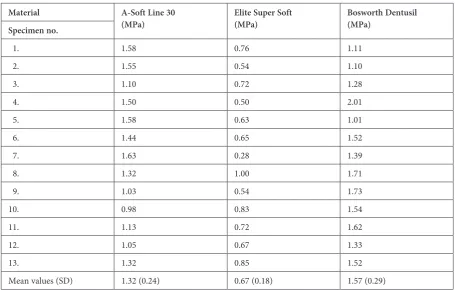
The tensile bond strength in MPa of the tested materials was calculated by dividing the load (uni-axial tension) by the specimen’s acrylic-silicone ad-hesive area. The shear bond strength was calculat-ed the same way. Tensile and shear bond strength tests result for each sample and the average values are shown in Table 2 and Table 3, respectively.
The average tensile bond strength results were 0.86 MPa for Bosworth Dentusil, 1.00 MPa for Elite Super Soft and 1.25 MPa for A-Soft Line 30. The two-way ANOVA analysis showed significant differences between those values [F: (2.36) = 4.18; p = 0.02]. The post hoc Fisher analysis showed that the tensile bond strength of A-Soft Line 30 is signif-icantly higher than Bosworth Dentusil (p = 0.008). The average values of A-Soft Line 30 and Elite Su-per Soft did not differ significantly. There is also no significant difference between Elite Super Soft and Bosworth Dentusil. The results of a compari-son of the mean values for tensile bond strength are presented graphically in Fig. 1.
Table 1. Materials used in the study
Material Lot number Manufacturer
A-Soft Line 30 6505853 S&C Polimer GmbH, Elmshorn, Germany Bosworth Dentusil 0609PR759 Bosworth Company, Skokie, Illinois, USA Elite Super Soft C700110 Zhermack, Badia Polesine, Italy
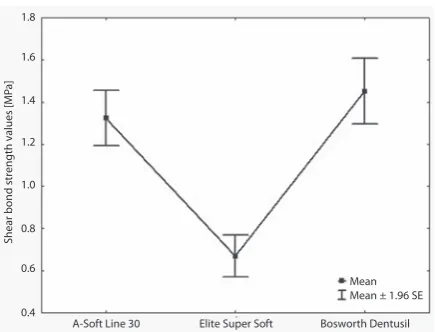
The silicone-based relining materials had dif-ferent average values of shear bond strength: 0.67 MPa Elite Super Soft; 1.32 MPa A-Soft Line 30 and 1.57 MPa Bosworth Dentusil. The ANOVA anal-ysis showed that the average shear bond strength of the tested relining materials differ significantly
[F: (2.36) = 39.91; p < 0.0001]. According to the
post hoc Fisher analysis, the average value for Elite Super Soft was significantly lower than the aver-age values for A-Soft Line 30 and Bosworth Den-tusil (p < 0.0001). It was also confirmed that there is no significant difference in shear bond strength
Table 2. Tensile bond strength values of soft relining materials
Material A-Soft Line 30
(MPa) Elite Super Soft(MPa) Bosworth Dentusil(MPa) Specimen no.
1. 0.96 0.76 1.43
2. 0.93 1.19 0.77
3. 1.93 1.00 0.12
4. 1.55 0.65 0.91
5. 0.74 1.23 1.43
6. 1.48 1.44 1.47
7. 1.10 1.13 0.52
8. 1.69 1.08 0.75
9. 1.40 0.87 0.44
10. 0.74 0.97 1.01
11. 1.48 0.78 0.71
12. 1.48 0.68 1.14
13. 0.83 0.83 0.45
Mean values (SD) 1.25 (0.39) 1.00 (0.24) 0.86 (0.42)
Table 3. Shear bond strength values of soft relining materials
Material A-Soft Line 30
(MPa) Elite Super Soft(MPa) Bosworth Dentusil(MPa) Specimen no.
1. 1.58 0.76 1.11
2. 1.55 0.54 1.10
3. 1.10 0.72 1.28
4. 1.50 0.50 2.01
5. 1.58 0.63 1.01
6. 1.44 0.65 1.52
7. 1.63 0.28 1.39
8. 1.32 1.00 1.71
9. 1.03 0.54 1.73
10. 0.98 0.83 1.54
11. 1.13 0.72 1.62
12. 1.05 0.67 1.33
13. 1.32 0.85 1.52
values between A-Soft Line 30 and Bosworth Den-tusil. A graphic presentation of a comparison of the mean values for shear bond strength is pre-sented in Fig. 2.
Discussion
The mechanical properties of relining materi-als have an influence on their usage. A crucial issue is the quality of adhesion of soft lining materials to denture base polymers, which can be evaluat-ed by testing tensile bond strength and shear bond strength [14–16]. During use or brushing the den-ture surface, tensile and shear loading may lead to separation of the liner from the denture base. As a result, the denture becomes unhygienic and non-functional [17]. Besides direct mechanical forc-es, the adhesion of silicone liners can be reduced by temperature, the oral environment or solu-tions used for cleaning dentures [14, 18, 19]. In this study, tensile bond strength and shear bond strength were measured after a 24-h storage period
in distilled water, which, according to research by Al-Athel et al., does not change the values of pri-mary adhesion [18].
Kawano et al. claimed that the lowest tensile bond strength value should be 0.96 MPa [20]. Com-paring the tensile bond strengths of the three sili-cone liners in the current study to this minimally ac-ceptable value, only Bosworth Dentusil did not have the proper bond strength. Under clinical conditions, shear bond strength is more critical than tensile bond strength, as the distribution of functional forc-es includforc-es mostly shear loading. The A-Soft Line 30 and Bosworth Dentusil silicone liners had great-er shear bond strength than tensile bond strength, which is a clinically positive prognostic factor. In contrast, the Elite Super Soft liner has lower shear bond strength than tensile bond strength, which agrees with the results of Elias et al. [14].
The present study concentrated on autopoly-merized silicone lining materials, as these are the most frequently used liners because of their me-chanical properties and easy usage. It is important to note that there is still no perfect soft lining mate-rial that meets all the key requirements. The adhe-sive and other mechanical properties of commer-cialy available silicone liners should be regulary checked in order to assure the best quality of func-tion and hygiene of relined dentures.
The following conclusions can be drawn: 1. All three of the tested silicone relining ma-terials gave satisfactory results and can be recom-mended for clinical use.
2. A-Soft Line 30 has the best average tensile bond strength of the three silicone relining mate-rials investigated.
3. Bosworth Dentusil has the best average shear bond strength of the three silicone relining materials investigated.
4. According to the tensile bond strength and shear bond strength tests carried out, A-Soft Line 30 has the best adhesive properties.
Fig. 2. Comparison of shear bond strength mean val-ues for the tested relining materials
A-Soft Line 30 1.8
1.6
1.4
1.2
1.0
0.8
0.6
0.4
Shear bond strength values [MP
a]
Elite Super Soft Bosworth Dentusil Mean Mean ± 1.96 SE
References
[1] Braden M, Wright PS, Parker S: Soft lining materials – a review. Eur J Prosthodont Restor Dent 1995, 3, 4, 163–174.
[2] Qudah S, Harrison A, Huggett R: Soft lining materials in prosthetic dentistry: A review. Int J Prosthodont 1990, 3, 5, 477–483.
[3] Santawisuk W, Kanchanavasita W, Sirisinha C, Harnirattisai C: Dynamic viscoelastic properties of experimental silicone soft lining materials. Dent Mater J 2010, 29, 4, 454–460.
[4] Kasuga Y, Takahashi H, Akiba N, Minakuchi S, Matsushita N, Hashimoto M: Basic evaluation on physical properties of experimental fluorinated soft lining materials. Dent Mater J 2011, 30, 1, 45–51.
[5] Mante FK, Mante MO, Petropolous VC:In Vitro Changes in Hardness of Sealed Resilient Lining Materials on Immersion in Various Fluids. J Prosthodont 2008, 17, 5, 384–391.
[6] Ergun G, Nagas IC: Color stability of silicone or acrylic denture liners: An in vitro investigation. Eur J Dent 2007, 1, 3, 2007, 144–151.
[8] Dinckal Yanikoglu N, Denizoglu S: An Investigation of the Tear Energy of Five Soft Lining Materials. Dent Mater J 2003, 22, 4, 444–451.
[9] Dahl JE, Frangou-Polyzois MJ, Polyzois GL:In vitro biocompatibility of denture relining materials. Gerodontology 2006, 23, 1, 17–22.
[10] Murata H, Hamada T, Sadamori S: Relationship between viscoelastic properties of soft denture liners and clinical efficacy. Jpn Dent Sci Rev 2008, 44, 2, 128–132.
[11] Kawano F, Dootz ER, Koran A, Craig RG: Sorption and solubility of 12 soft denture liners. J Prosthet Dent 1994, 72, 4, 393–398.
[12] El-Hadary A, Drummond JL: Comparative study of water sorption, solubility, and tensile bond strenght of two lining materials. J Prosthet Dent 2000, 83, 3, 356–361.
[13] Murata H., Taguchi N, Hamada T, Mccabe JF: Dynamic viscoelastic properties and the age changes of long-term soft denture liners. Biomaterials 2000,21, 14, 1421–1427.
[14] Elias CN, Henriques FQ: Effect of thermocycling on the tensile and shear bond strengths of three soft liners to a denture base resin. J Appl Oral Sci 2007, 15, 1, 18–23.
[15] Mutluay MM, Ruyter IE: Evaluation of bond strength of soft relining materials to denture base polymers. Dent Mater 2007, 23, 11, 1373–1381.
[16] Mese A, Güzel KG, Uysal E: Effect of storage duration on tensile bond strength of acrylic or silicone-based soft denture liners to a processed denture base polymer. Acta Odontol Scand 2005, 63, 1, 31–35.
[17] Wright PS:A three year longitudinal study of denture soft lining materials in clinical use. Clin Mater 1986,1, 281–291.
[18] Al-Athel M, Jagger R, Jagger D: Effect of ageing on the bond strength of a permanent denture soft lining material. J Oral Rehabil 2002, 29, 10, 992–996.
[19] Yanikoglu N, Denizoglu S: The effect of different solutions on the bond strength of soft lining materials to acrylic resin. Dent Mater J 2006, 25, 1, 39–44.
[20] Kawano F, Dootz ER, Koran A, Craig RG: Comparison of bond strength of six soft denture liners to denture base resin. J Prosthet Dent 1992, 68, 2, 368–371.
Addres for correspondence:
Mieszko Więckiewicz Division of Dental Materials Wroclaw Medical University Krakowska 26
50-425 Wrocław Poland
Tel.: +48 660 47 87 59
E-mail: [email protected]
Conflict of interest: None declared