AUT Journal of Civil Engineering
AUT J. Civil Eng., 1(2) (2017) 121-128 DOI: 10.22060/ceej.2017.12346.5180
A Robust Optimization Model for Improving Reliability of Tuned Mass Damper
Mohsen Balanian, Maryam Daei*, Hossein Tajmir RiahiDepartment of Civil Engineering, University of Isfahan, Isfahan, Iran
ABSTRACT:One of the most promising and effective passive vibration control dampers is the Tuned Mass Damper (TMD). Many conventional optimization criteria are based on the implicit assumption that all parameters involved are deterministically known. Removing this assumption means to convert a conventional optimization into a robust one. In this paper, a model for the robust optimum design of TMD is provided so that the optimal design of damper by considering the uncertainties possible in the earthquake load and also the structure properties can be achieved. The structural vibration control of the main system with a single linear TMD under a stochastic dynamic load is investigated. The dynamic input is represented by a random base acceleration, modeled by a stationary filtered white noise process. It is assumed that not only mechanical parameters of the main structure but also the input spectral contents are affected by uncertainty. The standard deviation of displacement of the protected main structure (dimensionless by dividing to the unprotected one) is calculated as the deterministic objective function (OF), and to achieve a robust design the mean and standard deviation of OF are considered as a multi-objective function which shall be minimum. The damping ratio and the frequency of TMD have been selected as design parameters. The results provide the different choices for designers to select an optimal TMD based on the priority of minimum mean of the maximum displacement of the structure or the minimum dispersion in a random space.
Review History: Received: 4 January 2017 Revised: 8 March 2017 Accepted: 24 July 2017 Available Online: 1 August 2017
Keywords: Tuned Mass Damper State Space Equation Passive control Uncertainty Robust Optimization
121 1- Introduction
Iran is one of the most seismically active countries in the world, hence the safe and economical design of structures against earthquake is the most important task of civil engineers. Lateral forces that are generated in a structure due to dynamic factors such as wind and earthquake are the functions of structural dynamic characteristics such as stiffness, damping coefficient and natural frequency of vibration.
There are two different strategies to design structures resistant to lateral forces caused by the earthquake: 1) A ductile design; so that under severe earthquakes, structural elements undergo significant deformations and will dissipate earthquake energy through non-linear behavior. 2) Increasing the structural damping by using mechanical damper devices and dissipation of seismic energy without causing significant damage to structural components. Recently the second type of design has been considered much more by engineers, because in this case, instead of energy dissipation due to the effect of deformation (damage) in members, the energy will dissipate due to the effect of damper vibration. In recent years, the use of dampers for structural vibration control has received a great deal of attention, while finding the optimal design of damper is an important issue to improve its performance [1]. Tuned mass damper (TMD) is one of the most reliable means of structural control that is known as a passive system since all of its characteristics remain constant during vibration. TMD is mounted in the structure to reduce the amplitude of mechanical vibrations. Its application can prevent discomfort,
damage, or a sudden collapse in the structure. TMD can be incorporated into an existing structure with less interference compared with others [2]. Mass dampers adjustable control devices are applied successfully in some structures such as tall buildings and bridges with large spans. The most famous structures equipped with this technology are the 535-meter CN tower in Canada, 60-story Jen Hancock tower in Boston, Centre Point tower in Sydney and Taipei in Taiwan [3]. In the design of TMD, standard approaches are based on the implicit assumption that all system parameters are deterministically known quantities. By removing these assumptions, a robust optimum design criterion for TMD should be developed, where robustness is obtained by finding solutions which are less sensitive to the variation of system parameters and also it improves the structural performance (reduction of displacement, increase energy absorption, etc.) [4, 5].
The first research in the random vibration effects in the structural optimization was proposed by Nigam [6]. In which the OF of the model is defined as the ratio between the root mean squares of maximum displacements for the protected and the unprotected systems. It is noticeable that mentioned OF has been used in several recent studies [1, 4, 7].
A method based on genetic algorithm for the robust optimal design of TMD examined the performance of optimal TMD from two perspectives of displacement and energy. By mounting the optimal TMD in the single degree of freedom concluded that two mentioned measures could be significantly improved using appropriate TMD [8]. In another study a model for the optimal reliable design of TMD under bounded
uncertainty parameters is proposed. In this research the first-passage probability of failure of the system was taken as the OF [9-11]. By comparing three different OF in the process of designing a TMD, such as structural displacement standard deviation, the hysteretic dissipated energy of a protected building and a functional damage concluded that the application of a TMD system reduces the amount of the hysteretic dissipated energy [12]. In the other method of optimum design, TMD developed two different optimizations criteria to minimize the main system displacement standard deviation or the inertial acceleration standard deviation with consideration mass, stiffness and damping of TMD as design variables. As a result, all solutions obtained considering also the mass of the TMD as design variable are more efficient if compared with those obtained without it [7]. Marano [13] further presented a comparative study between the conventional and the robust optimal design of a TMD under system parameter uncertainties.
Generally about robust optimal design, in conventional procedures, the optimization aims to minimize only a deterministic objective functions. If the uncertainty in the system parameters can significantly affect the performance of the system, then one option for the robust optimization is to minimize both mean value and the standard deviation of the objective function [14].
In this study, an optimal design model of the tuned mass damper and the structural vibration control of the main system subject to a stochastic dynamic load with a single linear TMD is investigated while the possible uncertainty in the earthquake load and structural parameters are considered. The dynamic input is represented by a random base acceleration, modeled by a stationary filtered white noise process. According to
what was mentioned in the literature, at first, the ratio between standard deviation (root mean squares) of displacement of the protected main system and unprotected one is adopted as the deterministic objective function (OF). And then to consider structural parameters uncertainty, a new multi-objective optimization model is defined to achieve robust optimal design. In the multi-objective model, the mean and standard deviation of the previous OF are optimized, and the Pareto frontier is plotted. The damping and frequency of the tuned mass damper have been selected as design parameters. This work is organized as follows. In section 2, structural model and motion equations are briefly introduced. In section 3, conventional and robust optimum design model proposed for TMD subject to random vibration are presented. The particle swarm optimization algorithm is investigated and demonstrated in section 4. In section 5 a numerical example is presented. At last, summary and important conclusions are presented section 6.
2- Description of analytical model
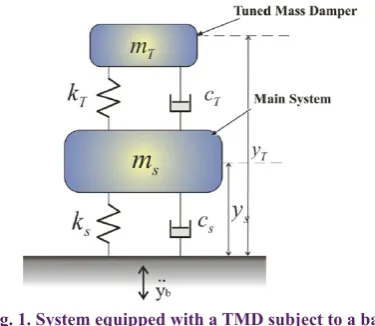
A TMD is comprised of a mass that is connected to the structure by a spring and a dashpot in parallel [15], as shown in Figure 1, such that it oscillates with the same frequency as the system predominant frequency, but with a phase shift. In civil engineering applications, the main system could be a building, a bridge or an offshore platform, and the use of a TMD is intended for reducing wind, earthquake or wave-induced vibrations, respectively.
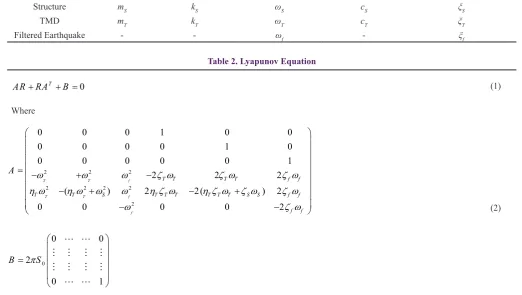
In case of a TMD system excited by a base acceleration, the structural response is determined by solving the dynamic equilibrium system equations [16]:
0 T
AR RA+ + =B (1)
Where
2 2 2
2 2 2 2
2
0
0 0 0 1 0 0
0 0 0 0 1 0
0 0 0 0 0 1
2 2 2
( ) 2 2( ) 2
0 0 0 0 2
0 0
2
0 1
T T f
T T f
f
T T T T f f
T T S T T T T T T S S f f
f f A
B S
ω ω ω ζ ω ζ ω ζ ω
η ω η ω ω ω η ζ ω η ζ ω ζ ω ζ ω
ω ζ ω
π
= − + −
− + − +
− −
=
(2)
Table 2. Lyapunov Equation
Parameters Mass Stiffness Frequency Damping Damping Coefficient
Structure mS kS ωS cS ξS
TMD mT kT ωT cT ξT
Filtered Earthquake - - ωf - ξf
Mohsen Balanian et al., AUT J. Civil Eng., 1(2) (2017) 121-128, DOI: 10.22060/ceej.2017.12346.5180
123
0
T
AR RA+ + =B (3)
Where Y(t)=(ys , yT)T is the relative base displacement vector,
and M, C and K are the mass, damping and stiffness symmetric matrices, respectively.
Introducing the state space vector:
.. .
Y(t) (t) KY(t) y (t)b
M +CY + =r (4)
system equation could be replaced by:
(t) A (t) (t)
s s s z b
Z = Z +r y (5)
where the structural system matrix is:
0 s K C I A H H =
(6)
and rz = (0 , 0 , 1 , 1)T , I and 0 the unit and zero 2x2 matrices,
respectively, and:
2 2
1
2 ( 2 2)
T T
K
T T S
H M K ω ω
ηω ηω ω
− − +
= = − − +
(7)
1 2 2
2 T T 2( T T )
C
T T T T S S
H =M C− −ηζ ωζ ω ηζ ω+ ζ ωζ ω
= − − +
(8)
where the system mechanical parameters are:
2 2
S T T
S T T
S T S
S S
S S
S S S S
k k m
m m m
c c
m k m k
ω ω η
ζ ζ
= = =
= = (9)
In these equations, the subtitles of S and T are earmarked for main structure and TMD, respectively. The k, m and c
parameters are used to show stiffness, mass and damping, respectively. Based on these parameters, ω, ξ and η are calculated which are fundamental frequency, damping ratio and mass ratio, respectively. All these parameters are shown in Table 1. It should be noted that the TMD parameters (ωT and ξT) are design parameters and must be determined from
the process optimization.
The state space covariance matrix R is then obtained as a solution of the Lyapunov equation [17], which in this case is represented by a 6×6 matrix given in Table 2.
The solution of Lyapunov equation gives the system displacements, velocities, accelerations and forces. These are the quantities that historically have been of most interest in evaluating the response of structures subjected to seismic actions [18].
S0 is power spectral density intensity of white excitation at the bedrock. The response covariance of unprotected main structure can be calculated by 4×4 R0 matrix in the same way as below:
0 0 0 0T 0 0
A R +R A +B = (10)
where system matrix is
2 2 0
2
0 0 1 0
0 0 0 1
2 2
0 0 2
S f S S f f
f f f
A ω ω ζ ω ζ ω
ω ζ ω
= − − − − (11)
The 4×4 B0 matrix has null elements except in the last array of the main diameter. The non-zero array is as below:
0 4,4 0
[ ]B =2πS (12)
3- Optimum design of TMD
Two possible approaches can be performed to solve the structural optimization problem.
1. Conventional optimization: In which only the loads considered are affected by uncertainty.
2. Robust optimization: In addition to the assumptions of the conventional optimization, the system parameters are uncertain, as well.
Application of these two different approaches in the optimal design of TMD is explained in the following:
3- 1- Conventional optimization
In this case of optimization, the design variables are mechanical parameters of TMD. Therefore there is a two-dimensional design vector (DV) as follows:
( , )T T T
DV b= = ω ζ (13)
In earthquake engineering, generally, the maximum displacement of the upper floor is considered as an index to evaluate improved structural response. It should be noted that the maximum response occurs at a single moment, therefore other criteria should be used. This criterion is a standard deviation or root mean square (RMS) of maximum displacement that is defined as follows:
2 1 S n i i X X n
σ =
∑
= (14)In Equation 14, n is the number of time steps in that range where the structural response is measured and Xi is a structural response at the ith time.
The standard deviation of maximum displacement of the protected structure is the criteria of optimality. To Fig. 1. System equipped with a TMD subject to a base
acceleration [1]
have dimensionless parameters, the objective function is considered as the ratio between the standard deviation of maximum displacement of the protected structure to the unprotected one.
0S
S
X X
OF =σσ (15)
where
0
2,2 0 1,1
[R] , [R ]
S S
X X
σ = σ = (16)
In conventional optimization, all parameters involved in the problem are deterministic. Therefore, the optimization model has a standard form as follows:
0 (b) minimize S S X X
find b that σ
σ (17)
3- 2- Robust optimization
In this model, the system parameters are considered uncertain, while the system is under a stochastic loading. Uncertain parameters of the system are modeled via random variables which are characterized by nominal mean value μd , and standard deviation σdi. The uncertain parameters vector d is composed of the following elements:
( , , , , )S S T f f
d = ω ζ η ω ζ (18)
If R(d) denotes the stochastic structural response, which depends on the uncertain parameter vector then the linear approximation of the mean value and standard deviation are described in the following:
[R]lin 2 2 [R]lin 1 ( ) ( ) d i D d n
i d d
i R
R d µ
µ µ
σ = σ
=
=
=
∑
∂ ∂ × (19)That nd is the number of elements of uncertainty [1].
Therefore Equation (19) can be rewritten based on OF as below:
2 2
1
(b,d) ( , )
(b,d) d ( OF(b,d) ) i
d
OF b d
n
OF d
i i
OF
d µ
µ µ µ
σ σ = = ∂ = ∂ ×
∑
(20) Where 0 0 0 2(d ) (d )
OF(b,d) ( ) S S S S S d X X X X i i i X d d d d d µ σ σ σ σ σ × − × ∂ = ∂ (21)
The two required derivatives in Equation 14 can be calculated as follows:
22
,
22 [R] (d,b) 1 (d )
( ) ,
(d ) 2 [R]
[R ] S S i X i X d i d d d d d σ
σ = =
(22)
As shown in Equation 22, it is needed to derive from state space matrix (equation 16), therefore the following Lyapunov equation is obtained.
0 0 0 0
0 0 0 0
[R] [R] [ ] [ ] 0, (d ) (d ) (d ) (d )
[R ] [R ] [ ] [ ] 0 (d ) (d ) (d ) (d )
T T
i i i i
T T
i i i i
d d d A d A
A A R R
d d d d
d d d A d A
A A R R
d d d d
+ + + =
+ + + = (23)
Now robust optimal design can be obtained from the following model:
, minimize{ (b), (b)}
b OF OF
find b∈Ω that µ σ (24)
4- Particle swarm optimization (PSO) Algorithm
PSO is a population-based search algorithm and is initialized with a population of random solutions, called particles. PSO is a nature-inspired algorithm developed by Kennedy and Eberhart in 1995. Its introduction in 1995 has attracted a lot of attention from the researchers around the world [19]. Particles fly through the search space with velocities which are dynamically adjusted according to their historical behaviors. Therefore, the particles have a tendency to fly towards the better and better search area over the course of the search process. In this way, the equation of speed guarantees the motion of particles into the optimal area. In the simulation algorithm, the behavior of each particle can be influenced by the best local or best general particle. An interesting feature of PSO is that this algorithm allows particles to exploit its best past experience. The basic steps of PSO algorithm are defined as follows:
• Step 1: In the algorithm, each particle is characterized by two parameters; position and velocity. These parameters are initialized randomly throughout the design space in the first iteration of the algorithm.
• Step 2: For each particle, the objective function value can be evaluated using its position and then each particle retains the memory of its best position, called a local best. This local best represents the best solution obtained by the particle so far.
• Step 3: In a similar manner, the swarm keeps its best solution, called the global best. Then the velocity of particles is updated based on local and global best according to the following equation.
1 1 2 2
(t) (t 1) c r ( b i i(t 1)) c r ( g i(t 1))
i i P x P x
υ =υ − + − − + − − (25)
This equation is presented to update velocity of ith particle
vi(t), which belongs to tth iteration. In this equation,
vi(t-1) is the current velocity vector of ith particle (for the
(t-1)th iteration), x
i(t-1) is the current position of ith particle
(for the (t-1)th iteration), P
bi and Pg are local best of ith particle
and global best of swarm so far respectively, r1 and r2 are selected randomly between (0, 1) and c1 and c2 are stochastic weighting values that indicate the degree of confidence to the memory of ith particle and experience of the swarm as a
_ _ 0 0 22 0 11 , 0 11 [R ]
(d,b) 1 (d )
( )
Mohsen Balanian et al., AUT J. Civil Eng., 1(2) (2017) 121-128, DOI: 10.22060/ceej.2017.12346.5180
125 whole, respectively.
• Step 4: Finally, the updated position of the particle xi(t) is calculated based on vi(t) according to the following equation.
(t) (t 1) (t)
i i i
x =x − +υ (26)
• Step 5: Search level steps are repeated until a terminating criterion is satisfied.
5- Numerical example
Based on the definition of Equation 24, a multi-objective optimization problem is modeled and solved by using PSO algorithm. The principal aim of the model is to incorporate uncertainties in both the load and the structural parameters. To find the robust optimal solution, the proposed algorithm is coded by using MATLAB software.
All data related to the certain and uncertain parameters are listed in Table 3. Since in Equation (20), the uncertain parameters (di) is required to standard deviation value (σ(di)), these values are also shown in Table 3.
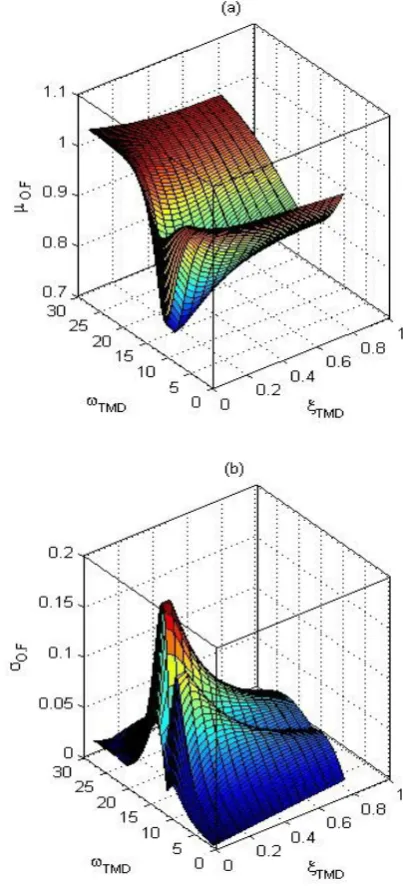
The diagrams of the mean and the standard deviation of OF based on the natural frequency and damping ratio of TMD are shown in Figure 2 separately.
As shown in Figure 2, the mean of the OF and its standard deviation do not treat in a similar way. It seems that the global minimum of the mean is where the standard deviation tends to increase.
Therefore, in the proposed robust design model, the structural performance is improved by reducing both the mean value and standard deviation of OF via the definition of a multi-objective optimization problem.
As a result, instead of a single solution, there is a set of good compromised solutions called Pareto solution, among which a designer can select his own proper situation.
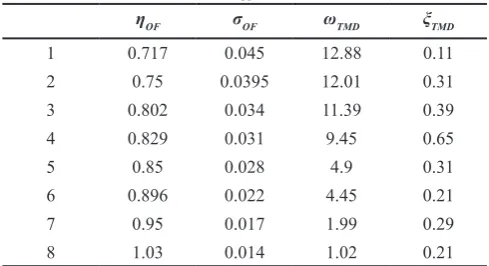
The Pareto solution of the proposed model is plotted in Figure 3 and TMD Parameters (ωTMD and ξTMD) for Pareto optimal values of ηOF and σOF are listed in Table 4. For example, where the mean value of OF is minimized by 0.717, the standard deviation is 0.45 and conversely where the standard deviation of OF is minimized by 0.014, the mean value is 1.03, thus where the mean value of OF is minimized, the standard
_ _
Input data Value
Power spectral density (S0) 1000 an2/s3
Uncertain
parameters Mean value Standard deviation di μ(di) σ(di)
Main system parameters
ωs (rad/s) 13.95 2.092
ξs (Non-unit) 0.05 0.01
η (Non-unit) 0.05 0.0075
Filter (Earthquake) parameters
ωf (rad/s) 18.62 1.862
ξf (Non-unit) 0.4 0.06
Table 3. Mean and standard deviation of system and stationary filtered white noise
Fig. 3. Pareto optimal front for different values of μOF and ηOF. Fig. 2. Mean value (a) and standard deviation (b) of the OF for
deviation is more than 3.2 times than its minimum case and conversely where the standard deviation of OF is minimized, the mean value is more than 44 percent to its minimum. By using the Pareto (in middle range points of Table 4), the mentioned values are reduced to 2 times and 12 percent, respectively. Indeed, Table 4 shows a set of good compromised solutions for robust optimization design of TMD. Hence, the use of Pareto shows a significant improvement in the efficient control of the system in uncertain situations
6- Conclusions
In this paper, a robust optimization model is studied to help the designers to choose the best TMD system in the uncertain situations. To achieve robust optimal design, a multi-objective model is presented in which the mean and standard deviation of the conventional OF are optimized.
1. The mean value of OF and its standard deviation do not treat in a similar way due to the changes in the TMD specifications. Where the mean of OF is minimized, its standard deviation is not in a good condition, therefore if system parameters are affected by uncertainty, the conventional model does not perform well.
2. Based on robust optimization model, a Pareto frontier is plotted which comprises a set of different combination of two objective functions. It provides the different choices for designers to select a TMD based on the priority of minimum of the standard deviation of displacement or the minimum dispersion in a random space.
3. Compared to conventional approach, robust approach induces a significant improvement in performance stability.
References
[1] G.C. Marano, S. Sgobba, R. Greco, M. Mezzina, Robust optimum design of tuned mass dampers devices in random vibrations mitigation, Journal of Sound and
Vibration, 313(3-5) (2008) 472-492.
[2] C. Lin, G. Lin, H. Lung, Dynamic test of multiple tuned mass dampers for vibration control of high-rise buildings, in: Tenth US National Conference on Earthquake
Engineering, Frontiers of earthquake engineering, 2014.
[3] T. Haskett, B. Breukelman, J. Robinson, J. Kottelenberg,
Tuned mass dampers under excessive structural
excitation, Report of the Motioneering Inc., Guelph,
Ontario, Canada, (2004).
[4] M.G. CARLO, R. Greco, Robust optimization for TMD with uncertain bounded system parameters and stochastic excitation, Asian Journal of Civil Engineering, 9 (2008) 433-455.
[5] H.-G. Beyer, B. Sendhoff, Robust optimization-a comprehensive survey, Computer methods in applied
mechanics and engineering, 196(33-34) (2007)
3190-3218.
[6] N. Nigam, Structural optimization in random vibration environment, AIAA Journal, 10(4) (1972) 551-553.
[7] G.C. Marano, R. Greco, B. Chiaia, A comparison between different optimization criteria for tuned mass dampers design, Journal of Sound and Vibration, 329(23) (2010) 4880-4890.
[8] R. Greco, G.C. Marano, Optimum design of Tuned Mass Dampers by displacement and energy perspectives, Soil
dynamics and earthquake engineering, 49 (2013)
243-253.
[9] S. Chakraborty, B.K. Roy, Reliability based optimum design of tuned mass damper in seismic vibration control of structures with bounded uncertain parameters,
Probabilistic Engineering Mechanics, 26(2) (2011)
215-221.
[10] E. Mrabet, M. Guedri, M. Ichchou, S. Ghanmi, Stochastic structural and reliability based optimization of tuned mass damper, Mechanical Systems and Signal
Processing, 60 (2015) 437-451.
[11] E. Mrabet, M. Guedri, S. Ghanmi, M. Soula, M. Ichchou, A Comparison between Two Reliability Based Optimization Strategies of Tuned Mass Damper Parameters under Stochastic Loading, in: Multiphysics Modelling and Simulation for Systems Design and
Monitoring, Springer, 2015, pp. 37-46.
[12] S. Sgobba, G.C. Marano, Optimum design of linear tuned mass dampers for structures with nonlinear behaviour, Mechanical Systems and Signal Processing, 24(6) (2010) 1739-1755.
[13] G.C. Marano, R. Greco, S. Sgobba, A comparison between different robust optimum design approaches: application to tuned mass dampers, Probabilistic
Engineering Mechanics, 25(1) (2010) 108-118.
[14] C. Zang, M. Friswell, J. Mottershead, A review of robust optimal design and its application in dynamics,
Computers & structures, 83(4-5) (2005) 315-326.
[15] Y. Daniel, O. Lavan, Gradient based optimal seismic retrofitting of 3D irregular buildings using multiple tuned mass dampers, Computers & Structures, 139 (2014) 84-97.
[16] H. Yu, F. Gillot, M. Ichchou, Reliability based robust design optimization for tuned mass damper in passive vibration control of deterministic/uncertain structures,
Journal of Sound and Vibration, 332(9) (2013)
2222-2238.
[17] S.S. Loren D. Lutes, Random Vibrations: Analysis of
ηOF σOF ωTMD ξTMD
1 0.717 0.045 12.88 0.11
2 0.75 0.0395 12.01 0.31
3 0.802 0.034 11.39 0.39
4 0.829 0.031 9.45 0.65
5 0.85 0.028 4.9 0.31
6 0.896 0.022 4.45 0.21
7 0.95 0.017 1.99 0.29
8 1.03 0.014 1.02 0.21
Table 4. TMD Parameters for Pareto optimal values of μOF and
Mohsen Balanian et al., AUT J. Civil Eng., 1(2) (2017) 121-128, DOI: 10.22060/ceej.2017.12346.5180
127
Structural and Mechanical Systems, Elsevier, Oxford,
UK, 2004.
[18] R. Greco, G.C. Marano, Optimum design of Tuned Mass Dampers by displacement and energy perspectives,
Soil dynamics and earthquake engineering, 49 (2013)
243-253.
[19] R. Eberhart, J. Kennedy, A new optimizer using particle swarm theory, in: Micro Machine and Human Science, 1995. MHS’95., Proceedings of the Sixth International
Symposium on, IEEE, 1995, pp. 39-43.
Pleasecitethisarticleusing:
Mohsen Balanian, Maryam Daei, Hossein Tajmir Riahi, A Robust Optimization Model for Improving Reliability of Tuned Mass Damper, AUT J. Civil Eng., 1(2) (2017) 121-128.