Comparison of Productivity, Cost and Chip
Quality of Four Balanced Harvest Systems
Operating in a
Eucalyptus globulus
Plantation in Western Australia
Martin Strandgard, Rick Mitchell, John Wiedemann
Abstract
There have been few comparative harvest system studies to provide a basis to understand the performance and chip quality of harvest systems used in eucalypt plantations.
The study compared the CTL – cut-to-length method at the stump, WTM – whole tree meth-od where trees were processed to logs at roadside, IFC-DDC – infield chipping using a debark/ delimb/chipper, IFC-F/C – infield chipping using a separate flail and chipper harvest systems on a single site in south-west Western Australia.
The WTM and IFC-F/C harvest systems were the most productive. The productivity of the CTL and IFC-DDC harvest systems was about 25% less than that of the other harvest systems. The CTL harvest system produced wood at the highest cost resulting from it having a large number of machines without a correspondingly high productivity level. However, the CTL harvest system has advantages over the other systems through retaining evenly distributed logging residues, low machinery impact on the site and flexibility to add or subtract machines as conditions change.
Two limitations of this study were that the harvest systems were only compared at a single mean tree size and operator performance differences may have influenced harvest system productivity. Previous studies have found that the balance of machines in a harvest system can change with changes in mean tree size. This is an area where further research is required. Wood chip samples from three of the four harvest systems did not meet the company chip specifications. However, the deviations from the specifications were minor.
Keywords: forest harvest system, cut-to-length, infield chipping, Eucalyptus globulus, wood chip, balanced system
length harvest systems are generally used: harvesters felling, debarking and processing trees to logs at the stump for extraction to roadside by a forwarder (CTL), or a feller-buncher, felling and bunching whole trees for extraction to roadside using grapple skidders and processing to logs at roadside using processors (WTM). In the former system, the forwarder may load trucks or a separate loader equipped with a boom and
grapple may be used. In the latter system, a loader would typically be used. Infield chipping systems con -sist of a feller-buncher, felling and bunching trees for extraction to roadside using grapple skidders, and an
1. Introduction
Eucalyptus is a dominant plantation genus glob-ally, with approximately 20 million hectares in cultiva-tion, the majority of which are in Asia and South America (Rejmánek and Richardson 2011). Australia has approximately 960 000 ha of hardwood planta-tions, of which 54% is Eucalyptus globulus Labill. man-aged for chiplog production (Gavran 2015). Eucalypt plantations are increasingly being harvested using
mechanised cut-to-length or infield chipping harvest
cut-to-infield delimb/debark/chipper (IFC-DDC) or separate flail and chipper units (IFC-F/C) discharging chips di -rectly into trucks.
Comparative studies of harvest systems allow con-clusions to be made about the relative performance of each harvest system in terms of its productivity, cost, product recovery, impacts on site productivity, etc. Conducting large harvest system comparison trials is
expensive and logistically difficult resulting in few
comparison trials having been carried out, and those that have mostly compared two harvest systems, often
on different sites (e.g. Lanford and Stokes 1996, Ade -bayo et al. 2007, Acuna and Kellogg 2009, Spinelli and
Magagnotti 2010). These trials typically use published
utilisation rates to calculate harvest system costs, (e.g.
Brinker et al. 2002), which may not reflect actual utili -sation rates of each machine when working as part of the studied harvest system potentially resulting in unbalanced systems, where the shift level production of each machine or machine type was not matched within the harvest system. Theoretical balancing of each harvest system can provide a consistent basis for the comparison of harvest system productivity and costs. Other potential sources of unwanted variation in comparative studies include site and operator
per-formance differences (Olsen et al. 1998). In the case of
eucalypt harvesting trials, differences in bark adhesion can also be a significant source of variation in harvest
machine performance (Strandgard et al. 2014). The objective of this study was to compare the pro-ductivity, cost and chip quality of four mechanised harvest systems used in E. globulus harvesting opera-tions to produce woodchips, all operating on the same
site. For the comparison, each harvest system was bal -anced in a desktop exercise.
2. Material and methods
The study was carried out in a first rotation, 10.5
year old E. globulus plantation in south-west Western
Australia (latitude –34.684, longitude 118.053). The
study area was 5.95 ha in total, with slopes less than
5 degrees and a duplex sandy gravel soil. Four harvest
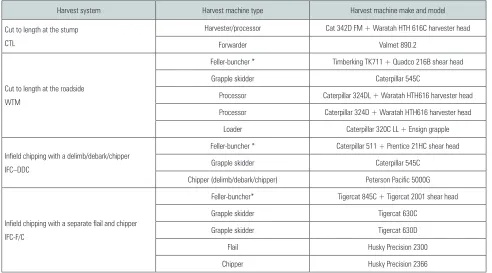
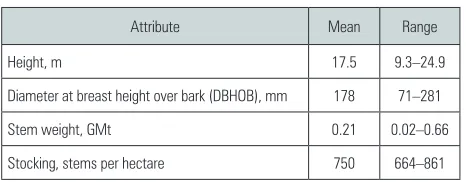
systems were studied (Table 1) in a uniform section of the plantation (Table 2). The study was conducted over nine consecutive days in January 2011. The weather
was fine and sunny until the last two days of the study
when a total of ~30 mm of rain fell during the WTM harvest. Each harvest system was studied when har-vesting in two non-adjacent three row swathes ap-proximately 12 m wide and 500 m long. Stump heights
were specified to be left 100–150 mm high to allow
Table 1 Description of harvest systems
Harvest system Harvest machine type Harvest machine make and model
Cut to length at the stump CTL
Harvester/processor Cat 342D FM + Waratah HTH 616C harvester head
Forwarder Valmet 890.2
Cut to length at the roadside WTM
Feller-buncher * Timberking TK711 + Quadco 216B shear head
Grapple skidder Caterpillar 545C
Processor Caterpillar 324DL + Waratah HTH616 harvester head
Processor Caterpillar 324D + Waratah HTH616 harvester head
Loader Caterpillar 320C LL + Ensign grapple
Infield chipping with a delimb/debark/chipper IFC–DDC
Feller-buncher * Caterpillar 511 + Prentice 21HC shear head
Grapple skidder Caterpillar 545C
Chipper (delimb/debark/chipper) Peterson Pacific 5000G
Infield chipping with a separate flail and chipper IFC-F/C
Feller-buncher* Tigercat 845C + Tigercat 2001 shear head
Grapple skidder Tigercat 630C
Grapple skidder Tigercat 630D
Flail Husky Precision 2300
Chipper Husky Precision 2366
coppice regeneration of the site. The specified mini
-mum small end diameter (SED) for the logs produced
by the cut-to-length systems was 50 mm, though logs
with a smaller SED were accepted. The CTL system
mean log length was 4.4 m. The majority of logs cut in the WTM system had a nominal length of 10 m with shorter logs cut from the crown or shorter trees. Logs produced from the two cut-to-length systems were chipped at a static chip-mill. Chips produced from the
infield chipping harvest systems were delivered to the
same mill.
Logging residues from the infield chipping sys -tems was redistributed by the skidders in small piles back onto the site during extraction, whereas the WTM harvest system logging residue was left at roadside.
The operators had a minimum of two years of ex-perience in operating the machine type they used in the study, except for the grapple skidder operators in
the IFC-F/C harvest system who each had less than
one year’s experience.
Machine productivity calculations were based on the total delivered green weight of wood for each sys-tem. Productivity was estimated by dividing the total weight of trees or logs in green metric tonnes (GMt) handled or processed by a machine by the total pro-ductive machine hours excluding delays (PMH0) for that machine. Productive machine hours were mea-sured using a stopwatch. At the start of the study each
machine’s fuel tank was filled. The amount of fuel required to refill the tank was measured at the end of each shift. Fuel consumption (l/PMH0) was estimated by dividing the fuel use for the shift by the PMH0 for
that shift. Where several machines of the same type were used in a harvest system, mean productivity and
fuel use figures were used in calculations. This was not
adopted across harvest systems because there were only single examples of some types of machine and multiple of others so an average productivity could not be obtained for all machine types used in the study.
Chip quality for each harvest system was assessed using eight 2 kg samples per system, one from each trailer of chips or logs. These samples were fraction-ated using a Kason automatic vibration machine into chip size classes and tested for bark percentage. Chip size class and bark percentages were assessed against
the static mill’s chip quality specifications (Table 3).
The harvest systems as tested in the study were not balanced, i.e. the shift-level productivities of each ma-chine within a harvest system (or the combined pro-ductivities when several machines of the same type were used) were not equal. The primary strategy used to balance each harvest system at a shift-level was the adjustment of machine utilisation rates. The minimum adjustment made in utilisation rate was 1%. Where
possible, utilisation rates were kept between 60–80%,
which is the typical range of utilisation rates observed in other studies (Brinker et al. 2002, Spinelli and Visser 2009, Holzleitner et al. 2011). The maximum utilisation
rate allowed during balancing was 80%. Where it was
not possible to balance a system using this approach, additional machines were added of the same types already used in that harvest system. This assumes the major delay source was imbalance between machines (i.e. delays caused by machines waiting for other
ma-chines to complete a task). From the authors’ experi -ence this is a reasonable assumption. The additional machines were assumed to have the same productiv-ity, fuel use and costs as existing machines of that type within that harvest system. Harvest systems were
deemed to be balanced when the difference in
shift-level productivity between the most and least produc-tive machines (or machine types if the harvest system contained several machines of the same type) was 1% or less. Harvest system productivity was expressed at a shift level and was set at the level of the least produc-tive machine (or machine type) in the harvest system. The time required per shift for the forwarder to load trucks was estimated using the forwarder loading ductivity observed in the trial and the shift level pro-duction of the balanced CTL harvest system.
Costs were estimated using the approach of Miyata
(1980) in Australian dollars (A$). Cost assumptions are provided in Table 4 and Table 5. Fuel consumption figures used were those measured during the study.
Table 2 Stand details (merchantable stems *)
Attribute Mean Range
Height, m 17.5 9.3–24.9
Diameter at breast height over bark (DBHOB), mm 178 71–281
Stem weight, GMt 0.21 0.02–0.66
Stocking, stems per hectare 750 664–861
* merchantable stems had a DBHOB > 75 mm
Table 3 Specifications used in the study for the required percentage of chips in each size class and the maximum allowable percentage of bark
>28.6 mm %
4.8–28.6 mm %
9.5–22.2 mm %
<4.8 mm %
Bark %
As the cut-to-length systems produced logs while the
infield chipping systems produced chips, the estimat
-ed cost for chipping the logs at a static chip-mill (A$5/
GMt) was added to the cut-to-length harvest system costs. Trucks were assumed to be available when re-quired and not to limit the productivity of the harvest systems. Truck transport costs were assumed to be
equal for chips and logs (A$5/GMt).
Analysis was performed using MS Excel 2010 and Minitab v. 16.
3. Results
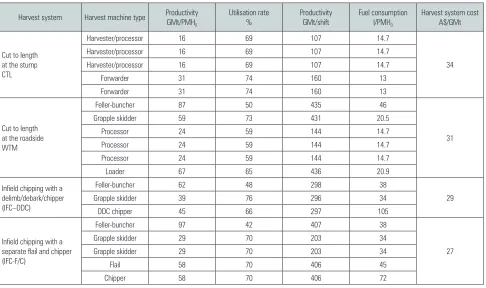
For each balanced harvest system, machine pro
-ductivity (hourly: GMt/PMH0 and shift level: GMt/
shift), utilisation rate (%), fuel consumption (l/PMH0)
and harvest cost (A$/GMt) are shown in Table 6. A
Table 4 Machine cost assumptions (consistent values for all stud-ied machines)
Category Value
Operating days per year 249
Shifts per day 1
Hours per shift 10.0
Salvage value, % of purchase price 20
Repair and maintenance, % of depreciation 75
Interest rate, % of average yearly investment 9
Insurance and tax rate, % of average yearly investment 6
Fuel cost, A$/L* 0.98
Oil & Lubricant, % of fuel cost 50
Labour costs, A$/SMH 46.59
Supervision (% of labour costs) 10
* at time of study off road vehicle use in Australia was eligible for a tax rebate of A$0.38143/litre
Table 5 Machine cost assumptions (variable between studied machines)
Harvester/
processor Forwarder Feller-buncher
Grapple
skidder Processor Loader DDC chipper Flail Chipper
Purchase price, A$ 750 000 660 000 650 000 670 000 750 000 280 000 1 500 000 750 000 750 000
Machine life, yrs 5 7 5 5 5 5 5 5 5
Table 6 Machine productivity at a productive machine hour level (GMt/PMH0) and shift level (GMt/shift), utilisation rate (%), fuel consumption
(l/PMH0) and harvest system cost (A$/GMt)
Harvest system Harvest machine type Productivity GMt/PMH
0
Utilisation rate %
Productivity GMt/shift
Fuel consumption l/PMH0
Harvest system cost A$/GMt
Cut to length at the stump CTL
Harvester/processor 16 69 107 14.7
34
Harvester/processor 16 69 107 14.7
Harvester/processor 16 69 107 14.7
Forwarder 31 74 160 13
Forwarder 31 74 160 13
Cut to length at the roadside WTM
Feller-buncher 87 50 435 46
31
Grapple skidder 59 73 431 20.5
Processor 24 59 144 14.7
Processor 24 59 144 14.7
Processor 24 59 144 14.7
Loader 67 65 436 20.9
Infield chipping with a delimb/debark/chipper (IFC–DDC)
Feller-buncher 62 48 298 38
29
Grapple skidder 39 76 296 34
DDC chipper 45 66 297 105
Infield chipping with a separate flail and chipper (IFC-F/C)
Feller-buncher 97 42 407 38
27
Grapple skidder 29 70 203 34
Grapple skidder 29 70 203 34
Flail 58 70 406 45
balanced CTL harvest system could also have been
achieved using two harvester/processors and one for -warder. However, more realistic utilisation rates were
obtained by adding two harvester/processors and one
forwarder to the studied system (i.e. a system
consist-ing of three harvester/processors and two forwarders).
An additional processor was added to balance the WTM harvest system. To balance the three harvest systems, which included a feller-buncher (the WTM,
IFC-DDC, IFC-F/C harvest systems), the feller-bunch
-er utilisation rates w-ere reduced to ≤50%. Balanced system productivities (GMt/shift) were: CTL 320, WTM 431, IFC-DDC 296, IFC-F/C 406. These theoreti
-cal systems and feller-buncher utilisation rates reflect
actual practice as they have been observed at other locations by the authors and by McEwan (2011).
The most expensive harvest system in the study
(A$/GMt) was the CTL system and the cheapest sys
-tem was the IFC-F/C sys-tem (Table 6).
There were no significant differences between
mean load sizes and mean extraction distances for the
skidders used in the WTM, IFC-DDC and IFC-F/C har
-vest systems (Table 7). The IFC-F/C skidders were sig
-nificantly slower than the IFC-DDC skidder when travelling empty with debris and significantly slower
than the IFC-DDC and WTM skidders when travelling empty without debris. The IFC-DDC and WTM skid
-der speeds were not significantly different when trav
-elling empty without debris. There were no significant differences between skidder travel loaded speeds be -tween any of the harvest systems.
Mean wood chip percentage by size class and bark percentage for chips produced from each studied
har-vest system are presented in Table 8. Chip samples from the CTL, WTM and IFC-DDC harvest systems did not meet the chip specifications.
4. Discussion
The balanced WTM and IFC-F/C harvest systems
were found to be the most productive systems in the
current study. The balanced IFC-DDC and CTL har -vest systems produced approximately 25% less wood over a shift than these systems. McEwan (2011) ob-tained similar results in his harvest system compari-son study, though in his study the productivity of the
IFC-DDC system was greater than that of the IFC-F/C.
The CTL harvest system had the highest estimated
costs (A$/GMt). This resulted from the CTL harvest
system having a large number of machines without a correspondingly large productivity. In contrast, the high costs associated with the large number of
ma-chines in the WTM and IFC-F/C harvest systems were
balanced by their correspondingly high productivities
and the lower productivity of the IFC-DDC harvest
system was balanced by it having the least number of machines. The relative system costs did not concur
with the findings of McEwan (2011), who found the
WTM harvest system to be the cheapest system. How-ever, the processors in the WTM system he studied produced tree length logs that were then cut to length
by a loader/slasher. The corresponding increase in
processor productivity enabled this system to operate with one less processor than the studied WTM system. Other harvest system comparison studies have found
Table 7 Mean load size (GMt), extraction distance (m) and travel speeds (km/h) for primary transport machines in each of the harvest systems
Machine Load size, GMt Extraction distance, m Travel speed, km/h
Travel empty with debris Travel empty without debris Travel loaded
Forwarder 18.8 303 – 5.6 5.8
WTM skidder 4.4 288 – 16.0 9.7
IFC-DDC skidder 4.5 270 12.4 15.2 9.1
IFC-F/C skidder* 4.2 281 8.6 8.9 8.6
* mean values for the two grapple skidders
Table 8 Mean wood chip percentages by size class and bark per-centage for each harvest system and the mean figures across all harvest systems (figures in italics did not meet the chip specifica-tions)
Harvest system
>28.6 mm %
4.8–28.6 mm %
9.5–22.2 mm %
<4.8 mm %
Bark %
CTL 3.7 95.3 53.1 1.0 0.0
WTM 5.2 93.6 59.3 1.1 0.1
IFC-DDC 3.1 94.7 66.5 1.5 0.7
IFC-F/C 3.4 94.4 68.2 2.0 0.2
CTL harvest systems to be more expensive than an
IFC-DDC system (Spinelli et al. 2009) or a WTM sys -tem (Adebayo et al. 2007).
A limitation of the current study was that the har-vest systems were only compared at a single mean tree size. A number of studies have found that the balance of machines in a harvest system is sensitive to changes in mean tree size because the productivity of each
ma-chine type can be affected differently by tree size changes (McNeel and Rutherford 1994, Holtzscher
and Lanford 1997, McEwan 2011). The restriction on stump height imposed on the study also reduced the ability of the shear head feller-bunchers to extract more of the available volume from each tree (Strand-gard and Mitchell 2012), which may have reduced the productivity of the three harvest systems that incor-porated a feller-buncher.
As the WTM, IFC-DDC and IFC-F/C harvest sys -tems used the same machine types for felling and
pri-mary extraction, productivity differences between these systems were likely to reflect differences in the
performance of the machines or operators. The excep-tion to this was that the WTM harvest system left
log-ging residues at roadside, whereas the infield chip -ping systems used the grapple skidders to return logging residue to the harvested area which reduced their productivity. The high productivity of the WTM
harvest system was believed to reflect the ability of this
system to match the productivity of the feller-buncher and skidder by adding multiple, relatively low
pro-ductivity processors, which is not possible for infield
chipping harvest systems with their single, high-pro-ductivity chipper. The WTM harvest system proces-sors also cut longer logs than the CTL harvest system harvesters, which has been shown to increase the
pro-ductivity of these machines (Gingras and Favreau
2005). Rainfall during the study of this harvest system may also have increased the processors’ productivity through reducing bark adhesion, however bark adhe-sion was not measured during the current study.
Infield chipping systems can be highly productive
but are very dependent on the productivity of the chipper. Major breakdowns to a feller-buncher or grapple skidder can be overcome through having spare machines onsite (Visser and Stampfer 2003, McEwan 2011), whereas the high capital cost of an
in-field chipper means that it is unlikely that spare chip -pers will be available. The productivity of the separate
flail and chipper in the current study was similar to
that found in previous studies (50 GMt/PMH0 Hartsough et al. 2002, 50 m3/PMH
0 and 55 m3/PMH0
McEwan 2011). However, the productivity of the DDC in the current study was lower. Major factors affecting
the productivity of an infield chipper are operator per -formance (McEwan 2011), flail chain condition (Thompson and Sturos 1991) and knife sharpness
(Hartsough et al. 2000). The productivity difference between the infield chippers in the current study was
believed to be the result of one or more of these factors
rather than inherent differences between the chipper types, though this was not verified. In contrast with infield chipping systems, the two log producing har
-vest systems have a greater degree of flexibility as they
can readily adapt to site or tree size changes by adding
or subtracting machines to balance productivity and/
or meet weekly log quotas or adapt to equipment breakdowns. They can also potentially be used to pro-duce sawlogs or other roundwood products.
The assumption that the shift-level productivity of the studied harvest systems was not limited by truck availability is rarely true in practice. Truck delays
(Acuna et al. 2012) and insufficient truck numbers
(Zamora-Cristales et al. 2013) often result in fewer trucks than required arriving at the harvest site. When
insufficient trucks are available, the CTL and WTM
harvest systems have a strong advantage over the
in-field chipping systems as they can continue to operate
while log storage space is available at roadside,
where-as infield chippers in most cwhere-ases only operate when a
truck is available or have limited on-site chip storage. A number of simulation studies have found that in-creasing truck availability increases chipper utilisation and productivity and reduces chipper costs (Acuna et al. 2012, Zamora-Cristales et al. 2013), though this cost saving can be reduced by corresponding increases in truck waiting times and hence in transport costs. Spi-nelli and Visser (2009) caution, however, that expected increases in chipper productivity from increased truck availability may be limited in practice by the conse-quent increase in delays related to increased chipper maintenance requirements and operational issues.
Although the CTL harvest system was less produc-tive and more expensive than the best performing har-vest systems studied, it has a number of advantages over other harvest systems. It requires the fewest ma-chines for a functioning harvest system (one harvester and one forwarder), which minimises a contractor’s capital and mobilisation costs. In areas where it is
dif-ficult to recruit and retain staff, it also minimises the
evaporation (O’Connell et al. 2004) and protecting soil from machinery damage (Cambi et al. 2015). In con-trast, skidders in roadside harvest systems redistrib-ute logging residues back onto the site in heaps (Ghaffariyan et al. 2013), or in some cases, logging resi -dues are burnt or left at roadside (Kumar et al. 2003).
Feller-bunchers have been shown in numerous
previous studies to be highly productive harvesting machines (e.g. Spinelli et al. 2002, Adebayo et al. 2007,
Strandgard and Mitchell 2010, Ghaffariyan et al. 2012).
Use of accumulating heads on feller-bunchers, such as those in the current study, enables them to maintain high productivity when harvesting small trees (Johansson and Gullberg 2002). The productivities of
the feller-bunchers in the WTM and IFC-F/C harvest
systems were comparable to those reported in previ-ous eucalypt harvesting studies with similar mean tree sizes (92 m3/PMH
0 Strandgard and Mitchell 2010, 109
GMt/PMH0 Ghaffariyan et al. 2012), whereas that for
the IFC-DDC feller-buncher was less than expected. In the latter case, the operator was experienced in operat -ing feller-bunchers but was not the regular operator of the studied machine. To balance the productivities of the feller-bunchers against the other machines in the studied harvest systems, their utilisation rates were
reduced to ≤50%, which was also the approach taken
by Adebayo et al. (2007). System balance could have been maintained by adding more machines to these systems. However, this would not replicate current practice in Australian harvest operations, in which the feller-buncher operator also operates a grapple skid-der or other machine as required, or if another harvest-ing crew was close by the feller-buncher may support multiple harvest systems.
Grapple skidder productivity has been found in previous studies to be primarily related to extraction distance and load size (Kluender et al. 1997, Visser and Stampfer 2003, Ghaffariyan 2013). As mentioned above, the productivity of the grapple skidders used
in the two infield chipping harvest systems was re -duced by them being used to return logging residues
to the harvested area. The productivity of the DDC system skidder was greater than that of the IFC-F/C harvest system skidders because the IFC-DDC harvest system skidder travelled significantly faster
when not carrying a load. This is likely to be due to the higher maximum speed of the Caterpillar 545C (27.5 km/h) used in IFC-DDC harvest system com
-pared with the Tigercat 640 skidders (18–19 km/h) used in the IFC-F/C harvest system.
The WTM harvest system grapple skidder was more productive at the same extraction distance than the grapple skidder studied by Spinelli and Hartsough
(2001) (~40 GMt/PMH0). In both cases logging residues
were left at roadside. The difference in productivity
was likely to be because the skidder mean load size in the Spinelli and Hartsough (2001) study was
approxi-mately 2/3 that of the skidder in the WTM harvest
system. However, the productivity of the grapple skidder in the study by Ghaffariyan et al. (2012)
(~47 GMt/PMH0) was greater than that in the
IFC-DDC harvest system although its mean load size was also approximately 2/3 that of the IFC-DDC harvest
system skidder. In both cases, the grapple skidders returned logging residue to the site, however, the
skid-der in the Ghaffariyan et al. (2012) study spent only
2% of its time on this activity during the study, which may have accounted for its greater productivity.
Harvester and processor productivity has been shown in previous studies to be strongly related to tree
size (McEwan 2011, Ghaffariyan 2013, Ramantswana
et al. 2013, Strandgard et al. 2014, Strandgard et al. 2015). As was found in the current study, roadside processors have higher productivities than harvesters as they do not travel through the stand, clear under-growth or fell trees (Spinelli et al. 2010). Similar har-vester productivities to that in the current study were reported by Ramantswana et al. (2013) (16 m3/PMH
0)
and Strandgard et al. (2014) (18 m3/PMH
0). However, the harvester productivity reported by McEwan (2011) (13 m3/PMH
0) was less than that in the current study
for the same mean tree size. The reason for this differ
-ence was not identified. Roadside processor produc
-tivities reported by Ghaffariyan (2013) and Strandgard et al. (2015) (25 GMt/PMH0) were similar to that of the processors in the current study for similar mean tree sizes, though the trees were not debarked in the Strandgard et al. (2015) study.
Previous studies have shown forwarder productiv-ity to be dependent on extraction distance and load size (Adebayo et al. 2007, Jiroušek et al. 2007, Nurminen
et al. 2006, McEwan 2011). Forwarder productivity in
the current trial was similar to that reported by Adebayo et al. (2007) (33 m3/PMH
0) and Jiroušek et al. (2007) (27 m3/PMH
0). Nurminen et al. (2006) reported a low-er forwardlow-er productivity (21 m3/PMH
0), though the mean forwarder load size (14 m3) in their study was considerably less than that in the current study.
Although the chip samples for three of the harvest
systems did not meet the company specifications, each
of the samples was only non-compliant in a single cat-egory and was close to meeting the company’s chip
specifications. Screening and re-chipping oversize chips (>28.6 mm) is routine practice at chip-mills
class for the WTM harvest system chip sample. The
higher than acceptable bark percentage for the IFC-DDC harvest system may indicate that the flail chains needed to be replaced or the trees fed through the flail
more slowly or fewer at a time (Thompson and Sturos
1991). The finding that the mean percentage figures across all the chip samples met company specifications
implied that the chips from each of the harvest systems would have been acceptable when mixed with chips from other sources.
5. Conclusions
The current study compared the cost and produc-tivity of four harvest systems processing short-rota-tion eucalypt plantashort-rota-tion trees to pulp chips. To reduce variations in the results from factors other than system
differences, the trial was conducted on a single site and
over a short time period and the systems were bal-anced in terms of their shift-level productivity in a desktop exercise to reduce potential distortions in the original study results caused by excessive machine waiting times.
The cheapest harvest system (A$/GMt) in the study was found to be the IFC-F/C system and the most pro
-ductive harvest system (GMt/PMH0) was the WTM system. However, system cost and productivity are not the only considerations used by harvest contrac-tors to select a harvest system.
The four harvest systems tested in the study fell into two classes: systems producing logs or chips at
roadside. Harvest systems producing logs are flexible
as harvest contractors can adjust machine numbers to balance a harvest system to adapt to changes in mean tree size or wood quotas. Log-producing harvest sys-tems can also produce chip logs or roundwood logs and typically are able to store logs at roadside thus reducing their dependence on truck availability. Of the two harvest systems that produced logs at road-side, the WTM system was superior to the CTL system in terms of its cost per GMt and its productivity. How-ever, CTL harvest systems distribute logging residue more evenly over the site and the simplest and cheap-est harvcheap-est system of those tcheap-ested would be a single harvester and forwarder CTL system.
As shown in the current study, infield chipping
harvest systems are capable of highly productive and
low-cost chip production. However, these attributes
are highly dependent on the mechanical availability of the chipper as few contractors will have a spare
chipper and on truck availability as typically little or
no chip storage is available on-site. Of the two harvest
systems producing chips at roadside, the IFC-F/C har
-vest system was superior to the IFC-DDC har-vest sys -tem in terms of its productivity and cost.
On the basis of the above considerations, the
low-cost, high productivity and flexibility of the WTM har -vest system suggested that it was the best har-vest sys-tem of those tested under the test conditions (assuming a chip mill was available to process the logs).
How-ever, if a plantation manager specified even redistribu -tion of logging residues to maintain site productivity, the only choice would be the CTL harvest system.
Two limitations of the current study were the
im-pact of differences in operator performance, as can be seen by the difference in productivity between ma
-chines of the same type used in different harvest sys -tems, and that the harvest systems were only com-pared at a single mean tree size. Rainfall late in the trial may also have increased the productivity of the WTM harvest system processors through reducing bark adhesion. As more studies of the harvest ma-chines and systems studied in this trial are collected, it will be possible in future to compare the productiv-ity and costs of »average« harvest systems of each type
using a simulation study to remove the effects of dif -fering operator performance and rainfall. The
simula-tion study could also be used to explore the effect of
changes in mean tree size as the productivity of each
machine type can be affected differently by tree size
changes.
Acknowledgements
The authors would like to thank Albany Plantation
Forests Ltd, Albany Plantation Export Company, Total Harvesting P/L, Edenborn P/L, Logging Services P/L and Albany Timber Services P/L, without whose as -sistance this study would not have been possible.
Note that some of the results in this article have
been previously published in Ghaffariyan et al. (2013) and Ghaffariyan and Brown (2013).
6. References
Acuna, M., Kellogg, L., 2009: An Evaluation of Alternative
Cut-To-Length Harvesting Technology for Native Forest Thinning in Australia. International Journal of Forest Engi -neering 20(2): 17–25.
Acuna, M., Mirowski, L., Ghaffariyan, M., Brown, M., 2012: Optimizing transport efficiency and costs in Australian
wood chipping operations. Biomass and Bioenergy 46: 291– 300.
Adebayo, A.B., Han, H-S., Johnson, L., 2007: Productivity and cost of cut-to-length and whole-tree harvesting in a
Brännvall, E., 2009: Wood Handling. In: Pulp and Paper Chemistry and Technology: Pulping Chemistry and Tech-nology (Ek, M., Gellerstedt, G., Henriksson, G., ed.) Walter de Gruyter, Berlin, 13–34 p.
Brinker, R.W., Kinard, J., Rummer, R., Lanford, B., 2002: Ma-chine rates for selected forest harvesting maMa-chines. Alabama Agricultural Experiment Station, Auburn University, Ala-bama, 32 p.
Cambi, M., Certini, G., Neri, F., Marchi, E., 2015: The impact of heavy traffic on forest soils: a review. Forest Ecology and Management 338: 124–138.
Gavran, M., 2015: Australian plantation statistics 2015 up-date. ABARES technical report, ABARES, Canberra, 17 p.
Ghaffariyan, M.R., 2013: Comparing productivity-cost of
roadside processing system and roadside chipping system
in Western Australia. Journal of Forest Science 59(5): 204–
210.
Ghaffariyan, M.R., Brown, M., Acuna, M., Kellogg, L., 2012:
Productivity of roadside processing system in Western Aus-tralia. Silva Balcanica 13(1): 49–60.
Ghaffariyan, M., Brown, M., 2013: Selecting the efficient har -vesting method using multiple-criteria analysis: A case
study in south-west Western Australia. Journal of Forest Sci
-ence 59(12): 479-486.
Ghaffariyan, M.R., Brown, M., Spinelli, R., 2013: Evaluating Efficiency, Chip Quality and Harvesting Residues of a Chip
-ping Operation with Flail and Chipper in Western Australia. Croatian Journal of Forest Engineering 34(2): 189–199. Gingras, J.-F., Favreau, J., 2005: Effect of log length and num -ber of products on the productivity of cut-to-length
harvest-ing in the boreal forest. FPInnovations, Pointe Claire, QC, Advantage 6(10): 8 p.
Hartsough, B., Spinelli, R., Pottle, S., Klepac, J., 2000: Fiber recovery with chain flail delimbing/debarking and chipping of hybrid poplar. International Journal of Forest Engineering 11(2): 59–68.
Hartsough, B., Spinelli, R., Pottle, S., 2002: Delimbing hybrid poplar prior to processing with a flail/chipper. Forest Prod
-ucts Journal 52(4): 85–93.
Holzleitner, F., Stampfer, K., Visser, R., 2011: Utilization
rates and cost factors in timber harvesting based on
long-term machine data. Croatian Journal of Forest Engineering 32(2): 501–508.
Holtzscher, M.A., Lanford, B.L., 1997: Tree diameter effects on cost and productivity of cut-to-length systems. Forest
Products Journal 47(3): 25–30.
Jiroušek, R., Klvač, R., Skoupý, A., 2007: Productivity and
costs of the mechanised cut-to-length wood harvesting
sys-tem in clear-felling operations. Journal of Forest Science 53(10): 476–482.
Johansson, J., Gullberg, T., 2002: Multiple handling in the selective felling and bunching of small trees in dense stands.
International Journal of Forest Engineering 13(2): 25–34.
Kluender, R., Lortz, D., McCoy, W., Stokes, B.J., Klepac, J.,
1997: Productivity of Rubber-tired Skidders in Southern Pine
Forests. Forest Products Journal 47(11/12): 53–58.
Kumar, A., Cameron, J.B., Flynn, P.C., 2003: Biomass power
cost and optimum plant size in western Canada. Biomass and Bioenergy 24(6): 445–464.
Lanford, B., Stokes, B.J., 1996: Comparison of two thinning
systems. Part 2. Productivity and costs. Forest Products Jour
-nal 46(11/12): 47–53.
Lapointe, J-F., Robert, J-M., 2000: Using VR for Efficient Training of Forestry Machine Operators. Education and In -formation Technologies 5(4): 237–250.
McEwan, A.M., 2011: The effect of tree and bundle size on
the productivity and costs of cut-to-length and multi-stem harvesting systems in Eucalyptus pulpwood. MSc disserta-tion, University of Pretoria, South Africa, 206 p.
McNeel, J.F., Rutherford, D., 1994: Modeling harvester-for -warder system performance in a selection harvest. Journal
of Forest Engineering 6(1): 7–14.
Mendham, D.S., O’Connell, A.M., Grove, T.S., Rance, S.J., 2003: Residue management effects on soil carbon and nutri
-ent cont-ents and growth of second rotation eucalypts. Forest Ecology and Management 181(3): 357–372.
Miyata, E.S., 1980: Determining fixed and operating costs of logging equipment. USDA Forest Service, North Central Forest Experiment Station. General Technical Report NC-55.
St. Paul, Minnesota. 16 p.
Nurminen, T., Korpunen, H., Uusitalo, J., 2006: Time con-sumption analysis of mechanized cut-to-length harvesting
systems. Silva Fennica 40(2): 335–363.
O’Connell, A.M., Grove, T.S., Mendham, D.S., Rance, S.J.,
2004: Impact of harvest residue management on soil nitrogen dynamics in Eucalyptus globulus plantations in south western
Australia. Soil Biology and Biochemistry 36(1): 39–48. Olsen, E.D., Hossain, M.M., Miller, M.E., 1998: Statistical
comparison of methods used in harvesting work studies.
College of Forestry, Forest Research Laboratory, Oregon
State University, Corvallis.
Ramantswana, M., McEwan, A., Steenkamp, J., 2013: A com-parison between excavator-based harvester productivity in coppiced and planted Eucalyptus grandis compartments in
KwaZulu-Natal, South Africa. Southern Forests 75(4): 239–
246.
Rejmánek, M., Richardson, D.M., 2011: Eucalypts. In: Ency
-clopedia of biological invasions (Simberloff D., Rejmanek,
M. ed.) University of California Press, Berkeley, 203–209 p. Spinelli, R., Hartsough, B.R., 2001: Extracting whole short rotation trees with a skidder and a front-end loader. Biomass and Bioenergy 21(6): 425–431.
Spinelli, R., Visser, R., 2009: Analyzing and estimating delays in wood chipping operations. Biomass and Bioenergy 33(3): 429–433.
Spinelli, R., Magagnotti, N., 2010: Comparison of two har -vesting systems for the production of forest biomass from the thinning of Picea abies plantations. Scandinavian Journal
Spinelli, R., Hartsough, B., Owende, P.M.O., Ward, S.M., 2002: Productivity and Cost of Mechanized Whole-Tree
Har-vesting of Fast-Growing Eucalypt Stands. International Jour
-nal of Forest Engineering 13(2): 49–60.
Spinelli, R., Ward, S., Owende, P., 2009: A harvest and trans-port cost model for Eucalyptus spp. fast-growing short rota-tion plantarota-tions. Biomass and Bioenergy 33(9): 1265–1270.
Spinelli, R., Hartsough, B., Magagnotti, N., 2010: Productiv
-ity standards for harvesters and processors in Italy. Forest
Products Journal 60(3): 226–235.
Strandgard, M., Mitchell, R., 2010: Benchmarking feller-buncher productivity in Western Australian blue gum
planta-tions. Bulletin 12, CRC for Forestry Program 3, Hobart, 4 p.
Strandgard, M., Mitchell, R., 2012: Choosing the right feller-buncher head for maximum volume extraction. Bulletin 22,
CRC for Forestry Program 3, Hobart, 2 p.
Strandgard, M., Mitchell, R., Acuna, M., 2014: General pro-ductivity model for single grip harvesters in Australian
eu-calypt plantations. Australian Forestry 79(2): 108–113. Strandgard, M., Walsh, D., Mitchell, R., 2015: Productivity
and cost of whole tree harvesting without debarking in a
Eucalyptus nitens plantation in Tasmania, Australia. Southern
Forests: a Journal of Forest Science 77(3): 173–178.
Thompson, M., Sturos, J., 1991: Performance of a Portable
Chain Flail Delimber/Debarker Processing Northern Hard
-woods. USDA Forest Service Research Paper NC-297, 17 p.
Visser, R., Stampfer, K., 2003: Tree-length system evaluation of second thinning in loblolly pine plantations. Southern
Journal of Applied Forestry 27(2): 77–82.
Zamora-Cristales, R., Sessions, J., Murphy, G., Boston, K., 2013: Economic impact of truck-machine interference in
for-est biomass recovery operations on steep terrain, Forfor-est
Products Journal 63(5–6): 162–173.
Received: October 25, 2016
Accepted: April 03, 2018
Authors’ addresses: Martin Strandgard, MSc * e-mail: [email protected]
AFORA
University of the Sunshine Coast 500 Yarra Boulevard
Richmond, 3121, Victoria AUSTRALIA
Rick Mitchell, BSc
e-mail: [email protected]
AFORA
University of the Sunshine Coast 35 Shorts Place
Albany, 6330, Western Australia AUSTRALIA
John Wiedemann, GDFSM
e-mail: [email protected]
Western Australian Plantation Resources (WAPRES) PO Box 444
Manjimup, 6258, Western Australia
AUSTRALIA