Variations
Hamid Hassanpour
a,
Omid Kohansal
a,
Sekineh Asadi Amiri
b,∗
aFaculty of Computer Engineering&IT, Shahrood University of Technology, Shahrood, Iran bFacaulty of Technology and Engineering, University of Mazandaran, Babolsar, Iran
A R T I C L E I N F O.
Article history:
Received:15 January 2018
Revised:14 August 2018
Accepted:16 August 2018
Published Online:30 November 2018
Keywords:
Face Recognition, PCA, SIFT Descriptor, Feature Extraction.
A B S T R A C T
There are many applications for face recognition. Due to illumination changes, and pose variations of facial images, face recognition is often a challenging and a complicated process. In this paper, we propose an effective and robust face recognition method. Firstly, we select those areas from the face (such as eyes, nose, and mouth), which are more informative in face recognition. Then SIFT (Scale Invariant Feature Transform) descriptor is utilized for feature extraction from the selected areas. SIFT descriptor detects keypoints in the image and describes each keypoint with a feature vector with length 128. To speed up the proposed method, PCA (Principal Component Analysis) is applied on the SIFT feature vector to reduce the vector’s length. Finally, Kepenekci matching method is used to assess similarity between the images. The proposed method is evaluated on the ORL, Extended Yale B, and FEI databases. Results show considerable performance of the proposed face recognition method in comparison with several state-of-the-arts.
c
2018 JComSec. All rights reserved.
1
Introduction
Face recognition plays a major role in biometrics. The main positive aspect of face recognition methods in comparison with other biometrics identification ap-proaches is the simple accessibility to facial images. As an example, in identification applications based on fingerprint processing, the finger should first be specially placed according to some restricted disci-plines. The identification process is then carried out. Whereas, human identification using face recognition can be done in a wider range without paying attention to the camera.
∗ Corresponding author.
Email address:[email protected](S. A. Amiri) https://dx.doi.org/10.22108/jcs.2018.110882.
ISSN: 2322-4460 c2018 JComSec. All rights reserved.
In uncontrolled environments, issues such as im-age degradations, occlusions, illumination variations, facial pose variations, scale variations, poor images quality can influence the face recognition rate [1]. Fa-cial occlusions may occur for several reasons. Some people wear sunglasses, scarf, and hat. Occlusions can also occur with medical masks, moustaches, beard, hairs covering the face, and make up. Thus, robustness to these problems is serious in face recognition sys-tems. Figure 1 shows some of these problems, which influence performance of face recognition systems.
seri-Figure 1. Examples of Different Conditions in Facial Images, Which Make Face Recognition Process a Challenging Task.
ously reduces using merely holistic approaches. These defects of the holistic approaches can be partially solved using feature-based methods. Feature-based approaches extract local features from specific regions of the facial image. Therefore, these methods are less sensitive to distortion than holistic methods [1]. A lot of methods exist for extracting features from facial im-age. Some of these methods are reviewed in the next section.
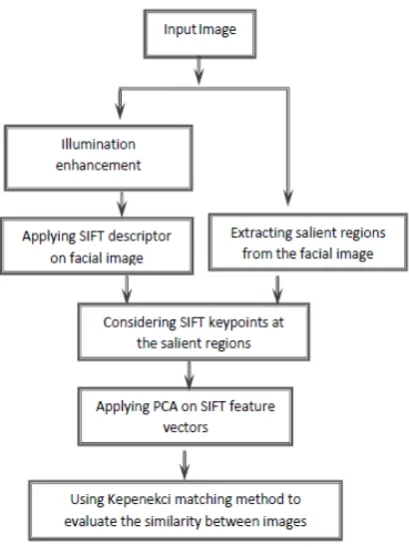
In this paper, a new method for face recognition is proposed, which is robust against illumination changes, and pose variations. Firstly, regions of interest in facial image such as the eyes, nose, and mouth are detected. Then, the Scale Invariant Feature Transform (SIFT) descriptor is extracted from these regions. SIFT de-scriptor detects keypoints from the image and specifies each keypoint with a feature vector of length 128. Fol-lowing, the Principal Component Analysis (PCA) is applied on the SIFT feature vector to employ features with more discriminative ability for face recognition. Finally, similarity between the images is computed using the Kepenekci matching method.
The rest of this paper is structured as follows: SIFT descriptor is reviewed in Section 2. Section 3 reviews related works on face recognition. Section 4 describes the proposed approach whereas; Section 5 presents the performance evaluation of the proposed method. Finally, the conclusions are drawn in Section 6.
2
SIFT Descriptor
SIFT was first presented by David Lowe [3]. It identi-fies points of interest in the image and provides local descriptors which specify the neighborhood of these points [2]. The SIFT descriptor basically contains four steps: extrema detection, elimination of unstable key-points, orientation assignment, and descriptor compu-tation [4].
In the first step, the extrema are determined in the image filtered using the Difference of Gaussian (DoG) filter. The input image is gradually down-sampled
Figure 2. Showing Neighboring of a Pixel to Determine the Exterma Keypoints.
Figure 3. The Possible Interactions Among the Agents, Or-ganizations, and Environment.
and filtered using the Gaussian filter. This process ensures the scale invariance of the technique. Figure 2 illustrates the implementation of the DoG filters at different scales.
To detect the extrema points, each pixel of the DoG filtered image is compared with its neighbors. Eight pixels in the same level and nine pixels in the two above and below levels are considered as its neighbors. If the pixel value is maximum or minimum compared to all of its neighboring pixels, it is considered to be a candidate keypoint. Figure 3 demonstrates the neighboring pixels for a pixel of the DoG filtered image. In this figure, neighboring pixels are shown as black rectangles.
In the second step, stability is calculated for each candidate keypoint. Keypoints with low contrast and keypoints along edges are eliminated.
In the third step, orientation is calculated for each remaining keypoints. The computation is done accord-ing to the gradient orientations in the neighboraccord-ing pixel. Indeed, the values are weighted by the gradient magnitudes from the neighboring of the keypoint.
descriptor is extracted from the facial image.
3
Related Works
Feature extraction is one of the most important steps in any face recognition system. Among the huge num-ber of facial feature extraction techniques, holistic approaches utilize the whole image for face recogni-tion, such as PCA [5], LDA1 [6], and ICA2 [7]. Geo-metric features, which are considered as local-based approaches, measure the distance between eyes, the width and length of the nose, and the mouth size [8]. These techniques are not inherently robust against variations in facial pose and expression variations. In-deed, any change in the facial pose or expression may result in different facial geometric features.
The Local Binary Patterns (LBP) [9], Gabor Wavelet [10], SIFT [11], and Speeded-Up Robust Features (SURF) [12], as a few, are among the major approaches developed for local-based face recognition. SIFT descriptor attracted a considerable attention and has been widely used in fields such as object detection [13], image retrieval [14] [15], and face recognition [16] [17]. SIFT-based face recognition techniques are named keypoint detectors, which lo-cate points of interest in the image, and describe each point with a feature vector. SIFT is robust against scale, rotation, viewing direction, and poses. In [4] a method was proposed to overcome the shortcom-ing of SIFT against illumination variations. In this approach, SIFT descriptors are computed at prede-fined (fixed) keypoints. These locations are obtained using learning algorithms. Although this method is partially robust against illumination variation, but it has a negligence robustness against different viewing directions and poses. To overcome this deficiency, one can use plenty of training samples. Indeed, a lot of training samples are necessary for creating the correct face models, but it is very time consuming and computationally expensive. The approach in [18] handles this deficiency using a new matching method.
The approach in [2] proposes a combination of SIFT and SURF descriptors, named SIFT/SURF descriptor. This method has a weak efficiency for images with poor quality. Because, SURF descriptor extracts only a few keypoints from these images. Generally, SIFT-based methods can be used in real time applications, due to their acceptable accuracy.
1 Linear Discriminant Analysis 2 Independent component analysis
for face recognition. The approach in [21] uses both Gauss-Laguerre and Log-Gabor filters for feature ex-traction. After that, PCA is applied on the feature vector to reduce its length. Finally the reduced feature vector is utilized by the K-Nearest Neighbor (K-NN) for face recognition.
In [22] a face recognition method using SIFT is proposed. In this method, theK-means algorithm is applied on keypoints extracted using SIFT. In [23] a face recognition approach was proposed for robustness against illumination variations. First, the whole facial image is divided into high-lighted and non-highlighted regions. Then a pixel-level transformation in log space is afterwards constructed. The final step is to extend this chromaticity invariance to color space by taking into account the shadow edge detection.
In [24] some salient patches are extracted from the face, then multi-scale LBP features are extracted from patches. This feature is a high-dimensional vector. In [25], the Dual-Cross Patterns (DCP) of salient key-points are used to describe the face. In [26] a new local facial descriptor, named as the Structural Binary Gra-dient Patterns (SBGP), for facial images is proposed. It measures relationships between local pixels in the image gradient domain and encodes them into a set of binary strings. The approach in [27] employs the kernel discriminates analysis for extracting features from input images. Furthermore, Support Vector Ma-chine (SVM) and K-NN are utilized to classify the face image based on the extracted features.
4
Proposed Method
Figure 4. Flowchart of the Proposed Face Recognition System.
Figure 5. Image Illumination Enhancement.
4.1 Illumination Enhancement
SIFT descriptor is not robust against unbalanced image illumination. Hence, in the proposed method, image illumination enhancement is applied on the input image using the technique introduced in [28]. This method, named Local Normalization, enhances image illumination using the following equation:
G(x, y) = F(x, y)−µF(x, y)
σF(x, y)
(1)
where F(x,y) is the original image, G(x,y) is the enhanced image, µF (x,y) andσF (x,y) are the
es-timation of local mean and local variance of F(x,y) respectively.
Although, there are other approaches such as [29] [30] [31] to improve image illumination, these methods have a high computational complexity. Figure 5 indi-cates an example of image illumination enhancement using these four methods.
Figure 6. Extracting Eight-Points From the Facial Image Using the Method Proposed In [32].
Figure 7. Effective Areas for Face Recognition.
4.2 Extracting Salient Regions
Eyes, nose, and mouth are the most important parts of facial images for face recognition. We named these regions as salient regions or regions of interest. In real conditions, because of variation in hair and beard, ignoring these regions and considering the salient re-gions will improve the recognition rate. Also, using only the salient regions improves robustness of the proposed method against partial coverages such as using hat.
In this paper, same as [32], eight-points from facial images including the points around the eyes, the tip of the nose, points around the mouth, and the center of the face are extracted. These eight-points are shown in Figure 6. It should be mentioned that in some of the facial images the points on the tip of the nose and the point on the center of the face are overlapped with each other. The method in [32] uses DPM3 -based classification to extract the mentioned eight-points. Indeed, a facial image is the input of the classifier and its output is the estimation of the above eight-points. Finally, using these points, effective areas are identified for face recognition (Figure 7).
4.3 SIFT Descriptor and PCA
In this paper, SIFT descriptor is applied on the fa-cial image. SIFT descriptor extracts some keypoints and describes each keypoint with a feature vector of length 128. In this step, only the SIFT keypoints ex-tracted from regions of interest are considered, and the rest are discarded. The SIFT descriptor specifies each keypoint using a feature vector with 128 values. It seems that all of the 128 values may not be effec-tive to describe a point; hence, feature reduction can be applied on these feature vectors. This reduction increases the time efficiency. In the proposed method,
reconstruction error [9].
4.4 Kepenekci Matching
The proposed method is applied on all of the training images and the test image. Then, the similarity be-tween the test face feature vector and each of the train-ing image feature vectors is computed ustrain-ing Kepenekci matching [18].
Kepenekci matching is a weighted combination of two measures. Let us call T a test image and G a training image. For each feature vector t from the face T, a set of relevant vectors g from the face G is determined. Vector g is relevant if following equation is satisfied:
q
(xt−yg)2+ (yt−yg)2< distanceT hreshold (2)
where x and y are coordinates of the feature vector points.
The overall similarity of two faces is calculated according to the following equation:
Sim1T ,G=mean{S(t, g), t∈T, g∈G} (3)
S(t,g) represents the similarity of two feature vectors according to cosine measure. Generally, the above equation computes the average of similarities between each pair of corresponding vectors. Then, the face with the most similar vector to each of the test face vectors is specified.
The following equation indicates the second measure which is used in Kepenekci matching:
Sim2T ,G=
CG
NG
(4) whereCG is the number of related points in the
train-ing face G with the test face T, andNGis the total
number of feature vectors in G.
Kepenekci similarity measure is a weighted sum of these two similarities:
SimFT ,G=αSim1T ,G+βSim2T ,G (5)
The recognized face is the one with the highest simi-larity value.
According to the Kepenekci matching, recognition rate can be calculated for each facial face recognition method. Recognition rate is defined as the percentage ratio of correctly identified images to the total number of images.
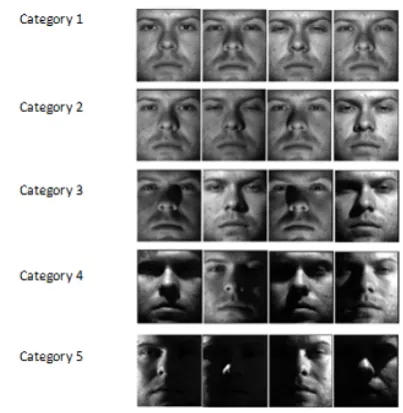
Figure 8. Example of One Individual in Different Illumination Conditions From the Extended Yale B Database.
5
Experimental Results
In order to evaluate the proposed method, ORL database [33] containing facial images with different viewing directions and poses; FEI database [34] con-taining facial images with different viewing directions; and Extended Yale B [35] containing facial images with different illumination conditions are used. In the following, experimental results on these three databases are evaluated.
5.1 Extended Yale B Face Database
For evaluating the proposed method in different illu-mination conditions, we tested our approach on the Extended Yale B database. This database contains 38 distinct individuals and 64 pictures for each individ-ual. All of the images in this database were catego-rized into five different sets in terms of illumination condition. The first category contains images with the appropriate illumination and gradually the illu-mination is dimmed in the following subsequent sets. Figure 8 shows these five categories.
The images of the first category are considered as the training set and categories 3, 4, and 5 are considered for the test sets. Table 1 shows the recognition rate before and after image illumination enhancement. The results show that image illumination enhancement increases the recognition rate.
5.2 FEI Face Database
Table 1. The Recognition Rate Before and After Images Illumination Enhancement.
Test
Train Before preprocessing After preprocessing Category 1 Category 1
Category 3 87.1 90.2
Category 4 47.5 58.7
Category 5 45.2 57.2
Figure 9. An Example of One Individual, From FEI Face Database, in Five Different Viewing Directions.
face database. This database contains 200 distinct individuals and 14 pictures (with different viewing directions) for each individual. Figure 9 shows an example of one individual in five different viewing directions.
First, one image of each individual was considered for the training stage and five images were used in the test stage. Following, three images of each individual were used in the training stage and five images were used in the test stage. These experiments were done on 50, 100, and 200 distinct individuals. Table 2 shows the effect of the salient regions on the face recognition rate. It can be observed that merely considering the SIFT descriptor on the salient regions of the face has a great influence on the face recognition performance.
As mentioned before, the SIFT descriptor addresses each keypoint with a feature vector of length 128. To speed up the proposed method, PCA has been applied on these feature vectors to reduce their length. Table 3 shows the face recognition rate with different lengths of the SIFT feature vectors. Overall, in the case of using PCA, the proposed algorithm works faster, however, to obtain more accurate results, PCA is not helpful.
5.3 ORL Face Database
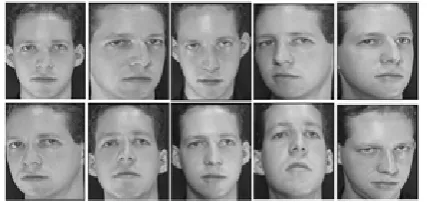
The ORL face database is used to evaluate the ro-bustness of the proposed method against different viewing directions and poses, as well as to compare the proposed method with several available methods. This database contains 40 distinct individuals and 10 pictures for each individual. Figure 10 indicates an example of one individual with ten different viewing directions and poses in the ORL database. Five im-ages were considered as the training imim-ages and the remaining five images were utilized as the test images. The results are shown in Table 4. Results show that
Figure 10. An Example of One Individual With 10 Different Viewing Directions and Poses in the ORL Database.
the proposed method has a higher recognition rate compared to the sate-of-the-arts.
5.4 Time Complexity
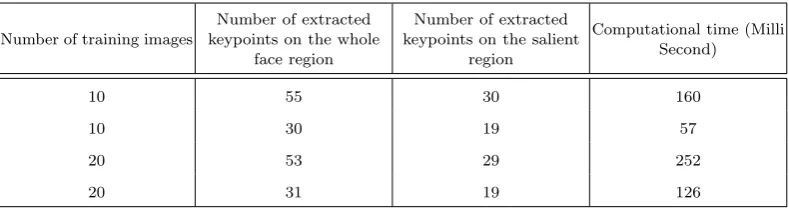
Our proposed face recognition method was imple-mented using C# programing language. The experi-ments were run on a computer with a 2.2 GHz Intel Corei7 and RAM of 6 GB. The computational times for the proposed face recognition technique on the images with size 70×70 and the length of the fea-ture vector 128 are shown in Table 5. In this table the number of extracted SIFT keypoints from the whole and salient regions of the face are also shown. The results indicate that the proposed method has very low execution time.
6
Conclusions
In this article, an effective method for face recognition was proposed. First, salient regions of facial image are extracted, then SIFT descriptor, and in the following, PCA are utilized for feature extraction. Finally, the Kepenekci matching method is used to compute the similarity between the images. The proposed method is robust against illumination changes, partial cov-erage, and pose variations. Also, to further enrich robustness of the proposed method against illumina-tion variaillumina-tions, a preprocessing is done on the image. The proposed method was evaluated on the ORL, Ex-tended Yale B, and FEI databases. The results showed that the proposed method outperforms the existing face recognition in terms of recognition rate.
References
[1] R. Min, A. Hadid, and J. L. Dugelay. Improv-ing the recognition of faces occluded by facial accessories. InIEEE International Conference on Automatic Face & Gesture Recognition and Workshop, pages 442–447. IEEE, 2011. ISBN
One picture
pictures picture pictures
50 83.8 99.6 90.4 100
100 82.5 99 89.8 100
200 80.6 98.2 87.9 99.4
Table 3. The Face Recognition Rate With Different Lengths of the SIFT Feature Vectors.
Length of the feature vector
Number of individuals
50 100
128 90.4 89.8
64 89.8 89.1
32 88.1 88
16 84.2 83.6
Table 4. Comparison of Different Methods With the Proposed Method in Face Recognition Rate on the ORL Database
Methods
Training images number
Five images
Gauss-Laguerre [21] 90
Local Gabor [19] 92.5
SIFT-Kepenekci [18] 97.9
2D Gabor [20] 99
kernel discriminates analysis [27] 96
Proposed Method 99.5
Table 5. Computation Time of the Proposed Face Recognition.
Number of training images
Number of extracted keypoints on the whole
face region
Number of extracted keypoints on the salient
region
Computational time (Milli Second)
10 55 30 160
10 30 19 57
20 53 29 252
20 31 19 126
descriptor for automatic face recognition. In Pro-ceedings of SPIE - The International Society for Optical Engineering, 2013. ISBN 9780819499967.
doi:10.1117/12.2052804.
[3] D.G. Lowe. Object recognition from local scale-invariant features. InProceedings of the Seventh IEEE International Conference on Computer Vi-sion, pages 1150–1157. IEEE, 1999. ISBN 0-7695-0164-8. doi:10.1109/ICCV.1999.790410.
[4] Janez Kri?aj, Vitomir ?truc, and Nikola Pave?i?
Adaptation of SIFT Features for Robust Face Recognition. In International Conference Im-age Analysis and Recognition, pages 394–404. Springer, Berlin, Heidelberg, 2010. ISBN 978-3-642-13772-3. doi:10.1007/978-3-642-13772-3 40. [5] M. Turk and A. Pentland. Eigenfaces for recognition. Journal of Cognitive Neuro-science, 3(1):71–86, 1991. ISSN 0898-929X. doi:10.1162/jocn.1991.3.1.71.
Krieg-man. Eigenfaces vs. Fisherfaces: Recognition us-ing class specific linear projection. IEEE Trans-actions on Pattern Analysis and Machine Intel-ligence, 19(7):711 – 720, 1997. ISSN 0162-8828. doi:10.1109/34.598228.
[7] M. S. Bartlett, J. R. Movellan, and T. J. Se-jnowski. Face recognition by independent compo-nent analysis. IEEE Transactions on Neural Net-works, 13(6):1450–1464, 2002. ISSN 1941-0093. doi:10.1162/jocn.1991.3.1.71.
[8] R. Brunelli and T. Poggio. Face recognition through geometrical features. InEuropean Con-ference on Computer Vision, pages 792–800. Springer, Berlin, Heidelberg, 1992. ISBN 978-3-540-55426-4. doi:10.1007/3-540-55426-2 90. [9] T. Ahonen, A. Hadid, and M. Pietik?inen. Face
Recognition with Local Binary Patterns. In Euro-pean Conference on Computer Vision, pages 469– 481. Springer, Berlin, Heidelberg, 2004. ISBN 978-3-540-24670-1. doi:10.1007/978-3-540-24670-1 36.
[10] B. V. Kumar and B. S. Shreyas. Face recognition using gabor wavelets. In2006 Fortieth Asilomar Conference on Signals, Systems and Computers, pages 593–597. IEEE, 2006. ISBN 1-4244-0784-2. doi:10.1109/ACSSC.2006.354817.
[11] David G. Lowe. Distinctive image fea-tures from scale-invariant keypoints. In-ternational Journal of Computer Vision, 60(2):91–110, 2004. ISSN 1573-1405. doi:10.1023/B:VISI.0000029664.99615.94. [12] H. Bay, T. Tuytelaars, and L. V. Gool. Surf:
Speeded up robust features. InEuropean Con-ference on Computer Vision, pages 404–417. Springer, Berlin, Heidelberg, 2006. ISBN 978-3-540-33833-8. doi:10.1007/11744023 32.
[13] M.V. Sudhamani and K. Halappa. Experimental analysis of SIFT and SURF features for multi-object image retrieval. International Journal of Computational Vision and Robotics, 7(3):344–356,
2017. doi:10.1504/IJCVR.2017.083448.
[14] V. Devi, J. Baber, M. Bakhtyar, I. Ullah, W. Noor, and A. Basit. Performance Evaluation of SIFT and Convolutional Neural Network for Image Retrieval. International Journal of Advanced Computer Science and Applications, 8(12), 2017.
doi:10.14569/IJACSA.2017.081268.
[15] H. Guo, S. Su, J. Liu, Z. Sun, and Y. Xu. An Image Retrieval Method Based on Manifold Learning with Scale-Invariant Feature Control.
Telecommunication Computing Electronics and Control, 17(2):252–258, 2016. ISSN 1693-6930.
doi:10.12928/telkomnika.v14i3A.4409.
[16] V. Purandare and K. T. Talele. Efficient heteroge-neous face recognition using Scale Invariant Fea-ture Transform. InInternational Conference on
Circuits, Systems, Communication and Informa-tion Technology ApplicaInforma-tions (CSCITA), pages 305–310. IEEE, 2014. ISBN 978-1-4799-2494-3. doi:10.1109/CSCITA.2014.6839277.
[17] H. Kumar and P. Padmavati. Face Recogni-tion using SIFT by varying Distance Calcula-tion Matching Method. International Journal of Computer Applications, 47(3):20–26, 2012. doi:10.5120/7168-9739.
[18] L. Lenc and P. Kr?l. Novel matching methods for automatic face recognition using sift. In Interna-tional Conference on Artificial Intelligence Appli-cations and Innovations, pages 254–263. Springer, Berlin, Heidelberg, 2012. ISBN 978-3-642-33409-2. doi:10.1007/978-3-642-33409-2 27.
[19] N. Sang, J. Wu, and K. Yu. Local Gabor Fisher Classi?er for Face Recognition. In Fourth In-ternational Conference on Image and Graphics (ICIG 2007), pages 620–626. IEEE, 2007. ISBN 978-0-7695-2929-5. doi:10.1109/ICIG.2007.76. [20] M. Srinivasan and N. Ravichandran and. A
new technique for Face Recognition using 2D-Gabor Wavelet Transform with 2D-Hidden Markov Model approach. In International Conference on Signal Processing , Image Pro-cessing & Pattern Recognition, pages 151– 156. IEEE, 2013. ISBN 978-1-4673-4861-4. doi:10.1109/ICSIPR.2013.6497977.
[21] K. Lai, A. Poursaberi, and S. Yanushkevich. One-shot facial feature extraction based on Gauss-Laguerre filter. In IEEE 27th Canadian Con-ference on Electrical and Computer Engineering (CCECE), pages 1–6. IEEE, 2014. ISBN 978-1-4799-3099-9. doi:10.1109/CCECE.2014.6901065. [22] I. Dagher, N. E. Sallak, and H. Hazim. Face
recognition using the most representative sift images. International Journal of Signal Pro-cessing, Image Processing and Pattern Recog-nition, 7(1):225–236, 2014. ISSN 2005-4254. doi:10.14257/ijsip.2014.7.1.21.
[23] W. ZHANG, X. ZHAO, J. M. Morvan, and L. Chen. Improving Shadow Suppression for Illu-mination Robust Face Recognition. IEEE Trans-actions on Pattern Analysis and Machine Intel-ligence ( Early Access), pages 1 – 1, 2018. ISSN 0162-8828. doi:10.1109/TPAMI.2018.2803179. [24] D. Chen, X. Cao, F. Wen, and J. Sun.
Bless-ing of dimensionality: High-dimensional feature and its efficient compression for face verifica-tion. InIEEE Computer Society Conference on Computer Vision and Pattern Recognition, pages 3025–3032. IEEE, 2013. ISBN 978-0-7695-4989-7. doi:10.1109/CVPR.2013.389.
doi:10.1016/j.patcog.2017.03.010.
[27] M. Z. N. Al-Dabagh, M. H. M. Alhabib, and F. H. AL-Mukhtar. Face Recognition Sys-tem Based on Kernel Discriminant Analysis, K-Nearest Neighbor and Support Vector Ma-chine. International Journal of Research and En-gineering, 5(3):335–338, 2018. ISSN 2348-7860. doi:10.21276/ijre.2018.5.3.3.
[28] D. Sage. Biomedical Imaging Group.
http://bigwww.epfl.ch/sage/soft/
localnormalization/, Date Accessed: August
15, 2017.
[29] Y. Shi, J. Yang, and R. Wu. Reducing illumina-tion based on nonlinear gamma correcillumina-tion. In
IEEE International Conference on Image Pro-cessing, pages 529 – 532. IEEE, 2007. ISBN 978-1-4244-1436-9. doi:10.1109/ICIP.2007.4379008. [30] H. Hassanpour. Image Enhancement via
Re-ducing Impairment Effects on Image Compo-nents. International Journal of Engineering-Transactions B: Applications, 26(11):1267–1274,
2013. doi:10.5829/idosi.ije.2013.26.11b.01. [31] S. A. Amir and H. Hassanpour. A
Preprocess-ing Approach For Image Analysis UsPreprocess-ing Gamma Correction. International Journal of Computer Applications, 38(12):38–46, 2012.
[32] M. U., V. Franc, and V. Hlavac. Detector of facial landmarks learned by the structured output SVM.
International Conference on Computer Vision Theory and Applications, 1:547–556, 2012. [33] ORL Database. Digital Technology Group.
http://www.cl.cam.ac.uk/research/dtg/
attarchive/facedatabase.html, Date
Ac-cessed: August 15, 2017.
[34] C.E. Thomaz. FEI Database. http://fei.edu.
br/~cet/facedatabase.html, Date Accessed:
August 15, 2017.
[35] k.Ch. Lee. Extended Yale B Database.
http://vision.ucsd.edu/~iskwak/
ExtYaleDatabase/ExtYaleB.html, Date
Ac-cessed: August 15, 2017.
neering from Amirkabir University of Tech-nology, Tehran, Iran, in 1997, and the Ph.D. degree in signal processing from Queensland University of Technology, Brisbane, Australia. He is currently a professor at Department of Computer Engi-neering, Shahrood University, Iran.
Omid Kohansalreceived the B.S. degree in Computer Engineering from Hakim Sabzevari University, Sabzevar, Iran, in 2013 and the M.S. degree in Computer Engineering from Shahrood University of Technology, Shahrood, Iran, in 2015.