A fault tolerance routing protocol considering
defined reliability and energy consumption in
wireless sensor networks
Hamid Hassan kashi1, Amir Masoud Rahamni2, Mehdi Hosein zadeh3, Vahid Sadatpour4
Received (20-8-2011) Accepted (20-11-2011)
Abstract - In wireless sensor networks, optimal consumption of energy and having maximum life time are important factors. In this article attempt has been made to send the data packets with particular reliability from the beginning based on AODV protocol. In this way two new fields add to the routing packets and during routing and discovering of new routes, the lowest remained energy of nodes and route traffic based on the number of discarded packages, will store in this field as two variables. These two variables will be considered during choosing a suitable route for sending the data to that message which should be answered by sink. The efficiency of this protocol is based on the fact that, at the route request, it finds the routes with high energy and low traffic through which data are sent(information is sent).So data packets reach the destination with a higher probability and also the balance of energy consumption is considered in the network. From the energy point of view, not using weak nodes routes leads to not having off nodes at the end of the process. This fact affects balancing of energy consumption and reducing the variance of the energy remainder proportional to AODV model. Not using high traffic routes leads to reducing collision and sending fewer signaling packets; more data packets with lower delay reach the destination. In the case of high congestion, for meeting the desired reliability, which is among the main goals there may be more sending signaling packets, delay and collision. But this happens with sending more packets and a guaranteed reliability.
Index Terms - Wireless Sensor Networks, Ad hoc networks.
1-Department of Computer, Arak Branch, Islamic Azad
University, Arak, Iran.([email protected])
2 Department of Computer Engineering, Science and Research Branch, Islamic Azad University, Tehran, Iran,
3 Department of Computer Engineering, Science and Research Branch, Islamic Azad University, Tehran, Iran, ([email protected])
I. INTRODUCTION
W
ireless sensor networks are bunches ofsensor nodes which have been scattered
in an environment. These nodes have the task of sensing the desired events and sending them to the sink via middle nodes. These nodes have limited
resources such as batteries and processors. These limitation should be considered while routing,
sending and receiving data in all protocols. Wireless sensor network is different from wired sensor network in routing and energy consumption.
As a result of limitation in energy, bandwidth
and doing various operations, routing protocols of wireless sensor networks are challenged. The conducted research, with the purpose of
optimizing the efficiency of the current algorithm
for proper energy consumption and avoiding a
rise in routes traffic, are related to the following
approaches.
1. Optimization of energy consumption (proposing methods for reducing energy consumption and increasing network lifetime)
2. Proposing various patterns for calculating
the reliability (selecting various parameters for the reliability of a route)
3.K-coverage and K-connectivity (proposing methods for coverage and connectivity in a way that, every second each node at least with K is
covered by the neighboring node).
4. Analyzing network fault tolerance
5. Examination of the network in high scales
and also in the above mentioned states.
In other words, all the existing algorithm,
focusing on one or some items mentioned above,
either attempt to optimize their performance or try to propose different methods for examination
of reliability and fault tolerance. Since none of
them attempts to propose a precise amount to
recognize a weaker or high traffic route and they
recognize these routes proportionality. So in this
article attempt has been made to focus on items
1 and 2 to appoint threshold quantity in order
to recognize a route from the energy and traffic viewpoint. It means that if the energy field of a
route is less than the threshold quantity, the route
is a weak one and if the reliability of a route is
less than the threshold quantity, it is a crowded
route. The final purpose of this article is creating a better balance in energy consumption, increasing
lifetime of the network, rising fault tolerance,
and with exploiting the above mentioned items, data be sent to the destination with a definite
reliability.
In the following section, the studies done
before will be presented and also AODV algorithm will be explained. Then, the proposed algorithm will be analyzed and simulation and its result will be presented in the next part. Finally, the future plans will be discussed.
II. A REVIEW OF THE RELATED STUDIES
In designing all routing algorithm, having the maximum lifetime in this kind of network
is one of the major subjects. Considering the
remainder of energy of each node and the quality
of connectivity can be good criteria in selecting
the appropriate route and sending data.
Multi-routing protocol seeks this purpose. [1] Efficiency in consumption is worthwhile when reliability
in delivering the data packets is taken into account. Routing, with exploiting the energy and
having reliability, seeks these issues [2,8,9]. For
example, after a while , those nodes which have
greater roles in sending data should be identified and special plan should be considered for them. Great care should be given to these nodes not to
lose their energy soon. [3] Semi proactive AODV protocol attempts to meet this purpose.
In wireless routing networks, nodes and connections have the potential of getting
damaged. So something must be done to have
alternative routes. Connectivity properties of large scale sensor networks algorithm seek providing alternative routes.[4] Coverage and
connectivity are other subjects which help to define network fault tolerance. It means that, every second, it is possible to define precisely how many neighboring nodes cover each node. As
connectivity is highly dependent upon the level of node coverage, always strong connectivity
should be used. Measuring fault tolerance
in wireless sensor network with large scales seeks to approximate this quantity.[5.6] Delay
and scalability along with reliability and low
energy consumption are important parameters
in a system. So there should be a balance among
energy consumption, fault tolerance, and delay. [7] Clustering is another method in satisfying
the above mentioned aims. In other words, neighboring nodes are located in a cluster and a node, which may be the strongest one, can be defined as the cluster head. Clusters communicate
with one another via cluster head and if the energy of cluster head is weakened, this task will
cluster-based wireless sensor system. In the following section, AODV protocol will be explained which is the basic and principal protocol in this paper and then the proposed protocol will be discussed and finally, simulation, result analysis, and future plans will be defined in the subsequent sections.
III. THE ANALYSIS OF AODV ALGORITHM
In this section AODV on-demand routing algorithm, which is one of the most important
proposed protocols in Ad hoc networks, has been applied as a basic protocol for research in this article and it has been analyzed.
AODV algorithm provides the possibility of
dynamic and multi-hop routing among nodes in a
network. In this algorithm, nodes can find a route
toward a destination fast and they do not save the unused routes.
In AODV algorithm, connectivity breakage,
and network topology changes are controlled. Routing operation in AODV lacks a loop and
it does not have the problem of “counting to infinity” of the Bellman-Ford algorithm at the
time of network topology changes.
Using destination sequence number in each record of routing table is one of the characteristics
of AODV algorithm.
Sequence number of destination is assigned by destination node. Using this field guarantee
not creating a loop in routing and its planning is so simple. If there are two routes for a destination, the sender node select the route with the larger
sequence number. Another characteristic of AODV is that a connectivity breakage is
immediately informed to the affected node [11].
IV. EXPLANATION OF PROTOCOL The existence of distinct traffic and sending
data via repetitive routes are among the important
problems in wireless sensor networks. These problems lead to high energy consumption of
route nodes and also result in turning off and deletion of these nodes from the whole collection of nodes. If these nodes sense important information, in other words, if the events happen near them, their deletion can affect the whole network.
On the other hand traffic rise from specific routes lead to repletion of middle node buffer
which can lead to another challenge in the network.
So there is enough energy in these nodes, but, as a result of buffer repletion, the received packets
must be deleted; a huge amount of data will not
reach the destination. Using on-demand routing and AODV protocol, this research attempts to prevent from transferring data through such
routes. As the information of a route is defined
when the route is discovered, the algorithm tries
to be informed of the energy state and the traffic of the route. In AODV –based method, when the
route request packets reach the destination node or when the middle nodes having a route towards the destination, route reply packets are sent to the
origin which defines the route and the number of
hops.
Having only this information cannot assure
that the nodes of this route have a suitable
condition regarding the energy and empty
capacity of buffer. In this protocol, two other fields, called energy and reliability, are added to the route discovery packets (probability of
sending the data through this route). During
passing the route, these fields are quantified to be situated along other information which reach the destination node or sink in basic model. With
considering all these data, an appropriate route
will be declared in response to the route request.
In this protocol, for satisfying the desired
reliability, if it is recognized that none of the routes has a suitable traffic state on its own(after
passing time and reducing energy in each node
and increasing the capacity of buffer), considering reliability formula, in parallel routes some routes can be offered to the origin. It is done to satisfy the desired reliability by sending multi-casting from the beginning.
The Manner of Quantifying the Energy Fields and Reliability in the Route Discovery Packet
The energy field is considered as a limiting parameter. In the beginning the quantity of this field equals the primary energy of each node (a primary energy is assumed for each node;
with each sending or receiving, depending on
the kind of contents, which can be signaling or
data, a quantity of it is reduced) and during the process of route discovery, each node which has
less energy of this field replace its energy. At the end of this procedure the energy field of route
discovery packet will equal the least energy of that route node.
time of route discovery, this number is multiplied by the reliability. A new field or a damaged probability, called ρ , is added the information of nodes in time scale and it is quantified according
to equation 1as follow:
ρ=(Dropped packets)/(Received packets) (1)
This fraction shows the ratio of drop packets
to the whole received packets. For example, if
it is 0.3, it means that the node has dropped 30 percent of the received packets.
Based on the quantity ofρ the reliability of the node will be according to the equation 2:
R= (1- ρ) (2) For the above mentioned node, reliability will be 70 percent; the information will pass through it with 70 percent probability.
The reliability of a route, which will be available when route discovery packets reach the sink, equals the multiplication of reliability of
each node and it is as follow:
(3)
In order to avoid sending the information
through low energy and high traffic routes, which
form the purpose of this article, we do as follow: 1. If the energy of the route is less than that
of defined threshold, that route will be ignored
(we should wait for new routes).
2. If the energy of the route is enough, its
reliability will be examined and if it meets the
desired quantity, response is given to this route.
3. If a route does not satisfy the reliability
on its own, the response is given to some routes
that generally satisfy the reliability.
Equation 4.the manner of calculation of
parallel routes reliability
(4)
We continue the number of selected routes (n)
until Rt reach the desired level.
While (not end of routes record list) { If (current route has enough energy) {
If (current route has enough reliability) { RREP (current route); Exit; }
Else
(add current route to parallel routes)
If (parallel routes had enough reliability) { RREP (parallel routes);
Exit; } }
go to next record; }
V. SIMULATION AND THE RESULTS In this article, by using Glomosim simulator software, attempt has been made to reconstruct
and analyze the proposed hypothesis such as the
existence of traffic in distinct routes. To this end, some nodes have been distributed in the whole
simulation environment to discover routes and
send information in a definite period and number. With having this number of sender nodes and data packets, we will certainly have heavy traffic
and crossed routes. In this simulation, the aim
is to show that AODV, by selecting repetitive
routes, will encounter heavy drop of energy in
specific nodes and finally their turning off. So, by
expanding the operation in a more extended area of the network, the proposed protocol attempts to
balance the energy consumption and increase the
life time of the network. It also tries to provide
the reliability. First simulation:
TABLE 1
The primary information is as follow
Sen der n od es Th e s ize o f da ta p ack et s Th e d esi red rel ia bili ty Th e q uan tity of e ne rgy thr esh ol d The pr im ary en er gy of no de s En vi ronm en t The num be r of no de s
11 512B 99% 500 2000unit 1000×
1000 Meter
100 nodes
By taking a look at the above chart, it is understood that about 10 percent of the nodes start
sending data. In the proposed protocol, regarding the quantity of the threshold with energy equal to 500, when the mentioned node reaches to the 25
percent of the primary energy, it will be renewed from the cycle of activity and it will not be used (with reducing the quantity of threshold, it can be
used in the future).
On the other hand, by determining reliability of 90 percent, it is expected that the same percent
of the data reach the destination.
The Results of simulation the important parameters of these networks are the criteria for evaluation of two protocols. These items include
balance in energy consumption, existence or non-existence of off nodes, delay, the number of occurred collisions, and the number of signaling
Fig.1 shows the topology of this simulation.
1. The Number of sent and arrival packets
TABLE2
The number of sent and arrived packets in the destination The number of arrived
packets
The number of
sent packets
The counter of packet
AODV
The proposed method
797 795
800 0
197 199
200 7
100 100
100 9
294 299
300 11
128 149
150 25
100 100
100 35
298 299
300 50
150 150
150 53
100 99
100 70
199 200
200 80
100 100
100 90
2463 2490
The sum of all packets
37 10
The number of dropped
packets
98.5% 99.6%
The percent of arrived packets
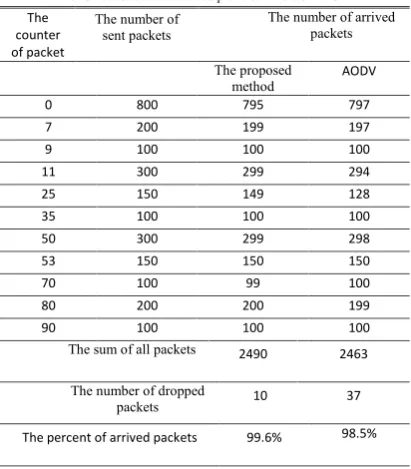
As shown in table 2, in the proposed protocol, the percent of arrived data satisfies the desired reliability. The number of arrived packets in the
destination in the proposed model is greater than
that of AODV, and the data with high probability
have arrived at the destination.
2. The condition of energy remainder
TABLE 3
The sum of energy remainder
Difference The proposed method
AODV
2782 152447
155229
Energy variance
911 1616
2527
Based on the information in table 3, sending
more data packets, it refers to sending data
through low traffic routes which do not need retransmission. Lesser variance points to a better balance in the energy remainder. It means that the energy of nodes has reduced in a balanced
proportion and unlike the AODV, there are neither
a number of nodes with energy equal the primary energy or a number of off nodes in another part.
All nodes are on and active.
As the number of nodes is 100 and their locations are random, the nodes from 0 to 99 have been classified into 10 groups for both. This has been done to simplify the explanation and
comparison of algorithm performance. Now each group is analyzed.
Graph .1 the amount of energy remainder of each group
As predicted, the balance in energy consumption in the proposed model is better than that of AODV algorithm and the variance (table3)
shows this issue.
In the proposed model, all nodes are on at the end of the simulation and their minimum energy
are off. Among these nodes, two of them are near the sink and are located in an important place.
Fig .2 turned off nodes
analyzing the energy of nodes more precisely after the simulation in AODV model, it is found
out that about 25 percent of them have lost a bit energy; it shows that they had no roles in sending
and receiving data. In the proposed model, more consumption of energy is the result of selecting
different routes which are possibly farther to the destination. It should be mentioned that more consumption of energy has been along sending
more data.
3. Collision condition
In graph 2, the amount of collision in 10
selected groups has been shown. As expected, identification of high and low traffic routes and
sending data through different and uncrowded routes has led to lesser intermixture.
As illustrated in the graph, except two groups, intermixture in each group either equals or is less than that of AODV model.
It has also been shown in energy consumption because intermixture rise in data packets can
have high energy consumption.
Graph .2 the amount of collision
4. End- to- End Delay Condition
Regarding sending data through different or farther routes, and expending the activity to a more extended area of the network, it seems
that there should be more delay. So intermixture
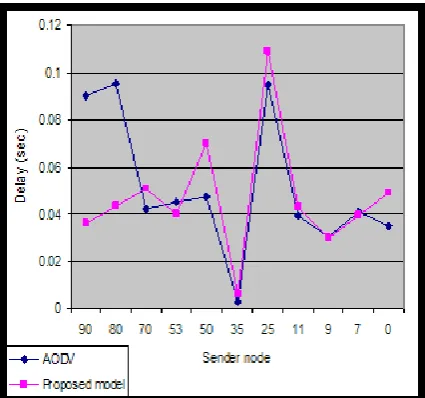
decrease in data packets, and not requiring retransmit have led to less delay generally. In graph 3, transfer delay rate of each node to the
destination by second has been defined
Graph .3 delay rate of all data transfer from each node
5. The Number of Signaling Packets
Data transfer through low traffic routes, result in better arrival of data packets. So there is no need to discover new routes to transfer data; regarding this approach, the number of signaling
Graph .4 number of signaling packets
Second simulation: (more extensive)
TABLE 4
The primary information is as follow
Sen der no de s Th e s ize o f da ta p ack et s Th e d esi red rel ia bili ty Th e q uan tity of e ne rgy thr esh ol d The pr im ary en er gy of no de s En vi ronm en t The num be r of no de s
11 2KB 90% 500 2000unit
1000× 1000 Meter
100 nodes
1. The Number of sent and arrival packets
TABLE5
The number of sent and arrived packets in the destination The number of arrived
packets
The number of
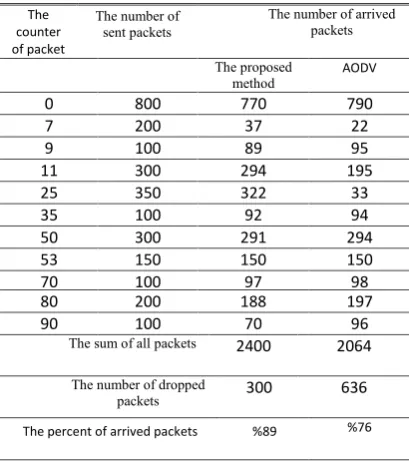
sent packets The counter of packet AODV The proposed method 790 770 800 0 22 37 200 7 95 89 100 9 195 294 300 11 33 322 350 25 94 92 100 35 294 291 300 50 150 150 150 53 98 97 100 70 197 188 200 80 96 70 100 90 2064 2400
The sum of all packets
636 300
The number of dropped
packets
%76 %89
The percent of arrived packets
2. The condition of energy remainder
TABLE 6
The sum of energy remainder
Difference The proposed method
AODV 21026 140194 161220 Energy variance 947 1047 1994
Graph .5 the amount of energy remainder of each group
3. Collision condition
Graph .6 the amount of collision
Graph .7 delay rate of all data transfer from each node
5. The Number of Signaling Packets
Graph .8 number of signaling packets
VI. FUTURE PLANS
Great attention must be given to an important case in the future and it can be precise selection of the quantity of threshold energy and reliability.
Sometimes, the static of this quantity can lead to
more energy consumption and greater number
of controlling messages. By selecting a precise and intelligent algorithm and implementing it in a sink which has no limitation, these quantities
can be changed dynamically and be transferred
to all nodes.
If a node is not used for a long time, its
reliability do not change (according to the ρ
formula, if no datum is given to it for transfer, the denominator remains constant) and despite transferring the current data in the memory, this
node is presumed as a high traffic node which is not used. So it is essential that, in specific time intervals, this node correct the reliability by considering the buffer capacity.
VII. CONCLUSION
As expected, two important aims have been met: creating balance in energy consumption in the network and providing the desired reliability for transferring data. It can be seen that for more parameters the proposed method has been better
than AODV.
REFERENCES
[1] Shuo XIAO, Xueye WEI and Yu WANG, “A
multipath routing protocol for wireless sensor network
for mine security monitoring” ,School of Computer and
Technology, Chaina University of Mining & Technology,
Xuzhou 221116, China September 2009
[2] R. Vidhyapriya and P.T. Vanathi, “Reliable energy-efficient routing with novel route update in wireless sensor networks “ , Journal of Zhejiang University SCIENCE Advances in Soft Computing, 2009, Volume 62, Fuuzy
Information and engineering Volume2
[3] Tooska dargahi, Amir Masoud Rahmani, Ahmad
Khademzadeh, “SP-AODV:A Semi-Proactive AODV Routing Protocol for Wireless Networks” , Internationsl
Conference on Advanced Computer Theory and Engineering 2008
[4] Hossein Pishro –Nik, Kevin Chan and Faramarz Fekri, “Connectivity properties of large-scale sensor networks” Lecture Notes in Computer Science, 2007 Volume 4761,Software Technologies for Embeded and Ubiquitous Systems
[5] Habib M, Ammari, Saja K.Das, “Fault tolerance measures for large scale wireless sensor networks”, ACM New York, NY, USA, Year of 2009
[6] Shu Qin, Ren, Jong. Sou Park, “Fault tolerance data aggregation for Clustering Wireless Sensor Networks”, Springer Science + Bussiness Media , LLC,2008
[7] Ilker Bekmezci, Fatih Algoz, “Energy Efficient, Delay Sensitive, Fault tolerant Wireless Sensor Networks for Military Monitoring” , International journal of Distributed Sensor networks , Vol 5 .Issue 6.November 2009
[8] Yong – Pyo, Kim, Euihyun jung, and Young-Jin Park, “A Radio- Aware Routing Algorithm for Reliable Distributed Diffusion in Lossy Wireless Sensor Network”Published: 13 October 2009
[9] Zhengyi Le.Eric Becker, Dimitrios G, Konstantinides, “ modeling reliability for wireless sensor node coverage in assistive testbeds “, Acm International
conference Proceeding Series,2010
[10] Wn Guowei, L in Chi, Yao Lin, Lin Bing,” A cluster Based WSN Fault Tolerant Protocol” , Journal of
electronics(CHINA), Vol.27 No.1. january 2010
[11] Advanced topic in Wireless Networks Drs. Baruch
Awerbuch & Amitabh mishra Departement of computer