February 2016. Volume 2. Number 1
Client-Centered Nursing Care
Tahereh Najafi Ghezeljeh1, Alireza Abbasi2*, Mansoureh Ashghali Farahani2, Nasim Naderi3
1. Department of Intensive Care Nursing and Cardiovascular Perfusion Technology, Faculty of Nursing & Midwifery, Iran University of Medical Sciences, Tehran, Iran.
2. Department of Medical-Surgical Nursing, Faculty of Nursing & Midwifery, Iran University of Medical Sciences, Tehran, Iran. 3. Rajaie Cardiovascular Medical and Research Center, Iran University of Medical Sciences, Tehran, Iran.
* Corresponding Author: Alireza Abbasi, MSc.
Address: Department of Medical-Surgical Nursing, School of Nursing & Miwifery, Iran University of Medical Sciences, Tehran, Iran.
Tel: +98(937) 5482857
E-mail: [email protected]
The Effect of Self-Management Training Using CD on the
Quality of Life in Patients with Chronic Heart Failure
Background: Chronic heart failure (CHF) can have negative effects on the quality of life (QoL). Self-management education is one of the approaches that can be adopted to increase the QoL of these patients. This study aimed to determine the effect of self-management training using compact disc (CD) on the QoL in patients with CHF.
Methods: This study was a non-randomized controlled clinical trial which was conducted on 74 patients with CHF hospitalized in Shahid Rajaie Cardiovascular medical and research center in 2015. Research samples were selected with convenience sampling method and randomly assigned to intervention (training with CD) and control (conventional training) groups. To collect data, Iranian questionnaire to assess QoL in patients with heart failure (IHF-QoL) was completed in both groups before and 3 months after the intervention. Data analysis was done using statistical tests of the Independent t test and paired t-test using SPSS version 21.
Results: According to the findings, there was no significant difference between two groups before the intervention with regard to QoL scores (P=0.58). Statistical tests showed that 3 months after the intervention, self-management education promoted QoL subscales including psychological status (t=-2.578, P=0.012), self-care (t=-3.633, P=0.001), as well as total QoL (t=-2.01, P=0.048) in patients in the intervention group as compared with the control group. Also in CD method group, themean scores of total QOL and its subscales before the intervention were significantly different from that mean scores 3 months after the intervention., i.e. their total QOL and its all subscales improved after intervention. (P<0.0001).
Conclusion: As self-management training with CD can improve QoL in patients with CHF compared with conventional training method, it is suggested that this training method be considered as a part of patients’ self-management education by nurses with the aim of improving QoL.
A B S T R A C T
Keywords:
Chronic heart failure, Compact disc, Quality of life, Self-management training
Article info:
Received: 06 Aug. 2015
Accepted: 02 Nov. 2015
Citation: Najafi Ghezeljeh, T, Abbasi, AR, Ashghali Farahani, M & Naderi, N 2016, 'The effect of self-management training using CD on the qual-ity of life in patients with chronic heart failure', Journal of Client-Centered Nursing Care, vol. 2, no. 1, pp. 53-62. https://doi.org/10.32598/jccnc.2.1.53
:
: https://doi.org/10.32598/jccnc.2.1.53
that may be due to any disturbance in struc-ture or function of the heart. Chronic heart failure (CHF) is the inability of the heart to meet the body’s metabolic needs (Tissot et al. 2014). Patients with CHF have low quality of life (QoL) due to the multiple physical and mental disorders (Heidar-zadeh et al. 2012). CHF has impact on all dimensions of life and can reduce QoL in every aspect. Thus, it is very important that the patient can manage these problems him/ herself (Smeulders et al. 2010;Heo et al. 2009).
Self-management is one of the interventions that can be used in chronic diseases, including CHF to improve QoL and reduce symptoms and hospitalizations. Self-manage-ment comprises measures taken with the aim of raising patient’s awareness to promote his or her participation in chronic disease management, in particular monitoring of symptoms, and changing in health behaviors (Jonkman et al. 2014). In self-management, person is actively respon-sible for treatment and management of the daily symptoms and has a key role with respect to newly developed signs, performing interventions, disease management, and mak-ing informed decisions. Generally, the responsibility of the people increase in the face of public health.
Efficient self-management boosts individual’s abilities and reactions which persuades patients in respect of long-term observance of the principles taught, promotion of indi-vidual participation, and reducing hospitalization of cardio-vascular patients. Studies indicate that intervention-based self-management can enhance self-care and QoL (Baljani et al. 2012;Rezasefat et al. 2014;Tung et al. 2013).
By optimizing self-management behaviors in patients, nurses can help them in optimal control of symptoms. They promote the abilities of patients and encourage them to do what has learned (Hoffman 2013). Self-management be-haviors must be presented to patients by nurses using appro-priate teaching methods. Training can be provided in differ-ent ways in which lecture is the most common method and by using good content and lecturer, we can obtain positive, reasonable, and appropriate outcomes from this method.
There are many obstacles to develop self-management in patients, but new self-management educational programs, including the use of CD have the potential to overcome these obstacles and have a useful role to change patients’ behaviors and decisions. Actually, such programs allow pa-tients to meet their educational needs without being present in treatment centers, and reduce the cost of individual
treat-tive in improving QoL, but the manner of its presentation had important role in its results, so that teaching via CD was more effective on QoL in old 8-12 years children with asthma, compared with group educational method. Also
Speck et al. (2016) showed that e-learning for 6 weeks can improve asthma control and enhance the QoL in patients with uncontrolled asthma. This study was conducted to de-termine the effects of self-management training program with CD on the QoL of the patients with CHF.
2. Materials & Methods
This research was a part of a non-randomized controlled clinical trial. It was conducted on patients with CHF ad-mitted to Rajaie Cardiovascular medical and research cen-ter, Tehran, Iran in 2015.
Study patients
After the permission of the Vice Chancellor for Research and Ethics Committee of Iran University of Medical Sci-ences (107/105/D/94) as well as authorities of Shahid Rajaie Cardiovascular medical and research center, the re-searcher referred to the research setting and relevant wards to select patients with CHF who met the inclusion criteria. After explaining the study purpose to the patients and their agreement to participate in the study, they signed written informed consent forms. Patients were assured regarding the confidentiality of their information, their freedom to decline cooperation and exiting from the study without making any problem in their treatment and care process.
The subjects were selected by convenience sampling method. Then, they were assigned in the intervention (CD method) and control groups by simple randomization. The name of groups (CD and control) was written on cards and were placed in a sealed envelope. At the beginning of each week and before encountering with the patients, by tak-ing an envelope from the box, the researcher specified that patients who would be enrolled in each group. Samples, then, were selected for that group. After ensuring the dis-charge of the sampled patients, recruitment to select the next group was done.
Inclusion criteria were as follows; confirmed diag-nosis of heart failure by physician, not being in acute phase of the disease, no sensory-perceptual problems, ability to communicate and literacy, as well as ability to use computers by the patient or a family member in the intervention group. To determine the required sample
February 2016. Volume 2. Number 1
Client-Centered Nursing Care
size at 95% confidence interval, power of 80%, and assuming that the effect of CD method of training on QoL in patients with CHF has statistically significant difference of at least 7(d=7) with the control group and deviation in QoL is 10 according to the study of Tung et al. (2013), study sample size was calculated by the following formula:
n=(Z1-α+Z1-β )2×2s2/d2
Accordingly, each group had 32 subjects. With 25% drop out rate in each group, the sample size was considered 40 (Total sample size=80). Due to unwillingness of some patients to continue participation in the study, 6 people dropped out. Thus, 38 and 36 patients in the intervention group and control group, respectively were finally studied.
Data collection
In the current study, two questionnaires were used:
1) A demographic form: This questionnaire included questions about age, gender, educational degree, marital status, history of underlying disease, BMI, heart ejection fraction, duration of disease, the severity of disease due to heart failure, history of the disease family, number of chil-dren, income status, and medicines taken. This form was completed before the intervention by checking patient’s file or asking the patients.
2) Iranian questionnaire to assess QoL in patients with heart failure (IHF-QoL): The questionnaire was devel-oped by Naderi et al. (2012) and comprised 16 questions that examined physical symptoms such as shortness of breath, fatigue, peripheral edema, sleep disorder; psychi-atric symptoms such as depression and anxiety; patient’s social, physical, and sexual activity, as well as work, and emotions. Questions 1, 2, 3, 4, and 6 investigate symp-toms and their severity, question 7 which has 4 parts in-vestigates the patient’s physical limitations, questions 8, 10, 12, and 13 investigate social interference, questions 5, 9, and 11 investigate psychiatric conditions, questions 14 and 15 investigate the knowledge and self-efficacy and question 16 investigates life satisfaction of patients. The questions are scored according to Likert-type scale in which the larger the number, the better would be the patient’s condition. Summing the total score of questions results in the total QoL score in which scores ranges from 15 to 63. Lower scores indicate poor QoL and higher total scores show better QoL. The Cronbach's α coefficient for IHF-QoL is 0.922. And correlation coefficient tests were reported to be significant before and 3 months after the intervention (from 0.708 to 0.883; all P-values<0.001)
which was indicative of reliability of the questionnaire (Naderi et al. 2012). In this study, the Cronbach's α was 0.89 which indicated internal consistency of the tool.
Demographic questionnaire and IHF-QoL questionnaire were completed by subjects (CD method and control groups) before implementing the educational program. Also 3 months after the study, subjects (of both groups) were asked to attend the hospital to control the treatment process and complete the IHF-QoL.
Intervention
In the intervention group, including the patients and their family member were taught how to use the CD in one ses-sion for 20-15 minutes. They were asked to use the CD at home after discharge with the help of their families in the 3 months period. Educational content of CD included anatomy and physiology of the heart, introducing CHF, risk factors, symptoms, managing the symptoms of the disease, diagnostic solutions, diet, proper exercise, medi-cation and side effects, blood pressure control method, and the calculation of body mass index.
These topics were stored in the CD as PowerPoint slides, training videos with subtitles in Farsi, related photos, and the full text of the training manual. Included in the CD were also applications necessary to run video, photos, PowerPoint, and the text. Patients in the inter-vention group were called by phone for 2-5 minutes in 1, 2, and 3 months after discharge. These conversations aimed at reviewing and emphasizing their use of the CD. Control group only received routine training. After col-lecting the information, content and educational CDs were delivered to patients in the control group, too.
Data analysis
To analyze the data, descriptive and inferential statistics including paired t-test for within-groups comparison, the Independent t-test for between-groups comparison, the Chi-squared, and Fisher’s exact test to compare qualita-tive variables between two groups, were used. All analy-ses were done by SPSS version 21. Significance level was also considered to be less than 0.05.
3. Results
Mean±SD or % (No.)
Age, y 51.60(15.29) 44.05(13.16) 0.026
Gender Male 50.00(19) 47.20(17) 0.81
Female 50.00(19) 52.80(19)
Marital status
Single 10.50(4) 13.50(5)
0.89
Married 84.20(32) 80.61(29)
Widow 5.20(2) 5.62(2)
Income
Sufficient 42.10(16) 44.40(16)
0.03
Somewhat sufficient 26.30(10) 5.60(2)
Not sufficient 31.60(12) 50.00(18)
Job
Unemployed 10.50(4) 13.90(5)
0.85
Housewife 36.10(13) 39.50(15)
Employee 10.50(4) 16.70(6)
Self-employment 21.11(8) 11.10(4)
Retired 5.33(2) 8.30(3)
Others 13.20(5) 13.91(5)
Smoking
Yes 7.90(3) 13.91(5)
0.29
No 71.10(27) 77.82(28)
Quit smoking 21.10(8) 8.33(3)
Exercise Yes 52.63(20) 50.00(18) 0.80
No 47.42(18) 50.00(18)
Family history of the disease
Yes 50.00(19) 33.30(12)
0.14
No 50.00(19) 66.75(24)
Education
Elementary 10.50(4) 8.36(3)
0.19
Under diploma 47.41(18) 25.00(9)
Diploma 26.32(10) 28.90(14)
Higher education 15.80(6) 27.81(10)
Heart failure stage
I 00.00(0) 00.00(0)
0.33
II 55.29(21) 50.00(18)
III 34.20(13) 47.20(17)
IV 10.50(4) 2.81(1)
Cause Ischemic 52.61(20) 33.30(12) P=0.09
Non-ischemic 47.40(18) 66.73(24)
Ejection fraction, % 30.92(8.96) 31.47(8.07) P=0.78
BMI, kg/m2 24.30(5.32) 23.86(6.29) 0.04
February 2016. Volume 2. Number 1
Client-Centered Nursing Care
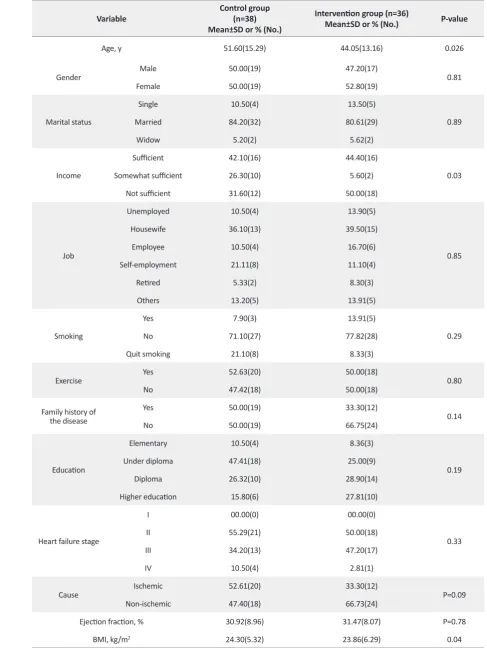
was 40-49 years and the statistical results showed that two groups were not matched in terms of age. The results showed that proportion of male to female patients in the control group was 1:1 but the number of males was higher in the intervention group (n=19). In both groups, most of the subjects were married and housewives, also the ma-jority did not smoke cigarette. With regard to educational
degree, most individuals in the control group were under diploma (47.4%) and in the CD method group, the high-est frequency belonged to diploma holders (28.9%). Fre-quency distribution and percentage of income in patients showed that the most frequent option in the control group was “sufficient” (42.1%) and in the CD method group was “not sufficient” (50%). In this respect, two groups were
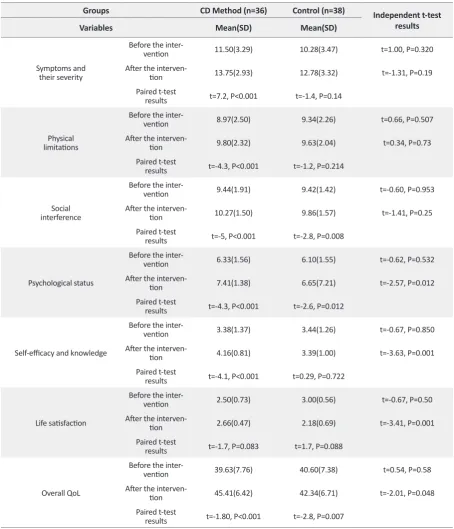
Table 2. Comparison of QoL scores in patients with CHF in control and CD method groups before and 3 months after self-management training.
Groups CD Method (n=36) Control (n=38) Independent t-test results
Variables Mean(SD) Mean(SD)
Symptoms and their severity
Before the
inter-vention 11.50(3.29) 10.28(3.47) t=1.00, P=0.320
After the interven
-tion 13.75(2.93) 12.78(3.32) t=-1.31, P=0.19
Paired t-test
results t=7.2, P<0.001 t=-1.4, P=0.14
Physical
limitations
Before the
inter-vention 8.97(2.50) 9.34(2.26) t=0.66, P=0.507
After the interven
-tion 9.80(2.32) 9.63(2.04) t=0.34, P=0.73
Paired t-test
results t=-4.3, P<0.001 t=-1.2, P=0.214
Social interference
Before the
inter-vention 9.44(1.91) 9.42(1.42) t=-0.60, P=0.953
After the interven
-tion 10.27(1.50) 9.86(1.57) t=-1.41, P=0.25
Paired t-test
results t=-5, P<0.001 t=-2.8, P=0.008
Psychological status
Before the
inter-vention 6.33(1.56) 6.10(1.55) t=-0.62, P=0.532
After the interven
-tion 7.41(1.38) 6.65(7.21) t=-2.57, P=0.012
Paired t-test
results t=-4.3, P<0.001 t=-2.6, P=0.012
Self-efficacy and knowledge
Before the
inter-vention 3.38(1.37) 3.44(1.26) t=-0.67, P=0.850
After the interven
-tion 4.16(0.81) 3.39(1.00) t=-3.63, P=0.001
Paired t-test
results t=-4.1, P<0.001 t=0.29, P=0.722
Life satisfaction
Before the
inter-vention 2.50(0.73) 3.00(0.56) t=-0.67, P=0.50
After the interven
-tion 2.66(0.47) 2.18(0.69) t=-3.41, P=0.001
Paired t-test
results t=-1.7, P=0.083 t=1.7, P=0.088
Overall QoL
Before the
inter-vention 39.63(7.76) 40.60(7.38) t=0.54, P=0.58
After the interven
-tion 45.41(6.42) 42.34(6.71) t=-2.01, P=0.048
Paired t-test
results t=-1.80, P<0.001 t=-2.8, P=0.007
lar exercise program and a history of the disease. In terms of the classification of heart failure according to the New York Heart Association (NYHA), patients in both groups were in class II of heart failure (Table 1). According to statistical tests, none of the demographic indicators were confounder in the test results.
The results of the Independent t-test showed that QoL and its subscales in patients with CHF had no signifi-cant difference in both groups before the intervention (P=0.58). However, after 3 months the control and inter-vention groups showed statistically significant differences (P=0.048) with regard to QoL scores. In other words, in-tervention improved the QoL of patients with CHF. Fur-thermore, after 3 months of intervention, QoL scores in subscales of psychological status (P=0.012), life satisfac-tion (P=0.001) and self-efficacy and knowledge (P=0.001) were significantly different between the intervention and control groups and have been improved. However, in other subscales no significant differences were observed between two groups (Table 2).
Based on the paired t-test results in the control group, QoL showed significant change after 3 months (P=0.007). Furthermore, the results of this test showed that in the intervention group there was a significant difference in terms of QoL 3 months after the intervention com-pared to the time before the intervention (P<0.001) and QoL has been improved. In reviewing various aspects of QoL in the intervention group, the statistical results of paired t-test showed that after 3 months, QoL scores of patients in all subscales (symptoms of heart failure, economic, social, psychological status, self-efficacy and knowledge, and daily activities of the individual) have been improved (P<0.001). With regard to different sub-scales of QoL in the control group, the statistical results of paired t-test showed that after 3 months of entering to the study, QoL scores of people in socio-economic (P=0.008) and psychological status (P=0.012) subscales significantly changed and QoL improved in these areas. However with regard to other subscales, no significant changes were observed in the control group before and 3 months after the start of the study (Table 2).
4. Discussion
Based on our findings, self-management education with CD method has improved QoL of patients with CHF com-pared with the control group. In line with the results of this study, Tung et al. (2013) showed that self-management
self-management training on QoL of patients with chronic obstructive pulmonary disease (COPD). They reported that self-management programs resulted in improvement of QoL through shortening the acute phase of the disease and its recurrence. Baljany et al. (2012) addressed the ef-fect of self-management by increasing patients’ aware-ness on the medicines adherence and changing lifestyle of patients with cardiovascular disorders.
However in a review study, out of 19 studies reviewed, in 5 studies, self-management training had no effect on QoL of patients with CHF. Nevertheless, the method-ological limitations of the studies evaluated in this re-view could be the cause of insignificant effects of the intervention on QoL. Self-management interventions are part of a multifaceted CHF intervention program and patients’ education is a key component of self-manage-ment, which its teaching is necessary to create aware-ness of the signs and symptoms, lifestyle changes, and adherence to treatment (Ditewig et al. 2010). In this re-gard, there are different methods of education with vari-ous effects on QoL. One can argue that compared to the conventional methods, like face-to-face training and giv-ing educational pamphlets, usgiv-ing educational CDs could improve QoL education. Also according to the findings in CD method group, QoL in patients with CHF after 3 months of training have had a significant improvement, compared with their QoL before the training period.
Mean score of QoL in these patients was improved after the training. In line with this study, Strömberg et al. (2006)
February 2016. Volume 2. Number 1
Client-Centered Nursing Care
Comparing two groups, 3 months after the intervention, revealed that, self-management education with CD im-proved QoL (compared with the control group) in these subscales: symptoms of heart failure, socio-economic and psychological status, daily activities, self-efficacy, and knowledge. However, these differences were statistically significant only in the areas of socio-economic status, self-efficacy, and knowledge.
Also with regard to within group comparison, the results showed that in the control group, an improvement was ob-served in the socio-economic status and consequently, in total QoL, 3 months after the study. However, this socio-economic improvement was higher in the CD method group after 3 months of intervention. Similarly, another study reported that self-management education programs can play an effective role in the economic status of patients with COPD by reducing the cost of readmission and also the number of patients admitted to hospital (Bourbeau et al. 2006). The results also showed that 3 months after the in-tervention compared with the pre-inin-tervention period, QoL improved in all aspects of QOL in the intervention group.
In another study, it was shown that limitations in phys-ical activities, mental disorders such as anxiety, and lack of knowledge about the disease can negatively affect QoL of these patients and it was proposed that the patient education be done to alleviate these problems (Malhotra et al. 2016). Similar to our study which indicated the QoL improvement in the psychological aspect, McCorkle et al. (2011) reported that self-management training in pa-tients with cancer could improve the management of the symptoms and reduce their anxiety and psychological problems in different courses of treatment and even after treatment, and consequently enhance patients’ QoL. One of the problems in patients with heart failure is limita-tions in physical activity. With regard to the QoL aspect of individual’s daily activities, the mean(SD) score in the control group (which has been provided with conven-tional self-management training) promoted significantly from 9.34(2.26) to 9.63(2.04). Likewise, in the interven-tion group, daily activities mean(SD) scores improved significantly from 8.97(2.50) to 9.80(2.3).
In line with these results, a study showed that life style of patients with CHF can be changed using different teaching methods and improving physical activity of these patients can prevent worsening of the disease and their restric-tions (Dontje et al. 2014). In self-management teaching group using CD, the mean(SD) score of self-efficacy and knowledge subscales improved from 3.38(1.37) to 4.16(0.81). Similarly, a study with the aim of compar-ing the computer-assisted traincompar-ing (uscompar-ing CD, includcompar-ing
contents such as videos, photos, etc.) and education using standard methods (giving brochures and face-to-face train-ing) on patients with heart disease showed that the level of knowledge and self-care in patients with CHF improved with both methods, but there was no significant difference between the two methods in terms of impact on self-care and self-efficacy (Dilles et al. 2011). de Walt et al. (2006)
also reported that patients with CHF who were taught with different educational methods performed more self-care control behavior over their daily weight compared to the patients in the control group. Also in their study, Ström-berg et al. (2002) concluded that in CD method group, training with CD increased patients’ knowledge, self-care, and self-efficacy compared with the control group.
Among the limitations of this study was impossibil-ity of blinding because of the nature of the intervention. Other limitation was failure to use block randomization method in sample selection. Also the impact of the inter-vention was evaluated in a 3-month period which is not long enough. We recommend that future studies be con-ducted with the aim of investigating the effects of long-term self-management training with CD on these patients. To determine the most suitable training approach, we sug-gest that different methods of teaching and their effects on QoL and self-management behaviors of these patients be compared. In this study, in addition to giving educational CD, telephone calls were made to be ensured of using CD. This was not done in the control group. Although in these calls, we tried only to emphasize the use of the CD, a study should be conducted with three groups under the conventional training and telephone follow-ups to ensure implementation of training tips to obtain the net effect of education considering follow-ups.
with modern methods like CDs to nurses and nursing stu-dents, a step is taken towards promoting self-management and QoL in patients with CHF.
Acknowledgments
This article is extracted from the thesis of Nursing and Midwifery School of Iran University of Medical Sciences. Researchers thank staff and directors of the Nursing and Midwifery School of Iran University of Medical Sciences and Shahid Rajaee Hospital and all those who participated and cooperated in the study.
Conflict of Interest
The authors declared no conflict of interests.
References
Aghvamy, M, Mohammadzadeh, S, Gallalmanesh, M & Zare, R 2011, '[Assessment the education compariment to two ways: groupe education and computer education on qol in the chil-dren 8-12 years suffering from asthma in the Valiasr Hospital of Zanjan (Persian)]'. Zanjan University of Medical Sciences Journal,
vol. 19, no. 74, pp. 78-85.
Baljani, E, Rahimi, Zh, Heidari, Sh & Azimpour, A 2012, '[The ef-fect of self-management interventions on medication adherence and life style in cardiovascular patients (Persian)]'. Scientific Journal of Hamadan Nursing & Midwifery Faculty, vol. 20, no. 3, pp. 58-68.
Bourbeau, J, Collet, JP, Schwartzman, K, Ducruet, T, Nault, D & Bradley, C 2006, 'Economic benefits of self-management educa-tion in COPD', Chest, vol. 130, no. 6, pp. 1704-711. doi: 10.1378/ chest.130.6.1704
de Walt, DA, Pignone, M, Malone, R, Rawls, C, Kosnar, MC, George, G et al. 2004, 'Development and pilot testing of a dis-ease management program for low literacy patients with heart failure', Patient education and counseling, vol. 55, no. 1, pp. 78-86. doi: 10.1016/j.pec.2003.06.002
Dickestein, K, Cohen-Solal, A, Filippatos, G, Mcmurray, JJ, Pon-ikowski, P, Poole-Wilson, PA et al. 2008, 'ESC guidelines for di-agnosis and treatment of acute and CHF', European Heart Journal,
vol. 29, no. 19, pp. 388-442.
Dilles, A, Heymans, V, Martin, S, Droogné, W, Denhaerynck, K & de Geest, S 2011, 'Comparison of a computer assisted learning program to standard education tools in hospitalized heart fail-ure patients', European Journal of Cardiovascular Nursing, vol. 10, no. 3, pp. 187-93. doi: 10.1016/j.ejcnurse.2010.07.001
Ditewig, JB, Blok, H, Havers, J & van Veenendaal, H 2010, 'Effec-tiveness of self-management interventions on mortality,
hospi-Dontje, ML, van der Wal, MH, Stolk, RP, Brügemann, J, Jaarsma, T, Wijtvliet, PE et al. 2014, 'Daily physical activity in stable heart failure patients', Journal of Cardiovascular Nursing, vol. 29, no. 3, pp. 218-26. doi: 10.1097/JCN.0b013e318283ba14
Dorn, S, Palsson, O, Woldeghebriel, M, Fowler, B, Mccoy, R, Weinberger, M et al. 2014, 'Development and pilot testing of an integrated, web-based self-management program for irritable bowel syndrome (IBS)', Neurogastroenterology & Motility, vol. 27, no. 1, pp. 128-34. doi: 10.1111/nmo.12487
Heidarzadeh, M, Hasani, P, Rahimzadeh, A, Ghahramanian, A, Kolahdouzipour, J & Yousef, I 2012, '[QoL and social support in congestive heart failure patients and healthy people (Persian)]',
Holistic Nursing & Midwifery Journal, vol. 23, no. 69, pp. 13-21. Heo, S, Lennie, TA, Okoli, C & Moser, DK 2009, 'Quality of life in
patients with heart failure: ask the patients', Heart & Lung: The
Journal of Acute and Critical Care, vol. 38, no. 2, pp. 100-108. doi: doi: 10.1016/j.hrtlng.2008.04.002
Hoffman, AJ 2013, 'Enhancing self-efficacy for optimized pa-tient outcomes through the theory of symptom self-manage-ment', Cancer Nursing, vol. 36, no. 1, pp. 16-26. doi: 10.1097/ NCC.0b013e31824a730a
Jonkman, NH, Westland, H, Trappenburg, JC, Groenwold, RH, Effing-Tijdhof, TW, Troosters, T et al. 2014, 'Towards tailoring of self-management for patients with CHF or chronic obstructive pulmonary disease: a protocol for an individual patient data meta-analysis', BMJ Open, vol. 4, no. 5, p. e005220. doi: 10.1136/ bmjopen-2014-005220
Malhotra, C, Wong, GC, Tan, BC, Ng, CS, Lee, NC, Lau, CS et al. 2016, 'Living with heart failure: Perspectives of patients from Singapore', Proceedings of Singapore Healthcare, vol. 25, no. 2, pp. 92-97. doi: 10.1177/2010105815624121
McCorkle, R, Ercolano, E, Lazenby, M, Schulman-Green, D, Schil-ling, LS, Lorig, K et al. 2011, 'Self-management: Enabling and empowering patients living with cancer as a chronic illness',
CA: A Cancer Journal for Clinicians, vol. 61, no. 1, pp. 50-62. doi: 10.3322/caac.20093
Mozaffarian, D, Benjamin, EJ, Go, AS, Grnett, DK, Blaha, MJ, Bush-man, M et al. 2015, 'Heart disease and stroke statistics--2015 up-date: a report from the American Heart Association', Circulation,
vol. 131, no. 4, pp. 299-322. doi: 10.1161/CIR.0000000000000152
Reihani, T, Pourghaznein, T, Ajam, M & Hasanzadeh, F 2012, '[A comparative study of lecturing and providing booklet on nurs-ing students’ learnnurs-ing and satisfaction (Persian)]', Modern Care Journal, 2012, vol. 9, no. 4, pp. 285-91.
Rezasefat Balesbaneh, A, Mirhaghjou, N, Jafsri Asl, M, Kohma-naee, S, Kazemnejad Leili, E & Monfared A 2014, '[Correlation between self-care and self-efficacy in adolescents with type 1 diabetes (Persian)]', Holistic Nursing and Midwifery Journal, vol. 24, no. 2, pp. 18-24.
Smeulders, ES, van Haastregt, J, Ambergen, T, Uszko-Lencer, NH, Janssen-Boyne, JJ & Gorgels, AP et al. 2010, 'Nurse-led self-man-agement group programme for patients with congestive heart failure: randomized controlled trial', Journal of Advanced Nursing,
February 2016. Volume 2. Number 1
Client-Centered Nursing Care
Sol, BG, van der Bijl, JJ, Banga, JD & Visseren, FL 2005, 'Vascu-lar risk management through nurse-led self-management pro-grams', Journal of Vascular Nursing, vol. 23, no. 1, pp. 20-24. doi: 0.1016/j.jvn.2004.12.003
Speck, A, Hess, M & Baptist, AP 2016, 'An electronic asthma self-management intervention for young African American adults',
Immunology in Practice, vol. 4, no. 1, pp. 89-95. doi: 10.1016/j. jaip.2015.08.007
Strömberg, A, Ahlén, H, Fridlund, B, Dahlström, U 2002, 'Interac-tive education on CD-ROM-a new tool in the education of heart failure patients', Patient Education & Counseling, vol. 46, no. 1, pp. 75-81. PMID: 11804773
Strömberg, A, Dahlström, U & Fridlund, B 2006, 'Computer-based education for patients with CHF: a randomised, controlled, multicentre trial of the effects on knowledge, compliance and QoL', Patient Education & Counseling, vol. 64, no. 1, pp. 128-135. doi: 10.1016/j.pec.2005.12.007
Tissot, C, da Cruz, EM & Miyamoto, SD 2014, 'Congestive heart failure', in E da Cruz, D ivy, J Jaggers (eds.), Pediatric and congeni-tal cardiology, cardiac surgery and intensive care, Springer-Verlag, London. doi: 10.1007/978-1-4471-4619-3_229
Tung, HH, Lin, CY, Chen, KY, Chang, CJ, Lin, YP & Chou, CH 2013, 'Self-management intervention to improve self-care and quality of life in heart failure patients', Congestive Heart Failure,
vol. 19, no. 4, pp. 9-16. doi: 10.1111/chf.12014
Wilson, PM, Kendall, S & Brooks, F 2006, 'Nurses' responses to expert patients: the rhetoric and reality of self-management in long-term conditions: a grounded theory study', International Journal of Nursing Studies, vol. 43, no. 7, pp. 803–818. doi: 803-18. 10.1016/j.ijnurstu.2005.10.011