EDUCATION
Nursing & Health Sciences Research Journal
Journal homepage: https://scholarlycommons.baptisthealth.net/nhsrj/
What’s in a Name: Performance Improvement, Evidence-Based Practice, and
Research?
Andrea Prentiss & Eve Butler
Keywords:performance improvement, evidence-based practice, research
Participants of the Institute of Medicine’s Roundtable on Evidence-based Medicine have identified that “by the year 2020, 90 percent of clinical decisions will be supported by accurate, timely, and up-to-date clinical information, and will reflect best available evidence” as a goal (Institute of Medicine, 2009). The committee felt every American should have as an expectation, at a minimum, this level of performance with health care delivery. Using resources already available to them, each organization should be able to motivate and track their progress.
One of the challenges healthcare providers have in meeting the IOM’s 2020 goal is a difficulty differentiating between performance improvement (PI), evidence-based practice (EBP), and research. The terms performance improvement, evidence-based practice, and research are frequently used inaccurately and interchangeably with evidence-based practice appearing to be the most misused of the three terms.
The common goal between PI, EBP, and Research is to provide care to patients based on scientific evidence and meet the patient’s needs. The final result is the same; they all should lead to improving clinical outcomes. Determining which process to use will be defined by what one wants to know. Questions that seek to answer a system issue, evaluate processes of care, or improve care delivery are addressed using quality improvement processes. Those that focus on how well existing science is used in care are evidence-based processes and those generating new knowledge about under-explored areas are answered using research methodologies. The purpose of this article is to review the distinction between performance improvement, evidence-based practice, and research.
PERFORMANCE IMPROVEMENT
The Centers for Disease Control and Prevention (2015) indicated that hospitals use a variety of terms to address similar principles (i.e., continuous quality improvement, quality improvement, performance improvement, six sigma, and total quality management). Performance improvement (PI) is comprised of systematic and continuous activities that result in measurable improvement in health care services and the outcomes of an identified group of patients (Health Resources and Services Administration, 2011). Donabedian (1966) proposed three components of health care quality when evalua- ting the quality of health care; structure, process, and outcome. He defined structure as the settings, qualifications of providers, and administrative systems through which care takes place; the organization’s resources. Process is defined as the components of care delivered; how the system works and specific measures for aspects of care. Outcome is defined as recovery, restoration of function, and survival; the final product or outcome. (Donabedian, 1966). These concepts remain the foundation of quality assessment today.
Step 1: Plan—Plan the test or observation, including a plan for collecting data. In order to determine what should be done to correct the problem you would need to identify the problem and analyze the problem determining the root causes.
Step 2: Do—try out the test on a small scale. Identify recommendations by the team to correct the problem. Put the plan into action on a small scale. Collect data and track successes or make changes to the plan as necessary.
Step 3: Check—set aside time to analyze the data and study the results. The question you want to ask is, has the improvement been sustained? If not further actions may be required.
Step 4: Act—refine the change, based on what was learned from the test. Communicate results to stakeholders. If changes are required repeat the PDCA cycle until the desired results are achieved.
The following is an example of a PI question. For patients who develop a hospital acquired pressure ulcer, was there consistent implementation of the skin care protocol?
EVIDENCE-BASED PRACTICE
There are numerous definitions of evidence-based practice (EBP) with most of them very similar. Evidence-based practice has been defined as “a science-to-service model of engagement of critical thinking to apply research-based evidence (scientific knowledge) and practice-based evidence (art of nursing) within the context of patient values to deliver
quality, cost-sensitive care (2014 Magnet® Applica- tion Manual, p. 67). Apel and Self (2003) describe evidence-based practice as the marriage of research and clinical services. It is about translating the evidence and using it to make patient-care decisions (Connor,2014). The majority of the best evidence comes from the research; however, it may come from patient/family preferences and values, clinical expertise, and experts in the field.
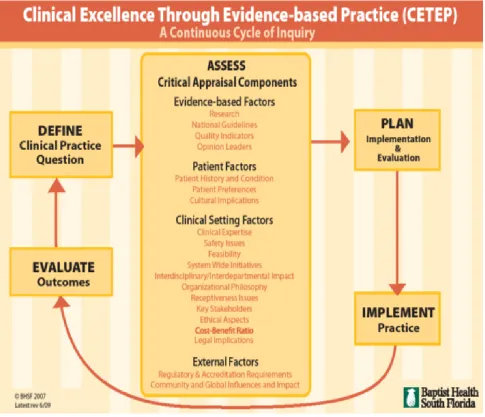
Multiple EBP models are available to guide nurses through implementation of an evidence based practice change including the John Hopkins Nursing Evidence-Based Practice Model (Dearholt & Dang, 2012), the Iowa Model (Titler et al., 2001), and the Star Model of EBP: Knowledge Transformation (Stevens, 2012). Baptist Health South Florida (2011) has developed its own model to guide practice changes, Clinical Excellence Through Evidence-Based Practice (CETEP). This model mirrors Sackett et al. (1996) five steps to EBP and contains the necessary components to be considered when making a practice change (Figure 1).
The CETEP model is comprised of five steps which include:
Step 1: Define the clinical practice question. It is important for nurses to formulate a searchable question that focuses on the population of interest (P), the intervention that you are interested in knowing more about (I), a comparison intervention if applicable (C) and lastly, the outcomes you hope to achieve (O). Using PICO to guide your question development will result in finding research applicable to your topic. An example of a searchable question using the PICO format is: For medical/surgical nurses (P) will implementation of a pet visitation program (I) decrease stress (O)?
Figure 1
change with the other critical appraisal components in the CETEP Model, patient factors, and clinical setting factors. Research evidence alone is not enough to justify a practice change.
Step 3: Develop a plan for the EBP change. In this step you will obtain the necessary approvals to implement the EBP change; determine what resources will be needed; develop and implement a communication and education plan; and identify how the process change will be evaluated.
Step 4: Implement the practice change. Review the plan and verify that support and resources are available during this step to ensure success.
Step 5: Evaluate the outcomes of the evidence-based practice change. Using the outcome measures identified in the planning phase, review the practice and invite feedback. Rephrase the question as needed repeating the steps outlined above.
The following is an example of an EBP question. For patients who develop a hospital acquired pressure ulcer, would implementation of a turn clock tool as compared to a turning team be a better method in preventing pressure ulcers during hospitalization?
RESEARCH
Polit and Beck (2010) define nursing research as a systematic approach to answering questions and solving problems using a disciplined method based on objective evidence. Its rigorous scientific inquiry provides a significant body of knowledge to shape health policy, advance nursing practice, and impact the health of people across the globe (p.3). The primary reason for conducting research is to expand the wealth of knowledge for nursing to improve their patients care and outcomes. Research enhances and validates existing knowledge as well as generating new knowledge (Burns & Grove, 2007). The results of research creates a strong scientific base for nursing practice (Melnyk & Fineout-Overholt, 2014); however, a void still exists with nursing linking research and practice.
Florence Nightingale is usually referenced as the first nurse researcher as result of her work in the 1850s surrounding morbidity and mortality of soldiers during the Crimean War. Recognizing the correlation between the environment and patient outcomes, her work led to improved conditions and care of sick people (UT Health, 2017). Nursing research is fundamental to the nursing profession and is crucial for continuing advancements that foster optimal nursing care. It generates new, or expands on existing, knowledge building the scientific underpinnings for clinical practice. Regardless of the setting a nurse works in,
the primary goal remains the same: to be a patient advocate and provide optimal care resulting in best outcomes (Jane, 2015).
Nursing research is usually categorized as quantitative, qualitative, or mixed methods. Quantitative focuses on measurable outcomes, usually analyzed with statistics whereas qualitative is based on phenomenology or ethnography focusing on experiences and analyzed with words. Research starts, as all three processes do, with the identification of a problem or question; what is it you want to know. One then needs to determine the research goals, identify what will be done, the methodology to conduct the research, and then evaluating the results.
Developing the research question begins with an idea, what is being questioned. This is also, as in EBP, phrased using the PICO acronym. The research question may be refined following the literature review but the development of the PICO question ensures the key words are present to help with the needed literature review. A thorough literature review then needs to be conducted in order to determine the existing knowledge surrounding the topic, a gap in the literature, narrow the research question, and determine the type of study to be completed. Occasionally a study can be found that is very similar to the one desired; it is perfectly acceptable to replicate a study.
A quantitative study should have a research aim or purpose, a hypothesis, independent and dependent variables, instruments or scales to measure the variables, and identified sample size, protection of human subjects, and statistical analysis. Qualitative studies involve similar steps but the data collection is usually performed through interviews and observations. There are four overarching types of quantitative research: experimental, quasi-experimental, descriptive, and correlational. Qualitative research, focused on understanding the human experience, has five main types of designs: phenomenology, ethnography, grounded theory, historical method, and case studies (Hunt, 2017). A conceptual framework or theoretical model should be identified to help guide the research process; these determine what you will measure and the statistical relationships.
Included in the study methodology is the study design, the sampling strategy, and data collection and analysis. The research process includes a protocol and application for Institutional Review Board approval. The entire research process should be developed with the entity nurse scientist.
participation, decrease the incidence of pressure ulcers in hospitalized patients?
SUMMARY
In summary, PI is a formal approach to the analysis of performance, unit based or entire hospital or system. It is driven by data. It classically assumes that the appropriate therapy or care is known but deviations from the know standard has occurred and needs to be identified and corrected. Changes are made in a systematic manner, measuring and accessing the effects of change, feeding the information back into the clinical setting, and making adjustments until successful results are obtained. The process is continual, cyclical, in order to ensure positive achieved outcomes continue.
Evidence-based practice is widely accepted by all healthcare personnel desiring to base their care on current evidence. Nurses are expected to have the ability to develop, implement, and evaluate evidence. Although the evidence-based practice model may differ, the guidelines for use are similar: synthesis of
the evidence, consideration of where and how the evidence is being implemented, and evaluation of the process.
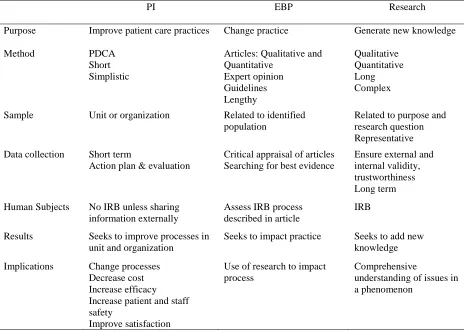
Research, the most rigorous of the three methods, is a systematic approach to answering questions. It is a disciplined method for solving problems based on objective evidence and is designed to contribute to generalizable knowledge. Institutional Review Board approval must be granted before conducting the study. Table 1 provides an overview of the differences between performance improvement, evidence-based practice, and research. Baptist Health South Florida is fortunate to have many resources to assist those attempting to understand and work with these three processes. Library services will facilitate the literature search obtaining abstracts and full articles upon request. Additionally, each entity has a nurse scientist who can also help differentiate what the project entails and how to conduct it. Dissemination is the final step in whichever process is conducted, whether at the unit level or through a larger venue.
Table 1
Differences between PI, EBP, and Research
PI EBP Research
Purpose Improve patient care practices Change practice Generate new knowledge
Method PDCA
Short Simplistic
Articles: Qualitative and Quantitative
Expert opinion Guidelines Lengthy
Qualitative Quantitative Long Complex
Sample Unit or organization Related to identified population
Related to purpose and research question Representative
Data collection Short term
Action plan & evaluation
Critical appraisal of articles Searching for best evidence
Ensure external and internal validity, trustworthiness Long term
Human Subjects No IRB unless sharing information externally
Assess IRB process described in article
IRB
Results Seeks to improve processes in unit and organization
Seeks to impact practice Seeks to add new knowledge
Implications Change processes Decrease cost Increase efficacy Increase patient and staff safety
Improve satisfaction
Use of research to impact process
Comprehensive
DECLARATION OF INTEREST
The authors report no conflicts of interest. The authors alone are responsible for the content and writing of the paper.
AUTHORS
Andrea Prentiss, PhD, MSN, ARNP, CNS, Nurse Scientist, Baptist Hospital of Miami, Miami, FL, US. Correspondence regarding this paper can be directed at [email protected].
Eve Buttler, PhD, RN, Nurse Scientist, Baptist Hospital of Miami, Miami, FL, US.
REFERENCES
Agency for Healthcare Research and Quality. (2013). Quality
tool: Plan-Do-Study-Act (PDSA) Cycle.
Retrieved from https://innovations.ahrq.gov/qualit ytools/plan-do-study-act-pdsa-cycle
American Nurses Credentialing Center. (2013). 2014 Magnet Application Manual. Silver Springs, MD. American Nurses Credentialing Center.
Apel, K., & Self, T. (2003). The marriage of research and
clinical services. ASHA Leader, 8(16), 6.
Retrieved from http://search.proquest.com.content proxy.phoenix.edu/docview/218105726/fulltextPD F/25DAACA4BBC04734PQ/16?accountid=35812 Baptist Health South Florida. (2011). CETEP. Retrieved from http://intranet.bhssf.org/en/nursing/nhsr/Page s/CETEP.aspx
Burns, N., & Grove, S. K. (2007). Understanding nursing
research: Building an evidence-based practice (5th
ed.). Philadelphia: Saunders Elsevier.
Centers for Disease Control and Prevention. (2015). Performance and quality improvement, definitions
and concepts. Retrieved from https://www.cdc.go
v/stltpublichealth/performance/definitions.html Conner, B. T. (2014). Differentiating research,
evidence-based practice, and quality improvement.
American Nurse Today, 9(6). Retrieved from https://
www.americannursetoday.com/differentiating- research-evidence-based-practice-and-quality-improvement/
Dearholt, S., & Dang, D. (2012). Johns Hopkins nursing
evidence-based practice: Models and guidelines (2nd edition.). Indianapolis, IN: Sigma Theta Tau International.
Donabedian, A. (1966). Evaluating the quality of medical care. Milbank Mem Fund Q,44: Suppl:166-206. Retrieved from http://www.zzjzfbih.ba/wp-content/ uploads/2012/11/donabedian.pdf
Jane, M. Y. (2015). Overview of nursing research. Innovative
Journal of Nursing Didactics, 5(12).
doi: http://dx.doi.org/10.15520/ijnd.2015.vol15.iss 12.118.05-13.
Hunt, D. D. (2017). Advance Healthcare Network for Nurses.
Understanding nursing research: Nurses must
contribute to evidence-based practice.
Retrieved from http://nursing.advanceweb.com/Co ntinuing-Education/CE-Articles/Understanding-Nursing-Research.aspx
Institute of Medicine (US) Roundtable on Evidence-Based
Medicine. Washington (DC): National Academies
Press (US); 2009. Leadership Commitments to Improve Value in Healthcare: Finding Common Ground: Workshop Summary. Chapter and Vision statement. Retrieved from https://www.nc bi.nlm.nih.gov/books/NBK52847/#__NBK52847_ dtls__
Melnyk, B. M., & Fineout-Overholt, E. (2014).
Evidence-based practice in nursing and healthcare: A guide
to best practice (3rd ed.). Philadelphia: Lippincott,
Williams, & Wilkins.
Polit, D., & Beck, C. (2010). Essentials of nursing research.
Philadelphia: Lippincott, Williams, & Wilkins. Sacket, D. L., Rosenberg, W. M. C., Gray, J. A. M., Haynes,
R. B., & Richardson, W. S. (1996). Evidence based
medicine: What it is and what it isn’t. BMJ,
312(71). doi:org/10.1136/bmj.312.7023.71
Stevens, K. R. (2012). Star Model of EBP: Knowledge Transformation. Academic Center for Evidence-based Practice. The University of Texas Health Science Center at San Antonio.
The W. Edwards Deming’s Institute. (2016). PDSA Cycle. Retrieved from https://deming.org/management-system/pdsacycle
Titler, M. G., Kleiber, C., Steelman, V. J., Rakel, B.A., Budreau, G, Everett, L.Q.,…Goode, C.J. (2001) The Iowa Model of Evidence-Based Practice to
Promote Quality Care. Crit Care Nurs Clin North
Am, 13(4): 497–509.
Health Resources and Services Administration (HRSA).
(2011). Quality improvement methodology.
Retrieved from https://www.hrsa.gov/quality/toolb ox/methodology/qualityimprovement/
UT Health Science Center Library. (2017). Treasures of the
P.I. Nixon. The lady with the lamp and her
contributions to modern nursing. Retrieved from