
Validated UV Method Development for the Simultaneous Estimation of Rabeprazole sodium and Cinitapride in Tablets
8
0
0
Full text
(2) 39 Prakash Katakam, et al / Int. J. of Pharmacy and Analytical Research Vol-3(1) 2014 [38-45]. in both small and large scale pharmaceutical R&Ds.[22-29] Multi-component formulations have gained a lot of importance now a days due to the greater patient compliance and acceptability, increased potency, multiple action, fewer side effects and faster relief. However analytical complexities of these multi-drug component dosage forms put forward considerable challenges to the analytical chemist during the analytical procedure.[8-12,15] Gastroesophageal Reflux Disease (GERD) or no ulcer dyspepsia (NUD) is a form of recurrent chronic disease requiring long term medical therapy where proton pump inhibitors and gastrprokinetic agents are the first line drug of choice. Combination of Rabeprazole sodium (RPZ) and Cinitapride (CTP) is very effective therapy for the GERD.[22-29] Rabeprazole Sodium (RPZ), chemically Benzimidazole derivative 2-[[[4-(3-methoxy propoxy)-3-methyl 2-pridinyl] methyl] sulfinyl]-1benzimidazole sodium (Fig.1), is a proton pump inhibitor which inhibits the enzyme system of hydrogen/potassium adenosine triphosphatase (H+/K+ ATPase) at the secretory surface of gastric parietal cells thereby suppressing gastric acid secretion. The –OCH3, pyridine, benzimidazole moieties largely attribute to the therapeutic actions of RPZ.[22-24] Cinitapride (CTP), chemically 4-. Fig. 1: Rabeprazole Sodium. amino-N-[3-(cyclohexan-1-yl-methyl)-4piperidinyl] -2 -ethoxy-5-nitrobenzamide (Fig.2) is a substituted benzamide gastroenteric prokinetic agent acting via synergistic effects on serotonergic 5HT-2 (inhibition) and 5-HT4 (stimulation) receptor and dopaminergic D2 (inhibition) receptors in the neuronal synapses of the myenteric plexi. [27-29] Marketed formulations containing 10 mg Rabeprazole sodium and 3 mg Cinitapride in a tablet dosage form was selected for UV method development. Literature reports various HPLC, LCMS methods for the analytical estimation of Rabeprazole sodium alone or in combination. Similarly various UV-HPLC analytical methods were reported for the estimation of Cinitapride alone or in combination with other drugs. However, there is no validated UV method development for the simultaneous estimation of these two drugs in combination to the best of our knowledge. The current research focuses on a UV method development for simultaneous analysis of RPZ and CTP. The prime requisite is to develop new methods to analyze the drugs simultaneously and without interference. The UV methodology becomes much more beneficial and acceptable if it can simultaneously estimate more than one drug at a time.. Fig.2: Cinitapride local drug store. Reagents of analytical grade were purchased from Merck, Mumbai.. MATERIALS AND METHODS Instruments used Electronic analytical balance (Shimadzu); Single beam UV-Vis spectrophotometer (Thermo Scientific Aquamate plus); Ultrasonic bath sonicator (Biotechnics) were used in the study.. Reagents and chemicals Analytical pure drugs of RPZ and CTP were obtained as kind gift samples from Hetero Drugs, Hyderabad, India. The combined tablet formulations with a labeled claim of RPZ 10 mg and CTP 3 mg respectively, were obtained from. Selection of solvent According to solubility profile and literature review, RPZ is freely soluble in water, methanol and chloroform. CTP was soluble in methanol and water. So, distilled water was chosen as the solvent for the proposed UV method development.. Preparation of standard stock solutions 10 mg each of pure RPZ and CTP were weighed separately, into two 10 mL volumetric flasks.. www.ijpar.com.
(3) 40 Prakash Katakam, et al / Int. J. of Pharmacy and Analytical Research Vol-3(1) 2014 [38-45]. Then small amount of distilled water was added to dissolve the drugs and then the volume was made up to 10 mL to get a concentration of 1 mg/mL.. Selection of wavelength From the above standard stock solutions, 0.1 mL aliquots were taken separately into two 10 mL volumetric flasks and diluted up to the mark with distilled water. These solutions were scanned in the UV region of 200-400 nm. Maximum absorbance was seen at the wavelength of 284.5 nm for RPZ and 267 nm for CTP. Hence all absorbance measurements. were made at 284.5 nm for RPZ and 267 nm for CTP.. Calibration curve A series of dilutions were prepared from the standard stock solutions of RPZ and CTP to obtain the concentration of 3-8 µg/mL of RPZ and 2-7 µg/mL of CTP. Absorbances of the above solutions were measured at 284.5 nm and 267 nm for RPZ and CTP respectively and a calibration curve of absorbance against concentration was plotted and the regression coefficient (R2) was also determined.. Fig.3: Standard Calibration curve of Rabeprazole Sodium. Fig.4: Standard Calibration curve of Cinitapride. Determination of absorptivity coefficients The absorptivity coefficients of both drugs (RPZ and CTP) were determined at selected wavelengths by using the formula: A=A (1%1cm) b c. where, c = concentration of the absorbing species, in g/100mL and b = path length in cm The absorptivity values are then substituted in the following equations (1) and (2): A1= ax1Cx + ay1Cy………….(1) A2= ax2Cx + ay2Cy…………..(2). Where, A1 and A2 are absorbances of sample at 284.5 nm and 267 nm, respectively.. aX1 and aX2 are absorptivities of RPZ at 284.5 nm and 267 nm respectively. aY1 and aY2 are absorptivities of CTP at 284.5 nm and 267 nm respectively. Cx and Cy are concentrations of RPZ and CTP respectively.. Preparation of Sample solutions Average weight of twenty tablets containing 10 mg of RPZ and 3mg of CTP (labeled claim) was calculated. The tablets were powdered well in glass mortar and pestle. Tablet powder weight equivalent to 10 mg of RPZ and 3 mg of Cinitapride was weighed accurately and transferred to a 25 mL volumetric flask. Then small quantity of distilled water was added and sonicated for 30 min. www.ijpar.com.
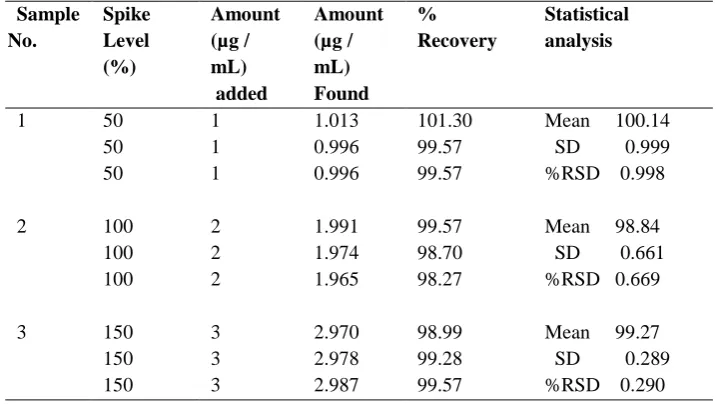
(4) 41 Prakash Katakam, et al / Int. J. of Pharmacy and Analytical Research Vol-3(1) 2014 [38-45]. to dissolve the drugs completely and then the volume was made up to the mark with distilled water and filtered through 0.45 μm membrane filter. From this, 0.25 mL was taken and diluted to 10 mL with distilled water. The absorbance of this solution was measured at 284.5 nm and 267 nm against distilled water as a blank. The assay was performed in triplicate.. Precision Precision was studied to find out intra and inter-day variations in the test method of RPZ and CTP. Intra-day assay precision was found by analysis of standard drug thrice on the same day. Inter-day assay precision was carried out at three different days and percentage relative standard deviation (%RSD) was calculated. The %RSD should not be more than 2.0%.[30]. Analysis of tablet dosage form Aliquot portion of the above sample stock solution was diluted with distilled water and the absorbance was measured at appropriate wavelengths and the concentrations of the two drugs were determined using equations (3) and (4). Analysis was done in triplicate.. Results The standard calibration curves and linearity range of RPZ and CTP are presented in Table 1-2 and Fig.3-4. The absorptivity values and assay results of RPZ and CTP are presented in Table 3-4. In method validation, the results of accuracy studies of RPZ and CTP are depicted in Table 5-6 and precision of inter and intraday variations in Table 7. The summary of all validation parameters are presented in Table 8.. Discussion METHOD VALIDATION The proposed method was validated as per ICH guidelines in terms of linearity, precision, accuracy.[30]. Linearity A Series of solutions were prepared using RPZ and CTP standard stock solution at concentration levels from 3-8 µg/mL and 2-7 µg/mL respectively. The absorbances of the solutions were measured at 284.5 and 267 nm against distill water as blank. The calibration curves were constructed by plotting concentrations on x-axis and absorbance on y-axis. R2 value not less than 0.99 was regarded as acceptance criterion.[30]. Accuracy The accuracy of the developed method was determined by recovery studies at three different levels. The preanalyzed samples were spiked with 50, 100 and 150% of mixed standard solution. The mixtures were analyzed and the recoveries were determined. The study was carried out in triplicate. The mean % recovery of the RPZ and CTP at each level should be not less than 98.0% and not more than 102.0% was considered as the acceptance criterion.[30]. The current research aims to develop a UV spectrophotometric method for the simultaneous estimation of RPZ and CTP in a commercially available tablet dosage. From the solubility profile of both the drugs, distill was selected as the common solvent. From the overlain spectra, 284.5nm and 267nm were selected as sampling wavelengths for RPZ and CTP. The simplicity and reliability of the method requires knowledge very accurate molar absorptivities of the components and the measurement of absorbances at 284.5nm and 267nm. The calculations being very simple, can be done manually. The above said two wavelengths were selected to frame the simultaneous equation. [1-6] From the assay results (Table 3), the amounts of RPZ and CTP in the tablet dosage form were found to be 10.008mg for RPZ and 2.974mg for CTP which are satisfactory. The method was validated as per ICH guidelines.[30] Linearity was obtained in the concentration range of 3-8 μg/mL for RPZ and 27μg/mL for CTP (Table 1-2). The %RSD for intraday and interday variations of RPZ was found to be 0.183±0.002 and 0.317±0.001 respectively. An intraday and interday variation of CTP was found to be 0.194±0.002 and 0.298±0.001 respectively (Table 7). In both cases the results are. www.ijpar.com.
(5) 42 Prakash Katakam, et al / Int. J. of Pharmacy and Analytical Research Vol-3(1) 2014 [38-45]. within the acceptance limit of <2% which indicates that the UV method developed has good precision. While validating the accuracy of the method (Table 5-6), it was found that the mean percent recovery for RPZ and CTP were found to be 98.57 % and 99.43 % respectively, which are within the acceptance limit of 98%-102% indicating the significant accuracy of the method. From the high. recovery values (< 98 %) it can be inferred that the method is free from the interference of excipients used in the formulation. Based on the results obtained the proposed method can be regarded as simple, accurate, precise, and reliable which can be employed for routine quality control of RPZ and CTP in bulk and combined tablet dosage forms.. Table 1: Table for calibration curve of RPZ and CTP Conc of RPZ (µg/mL) 3 4 5 6 7 8. Absorbance (nm) 0.224 0.32 0.418 0.508 0.621 0.711. R² = 0.99. Conc of CTP (µg/mL) 2 3 4 5 6 7. Absorbance (nm) 0.252 0.361 0.458 0.564 0.664 0.779. R² = 0.99. Table 2: Linearity of Rabeprazole Sodium and Cinitapride Parameters 95% confidence intervals Slope Y-intercept X-intercept Goodness of Fit R2 P value Equation Best fit values Slope Y-intercept X-intercept. RPZ. CTP. 0.09794 ± 0.001298 -0.07169 ± 0.007475 0.7319. 0.1012 to 0.1074 0.02886 to 0.05857 -0.5778 to -0.2692. 0.99 < 0.0001 Y = 0.09794X - 0.07169. 0.99 < 0.0001 Y = 0.1043X + 0.04371. 0.09434 - 0.1015 -0.09244 to -0.05093 0.5389 - 0.9120. 0.1043 ± 0.001112 0.04371 ± 0.005353 -0.4192. Table 3: Absorptivity values of Rabeprazole Sodium and Cinitapride Absorptivity values of. Absorptivity values of. Rabeprazole HCL. Cinitapride. 284.5 (nm) –ax1. 846.67. 284.5 (nm) –ay1. 516.67. 267 (nm)- ax2. 663.33. 267 (nm)- ay2. 1106.67. Table 4: Assay results of Rabeprazole Sodium and Cinitapride Drug RPZ CTP. Labeled amount(mg) 10 3. Amount present (mg) 10.008 2.974. www.ijpar.com. % Assay 100.07 99.14.
(6) 43 Prakash Katakam, et al / Int. J. of Pharmacy and Analytical Research Vol-3(1) 2014 [38-45]. Sample No. 1. Table 5: Accuracy studies of Rabeprazole Sodium Spike Amount Amount % Recovery Statistical analysis Level (%) (µg / mL) (µg / mL) added Found 50 1.5 1.473 98.21 Mean 98.51 50 1.5 1.473 98.21 SD 0.515 50 1.5 1.487 99.11 %RSD 0.523. 2. 100 100 100. 3 3 3. 2.973 3.027 2.973. 99.11 100.90 99.11. Mean 99.70 SD 1.030 %RSD 1.034. 3. 150 150 150. 4.5 4.5 4.5. 4.473 4.567 4.527. 99.40 101.49 100.59. Mean 100.50 SD 1.045 %RSD 1.040. Sample No.. Spike Level (%). Table 6: Accuracy studies of Cinitapride Amount Amount % (µg / (µg / Recovery mL) mL) added Found 1 1.013 101.30 1 0.996 99.57 1 0.996 99.57. Statistical analysis. 1. 50 50 50. Mean 100.14 SD 0.999 %RSD 0.998. 2. 100 100 100. 2 2 2. 1.991 1.974 1.965. 99.57 98.70 98.27. Mean 98.84 SD 0.661 %RSD 0.669. 3. 150 150 150. 3 3 3. 2.970 2.978 2.987. 98.99 99.28 99.57. Mean 99.27 SD 0.289 %RSD 0.290. Table 7: Results of precision studies of Rabeprazole Sodium and Cinitapride S.No. Rabeprazole Sodium Cinitapride Concentration Intra Inter Concentration Intra Inter day day day day (%RSD) (%RSD) (%RSD) (%RSD) 1 5 0.276 0.478 5 0.205 0.572 2 6 0.114 0.228 6 0.230 0.174 3 7 0.161 0.246 7 0.148 0.148 Table 8: Summary of the validation parameters of the proposed method S.No. Parameters Rabeprazole sodium Cinitapride 1 Linearity (µg/mL) 3-8 2-7 2 Correlation Coefficient 0.9996 0.9997 3 Precision(%RSD) (i)IntradayPrecision 0.183 0.194 (ii)Interday Precision 0.318 0.298 4 Accuracy (%recovery) 99.57 99.43 5 Tablet Assay (%) 100.08 99.14. www.ijpar.com.
(7) 44 Prakash Katakam, et al / Int. J. of Pharmacy and Analytical Research Vol-3(1) 2014 [38-45]. CONCLUSION Properly validated simple, cost effective, time saving UV method development are of immense benefit for the pharmaceutical R&Ds for routine drug estimations and in various phases of preformulation-formulation studies. The methodology becomes more acceptable when more than one drug can be simultaneously estimated by. the same method with very less interference from the excipients added to the formulations. The current properly validated UV methodology is found to be successful for the simultaneous estimation of RPZ and CTP in combined tablet dosage form and expected to be beneficial for the routine estimations of the same.. REFERENCES [1] Higuchi, T., Brochmann-Hansen, E. Pharmaceutical Analysis. New Delhi: CBS publications, India, 1997,1-3. [2] Douglas, A., Skoog, F., Holler, J. Fundamentals of Analytical chemistry.8th ed. Broks/cole publications, 2009, 2-3. [3] Willard, H.H., Merritt, L.L., Dean, J.A., Settle, F.A. Instrumental methods of analysis. 7th ed. New Delhi: CBS Publishers, 1986, 580-613. [4] The Merck index, An encyclopedia of chemicals drugs and biologics. 14th edition, 2000, 383-1392. [5] Martindale: The Complete Drug Reference, 31st edition, Edited by Sean c Sweepman., published by Pharmaceutical press, Lambethi street, London, 1237.2 & 1213.3. [6] Indian Pharmacopoeia 2010, published by The Indian Pharmacopoeia Commission, Ghaziabad, Volume III, 2037. [7] Reddy, M.K.O., Bodepudi, C., and Sundaram, P.S., “Method development and validation of Rabeprazole in bulk and tablet dosage form by RP-HPLC method”, International Journal of Chem Tech Research, 3(3), 1580-1588, Jul-Sept 2011. [8] Kalirajan, R., Anandarajagopal, K., Mathew, S.M., Gowramma, B., S. Jubie and B. Suresh, “Simultaneous determination of Rabeprazole and Domperidone in dosage forms by RP-HPLC”, Rasayan Journal of Chemistry, 1(2), 232-235, Mar 2008. [9] Heda, A.A., Gadade, D.D., Kathiriya J.M. and Puranik, P.K., “HPLC method development and validation for simultaneous analysis of Diclofenac sodium and Rabeprazole sodium”, E-journal of chemistry, 7, S386-S390, May 2010. [10] Umamaheswari, D., Kumar, M., Jayakar, B., and Chatakonda, R., “Method development and validation of Itopride Hydrochloride and Rabeprazole Sodium in pharmaceutical dosage form by reversed phase high performance liquid chromatography”, Journal of Chemical and Pharmaceutical Research, 2(5), 399-417, 2010. [11] Suganthi, A., John, S., and Ravi, T.K., “Simultaneous HPTLC determination of Rabeprazole and Itopride hydrochloride from their combined dosage form”, Indian Journal of Pharmaceutical sciences, 70 (3), 366–368, Jun 2008. [12] Pillai, S., Singhvi, I., “Quantitative estimation of Itopride hydrochloride and Rabeprazole sodium from capsule formulation”, Indian journal of Pharmaceutical sciences, 70(5), 658-661, Sep-Oct 2008. [13] Ramakrishna, N.V.S., Vishwottam, K.N., Wishu, S., Koteshwara, M., and Suresh Kumar, S., “Highperformance liquid chromatography method for the quantification of Rabeprazole in human plasma using solid-phase extraction”, Journal of Chromatography B, 816 (1-2), 209–214, Feb 2005. [14] El-Gindy, A., El-Yazby, F., and Maher, M.M., “Spectrophotometric and chromatographic determination of Rabeprazole in presence of its degradation products”, Journal of Pharmaceutical and Biomedical Analysis, 31(2), 229–242, Jan 2003. [15] Sahu, D., Agrawal, Y.P., Sabarwal, N., Jain, A. and Gupta, A.K., “Simultaneous estimation of Aceclofenac & Rabeprazole Sodium in solid dosage form”, Asian Journal of Biochemical and Pharmaceutical Research , 1(3), 13-21, Feb 2011. [16] Hemalatha, P.V., Suresh, A. J. and Niraimathi, V., “RP-HPLC method development and validation for the estimation of Cinitapride and Pantoprazole in solid oral dosage form”, Asian Journal of Research in Chemistry, 2012; 5(2): 221-224..
(8) 45 Prakash Katakam, et al / Int. J. of Pharmacy and Analytical Research Vol-3(1) 2014 [38-45]. [17] Jagani, N.M., Shah J.S. and Patel, P. B., “Development and Validation of dual wavelength method for simultaneous estimation of Omeprazole and Cinitapride in combined capsule dosage form”, International Journal of Research in Pharmaceutical and Biomedical Sciences, 3(2), 762-767, Apr-Jun 2012. [18] Thangabalan, B., Prabahar, A.E., and Kumar, P.V., “Development and validation of a RP-HPLC method for the determination of Cinitapride in pharmaceutical dosage forms”, Journal of Pharmacy Research, 4(3), 587-588, Mar 2011. [19] Patel G.H, Prajapti S. T., and Patel C. N, Development and validation of HPLC method for simultaneous estimation of Cinitapride and Pantoprazole in pharmaceutical dosage form. International Journal of Pharmacy & Technology, 4(2), 4253-4260, Jul 2012. [20] Humaira, S., Dey, A., Raju, S.A., and Sanaullah, S., “Development and validation of a rapid RP HPLC method for the determination of Cinitapride hydrogen tartarate in solid oral dosage forms”, E-Journal of chemistry, 8(3), 1424-1429, Aug 2011. [21] Reddy, S.A., Chandra Shekar, K.B., and Murali C.M., “Development and validation of RP-HPLC method to determine Cinitapride hydrogen tartarate in bulk and pharmaceutical formulation”, Journal of Global Trends in Pharmaceutical Sciences, 3(2), 619-627, Apr-June 2012. [22] Gunji, R., Nadendla R.R., and Ponnuru V.S., “Simultaneous UV spectrophotometric determination and validation of Diclofenac sodium and Rabeprazole sodium using hydrotropic agents in its tablet dosage forms”, International Journal of Drug Development & Research, 4(1), 316-324, Jan-Mar 2012. [23] Pandey,G., Mishra, K., “Spectrophotometric method for estimation of Rabeprazole sodium in tablets”, International Research Journal of Pharmacy, 4(3), 193-195, Mar 2013. [24] Kumar, A.A., Lavanya, K., Suneetha, P., and Kumar, A.A., “New simple UV spectrophotometric method for determination of Rabeprazole sodium in bulk and pharmaceutical dosage forms”, International Journal of Research in Pharmaceutical and Biomedical sciences, 3(3), 1070-1073, Sep 2012. [25] Gopiraju,T., Rajesh, A., Ramya, M.G., and Surendra, Y., “Spectrophotometric methods for simultaneous estimation of Rabeprazole and Diclofenac from combined dosage forms”, International Journal of Pharmacy and Biological Sciences, 2(4), 37-48, Oct-Dec 2012. [26] Makani, Y.G., Raj, H.A., Pipaliya, S.G., and Shelar, V., “Development and validation of spectrophotometric method of analysis for the simultaneous estimation of Omeprazole and Cinitapride in pharmaceutical dosage forms”, Inventi Rapid:Pharma Analysis and Quality Assurance, 2012(3), 1-5, Apr 2012. [27] Thangabalan, B., Prabahar A.E., Kalaichelvi, R., and Kumar P.V., “UV spectrophotometric method for determination of Cinitapride in pure and its solid dosage form”, E-Journal of Chemistry , 6, S21-S24, Jun 2009. [28] Thangabalan, B. and Kumar, P.V., “Spectrophotometric analysis of Cinitapride in tablet dosage form using 2.0 M Sodium Benzoate solution as hydrotropic solubilizing agent”, IJPI’s Journal of Analytical Chemistry, 1:2, 47-50, 2011. [29] Patel S., “Simultaneous spectrophotometric estimation of Cinitapride hydrogen tartarate and Omeprazole in capsule dosage form”, International Journal of Pharmaceutical Frontier Research, 1(3), 8-17, Oct-Dec 2011. [30] ICH Harmonized Tripartate Guideline, Validation of analytical procedures: Text and Methodology, Q2 (R1), 2005, pp.1-13. *******************************. www.ijpar.com.
(9)
Figure

Related documents
A Monthly Double-Blind Peer Reviewed Refereed Open Access International e-Journal - Included in the International Serial Directories.. International Research Journal of Commerce and
The differences of our algorithm are that according to the specific requirements for patients, who already gained osteoporotic fractures of the proximal femur or multiple vertebral
LP: Locking plate alone; LPDP: Locking plate combined with a distal radius plate; LPMP: Locking plate combined with medial anatomical locking plate; LPSG: Locking plate combined with
AGDL: Agglomerative clustering on a directed graph; AGMFit: Affiliation graph model fitting; CD: Community discovery; CDlib: Community discovery library; CDTB: Community
Yet the story presented by Skloot had the potential to generate a broader discussion in the media and among the public about the ethical concerns related to biobanks and
attenuated virus, as it is clear from the tissue culture studies that this virus replicates well; direct comparisons in which the two isolates are used to infect a compatible cell
In contrast, PAM incubated 1 h with EPI300 (pMCH-vtaA8 pEGFP) or EPI300 (pMCH-vtaA9 pEGFP) showed a lower percentage of macrophages with fluores- cent bacteria than the control with
