IJPAR |Vol.6 | Issue 1 | Jan - Mar -2017
Journal Home page: www.ijpar.com
Research article Open Access
Physicochemical standardization, phytochemical screening, TLC profiling
and GC-MS study of
Buddleja asiatica
*Raja S and Ramya I
GITAM Institute of Pharmacy, GITAM University, Visakhapatnam-530045, Andhra Pradesh, India
*Corresponding Author: Dr. S. Raja Email:[email protected]
ABSTRACT
BackgroundBuddlejaasiatica is a deciduous shrub traditionally used as an antipyretic, antimalarial and abortifacient. The present study was designed to perform physicochemical standardization and to examine the presence of various phytoconstituents by phytochemical screening and gas chromatography-mass spectroscopy method.
Methods
Evaluation of organoleptic characters and physicochemical parameters were carried out according to WHO guidelines. Various extracts (petroleum ether, chloroform, ethyl acetate and methanol) were subjected to standard phytochemical screening methods. Different phytoconstituents in the extracts were analyzed by thin layer chromatography (TLC). Further, gas chromatography mass spectroscopy (GC-MS) study of ethanol extract was performed in Scion 436-GC Bruker instrument.
Results
The values of standardization parameters were found to be 19.25 ± 0.33% w/w, 07.36 ± 0.07 % w/w, 03.35 ± 0.06 % w/w, 25.75±1.13% w/w and 01.85± 1.12 % w/w for loss on drying, total ash, acid insoluble ash, water soluble extractive and swelling index respectively. In phytochemical screening, petroleum ether extract revealed the presence of saponins, steroids and terpenoids whereas chloroform extract confirmed the presence of alkaloids and saponins. Ethylacetate extract proved the presence of glycosides, phenolic compounds, tannins and steroids. Further, major constituents like glycosides, phenols, tannins, steroids, saponins, tannins flavonoids, carbohydrates and proteins were present in methanol extract. TLC analysis confirmed the presence of steroids in ethyl acetate extract and terpenoids & flavonoids in methanol extract. GC-MS analysis exhibited the presence of main constituents such as carbohydrates (myoinositol-4-c-methyl), terpenoids(6-epi-shyobunol), fatty acid (dibutyl phthalate) and steroids (stigmasterol) in ethanol extract.
Conclusion
The results of standardization parameters ensure quality and purity of Buddlejaasiatica crude drug. Phytochemical, TLC and GC-MS studies indicate the presence of significant constituents like steroids, terpenoids and flavonoids in different extracts.Further experimental designs to isolate active constituents and examine their pharmacological aspects are highly recommended.
Keywords: Buddlejaasiatica, Extraction, GC-MS, Physicochemical, TLC
INTRODUCTION
In order to sustain and expand the growth of herbal drugs in market, gaining the trust of people is essential. However a variation in the concentration of active constituents in herbal medicine often deters people from using it. Studies found that factors like genetics, climatic conditions, bacterial, viral infection, processing and formulation methods play a major role in causing inconsistency in the percentage of active constituents of herbal drugs [1]. In general, standardization includes evaluation of physicochemical parameters along with assessment of quality, safety and efficacy of the crude drug. Standardization and validation parameters are implemented to ensure that active constituents, moisture content, inorganic impurities or heavy metals, microbial limits, pesticides etc within the prescribed limits. Separation techniques viz high performance liquid chromatography (HPLC), high performance thin layer chromatography (HPTLC), gas chromatography mass spectroscopy (GC-MS), Liquid chromatography mass spectrometry (LC-MS) and capillary electrophoresis provide a new dimension for herbal drug analysis [2]. GC-MS
chromatogram provides data regarding the retention time, peak area and mass spectra of phytoconstituents present in plant extract. GC-MS analysis revealed the existence of major phytoconstituents such as esters, fatty acids, terpenes, phenols, sterols etc in several plant extracts [3, 4].
Buddleja also referred as buddleia contains almost 100 species that belongs to the family loganiaceae [5]. Buddleja asiatica (Fig 1) is wide spread in tropical and subtropical regions of India, Malaysia, Indonesia, Philippines etc. as the plants are endemic to East Asian countries [6]. Buddleja asiatica are erect evergreen shrubs or small trees growing up to the height of 1to5m. The tree is trichotomously branched and leaves have a flat midrib with secondary veins that are oblique and tertiary veins which are reticulate [7]. The leaves are up to 15 cm long with opposite or alternate arrangement near the branch tips. The leaves are generally lanceolate with sharp tooth like structures in the margin followed by a tip that is sharp and pointed. Slender white flowers which are up to 4 mm long are generally observed in the plant [8]. Fruits are oblong in shape and 4mm long [9].
Figure 1[Courtesy- wildlifeofhawaii.com]
Traditionally, Buddleja asiatica is used to treat tumour and malaria [9]. The stem and leaves of the plant are used as popular traditional chinese medicine for the treatment of diarrhea and articular rheumatism10. Pharmacological activities like antioxidant, antiinflammatory, antimicrobial, antihepatotoxic, antipyretic, hypotensive, antimalarial and cytotoxicityactivities were also reported [11, 12]. Standardization makes an important contribution in evaluation of herbal medicine. Therefore, in the present study, research work was carried out to standardize whole plant of
Buddleja asiatica by evaluating its physicochemical parameters. In addition, identification of various phytoconstituents was performed by preliminary phytochemical screening, thin layer chromatography and GC-MS studies.
MATERIALS AND METHODS
Collection of Plant Material
Botany department, Sri Venkateswara University, Tirupati. A part of the plant material was preserved in the herbarium of GITAM Institute of Pharmacy, GITAM University, for future reference (Voucher specimen No -1751). The collected plant material was washed, oven dried at 40°C, pulverized, sieved up to 80 mesh powder and then stored at ambient temperature (22°C) in the dark for furthers analysis.
Organoleptic Parameters
The appearance colour, taste, and odour of whole plant of Buddleja asiatica course powder were noted.
Physicochemical
parameters
for
the
standardization of crude drug
This analysis includes the determination of pH values at 1% and 10% solution, loss on drying, ash value, water, ethanol soluble extractive values and swelling index [12].
Determination of pH range
The pH of different formulations in 1% w/v (1:100) and 10% w/v (10: 100) of water soluble portions of whole plant powder of Buddleja asiatica were determined using standard simple glass electrode pH meter [13].
Determination of loss on drying
About 10.0g of whole plant powder of the
Buddleja asiatica was placed in a flat weighing bottle. For estimation of loss on drying, the sample was dried in an oven at 100°C–105°C until two consecutive weighings did not differ by more than 5 mg. Then it was cooled in a desiccator for 30 minutes, and weighed. The loss of weight was calculated with reference to initial weight.
Determination of total ash
Four grams of the powdered material was accurately weighed and placed in a previously ignited and tared silica crucible. The material was spread in an even layer and ignited by gradually increasing the heat to a temperature not exceeding 450°C until it was grey, indicating the absence of carbon. The material was cooled in a desiccator and weighed. The content of total ash was calculated in mg/g of air-dried material.
Determination of water soluble ash
A small amount of ash was obtained by igniting the plant material. It was taken in a crucible and twenty five ml of water was added to it. It was covered with a watch glass and boiled gently for 5 minutes. Insoluble matter was collected on an ash less filter paper and washed with hot water and ignited in a crucible for 15 minutes at a temperature not exceeding 450°C in a muffle furnace. The residue was allowed to cool and then weighed. The weight of the residue was subtracted from the weight of total ash. Water soluble ash content was calculated as mg/g of air dried material.
Determination of acid insoluble ash
To the ash obtained by igniting the plant material, twenty five ml of hydrochloric acid was added and boiled for 5minutes. The insoluble matter was collected on an ash less filter paper. The filter paper containing the insoluble matter was transferred to the original crucible, ignited in a crucible at a temperature not exceeding 450°C in a muffle furnace. The residue was allowed to cool in a desiccator and then weighed. Acid insoluble ash content was calculated as mg/g of air dried material.
Determination of water soluble extractive
Five gm of Buddleja asiatica was macerated with 100 ml of chloroform water in closed flask for 24 hrs, shaking frequently during six hours and allowed to stand for eighteen hours. It was filtered rapidly. 25ml of filtrate was then evaporated in a tarred flat bottom shallow dish, dried at 105°C and weighed. The percentage of water soluble extractive was calculated with reference to air dried drug.
Determination of alcohol soluble extractive
Determination of Swelling Index
About one gram of powder was taken in a measuring cylinder. The internal diameter of the cylinder was about 14 mm, the length of the graduate portion about 125 mm, marked in 0.2 ml in division from 0 to 25 ml in upward direction. Water (25ml) was added and the mixture thoroughly shaken every 10 minutes for one hour. This was kept for three hrs at room temperature and the volume in ml occupied by the plant material, including any sticky mucilage was measured. The mean value of the individual determination was calculated.
Extraction
Based on polarity, Buddleja asiatica was extracted successively with different organic solvents like petroleum ether, chloroform, ethylacetate and methanol in a soxhlet extractor for 72 hrs. Every time, the marc was dried before extracting with the next solvent. The excess solvents were removed from all the extracts by vacuum rotary flash evaporator and stored in desiccators for phytochemical analysis.
Preliminary Phytochemical Screening
The preliminary phytochemical screening of the petroleum ether, chloroform, ethylacetate and methanol extracts of whole plant powder of
Buddleja asiatica was carried out as per standard procedure [13, 14]. The chemical tests for various phytoconstituents in different extracts were carried out as described below.
Test for alkaloids
To the extract, few drops of acetic acid was added, followed by dragendroff’s reagent and shaken well. Formation of orange red precipitate indicates the presence of alkaloids.
The extract was mixed with little amount of dil. hydrochloric acid and mayer’s reagent. Formation of white precipitate indicates the presence of alkaloids.
Test for Glycosides
Borntrager’s test: After adding few ml of dil. sulphuric acid to the extract, it was boiled, filtered and the filtrate was treated with ether. To the organic layer ammonia was added. A pink red color was produced in organic layer.
Test for
Saponins
5 ml of extract was shaken vigorously with 5ml of distilled water in a test tube and warmed. The formation of stable foam was taken as an indication of the presence of saponins.
Test for phenols
To the extract, 5 mL of distilled water was added. To this, 3ml of 10% lead acetate was added. A bulky white precipitate indicated the presence of phenol compounds.
Test for Tannins
About 2ml of the extract was stirred with 2ml of distilled water and few drops of FeCl3 Solution.. Formation of green precipitate indicated the presence of tannins.
Test for Steroids
Liebermann burchard test: 1 mg of the extract was dissolved in a few drops of chloroform. 3 ml acetic anhydride, 3 ml of glacial acetic acid were added, warmed and cooled under the tap and drops of concentrated sulphuric acid were added along the sides of the test tube and observed for bluish green color for the presence of steroid.
Test for terpenoids
2 ml of the extract was dissolved in 2ml of chloroform and evaporated to dryness. 2ml of concentrated sulphuric acid was added and heated for about 2 min. Development of a greyish colour indicated the presence of terpenoids.
Test for flavonoids
Shinoda’s Test: To the extract, few magnesium turnings and few drops of concentrated hydrochloric acid were added and boiled for five minutes. Reddish pink color shows the presence of flavonoids.
To the extract, 10% sodium hydroxide solution and ammonia was added. Dark yellow color indicates presence of flavones.
Test for carbohydrates
appearance of a purple ring at the interface between the layers.
Test for Proteins
Biuret test: To the extract, 1 ml of 40% NaOH and 2 drops of 1%copper sulphate were added. Violet color indicated the presence of proteins.
Thin layer chromatography
The solvent system that showed maximum separation in TLC plates was selected as an ideal mobile phase for the study.
Preparation of TLC plates and mobile phase
Pre coated Silica Gel-GF TLC plates were used for the study. Using a micropipette, about 10μl of different extracts were individually loaded over the plates and air dried. The plates were developed in different solvent systems such as methanol:dichloromethane(1:9);
methanol:water(1:1); toluene:chloroform:acetone (8:5:7); toluene:dioxane:acetic acid (9:2.5:0.4); chloroform: benzene (1:1); benzene: ethyl acetate(1:1) and hexane:ethyl acetate(1:1). The chromatograms were observed under visible light, UV light, iodine chamber and suitable spraying reagents were used.
Instrumentation
GC-MS analysis of the methanol extract of
Buddleja asiatica was performed using Equipment Scion 436-GC Bruker auto-sampler and a gas chromatograph interfaced to a mass spectrometer (GC-MS) equipped with a column BR-5MS (5% diphenyl / 95% dimethyl poly siloxane), 30m x 0.25mm ID x 0.25μm df. For GC-MS detection, an electron ionization system was operated in electron impact mode with ionization energy of 70eV. Helium gas (99.999%) was used as carrier gas at a constant flow rate of 1ml/min.
Extraction of plant material and GC-MS
analysis
About 10 gm of the whole plant powder was added to 100 ml of ethanol. It was incubated overnight and filtered through filter paper. Sodium sulphate was also used during filtration to remove the sediments and traces of water in the filter paper. The filtrate was concentrated. 2µl of the sample solution was employed in GC-MS for analysis. The injector temperature was maintained at 280°C, the
ion-source temperature was 250°C and the oven temperature was programmed for 110°C (isothermal for 3.50min). Mass spectra were taken at 70eV; a scan interval of 0.5 seconds and fragments from 45-500Da. The solvent delay was 0 to 2min and the total GC-MS running time was 40.50min. The relative percentage amount of each component was calculated by comparing its average peak area to the total areas. Measurement of peak areas and data processing were carried out by Turbo-Mass OCPTVS-Demo SPL software.
Identification of compounds
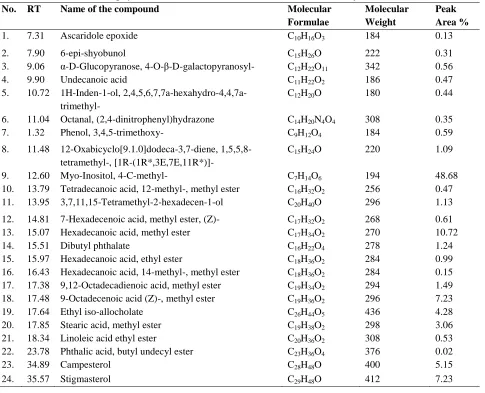
Interpretation was done by GC-MS using the database from National Institute of Standards and Technology (NIST) library which has more than 82,000 patterns. Comparison of the spectrum of unknown components with the spectrum of the known components stored in the NIST library was carried out. The retention time, name of the compound, molecular formula, molecular weight and peak area of the phytoconstituents are given in Table 7. The nature of compound, molecular structure and activities of the phytoconstituents are given in Table 8.
RESULTS
Organoleptic evaluation
The powder was coarse and appeared to be green in color with aromatic odour. The taste was found to be bland.
Physicochemical investigation
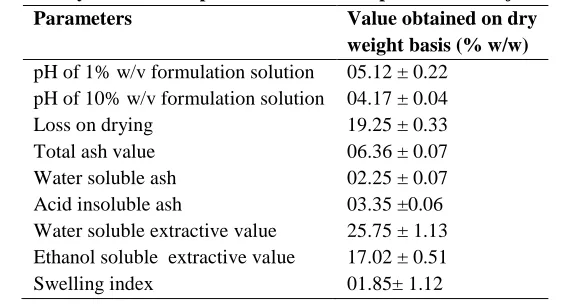
Physicochemical parameters of whole plant powder of Buddleja asiatica were estimated based on the methods recommended by World Health Organization (WHO). The pH of 1% w/ v and 10% w/ v solutions were found to be 05.12 ± 0.22 and 04.17 ± 0.04 respectively. Analysis of loss on drying is vital to ensure material quality. Moisture content greatly influences the physical properties of plant material during processing and formulation. The value for loss on drying of Buddleja asiatica
02.25 ± 0.07 and 03.35 ± 0.06 %w/w respectively. Extractive values are valuable to identify the nature of chemical constituents present in the crude drug. The water solubility percentage of Buddleja asiatica was found to be 25.75±1.13 % w/w and ethanol solubility was found to be 17.02 ± 0.51%w/w. Swelling index is an important
charecteristics of plant material. A high swelling index value indicates better extraction potential by the applied solvent. Swelling index was found to be 01.85± 1.12 %w/w. The values of physico chemical constants of whole plant of Buddleja asiatica are given in Table 1.
Table 1: Physicochemical parameters of whole plant of Buddleja asiatica
Parameters Value obtained on dry
weight basis (% w/w) pH of 1% w/v formulation solution 05.12 ± 0.22
pH of 10% w/v formulation solution 04.17 ± 0.04
Loss on drying 19.25 ± 0.33
Total ash value 06.36 ± 0.07
Water soluble ash 02.25 ± 0.07
Acid insoluble ash 03.35 ±0.06 Water soluble extractive value 25.75 ± 1.13 Ethanol soluble extractive value 17.02 ± 0.51
Swelling index 01.85± 1.12
Determination of solvent extractive value
The air dried powder of Buddleja asiatica
underwent successive extraction with a variety of organic solvents. The average yield obtained in
successive extraction with petroleum ether, chloroform, ethyl acetate and methanol was found to be 2.7% w/w, 2.2%w/w, 3.3%w/w and 5.5%w/w respectively. The average yield is given in Table 2.
Table 2: Successive extraction of Buddleja asiatica
Solvent Extractive yield(% w/w) Appearance
Petroleum ether 2.7 Greenish brown
Chloroform 2.2 Greenish brown
Ethyl acetate 3.3 Brown
Methanol 5.5 Brownish mass
Phytochemical screening
The preliminary phytochemical screening of
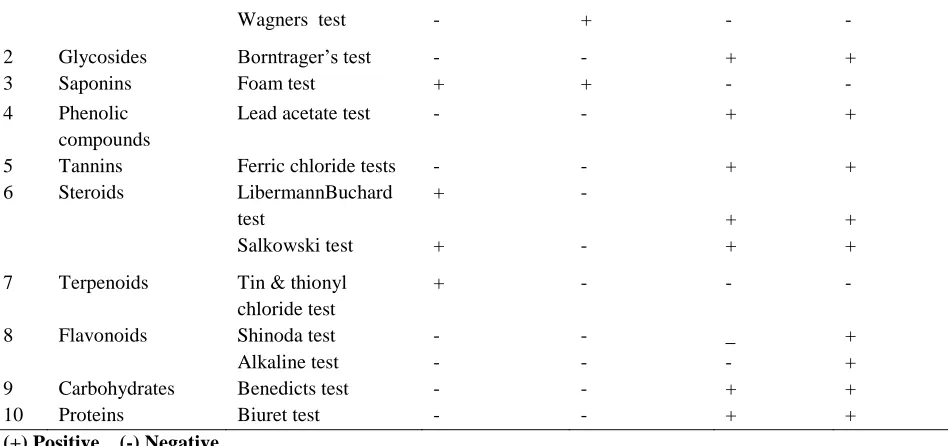
Buddleja asiatica revealed the presence of saponins, steroids and terpenoids in petroleum ether extract. Only few secondary metabolites like alkaloids and saponins were detected in chloroform extract. A mixture of polar compounds like glycosides, phenolic compounds, tannins and steroids (non polar compound) were present in
ethylacetate extract. In addition carbohydrates and proteins were found in ethyl acetate extract. Methanol extract showed positive for the presence of glycosides, phenolic compounds, tannins, steroids, flavonoids, carbohydrates, proteins and gave a negative result for alkaloids, saponins, terpenoids etc. The Preliminary phytochemical screening for various functional groups is tabulated in Table No. 3
Table 3:Phytocochemical screening petroleum ether, chloroform, ethylacetate and methanol extracts of Whole Plant of Buddleja asiatica
s.no Phytoconstituents Tests Petroleum
ether extract
Chloroform extract
Ethyl acetate extract
Methanol extract
Wagners test - + - -
2 Glycosides Borntrager’s test - - + +
3 Saponins Foam test + + - -
4 Phenolic compounds
Lead acetate test - - + +
5 Tannins Ferric chloride tests - - + +
6 Steroids LibermannBuchard test
+ -
+ +
Salkowski test + - + +
7 Terpenoids Tin & thionyl chloride test
+ - - -
8 Flavonoids Shinoda test - - _ +
Alkaline test - - - +
9 Carbohydrates Benedicts test - - + +
10 Proteins Biuret test - - + +
(+) Positive (-) Negative
Thin Layer Chromatography
Thin Layer Chromatography analysis of
Buddleja asiatica ethyl acetate extract showed the presence of steroids with Rf value of 0.55 and 0.65
in solvent system of
methanol:dichloromethane(1:9); methanol:water (1:1); respectively. The spots were revealed after spraying phosphomolybdic acid in methanol reagent and sulfuric acid in methanol reagent. Appearance of brown and orange colour spot indicated the presence of steroids in ethyl acetate extract. Similarly, methanol extract showed the presence of terpenoids with Rf value of 0.64 and 0.43 in solvent system of benzene:ethyl acetate(1:1); hexane:ethyl acetate(1:1) respectively.
Vanillin in sulphuric acid was used for the detection of alkaloids. Appearance of violet and brown colour spot indicated the presence of terpenoids in methanol extract. Furthermore, methanol extract of Buddleja asiatica showed the presence of flavonoids with Rf value of 0.72 in toluene: Chloroform:acetone (8:5:7) as solvent system and another spot with Rf value of 0.84 was detected with a solvent system of toluene:dioxane:acetic acid (9:2.5:0.4). Appearance of yellow and orange colour spot indicated the presence of flavonoids in methanol extract. Rf values of steroids, terpenoids and flavonoids identified from various extracts of Buddleja asiatica are tabulated in Table 4,5 & 6 .
Table 4: Steroids: TLC Studies for ethyl acetate extract of Buddleja asiatica
Solvent system Spraying reagent Color of spot Rf value Inference
Methanol:dich loromethane(1:9)
Phosphomolybdic acid in methanol Brown 0.55 Presence of steroids
Methanol:water (1:1) Sulfuric acid:methanol(1:9) Orange 0.65 Presence of steroids
Table 5: Terpenoids: TLC Studies for methanol extract of Buddleja asiatica. Solvent system Spraying reagent Color of spot Rf value Inference
Benzene:ethyl acetate(1:1) Vannilin in sulphuric acid Violet 0.64 Presence of terpenoids Hexane :ethyl acetate(1:1) Vannilin in sulphuric acid Brown 0.43 Presence of terpenoids
Table 6: Flavonoids: TLC Studies for methanol extract of Buddleja asiatica
Solvent system Spraying reagent Color of spot Rf value Inference
Toluene:dioxane:acetic acid (9:2.5:0.4) 365 nm UV light Orange-yellow 0.84 Presence of flavonoids
Table 7: phytoconstituents identified in ethanol extract of Buddleja asiatica
No. RT Name of the compound Molecular
Formulae
Molecular Weight
Peak Area %
1. 7.31 Ascaridole epoxide C10H16O3 184 0.13
2. 7.90 6-epi-shyobunol C15H26O 222 0.31
3. 9.06 α-D-Glucopyranose, 4-O-β-D-galactopyranosyl- C12H22O11 342 0.56
4. 9.90 Undecanoic acid C11H22O2 186 0.47
5. 10.72 1H-Inden-1-ol, 2,4,5,6,7,7a-hexahydro-4,4,7a-trimethyl-
C12H20O 180 0.44
6. 11.04 Octanal, (2,4-dinitrophenyl)hydrazone C14H20N4O4 308 0.35
7. 1.32 Phenol, 3,4,5-trimethoxy- C9H12O4 184 0.59
8. 11.48 12-Oxabicyclo[9.1.0]dodeca-3,7-diene, 1,5,5,8-tetramethyl-, [1R-(1R*,3E,7E,11R*)]-
C15H24O 220 1.09
9. 12.60 Myo-Inositol, 4-C-methyl- C7H14O6 194 48.68
10. 13.79 Tetradecanoic acid, 12-methyl-, methyl ester C16H32O2 256 0.47 11. 13.95 3,7,11,15-Tetramethyl-2-hexadecen-1-ol C20H40O 296 1.13
12. 14.81 7-Hexadecenoic acid, methyl ester, (Z)- C17H32O2 268 0.61 13. 15.07 Hexadecanoic acid, methyl ester C17H34O2 270 10.72
14. 15.51 Dibutyl phthalate C16H22O4 278 1.24
15. 15.97 Hexadecanoic acid, ethyl ester C18H36O2 284 0.99 16. 16.43 Hexadecanoic acid, 14-methyl-, methyl ester C18H36O2 284 0.15 17. 17.38 9,12-Octadecadienoic acid, methyl ester C19H34O2 294 1.49 18. 17.48 9-Octadecenoic acid (Z)-, methyl ester C19H36O2 296 7.23
19. 17.64 Ethyl iso-allocholate C26H44O5 436 4.28
20. 17.85 Stearic acid, methyl ester C19H38O2 298 3.06 21. 18.34 Linoleic acid ethyl ester C20H36O2 308 0.53 22. 23.78 Phthalic acid, butyl undecyl ester C23H36O4 376 0.02
23. 34.89 Campesterol C28H48O 400 5.15
24. 35.57 Stigmasterol C29H48O 412 7.23
Table 8: Activities of phytoconstituents identified in methanol extract of Buddleja asiatica S no Name of the compound Nature of
compound
Structure Activity**
1 Hexadecanoic acid-14-methylmethyl ester
Fatty acid Antioxidant
2 Hexadecanoic acid-ethyl ester
Fatty acid Antioxidant
3 Dibutyl phthalate Fatty acid Plasticizer
O
O
O
O
O
O
O
4 Hexadecanoic acid-methyl ester
Fatty acid Acidifier
5 7Hexadecanoic acid -methyl ester
Fatty acid Adhesive
6 Tetradecanoic acid-12-methyl-methyl ester.
Fatty acid Cosmetics
7 Myo –inositol-4-c-methyl carbohydrate Antiovarian
disorder agent
8 3,4,5-trimethoxy phenol Phenolic compound
Antioxidant, Disinfectant
9
Octanal(2,4-dinitrophenyl)hydrazone
alkaloid Cosmetics
10 1H-Inden-1-ol-2,4,5,6,7a-hexahydro-4,4,7a-trimethyl
terpene Perfumery
11 Undecanoic acid Fatty acid Antifungal
O
O
O
O
O
O
OH
OH
OH
OH HO
HO
O
O
O
OH
N N H N+
O
-O
N+ O -O
OH
O
12 6-epi-shyobunol terpene Antipyretic
13 Ascaridole epoxide Terpene Amoebicidal
activity
14 9-octadecenoic acid-methyl ester
Unsaturated fatty acid
Acidulant
15 Stearic acid- methyl ester Fatty acid Plasticizer
16 Linoleic acid- ethyl ester Unsaturated fatty acid
Acidulant
17 Phthalic acid butyl undecyl ester
Fatty acid Antibacterial
18 Campesterol steroid Antibacterial,
Antioxidant OH
O
O
O
O
O
O
O O
O
O O
O
19 Stigmasterol steroid Antioxidant
20 β-Sitosterol steroid Anticancer
**Source: Dr. Duke’s phytochemical and ethnobotanical database (online database)
GC-MS analysis
Phytochemical analysis of ethanol extract of
Buddleja asiatica showed the presence of an array of compounds like fatty acids (hexadecanoic acid-14-methylmethyl ester, hexadecanoic acid-ethyl ester, dibutyl phthalate, hexadecanoic acid-methyl ester, 7-Hexadecanoic acid-methyl ester, tetradecanoic acid-12-methyl-methyl ester), carbohydrates (myo –inositol-4-c-methyl), phenol
(3,4,5-trimethoxy phenol), terpenes (1H-Inden-1-ol-2,4,5,6,7a-hexahydro-4,4,7a-trimethyl, 6-epi-shyobunol, ascaridole epoxide) and steroids (campesterol, stigmasterol and β-sitosterol). The phytoconstituents were identified in the ethanol extract of Buddleja asiatica by relating to the corresponding peak area through coupled GC–MS (Fig 2).
HO
Figure 2: GC-MS/MS chromatogram of ethanol extract of Buddleja asiatica
Sample: 241 Operators: IICPT Scan Range: 1- 20683 Time Range: 3.50-40.50 min.
DISCUSSION
Phytoconstituents such as flavones, flavonol, anthocyanins and other coloured substances are pH sensitive and can be used as a natural acid base indicator. In present study the pH of 1% w/v and 10% w/v solutions of Buddleja asiatica were found to be 05.12 ± 0.22 and 04.17 ± 0.04 respectively. Ash of any plant material is composed of their nonvolatile inorganic components. Upon incineration of crude drug, they leave behind an ash which consists of carbonates, phosphates and silicates of sodium, potassium and magnesium 15. Hence ash determination becomes necessary in determining the identity and quality of the drug. Total ash involves the oxidation of the organic and inorganic compounds in crude material. A high ash value indicates the presence of more minerals and it may be a sign of adulteration. In the investigation, the value of total ash was found to be 06.36 ± 0.07%w/w. The water soluble ash content indicates the amount of total ash that is soluble in water. The value of water soluble ash was found to be 02.25 ± 0.07%w/w. The acid insoluble ash content is the part of total ash that is not hydrolysed by mineral acid. A high value of acid insoluble ash indicates adultration with silicaceous materials. The value was found to be 03.35 ± 0.06%w/w. Estimation of loss on drying is important to control and minimize water content in crude drug. A high amount of moisture content may lead to contamination of crude drug [16]. The value of loss on drying was found to be 19.25 ± 0.33%w/w, which is high value. Hence the plant should be thoroughly dried before use. Extractive values are valuable to estimate the chemical constituents present in the crude drug and furthermore assist in evaluation of chemical constituents soluble in a particular solvent [17]. The water soluble and the alcohol soluble extractives were found to be 25.75 ± 1.13%w/w and 17.02 ± 0.51%w/w respectively. The solubility percentage of Buddleja asiatica in aqueous extraction is higher due to the presence of tannins, glycosides etc in plant extract. The swelling index of the plant is very low which implies the presence of minimum amounts of mucilage and pectin.
The average yield during successive extraction of Buddleja asiatica with four different solvents including petroleum ether, chloroform, ethyl acetate and methanol was found to be 2.7%w/w,
2.2%w/w, 3.3%w/w and 5.5%w/w.
Pharmacological properties of a plant are mainly owed to the presence of phytoconstituents. Bioactivities of plants are enhanced by the synergistic activity of different phytoconstituents present in plant. Indeed, the role of terpenoids as intermediates in cholesterol synthesis and their regulation of 3-hydroxy-3-methylglutaryl-coemzyme A (HMG-CoA) reductase were reported by many studies. In this way terpenoids are significant for management of disease like cancer and cardiovascular diseases [18]. In the current study phytochemical screening of Buddleja asiatica
showed the presence of saponins, steroids and terpenoids in petroleum ether extract. Plant saponins are used as immunological substituents in the formulation of vaccines due to their immune enhancing properties [19]. Chloroform extract of
Buddleja asiatica revealed the presence of alkaloids and saponins. The positive result for only a few compounds in chloroform extract shows the limited number of phytoconstituents present in this extract. Plant steroids have many remarkable medicinal, pharmaceutical activities like immunosuppressive, hepatoprotective, plant growth hormone regulator, antihelminthic, cytotoxic and cardiotonic activity [20]. Ethyl acetate extract showed the presence of glycosides, phenolic compounds, tannins and steroids. There is colossal evidence for the key role played by flavonoids as scavengers of reactive oxygen species and as signaling molecules in mammals, through their ability to interact with a wide range of protein kinases, including mitogen-activated protein kinases. Methanol extract showed the presence of more phtoconstituents like glycosides, phenolic compounds, tannins, steroids, flavonoids, carbohydrates, proteins etc. than the rest of other extracts [21].
0.55 and 0.65 clearly indicates that the polarity of steroids are influenced by position and configuration of substituents. Steroids with more polar functional groups like hydroxyl, carbonyl, and double bonds absorb more tightly to the silica gel and move slower up the plate than nonpolar steroids. Literature survey shows the presence of more than 20 oleanane type triterpenoids and their glycosides in Buddleja species. Present TLC study supports the presence of terpenoids in ethyl acetate extract. Flavonoid aglycones and their glycosides can be separated by using a mixture of polar and non polar solvents. The TLC analysis in various solvent systems revealed the presence of spots with Rf value 0.72 and 0.84, respectively. Each spot is presumably due to a presence of flavonoid aglycones or flavonoid glycosides.
Most of compounds identified by GC-MS were reported to have pharmacological property. Compounds like stigmasterol, hexadecanoic 14-methyl methyl ester and hexadecanoic acid-ethyl ester have antioxidant activity. Apart from the compound mentioned above there are reports of other compounds exhibiting activities like anticancer (β-sitosterol), antibacterial (campesterol, phthalic acid butyl undecyl ester), plasticizer (stearic acid- methyl ester, dibutyl phthalate), acidulant (linoleic acid- ethyl ester, 9-octadecenoic acid-methyl ester), antifungal (undecanoic acid), antipyretic (6-epi-shyobunol). There are certain compounds which find extensive use in cosmetics and perfumery industry. The most prevailing compound identified in the whole plant ethanol extract of Buddleja asiatica was myo
–inositol-4-c-methyl, used in the treatment of polycystic ovarian syndrome.
CONCLUSION
Standardization, phytochemical screening, TLC and GC-MS profiling were done to determine the qualitative and quantitative parameters of Buddleja asiatica. Organoleptic characters and physicochemical parameters were found to be within the prescribed limits as per WHO. Qualitative analysis of different extracts confirmed the presence of many phytoconstituents such as alkaloids, terpenoids, tannins, flavonoids, glycosides etc. Thin layer chromatography findings support the presence of steroids in ethyl acetate and terpenoids, flavonoids in methanol extracts. The results pertaining to GC-MS analysis identifies carbohydrates (myoinositol-4-c-methyl), terpenoids (6-epi-shyobunol, ethyl iso-allocholate), fatty acid (dibutyl phthalate, hexadecanoic acid methyl ester, methyl ester 9-octadecenoic acid) and steroids (sitosterol, stigmasterol) in ethanol extract. In general, the present study recommends Buddleja asiatica as a plant of phytopharmaceutical importance and may be a herbal alternative for the synthesis of many pharmacologically potent agents.
Acknowledgement
The authors are thankful to the management of GITAM University, Visakhapatnam, Andhra Pradesh, India, for providing the necessary facilities to carry out the research work.
Conflict of interest
No
REFERENCES
[1]. Kunle, Folashade O, Egharevba, Omoregie H, Ahmadu, Ochogu P: Standardization of herbal medicines A review. Int J Biodivers Conserv. 4(3), 2012, 101-112.
[2]. Bansal A, Chhabra V, Rawal RK, Sharma S: Chemometrics: A new scenario in herbal drug standardization. J Pharm Analysis. 4(4), 2014, 223–233.
[3]. Thomas E, Aneesh TP, Thomas DG, Anandan R: GC-MS analysis of phytochemical compounds present in Rhizomes of Nervilia aragoana Gaud. Asian J. Pharmaceut. clin. Res.6 (3), 2013, 68-74.
[4]. Nithyadevi, Sivakumar: Phytochemical Screening and GC-MS, FT-IR analysis of methanolic extract leaves of
Solanum and torvum. Int J of Res in Biosci. 3(9), 2015, 2349-0357.
[5]. Chopra RN, Nayar S., Chopra IC. Glossary of Indian medicinal plants, Council of Scientific & Industrial Research, New Delhi; 1956; pg: 42.
[7]. Sheat W G. Propagation of Trees, Shrubs and Conifers: St. Martin publications. 1948.
[8]. Maheshwari JK. The Flora of Delhi: Council of Scientific and Industrial Research, New Delhi; India, 1963, 222.
[9]. Arjun J, Verma A K, Prasad S B: Method of preparation and biochemical analysis of local tribal wine Judima: an indegenous alcohol used by Dimasa tribe of North Cachhar Hills District of Assam, India. Int Food Res J. 21(2), 2014, 463-470.
[10]. Shah GM, Khan MA, Ahmad M, Zafar M, khan AA: Observations on antifertility and abortifacient herbal drugs. Afr J Biotechnol. 8 (9), 2009, 1959-1964.
[11]. Ali F., Ali I., Khan H., Khan. Gilani AH. Studies on Buddleja asiatica antibacterial, antifungal, antispasmodic and Ca++ antagonist activities. Afr J Biotechnol. 10(39), 2011, 7679-7683.
[12]. Singh S, Mathur A, Sinha J, Singh N, Kohli R: A Study on the mechanism of the hypotensive activity of
Buddleja asiatica (Newarpati). Pharma Biol. 18(2), 1980, 83-87.
[13]. Choudhary N, Bhupinder Singh Sekhon: An overview of advances in the standardization of herbal drugs. J Pharma Edu Res. 2(2), 2011, 55-70.
[14]. Kokate CK, Khandelwal KR, Pawer AP, Gokhale SB. Practical Pharmacognosy. 3rd edition, Nirali Prakashan, Pune, 1995, 137.
[15]. Tiwari P, Kumar B, Kaur M, Kaur G, Kaur H: Phytochemical screening and Extraction. Review. Int Pharma Sci. 1(1), 2011, 98-106.
[16]. Gupta AK, Neeraj Tandon, Madhub Sharma: Quality Standards of Indian Medicinal Plants, Indian Council of Medical Research, New Delhi. 7, 2008, 331-339.
[17]. Pandey MK, Singh GN, Rajeev Kr Sharma, Snehalata: Standardization of Yakrit Plihantak Churna: An Ayurvedic Poly herbal formulation. Int J Pharma Sci and Res. 3(1), 2012, 171-176.
[18]. Tsuyoshi G, Nobuyuki T, Shizuka H , Teruo K: Various terpenoids derived from herbal and dietary plants function as PPAR Modulators and regulate carbohydrate and lipid metabolism. Egypt: Hindawi Publishing Corporation, 2010, 1-9.
[19]. Hassan HS, Sule MI, Musa AM., Musa KY, Abubakar MS, HassanAS. Anti inflammatory activity of crude saponin extracts from five Nigerian medicinal plants. Afr J Tradit Complement Altern Med. 9(2), 2012, 250– 255.
[20]. Patel SS, Savjani JK: Systematic review of plant steroids as potential anti- inflammatory agents: Current status and future perspectives. J of Phytopharmacol. 4(2), 2015, 121-125.
![Figure 1[Courtesy- wildlifeofhawaii.com]](https://thumb-us.123doks.com/thumbv2/123dok_us/8869484.1813017/2.612.230.379.407.520/figure-courtesy-wildlifeofhawaii-com.webp)