ISSN 2373-2156 (Print) 2373-2164 (Online) Copyright © The Author(s). 2015. All Rights Reserved. Published by American Research Institute for Policy Development DOI: 10.15640/jpesm.v2n1a1 URL: http://dx.doi.org/10.15640/jpesm.v2n1a1
The Effects of a 6-Week Dry Land Exercise Program for High
School Swimmers
Jenna Sawdon-Bea1 & Jessica Benson2
Abstract
Background: In swimmers, the great number of stroke repetitions and force
generated through the upper extremity, leaves the shoulder uniquely vulnerable to injury. Numerous high school swimmers experience shoulder pain, muscle shortening, and/or weakness leading to poor swim mechanics. Purpose: The purposes of this study were to examine the effects of a six week dry land intervention program on the 1) flexibility of the shoulder girdle, 2) muscular strength of the shoulder girdle and core, and 3) swim performance in high school aged competitive swimmers. Methods: 32 high-school swimmers were divided into control (N = 16) and intervention (N = 16) groups. Measurements for shoulder strength, core strength and swim times were measured. The intervention group completed a dry-land home exercise program three times a week for six weeks. Results: A MANOVA comparing flexibility, strength and swim times for pre- and post-test measurements by control and intervention group, revealed a significant group by time interaction. Post-hoc tests revealed a significant improvement in core strength in the intervention group (F = 15.847, p = .000). Conclusion: A 6-week dry land exercise program was effective in improving core strength, however, shoulder flexibility, strength and swim performance remained unchanged in this group.
Keywords: Swimmers, Shoulder Pain, High School, Strength, Exercise
1. Introduction
Swimmers are often classified as overhead athletes as they tend to suffer similar injuries. However, the sport of swimming is very different than other sports due to training in a prone position and use of both arms and legs for propulsion, with 90% of the propulsive force supplied by the upper extremities.
1
PT, PhD, Assistant Professor, Department of Physical Therapy, California State University, Fresno, 2345 E. San Ramon Avenue M/S MH29. Phone: 559-278-6376, fax 559-278-3635, Email: [email protected]
2
(S. T. Aspenes & Karlsen, 2012; Fig, 2005; Heinlein & Cosgarea, 2010; E.E. Hibberd, Oyama, Spang, Prentice, & Myers, 2012; Kluemper, Uhl, & Hazelrigg, 2006; Troup, 1999) Another main difference is that land-based sports use the ground as a reference point of movement, while swimming does not involve ground contact. Therefore, swimmers must use their core as the reference point of movement, which reinforces the need for swimmers to have a strong core to be successful in the sport.(Fig, 2005) An estimated 5 million American high school-aged individuals participate in organized swimming each year.(Johnson, Gauvin, & Fredericson, 2003)Typically, swimmers begin their intense training at an early age of 8 to 11 years old,(Bak, 2010)with seasons typically occurring for 10 to 12 months of the year.(Beach, Whitney, & Dickoff-Hoffman, 1992)An average of 8 to10 arm cycles or strokes are performed by competitive swimmers per 25 m resulting in an estimated 25,000 to 30,000 rotations of the each shoulder per week.(Heinlein & Cosgarea, 2010; Johnson et al., 2003; Kluemper et al., 2006) Since this sport creates repetitive movements of the shoulder, it is at high risk for repetitive use injuries. This may be the reason 45-87% of swimmers complain that pain has limited their swim participation during their career resulting in either alteration or cessation of their normal swimming routines. (Bak, 2010; Beach et al., 1992; Folland & Archer, 2014; Elizabeth E Hibberd & Myers, 2013; E.E. Hibberd et al., 2012; King, 1995; Lynch, Thigpen, Mihalik, Prentice, & Padua, 2010; Van de Velde, De Mey, Maenhout, Calders, & Cools, 2011)
In the sport of swimming, the body is actually pulled over the arms of the swimmer, with the pectoralis major, latissimus dorsi and triceps brachii as the primary movers. Due to the dominance of the pectoralis major and latissimus dorsi, swimmers tend to have increased adduction and internal rotation strength. Factor this with the large amount of swim distances performed over the course of a year, an overdevelopment of anterior shoulder musculature may occur, thereby creating a strength imbalance with posterior shoulder musculature. Specifically, decreased lower trapezius and serratus anterior strength may account for impaired scapulohumeral rhythm. With increased fatigue and decreased force output, the inability to stabilize the scapula against the thoracic cage causes further scapular upward rotation.(Blanch, 2004) Literature also links an imbalance between the internal and external shoulder rotators and shoulder pain in swimmers.(Batalha et al., 2013; Straub & Mattacola, 2004)Weak scapular stabilizing muscles might cause a loss of proximal stability that would increase demands on the rotator cuff and perhaps contribute to faulty stroke mechanics, and ultimately, shoulder pain.(Russ, 1998; Tate et al., 2012)Numerous studies have reported that the internal rotator musculature is stronger in swimmers because of the repetitive concentric contractions required during the propulsive phase of the swim stroke. (Batalha et al., 2013; Beach et al., 1992; Straub & Mattacola, 2004; K. Swanik et al., 2002; K. A. Swanik et al., 2002) In contrast, external rotator strength is consistently weaker in swimmers and literature states that the high eccentric demands placed on the external rotator muscles cause chronic fatigue making it difficult to control glenohumeral-joint translation.(Straub & Mattacola, 2004; Weldon III & Richardson, 2001) As a swim season progresses, there is evidence that suggests an increase of muscular imbalances in the shoulder rotators of young swimmers, largely due to increased levels of internal rotator strength and endurance that are larger than those of the external rotators.(Batalha et al., 2013)
As a result the swimmer may present with decreased range of motion of the shoulder internal rotators and adductors as they have increased strength and are overdeveloped. (Blanch, 2004; E.E. Hibberd et al., 2012; Johnson et al., 2003)As the internal rotators and adductors are shortened, the shoulder external rotators and abductors tend to be overstretched and weak secondary to compensation.(E.E. Hibberd et al., 2012; Johnson et al., 2003) Blanch et al. notes that swimmers will attempt to compensate and alter their swimming mechanics secondary to the imbalance in shoulder range of motion.(Blanch, 2004) In order to decrease a swimmer’s risk of swimmer’s shoulder, an injury prevention program must address strength imbalances, impaired range of motion and flexibility.(E.E. Hibberd et al., 2012)Exercises aimed to strengthen the weak and lengthened muscles, while stretching the shortened shoulder muscles, have been reported to reduce the risk of shoulder impingement.(Lynch et al., 2010)Specifically, isolated stretches of the pectoralis minor, pectoralis major, posterior capsule and latissimus dorsi should be included in a dry land exercise program.(Blanch, 2004; Tate et al., 2012)In addition, scapular stabilizers, such as serratus anterior, lower trapezius and subscapularis muscles, external rotators and core musculature must be strengthened in order to have the endurance to cover the high yardage these athletes swim throughout their practices and competitions.(Batalha et al., 2013; Johnson et al., 2003)Currently, there is conflicting research on the effects of a dry land intervention program on glenohumeral muscle strength and swim performance.(S. Aspenes, Kjendlie, Hoff, & Helgerud, 2009; S. T. Aspenes & Karlsen, 2012; Sébastien Girold et al., 2012; S. Girold, Maurin, Dugué, Chatard, & Millet, 2007; Trappe & Pearson, 1994)
Therefore, the purposes of this study were to examine the effects of a six week dry land intervention program on the 1) flexibility of the shoulder girdle, 2) muscular strength of the shoulder girdle and core, and 4) swim performance in high school aged competitive swimmers.
2. Methods
2.1 Subjects and Recruitment
The intervention group continued to participate in regularly scheduled swim practice as well as engaged in the six week dry land program. The control group was expected to continue to participate in their regularly scheduled swim practice without engaging in the six week dry land intervention program. Participants were excluded from the study if they had suffered a recent shoulder, cervical or thoracic injury for which they have sought medical attention and/orhad kept them from practicing. Testing was conducted poolside at the two local Fresno County high schools during normal practice hours. All participant’s guardian read and signed a consent form approved by the university’s institutional review board.
2.2 Testing and Instrumentation
During a scheduled swim practice, participants were screened in a random order atthe following testing stations. Participants had no warm up prior to measurements.
Station 1: Pectoralis Minor Muscle Length: Participants were placed in a supine
position on the treatment the table. Their arms were placed on the side of body with their elbows flexed and rested against the lateral wall of the abdomen. The investigator measured the linear distance (cm) using a rigid standard plastic transparent right angle ruler. The base of the ruler was placed on treatment table and the vertical side was placed adjacent to lateral aspect of the acromion. Two measures were taken bilaterally, in succession. The average of the two measurements wasused for data analysis. Intra-rater reliability (0.96) was established prior to assessment of study participants. Lewis et al. demonstrated that the pectoralis minor muscle length test is reliable with an ICC of > 0.90.(Lewis & Valentine, 2007)
Station 2: Posterior Shoulder Tightness: Participants were placed in a supine
Both upper extremities were measured two times with the average of the two trials used for data analysis. Intra-rater reliability of 0.92 was established prior to assessment. Prior literature reported a reliability for intra-session at 0.91 and inter-rater at 0.94 for posterior shoulder tightness.(Myers et al., 2007)
Station 3: Upper Extremity Strength Measures: Strength of the bilateral shoulder
internal and external rotators, lower trapezius, serratus anterior, and latissimus dorsiwas assessed using a hand held dynamometer (MicroFET3; Hoggan Industries, Draper, UT). Each participant performed two warm up trials and then two maximal testing trials of six seconds each. A third trial was performed if there was greater than a five pound difference between the first two trials. There was a 30 second rest break between each trial. The average of the two most similar trials was used for data analysis.
For this study, maximal isometric force production was tested for shoulder internal and external rotation with the participant in a prone position on a portable treatment table. The participant’s tested arm was positioned at 90° abduction and 0° of rotation with the elbow flexed to 90°. This position has been recommended because swimmers are familiar with it and generates the highest torque values.(Malanga, Jenp, Growney, & An, 1996)Lower trapezius strength was measured with the participant lying prone and the arm over head at 145° of flexion with the thumb pointing to the ceiling. Latissimus Dorsi strength was also assessed with the participant prone with the testing arm next to the trunk in full extension. Serratus Anterior strength was measured with the participant supine and the shoulder and elbow flexed to 90°. Participants were asked to maximally retract scapula as investigator places the dynamometer on participant’s elbow. The participant was asked to push forward on the dynamometer without rotating their body.
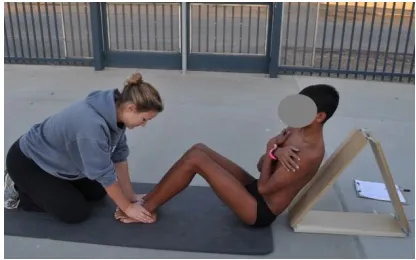
Station 4: Core Strength: Core strength was measured using the McGill Trunk
(Evans, Refshauge, & Adams, 2007; McGill, Childs, & Liebenson, 1999)Excellent reliability coefficients with the McGill Trunk Flexor test have been reported (0.97).(McGill et al., 1999)
Figure 1: McGill Trunk Flexor Test Position
Station 5: Swim Performance: After a standard warm-up, all participants
performed a 50 m maximal test in freestyle stroke. The evaluation process was conducted in a 25 m outdoor pool, and the participants used in-water starts. Swim performance time was determined by an investigator with a stopwatch and was measured in seconds.
2.3 Intervention
Each participant received a handout which included a pictorial representation of each exercise as well as a description on instructions for execution (Appendix A). After the 6 week intervention was completed, each group (intervention group and control group) participated in post-testing.
3.0 Statistical Analysis
All of the results are presented with their mean and standard deviation (SD). A MANOVA was used to compare flexibility, strength and swim times for pre- and post-test measurements by control and intervention group. Univariate tests (ANOVAs) were subsequently used. SPSSv20 (SPSS Inc, Chicago, IL) was used for data analysis. A p value of less than or equal to 0.05 was considered statistically significant.
4.0 Results
Descriptive data about the participants can be seen in Table 1.
Variable Control (N=16) Intervention (N=16)
Mean Min Max Mean Min Max
Age 15 14 16 15 14 17
Years Swimming 5.6 3 11 3.5 1 8
Hours swimming/wk 11.4 6 16 11.3 8 20
Dry-Land hours/wk 7.065 5 12 3.5 0 17
Male Female Male Female
Gender 5 11 11 5
Right Left Right Left
Hand Dominance 16 0 14 2
Table 1: Descriptive Data of Participants
4.1 Flexibility
No significant between-group differences were found for bilateral pectoralis minor length (p = .07 right; p = .08 left) or bilateral posterior capsule tightness (p = .22 right; p = .48 left) between pre and post test measures (Table 2).
Control Group N= 16
Intervention Group N = 16
Pec Length (cm)
Right Pre 7.18 ± 0.82 7.19 ±1.33
Post 7.37 ± 0.71 8.39 ± 1.34
Left Pre 7.03 ±0.73 8.17 ± 1.49
Post 6.77 ± 0.88 6.62 ± 1.45
Post Capsule (degrees)
Right Pre 109.81 ± 4.53 109.47 ± 3.98
Post 110.21 ± 7.08 113.47 ± 8.62
Left Pre 111.93 ± 7.63 109.47 ± 3.98
Post 112.37 ± 7.19 109.78 ± 7.61
Table 2: Flexibility Results. Pec Length: Pectoralis Minor Length, cm: Centimeters, Post Capsule: Posterior Capsule
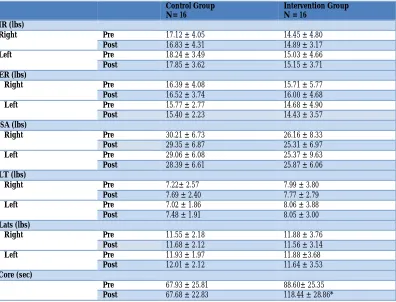
4.2 Strength
Control Group N= 16
Intervention Group N = 16
IR (lbs)
Right Pre 17.12 ± 4.05 14.45 ± 4.80
Post 16.83 ± 4.31 14.89 ± 3.17
Left Pre 18.24 ± 3.49 15.03 ± 4.66
Post 17.85 ± 3.62 15.15 ± 3.71
ER (lbs)
Right Pre 16.39 ± 4.08 15.71 ± 5.77
Post 16.52 ± 3.74 16.00 ± 4.68
Left Pre 15.77 ± 2.77 14.68 ± 4.90
Post 15.40 ± 2.23 14.43 ± 3.57
SA (lbs)
Right Pre 30.21 ± 6.73 26.16 ± 8.33
Post 29.35 ± 6.87 25.31 ± 6.97
Left Pre 29.06 ± 6.08 25.37 ± 9.63
Post 28.39 ± 6.61 25.87 ± 6.06
LT (lbs)
Right Pre 7.22± 2.57 7.99 ± 3.80
Post 7.69 ± 2.40 7.77 ± 2.79
Left Pre 7.02 ± 1.86 8.06 ± 3.88
Post 7.48 ± 1.91 8.05 ± 3.00
Lats (lbs)
Right Pre 11.55 ± 2.18 11.88 ± 3.76
Post 11.68 ± 2.12 11.56 ± 3.14
Left Pre 11.93 ± 1.97 11.88 ±3.68
Post 12.01 ± 2.12 11.64 ± 3.53
Core (sec)
Pre 67.93 ± 25.81 88.60± 25.35
Post 67.68 ± 22.83 118.44 ± 28.86*
Table 3: Strength Results. IR: Internal Rotators, ER: External Rotators, SA: Serratus Anterior, LT: Lower Trapezius, Lats: Latissimus Dorsi, lbs: Pounds,
Sec: Seconds. * Significance @ p ≤ 0.05.
4.3 Swim Performance
No statistical significance (p = .42) was found for the 50 m freestyle swim times in either the control or experimental groups (Table 4).
Control Group N= 16
Intervention Group N = 16
Swim
Performance (sec)
Pre 31.69± 2.61 31.52 ±3.48
Post 31.74 ± 2.23 32.06 ± 3.08
5.0 Discussion
The purposes of this study were to examine the effects of a six week dry land intervention program on the 1) flexibility of the shoulder girdle, 2) muscular strength of the shoulder girdle and core, and3) swim performance in high school aged competitive swimmers. We hypothesized that the intervention program would significantly improve shoulder girdle flexibility and strength, as well as core strength and swim performance. Results of this six week dry land intervention reveal that there wasa significant improvement in core strength with the swimmers in the intervention group as compared to the control group. Flexibility, muscular strength about the shoulder, and 50m freestyle swim times did not show improvements between the two groups. Referred to the "power center" of the body, the core musculature must be strong enough to stabilize a swimmer’s body in the water to maintain correct form. Core strength is a major component for swimmers that is commonly neglected. It not only helps stabilize the swimmer’s body in the water, it helps increase speed during flip turns and aids in propulsion through the water.
Participants performed the upper extremity strengthening exercises for 30 seconds, rather than 10 or 12 repetitions commonly seen in strengthening programs. In addition, there is evidence to support the specificity principle and suggests that core stabilization training should be specific to the task performed.(Keogh et al., 2010)Keogh et al. examined core stability measures with an upper extremity exercise (shoulder press) and concluded that significant improvements in functional dynamic performance may be attained if the postures, mode and velocity of contraction performed in training are similar to the competitive tasks. In this present study, swimming speed was the functional dynamic performance. It is hypothesized that the plank progression exercises did not mimic the motion of a freestyle swim stroke enough to demonstrate improvements in swim times.
The stretching component of the intervention did not result in significant changes. In fact, the intervention group’s mean pectoralis muscle lengthon the dominant side worsened at post-testing. Perhaps the unilateral stretch that was implemented in the present study was not as effective as the more traditional bilateral corner stretch which has been shown to be effective in swimmers. (Borstad & Ludewig, 2006) Furthermore, the lack of improvement of posterior capsule tightness may be attributed to the sole selection of the sleeper stretch. In contrast, McClure et al reported that the cross-body stretch is more effective than the sleeper stretch in improving internal-rotation range of motion deficits.(McClure et al., 2007) In future studies, the cross-body stretch should be added to the intervention program to provide additional stretching to the posterior capsule. While this study did not find improvements with swim performance after a dry land strengthening program, other authors have.(Sébastien Girold et al., 2012; S. Girold et al., 2007; Trappe & Pearson, 1994) While Trappe et al. reported a significant reduction in sprint swim times in 10 trained male collegiate swimmers, the weight-assisted intervention program was 12 weeks.
Aspenes et al. investigated the effect of a combined intervention of maximal strength training and high-intensity interval training on swim performance in 20participants ranging from 14 – 20 years of age.(S. Aspenes et al., 2009) Pre- and post-test measurements included measurements of the freestyle stroke for 50 m, 100 m and 400 m. The authors reported that the only significant difference noted between the intervention group and the control group was the improved swim time for the intervention group during the 400 m freestyle swim. Therefore, a longer swim distance may be necessary to determine if a dry land strength intervention is effective in improving swim performance. In disagreement with other research, this study did not find significant strength improvements of the shoulder internal and external rotators, serratus anterior, lower trapezius, or latissimus dorsi. (K. Swanik et al., 2002; Wang, McClure, Pratt, & Nobilini, 1999) One explanation for this is the selection of the five resistive band exercises. In contrast to prior research that has implemented the “Y”, “T” and “W” exercises for scapular stabilizing muscles, this study attempted to incorporate resistive exercises that also targeted core stabilizers, and thoracic extension and rotation.
6.0 Limitations
There were limitations in this study. Many participants were unable to return signed consent forms from their parents/guardians and this resulted in a limited sample population. Moreover, multiple participants did not complete the study due to various circumstances including injury, illness and vacation. Another limitation was the level of effort put forth by the participants in the intervention group. Although the coaches supervised the exercises, there was no specific way to monitor effort and correct form during each session.
7.0 Conclusion
A 6-week dry land exercise program was effective in improving core strength, however, shoulder flexibility, strength and swim performance remained unchanged in this group of participants. Further research is necessary to explore a dry land resistance program of a longer duration in anticipation of improving swim performance. Further, future research is needed to assess whether a dry land intervention program can reduce shoulder injuries prospectively.
Acknowledgements
The authors wish to thank the high school swimmers and coaches for participating in the program. The authors warmly thank Sarah Spadaro, Danielle Gwin and Michael Sanchez for their assistance with data collection.
References
Aspenes, S., Kjendlie, P. L., Hoff, J., & Helgerud, J. (2009). Combined strength and endurance training in competitive swimmers. Journal of Sports Science and Medicine, 8(3), 357-365.
Aspenes, S. T., & Karlsen, T. (2012). Exercise-Training Intervention Studies in Competitive Swimming. Sports Medicine, 42(6), 527-543.
Bak, K. (2010). The Practical Management of Swimmer's Painful Shoulder: Etiology, Diagnosis, and Treatment. Clinical Journal of Sport Medicine, 20(5), 386-390. Batalha, N. M., Raimundo, A. M., Tomas-Carus, P., Barbosa, T. M., & Silva, A. J. (2013).
Shoulder Rotator Cuff Balance, Strength, and Endurance in Young Swimmers During a Competitive Season. The Journal of Strength & Conditioning Research, 27(9), 2562-2568.
Blanch, P. (2004). Conservative management of shoulder pain in swimming. Physical Therapy in Sport, 5(3), 109-124.
Borstad, J. D., & Ludewig, P. M. (2006). Comparison of three stretches for the pectoralis minor muscle. Journal of shoulder and elbow surgery, 15(3), 324-330.
Brumitt, J., & Dale, R. B. (2009). Integrating shoulder and core exercises when rehabilitating athletes performing overhead activities. North American Journal of Sports Physical Therapy: NAJSPT, 4(3), 132.
Brushøj, C., Bak, K., Johannsen, H., & Faunø, P. (2007). Swimmers' painful shoulder arthroscopic findings and return rate to sports. Scand J Med Sci Sports, 17(4), 373-377.
Evans, K., Refshauge, K. M., & Adams, R. (2007). Trunk muscle endurance tests: Reliability, and gender differences in athletes. Journal of Science and Medicine in Sport, 10(6), 447-455. doi: 10.1016/j.jsams.2006.09.003
Fig, G. (2005). Strength training for swimmers: Training the core. Strength & Conditioning Journal, 27(2), 40-42.
Folland, J., & Archer, G. (2014). SHOULDER INJURIES IN HIGHLY TRAINED COMPETITIVE SWIMMERS. British journal of sports medicine, 48(7), 593-593. Garrido, N., Marinho, D. A., Reis, V. M., van den Tillaar, R., Costa, A. M., Silva, A. J., &
Marques, M. C. (2010). Does combined dry land strength and aerobic training inhibit
performance of young competitive swimmers? Journal of sports science & medicine, 9(2), 300.
Gaunt, T., & Maffulli, N. (2012). Soothing suffering swimmers: a systematic review of the epidemiology, diagnosis, treatment and rehabilitation of musculoskeletal injuries in competitive swimmers. Br Med Bull, 103, 45-88.
Girold, S., Jalab, C., Bernard, O., Carette, P., Kemoun, G., & Dugué, B. (2012). Dry-land strength training vs. electrical stimulation in sprint swimming performance. The Journal of Strength & Conditioning Research, 26(2), 497.
Girold, S., Maurin, D., Dugué, B., Chatard, J., & Millet, G. (2007). Effects of dry-land vs. resisted-and assisted-sprint exercises on swimming sprint performances. Journal of Strength and Conditioning Research, 21(2), 599.
Heinlein, S. A., & Cosgarea, A. J. (2010). Biomechanical Considerations in the Competitive Swimmer’s Shoulder. Sports Health: A Multidisciplinary Approach, 2(6), 519-525. Hibberd, E. E., & Myers, J. B. (2013). Practice Habits and Attitudes and Behaviors
Concerning Shoulder Pain in High School Competitive Club Swimmers. Clinical Journal of Sport Medicine, 23(6), 450-455.
Hibberd, E. E., Oyama, S., Spang, J. T., Prentice, W., & Myers, J. B. (2012). Effect of a 6-Week Strengthening Program on Shoulder and Scapular-Stabilizer Strength and Scapular Kinematics in Division I Collegiate Swimmers. Journal of sport rehabilitation, 21(3), 253.
Johnson, J. N., Gauvin, J., & Fredericson, M. (2003). Swimming biomechanics and injury
prevention: new stroke techniques and medical considerations. Phys Sportsmed, 31(1), 41.
Keogh, J. W., Aickin, S. E., & Oldham, A. R. (2010). Can common measures of core stability distinguish performance in a shoulder pressing task under stable and unstable conditions? The Journal of Strength & Conditioning Research, 24(2), 422.
King, D. (1995). Glenohumeral Joint Impingement in Swimmers. Journal of athletic training, 30(4), 333.
Lewis, J., & Valentine, R. (2007). The pectoralis minor length test: a study of the intra-rater reliability and diagnostic accuracy in subjects with and without shoulder symptoms. BMC musculoskeletal disorders, 8(1), 64.
Ludewig, P. M., Hoff, M. S., Osowski, E. E., Meschke, S. A., & Rundquist, P. J. (2004). Relative balance of serratus anterior and upper trapezius muscle activity during push-up exercises. The American journal of sports medicine, 32(2), 484-493.
Lynch, S. S., Thigpen, C. A., Mihalik, J. P., Prentice, W. E., & Padua, D. (2010). The effects of an exercise intervention on forward head and rounded shoulder postures in elite swimmers. Br J Sports Med, 44(5), 376-381.
Malanga, G. A., Jenp, Y., Growney, E. S., & An, K. (1996). EMG analysis of shoulder positioning in testing and strengthening the supraspinatus. Medicine and science in sports and exercise, 28(6), 661-664.
McClure, P., Balaicuis, J., Heiland, D., Broersma, M. E., Thorndike, C. K., & Wood, A. (2007). A randomized controlled comparison of stretching procedures for posterior shoulder tightness. Journal of Orthopaedic & Sports Physical Therapy, 37(3), 108-114.
McGill, S. M., Childs, A., & Liebenson, C. (1999). Endurance times for low back stabilization exercises: Clinical targets for testing and training from a normal database. Archives of Physical Medicine and Rehabilitation, 80(8), 941-944.
doi: 10.1016/s0003-9993(99)90087-4
McMullen, J., & Uhl, T. L. (2000). A kinetic chain approach for shoulder rehabilitation. Journal of athletic training, 35(3), 329.
Myers, J. B., Oyama, S., Wassinger, C. A., Ricci, R. D., Abt, J. P., Conley, K. M., & Lephart, S. M. (2007). Reliability, precision, accuracy, and validity of posterior shoulder tightness assessment in overhead athletes. The American journal of sports medicine, 35(11), 1922-1930.
Russ, D. W. (1998). In-season management of shoulder pain in a collegiate swimmer: a team approach. Journal of Orthopaedic & Sports Physical Therapy, 27(5), 371-376. Straub, S., & Mattacola, C. (2004). Shoulder-rotator strength of high school swimmers over
the course of a competitive season. Journal of sport rehabilitation, 9.
Swanik, K., Swanik, C., Lephart, S., & Huxel, K. (2002). The effect of functional training on the incidence of shoulder pain and strength in intercollegiate swimmers. Journal of sport rehabilitation, 11(2), 140-154.
Swanik, K. A., Lephart, S. M., Swanik, C. B., Lephart, S. P., Stone, D. A., & Fu, F. H. (2002). The effects of shoulder plyometric training on proprioception and selected muscle performance characteristics. Journal of shoulder and elbow surgery, 11(6), 579-586. Tarnanen, S. P., Ylinen, J. J., Siekkinen, K. M., Mälkiä, E. A., Kautiainen, H. J., & Häkkinen,
A. H. (2008). Effect of isometric upper-extremity exercises on the activation of core stabilizing muscles. Archives of Physical Medicine and Rehabilitation, 89(3), 513-521. Tate, A., Turner, G. N., Knab, S. E., Jorgensen, C., Strittmatter, A., & Michener, L. A. (2012). Risk factors associated with shoulder pain and disability across the lifespan of competitive swimmers. Journal of athletic training, 47(2), 149.
Trappe, S. W., & Pearson, D. R. (1994). Effects of weight assisted dry-land strength training
on swimming performance. The Journal of Strength & Conditioning Research, 8(4), 209-213.
Troup, J. P. (1999). The physiology and biomechanics of competitive swimming. Clinics in Sports Medicine, 18(2), 267-285.
Virag, B., Hibberd, E. E., Oyama, S., Padua, D. A., & Myers, J. B. (2014). Prevalence of Freestyle Biomechanical Errors in Elite Competitive Swimmers. Sports Health: A Multidisciplinary Approach, 6(3), 218-224.
Wang, C.-H., McClure, P., Pratt, N. E., & Nobilini, R. (1999). Stretching and strengthening exercises: Their effect on three-dimensional scapular kinematics. Archives of Physical Medicine and Rehabilitation, 80(8), 923-929. doi: 10.1016/s0003-9993(99)90084-9 Weldon III, E. J., & Richardson, A. B. (2001). Upper extremity overuse injuries in swimming:
a discussion of swimmer's shoulder. Clinics in Sports Medicine, 20(3), 423-438.