Volume 6|Issue 1 Article
6-2019
Cultural Assessment: A Study of Midwives’
Knowledge, Attitude and Self-reported Practice in
Uganda
Mercy Muwema
Uganda Nurses and Midwives Council, [email protected]
Karen Drake
Bethel University, USA, [email protected]
Pamela Friesen
Bethel University, USA, [email protected]
Grace Edwards
Aga Khan University, [email protected]
Follow this and additional works at:https://ecommons.aku.edu/jam
Part of theNursing Midwifery Commons
Recommended Citation
Cultural Assessment: A Study of Midwives’ Knowledge, Attitude and Self-reported
Practice in Uganda
1*Mercy Muwema, 2Karen Drake, 3Pamela Friesen, 4Grace Edwards
1. Quality Assurance Manager, Uganda Nurses and Midwives Council Kampala, Uganda
2. Professor of Nursing, Bethel University St. Paul, MN, USA
3. Professor of Nursing, Bethel University St Paul, MN, USA
4. Professor of Midwifery, Aga Khan University – East Africa
Kampala, Uganda
*Corresponding author:Mercy Muwema
Abstract
Background: Cultural assessment is critical due to the increased movement and resettlement of
people across the globe, and diverse cultural groups in Uganda. This is putting the health care
delivery systems serving the communities under pressure to recognize the different attitudes of
people towards health and to develop care systems that are effective in meeting diverse needs.
However, despite the importance of cultural assessment in nursing literature, little is known
about the cultural assessment competence of Ugandan midwives. This study assessed the
knowledge, attitude, and practice of midwives in this assessment process.
Methods: A descriptive correlational design was used to generate data for the study from a
convenience sample of midwives in three hospitals using a structured questionnaire. Data were
analysed using SPSS version 20.
Results: Forty-nine midwives participated in the study. Over half of the respondents [57%, n =
28], demonstrated a positive attitude, however, their knowledge level was low. Almost all the
their basic midwifery programmes. The majority of the midwives cared for at least 1 – 5 mothers
a month from a culture different from their own and occasionally (once a month) [65%, n = 32]
experienced difficulties or problems attributed to cultural differences. Despite the diversity of the
midwives’ clients and their experiences, over half of the midwives [55%, n = 27] reported that
they did not record cultural data during the assessment of mothers in labour. Where the data were
recorded, it was limited to biographic information such as name, age, religion, tribe, and next of
kin. These data were used to plan a client’s care. The major barrier to cultural assessment
practice cited by the respondents was lack of time.
Conclusion: Overall, the midwives knowledge level about cultural assessment was low. With a
culturally diverse population living in Uganda, providing culturally congruent care to all women
will continue to be a challenge and necessity. It is, therefore, recommended that a culture-based
curriculum and in-service training on cultural assessment be developed for midwives.
Key Words: cultural assessment, midwives, cultural competence, labouring mothers, Uganda
Background
Uganda failed to meet the Millennium Development Goal (MDG) 5 of reducing maternal
mortality by three quarters 1 and may face challenges in meeting the Sustainable Development
Goals (SDGs). The Maternal Mortality Ratio (MMR) in Uganda is 336 per 100,000 live births
with an infant mortality rate estimated at 27 per 1,000 live births.2 Uganda signed the
Sustainable Development Goals which include targets 1 and 2 of SDG 3: reducing the global
maternal mortality ratio to less than 70 per 100,000 live births and ending preventable deaths of
newborns and under five children respectively by 2030.3
Achieving these targets in Uganda has been challenging; barriers to accessing health
care are reflected in the institutional delivery rate of 55% and antenatal care coverage for 4th visit
of 38%.4 In 2016, the recommendation was changed to eight visits.5 Barriers to accessing
maternal health care services in Uganda include but are not limited to: i) costs of care; ii)
distance from health facilities and lack of transport; and iii) lack of decision making power
The reasons for under-utilization of health services are many and complex. Socio-cultural
barriers need to be overcome if women are to access technical services and information that can
prevent maternal mortality and morbidity.6 As a result, it is important for health care delivery
systems to recognize the differing attitudes of people towards health and develop care systems
that are effective in meeting their needs.7
Midwives have been recognized as skilled health care professionals who can be part of
the solution in the quest for a culturally sensitive and competent health care system. Lack of
knowledge and respect for health-related cultural variations can result in the client’s refusal of
many recommendations for health promotion and disease prevention.8 Furthermore, when
cultural differences exist regarding beliefs about health and illness, health practices, and
health-seeking behaviour, the progress of health-related interaction between midwife and patient
becomes difficult and can negatively affect health outcomes.9
A cross-sectional study conducted in Ethiopia of 274 maternal health care providers
revealed that nearly 10% of the health workers did not know the greeting style of women they
were serving and had limited proficiency of key words and phrases of the women’s native
language that could facilitate health care delivery. Furthermore, 21.2% of the participants did not
allow a woman in labour to pray, even when there was a request to do so, 33.9% restricted
mothers from lying supine during delivery, 35% of respondents would only allow women to give
birth on a bed, and 77% did not feel comfortable in asking a client’s ethnic background. In
addition, 69.3% of the participants never sought women’s wishes around disposal of the
placenta. Forty one percent of the participants did not agree with incorporating cultural
considerations in their clinical service.10
Uganda is home to diverse cultural groups; over thirty different languages are spoken.
This diversity is compounded by the increased movement and resettlement of people generally
across the globe. Uganda has nationals from Southern Sudan, Kenya, Rwanda, Burundi,
Democratic Republic of Congo and Somalia, among others.11 This has created major changes in
the mix of cultures and poses a significant challenge to midwives providing individualized and
Ugandan women adhere to very traditional birthing practices and believe that pregnancy
is a test of endurance and maternal death is merely a sad but normal event.12 Culture is an
important consideration in clinical care as it contributes to shaping patients’ health-related
values, beliefs, and behaviours. Despite an extensive literature review, no study was found about
how Ugandan midwives elicit information about women’s cultural beliefs and traditions.
Therefore, this study aimed to assess midwives’ knowledge, attitudes, and practice of cultural
assessment of mothers in labour.
Methods
Design
A descriptive correlational study was conducted among midwives in three hospitals. The
design of the study and more specifically the framework of the qualitative data was guided by
Leininger’s theory of culture care diversity and universality theory.13
Setting
The study was conducted in two public and one private referral hospitals located in the
central (Masaka and Kampala) and eastern (Mbale) part of Uganda. These facilities are known to
serve large multicultural populations.
Study participants
The study included midwives employed as permanent staff in the three health facilities’
labour wards who were recognized by the Uganda Nurses and Midwives Council as Midwives or
Nurses with midwifery skills. Fifty-six (56) midwives were eligible to participate in the study
and forty-nine (49) agreed to participate and were available during the data collection period.
Data collection
Data were gathered using a self-administered structured questionnaire authored by Hart
(1999)14 which was adapted for this study. Permission to use the questionnaire was sought and
granted. The instrument contained 30 closed questions where participants selected responses
from the provided options with eight open questions that encouraged the participants to write
their individual responses. The questionnaire had three major components that included
midwives’ knowledge, attitude, and practice in addition to demographic information.
Midwives’ knowledge was measured by items asking what constituted cultural
midwifery care. Attitude was measured by asking about midwives’ feelings towards conducting
cultural assessment during labour and its importance while caring for a labouring woman.
Midwives’ practice was measured by self- report of the ability to conduct a cultural assessment,
analyse the cultural data gathered during the assessment and use the data in planning and
providing care.
Data Analysis
Thorough discussions with the research team were held and consensus was reached on
how variables should be rated and categorized. Statistical advice was sought on the items to
include for analysis of each response. The possible responses to each question could be negative
(e.g. I have no time to assess) or positive. To analyse the total attitude score of the participants,
five of the six questions in that section were analysed. One item was analysed separately
because it allowed multiple responses and related to barriers. For the 5 items, every positive
response was given a score of one while a score of zero was given to every negative response.
The total sum was then divided by the total number of questions and then multiplied by 100. A
participant with a score of 80% and above was considered to have a positive attitude while a
score below 80% was considered to reflect a negative attitude to cultural assessment.
For the total knowledge level of the participants, four questions that assessed knowledge
of cultural assessment were included. Each response was counted separately since the questions
required more than one response. Every correct response was given a score of one while a score
of zero was given to every wrong response. The total sum was then divided by the total number
of response items and multiplied by 100. A participant with a score of above 80% was
considered to have a high level of knowledge, a score of 60% to 80% was considered a moderate
level of knowledge, while a score below 60% was considered a low level of knowledge.
Ethical consideration
The Uganda Christian University Research and Ethics Committee approved the study.
Prior to commencement of data collection in each hospital, permission was sought from the
hospital research and ethics committees. All participants in the study consented in writing upon
acquisition of information about the study and their rights. Participants’ information was kept
Results
Socio-demographic characteristics
Fifty-six midwives received the questionnaires, 49 midwives filled and returned the
questionnaires yielding a response rate of 87.5%. The majority of the participants were working
in public hospitals, with most midwives aged 30 years or younger (43%, n=21). Study
participants were predominantly Diploma-level midwives [61%], had more than 15 years of
experience as midwives [39%], had stayed in the area of their employment for 1 – 5 years [35%],
and were from the Baganda ethnic group [41%] (Table 1).
Table 1: Socio-demographic characteristics of midwives
Socio-demographic characteristic Number Percentage
1. Gender (n = 49)
▪ Male 2 4
▪ Female 47 96
2. Age (n = 49)
▪ ≤ 30 21 43
▪ 31 – 40 9 18
▪ 41 – 50 10 20
▪ 51 – 60 9 18
3. Educational background (n = 49)
▪ Certificate 17 35
▪ Diploma 30 61
▪ Degree 2 4
4. Length of stay in years in the geographical area
(n = 48)
▪ < 1 9 19
▪ 1 – 5 17 35
▪ 6 – 10 7 15
▪ 11 – 15 5 10
▪ >15 10 21
5. Ethnicity of the midwives (n = 46)
▪ Baganda 19 41
▪ Ateso 6 13
▪ Bagishu 6 13
▪ Basoga 7 15
▪ Others 8 17
First point of contact for midwives
Midwives were asked to estimate how frequently their first contact with a labouring
scale was used with 1 meaning never at this stage of labour to 4 meaning always at this stage of
labour (every mother). The highest frequency [46] was Early Active, 4 – 6cm (Table 2).
Table 2: First point of contact for midwives
N Mean Std. Deviation
Latent 33 2.85 .755
Early Active (4-6cm) 46 3.22 .629 Active (7-10cm) 33 2.97 .637
Second stage 34 2.44 .786
Cultural assessment practices
Almost 42% (n = 20) of midwives stated that they cared for 1 – 5 mothers in a month
from a culture different from their own. The majority [55%, n = 27] of the midwives stated that
hospital labour admission forms did not include any cultural information. When it was included,
most of the information was biographic such as name, religion, age, tribe, and next of kin. Of
the 22 midwives who responded to this question, 12 thought it was limited and that current
admission forms needed to be expanded; 14 indicated that the acquired cultural data were used to
plan women’s care. All 49 respondents [100%] reported that no separate cultural assessment
forms were available on any labour ward.
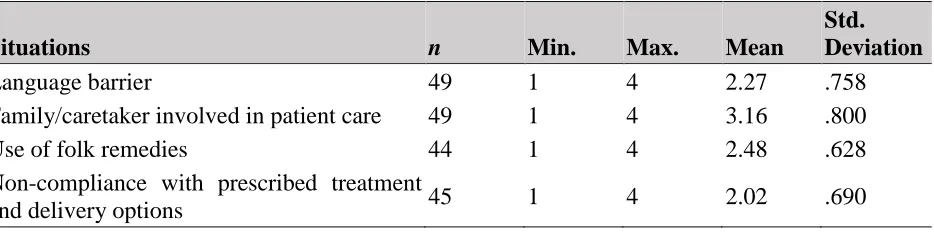
The midwives were asked how often they experienced problems related to cultural
differences. Several cultural situations were considered as indicated in Table 3. A Likert scale
was used where “1” was never, “2” was occasionally (once a month), “3” was frequently (once a week), and “4” was always (once a day). The majority [65%, n = 32] of the midwives
experienced problems or difficulties that were attributed to cultural differences while taking care
of labouring mothers and their families “occasionally (once a month)”.
Table 3: Cultural situations faced by Midwives while taking care of labouring mothers
Situations n Min. Max. Mean
Std. Deviation
Language barrier 49 1 4 2.27 .758
Family/caretaker involved in patient care 49 1 4 3.16 .800
Use of folk remedies 44 1 4 2.48 .628
Non-compliance with prescribed treatment
Performance of religious customs 46 1 4 2.39 .881 Role expectations between nurse – patient 43 1 4 2.23 .922 Desire for cultural health practitioner 45 1 4 1.91 .949
Others 1 1 1 1.00 .
Knowledge about cultural assessment
Nearly 90 % [n = 44] of the midwives were not trained on transcultural or cross-cultural
midwifery care during their basic midwifery programmes. When the total knowledge level of the
midwives was calculated as a percentage score and categorized, 16% (n = 8) had a high level of
knowledge, 29% (n = 14) had a moderate level of knowledge, and 55% (n = 27) fell below the
agreed measure of 60%, which was low. Despite not receiving training, 48% [n = 23] of the
midwives indicated that cultural assessment should be done during the initial antenatal
assessment. The majority [61%, n = 30] of the midwives believed that cultural data positively
influenced the quality of midwifery care and should be used in planning care for the mothers
[69%, n = 34].
Attitude towards cultural assessment
When the attitude of each midwife was scored as a percentage, 57% [n = 28] of the
midwives were considered to have a positive attitude while 43% [n = 21] of the midwives were
considered to have a negative attitude.
The majority [59%, n = 29] of the midwives were willing to spend 15 minutes or less
carrying out a cultural assessment. An equal number (n = 29) indicated they would use the
cultural assessment form once a day if it were readily available. The acquired cultural data were
perceived as useful by just over one third of the respondents [39%, n = 19]. In addition,
midwives cited lack of time [35%, n = 34] and language difficulties [33%, n = 32] as the biggest
barriers to doing a cultural assessment of women in labour.
Relationship between total knowledge, total attitude, and various predictors
A multiple regression analysis was conducted to examine the possible association
between knowledge level, attitude level, and various independent variables. The knowledge
level of diploma midwives when compared with certificate midwives increased by 0.191 while
midwives increased by 0.326. Both differences were not statistically significant (p = 0.489; p =
0.393 respectively).
There were some observed differences in the attitude levels of midwives in the different
age groups, but the differences were not statistically significant
Discussion
This study around the knowledge and skills of midwives in performing a cultural
assessment found that the skills were largely lacking. Although most of the midwives felt a
cultural assessment was important, many felt they lacked the skills to conduct one as this had
never been taught. This finding is in agreement with a study conducted by Reihani and
colleagues15 in Iran among 104 nurses and midwives on cultural safety that revealed the mean
knowledge score for the participants being 4.32 out of 10 and thus considered undesirable. The
high scores on attitude however provides hope that when cultural assessment practice is
introduced, many midwives will be able to implement it routinely in their practice This is
motivation for future implementation.
The majority [48%] of the midwives preferred to have cultural assessments performed
outside the labour ward, during the initial antenatal assessment. These findings do not concur
with work by Hart 14 who highlighted that while conducting a careful cultural assessment may be
impossible in labour, a quick assessment of patient’s cultural needs should be done. This is
especially relevant in this study as the first contact with women for the majority of midwives was
during active labour. Furthermore, 61% of midwives in this study stated that cultural data
positively influenced the quality of midwifery care suggesting that they are knowledgeable about
the influence of cultural assessments on care, which increases the likelihood of implementing
cultural assessment. These findings are supported by a study conducted by Murray and
Huelsmann 16 that revealed midwives were culturally aware. The cultural awareness of midwives
is further emphasized by our result [69%, n = 34] that showed cultural assessment findings were
used to plan care. The percentage, however, is too low to conclude that all midwives know when
to use cultural assessment data and therefore is an area needing reinforcement through training.
Midwives were willing to spend 15 minutes or less to obtain cultural information in
addition to the routine admission information and then use the cultural information only once a
that the cultural assessment tool for use is short. This may be due to a shortage of providers
resulting in heavy workloads. Midwives are realistically reflecting a known shortage and urgent
need for recruitment in Uganda.17 The addition of extra work may further worsen the maternal
health indicators in Uganda; innovative strategies of incorporating cultural assessment into
current practice are needed.
Midwives indicated in the month previous to the study that they cared for one to five
mothers that were from a culture different from their own. This relatively small number may
explain why midwives did not conduct a cultural assessment in labour. Since midwives
experienced problems or difficulties believed to be caused by cultural differences occasionally,
once a month, they may not feel it is important to address the cultural needs of women in their
care. However, despite the relatively low numbers, some women may lack the cultural support
and sensitivity needed at this vulnerable time.
Furthermore, the data analysis showed no significant difference among the hospitals
regarding the cultural diversity of the women. This finding is noteworthy because when
languages spoken by midwives were compared to the dominant languages of the hospitals’
locations, the majority of midwives in the central public referral facility did not belong to the
dominant culture. Women who seek health care in this facility may also originate from outside
the area.
None of the hospitals where the midwives worked had a separate cultural assessment
form. The hospital admission form had limited cultural data. This further shows the difficulty
midwives had in acquiring knowledge about cultural assessment because it was not being
practiced. Intuitively perhaps, the midwives considered that cultural assessment would influence
midwifery care positively and wanted an expanded admission form to include more cultural data.
The study involved a limited number of midwives and health facilities that may have
some impact on the generalizability of findings. The study also examined an unfamiliar but
recognizable influencing factor of quality midwifery care, cultural assessment that may have
Conclusion
The overall knowledge level of the midwives around cultural assessment was
unsatisfactory due to lack of theory and practice during their basic midwifery programmes and
subsequent professional development. The midwives’ attitudes toward cultural assessment was
positive indicating that they considered it an important aspect of midwifery care but limited
knowledge and skills in cultural assessment affected their ability to effectively integrate it into
practice.
These results have national implications for maternal health and, therefore, call for
continuing education of midwives and research in this area, and innovative strategies of offering
culturally sensitive care as part of achieving holistic care. We recommend cultural assessment be
part of the curriculum for midwives; that role models of cultural assessment be developed in
practice sites and further research be done about cultural beliefs and practices exhibited by
labouring women. Further research about the knowledge, attitudes, and the practice of cultural
assessment by midwives could assess the impact of an increased emphasis on cultural
competence.
Competing interests
The authors declare that they have no conflict of interests
Acknowledgements
The authors are grateful to the administration of the public and private referral hospitals that
participated; and the study participants.
References
1. United Nations Development Programme. Millennium Development Goals Report for
Uganda 2015. Kampala, Uganda: Ministry of Finance and Planning. 2015.
2. Uganda Bureau of Statistics and ICF. Uganda Demographic and Health Survey 2016: Key
Indicators Report. Kampala, Uganda and Rockville, Maryland, USA: Uganda Bureau of
Statistics and ICF. 2017
3. Kaducu MJ. Ministry of Health press statement on safe motherhood day. Kampala, Uganda:
4. Ministry of Health. Annual Health Sector Performance 2015/2016. Kampala, Uganda:
Ministry of Health. 2016
5. World Health Organization WHO recommendation on antenatal care for a positive
pregnancy experience. Geneva, Switzerland: World Health Organization. 2016
6. Damen H. Bridging the availability-utilization gap: the issue of quality in the provision of
health care. Ethiopian J Health Devel. 2011;25(1), 1-99.
7. Stewart M. Cultural competence in undergraduate healthcare education: review of the issues.
Physiotherapy. 2002;88(10), 620-629.
8. Doyle EL, Faucher MA. Pharmaceutical therapy in midwifery practice: a culturally
competent approach. J Midwifery Womens Health. 2002;47, 122-129.
9. Zahr LK, Hattar-Pollara M. Nursing care of Arab children: consideration of cultural factors. J
Pediatr Nurs. 1998; 13, 349 – 355.
10.Aragaw A, Yigzaw T, Tetemke D, G/Amlak W. Cultural competence among maternal health
care providers in Bahir Dar City administration, Northwest Ethiopia. BMC Pregnancy
Childbirth. 2015;15, 227.
11.International Organization for Migration. Migration in Uganda: a rapid country profile 2013.
Kampala, Uganda: International Organization for Migration. 2015
12.Rutaremwa G, Wandera OS, Jhamba T, Akiror E, Kiconco A. Determinants of maternal
health services utilization in Uganda. BMC Health Serv Res. 2015;15, 271.
13.Leininger MM. Leininger's theory of nursing: Cultural care diversity and universality. Nurs
Sci Quart. 1988;1(4), 152-60.
14.Hart D. Assessing culture: pediatric nurses' beliefs and self-reported practices. J Pediatr Nurs.
1999;14(4), 255-262.
15.Reihani M, Keshavarz Z, Vedadhir A, Zaeri F. Cultural safety in motherhood: evidence from
midwives and nurses in the multicultural context of Iran society. Med Ethics J. 2016;10(36),
55-64.
16.Murray M., Huelsmann G. Labor and delivery nurse: a guide to evidence-based practice.
New York, USA: Springer Publishing Company. 2009.
17.Sekanjako H. Uganda needs 2,000 midwives. 2011. Available at: