Vol. 9, No. 1, 2015, 61-71
ISSN: 2320 –3242 (P), 2320 –3250 (online) Published on 8 October 2015
www.researchmathsci.org
61
International Journal of
A Method for Ranking of Fuzzy Numbers Using new
Area Method
D. Stephen Dinagar1 and S. Kamalanathan2 PG & Research Department of Mathematics Porayar – 609307, India, e-mail: [email protected]
1
Corresponding author 2
Department of Science & Humanities, RVS College of Engg. & Tech. Karaikal – 609609, India, e-mail: [email protected]
Received 6 September 2015; accepted 2 October 2015
Abstract. In this paper, the researchers proposed a modified new weighted area method to rank fuzzy numbers using the area of trapezium. We also use some comparative examples to illustrate the advantage of the proposed method with the existing metric index ranking methods. If the comparison for negative numbers is not possible, we are using the comparison based on spread and weight. The process of this method is easier than that of other. A set of illustrative examples are also used.
Keywords: Area of trapezium, generalized trapezoidal fuzzy numbers, ranking of fuzzy numbers
AMS Mathematics Subject Classification (2010): 03E72, 90B99 1. Introduction
Ranking fuzzy numbers plays an important role in decision making. Most of the real world problems that exist in nature are fuzzy, than probabilistic or deterministic. Problems in which fuzzy theory is used, like fuzzy risk analysis, fuzzy optimization, etc., at one or the other stage fuzzy numbers must be ranked before an action is taken by a decision maker.
In this paper, we want to propose a new method for ranking in area of two generalized trapezoidal fuzzy numbers. A simpler and easier approach is proposed for the ranking of generalized trapezoidal fuzzy numbers. For the validation the results of the proposed approach are compared with different existing approaches [17].
62
function. Since then, various procedures to rank fuzzy quantities are proposed by various researchers. Yager [23,24] proposed four indices to order fuzzy quantities in [0, 1]. An Adamo [3] fuzzy decision tree was an important breakthrough in ranking fuzzy numbers. Dubois and Prade [12] proposed a complete set of comparison indices in the frame work of Zadeh’s possibility theory.
Liou and Wang [16] presented ranking fuzzy numbers with integral value. Choobineh and Li [10] presented an index for ordering fuzzy numbers. Since then several methods have been proposed by various researchers which include distance method by Cheng [9]. Wang and Kerre [21,22] classified the existing ranking procedures into three classes. The first class consists of ranking procedures based on fuzzy mean and spread and second class consists ranking procedures based on fuzzy scoring whereas, the third class consists of methods based on preference relations and concluded that the ordering procedures associated with first class are relatively reasonable for the ordering of fuzzy numbers specially, the ranking procedure presented by Adamo [3] which satisfies all the reasonable properties for the ordering of fuzzy quantities. The methods presented in the second class are not doing well and the methods which belong to class three are reasonable. Stephen Dinagar and Kamalanathan [20] defined a distance based ranking procedure SD of PILOT to solve the maximize net present value.
Later on, ranking fuzzy numbers by area between the centroid point and original point by Chu andTsao [11], fuzzy risk analysis based on ranking of generalized trapezoidal fuzzy numbers by Chen and Chen [7], a new approach for ranking trapezoidal fuzzy numbers by Abbasbandy and Hajjari [1], fuzzy riskanalysis based on ranking generalized fuzzy numbers with different heights and different spreads by Chen and Chen [8] came into existence.Amit Kumar et al. [15] presented a procedure on ranking generalized trapezoidal fuzzy numbers based on rank, mode, divergence and spread.
In this paper, we have used area of trapezium as a new ranking procedure for generalized trapezoidal fuzzy numbers. The trapezium has two bases parallel to each other and two legs joining these bases at the points (a, 0), (b, 0), (c, w) and (d, w). The area covered by these four points is our ranking function. In addition to this [9] gives equal ranking for this case as the method calculate similar distance for bothfuzzy
numbers as the centroid points are the samewhereas [9] also ranked equally (C1≈C2) for this casebecause both fuzzy numbers have similar area betweenthe centroids and original points. To overcome this, we can use mode, spread and weight method in addition [4,17].
Section 2 briefly introduces the basic concepts and definitions of fuzzy numbers. Section 3 presents the proposed new method. In Section 4, we have explained the comparative study made by the existing methods. In section 5, we have concluded the paper.
2. Preliminaries
Chen (1985, 1990) represented a Generalized Trapezoidal Fuzzy Number (GTrFN) A~as
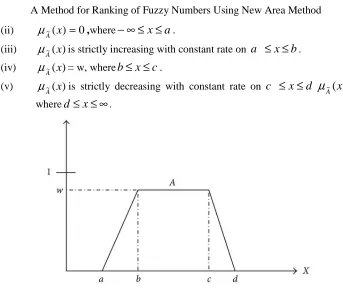
A~ = (a,b,c,d;w), 0 <w ≤ 1 and a, b, c and d are real numbers. The generalized fuzzy number A~ is a fuzzy subset of real line R, whose membership function
µ
A~ satisfies the following conditions:(i) ~(x) A
63 (ii) ~(x)=0
A
µ
,where−
∞
≤
x
≤
a
. (iii) ~(x)A
µ
is strictly increasing with constant rate on a ≤x≤b. (iv) ~(x)A
µ
= w, whereb≤x≤c. (v) ~(x)A
µ
is strictly decreasing with constant rate on c ≤x≤d ~(x)=0 Aµ
,whered≤x≤∞.
Figure 1: Generalized trapezoidal fuzzy number
A Generalized Trapezoidal Fuzzy Number A~ = (a,b,c,d;w) is a fuzzy set of the real line R whose membership function ~(x)
A
µ
: R → [0,w]is defined as
≤
≤
−
−
=
≤
≤
≤
≤
−
−
=
=
Otherwise
d
x
forc
c
d
x
d
w
x
c
x
forb
w
b
x
fora
a
b
a
x
w
x
x
A R w A L w A,
0
,
)
(
,
,
)
(
)
(
~ ~ ~µ
µ
µ
wherea<b<c< d and
w
∈
(
0
,
1
]
3. Proposed method64
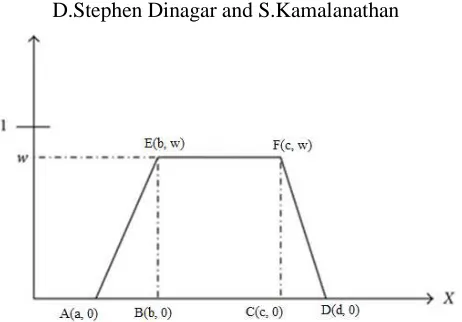
Figure 2: Generalized trapezoidal fuzzy number ABCDEF
The area of trapezium is give by
(
1 2)
2
b
b
h
A
=
+
where h = height = w; b1, b2 = bases of trapezium
b1 = distance between A(a, 0) and D(d,0) =
[
(
) ( )
0]
( )2 2
a d a
d − + = −
b2 = distance between E (b, w) and F (c, w)
[
(
) (
)
]
( ) 22
b c w
w b
c− + − = −
=
The area of the trapezium ADFE is,
[
(
d a) (
c b)
]
w
A= − + −
2
The ranking function of the generalized trapezoidal fuzzy number A=
(
a,b,c,d;w)
which maps the set of all fuzzy numbers to a set of real numbers is defined as:
(
) (
)
[
c d a b]
w
A = + − +
ℜ
2 ) ~ (
The mode of the generalized trapezoidal fuzzy number A=
(
a,b,c,d;w)
is defined as:(
b c)
dx w(
b c)
Mode w
+ = +
=
∫
2 2
1
0
The spread of the generalized trapezoidal fuzzy number A=
(
a,b,c,d;w)
is defined as:(
d a)
dx w(
d a)
Spread
w
− = − =
∫
0
The left spread of the generalized trapezoid dal fuzzy number A=
(
a,b,c,d;w)
isdefined as: LeftSpread
(
b a)
dx w(
b a)
w− = − =
∫
65
The right spread of the generalized trapezoidal fuzzy number A=
(
a,b,c,d;w)
isdefined as: Right Spread
(
d c)
dx w(
d c)
w− = − =
∫
0
Figure 3:
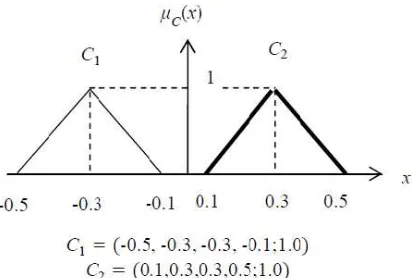
In exercise 3, the fuzzy number A is mirror image of B (non-overlapping fuzzy number). The existing ranking methods including the defined our proposed method does not consider this case. [9] gives equal ranking for this case as the method calculate similar distance for both fuzzy numbers as the centroid points are the same whereas [9] also ranked equally (C1≈ C2) for this case because both fuzzy numbers have similar area between the centroids and original points. To overcome this, we can use the method based on mode, spread and weight as an additional tool.
Using the above definitions we now define the ranking procedure of two generalized trapezoidal fuzzy numbers A=
(
a1,b1,c1,d1;w1)
and(
a2,b2,c2,d2;w2)
B= be two generalized trapezoidal fuzzy numbers.
Figure 4: Non-overlapping Fuzzy Numbers (Mirror image case).
The working procedure to compare A ad B are as follows [17]: Step 1. Find ℜ( A) and ℜ(B)
Case (i) If ℜ( A)<ℜ(B) then A
p
BCase (ii) Ifℜ( A)>ℜ(B) then A f B
Case (iii) If ℜ( A) =ℜ(B), comparison is not possible, then go to step 2.
66 Case (i) If Mode (A) < Mode (B) then A p B
Case (ii) If Mode (A) > Mode (B) then A
f
BCase (iii) If Mode (A) = Mode (B) then go to Step 3.
Step 3. Find left spread (A) and left spread (B) Case (i) If Spread (A) < Spread (B) then A
f
BCase (ii) If Spread (A) > Spread (B) then A
p
BCase (iii) If Spread (A) = Spread (B) then go to Step 4.
Step 4. Find Left Spread (A) and Left Spread (B) Case (i) If left spread (A) < left spread (B) then A
p
BCase (ii) If left spread (A) > left spread (B) then A f B
Case (iii) If left spread (A) = left spread (B) then go to Step 5.
Step 5. Examine w1 and w2 Case (i) If left w1<w2, then A p B Case (ii) If w1< w2, then A
f
B Case (iii) If w1 = w2, thenA
≈
B
.4. Results and discussion
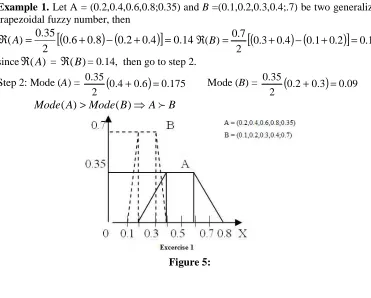
Example 1. Let A = (0.2,0.4,0.6,0.8;0.35) and B =(0.1,0.2,0.3,0.4;.7) be two generalized trapezoidal fuzzy number, then
(
) (
)
[
0.6 0.8 0.2 0.4]
0.14 235 . 0 )
( = + − + =
ℜ A
[
(
0.3 0.4) (
0.1 0.2)
]
0.142 7 . 0 )
( = + − + =
ℜ B
sinceℜ( A) = ℜ(B)= 0.14, then go to step 2.
Step 2: Mode (A) =
(
0.4 0.6)
0.175 235 . 0
=
+ Mode (B) =
(
0.2 0.3)
0.09 235 . 0
= +
B A B Mode A
Mode( )> ( )⇒ f
67
Example 2. Let A =(0.1,0.2,0.4,0.5;1) and B =(0.1,0.3,0.3,0.5;1) be two generalized trapezoidal fuzzy number, then
(
) (
)
[
0.4 0.5 0.1 0.2]
0.3 20 . 1 )
( = + − + =
ℜ A
[
(
0.3 0.5) (
0.1 0.3)
]
0.22 0 . 1 )
( = + − + =
ℜ B
soℜ(A)>ℜ(B)⇒ AfB
Figure 6:
Example 3. Let A =(0.1,0.2,0.4,0.5;1) and B =(1,1,1,1;1) be two generalized trapezoidal fuzzy number, then
(
) (
)
[
0.4 0.5 0.1 0.2]
0.3 20 . 1 )
( = + − + =
ℜ A
( ) ( )
[
1 1 1 1]
02 0 . 1 )
( = + − + =
ℜ B
soℜ(A)>ℜ(B)⇒AfB
Figure 7:
Example 4. Let A =(-0.5,- 0.3, -0.3,- 0.1;1) and B =(0.1,0.3,0.3,0.5;1) be two generalized trapezoidal fuzzy number, then
(
) (
)
[
0.3 0.1 0.5 0.3]
0.2 20 . 1 )
( = − − − − − =
ℜ A
(
) (
)
[
0.3 0.5 0.1 .03]
0.2 20 . 1 )
( = + − + =
ℜB
68 Step 2: Mode (A) =
[
( 0.3) ( 0.3)]
0.32 0 . 1 − = − + −
Mode (B) =
[
0.3 0.3]
0.3 20 . 1
=
+ Mode(A)<Mode(B)⇒ ApB
Figure 8:
Example 5. Let A =(0.3,0.5,0.5,1;1) and B =(0.1,0.6,0.6,0.8;1) be two generalized trapezoidal fuzzy number, then
(
) (
)
[
1.0 0.5 0.3 0.5]
0.35 2 0 . 1 ) ( = + − + = ℜ A(
) (
)
[
0.6 0.8 0.1 0.6]
00.35 2 0 . 1 ) ( = + − + = ℜ Bsinceℜ( A) = ℜ(B)= 0.35, then go to step 2.
Step 2: Mode (A) =
[
0.5 0.5]
0.5 20 . 1
=
+ Mode (B) =
[
0.6 0.6]
0.6 2 0 . 1 = + B A B Mode AMode( )< ( )⇒ p
Figure 9:
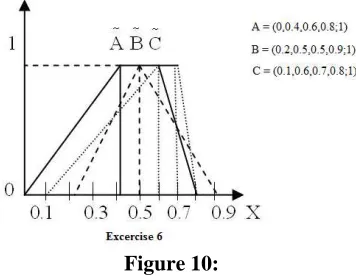
Example 6. Let A =(0,0.4,0.6,0.8;1) and B =(0.2,0.5,0.5,0.9;1) and C = (0.1,0.6,0.7,0.8;1) be two generalized trapezoidal fuzzy number, then
(
) (
)
[
0.8 0.6 0.0 0.4]
0.5 2 0 . 1 ) ( = + − + =ℜ A
[
(
0.9 0.5) (
0.2 0.5)
]
0.352 0 . 1 ) ( = + − + = ℜ B
(
) (
)
[
0.8 0.7 0.1 0.6]
0.4 2 0 . 1 ) ( = + − + = ℜC ⇒ ℜ > ℜ >69 Figure 10:
Example 7. Let A =(0.1,0.2,0.4,0.5;1) and B =(-2,0,0, 2;1) be two generalized trapezoidal fuzzy number, then
(
) (
)
[
0.4 0.5 0.1 0.2]
0.3 20 . 1 )
( = + − + =
ℜ A
[
(
0 2.0) (
2.0 0)
]
2.02 0 . 1 )
( = + − − + =
ℜ A
soℜ(A)pℜ(B)⇒A<B
Now consider the example that A = (0.1,0.2,0.4,0.5;1.0) and
B = (0.2,0.3,0.3,0.8;1.0) be two generalized trapezoidal fuzzy number, then
(
) (
)
[
0.4 0.5 0.1 0.2]
0.3 20 . 1 )
( = + − + =
ℜ A
(
) (
)
[
0.3 0.8 0.2 0.3]
0.3 20 . 1 )
( = + − + =
ℜ A
sinceℜ( A) = ℜ(B)= 0.35, then go to step 2.
Step 2: Mode (A) =
[
0.2 0.4]
0.3 20 . 1
=
+ Mode (B) =
[
0.3 0.3]
0.3 20 . 1
= +
Since Mode (A) = Mode (B) = 0.3, then go to step 3.
Step 3: Spread (A) = 1.0 (0.5 – 0.1) = 0.4 Spread (B) = 1.0 (0.8 – 0.2) = 0.6 Since Spread (A) < Spread (B)
B Af
⇒
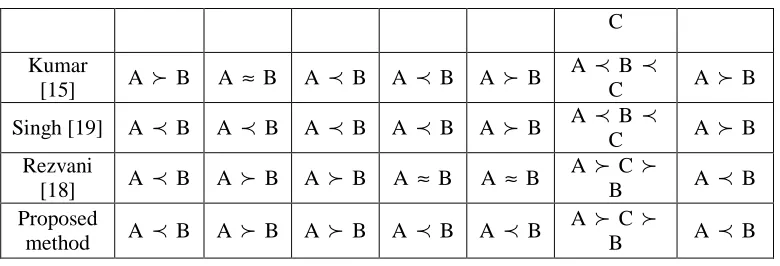
The following Table 1 indicates the comparison of this proposed method with various ranking methods.
Approach Ex 1 Ex 2 Ex 3 Ex 4 Ex 5 Ex 6 Ex 7
Cheng [9] A p B A ≈ B Error A ≈ B A f B A
p
Bp
C Error
Chu [11] A
p
B Ap
B Ap
B Ap
B Af
B Ap
Bp
C Error
Chen [7] A
p
B Ap
B Ap
B Ap
B Af
B A p C pB A
f
BAbbasban
dy [1] Error A ≈ B A p B A ≈ B A p B
A
p
Bp
C A f B
70
C
Kumar
[15] A f B A ≈ B A p B A p B A f B
A
p
Bp
C A f B
Singh [19] A
p
B Ap
B Ap
B Ap
B Af
B Ap
Bp
C A
f
BRezvani
[18] A
p
B Af
B Af
B A ≈ B A ≈ BA f C f
B A
p
BProposed
method A
p
B Af
B Af
B Ap
B Ap
BA f C f
B A
p
BTable 1. A comparison of the ranking results for different approaches
5. Conclusion
It is clear from Table 1 that the results of the proposed approach are same as obtained by using the existing approach (Chen and Chen, 2009). The main advantage of the proposed approach is that the proposed approach provides the correct ordering of generalized and normal trapezoidal fuzzy numbers and also the proposed approach is very simple and easy to apply in the real life problems.
REFERENCES
1. S.Abbasbandy and T.Hajjari, A new approach for ranking of trapezoidal fuzzy numbers, Computers and Mathematics with Applications, 57(3) (2009) 413-419. 2. S.Abbasbandy and B.Asady, Ranking of fuzzy numbers by sign distance,
Information Sciences, 176 (2006) 2405-2416.
3. J.M.Adamo, Fuzzy decision trees, Fuzzy Sets and Syst., 4 (1980) 207-219.
4. A.S.Abu Bakar, D.Mohamad and N.H.Sulaiman, Distance-based ranking fuzzy numbers, Advances in Computational Mathematics and its Applications 1(3) (2012). 5. J.F.Baldwin and N.C.F.Guild, Comparison of fuzzy numbers on the same decision
space, Fuzzy Sets and Syst., 2 (1979) 213-233.
6. G.Bortolan and R.Degani, A review of some methods for ranking fuzzy subsets, Fuzzy Sets and Syst., 15 (1985) 1-19.
7. S.J.Chen and S.M.Chen, Fuzzy risk analysis based on the ranking of generalized trapezoidal fuzzy numbers, Applied Intelligence, 26(1) (2007) 1-11.
8. S.M.Chen and J.H.Chen, Fuzzy risk analysis based on ranking generalized fuzzy numbers with different heights and different spreads, Expert Syst. Appl., 36(3) (2009) 6833-6842.
9. C.H.Cheng, A new approach for ranking fuzzy numbers by distance method, Expert Syst. Appl., 95(3) (1998) 307-317.
10. F.Choobineh and H.Li, An index for ordering fuzzy numbers, Expert Syst. Appl., 54(3) (1993) 287–294.
71
12. D.Dubois and H.Prade, Ranking fuzzy numbers in the setting of possibility theory, Information Sciences, 30 (1983) 183-224.
13. R.Jain, Decision making in the presence of fuzzy variables, IEEE Trans. Syst. Man Cybern., 6 (1976) 698-703.
14. R.Jain, A procedure for multi aspect decision making using fuzzy sets, Int. J. Syst. Sci., 8 (1978) 1-7.
15. A.Kumar, P.Singh, A.Kaur and P.Kaur, Ranking of generalized trapezoidal fuzzy numbers based on rank, mode, divergence and spread, Turkish Journal of Fuzzy Systems, 1(2) (2010) 141-152.
16. T.S.Liou and M.J.Wang, Ranking fuzzy numbers with integral value, Fuzzy Sets and Syst., 50 (1992) 247-255.
17. P.P.Bushan Rao and N.Ravi Shankar, Ranking generalized fuzzy numbers using area, mode, spreads and weights, International Journal of Applied Science and Engineering., 10(1) (2012) 41-57.
18. S.Rezvani, A new method for ranking in perimeters of two generalized trapezoidal fuzzy numbers, International Journal of Applied Operational Research, 2(3) (2012) 85-92.
19. P.Singh, et al., Ranking of generalized trapezoidal fuzzy numbers based on rank, mode, divergence and spread, Turkish Journal of Fuzzy Systems, 1(2) (2010) 141-152.
20. D.Stephen Dinagar and S.Kamalanathan, A note on maximize fuzzy net present value with new ranking, Intern. J. Fuzzy Mathematical Archive, 7(1) (2015) 63-74. 21. X.Wang and E.E.Kerre, Reasonable properties for the ordering of fuzzy quantities
(I), Fuzzy Sets and Systems, 118 (2001) 375-385.
22. X.Wang and E.E.Kerre, Reasonable properties for the ordering of fuzzy quantities (II), Fuzzy Sets and Systems, 118 (2001) 387-405.
23. R.R.Yager, On choosing between fuzzy subsets, Kybernetes, 9 (1980) 151-154. 24. R.R.Yager, A procedure for ordering fuzzy subsets of the unit interval, Information
Sciences, 24 (1981) 143-161.