HIGH SPIN FEATURES OF ODD-A NUCLEI USING
THREE QUASIPARTICLE PLUS ROTOR MODEL
A THESIS
SUBMITTED TO THE FACULTY OF SCIENCES
GURU NANAK DEV UNIVERSITY, AMRITSAR
FOR THE DEGREE OF
DOCTOR OF PHILOSOPHY
IN
PHYSICS
(2007)
BY
SUKHJEET SINGH
SUPERVISOR CO-SUPERVISOR
Dr. S. S. MALIK PROF. A. K. JAIN
DEPARTMENT OF PHYSICS DEPARTMENT OF PHYSICS
GURU NANAK DEV UNIVERSITY INDIAN INSTITUTE OF TECHNOLOGY
AMRITSAR ROORKEE
Dr. Sham Sunder Malik Phones: (O) +91-0183-2258802-09 Ext.3475
Reader (R) +91-0183-2451012
Fax: +91-0183-2258819, 2258820 E-mail: [email protected]
_____________________________________________________________________
Certificate
It is certified that the research work presented in this thesis entitled “High Spin
Features of Odd-A Nuclei Using Three Quasiparticle Plus Rotor Model” has been
carried out by Mr. Sukhjeet Singh under our supervision in the Department of Physics, Guru
Nanak Dev University, Amritsar, and in Department of Physics, Indian Institute of
Technology, Roorkee, for the degree of “DOCTOR OF PHILOSOPHY”. This research
work is original and has not been submitted before for any degree of this or any other
university. This thesis is fit to be considered for the award of the degree of Doctor of
Philosophy.
(Dr. Sham Sunder Malik) (Dr. Ashok Kumar Jain)
Reader Professor
Department of Physics Department of Physics
Guru Nanak Dev University Indian Institute of Technology
Amritsar Roorkee
D E P A R T M E N T O F P H Y S I C S
GURU NANAK DEV UNIVERSITY
Certificate
It is certified that the research work presented in this thesis entitled “High Spin
Features of Odd-A Nuclei Using Three Quasiparticle Plus Rotor Model” is my own and
was carried out in the Department of Physics, Guru Nanak Dev University, Amritsar and
Department of Physics, Indian Institute of Technology, Roorkee. All the ideas and
references have been duly acknowledged.
(Sukhjeet Singh)
Supervisor Co-supervisor
(Dr. Sham Sunder Malik) (Dr. Ashok Kumar Jain)
Reader Professor
Department of Physics Department of Physics
Guru Nanak Dev University Indian Institute of Technology
Dedicated to beautiful soul of Giani Sant Singh
ACKNOWLEDGEMENTS
After the completion of this thesis, as I look back, all those people come to my mind
that stood by me during the last years and helped me contribute my bit to the world of
science through my Ph.D.
First of all I express my deep sense of overwhelming gratitude and immense respect
to GOD by grace of which I got opportunity to work under the excellent supervision of
reverend teachers Prof. Ashok Kumar Jain, Department of Physics, Indian Institute of
Technology Roorkee and Dr. Sham Sunder Mailk, Department of Physics, Guru Nanak Dev
University Amritsar. They not only guided me but also trusted me to dabble with nuclear
physics to achieve the goals I desired. The long hours of fruitful discussions, their incisive
criticism, pertinent suggestions not only strengthened my skills in the research methodology
but also helped me to emerge as a more confident personality. I am indebted to Mrs.
Neeraja Jain and Mrs. Vibha Malik for their lot of love and encouragement during this
work. I am very thankful to Prof. Ashok Kumar Jain for providing me excellent working
conditions at Indian Institute of Technology Roorkee for completion of my research work,
for training me in Nuclear Decay Data Evaluation Activity and for constant encouragement
and moral support at the difficult period in my life during this research work.
I am extremely grateful to Prof. P.M. Walker, University of Surrey, United Kingdom
and Prof. I. Ragnarsson, Lund Institute of Technology, Sweden for useful discussion during
their India visit and through number of emails. I am also indebted to Dr. Balraj Singh,
McMaster University Canada, Prof. G. Hagemann, Prof. B. Herskind, University of
Copenhagen, Denmark, Prof. M.A. Riley, Florida State University Tallahassee, USA, Dr.
S.R. Jain, BARC, India and Dr. Alpna Goel, Amity University, Noida, India for useful
discussions during the course of my work.
I am very thankful to Prof. B.S. Bajwa, Head, Department of Physics, and all the
faculty members for their constant help and encouragement during this work. I am grateful
to Prof. Jagdish Rai, Head, Department of Physics, Indian Institute of Technology Roorkee
for providing me all the necessary facilities during my stay at Indian Institute of Technology
Special thanks to my respected father S. Tarsem Singh Dhindsa and my uncles S.
Mukand Singh Dhindsa, S. Nirmal Singh Dhindsa, Prof. (Retd.) Darshan Singh Basra,
Dr. Lakhwinder Singh, Sant Balwinder Singh Bhamri, and Principal Swaran Singh Virk
for their immense help and moral encouragement. I donot know where to begin to thank my
other family members and relatives for their sacrifices, love and support. I am thankful to
my beloved daughter who missed me during the span and that too at such a tender age. I am
extremely grateful to my brother S. Jagjeet Singh Dhindsa who worked very hard at
different family functions held at my home place during the course of this work.
I am very grateful to my brother like friend Dr. Maninder Singh Kamboj and his
family, Brampton, Canada for constant help and encouragement. Without his help it could
not be possible to achieve my goal. I am also thankful to Dr. Harvinder Singh Klare,
Brampton, Canada for his help during the initial years of my research work. I am really at a
loss of words to express my gratitude to my friends Dr. Hrapreet Singh, Dr. Ranjeet Singh,
Dr. Manmohan Singh Heer, Dr. Priyanka Agarwal, Ravider Singh, Mohan Singh,
BirBikram Singh, Sukhwinder Singh Brar, Kawaljeet Singh Samra, Amandeep Singh
Bains, Suresh Kumar, Dinesh Pathak, Ravi Gupta, Mrs. Neeru Gupta, Pankaj Gaur,
Pankaj Prasad and Mohit Dhiman for their help and encouragement they offered all
through the work. I am very thankful to S. Gurdeep Singh Mahal and Kristina Myrvold, Lund Institute of Technology, Sweden for their help during my Sweden visit.
I gratefully acknowledge the financial support received from Department of Science
and Technology, Department of Atomic Energy, Council of Scientific and Industrial
Research (Govt. of India) and International Atomic Energy Agency, Austria.
CONTENTS
1 INTRODUCTION 11
1.1 BACKGROUND 11
1.2 THREE-QUASIPARTICLE INTRINSIC EXCITATIONS 12
1.3 CLASSIFICATION OF BANDS 15
1.4 BEHAVIOR OF THREE-QUASIPARTICLE ROTATIONAL BANDS 15
1.4.1 Signature splitting 15
1.4.2 Signature Inversion 16
1.5 OBJECTIVE AND IMPORTANCE OF THE STUDY 17
2 EXPERIMENTAL DATA ON THREE-QUASIPARTICLE BANDS
AND THEIR UNUSUAL FEATURES 21
2.1 INTRODUCTION 21
2.2 SALIENT FEATURES OF THREE-QUASIPARTICLE BANDS 22
2.3 THEORETICAL APPROACHES FOR IDENTIFICATION OF
THREE-QUASIPARTICLE STRUCTURES 25
2.3.1 Particle Plus Rotor Models 25
2.3.2 Potential-Energy Surface (PES) and Cranked Shell Model
(CSM) calculations 26
2.4 EXPERIMENTAL INPUTS TO THE QUASIPARTICLE
CONFIGURATION ASSIGNMENTS 26
2.4.1 B(M1)/B(E2) ratios and gK-gRvalues 26
2.4.2 Aligned Angular Momentum 29
2.5 UNUSUAL FEATURES OF THREE-QUASIPARTICLE BANDS 29
2.5.1 Generalization of Gallagher-Moszkowski (GM) rules 30
2.5.2 Band Termination Phenomenon 31
2.5.3 Tilted Rotational Band Phenomenon 31
2.5.4 High-K States and Isomers 32
2.5.5 Regular bands 34
2.5.6 Moment of inertia, Alignment and back-bending 35
2.5.7 Identical bands 38
2.5.8 Comparison of one-quasiparticle and three-quasiparticle
excitation energies 39
2.5.9 Signature splitting and Signature Inversion 40
2.6 CONCLUSIONS 42
3 ODD-EVEN STAGGERING AND TEST OF CHAOTICITY IN
THREE-QUASIPARTICLE ROTATIONAL BANDS 102
3.1 INTRODUCTION 102
3.2 ODD-EVEN EFFECTS IN THREE-QUASIPARTICLE
ROTATIONAL BANDS 103
3.3 DISCUSSION 106
3.4 TEST OF CHAOTICITY IN THREE-QUASIPARTICLE
EXCITATIONS 113
3.4.1 Statistical Approach for Nuclear spectra-Random Matrix
Theory 113
3.4.2 Signature of Quantum Chaos-Fluctuation Properties of
Gaussian Orthogonal Ensemble (GOE) 114
3.4.3 Analysis procedure for Random Matrix Theory 114
3.5 DISCUSSION 116
4 THREE-QUASIPARTICLE PLUS ROTOR MODEL FOR THREE-
QUASIPARTICLE ROTATIONAL BANDS 124
4.1 INTRODUCTION 124
4.2 THREE-QUASIPARTICLE PLUS ROTOR MODEL 126
4.2.1 Salient features of The Model 126
4.2.2 Methodology of The Model 126
4.3 CALCULATION OF THE MATRIX ELEMENTS 130
4.3.1 Matrix elements of the rotational term 130
4.3.2 Matrix elements of the irrotational term 131
4.3.3 Matrix elements of the Particle-Particle Coupling (PPC) term 131
4.3.4 Matrix elements of the Rotor Particle Coupling (RPC) term 132
4.4 MATRIX ELEMENTS FOR VARIOUS CASES OF COUPLINGS 132
4.4.1 Contributions of the Particle-Particle Coupling terms for
various cases of couplings 133
4.4.2 Contributions of the Rotor-Particle Coupling terms for
various cases of couplings 137
4.5 CONCLUSIONS 144
5 EMPIRICAL RESIDUAL INTERACTIONS AND BAND-HEAD
ENERGIES FOR THREE-QUASIPARTICLE ROTATIONAL BANDS 145
5.1 INTRODUCTION 145
5.2 THE MODEL 146
5.3 GENERALIZED RULES FOR FIXING THE ODERING OF
THE THREE-QUASIPARTICLE QUADRUPLET 151
5.3.1 Rules for pnn and npp configurations 151
5.3.2 Rules for ppp and nnn configurations 152
5.4 RESULTS AND DISCUSSION 153
5.4.1 npp and pnn configurations 154
5.4.2 nnn and ppp configurations 155
6 APPLICATIONS OF THREE-QUASIPARTICLE PLUS ROTOR
MODEL 163
6.1 INTRODUCTION 163
6.2 CHOICE OF THE PARAMETERS 164
6.3 RESULTS AND DISCUSSION 165
6.3.1 Signature splitting in 155Dy 165
6.3.2 Signature splitting in 165W 174
6.3.3 Signature splitting in 167W 185
6.4 CONCLUSIONS 194
7 CONCLUSIONS 195
7.1 CONCLUSIONS 195
7.2 FUTURE STUDIES 196
7.2.1 Theoretical residual interactions in odd-odd, even-even
and odd-A nuclei 196
7.2.2 Complete theoretical study for three-quasiparticle
rotational bands 197
7.2.3 Calculation of transition probabilities for three-quasiparticle
rotational bands 198
7.2.4 Band crossing in three-quasiparticle rotational bands and
Three-Quasiparticle Plus Tri-axial Rotor model 198
7.2.5 Statistical analysis of multi-quasiparticle states 198
REFERENCES 199
CHAPTER 1
INTRODUCTION
1.1 BACKGROUND
In 1950, it was proposed by Rainwater, Bohr and Mottelson (Rainwater, 1950; Bohr,
1951a; Bohr and Mottelson, 1953) that rotation is a natural consequence of the nucleus
moving away from a spherical shape. Quantum mechanically a spherical symmetric system
cannot rotate. Rotational excitations appear only when spherical symmetry is broken. A
nucleus can, therefore, rotate if the distribution of the mass, the charge density or, the
current density inside the nucleus becomes non-spherical. This rotation is known as
collective rotation because many of the nucleons (proton and neutrons) are involved. Bohr
(1951b) and Bohr and Mottelson (1975) used this concept of collective rotation to develop a
model for collective phenomenon and suggested the method of coulomb excitation for
populating the rotational bands. The experimental and theoretical studies received a major
momentum after the discovery of back-bending phenomenon in the ground state rotational
bands of the even-even nuclei in the 1970’s and also after the development of the powerful
shell correction method by Strutinsky (1967). With the availability of heavy ion
accelerators, it became possible to identify the band structures up to high-spin states. Due
to the recent developments in large gamma-ray detector arrays such as GAMMASPHERE,
EUROBALL etc., and sophisticated gamma-ray analysis techniques for discovering the
band structures, we now have a large amount of data for one-quasiparticle (1qp) and
multi-quasiparticle (MQP) states. Many interesting and varied nuclear properties and phenomena
have come to light from these high-spin studies. As we go to higher angular momentum the
Coriolis and centrifugal forces become more and more important. They affect the properties
of the nuclei by changing the pairing correlations, equilibrium shape of the nucleus and most
importantly by changing the pattern of angular momentum generation. This is because the
angular momentum in the nucleus may be generated by pure collective motion, pure single
particle motion and finally a combination of the two. This gives rise to the observation of the
etc. (Bengtsson et al., 1978; Bonatsos, 1985; Foin et al, 1985; Garret et al, 1982; Holzmann
et al., 1983; Stephens et al., 1964; Stephens et al., 1972; Stephens, 1975). Much theoretical
work has also been done to obtain proper understanding of these new features. The two main
approaches existing in the literature for an understanding of these high-spin features are the
Cranked Shell Model approach (Wheldon et al., 1999; Xu et al., 1998) and the particle plus
rotor model approach (Flaum and Cline, 1976; Larsson et al, 1978; Ragnarsson and
Semmes, 1988; Jain et al., 1989; Goel and Jain, 1992). However there have been no
quantitative calculations for the high-spin features of the three-quasiparticle (3qp) rotational
bands by using the particle plus rotor model approach.
Our compilation of data (Singh et al., 2006b) of three-quasiparticle intrinsic
excitations in the mass region A=153-187 (Z = 63-78, N = 88-112) indicated the richness of
the 3qp data now available. It is therefore now possible to carry out a systematic study of
these intrinsic excitations and the rotational bands based on them. The main focus of the
study presented in this thesis is on the 3qp rotational bands and a theoretical understanding
of the various high-spin features exhibited by these bands.
1.2 THREE-QUASIPARTICLE INTRINSIC EXCITATIONS
In odd-A nuclei, the states of next higher seniority following the 1qp excitations are
the 3qp excitations. At excitation energy ≥ 1MeV, which is approximately the energy gap in the rare-earth region, a proton or a neutron pair can break up and form a 3qp state in an
odd-A nucleus. Two kinds of 3qp states are possible; those having all the three particles of same
kind (nnn/ppp) and others having a combination of two kinds of particles (nnp/ppn). In a
deformed nucleus, the coupling of three-quasiparticles in the Nilsson states having K values
sayK ,1 K and 2 K leads to a quadruplet with the resultant 3 K = K1±K2±K3 . The couplings
Rot. axis
Symmetry axis K 1 K 2 K 3
K =K1+K2+K3
Rot. axis
Symmetry axis
K 3 K 1 K 2
K =K1+K2−K3
Rot. axis
Symmetry axis
K 1 K 2 K 3
K = − +K1 K2+K3
Fig. 1.1(a) The couplings corresponding toK =K1+K2+K3,K =K1+K2−K3 and K = − +K1 K2+K3 situations.
j1 j2
j3 J
j1 j2 J
j3
j2 j3 J
Rot. axis
Symmetry axis
K 2 K 1 K 3
K =K1−K2+K3
Fig. 1.1(b) The coupling corresponding to K =K1−K2+K3 situation.
It was pointed out by Gallagher and Moszkowski (1958) that in the case of odd-odd nuclei a
triplet state (neutron and proton single particle states having parallel spins) always lie lower
in energy than the singlet state (neutron and proton single particle states having opposite
spins). But in the case of doubly even nuclei, the reverse is the situation i.e. the residual
interaction between two quasiparticles lowers the singlet state in energy (Gallagher, 1962).
Jain and Jain (1992) generalized these Gallagher-Moszkowski (GM) rules for the 3qp states
and proposed two strong rules for nnp/ppn configurations. According to these rules the state
having all the spins in same direction
( )
⇑↑↑ cannot be lowest in energy and state having spins of like particle parallel( )
↑↑ and that of unlike particles anti-parallel( )
⇑↓ will be highest in energy. Here⇑denotes the spin of unlike particle and ↑↑ denotes the spins of two like particles. Jain and Jain (1992) also proposed one strong rule for nnn/ppp configurations.According to this rule the state having all the spins in same direction
( )
↑↑↑ will be the highest in energy. But the ordering of all the four members of a quadruplet for a given 3qpconfiguration was still an unresolved problem. We have also focused on this problem in this
thesis.
j1 j3 J
1.3 CLASSIFICATION OF BANDS
We know that two types of 3qp configurations are possible, those having all the three
particles of the same kind (nnn/ppp) and others having a combination of two types of
particles (nnp/ppn). The band structure of these two types of configurations will be different
from each other because of the following reasons:
(a) In case of odd-odd nuclei, triplet state lies lower in energy than the singlet state.
But opposite is the situation in the case of even-even nuclei.
(b) GM splitting energies in case of even-even nuclei is generally 3 to 4 times larger
than that in the odd-odd nuclei.
(c) The residual interaction parameters of even-even nuclei are entirely different
from the residual interaction parameters of odd-odd nuclei.
(d) The odd-even shift for K=0 bands in case of even-even nuclei is opposite in sign
from that of odd-odd nuclei.
A detailed study of these two types of bands will lead to a better understanding of the
residual interactions among odd-odd and even-even nuclei.
1.4 BEHAVIOR OF THREE-QUASIPARTCILE ROTATIONAL BANDS
1.4.1 Signature splitting
Jain et al. (1988, 1989) studied the rotational bands based on two-quasiparticle (2qp)
intrinsic excitations in doubly-odd nuclei in the framework of particle-rotor-model
calculations. They have pointed out a number of interesting features such as the odd-even
staggering in the K− bands but almost no staggering in the K+ bands. These calculations
highlighted the role of various mechanisms responsible for the odd-even staggering. They
have also pointed out that the Coriolis force and the particle-particle couplings are active to
very high orders and the various bands develop many interconnections because of these
terms. Goel (1992) pointed out that in case of even-even nuclei, the K−and K+bands also
from the high-j configurations exhibit a greater odd-even staggering than the K−partner
bands though K is very large. Goel and Jain (1992) noted a similar picture, as observed in
odd-odd nuclei, of interconnections of various bands due to rotor-particle and
particle-particle couplings. The explanation of signature effects (signature splitting and signature
inversion) exhibited by the 3qp rotational bands in the framework of the Three-Quasiparticle
Plus Axially Symmetric Rotor Model (TQPRM) is the main focus of this thesis. Since
complete and confirmed quadruplet and hence rotational bands based on them in any nuclide
is yet to be observed, we will explore the behavior of staggering pattern for all the members
of a quadruplet on the basis of Coriolis calculations. As pointed out for the 2qp bands
observed in odd-odd and even-even nuclei, we notice that in case of the 3qp rotational bands
also, the rotor-particle couplings are active to a very high orders and various bands develop
interconnections because of these terms.
1.4.2 Signature Inversion
Whenever an expected favored branch (lower in energy) becomes unfavored at
higher spins, it is known as signature inversion. This phenomenon has recently attracted a
lot of attention both in experimental and theoretical works. Bengtsson et al. (1984)
interpreted this phenomenon by the Cranked Shell Model as a consequence of a triaxial
deformation with positive γ- deformation parameter. They have pointed out that signature
inversion can be expected in the 2qp and 3qp bands of γ- soft nuclei when one of the valence
nucleons lies in a low-Ω orbital of j shell and the other valence nucleon lies in a
high-Ω or a medium-Ω orbital of high-j shell. A large amount of experimental information has been collected showing that the πg9/2 νg9/2 bands in A=80, as well as, the πh11/2 νh11/2 bands
in A=130 and the πh11/2 νi11/2 bands in A=160 mass regions systematically show signature
inversion (Komatsubara et. al., 1993). Jain and Goel (1992) demonstrated that in case of
odd-odd nuclei, the signature inversion is a result of Coriolis mixing arising from the
coupling of the h11/2 proton orbitals and i13/2 neutron orbitals. A systematic study of the
signature inversion phenomenon in the rare-earth region was presented by Goel and Jain
(1996, 1997) which used only the higher order Coriolis effects to explain the signature
nucleus 170Yb was also pointed out by Goel and Jain (1994) and explained by the Coriolis mixing calculations. Other calculations required γ values to account for the experimental
data which were in many cases much larger than the γ – values obtained from the potential
energy surface calculations indicating that triaxiality is not sufficient to interpret the
phenomenon of signature inversion. This point has also been supported by Hamamoto
(1990) and Ragnarsson and Semmes (1988) on the basis of the particle-rotor-model
calculations. In another explanation, it has been suggested that the proton-neutron residual
interaction may also lead to signature inversion (Hamamoto, 1986; Cederwall et al., 1992;
Tajima, 1994) and recently the role of mean field contribution of the quardrupole pairing
interaction has also been cited as a possible reason (Xu et al., 2000). These calculations
describe reasonably well the behavior of the signature inversion within one or two regions.
Zheng et al. (2001) suggested that the competition between the proton-neutron residual
interaction and the Coriolis interaction could be a universal mechanism of the signature
inversion in doubly odd nuclei for different mass regions. In the present thesis we also focus
on this problem of signature inversion in the 3qp rotational bands having nnn type
configurations.
1.5 OBJECTIVE AND IMPORTANCE OF THE STUDY
An explanation of the various features exhibited by the 1qp and the 2qp rotational bands
by using the particle-rotor-model approach has been discussed in great detail (Flaum and
Cline, 1976; Ragnarsson and Semmes, 1988; Jain et al., 1989; Goel and Jain, 1992). But
there is no quantitative calculation available for an explanation of the various features
exhibited by the 3qp rotational bands by using the particle-rotor-model approach. Since our
main objective in future is the development of a universal model as well as its computational
subroutines for the particle-rotor-model approach, the work presented in this thesis is an
important step in this direction.
This thesis mainly deals with the properties of the 3qp rotational bands in odd-A nuclei
and their explanation in terms of intricate Coriolis and particle-particle coupling
1. The compilation of data on 3qp states in the mass region 153≤ ≤A 187 and extraction of various features exhibited by the experimentally observed 3qp
bands.
2. The formulation of a Three-Quasiparticle Plus Axially Symmetric Rotor model
for explanation of various features such as the signature effects exhibited by
these bands.
3. The development of a complete empirical model for band-head energy
calculations by including all the possible contributions from the various terms
such as Coriolis, particle-particle interaction and irrotational terms.
4. A statistical analysis of the existing 3qp data within the frame work of Random
Matrix Theory.
5. Framing of rules to predict the energy ordering of the members of a quadruplet of
a given 3qp configuration.
The work presented in this thesis will be useful to various research groups working in
nuclear structure physics in the following ways:
1. We have presented complete, confirmed and updated experimental information
of 171 3qp rotational bands observed in 58 nuclei. We have pointed out the
various spin features such as tilted rotational band, band termination,
high-K isomers, signature splitting, signature inversion, back-bending and
band-crossing etc. The various theoretical and semi-empirical approaches existing in
the literature for explanation of these features has also been discussed briefly. So
this work reflects the existing experimental and theoretical information about the
3qp rotational bands.
2. The main part of the work presented in this thesis is the development of the
Three-Quasiparticle Plus Axially Symmetric Rotor Model (TQPRM) and its
applications to the 3qp rotational bands for an explanation of various features
mainly the signature effects. Although the present model with further additions
number of applications but we have presented here the simplest version. The
present TQPRM highlights the following features of the 3qp rotational bands:
(a) The role of the Coriolis and particle-particle interactions for an
explanation of the observed signature splitting in the 3qp rotational
bands.
(b) The variation of phase of staggering within the members of a given
3qp quadruplet. As we have pointed out that complete and confirmed
quadruplet and hence rotational bands based on them are yet to be
observed in any nuclide. So these calculations will be useful for
identification of the unobserved members of the 3qp quadruplets.
(c) These calculations will be useful for the prediction of the band-heads
in those 3qp bands where low lying members are not observed
experimentally.
(d) These Coriolis mixing calculations will also be useful for
confirmation of the configuration assignment, spin and parity
assignments in those cases which do not have enough experimental
information for complete identification of their confirmed nature.
3. In one part of this thesis, we have presented an empirical rule for testing the
favored signature in case of the 3qp rotational bands. This work is useful to
experimentalists for configuration assignments, spin and parity assignments and
prediction of signature inversion in the unobserved part of a band. In our
compilation of data on 3qp states we have pointed out that there are seven tilted
rotational bands and out of these seven bands only five bands exhibit signature
splitting. The violation of the rule in these cases confirms the fact that signature
does not remains a good quantum number under tilted rotation.
4. The statistical analysis of the 1qp and the 3qp excitations in the frame work of
Random Matrix Theory highlight the ideas that both 1qp and 3qp data sets
conform to the Poisson-type energy-level fluctuations. Although the data set for
that there is no further breakdown of symmetries or loss of integrability as we go
from the 1qp excitations to the 3qp excitations.
5. We have revised the existing model of Jain and Jain (1992) by incorporating all
the possible contributions from rotor-particle coupling, particle-particle coupling
and irrotational part of the Hamiltonian. This revised version of model will be
useful to the experimentalists for the configuration assignments to the
band-heads. In the present thesis we have used this revised version of model for
generalization of the GM rules for fixing the ordering of all the members of 3qp
quadruplet for nnn/ppp and npp/pnn configurations.
Computer codes in Fortran 77 have been written and tested for all the models and
calculations presented in this thesis. It may be pointed out that only some applications of the
TQPRM have been presented here. It is expected that the model will become a very
CHAPTER 2
EXPERIMENTAL DATA ON
THREE-QUASIPARTICLE BANDS AND THEIR UNUSUAL
FEATURES
2.1 INTRODUCTION
The population of three-quasiparticle (3qp) bands is generally weak and these could
only be investigated in detail in recent years. Advent of large gamma-ray detector arrays
such as GAMMASPHERE, EUROBALL, and the improved gamma-ray analysis techniques
for discovering band structures and isomers have given a push to the observation of 3qp and
multi-quasiparticle (MQP) excitations. As a consequence of sophisticated experimental
facilities and gamma-ray analysis techniques, now we have extensive experimental data on
3qp states. In this chapter we presented complete, confirmed and updated information for
3qp rotational bands. Confirmed in the sense that recent structures are based on
experimentally measured quantities such as B(M1)/B(E2) ratios, gK-gR values, lifetimes etc. and complete in the sense that we presented the information by deducing the
B(M1)/B(E2) ratios andgK-gR values where these were not given in the original papers but could be deduced from available experimental data in the publications. All the new
references appeared after cutoff date (July 15, 2005) of our compilation (Singh et al., 2006b)
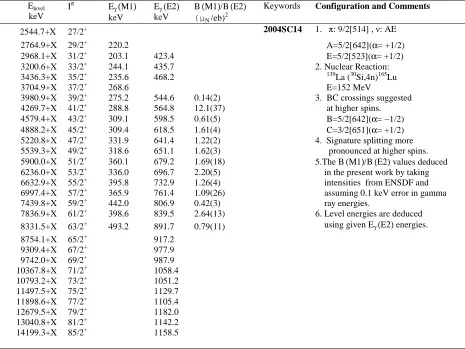
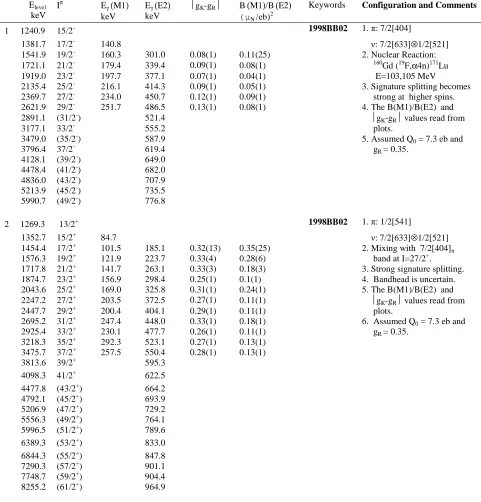
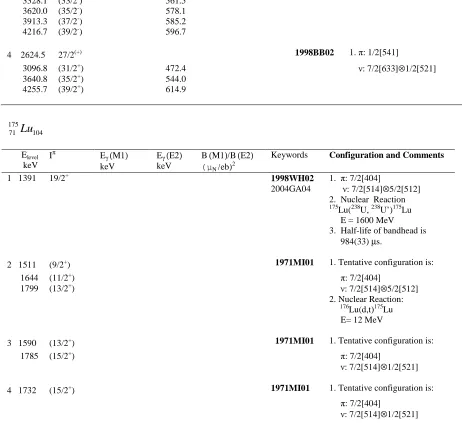
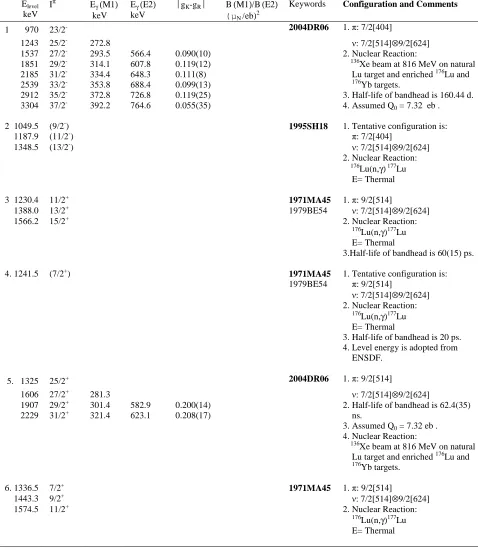
have been included in the present chapter. Thus, the present chapter with a collection of 171
3qp bands in 58 nuclides replaces the old compilation (Jain et al., 1990) having only 48
bands in 20 nuclides. Out of these 48 3qp bands of old compilation, 6 bands have been either
assigned a structure different from 3qp structure or do not possess enough experimental
evidence to qualify as a 3qp band; 2 bands, whose tentative nature has now been confirmed
and 3 bands, have been assigned a new 3qp configuration on the basis of alignment and gK
factor etc. Except for the above-mentioned 6 bands, remaining 42 bands (along with their
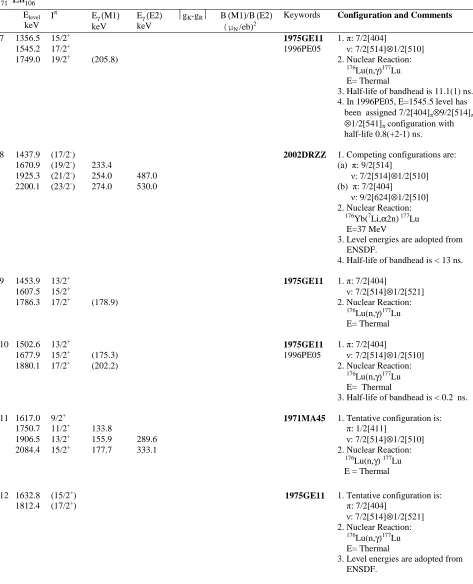
In this chapter, we present a collection of experimentally known 3qp bands in the
mass region A=153-187 ( Z = 63-78, N = 88-112), and present a table of the energy levels,
spins and parities, and other observed or deduced characteristics in 58 nuclides. Most of the
bands included here start out as 3qp bands at the bandhead. However, the complete band, i.e.
including the top portion where it may have undergone band crossings, is listed once it starts
as a 3qp band. The cutoff date for collection of data from original publications is September
15, 2007.
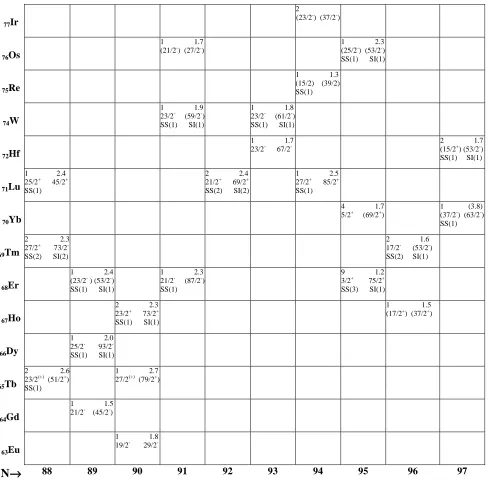
All the nuclei included in the compiled Table are shown in Fig. 2.1(a, b). Each
nucleus is assigned a box that exhibits the total number of observed 3qp bands, minimum
excitation energy, minimum and maximum spins assigned in these bands, the corresponding
parities, and the number of bands which exhibit signature splitting and signature inversion.
The largest concentration of 3qp bands is found in the A=180 mass region, where seven Re
isotopes, six Lu isotopes, seven Ta isotopes and eight Hf isotopes, exhibit 28, 27, 26, and 22
bands, respectively.
2.2 SALIENT FEATURES OF THREE-QUASIPARTICLE BANDS
1. These are mostly well deformed structures:
ε
≥ 0.2.2. Their bandheads lie at higher excitation energy (≥1 MeV) and have high spins (I~ 5-18η).
3. These bands exhibit both ∆I=1 and ∆I=2 structures.
4. For ∆I=1 bands, crossover E2 transitions are seen in many cases. The resulting B(M1)/B(E2) ratios and the gK-gRvalues lie in the range of 0.01 – 13.8 (µN/eb)2 and 0.01- 0.76, respectively. Only in one case (a level in band #5 of 183
W), B(M1)/B(E2) ratio is 36.4 (µN/eb)2.
5. These bands carry dynamical moment of inertia ℑ(2) close to that of the other normal deformed bands.
6. Signature splitting is observed in many cases. Signature inversion is also seen in
some 3qp bands.
7. Few of these bands also display back-bending and band-crossing phenomenona.
77Ir
2 (23/2-) (37/2-)
76Os
1 1.7 (21/2-) (27/2-)
1 2.3 (25/2-) (53/2-) SS(1) SI(1)
75Re
1 1.3 (15/2) (39/2) SS(1)
74W
1 1.9 23/2- (59/2-) SS(1) SI(1)
1 1.8 23/2- (61/2-) SS(1) SI(1)
72Hf
1 1.7
23/2- 67/2- 2 1.7 (15/2+) (53/2-) SS(1) SI(1)
71Lu
1 2.4 25/2+ 45/2+ SS(1)
2 2.4 21/2+ 69/2+ SS(2) SI(2)
1 2.5 27/2+ 85/2+ SS(1)
70Yb
4 1.7 5/2+ (69/2+)
1 (3.8) (37/2-) (63/2-) SS(1)
69Tm
2 2.3 27/2+ 73/2 -SS(2) SI(2)
2 1.6 17/2- (53/2-) SS(2) SI(1)
68Er
1 2.4 (23/2- ) (53/2-) SS(1) SI(1)
1 2.3 21/2- (87/2-) SS(1)
9 1.2 3/2+ 75/2+ SS(3) SI(1)
67Ho
2 2.3 23/2+ 73/2+ SS(1) SI(1)
1 1.5 (17/2+) (37/2+)
66Dy
1 2.0 25/2- 93/2 -SS(1) SI(1)
65Tb
2 2.6 23/2(+) (51/2+) SS(1)
1 2.7 27/2(+) (79/2+)
64Gd
1 1.5 21/2- (45/2-)
63Eu
1 1.8 19/2- 29/2
-N→→→→ 88 89 90 91 92 93 94 95 96 97
78Pt
1 3.1 (33/2-) (47/2-) SS(1)
1 1.9 25/2- 47/2- SS(1) SI(1)
77Ir
6 1.8 19/2+ (53/2+) SS(2)
76Os
3 1.7 21/2+ 71/2 -SS(2)
2 1.6 15/2- (51/2-) SS(1) SI(1)
2 1.6 19/2+ (55/2-) SS(2)
75Re
5 1.4 15/2+ (49/2+) SS(2)
5 1.3 15/2- ( 31/2+) SS(1)
5 1.7 17/2+ 55/2 -SS(4)
9 1.6
(11/2+) 49/2+ SS(1)
2 1.5 19/2- (21/2+)
74W
2 1.6 19/2+ 37/2+ SS(1)
6 0.7 (3/2)+ (53/2-) SS(1) SI(1)
5 1.7 19/2- 31/2(-)
73Ta
4 1.6 17/2+ (47/2) SS(1)
9 1.3 3/2- (47/2+) SS(1)
4 1.3 21/2- (41/2-) SS(1)
4 1.4
15/2- 29/2- 1 1.3 21/2-
72Hf
2 1.4 19/2+ 39/2-
3 1.3 19/2- 39/2+
6 1.1 (17/2+) (37/2-)
3 1.0 (17/2+) (25/2-)
71Lu
4 1.4 (9/2+) 19/2+
- 15 1.0 7/2+ 37/2
-70Yb
4 1.5 1/2+ 3/2+
1 1.2 15/2+ 21/2+
N→→→→ 102 103 104 105 106 107 108 109 112
Fig. 2.1(b) Same as Fig. 2.1(a). See the key (inset) for nomenclature of entries in each
box.
75Re
1 1.8 (19/2) (41/2)
73Ta
1 2.2 (23/2+) (43/2+)
3 1.5 17/2- (59/2+) SS(2) SI(1)
72Hf
2 1.6 19/2+ 47/2- SS(1) SI(1)
3 1.1 (13/2+) 41/2+
71Lu
4 1.2 13/2+ (61/2+) SS(2)
N→→→→ 96 99 100 101
No. of bands Emin(MeV)
Iπ (min.) Iπ(max.)
2.3 THEORETICAL APPROACHES FOR IDENTIFICATION OF
THREE-QUASIPARTICLE STRUCTURES
There are mainly two kinds of models, one based on the Cranking Model, which
leads to the Cranking Shell Model (CSM) (Wheldon et al., 1999; Xu et al., 1998) and
self-consistent approach like the Cranked Hartee-Fock-Bogolyubov calculations (Szymanski,
1983; Voigt et al., 1983). The other approach is based on the treatment of valence particles
coupled to the rotor core called Particle Plus Rotor Model approach (PPRM). We give a
brief description of these two approaches in the following sections.
2.3.1 Particle Plus Rotor Models
This approach provides an interesting alternative for the calculation of nuclear
properties at high angular momentum. The PPRM formulation is in terms of angular
momentum, a physical observable in the experiments. Also these classes of models are
intuitively simple and a direct comparison with the experimental data can be made. Many
versions of these models are now available which differ in shape of core (axially symmetric,
asymmetric or octupole) and number of valence particles treated (Larsson et al., 1978;
Ragnarsson and Semmes, 1988, Jain et al., 1989; Goel and Jain, 1992; Flaum and Cline,
1976). More recently a many particle plus rotor model has been presented by Carlsson and
Ragnarsson (2006), which follows a slightly different approach. It is possible to obtain a
basic understanding of high-spin phenomena by using these models in terms of the familiar
concepts like Coriolis force, alignment of spin and band-crossing etc. But no quantitative
calculations for 3qp bands using the Three-Quasiparticle Plus Axially Symmetric Rotor
(TQPRM) exist in the literature. We have developed the TQPRM for explanation of
high-spin features of the 3qp bands. Details of the formulation of this model are given in chapter
2.3.2 Potential-Energy Surface (PES) and Cranked Shell Model (CSM) calculations
In another approach to understand the excitation energies and the shapes of MQP
configurations, the potential-energy surface calculations of Xu et al. (1998) have also been
used. For example, Purry et al. (2000) apply this method to 183Re where occupied orbitals are fixed for each quasiparticle configuration and the shape is varied to minimize the
excitation energy. These calculations ignore the residual nucleon-nucleon interactions. This
method is also helpful in the assignment of a configuration to a MQP state.
Many authors have also used the Cranked Shell Model (CSM) calculations
(Bengtsson and Frauendorf 1979a; Bengtsson et al., 1986) to make specific single-particle
configuration assignments. The CSM calculates the quasiparticle energies e
′
in the rotatingframe providing Routhians as a function of the rotational frequency ηω. The alignment i can be calculated as i = - de
′
/dω. These calculations also ignore the residual nucleon-nucleon interactions. The experimental values of the Routhians and alignments (see sec. 2.4.2) arealso extracted from the data and compared with the theoretical results. This also helps in
identifying the quasiparticle configuration of a rotational band. As examples, we cite the
works of Evans et al. (2006) for 157Er and Vlastou et al. (1994) for 155Dy.
2.4 EXPERIMENTAL INPUTS TO THE QUASIPARTICLE CONFIGURATION
ASSIGNMENTS
2.4.1 B (M1)/B (E2) ratios and gK-gRvalues
Several papers, for example Walker et al. (1994), discuss the most commonly used
methodology for assignments of angular momentum, parity, and the configuration of each
band. If the Coriolis perturbations are not large, it is reasonable to assume that the quantum
number K of a band is equal to the spin of the bandhead. If high-j orbitals are involved in the
configuration, this assumption is only approximately valid. Most of the papers proceed to
extract the intrinsic gyromagnetic factor gK,and the B(M1)/B(E2) ratio by using the
distribution/correlation measurements. Other inputs are the rotational g-factor gR,and the
intrinsic quadrupole momentQ . 0
In view of their importance, we have compiled or deduced in this chapter, the values
of gK-gR and the B(M1)/B(E2) ratios. The B(M1)/B(E2) ratios have been listed for a total of 81 bands, values for 52 bands have been taken from the published works, and for 29
bands these have been deduced in the present work from available experimental information
in the original papers, Evaluated Nuclear Structure Data File (ENSDF) and Experimental
Unevaluated Nuclear Data List (XUNDL). Similarly, the gK-gRvalues are listed for a total of 74 bands, of which values for 19 bands have been deduced in the present work from the
available experimental data.
In the strong coupling limit, and assuming pure-K, the general expressions for
deducing the B(M1)/B(E2) ratios and the gK-gR values are: ) 1 ( ) 2 ( − → − → = I I I I I I γ γ
λ (2.1)
λ
δ
δ
γ γ ) 2 ( ) 1 ( ) 1 )( 1 )( 1 ( ) 1 2 ( 2 1 5 5 2 2 2 − → − → − − − + + − = + = I I E I I E K I K I I I Kq (2.2)
1 ) 1 ( 933 . 0 ) ( 2 0 − − → = − I I I E Q g
gK R
δ γ (2.3) ) 1 ( 1 ) 1 ( ) 2 ( 697 . 0 ) 2 : 2 ( ) 1 : 1 ( 2 3 5
δ
λ
γ γ + − → − → = − → − → I I E I I E I I E B I I M B (2.4)where λ is the branching ratio, Iγ is the γ-ray transition intensity, q is the quadrupole
admixture, δ is the E2/M1 mixing ratio, Eγ is the transition energy in MeV, gR is the rotational g-factor, Q0is the intrinsic quadrupole moment in units of eb. Only the angular
distribution/correlation measurements can give directly the magnitude and sign ofδ , while the magnitude of δ can also be obtained from conversion electron data. However, since the angular anisotropy data generally have large uncertainties, and the conversion measurements
are rare, most experimentalists extract the magnitude of δ by using the expression (2.2). Once δ is known, it can be used to extract gK-gR, provided Q0is known. In the absence of
(i) one can obtain gR by using the measured magnetic moment (
µ
) of the ground state band (gsb) in the pure-K formula,
1 ) (
2 + −
+ =
I K g g I
gR K R
µ
(2.5)where gK-gR is inserted from the equation (2.3) (Dasgupta et al., 2000; Kondev et al., 1996; Kondev et al., 1997). Similarly the value of Q0measured
for the gsb can be used in the equation (2.3) for the determination of gK-gR (e.g. Kondev et al., 1997). Some authors have also used an estimate of Q0from
the neighboring nuclei (Dasgupta et al., 2000).
(ii) one can assume the values of gR andQ0, which are consistent with the systematics of a region under study (Walker et al., 1994; Shizuma et al., 1997).
(iii) one can obtain gR by using the relation ( Purry et al., 2000),
p n
p R
Z N
Z g
ℑ + ℑ
ℑ
= (2.6)
where ℑpand ℑn are proton and neutron moments of inertia.ℑpandℑncan be calculated from the pairing parameters ∆p,n by using the Migdal prescription (Migdal, 1959)
The measured gK value (given by eq. 2.3) may not always match with the calculated gK
value (Walker et al., 1994; Bark et al., 1995) due to the Coriolis mixing between MQP
rotational bands having high-j configurations (Bark et al., 1995), mixing between MQP
rotational bands having different intrinsic configurations, changes in gR due to reduction of pairing and changes in deformation, which leads to changes in Q0.
2.4.2 Aligned Angular Momentum
The aligned angular momentum or, simply the alignment often assists in making the
configuration assignment, particularly when the alignment is large suggesting that high-j
orbitals are involved. The alignment is usually extracted by using the plots of Ix(
ω
) and) (ω ref
I vs. the rotational frequency
ω
, and calculating the difference,i(ω)=Ix(ω)−Iref(ω) (2.7)
where Ix(ω)= I(I +1)−K2 is the component of the total angular momentum I of the band on the rotation axis, and Iref(ω)corresponds to a reference band (usually that of the
even-even core nucleus) having zero alignment. To first order, the total alignment for a 3qp
band should be the sum of the constituent 1qp components. However, this additivity may
fail due to blocking of pairing correlations as shown by Dracoulis et al. (1998).
2.4.3 Band-head energies for three-quasiparticle quadruplet
A comparison of the experimental band-head energies with the calculated energies
by using the model proposed by Jain et al. (1995) is an important tool for configuration
assignment. As an example we cite MQP calculations by Kondev et al. (1997). This model
is based on empirical orbital dependent residual nucleon-nucleon interactions between
quasiparticles. The interaction of valence particles with core and among themselves is not
included in this model. We present the improved version of this model including above
interactions and irrotational contributions from valence particles. Details of our model along
with the calculations of band-head energies for 3qp states are presented in chapter 5.
2.5 UNUSUAL FEATURES OF THREE-QUASIPARTICLE BANDS
In this section we will discuss some important and unusual characteristics of the 3qp
bands in detail. It should be noted that we will present here only the experimental features;
2.5.1 Generalization of the Gallagher-Moszkowski (GM) rules
In a deformed nucleus, coupling of three-quasiparticles in Nilsson states having K
values, say, K1, K2 and K3, leads to a quadruplet with resultant K=K1 ± K2 ± K3. These four intrinsic states split up due to residual n-p interaction among the three nucleons. In our
compilation presented in this chapter, we have noted that a complete and confirmed
quadruplet of 3qp states is yet to be observed in any nucleus. Therefore, reliable
identification of 3qp multiplets and observation of examples of all the four couplings of the same 3qp configuration remains an open challenge for experimentalists. On the basis of a
semi-empirical model for the calculation of energies of 3qp states, Jain and Jain (1992)
proposed two strong rules for (nnp) or (ppn) configurations. According to these rules, the
highest-lying member of a given quadruplet always has a spin combination in which spins of
like particles are parallel while those of unlike particles are antiparallel, and states having all
three spins in the same direction cannot lie lowest in energy. For (nnn) or (ppp)
configurations, however, the state having all three spins in the same direction will be the
highest in energy. These rules were further strengthened by Jain et al. (1994a) who
generalized the model as well as these rules for MQP states. As an example, we cite the
9/2[514]π⊗7/2[514]ν⊗9/2[624]ν configuration of 177Lu. Out of four bandheads
corresponding to this configuration, the following three (bands 3, 5 and 6 of 177Lu in the Table 2.1) are experimentally confirmed:
K E Spin Combinations (pnn)
11/2+ 1230.4 ↑↑↑ 25/2+ 1325 ↑↓↑ 7/2+ 1336.5 ↑↓↓
The 7/2+ state with spin combinations ↑↓↓ is the highest in energy, which is in accordance with the generalized GM rules. But the problem of ordering of all the members of a
quadruplet for given 3qp configuration is yet to be resolved. In chapter 5, we present
calculations for band-head energies for resolution of the above problem of ordering of a 3qp
2.5.2 Band Termination Phenomenon
At very high angular momentum, nuclei in the N= 88-92 region are expected to
undergo a shape transition whereby the yrast configuration changes from that corresponding
to the collective rotation of a prolate nucleus about an axis perpendicular to its symmetry
axis (
ε
= 0.2, γ ~0 ) to weakly collective configurations which evolve across the (° ε,γ)-plane and eventually terminate on γ =60 oblate axis. This transition arises since the nucleus ° is a quantal system so that its collective behavior must have an underlying microscopic
basis. Therefore there is a limiting angular momentum that a nucleus can generate for a
particular configuration (band) or distribution of valence nucleons among the available
j-shells (Bohr and Mottelson, 1975). Higher spin states above the original band-head are built
by a gradual alignment of the spin vectors of the available valence nucleons until full
alignment is reached (Bengtsson and Ragnarsson, 1983). At this point the rotational band
associated with a specific initial configuration has lost its collectivity and is said to
terminate. Spectroscopy of band terminating states is of great importance in nuclear
structure studies since it enables a detailed study of the balance and interplay between the
two extreme facets of nuclear dynamics, collective rotation and alignment of valence nucleons. As examples, we cite the band termination spectroscopy observed in 155Dy (Vlastou et al., 1994).
2.5.3 Tilted Rotational Band Phenomenon
In rapidly rotating nuclei the competition between the inertial forces and the ones
generated by the deformed field results in a variety of angular momentum coupling schemes
(Bohr and Mottelson, 1975). In the presence of pairing the quasiparticles may, with
increasing rotational frequency, undergo a change from deformation aligned coupling to
Fermi aligned coupling and finally to rotation aligned coupling. Details of this change in
coupling scheme depend on the quasiparticle angular momentum and the position of the
Fermi energy (Frauendorf, 1981). Thus, for the MQP bands seen at high spins, a
combination of the different coupling schemes is expected. It has been shown that
can be successfully described by means of a cranking around an axis tilted relative to the
principal axes of the deformed field. This type of rotation is referred to as the Tilted-Axis
Cranking (TAC), in contrast to the widely used Principal-Axis Cranking (PAC), which
assumes that the nucleus rotates about one of the principal axes, and the band built by this
rotation is referred to as the Tilted rotational band (t-band). We have seven such bands in
this compilation; these are band 5 of 163Er, band 4 of 179W, band 3 and band 5 of 181Re, band 3 and band 8 of 183Re, band 2 of 181Os. The involvement of t-bands in the explanation of anomalous (weakly hindered) K-isomer decays in 179W has been discussed by Walker et al. (1991). The observation of t-band in 181Re (Pearson et al., 1997), together with their qualitative description by TAC model, suggest a more widespread influence of t-bands,
which provide a mechanism for the introduction of large-amplitude high-K components in
the yrast bands of A~180 region. Hence, t- bands would have an important role to play in
determining decay rates of the MQP isomers.
2.5.4 High-K States and Isomers
At least one member of the 3qp quadruplet having K=K1 + K2 + K3 has a large K value. This leads to a K-forbiddenness in the gamma transitions and gives rise to isomers.
High K-isomers have attracted considerable attention in recent times, and their detailed
understanding presents new challenges (Walker and Dracoulis, 2001). Most of these high
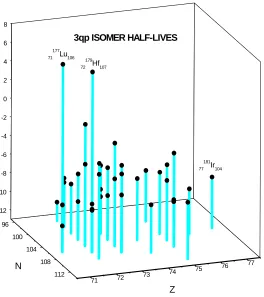
K-isomers have been found to be concentrated in the A≈ 180 mass region. We plot LogT1/2 vs. N and Z for known 3qp isomers in Fig. 2.2, and note that the 3qp isomers are also located in
precisely the same mass region. All except two lie in the range Z = 71 to 77 and N= 99 to
112. The two exceptions are 153Euand 163Er which have a half-life of 475 ns and ≤ 75 ns, respectively, and are not shown in Fig. 2.2. The band-head spin (K) for these isomers lies in
the range ≈ 19/2 to 25/2; only one example (181Ta) has K = 29/2-. The occurrence of these isomers can be reasonably explained on the basis of the deformed shell model as several
high-Ω orbitals lie near the Fermi energy in this mass region. Of particular importance are h11/2 and g7/2 proton and h9/2 and i13/2 neutron orbitals. A detailed investigation of the spins,
half-lives, and K-forbiddenness of these isomers is currently of great interest in nuclear
96 100
104 108
112 -12
-10 -8 -6 -4 -2 0 2 4 6 8
71 72 73
74 75 76 77
72 179
Hf107
77 181
Ir104
71 177
Lu106
3qp ISOMER HALF-LIVES
Z N
Fig. 2.2 A plot of the N-Z plane around the A ≈ 180 mass region illustrating the
2.5.5 Regular bands
Almost all the 3qp bands reflect nearly (I I +1) behavior, hence are regular in nature (not considering back-bending or, odd- even staggering as an irregularity). It may be pointed
out that signature splitting in a band must be distinguished from the irregular nature of a
1 I
∆ = band. This distinction may be achieved by dividing a ∆ =I 1 band into two ∆ =I 2 bands, then analyzing the levels within the ∆ =I 2 sub-bands for regularity and band-crossing. As an example we present 6 bands in Fig. 2.3 which exhibit (I I+1) behavior. In this Figure black line represents the experimental data and red line represents AI I( +1) values where the moment-of-inertia parameterA is derived from first two rotational level
energies.
I (η) Fig. 2.3 Plots of some 3qp bands exhibiting I (I+1) pattern (regular bands).
E
(
M
eV
2.5.6 Moment of inertia, Alignment and back-bending
The kinematic moment of inertia
2 (1)
( 1)
I I
E Iγ I
ω
ℑ = =
→ −
h h
and the dynamic moment
of inertia
2 (2) dI
dω Eγ
ℑ = =
∆
h h
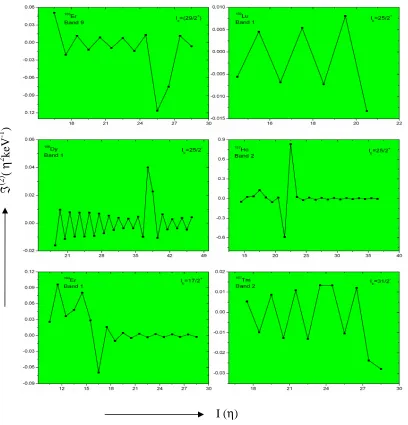
for some of the 3qp bands are plotted in Figures 2.4 and 2.5
respectively. Here∆E Iγ( )=E Iγ( → − −I 1) Eγ(I− → −1 I 2).
I (η)
Fig. 2.4 Plots of Kinematic moment of inertia vs. spin for some 3qp bands.
From Fig. 2.4, it is clear that the ℑ(1) values generally decreases with increasing angular momentum, a trend opposite to what one observes in normal deformed rotational
ℑ
(1
) (η 2 keV
bands where ℑ(1) generally rises with increasing angular momentum. This is indicative of a large contribution to the total angular momentum from a source other than collective. In Fig.
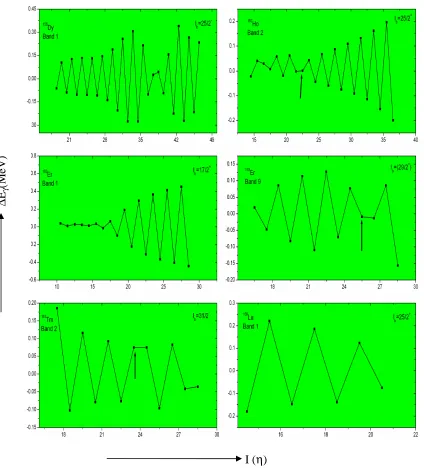
2.5, we have presented some cases exhibiting staggering behavior inℑ(2) and in Fig. 2.6; we have presented some of the 3qp bands having pronounced staggering. This large
fluctuations in ℑ(2) are due to large odd-even staggering in these bands (see Fig. 2.6).
I (η)
Fig. 2.5 Plots of 3qp bands (presented in Fig. 2.6) having staggering in DMI.
Sudden increase/decrease in ℑ(2) indicates band-crossing.
ℑ
(2
) (η 2 keV
I (η)
Fig. 2.6 Plots of some 3qp bands exhibiting large staggering. Arrow indicates the point
of inversion
Many bands display a large odd-even staggering behavior and/ or back-bending. We discuss
these topics in detail in chapter 3. A kind of singularity or sharp rise or fall is observed in the
value of ℑ(2) at angular momenta where back-bending occurs, which is normally attributed to a band-crossing with a further alignment of an extra pair of high-j particles. For example,
∆
Eγ
(Μ
eV
a sharp rise in ℑ(2)values for 155Dy at 75 2 I
−
= h (Fig. 2.5) is an indication of the
band-crossing. Thus band 1 of 155Dy (Table 2.1) having 3qp configuration
3 1 1
[521] [660] [660]
2 ν ⊗2 ν ⊗2 ν changes to 5qp band having
3 1 1 7 7
[521] [660] [660] [523] [523]
2 ν ⊗2 ν ⊗2 ν ⊗2 π ⊗2 π at
75 2 I
−
= h . There are many other 3qp
bands which display band-crossing for example band 1 and band 2 of 157Ho, band 1 of 157Er, band 1 of 159Er etc. as listed at the end of this chapter.
2.5.7 Identical bands
Generally with a change in mass number, some changes in rotational energies are
expected due to change in inertia and pairing correlations etc. However there are some
nuclei which have identical gamma ray cascades over a very wide range of angular
momenta. We present here one example from the experimental data on identical 3qp bands
having the configuration 7/2[404]π5/2[402]π 7/2[633]νin a series of Hf isotopes as shown in
Fig. 2.7.
It may be noted that the 3qp bands having the same configuration are identical in 173
Hf and 175Hf isotopes but the same band in 171Hf is quite different. It may also be noted that the deformation is expected to remain same in all the three isotopes. An understanding
of why the bands in A = 173 and 175 are identical but not that in A=171 may provide a clue
to the resolution of Identical Band (IB) phenomenon. This feature in normal deformed
nuclei was pointed out for the first time by Jain (1984) and interpreted in terms of an
effective decoupling mechanism. Whether these remarkable degeneracies are caused by
subtle cancellations among the many parameters which can affect the moment of inertia or
by some new physics is still an unresolved problem. However there is an increasing
evidence, at least for normal deformed nuclei at low spins, that IB’s between adjacent
even-even and odd mass nuclei occur because of cancellations between the pairing and
deformation parameters ( Brown et al., 2002).
2.5.8 Comparison of one-quasiparticle and three-quasiparticle excitation energies
A comparison of the 3qp bands with the 1qp bands may be made by considering
some examples of the plots of excitation energy vs. angular momentum as shown in Fig. 2.8.
It may be noted that the 3qp bands start out as non-yrast bands running almost
parallel to the 1qp bands which generally define the yrast line at low excitation. However,
many 3qp bands become yrast at higher spins and in the process, they cross the 1qp bands.
In fact many 3qp bands are observed to cross each other also. As an example we cite band 1
and band 2 of 157Ho as listed at the end of this chapter.
2.5.9 Signature splitting and Signature Inversion
In our compilation, we have noticed that there are 49 bands, which exhibit a
signature splitting, and sometimes signature inversion also. In Fig. 2.6., we plot ∆E vs Iγ . for 6 of the 49 cases; signature splitting and signature inversion is evident from these plots.
It is not possible to draw any conclusion for those cases where only 3 - 4 transitions are
known; these are not included in the 49 cases. Such a phenomena of signature splitting and
signature inversion have been studied in normal deformed even-even nuclei (Goel and Jain,
1992) and in odd-odd nuclei (Jain et al., 1989) by using the Particle Rotor Models.
However, no such quantitative calculations for 3qp bands using the Particle Rotor Models
are reported in the literature. In order to understand the observed signature splitting in the
3qp bands, we have formulated a TQPRM for the 3qp bands. The formulation for this model
is given in chapter 4 and its applications to 3qp bands are discussed in chapter 6. The rule
for predicting favored signature for 3qp bands is given in chapter 3. A comparison of the
staggering pattern and the magnitude of staggering in a 3qp band with 1qp and 2qp bands
involving same Nilsson orbital are shown in Fig. 2.9. It may be noticed that the 1qp band
based on 9/2[514] proton (belonging to h11/2) exhibits a large signature splitting which diminishes (at similar spins) when we go to 2qp band based on 9/2[514] proton and 5/2[642]
neutron. This magnitude further reduces as we go to the 3qp band based on 9/2[514] proton,
5/2[642] neutron and 5/2[523] neutron. The staggering, however, does not disappear and is
observed to increase in magnitude with increasing spin. Such a behavior is expected because the number of the matrix elements goes on increasing with number of particles, many of
them cancelling each other. The observed decrease in magnitude of staggering is further
confirmed by the plots presented in Fig. 2.10(a) and Fig. 2.10(b). It is noticed from Fig.
with a 3qp band. Another 3qp band, whose neutron orbital are the same as those of the 3qp
band crossing the 1qp band, has the same phase as well as magnitude of staggering. The K
values of the two 3qp bands will obviously differ. This in a way also confirms the
configuration assignments of these bands. As a result, the staggering pattern of the two 3qp
bands is similar. This also suggests that the missing members of some 3qp quadruplets must
be searched for in the 3qp bands crossing the 1qp bands.
Fig. 2.10(a, b) Same as Fig. 2.9
2.6 CONCLUSIONS
In this chapter, we have presented experimental data taken from literature for the
structures, which are interpreted as 3qp states. Data for a total of 171 bands in 58 nuclei in
the region 153≤A≤187 have been compiled. The energies, spins, parities, configuration assignments, electromagnetic properties, half-lives and other useful details of 3qp bands are
listed in the Table 2.1. A good understanding of these bands and that of high-spin features
such as t-band, band termination, high-K isomers, signature splitting, signature inversion,
approaches and generalization of the GM rules as discussed in this chapter. A detailed
understanding of the 3qp states and the rotational bands based on them in terms of the
Coriolis effects, residual interactions, and the pairing is discussed in chapters 5 and 6.
Observation of pred