R E S E A R C H
Open Access
A mixed Legendre-Galerkin spectral
method for the buckling problem of simply
supported Kirchhoff plates
Junying Cao
1,2, Ziqiang Wang
1,2, Waixiang Cao
3and Lizhen Chen
2**Correspondence:
2Beijing Computational Science
Research Center, Beijing, 100193, China
Full list of author information is available at the end of the article
Abstract
In this paper, we develop a mixed Legendre-Galerkin spectral method to approximate the buckling problem of simply supported Kirchhoff plates subjected to general plane stress tensor. By the spectral theory of compact operators, the rigorous error estimates for the approximate eigenvalues and eigenfunctions are provided. Finally, we present some numerical experiments which support our theoretical results.
Keywords: buckling problem; Legendre-Galerkin spectral method; simply supported Kirchhoff plates
1 Introduction
Buckling problem has attracted lots of interest since it is frequently encountered in engi-neering applications such as bridge, ship, and aircraft design. The buckling problem has been studied for years by many researchers (see [–] and the references therein). Further-more, many numerical methods for the buckling problem have been studied, for example, finite element schemes [, –]. They are based on the well-known mixed methods to deal with the source problem of thin plates modeled by the biharmonic equation which was introduced by Ciarlet and Raviart []. The main idea is to introduce an auxiliary vari-ableω:=Δψ(withψbeing the transverse displacement of the mean surface of the plate) to write a variational formulation of the spectral problem. This mixed trick now has been widely used. Marin and Lupu solved the unknowns of the displacement and microrotation on harmonic vibrations in thermoelasticity of micropolar bodies []. Pop et al. proposed a novel algorithm for the condition detection in which the solution breaks down []. The author presented a spline collocation method for two different integral equations which were split by Fredholm-Hammerstein integral equations of the second kind over a rect-angular region in a plane [].
The main purpose of this paper is to propose a mixed Legendre-Galerkin spectral method to approximate the buckling problem of simply supported Kirchhoff plates sub-jected to general plane stress tensor. We introduce a compact operator to analyze the con-tinuous problem. The basis functions are constructed by combining the Legendre poly-nomials which satisfy the boundary condition automatically. Finally, we prove the optimal order error estimate for the eigenfunctions and a double order for the eigenvalues.
The remainder of this paper is organized as follows. Section describes simply sup-ported Kirchhoff plates subjected to general plane stress tensor. The Legendre-Galerkin spectral method and the error estimate are proposed in Section . The details of imple-mentation and the expression of a linear algebra system corresponding to the discrete variational formulation are given in Section . Section presents the main numerical re-sults of this work which demonstrate the efficiency and accuracy of this method. Finally, a conclusion of this paper is made in Section .
2 The spectral problem
LetΩdenote a bounded Lipschitz polygon domain inRwith boundary∂Ω. The eigen-values of the buckling problem of a plate on a reference domain read as the following eigenvalue problem:
Δψ= –λ∇ ·(σ∇ψ), x∈Ω,
ψ=Δψ= , x∈∂Ω,
()
where the transverse displacement of the mean surface of the plateσ is a plane stress tensor fieldσ:Ω→R×,σ= , satisfying the equilibrium equations
σt=σ, x∈Ω,
∇ ·σ= , x∈Ω.
Define
V=
ψ∈H(Ω) :ψ=∂ ψ
∂n = , on∂Ω
. ()
A classical variational formulation of () reads as follows: findλ,ψ∈R×V such that
Ω
Δψ ΔχdΩ=λ
Ω
(σ∇ψ)· ∇χdΩ, ∀χ∈V. ()
It is immediate to prove that the eigenvalues of the above problem are real and positive wheneverσis positive definite.
In this paper, we consider another variational formulation of () which is based on the splitting method. We introduce the auxiliary variableω=Δψ, then () can be rewritten equivalently as follows:
⎧ ⎪ ⎨ ⎪ ⎩
ω=Δψ, inΩ,
Δω= –λdiv(σ∇ψ), inΩ,
ψ=ω= , on∂Ω.
()
Therefore, by testing the system above with functions inH
(Ω), we arrive at the following weak formulation:
Find (λ,ω,ψ)∈R×H
(Ω)×H(Ω),ψ= , such that
Ω∇ω· ∇v dΩ= –λ
Ω(σ∇ψ)· ∇v dΩ, ∀v∈H(Ω),
Ω∇ψ· ∇ηdΩ+
ΩωηdΩ= , ∀η∈H(Ω).
Now, we introduce a compact notation for the spectral problem (). LetA: (H (Ω)× H
(Ω))×(H(Ω)×H(Ω))−→RandB:H(Ω)×H(Ω)−→Rbe the continuous and symmetric bilinear forms, respectively, defined by
A(ω,ψ), (v,η):=
Ω
∇ω· ∇v dΩ+
Ω
∇ψ· ∇ηdΩ+
Ω ωηdΩ,
B(ψ,η) :=λ
Ω
(σ∇ψ)· ∇v dΩ.
()
Then problem () can be written as follows:
A(ω,ψ), (v,η)= –λB(ψ,η), ∀(v,η)∈H(Ω)×H(Ω). ()
Problem () has an eigenvalue sequenceλj(see [])
<λ≤λ≤ · · · ≤λk≤λk+≤ · · ·, lim k→∞λ
k=∞
and the associated eigenfunctions
ϕ,ϕ, . . . ,ϕk,ϕk+, . . . .
Before introducing the spectral method, we introduce the following bounded linear oper-ator which is called solution operoper-ator:
T:H(Ω)→H(Ω),
f →ψ,
with (ω,ψ)∈H
(Ω)×H(Ω) being the solution of the corresponding source problem
A(ω,ψ), (v,η)= –B(f,η), ∀(v,η)∈H(Ω)×H(Ω). ()
This problem can be decomposed into the following well-posed problems: - Findω∈H
(Ω)such that
Ω
∇ω· ∇v dΩ= –
Ω
(σ∇f)· ∇v dΩ, ∀v∈H(Ω); ()
- Findψ∈H
(Ω)such that
Ω
∇ψ· ∇ηdΩ= –
Ω
ωηdΩ, ∀η∈H(Ω). ()
From () we know that an equivalent operator formulation of () is
Tψ=λ–ψ.
Givenf ∈H
(Ω), findψ∈H(Ω)∩H(Ω) such that
Ω
Δψ Δv dΩ=
Ω
(σ∇f)· ∇v, ∀v∈H(Ω)∩H(Ω). ()
This equivalence was introduced by Zhang and Zhang [] and was proved by Millar and Mora [] for the sake of completeness.
In order to imply the spectral method on problem (), we introduce the discrete space as follows.
Let
SN :=
Φ∈L(Ω);Φ∈PN(Ω)
,
wherePN(Ω) denotes the space of all polynomials of degree at mostN with respect to each variable inΩ. Now, let
VN=SN∩H(Ω).
Then the corresponding · is defined by
∀ϕ∈VN, ϕ= (ϕ,ϕ) + (∇ϕ,∇ϕ).
We define below an orthogonal projector with respect to the global domainΩ:ΠN,:V→ VN such that for allψ∈V,
∇ψ–ΠN,ψ,∇χN
Ω= , ∀χN∈VN.
Then we have the following approximation results.
Lemma Let r≥,then for allψ∈Hr(Ω)∩V,we have the following estimate:
ψ–ΠN,ψ
;ΩN
–rψr;
Ω.
Proof For details of the proof, one can refer to Theorem . in [].
3 Error estimate for eigenvalues
The Legendre-Galerkin spectral method for () is as follows: find (ωN,ψN)∈VN×VNsuch that
A(ωN,ψN), (vN,ηN)
= –λNB(ψN,ηN), ∀(vN,ηN)∈VN×VN. () This problem decomposes into a sequence of two well-posed problems, which are the discretizations of problems ():
- FindλN,ωN∈VN such that
Ω
∇ωN· ∇vNdΩ= –λN
Ω
- FindψN∈VNsuch that
Ω
∇ψN· ∇ηNdΩ= –
Ω
ωNηNdΩ, ∀ηN∈VN. ()
Problem () has eigenvalues
<λN ≤λN≤ · · · ≤λkN≤λk+N ≤ · · · ≤λKN, K=dim(VN)
and the associated eigenfunctions
ϕN,ϕN, . . . ,ϕNk,ϕNk+, . . . ,ϕKN.
As in the continuous case, we introduce for the analysis the discrete solution operator
TN:VN→VN,
f →ψN,
with (ωN,ψN)∈VN ×VNbeing the solution of the corresponding source problem
A(ωN,ψN), (vN,ηN)
= –B(f,ηN), ∀(vN,ηN)∈VN×VN. () This problem can be rewritten in the following forms, which are the respective dis-cretizations of problems () and ():
- FindωN∈VN such that
Ω
∇ωN· ∇vNdΩ= –
Ω
(σ∇f)· ∇vNdΩ, ∀vN ∈VN; ()
- FindψN∈VNsuch that
Ω
∇ψN· ∇ηNdΩ= –
Ω
ωNηNdΩ, ∀ηN∈VN. ()
From () we know that an equivalent operator formulation of () is
TNψ=λ–Nψ.
Theorem There exists C> ,∀r> such that,for all f ∈H (Ω),
(T–TN)f,Ω≤CN–r.
Proof For a givenf ∈H
(Ω), let (ω,ψ) and (ωN,ψN) be the solutions of problems () and (), respectively, so thatψ=Tf andψN =TNf. From () and (), and the first Strang lemma [], we have
ψ–ψN,Ω≤
inf
ϕN∈VN
ψ–ϕN,Ω+ sup ψN∈VN
Ω(ω–ωN)ηNdΩ
ηN,Ω
The first term on the right-hand side of the above inequality can be estimated by (..) in []
inf
ϕN∈VN
ψ–ϕN,Ω≤ψ–ΠN,ψ,Ω≤CN–rψr.
The estimate of the second term can be obtained by the Cauchy-Schwarz inequality and by (..) in []
sup
ψN∈VN
Ω(ω–ωN)ηNdΩ
ηN,Ω ≤
ω–ωN,Ω≤ω–ΠN,ω,Ω≤CN–rωr.
Combining the above three inequalities gives the desired result.
LetE(λ) be the eigenfunctions space of () corresponding to the eigenvalueλ, and letC stand for a generic positive constant independent of any functions and of any discretiza-tion parameters. Then we give theoretical analysis of the eigenvalue problem by assuming here that all eigenvalues have ascent.
Theorem Let(λ,ϕ)and(λN,ϕN)be an eigenpair of ()and(),respectively. Ifϕ ∈ V∩Hr(Ω)with r≥,then for all N≥,
|ϕ–ϕN|≤CN–r, (a)
λ–λN≤CN(–r). (b)
Proof Thanks tolimN→∞|T–TN|= , Theorem and Theorem . in [], we have
|ϕ–ϕN|≤C(T–TN)|E(λ)
=C sup
ϕ∈E(λ),|ϕ|=
(T–TN)ϕ
≤CN–r.
From () and (), we can obtain
A(ω,ψ) – (ωN,ψN), (ω,ψ) – (ωN,ψN)
+λB(ψ–ψN,ψ–ψN) =A(ω,ψ), (ω,ψ)– A(ω,ψ), (ωN,ψN)
+A(ωN,ψN), (ωN,ψN)
+λB(ψ,ψ) – λB(ψ,ψN) +λB(ψN,ψN) =A(ωN,ψN), (ωN,ψN)
+λB(ψN,ψN) = –(λN–λ)B(ψN,ψN).
Dividing byB(ψN,ψN) both sides of the above equation together with () yields
λN–λ= |
ωN–ω|+|ψN–ψ|
B(ψN,ψN)
–λ|ψN–ψ|
B(ϕN,ϕN) ≤|ωN–ω|+|ψN–ψ|
B(ψN,ψN) ≤
CN(–r), ()
4 Implementation
In this subsection, we start with some implementation details in the basis function con-struction.
Firstly, construct one-dimensional basis functions similar to [] as follows: for ≤i≤ N– ,
φi(x) = √
i+
Li(x) –Li+(x)
, x∈Λ= (–, ).
We have
VN=spanφ(x),φ(x), . . . ,φN–(x)
.
ExpressψN(x,y) as a combination of the above basis functions
ωN(x,y) = N– i= N– j= ˆ
ωijφi(x)φj(y), ψN(x,y) = N– i= N– j= ˆ
ψijφi(x)φj(y), ()
where{φi(x)}N–
i= and{φi(y)}N–i= are the sets of one-dimensional basis functions in the x-andy-direction, respectively (i.e., the basis functions ofVN).
By inserting the expansions of () into () and taking the test functions asvN=φmφn,
ηN=φpφq, we set
Bij= (φj,φi)Λ, Cij= (∂xφj,φi)Λ, Sij= (∂xφi,∂xφj)Λ,
B= (Bij)≤i,j≤N–, C= (Cij)≤i,j≤N–, S= (Sij)≤i,j≤N–.
Denote
S=S⊗B+B⊗S, M=B⊗B, E=σS⊗B– (σ+σ)C⊗C+σB⊗S,
where
σ=
σ σ
σ σ
.
Then problem () can be written in the following matrix form:
M S
St
ω ψ
=λN
E ω ψ , ()
where⊗is the tensor product operator,ω,ψis the coefficient vector of a numerical solu-tion ofωN,ψN.
The nonzero entries ofBandCcan be easily determined from the properties of Legen-dre polynomials as follows.
Lemma The stiffness matrix S is a diagonal matrix with
The mass matrix B is symmetric penta-diagonal whose nonzero elements are
Bi,i=
(i+ )(i+ ), Bi,i+=Bi+,i= –
(i+ )√i+ √i+ .
Nonzero elements of the mass matrix C are
Cij=
√
(i+)(i+) if i–j= –, –√
(i+)(i+) if i–j= .
It is obvious thatBis a symmetric positive definite matrix, and it is easy to show that
bkj= , ifk=j,j±.
Hence, the above linear system () can be solved efficiently by LAPACK routine dggev. The dggev is based on the generalized Schur decomposition (the QZ decomposition). The computational complexity isO(N) for the solution of the eigenvalue problem (by using the QZ decomposition), whereNis a total number of collocation points for one direction of the unknowns.
5 Numerical results
In this section, we will show some numerical results which demonstrate the accuracy and efficiency of the Legendre-Galerkin spectral method for the buckling problem of simply supported Kirchhoff plates on the reference square. We have taken the unit squareΩ= (, )×(, ) as an example of a convex domain.
Example (Uniformly compressed square plate) We consider the following problem as-sociated with the vibration problem of a simply supported Kirchhoff plate:
Δu= –λΔu, inΩ,
u=Δu= , onΓ.
For more information on the exact eigenvalues and eigenfunctions of the last problem, one can refer to [, ].
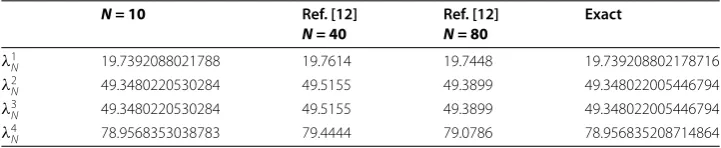
In Table we list the lowest four buckling coefficients. The table also includes the re-sults computed from [] withN= andN= by the finite element method. The last column of the table shows the exact buckling coefficient. In Figure we plot the error of the first four eigenvalues in a semi-log scale for the buckling problem of simply supported
Table 1 The lowest four buckling coefficients of a uniformly compressed simply supported square plate
N = 10 Ref. [12]
N = 40
Ref. [12]
N = 80
Exact
λ1
N 19.7392088021788 19.7614 19.7448 19.739208802178716
λ2
N 49.3480220530284 49.5155 49.3899 49.348022005446794
λ3
N 49.3480220530284 49.5155 49.3899 49.348022005446794
λ4
Figure 1 The error of the first four eigenvalues in a semi-log scale for the buckling problem of simply supported Kirchhoff plates.
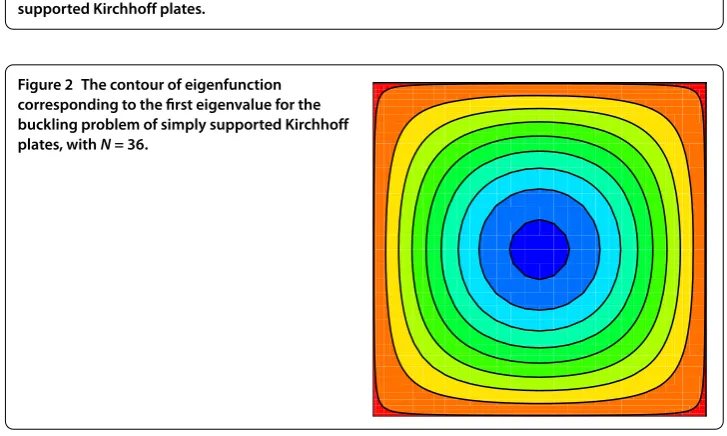
Figure 2 The contour of eigenfunction corresponding to the first eigenvalue for the buckling problem of simply supported Kirchhoff plates, withN= 36.
Kirchhoff plates. These results demonstrate that our approach can achieve an exponen-tial convergence rate which is in good agreement with the theoretical result. Moreover, Figure shows the contour line of eigenfunction corresponding to the lowest buckling coefficient of the buckling problem.
Example (Square plate under combined bending and compression in one direction) In this paper, we define a non-dimensional buckling intensity as follows:
κi:=
λi N
π
and choose a plane stress field
σ=
–αy
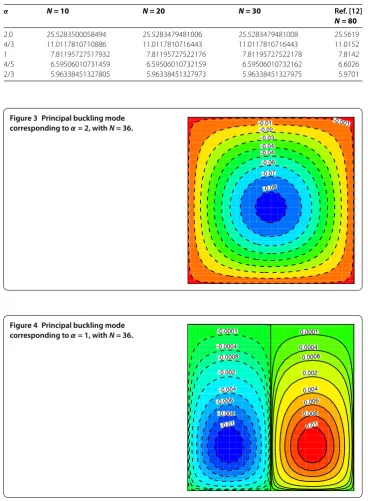
Table 2 The lowest four buckling coefficients of a uniformly compressed simply supported square plate
α N = 10 N = 20 N = 30 Ref. [12]
N = 80
2.0 25.5283500058494 25.5283479481006 25.5283479481008 25.5619
4/3 11.0117810710886 11.0117810716443 11.0117810716443 11.0152
1 7.81195727517932 7.81195727522176 7.81195727522178 7.8142
4/5 6.59506010731459 6.59506010732159 6.59506010732162 6.6026
2/3 5.96338451327805 5.96338451327973 5.96338451327975 5.9701
Figure 3 Principal buckling mode corresponding toα= 2, withN= 36.
Figure 4 Principal buckling mode corresponding toα= 1, withN= 36.
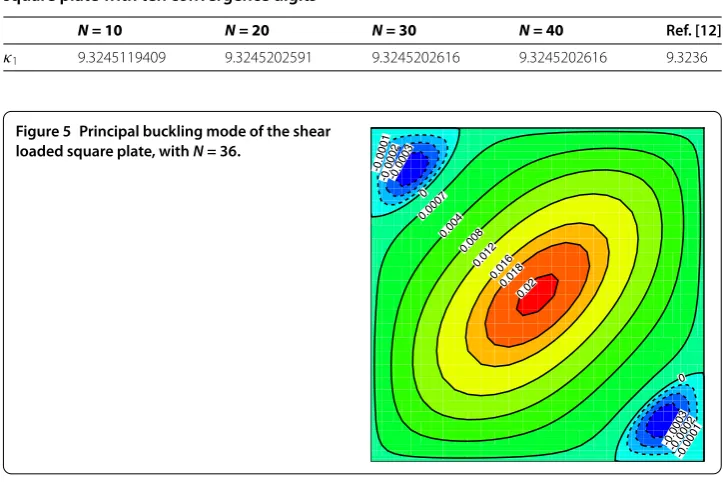
Table 3 The lowest four buckling coefficients of a uniformly compressed simply supported square plate with ten convergence digits
N = 10 N = 20 N = 30 N = 40 Ref. [12]
κ1 9.3245119409 9.3245202591 9.3245202616 9.3245202616 9.3236
Figure 5 Principal buckling mode of the shear loaded square plate, withN= 36.
Example (Shear loaded square plate) In this example, we chose the plane stress field
σ=
.
We have computed the non-dimensional buckling intensity of the same plate as in the previous example, subjected to a uniform shear load.
In Table we list the lowest non-dimensional buckling intensity. Also we compare our results with those obtained in [] which are listed in the last column. Figure shows the transverse displacements of the principal buckling mode for the shear loaded square plate computed with the computational parameterN= .
6 Conclusion
We have proposed an efficient mixed Legendre-Galerkin spectral method for the solution of the buckling problem of simply supported Kirchhoff plates. The optimal error estimates for eigenvalues and eigenfunctions are also provided. Finally, the efficiency and accuracy of the spectral method for the buckling problem of simply supported Kirchhoff plates have been illustrated by numerical results. In the future, we will consider dealing with more complicated domains by the mixed Legendre-Galerkin spectral element method. Firstly, we will divide the domain into lots of subdomains by domain decomposition, then we will construct the same basis functions in each subdomain similar to the square plate examples and construct the hat basis functions at each interface between the two domains. Here we want to mention that if the subdomain is irregular, the expressions of the mass matrix and the stiffness matrix should be computed by numerical integration.
Competing interests
Authors’ contributions
All authors discussed, read and approved the final version of the manuscript.
Author details
1School of Data Science and Information Engineering, Guizhou Minzu University, Guiyang, 550025, China.2Beijing
Computational Science Research Center, Beijing, 100193, China.3School of Data and Computer Science, Sun Yat-Sen
University, Guangzhou, 510275, China.
Acknowledgements
JYC and ZQW would like to acknowledge the support from the National Natural Science Foundation of China (NSFC) under Grant 11501140, the Foundation of Guizhou Science and Technology Department under Grants [2014]2098 and Innovation Group Major Program of Guizhou Province KY[2016]029. WXC would like to acknowledge the support from China Postdoctoral Science Foundation under Grant 2016T90027. LZC would like to acknowledge the support from NSFC through Grants 11671166 and U1530401, Postdoctoral SFC through Grant 2015M580038.
Received: 6 December 2016 Accepted: 24 February 2017
References
1. Ishihara, K: On the mixed finite element approximation for the buckling of plates. Numer. Math.33, 195-210 (1979) 2. Rannacher, R: Nonconforming finite element methods for eigenvalue problems in linear plate theory. Numer. Math.
33, 23-42 (1979)
3. Mercier, B, Osborn, J, Rappaz, J, Raviart, PA: Eigenvalue approximation by mixed and hybrid methods. Math. Comput.
36, 427-453 (1981)
4. Mora, D, Rodríguez, R: A piecewise linear finite element method for the buckling and the vibration problems of thin plates. Math. Comput.78, 1891-1917 (2009)
5. Lovadina, C, Mora, D, Rodríguez, R: Approximation of the buckling problem for Reissner-Mindlin plates. SIAM J. Numer. Anal.48, 603-632 (2010)
6. Ciarlet, PG, Geymonat, G, Krasucki, F: Nonlinear Donati compatibility conditions for the nonlinear Kirchhoff-von Karman-Love plate theory. C. R. Math. Acad. Sci. Paris351(9), 405-409 (2013)
7. Kumar, S, Kumar, D, Singh, J: Fractional modelling arising in unidirectional propagation of long waves in dispersive media. Adv. Nonlinear Anal.5(4), 383-394 (2016)
8. Babuška, I, Osborn, J: Eigenvalue problems. In: Handbook of Numerical Analysis, vol. 2, pp. 641-787. North-Holland, Amsterdam (1991)
9. Zhong, H, Gu, C: Buckling of simply supported rectangular Reissner-Mindlin plates subjected to linearly varying in-plane loading. J. Eng. Mech.132, 578-581 (2006)
10. Boffi, D: Finite element approximation of eigenvalue problems. Acta Numer.19, 1-120 (2010)
11. Civalek, Ö, Korkmazb, A, Demir, Ç: Discrete singular convolution approach for buckling analysis of rectangular Kirchhoff plates subjected to compressive loads on two-opposite edges. Adv. Eng. Softw.41, 557-560 (2010) 12. Millar, F, Mora, D: A finite element method for the buckling problem of simply supported Kirchhoff plates. J. Comput.
Appl. Math.286, 68-78 (2015)
13. Ciarlet, PG, Raviart, PA: A mixed finite element method for the biharmonic equation. In: Mathematical Aspects of Finite Elements in Partial Differential Equations, pp. 125-145. Academic Press, New York (1974)
14. Marin, M, Lupu, M: On harmonic vibrations in thermoelasticity of micropolar bodies. J. Vib. Control4, 507-518 (1998) 15. Pop, N, Vladareanu, L, Popescu, LN, Ghi¸t˘a, C, Gal, A, Cang, S, Yu, SN, Deng, MC, Bratu, V: A numerical dynamic
behaviour model for 3D contact problems with friction. Compos. Mater. Sci.94, 285-291 (2014)
16. Micula, S: A spline collocation method for Fredholm-Hammerstein integral equations of the second kind in two variables. Appl. Math. Comput.265, 352-357 (2015)
17. Zhang, S, Zhang, Z: Invalidity of decoupling a biharmonic equation to two Poisson equations on non-convex polygons. Int. J. Numer. Anal. Model.5, 73-76 (2008)
18. Bernardi, C, Maday, Y: Spectral methods. In: Handbook of Numerical Analysis, vol. 5, pp. 209-485. North-Holland, Amsterdam (1997)
19. Ciarlet, PG: Basic error estimates for elliptic problems. In: Handbook of Numerical Analysis, vol. 2, pp. 17-351. North-Holland, Amsterdam (1991)
20. Quarteroni, AM, Valli, A: Numerical Approximation of Partial Differential Equations. Springer, Berlin (2008) 21. Shen, J: Efficient spectral-Galerkin method. I: direct solvers of second and fourth-order equations using Legendre
polynomials. SIAM J. Sci. Comput.15, 1489-1505 (1994)