AN EFFICIENT DATA TRANSMISSION USING
TREE-BASED SELF-ORGANIZING PROTOCOL
Arti Mandlik
Department of Electronics and Telecommunication G.H Raisoni College of Engineering and Management
Maharashtra, India
Ms. Bharti Patil
Department of Electronics and Telecommunication G.H Raisoni College of Engineering and Management
Maharashtra, India
I.
INTRODUCTION
Sensor Networks involve ease and low power little sensor node which are appropriated haphazardly. These nodes can accumulate and forward detecting information data. With the scale growing and device updating, the framework turns out to be complex. The system hub can constrained the capacity of processing memory and vitality. For amplify lifetime of system numerous Researchers put efforts on control organize topology, construct better information transmission course, and adjust vitality utilization of nodes.
Tree system is a mix of star system and transport organize, which can boost the system lifetime. Thusly, how to shape a tree-based system with a most extreme lifetime for sensor systems has turned into a basic issue. NP-finish issue is presented when we are picking a most extreme lifetime tree from the all tress . So we pick an imperfect system, to meet the necessity of ongoing system.
In Zhu et al.[2] Author demonstrated that tree structure can’t worked inside a period. They develop an intersection tree through subset division in polynomial period. Wireless Sensor Network, opening up the lifetime of an information gathering tree without combination has been ended up being NPwrapped up. We center the issue of tree change for increasing the system lifetime. Orchestrate lifetime is depicted as the time until the basic center point exhausts its essentialness. In[3], we show that, unless P = NP, no polynomial-time number can assembled the issue with a segment out and out more unmistakable than 2/3. The outcome even holds in the extraordinary condition where all sensors have a relative starting centrality. We propose the basic non-insignificant unequivocal estimation to locate an impeccable intersection tree.
Ye et al. [4] ,have affirmed that without data add up to the most extreme farthest reaches of each of the one-bounce hub imperativeness usage. LBT (Load-Balanced and imperativeness compelling Tree) can extend the framework lifetime. Estimation LBT can spare that the essentialness use of the tree system framework is close quite far, generally. In this paper, we propose a Load-Balanced and essentialness capable Tree (LBT)
Abstract:
The use of Wireless Sensor Network (WSN) to handle more complex functions is increasing
drastically. Tree Networks are widely used in Sensor Networks. The sensor networks are self organizing wireless networks. We proposed methods and algorithms to implement ETPS (Efficient Tree-Based Self Organizing Protocol) a new model of Network and algorithms to route network it can enhance dependability and effectiveness of correspondence. In ETSP, The Nodes are partitioned into: Non- Network and Network node. Arrange node can convey to their neighboring node. Non-Network node assemble the communicate parcel. For joining the system we utilize self sorting out process, in that we utilize diverse measurements are utilized, for example, youngster node, bounce, correspondence remove and leftover vitality to reach available sink node. we select the sink hub with maximum weight. Tree Network is framed layer by layer when Non-Network hub can be changed into Network hub. These tree organize topology is balanced powerfully to adjust vitality utilization and delay arrange life time. We take the experimental simulation with NS2 to assess ETSP. The results of simulation show that our proposed convention can build a tree-based network with higher success rate at very fast timing.computation to intensify the lifetime of wsns, which considers the pile alter and imperativeness profitability of 1- bounce centers. To the best of our knowledge, we are the first to present the upper bound of framework lifetime for data gathering without collection with tree system topology. we use the data gathering development in tree framework to reduce the essentialness use and framework stack. The essential issue in data party is sparing sensor imperativeness and increasing lifetime of sensor.
We proposed an Efficient Self-association Protocol (ETSP) in tree-based system. The system hubs are partitioned into three sorts: root, sink and sensor hub. In the start of ETSP, we select root hub with zero jump. At that point, the root hub looks youngster hubs by sending bundles. In the wake of accepting the parcels, the neighboring non-arrange hubs record the topology data and utilize diverse measurements, for example, number of tyke hubs, bounce, correspondence separation and leftover vitality to achieve accessible sink hubs’ weight. Next, the chose sink hub with max weight of hub. Our proposed calculation can manufacture a tree-based system powerfully when hubs can framed system effectively utilizing Non-Network hubs .We evacuate the most remote tyke hub to adjust vitality utilization and Maximize the entire system lifetime.
II.
LITERATURE SURVEY
The control topology system can be partitioned into the three sorts: Multi-hub transmit Connected overwhelming set, [1] The algorithm of clustering techniques is a for the most part utilized as a part of instance of execution of different issues, for example, directing and asset administration in portable impromptu systems (MANET). They propose an appropriated calculation for grouping in manets that can shape larger amount bunches by expanding their levels. They can likewise utilization the lower and upper bound heuristics which adjusted number of hubs in the groups framed. The operation of the calculation and investigate its time and message complexities and give results about the reenactment condition of ns2.[5]
The Authors Silva R, Silva JS, Boavida F.”Mobility in wireless sensor systems Survey and proposition” Focusing on an extending number of potential application ranges, wireless sensor networks (WSN) have been the subject of unprecedented research, to streamline their execution while guaranteeing enduring quality in outstandingly asking for circumstances. Regardless, gear objectives have obliged their application, and bona fide associations have demonstrated that WSNs encounter issues in adjusting to complex correspondence assignments, for instance, versatility despite applicationrelated endeavors. Versatility reinforce in WSNs is earnest for a high rate of use circumstances. It is, in this way, basic to know the present responses for flexibility in WSNs, perceiving their essential qualities and requirements. Along these lines, we firstly demonstrate a review of models for adaptability reinforce in WSNs. We then present the Network of Proxies (NoP) helped transportability suggestion, which quiets resource obliged WSN hubs from the mind-boggling strategies characteristic to flexibility organization. The presented recommendation was executed and evaluated in an authentic stage, demonstrating its purposes of enthusiasm over routine game plans, and additionally its awesome execution in the synchronous treatment of a couple of flexible hubs, inciting to high handoff accomplishment rate and low handoff time.[6] In [7] The Author Develop and break down low-vitality versatile grouping progressive system (LEACH), a convention design for small scale sensor organizes that consolidates the thoughts of vitality productive bunch based steering and media get to together with application-particular information total to accomplish great execution as lifetime, dormancy, and application-saw quality. Filter (Low Energy Adaptive Clustering Hierarchy) is one of bunching calculations, which makes and keeps up groups to bring down the vitality of system. Every hub utilizes a stochastic calculation to figure out if it turns into a bunch head. The hub with the greatest vitality is chosen as the group head. These elements prompted to configuration LEACH, a convention engineering where calculation is performed locally to decrease the measure of transmitted information, arrange design and operation is done utilizing nearby control, and media get to control (MAC) and directing conventions empower low-vitality organizing.
availability (the connection between bunch range and transmission go under a predefined thickness show) hold. This approach would he be able to connected to the plan of a few sorts of sensor system conventions that require vitality proficiency Scalability, delayed system lifetime and load balancing.[8]
Wireless Sensor Networks (WSN) assumes a key part in such a situation, since they cover a wide application field. Such interconnection can be seen from the part of a remote client who can get to a solitary wanted sensor hub from the WSN without the need of firstly interfacing with a portal hub (GWN). This framework concentrates on such a domain and proposes a novel client verification and key understanding plan for heterogeneous impromptu remote sensor systems. The framework utilizes an uncommon four-stage verification display which is, as per our examination, the most appropriate for such prerequisites and condition. To the best of our insight, this is a first of its kind plan, intended to ideally work inside the IOT condition. The plan gives and empowers shared validation between all gatherings, secret word assurance, free watchword decision, watchword changing, and dynamic hub addition[9].
In [10] The Authors proposed framework to build up a viable uninvolved bunch based hub disjoint many to one multipath steering convention to fulfill the prerequisites of vitality effectiveness and qos in process, is actualized to discover numerous ways at the base cost. These propose another calculation to manufacture information transmission courses with multi-way disjoint convention. The new calculation enhances the vitality effectiveness of hubs and guarantees that the system has a higher qos (Quality of Service). However, every hub contains multi-way that expands the multifaceted nature of the reasonable wsns. Aloof bunching methodology is put to use in the first round, while dynamic grouping procedure is taken in alternate rounds. Usage of keen defer system makes the bunches convey consistently, and in addition decrease the quantity of hubs that have participated in directing. Among group heads, a hub disjoint many to one multipath directing revelation calculation, which is made out of the ideal way seeking process and multipath development arrange administration.
III. MOTIVATION AND OBJECTIVE
A. Clustering MethodAfter reviewing different methods we analyzed some drawbacks associated with these techniques. we found that there are three main widely used topologies,
1. Multi Node Transmit 2. Connected Dominating Set 3. Clustering Methods
Out of these methods clustering method is mostly used in various algorithms like LEACH, HEED, EEDCH. Main Drawback with these technique is that energy consumptions. Energy efficiency is very low so it limits the network life time. LEACH is the clustering algorithms, which creates and maintains clusters to minimize the energy of network. Each node uses a algorithm to determine whether it becomes a cluster head. The node witch having the the maximum energy is selected as the cluster head. HEED is also based on clustering algorithms. It used the residual energy, HEED can calculate the number of neighboring child nodes for selection of cluster head. The drawbacks with LEACH and HEED is it still reelect the cluster-head after some time frame , which wastes small amount of energy.
B. Routing Algorithm
There are Two kinds of routing algorithm of Ad hoc network:
1. DSDV (Destination Sequenced Distance Vector Routing) : Table driven routing algorithm 2. AODV (Ad hoc On Demand Distance Vector Routing): Demand driven routing algorithm
IV. POPOSED SYSTEM
A. Problem StatementWe Proposed methods and algorithms to implement ETPS (Efficient Tree-Based Self Organizing Protocol) a new Network model and route algorithms to improve reliability and efficiency of communication.
Implementation of Tree- Based Routing Protocol with
1. Maximum Network life Time.
2. Maximum Packet Success Rate.
3. Fast Network Establishment.
B. Network Topology
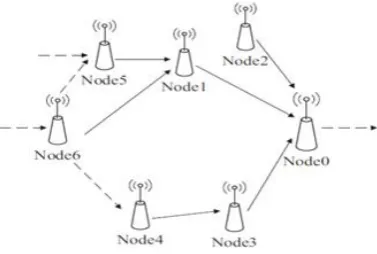
Fig. 1. Network Topology for Sensor
In Figure, we consider that Node 6 is selected as sink node witch having child node 1, 4 and 5 but Node1 is having 4 child nodes hence Node1 is the best node and if we selects Node1 as sink node that will increase the energy consumption and minimize the lifetime of network. If we selects Node4 or Node5 as sink node. It can results in reduction of the energy consumption. If we consider that residual energy of Node5 is greater than residual energy of Node4 hence Node5 is better sink node than Node4. For increasing lifetime of network Node5 can be selected as sink node .To balance energy consumption of Node5 and Node4 after some period Node6 can reelect Node4 as sink node.
C. METHODOLOGY OF THE SYSTEM
The procedure of development of system topology, arrange nodes seek child nodes by sending parcels. Non-organize nodes select sink node as indicated by the got packets. The determination of sink node adjusts the residual energy , bounce, number of kid nodes and separation between two nodes. At the point when there is more number of jumps it takes more transmission times. More transmission times builds the aggregate vitality utilization. So we have to control the quantity of bounce in system. In the event that a sink node has extensive number of youngster nodes it will get more packets and devour more vitality. So we take the thought of number of kid nodes while choosing sink node for adjusting vitality utilization. Hubs of system can be three sorts: root hub, sink hub and sensor hub. Root hub is a fundamental hub whose vitality is unbounded and it is dynamic constantly. Root hub is the principal arrange hub and toward the starting root hub sends t bundles to youngster hubs. Non-organize hub spares the send parcels and figures the sink hubs weight. At last, non-arrange hub chooses the best sink hub with most extreme weight to join the system. On the off chance that the best sink hub declines the non-arrange hub to join the system, the non-organize hub needs to choose the imperfect sink hub, third-ideal sink hub until it has joined the system effectively. On the off chance that the non-organize hub can’t join the system in the wake of filtering all accessible sink hubs, it needs to clear all accessible sink hubs’ data and afterward spares different parcels to reelect an accessible sink hub.
1. Efficient Tree-Based Self-Organizing Protocol
tree-based self-sorting out convention is tree-based system. The system hubs (the hubs that have joined the system) are characterized into three sorts: root hub, sink hub, sensor hub. In the start of ETSP, there is just a root hub with zero jump. At that point, the root hub looks youngster hubs by sending parcels. In the wake of accepting the parcels, the neighboring non-arrange hubs record the topology data and utilize diverse measurements, for example, number of youngster hubs, correspondence separate , jump and leftover vitality to achieve accessible sink hubs’ weight. Next, the hub with max weight is chosen as sink hub. At the point when non-organize hubs join the system effectively, they can be transformed into system hubs on the double.
2. Network Self-organization
During the procedure of development of system topology, arrange hubs seek youngster hubs through sending communicate parcels. Non-arrange hubs select sink hub as indicated by the got communicate parcels. The determination of sink hub adjusts the jump, lingering vitality, number of tyke hubs and separation between two hubs. The more jumps there are, the more transmission times will be required. transmission times will expands the aggregate vitality utilization. So we have to control the bounce of system. On the off chance that a sink hub has more youngster hubs it will get more parcels and devour more vitality. So for determination of sink hub we take thought of number of youngster hub for adjusting vitality utilization .
V. SIMULATION RESULTS
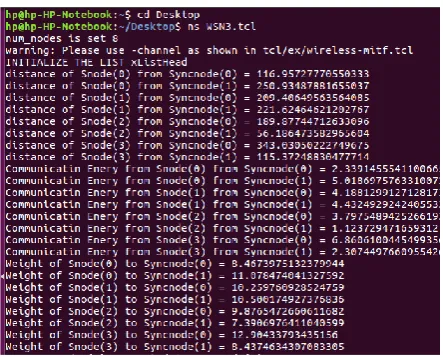
In this section the presented real NS-2 simulation for six node network topology. we build network with four sensor node and two sink node. calculating distance, communication energy and weight between two nodes for finding sink node to form a tree-based netwok.NS2 simulation shows the randomly allocated nodes and calculation of parameter for finding sink node.
Fig. 2. Randomlly Allocated nodes in given area
VI. CONCLUSION
The proposed system with network topology based on an efficient self-organization protocol. ETSP saves the energy and It has a longer lifetime of network by constructing a treebased network with short timing. By using the nodes weight, the residual energy of nodes, hop, number of child nodes and distance between the two nodes we determine the Best sink node. The network topology changes dynamically in the process of data transmission. Each sink node can dynamically reselected the nodes according to energy consumption of that node. In future we shows simulation results for ETSP which is build the reliable topology of tree-based networks which can reduces energy consumption and also Maximize the lifetime of Network.
REFERENCES
[1]. Tie Qiu, Senior Member, IEEE, Xize Liu, Lin Feng, Yu Zhou, Kaiyu Zheng, Student Member, IEEE,
”An Efficient Tree-based Self-Organizing Protocol for Internet of Things”.2169-3536 (c) 2016 IEEE.
[2]. Qiu T, Chi L, et al. STETS, Guo W” A Novel Energyefficient Time Synchronization Scheme based on
Embedded Networking Devices.” Microprocessors and Microsystems 2015; 39(8):1285-1295.
[3]. Wu X,Zhu X, Chen G. ”An exact algorithm for maximum lifetime data gathering tree without
aggregation in wireless sensor networks.”Wireless Networks 2015; 21(1):281- 295.
[4]. Ye JH, Wang YK, Peng K, Wang CG, Zhang L, Ma XQ, Jiang HB. ”Lifetime optimization by
load-balanced and energy efficient tree in wireless sensor networks.” Mobile Networks and Applications 2013; 18(4):488-499.
[5]. Erciyes K, Dagdeviren O,Cokuslu D,”A Merging Clustering Algorithm for Mobile Ad Hoc Networks
”proceedings of International Conference on Computational Science and Its Applications 2006;681-690.
[6]. Balakrishnan H,Heinzelman WB, Chandrakasan AP, ”An application-specific protocol architecture for
wireless micro sensor networks” IEEE Transactions on Wireless Communications 2002;1(4):660-670. [7]. Younis O, Fahmy S,”Distributed Clustering in Adhoc Sensor Networks: A Hybrid, Energy-Efficient
Approach” Twenty-third Annual Joint Conference of the IEEE Computer and Communications Societies 2004; 629-640.
[8]. Chen YL, Wang NC, Shih YN, Lin JS, ”A Novel Energy-Efficient and Distance Based Clustering
Approach for Wireless Sensor Networks” Wireless Personal Communications, 2014; 75(1):349- 368. [9]. Jin RC, Gao T, Song JY, Zou JY, Wang LD,” Passive cluster based multipath routing protocol for