T
rento
Dipartimento di FisicaThesis submitted to the
DoctoralSchool inPhysics– XXIX cycle by
Simone Serafini
in candidature for the degree of
Philosophiae
Doctor
– Dottore di
Ricerca
Dynamics of Vortices and
their Interactions in
Bose-Einstein Condensates
Supervisor: prof. Gabriele Ferrari
their Interactions in
Bose-Einstein Condensates
SimoneSerafiniDoctoral School in Physics – XXIX cycle Dipartimento di Fisica
Università degli Studi di Trento
Thesis Doctoral School in Physics – XXIX cycle,
This work is licensed under a Creative Commons “Attribution 3.0 Unported” li-cense.
supervisor:
prof. GabrieleFerrari referees:
prof. FrédéricChevy prof. NicholasG. Parker
Trento
introduction ix
i theoretical background 1
1 vorticity in bose-einstein condensates 3 1.1 Bose-Einstein Condensation 3
1.1.1 Mean-Field Description of a BEC 5
1.1.2 Time-dependent GPE and Hydrodynamic Ana-logue 8
1.2 Excited States of BEC 9
1.2.1 Linear Excitations, Dispersion Relation and Su-perfluidity 9
1.2.2 Non-linear Topological Excitations 11 2 production and detection of vortices in a bec 19
2.1 Geometry and Dimensionality 19 2.2 Production of Vortices 21
2.3 Vortex Detection 25
2.3.1 Resolution and Destructivity 28 2.3.2 Probing Matter Waves 28 2.4 Our System 31
ii experimental setup and techniques 35
3 experimental setup 37 3.1 Lasers System 38 3.2 Vacuum System 39 3.3 Magnetic Trap 42
3.4 Electronics and Control Systems 47 3.5 Imaging System 48
4 experimental techniques 51 4.1 The BEC Production 51
4.1.1 From Hot to Cold Atoms 51
4.1.2 Crossing the Transition and Generating Vortices 54 4.1.3 Manipulations of the Condensate 55
4.2 Probing and Imaging Techniques 57 4.2.1 Bragg Interferometry 60
4.2.2 µ-Wave Pulsed Minimally Destructive Imaging 64 4.2.3 Radiofrequency Sweep Minimally Destructive
Imag-ing 70
iii experimental results 81
5 single vortex static and dynamic properties 83 5.1 Defects in Elongated Systems 85
5.1.1 In-situ Properties of the Solitonic Vortex 86
5.2.1 Precession 93 5.2.2 Spinning 101 6 vortex interactions 105
6.1 The Role of Vortex Interactions 105 6.2 Observation of Vortex Interactions 110
6.2.1 First Evidences of Interactions 110
6.2.2 Characterization of3D Vortex-vortex Interactions 114 6.3 Conclusions and Perspectives 122
iv appendix 123
a sodium properties 125 b list of publications 129
bibliography 131
The topic of the present thesis concerns vortex physics in Bose-Einstein condensates. Vortices play a central role in many phenomena both in quantum and in classical regime, so that the study of both have to learn something from the other. Vortices in fluid motion were observed since ancient time, but their first description in the context of ideal fluids was given by Helmholtz and Kelvin in the second half of XIX century. A first golden age of vorticity appears during the first years of XX century, when the first airplanes were built and aerody-namics became a central discipline in engineering, the role of vortices is indeed fundamental for understanding the physics of planes. A second golden age took place when turbulent systems became the subject of intense research since the second half of XX century.
The main drawback of studying classical turbulence is the high complexity of the equation describing the fluid motion. A turbulent fluid is far from the ideal and tractable situations. The chemistry No-bel laureate sir Cyril Hinshelwood, indeed, observed that “. . . fluid dynamicists were divided into hydraulic engineers who observed what could not be explained, and mathematicians who explained things that could not be observed.” (Lighthill1956). But actually there
is a physical situation where the model of an ideal irrotational com-pressible isentropic fluid is a suitable description. Such a situation is the case of asuperfluid, which is a purely quantum situation. Surpris-ingly in the field of vorticity the quantum case is simpler than the classical one. Superfluidity was observed by Kapitza 1938and Allen
et al.1938, who showed that helium can flow without viscosity below
a critical temperature. Superfluidity and superconductivity represent
the main puzzles for the physicists in the first half of XX century. Macroscopic quantum physics: BECs
The developement of quantum mechanics during the past century poses a huge number of puzzles and weird effects, whose interpre-tation and understanding is often counterintuitive and paradoxical. One of these weird behaviours was Bose-Einstein Condensation, theo-retically discovered by Bose and Einstein in1924, which occurs when the effects of quantum statistics plays a major role in the description of a system, revealing the fact that at a sufficiently low temperature all the particles of a Bose gas or liquid occupy the lowest energy level, sharing the same wavefunction: a system composed by a macroscopic number of particles behave, when its energy is sufficiently low, as a giant unique matter wave. BEC was proposed to play a key role in weird behaviour systems like superconductivity and superfluidity, which are not at all interpretable in the framework of classical physics. For about seventy years BEC remained just a useful model for theories,
clearly Bose-Einstein condensation implies to access to quantum me-chanical effects on a macroscopic scale, thus the possibility to have a unique testbed for the whole framework of quantum physics, which is the foundation for the whole XX century physics. This possibility became reality in 1995 when BEC condensation was experimentally achieved in a dilute gas of neutral atoms thanks to the impressive de-velopment of laser cooling and trapping techniques in the last thirty years of XX century. BEC is possible in a gas of neutral atoms gas as a metastable state, playing on the interplay of particle density n and temperatureTthat define thequanticityof a system,i.e.the phase-space density:D = nλ3T ∝NT3/2, where λT =
q
2πh¯2/mkBTis the de Broglie wavelength.
Analogies and similarities across different physical systems and their descriptions are the most powerful and exciting tools in scien-tific research. Indeed Feynman, in his extraordinary lectures (R. Feyn-man et al.1963), recognized the importance of analogies not only as a
useful tool to access new physics, but also as the unique way in which the discovered physics can be learned and taught. Dealing with the traditional superfluids the theory of vortices in ideal fluids could be tested. Later, when BEC was achieved in atomic gases, thanks to the high degree of control on such systems, vorticity became an impor-tant research field of ultracold-matter physics.
The thesis
My thesis focuses on the experimental study of vortices in Bose-Einstein Condensates, with particular attention to the interaction pro-cesses between them. So far vortex-vortex interaction was studied in BECs either in rotating systems with the observation of regular Abrikosov lattices or in flat condensates across the Berezinskii-Koster-litz-Thouless transition. In both cases the geometrical constraints al-lowed just a planar interaction among aligned or anti-aligned vor-tices.
The present study instead is carried out in an axisymmetric cigar-shaped BEC. This geometry is especially suitable for investigating vortex interactions. Indeed vortices are oriented perpendicularly to the BEC axis to minimize their length, hence energy, and, because of the cylindrical symmetry, the orientation of a vortex in the radial plane has no constraints. These facts permit interactions to occur with different incoming relative angles between the vortex lines and with different relative velocities. The strong confinement acting along the radial axis enhances also interesting effects due to the boundaries. Vortices in prolate structures are also known as solitonic vortices for the reason I will explain. Atomic BECs are particularly suited to study vorticity because of their tunability in terms of shape and dimensions, which are crucial to explore inhomogeneous superfluids in presence of boundaries. On the contrary, all the length scales are fixed by
Vortex reconnections and interactions play a fundamental role in the dynamics of fluids and turbulent flows, both in the classical and quantum regime. Studying vortices in a clean system like ultracold gases can therefore help, as a bottom-up approach, to understand the physics in a wider context, including superfluid helium, polari-ton condensates, fluid dynamics and turbulence, neutron stars and cosmological models.
The first part of the thesis provides an overview of the state-of-the-art in the field of vorticity in Bose-Einstein Condensates. I will introduce the phenomenon of BEC from a theoretical point of view, referring to its mean-field description through the Gross-Pitaevskii equation. Such a description is particularly suited for introducing the formalism of vortex physics because of its analogies with the equation of hydrodynamics. After that I will define the vortex as an excitation of a BEC which lies in the non-linear regime and has a topological nature.
In the second chapter I will give an overview on the actual ex-perimental techniques developed for the investigation on vorticity in BECs. I will make a comparative description of the actual vor-tex production techniques, distinguishing between deterministic and stochastic ones. Then I will introduce the subject of vortex detec-tion. Both the production and the imaging technique, taking also into account the geometry of the system, fix the range in which vortex physics can be studied.
The second part of the thesis is devoted to the description of the experiments I performed. The apparatus will be described focusing on the laser and the vacuum system. I will then describe the proce-dure to obtain BEC with a controlled average number of stochastic vortices. Imaging of stochastic vortices with the aim to probe their dynamics must be done through real-time and weakly-destructive techniques, thus I will firstly describe the application of a slightly modified known technique, which I call Microwave-Pulse Minimally Destructive (µw-PMD) imaging. This technique consists of the uni-form coherent extraction of a small part of the condensate viaµ-wave radiation into an untrapped state exploiting the non-degenerate Zee-man internal levels. The outcoupled atom cloud only is then reso-nantly imaged after a short expansion. These actions are repeated many times, removing each time the same small amount of atoms from the trapped condensate. This technique allows precise study on the dynamics of single vortices but is not optimal for studying vortex interactions. The main drawbacks of µw-PMD are: strong interaction of the outcoupled atoms with the original condensate, excitation of collective oscillation modes and a complete loss of information about the orientation of the nodal line in the radial plane. For this reason we
tational potential energy on the atomic levels to implement a resonant radiofrequency-transfer to a magnetically untrapped state. The transi-tion to the new state affects atoms near a surface that crosses horizon-tally the condensate. Such a surface is then moved across the sample from the top to the bottom by chirping the radiofrequency in a finite time. The repetition of this action produces bunches of atoms that fall under the effect of gravity, in analogy to a pulsed atom laser. After some time of flight, atoms are resonantly imaged. The new technique permits to improve the frame rate and to reduce the perturbations on the trapped sample, but the most important feature is the possi-bility to extract information about the radial orientation of the vortex from the radially integrated absorption profile. This feature results from the interference of atoms extracted at different times because of the moving outcoupling surface; the interference also depends on the local direction of the superfluid velocity field with respect to the di-rection of the outcoupling surface. This effect is maximal for vortices aligned to the imaging axis and leads to an accumulation (higher density) or depletion (lower densities) of atoms in the falling atomic cloud.
In the last part of the thesis I will report the results of the experi-ments. The first result on which I report is the first experimental char-acterization of solitonic vortices. The solitonic vortex is the least ener-getic non-linear excitation allowed in the case of prolate geometries, hence having long lived existence. The solitonic part of this structure is given by its phase pattern, which shows a non-uniform gradient concentrated in a radial plane; far from the defect the phase is uni-form. This structure for a vortex in a cigar-shaped BEC comes from the effect of boundaries. The characterization is performed through a simultaneous triaxial absorption imaging after a free expasion. Such a technique permits to highlight both the vortex nodal line, and the planar depletion characterizing the solitonic vortex. The planar de-pletion is due to the peculiar vortex phase pattern and it also brings information about the direction of the velocity field, which is trans-lated in a Z- or S-shaped twist with a hollow core appearing in the density profile after the expansion. Such a relation was demonstrated theoretically, through a numerical simulation of the free expansion, and experimentally, through an interferometric technique. The inter-ferometric technique consists of a coherent splitting of the conden-sate, then the two copies are overlapped, obtaining information on the phase pattern through a homodyne detection.
After the characterization of the “static” properties of the solitonic vortex, I report the characterization of its dynamical behaviour. A vortex in a cigar-shaped trap is expected to precess along an equipo-tential elliptic orbit. The period of motion is directly proportional to
where χ is the ratio of the maximum axial amplitude with the axial Thomas-Fermi radius andµis the peak chemical potential, which de-pends on the atom number. We used theµw-PMD imaging technique and, exploiting the variable atom number in the condensate during the sampled period, we measured the dependence of the vortex oscil-lation period as a function of the amplitude of the osciloscil-lation and of the atom number, within the same experimental run.
After observing signatures of vortex interactions, we developed the new aforementioned rf-SMD technique. The application of such a technique leads to an impressive capability to observe vortex paths with a detailed resolution also in the vicinity of their intersection. In order to have a closer insight into vortex interactions the results of the experiments were compared to numerical simulations of inter-acting vortices; simulations were provided by Luca Galantucci and Carlo Barenghi from Newcastle University, with whom a collabora-tion on this topic was set. The cigar-shaped confinement suppresses the long-range part of the vortex-vortex interaction, that becomes thus appreciable only when the two vortices come at a relative distance of the order of the transverse Thomas-Fermi radius. When vortices are in the regime to feel each other, their dynamics is mainly de-termined by their relative entrance orientation and their individual entrance axial velocities. Single vortices are free to rotate in the radial plane because their energy does not depend on it. Thus, when two vortices approach, they tend to arrange themselves in the preferred anti-parallel configuration, favoured by energy conservation: a radial motion is then activated by interactions. The interplay between the axial precessional motion and the interaction-activated radial motion determines the outcome of the scattering. If the axial impact velocities are sufficiently high, the two vortices may reconnect, a phenomenon already observed numerically and experimentally. When instead the axial velocities are small, an unexpected behaviour appears: vortices tend to align in the anti-parallel configuration and bounce. This new behaviour happens because the radial motion makes the vortices to pass the radial centre of the condensate, reversing their axial motion because of the reversed velocity field induced by the inhomogeneous density imposed by the sample boundary. In an intermediate regime, simulations show the occurence of a double reconnection process; such a process was here observed for the first time in a dynamical simulation. The case of bouncing vortices is clearly pointed out by the experiment as non intersecting vortex trajectories. We study the dynamics of hundreds of different experimental realizations and we show the expected enhanced probability of rebound for the case of lower relative axial velocities and when vortices are anti-aligned just before the avoided intersection; this information is accessible thanks
experiment because it is an indication of the vicinity of the vortex to the boundary. Indeed a statistical analysis shows that in cases of intersections concerning a fast vortex, i.e., with a large amplitude, a dramatic change in visibility of one or both of the outcoming vortices is more likely. The combination of the information carried by all these signals,i.e., the axial projection of the trajectory, the asymmetry of the vortex signal in the outcoupled bunch of atoms and its visibility, al-lows us to draw a clear picture of the dynamics occuring during the interaction.
To conclude some perspectives and improvements to the method-ology will be discussed.
T H E O R E T I C A L B A C K G R O U N D
1
V O R T I C I T Y I N B O S E - E I N S T E I N
C O N D E N S A T E S
c o n t e n t s
1.1 Bose-Einstein Condensation 3
1.1.1 Mean-Field Description of a BEC 5
1.1.2 Time-dependent GPE and Hydrodynamic Analogue 8 1.2 Excited States of BEC 9
1.2.1 Linear Excitations, Dispersion Relation and
Superflu-idity 9
1.2.2 Non-linear Topological Excitations 11
In the present chapter I will briefly introduce the phenomenon of Bose-Einstein Condensation and I will describe its simplest model, i.e., themean-field approach. Within this formalism it is possible to point out some analogies with classical hydrodynamics. The first part of the chapter is devoted to the description of the ground-state properties of a Bose-Einstein Condensate (BEC), the introduction of the Thomas-Fermi limit and to the definition of some important quantities like the healing lengthand the chemical potential. In the central part I will describe BEC excitations. Linear excitations, phonons, are briefly de-scribed in order to introduce, through the dispersion relation due to Bogoliubov (which derivation is not included), the concept of superflu-idity. Then non-linear topological excitations are introduced showing in particular the role of vortices in this framework. Some general con-cepts regarding classical vortices and topology are addressed across the chapter. The properties of quantization of the vortex velocity field are derived in the last part of the chapter.
1.1
bose-einstein condensation
The Bose-Einstein Condensate is a particular phase of matter whose theoretical prediction dates back to 1924, when the Indian physi-cist Satyendra Nath Bose proposed a new derivation of Planck’s law for black body radiation based on the maximization of the entropy of a gas of indistinguishable photons. Bose sent his work to Ein-stein, who generalized it to an ideal gas of indistinguishable atoms. When the temperature of a gas of bosonic particles is lowered, quan-tum effects become more and more evident. This concept is qual-itatively depicted in the popular Ketterle’s cartoon reported in fig-ure 1.1 (from Ketterle, Durfee, et al.1999). At high temperatures the
gas can be completely described with classical physics as an ensem-ble of “billiard balls”. The “quanticity” of a system is measuraensem-ble comparing the de Broglie wavelength λT of its constituents, which is inversely proportional to the square root of the temperature, with the characteristic length scales of the system, as the mean interparticle distance dand the range of the particle-particle interaction r0. When r0≪λT ≪dthe gas is still described by a Maxwell-Boltzmann distri-bution like a classical gas, but collisions have to be treated quantum-mechanically. When the temperature reaches a critical valueTc, the de Broglie wavelength becomes equal to the mean interparticle distance, leading to the overlap of the particles’ matter waves, which now in-terfere strongly. When temperature goes belowTc, and henceλT >d, such an interference leads to the setting of a “giant matter wave” due to a constructive interference of all the waves describing particles in the groud state. The system belowTcstarts to macroscopically occupy its ground state, hence populating theBose-Einstein Condensate(BEC). In this regime all the particles behave as a single one because of the macroscopic occupation of the single-particle ground state. This ef-fect is purely statistical,i.e., it depends only on the quantum statistics of the constituents, and not on the interparticle interaction. Indeed condensation occurs also in ideal non-interacting gases.
BEC in nature
Figure 1.1:The popular Ketterle’s car-toon sketching the BEC transition. The phenomenon of
Bose-Einstein condensation was pro-posed as being the fundamen-tal mechanism occurring in many unexplained phenomena observed during the pioneering era of quantum mechanics, like supefluidity and superconduc-tivity. Such effects are macro-scopic but cannot be explained with classical concepts. Bose-Einstein condensation is also ex-pected to appear in astrophys-ical objects like neutron stars (Migdal 1959). In the recent
years also condensates of quasi-particles were proposed and ob-served, like excitons (Nikuni et al. 2000), magnons (Demokritov
et al. 2013) and polaritons, reviewed in Carusotto et al. 2013. The
most evident signature of Bose-Einstein condensation occurs in neu-tral atomic gases, first obtained in1995by M. H. Anderson et al.1995
and K. B. Davis et al.1995thanks to the impressive improvements in
atomic states (a good overview is given in Cohen-Tannoudji et al.
2011). In the following I will consider only atomic gases, with which
the experimets in this thesis are carried on. In chapter3I will describe
the experimental procedure to obtain BEC in an atomic sample. Atomic BECs in experiments
A very promising research area in the Bose-Einstein Condensation studies is the one which uses BECs to simulate complex quantum phe-nomena of condensed matter or even high-energy physics. Such an approach is calledquantum simulation, and it was proposed originally by R. P. Feynman 1982. It exploits the high level of tunability and
ac-cessibility of atomic gases to map hamiltonians describing complex systems to a quantum hardware. At the end of an evolution time of such a quantum hardware, predictions regarding the complex system can be formulated scaling the results of a measure performed on the simulator. Many reviews on this topic exist and many experiments have been succesfully performed and many are proposed. A useful review is given by Georgescu et al.2014, which treats also other
quan-tum hardwares, and by Bloch, Dalibard, et al.2012.
1.1.1 Mean-Field Description of a BEC
In the following I will focus on the case of an interacting atomic gas at T = 0, to which I will refer simply as Bose-Einstein Conden-sate. The case of an interacting gas is generally described through the mean-field description based on theGross-Pitaevskii equation(GPE) (in the following sections I will refer to Cohen-Tannoudji et al.2011,
Dal-fovo et al.1999and L. Pitaevskii et al.2016). This description relies on
a variational approach for calculating the condensate wave function starting from the non-interacting ground state of N bosons and in-cluding in the hamiltonian a two-body interaction term. The N-body wave function of non-interacting bosons is simply the product of N wave functions of the ground state of the trap|φ0i:
|ψi= |φ0(1)i ⊗ |φ0(2)i ⊗ · · · ⊗ |φ0(N)i.
The hamiltonian in the presence of interaction can be written in the following way:
H= N
∑
i=1
~
p2i
2m+Vt(~ri)
+ 1
2
∑
i∑
j6=iV(~ri−~rj),where a two-body interaction term V is added to the single-particle hamiltonian in the trap Vt. The variational approach consists in iter-atively adjusting the starting wave function in order to minimize the energy functional
Minimization has to be performed with the constraint of the conser-vation of the norm of the wave function, hence of the number of particles. This can be done through the Lagrange multipliers method, yielding the following equality for the energy functional differentia-tion:
δ(hψ|H|ψi −µhψ|ψi) =0.
This approach leads to the following Schrödinger-like equation:
− h¯
2
2m∇
2φ(~r) +V
t(~r)φ(~r)+ (N−1)
Z
d3r′V(~r−~r′)|φ(~r′)|2
φ(~r) =µφ(~r), (1.1) where the evolution of each atom is determined by the trapping po-tential and by the mean field in its position due to the other N−1 atoms. The interaction potential acts in the low-energy limit only through the lowest term in the partial wave expansion of the cross-section of the scattering process between two atoms. In this limit the cross-section for identical bosons is approximated as σB ≈ 8πa2, where the s-wave scattering length ais introduced1. The exact
interac-tion potential is difficult to calculate, but because of the behaviour in the low-energy limit just described, it is convenient to introduce a pseudo-potential Vpseudo, easy to manipulate in calculations but
repro-ducing the low-energy limit of the true potential. It can be shown that the contact potential
Vpseudo(~r−~r′) = 4πh¯ 2a
m δ(~r−~r
′) =gδ(~r−~r′) (1.2) reproduces the desired behaviour. In the following I will consider V(~r−~r′) = Vpseudo(~r−~r′). The mean-field approach is valid only when the correlations between atoms at short distances can be ne-glected, hence the gas has to be dilute: n|a|3 ≪ 1, ensuring the ap-plicability of the pseudo-potential approach. In this thesis I will con-sider only the case of repulsive interaction between the constituents, i.e., a>0.
Gross-Pitaevskii
equation With the assumption introduced above we obtain the so called
Gross-Pitaevskii equation(GPE):
− ¯h
2
2m∇
2φ(~r) +V
t(~r)φ(~r) + (N−1)g|φ(~r)|2φ(~r) =µφ(~r). (1.3) Given the usual large atom number, the term N−1 can be replaced by N. One can show that the Lagrange multiplier µ is nothing else than the variation of the total energy when the number of particle varies by a unit, henceµis the chemical potential.
1 ais the amplitude of the first term in the partial wave expansion of the scattering
The healing length
The presence of repulsive atom-atom interactions introduces an im-portant length scale, called healing length. This characteristic length can be seen as a “recovery” length of the condensate,i.e., the distance in which the density goes from 0 to the local equilibrium valuen; the healing length is indeed the characteristic size of vortices and solitons. The definition of the healing length is:
ξ = r
1
8πna, (1.4)
derived balancing the kinetic and interaction energy. Harmonic trapping
Usually a BEC is obtained in contactless traps (magnetic trap, op-tical trap), where the trapping force is linear with the displacement. The potential energy due to these kinds of traps is therefore harmonic and is characterized by the trapping frequencies along the coordinate directionsωx,y,z/2π:
Vt(x,y,z) = 12mω2xx2+ 1
2mωy2y2+ 1
2mωz2z2. (1.5) The characteristic length is the oscillator length aho = √h¯/mω˜, where
˜
ω = (ωxωyωz)1/3 is the geometrical mean of the trapping
frequen-cies. In the following, harmonic confinement is assumed. The Thomas-Fermi limit
When the contribution to the total energy coming from interactions is large with respect to the contribution from the kinetic energy, the GPE can be reduced to an algebraic equation:
Vt(~r) +Ng|φ(~r)|2=µ. (1.6) This regime is known asThomas-Fermi(TF) limit. One can show that this description is accurate to describe the BEC ground state when N a/aho ≫ 1. From equation1.6one derives the spatial density of a trapped BECn(~r) =N|φ(~r)|2:
n(~r) = µ−Vt(~r)
g , (1.7)
from which the shape of the confined condensate can be determined: for example in a harmonic confining potential the density profile has the shape of an inverted parabola up to the chemical potential, while it vanishes where the potential energy exceedsµ. Integrating the den-sity profile and imposing the normalization, we obtain the chemical potential:
µ= h¯ω˜ 2
15 N a
aho
2/5
; (1.8)
the central density is thereforen =µ/g. The size of the condensate is given by theThomas-Fermi radii:
Rx,y,z =
s 2µ mωx,y,z
The local chemical potential can be written as
µloc(x,y,z) =µ 1− x 2 R2 x − y2 R2 y − z2 R2 z ! . (1.10)
1.1.2 Time-dependent GPE and Hydrodynamic Analogue
The generalization to time-dependent problems of the GPE can be obtained through a generalized time-dependent Schrödinger equa-tion:
i¯h∂
∂tφ(~r,t) =− ¯ h2 2m∇
2φ(~r,t) +V
t(~r,t)φ(~r,t)+
Ng|φ(~r,t)|2φ(~r,t). (1.11) If the trapping potential does not depend on time, the general so-lution to equation (1.11) can be found through the ansatz φ(~r,t) = φ(~r)exp(−iµt/¯h), recovering in this way the stationary GPE forφ(~r).
Hydrodynamic
formulation The treatment of the dynamics of a BEC through the time-dependent
Gross-Pitaevskii equation can be interpreted in light of hydrodynamic equations. In the following I will consider the wavefunction to be nor-malized to the number of particles, R
d3r|φ(~r,t)|2 = N. With such a normalization the square modulus of the wavefunction gives directly the spatial density of the BECn(~r,t) =|φ(~r,t)|2and the GPE does no longer depend explicitly on N. The wavefunction can be rewritten in terms of its modulus and phase
φ(~r,t) = q
n(~r,t)eiS(~r,t), (1.12) which is known as Madelung transformation. This representation of the wavefunction permits the immediate interpretation of the phase gradient in term of a simple physical quantity: indeed calculating the quantum current density~ = 2h¯
mi(φ∗~∇φ−φ∇~φ∗) and interpreting it as a particle current density~=n~v, one obtains the following relation between the velocity field and the phase gradient:
~v(~r,t) = h¯ m
~
∇S(~r,t). (1.13)
The GPE can be rewritten in the Madelung representation as two coupled equations for the density and the velocity field:
∂ ∂tn+
~
∇ ·(~vn) =0 (1.14a)
m∂ ∂t~v =−
~
∇ Vt+gn− ¯ h2 2m√n∇
2√n+mv2
2 !
. (1.14b)
Quantum pressure
In the coupled equations (1.14) the only term containing explicitly ¯
his calledquantum pressure. Its physical meaning is strictly related to the Heisenberg uncertainity principle: where the density gradient is steeper the confinement is stronger, hence a broader kinetic energy is necessarily generated. Quantum pressure plays a central role in the physics of vortices, being the term responsible for the appearence of the healing length in BEC description. Such a length is the typical
transverse dimension of a vortex line. Hydrodynamics in Thomas-Fermi limit
In the time-dependent problem the Thomas-Fermi limit cannot be obtained simply neglecting the kinetic term in the Gross-Pitaevskii equation. Indeed, considering for example a ballistic expansion of the condensate, the kinetic energy term, which is small at the beginning, becomes rapidly dominant through the conversion of interaction en-ergy into kinetic one. The TF limit is then obtained considering sepa-rately the contribution to kinetic energy given by the density gradient and by the phase gradient, respectively the last two terms in the right-hand side of equation (1.14b). For large values of N a/aho (TF limit),
the quantum pressure term arising from the density gradient can be neglected, leading to the following hydrodynamic equations:
∂ ∂tn+
~
∇ ·(~vn) =0 (1.15a)
m∂ ∂t~v=
~ ∇
−mv22 −Vt−gn
. (1.15b)
The first one is the same continuity equation as before, while the Euler-like equation does no longer show any quantum term (no terms depend explicitly on Planck constant). Equations (1.15) describe the motion of a trapped BEC as the motion of a fluid in a trapping
poten-tial and in a pressure field due to the density of the other particles. Irrotationality
An important point is that the velocity field isirrotational,i.e.,∇ ×~ ~v=0, because the velocity field is given by the gradient of the quan-tum phase. Hence velocity is a conservative field and the phase of the wavefunction acts as a potential. No friction occurs in an interacting BEC, the reasons for that are explained in the following section.
1.2
excited states of bec
1.2.1 Linear Excitations, Dispersion Relation and Superfluidity
after a linearization with respect to the variationsδnandδ~vfrom the equilibrium solutionneq(~r) = [µ−Vt(~r)]/gand~veq(~r) =~0:
∂2δn(~r,t) ∂t2 =
~
∇ ·hc2(~r)~∇δn(~r,t)i, (1.16)
where c2(~r) = g
mneq(~r) = µloc(~r)
m . The quantityc(~r)is the local sound velocity. These modes must be seen in this framework as classical waves, without quantized structure.
Bogoliubov
dispersion relation A more refined description of a BEC, based on a second
quantiza-tion approach, is known as the Bogoliubov approach, for which I refer to Dalfovo et al. 1999. Such a formalism permits to interprete BEC
excitations as quasi-particles characterized by the Bogoliubov disper-sion relation:
¯ hωBk =
v u u t¯h
2k2
2m ¯ h2k2
2m +2µ
!
. (1.17)
In the dispersion relation (1.17) two regimes can be identified observ-ing that 2µ=2gn=8πh¯2na/m=h¯2/(mξ2):
• k ≪ 1ξ,i.e., the long-wavelength limit: the kinetic term is negli-gible with respect to the chemical potential and the dispersion relation becomes linear withk:
ωBk ≃ ck with c= r
µ
m; (1.18)
in this regime excitations are phonons propagating through the condensate at the sound velocity c, in analogy to what is ob-tained with the hydrodynamic approach;
• k ≫ 1ξ: dispersion relation is approximated as:
¯
hωkB ≃ h¯
2k2
2m +µ, (1.19)
recovering the free-particle dispersion law shifted by the chem-ical potential. In this regime an elementary excitation is close to an ordinary particle propagating in the condensate with an energy modified by the interaction with the condensed atoms (mean-field energy).
Superfluidity
The Bogoliubov dispersion relation plays a central role in the mi-croscopic interpretation ofsuperfluidity. A superfluid is characterized by a vanishing viscosity, thus it flows without dissipation. The first experimental evidence of such a phenomenon dates back to1938with the experimental observations by Allen et al.1938; Kapitza1938. The
microscopic probe (e.g. a point-like particle of mass Mand velocity~v) and the surrounding fluid. The particle experiences friction forces if and only if it interacts with the fluid, creating an excitation (¯h~k, ¯hωkB) according to (1.17). Imposing energy and momentum conservation one obtains the following condition for transferring energy from the particle to the fluid:
~v·~k=ωB k +
¯ hk2 2M ≥ω
B
k, (1.20)
from which the Landau criterion can be derived:
v>vc =min k
ωkB
k . (1.21)
If the right-hand term of (1.21) is different from zero, for sufficiently small velocities the particle does not transfer energy to the fluid, flow-ing through it without drag. Thus ifvc 6=0 the fluid is said to be a su-perfluid. In the case of the interacting BEC, from the Bogoliubov dis-persion relation (1.17) one obtains that the critical velocity is the speed of sound:vc =c; this behaviour comes from the linearity of the disper-sion relation for long-wavelength excitations. A distinction between superfluidity and condensation has to be stressed. Indeed the two phenomena are independent and one can occur without the other: in the case of a non-interacting gas (experimentally achievable by tun-ing to zero the scattertun-ing length via the Fano-Feshbach mechanism) the dispersion relation shows a quadratic behaviour for k → 0 and hence the critical velocity vanishes; in this case we have condensation without superfluidity. On the other hand a system with reduced di-mensionality does not undergo the BEC continuous phase transition because of the lack of long-range order, nevertheless such systems can show superfluidity thanks to a non-vanishing critical velocity. For ex-ample in two-dimensional uniform systems there is no BEC transition but interactions introduce a different kind of phase transition, known as Berezinskii-Kosterlitz-Thouless (BKT) transition, which separates a superfluid phase (T<TBKT) from a normal one (T> TBKT).
1.2.2 Non-linear Topological Excitations
diverges when approaching the vortex core. In the following section I will describe the structure of quantum vortices from a topological point of view, showing the necessity of the quantization of the veloc-ity flux.
1.2.2.1 Some Useful Concepts
Before entering in the description of vortex states in a BEC, it is use-ful to introduce some ideas from classical hydrodynamics and math-ematics. In the following paragraphs I will introduce the two main types of vortex in classical hydrodynamics: rotational andirrotational vortex. Such a distinction provides a usefool tool for discriminating classical from quantum vorticity. Then I will introduce some basic ideas of topology, a branch of mathematics which is central in the framework of quantum vorticity to justify the irrotationality of the superfluid.
vorticity Avortex is a region in a fluid in which the particles are rotating around a straight or curved line. A useful quantity for de-scribing the behaviour of vortices is the vorticity, which is a vector coding the local rotary motion at a point in the fluid with respect to a reference system moving with the fluid. Mathematically, vorticity is defined as
~
̟ =~∇ ×~v, (1.22)
not to be confused with the angular velocity ~Ω. Vorticity is twice the angular velocity of a local probe traveling along the fluid relative to its center of mass. Basing on the properties of vorticity one can distinguish two main kinds of vortex, see figure1.2:
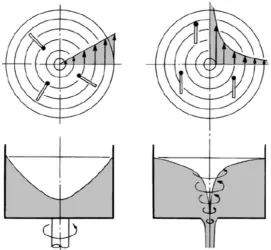
• rigid-body or rotational vortex: the fluid rotates like a rigid body, with uniform angular velocity. The velocity increases linearly with the distance from the vortex line and vorticity is finite:
~
̟ =~∇ ×~v=~∇ ×(~Ω×~r) =2~Ω. (1.23)
Hence the local probe revolves around its center while orbiting around the vortex core with an angular velocity which is the half of vorticity and directed in the same way as the vortex spin;
• irrotational or free vortex: the velocity field is inversely propor-tional to the distance from the core, leading to a null vorticity:
~v =−αy r2,
αx r2, 0
⇒ ~Ω=0, 0, α
r2
Figure 1.2:Velocity field in the case of a rotational (left) and an irrotational (right) vortex. A local probe is depicted by the stick.
In the case of an irrotational vortex the circulation of the velocity field
Γ= H
d~r·~v(~r)is null when the integration contour does not enclose the vortex core because of the applicability of the Stokes’ theorem, while it has a fixed value for any contour which encloses the vortex core. At the vortex core the singularity of the velocity field forbids the application of Stokes’ theorem. In the classical framework a pure irro-tational vortex does not exist because of the finite viscosity of a real ordinary fluid; a realistic model for a free vortex is the Rankine vor-tex, where an irrotational pattern occurs outside the core of the vortex
while a rigid-body pattern describes the motion inside the core. Toward quantum vorticity
What makes quantum vorticity different from classical vorticity is the intrinsic irrotational nature of the superfluid flow (given the re-lation (1.13)), which is given by the total absence of fricton in a su-perluid flow. Another difference is given by the quantization of the velocity field around the vortex core, required by the topological prop-erties of the wavefunction of the system for describing vortices in the quantum picture. A word about topology to clarify its role is spent in the next paragraph.
classi-fied according to the relations between them: the key concept is the continuous mapping between two spaces. A continuous map is a transformation that transforms an object (topological space) into an-other “without cutting and pasting” it. In the case where such a trans-formation is possible between two objects, these are said to be homo-morphic, and the transformation is called homomorphism. A weaker relation is the homotopy, which is a continuous transformation per-mitting some “stretching” of the object: for example the letters “O” and “Q”, interpreted as topological objects for their shapes, are two not homomorphic topological spaces, but a homotopy between the two exists. Through homotopy topological spaces can be reduced to fundamental groups of the topology, which simply code the “number of holes” characterizing topological spaces belonging to a specific topol-ogy.
The concepts of topology find a large field of application in quan-tum mechanics: wavefunctions, being topological objects, can describe states differing in their topological charge (number of holes), giving access to exotic topological states. The role of topological phases of matter is now subject of numerous researches, culminating with the award of the2016Nobel prize for Physics to John Michael Kosterlitz, Duncan Haldane and David Thouless.
1.2.2.2 Vortices in BEC
A vortex in a Bose-Einstein Condensate is described by a solution of the Gross-Pitaevskii equation that carries angular momentum. To investigate the fundamental properties of a quantum vortex we con-sider for simplicity a homogeneous condensate and we treat the prob-lem in cylindrical coordinates (r⊥,ϕ,z), where z is the axis along which the vortex core lie. A wavefunction carrying angular momen-tum alongzhas to be eigenfunction of the equaton:
ˆ
LzΨ=hl¯ Ψ, (1.25)
where ˆLz = −i¯h∂/∂ϕ is the z projection of the angular momentum operator. A function which is general solution of equation (1.25) can be written in the form
Ψ(r⊥,ϕ,z) =ψ(r⊥,z)eilϕ, (1.26) where we considerΨin the Madelung form, thusψ(r⊥,z) =√n. The GP equation (1.3) for the wavefunctionψ(r⊥,z)becomes:
− ¯h
2
2m 1 r⊥
∂ ∂r⊥r
∂ψ ∂r⊥ +
¯ h2l2
2mr2⊥ψ+gψ
3−µψ=0, (1.27)
which can be rewritten in adimensional units introducing the nor-malized coordinate η= r⊥/ξ, where ξ is the healing length, and the adimensional function f(η)asψ=√n f(η):
1 η ∂ ∂ηη ∂f ∂η + 1− l2
η2
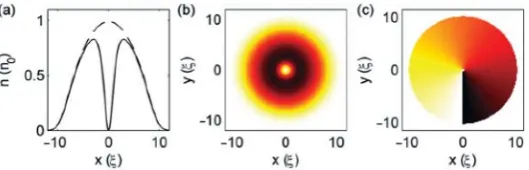
Figure 1.3:Density(a-b)and phase(c)profile of a vortex as calculated
inte-grating the2D Gross-Pitaevskii equation, from N. G. Parker et al.2007.
The solutions of equation (1.28) are non-analytic, but from their asymp-totic behaviour we reveal the importance of the quantum pressure term due to the density gradient:
f(η→∞)→1 ⇒ n=ψ2→nbulk (1.29) f(η→0)∼η|l| ⇒ n=ψ2 →0, (1.30) i.e., the density of the superfluid tends to zero approaching the vortex core, while it assumes a constant bulk values nbulk far away from the vortex. The length-scale that governs this behaviour is, as expected, the healing length. In figure 1.3 the density and phase profile of a
condensate with a vortex are shown. Vortex stability: topology, thermal instability, reconnection and Kelvin waves
Figure 1.4: Sketch of the reconnection process, from Fonda et al.2014.
The singularity of the wavefunction along the vortex core means that the vortex solution and the ground-state solution of the GPE are topologically distinct, being not connected by any homotopy. Such a property makes the vor-tex a stable structure because it is topologically protected: while a classical vortex can disappear everywhere in the fluid through thermal dissi-pation, a quantum vortex can be removed from a system only at its boundaries where density vanishes in confined systems. For example a vortex in a harmonically trapped system pre-cesses around the center of the trap scattering with thermal excitations due to finite tempera-ture. Such losses of energy make the vortex to drift radially toward the edges of the conden-sate.
and reconnections are responsible for the emission of sound waves in the condensate, dissipating in this way vortex energy.
Velocity field
The relation between the phase of the wavefunction and velocity (equation (1.13)), together to the wavefunction (1.26) gives the follow-ing components of the velocity field:
vr⊥ =0 (1.31)
vz =0 (1.32)
vϕ= ¯hl
mr⊥, (1.33)
which is the velocity pattern typical for irrotational vortices, singular atr⊥ = 0. The circulation Γis therefore zero for paths not including
the vortex line. Instead, if the circulating path includes a region which is not connected, the circulation takes a fixed value independently of the contour. Integrating along a circle of radius r⊥:
Γ =
I
C
~v·d~r=
Z 2π
0 r⊥vϕdϕ= l
2πh¯
m . (1.34)
Such a relation can be seen also in a more general fashion as the requirements of the single valueness of the wavefunction around the vortex: the integralδS = H
C~∇S·d~r is the phase increment in a loop around the vortex, hence δS = 2πl, wherelis an integer, for having a uniquely defined wavefunction at a given point. Recapitulating, the velocity field around the vortex is quantized, taking discrete values given by the integer multiples of the quantum of circulation h/m.
Analogies with
magnetostatics In the case of the homogeneous and stationary system, the
conti-nuity equation (1.14a) becomes simply∇ ·~ ~v=0. Then the equations for the superfluid velocity show a strict analogy with equations of magnetostatics:
~
∇ ·~B=0 ⇔ ~∇ ·~v=0 (1.35)
~
∇ ×~B= j
ǫ0c2δ (2)(~r
⊥)zˆ ⇔ ~∇ ×~v=lmh¯ δ(2)(~r⊥)zˆ, (1.36) where δ(2)(~r⊥) is the 2D delta function in the radial plane; thus the velocity field of a vortex has the same structure of the magnetic field produced by a current through a wire. This analogy is often used to simulate vortex dynamics in the mesoscopic scale.
Other descriptions
of superfluidity The description of superfluidity based on the Gross-Pitaevskii
equa-tion has a microscopic approach, which catches the mechanisms of vortex dynamics and vortex-vortex interaction (reconnection); its use is especially suited to atomic condensates because of their diluteness, while, in the case of strongly interacting systems like helium, its re-sults have only a qualitative relevance. The mean-field approach de-scribed here is valid at T = 0, or, in good approximation, at very low temperatures, Dalfovo et al. 1999. Generalizations to finite
the Zaremba-Nikuni-Griffin theory or the stochastic Gross-Pitaevskii Equation. For details about these theories I refer to N. P. Proukakis
2007. Exploiting the analogy pointed out by (1.36), vortex dynam-ics can be treated through the Schwarz approach (Schwarz1988):
ne-glecting the effects at the scale ofξ the vortex is approximated as an infinitesimally thick line which moves according to the self-induced velocity field calculated via the Biot-Savart law. This approach does not directly include the possibility of reconnection.
vortex energy and its orientation The energy of a vortex is dominated by the kinetic energy due to the superfluid flow~v= ¯h
m~∇S around its core (Cohen-Tannoudji et al. 2011). An estimation of this
energy can be given considering the vortex core as a straight line parallel to ˆzacross the condensate. The vortex position is identified by the vector~r0= (x0,y0)in the planexy. The kinetic energy associated to a vortex of topological charge lis:
EV(l)≈
Z
d3r1
2m n(~r,z)v2(l). (1.37) The dependence in the plane xy of the density in equation (1.37) is neglected because the diverging contribution of the velocity field in~r0 dominates the smooth variation of the density, which can be approxi-mated with its value at the vortex positionn(~r0,z). The problem has cylindrical symmetry along ˆz, hence d3r = dz dr rdϕ. Considering a uniform varying phase pattern around the core,S=arctanx−x0
y−y0 = ϕ,
the velocity term becomesv2= ¯h2l2
m2r2. Thus the integration ondϕgives simply a 2π, while on dz it gives the column density along ˆz at the core positionnz2D(x0,y0). The integral indrcan be calculated between
the core radius ξ and the extension of the sample R⊥ along the axis perpendicular to the vortex, and it gives a logarithmic correction of the energy value. Hence
EV(l)≈ π¯h
2l2
m n
z
2D(x0,y0)ln R⊥
ξ . (1.38)
Noticing that the column density is proportional to length of the vor-tex line Lwe get the important relation:
EV∝ L. (1.39)
Vortex orientation and System geometry
Given the behaviour (1.39), vortices tend to be the shortest as pos-sible to minimize the energy. Two cases are then pospos-sible:
• oblate or pancake systems, where the shortest axis is parallel to the symmetry axis of the sample;
2
P R O D U C T I O N A N D D E T E C T I O N
O F V O R T I C E S I N A B E C
c o n t e n t s
2.1 Geometry and Dimensionality 19
2.2 Production of Vortices 21
2.3 Vortex Detection 25
2.3.1 Resolution and Destructivity 28 2.3.2 Probing Matter Waves 28 2.4 Our System 31
In this chapter I will introduce the main techniques that may be used for generating and probing vortices in a Bose-Einstein conden-sate. The role of the geometry and dimensionality of the sample will be pointed out. Finally I will describe the main characteristics of the system considered in this thesis, highlighting its novel elements with respect to the more traditional approaches described during the chap-ter.
2.1
geometry and dimensionality
An important role in the studies of vorticity in BECs is played by the geometry and the dimensionality of the sample. A strictly 1D system cannot sustain vortex solutions: the only defect supported in this system is the soliton, which represents a phase disontinuity in the order parameter (phase kink)1. In 2D systems a vortex can ap-pear as a point-like singularity characterized by a 2π phase winding around it. If the system is infinite the absence of a long-range order, because of the algebraic decay of the coherence length, prevents the system from condensation. Such systems undergo to a transition be-tween a normal and a superfluid phase without the appearence of Bose-Einstein condensation. The different phase transition is called Berezinskii-Kosterlitz-Thouless transition. On the other hand, if the 2D system is finite, the setting of a condensed phase is permitted be-cause of the non neglibility of the coherence length given by the alge-braic behaviour. In a3D system the vortex has a filamentary structure: the singularity of the wavefunction happens along a line of vanishing density, around wich the phase winds up.
1 A compete review on solitons, vortices and related phenomena can be found in the
book by Kevrekidis et al.2007.
3D case
2D crossover
1D crossover
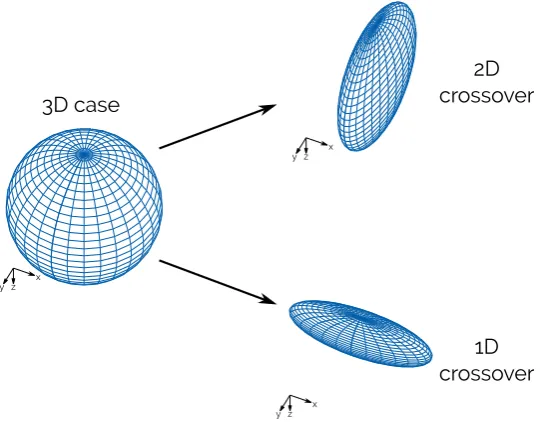
Figure 2.1:Sketch of the dimensional crossover from a spherical3D system toward2D and1D geometries.
Dimensionality
crossovers Dealing with phase defects it is useful to define the dimensionality
of a system through the relation between the sizes of the sample and the characteristic dimension of a defect in a BEC, i.e., the healing lengthξ. A dimension is actually frozen if the extension of the sample in that direction is less than the healing length. A system is fully3D if all its sizes are much larger than the healing length. The intermediate cases, where the system is not too large with respect the defect size, can be considered as sorts of dimensional crossovers, which can show peculiar properties in the dynamical behaviour of the defects. Three main regimes can be recognized:
• 3D →2D regime: the trap frequencies have the hierarchy ωx > ωy =ωz ≡ω⊥, and the sample has anoblate(pancake) shape;
• 3D →1D regime: the trap frequencies have the hierarchy ωx < ωy =ωz ≡ω⊥, and the sample has aprolate(cigar) shape;
• intermediate regime: the frequencies areωx <ωy <ωz.
as a 2D interaction between point-like particles, since all vortices are aligned. The intermediate case is characterized by an effective 2D vortex behaviour, because the alignement is favoured along the only
direction of maximum confinement. Effect of trap rotation
The case of a rotating system is also important, since many exper-iments deal with rotating traps to produce vortices. In the case of a trapping potential rotating with an angular velocity Ωaround the x
axis, the energy of the condensate in the rotating frame becomes:
E=E0−ΩLx, (2.1)
whereE0is the energy in the rest frame andLx is the projection along xof the angular momentum carried by the condensate. If no vortices are presentLx =0 and henceE=E0. This happens when the rotation
frequency of the trapping potential is below a critical value and hence the sample does not rotate, in accordance to the Landau criterion for the appearence of excitations in a superfluid. The presence of a vortex with topological charge l introduces an angular momentum Lx = lh¯ and energy EV(l) in the system. The energy is therefore E=E0+EV(l)−hl¯ Ω. The creation of a vortex is favorable in the case of rotations with a frequencyΩ> ΩC≈ EV(l)
l , in which condition the energy in the rotating frame is minimized. The minimization here occurs if vortices carry angular momentum along the rotation axis, hence a vortex state in a rotating system shows vorticity aligned along that axis, independently of the shape of the sample.
2.2
production of vortices
Many techniques for the production of vortices have been devel-oped since the first pioneering experiment by Matthews et al. 1999.
We can characterize such techniques according to the number of vor-tices they are able to generate, and to thedeterministicorstochastic na-ture of the method, i.e., the possibility to generate in a reproducible
manner a given vortex configuration. Vortex number
Some techniques can be used to produce states with a single vortex, useful to probe the structure of a vortex and its dynamical behaviour from a “single-particle” point of view. Other techniques permit in-stead to probe the physics of few-vortex systems, hence studying the effects due to the simultaneous presence of two or three vortices, also with different signs. Finally systems with many vortices (up to hun-dreds) can be produced, where the mechanisms of the interactions can lead to the formation of an ordered phase, a vortex lattice, or of
the chaotic phase called turbulence. Deterministic and stochastic vortex production
gener-(a)
(b)
Figure 2.2: (a) Putting a condensate into rotation, from Chevy 2007. (b)
Vortex lattice, from Abo-Shaeer et al.2001.
ated obtaining always the same dynamical state within different ex-perimental runs, its study can be carried on with a standard destruc-tive imaging technique and repeating the experiment in the same con-ditions. For studying stochastically generated vortices, instead, real-time barely-destructive techniques have to be implemented, because each experimental run produces a different vortex state.
stirring and rotation The most straightforward method for cre-ating vortices in a BEC consists in putting the superfluid in rotation through mechanical stirring of the sample. This approach is imple-mented by introducing a transverse asymmetry in the confinement of an axisymmetric sample, and then varying in time such an anisotropy to set an effective rotation of the trapping potential. This method can be applied to oblate systems rotating around the tight-confinement axis or to prolate ones rotating around the axis of shallower con-finement. The first realization of such a scheme was implemented by Madison et al. 2000, where a cigar-shaped condensate in a
mag-netic trap was perturbed by two far detuned optical beams coprop-agating along the axis of the sample and rotataing around it (see figure 2.2 (a)). The beams introduce a slight modification of the ra-dial confinement in the plane defined by the beams. The rotational motion of such a distortion puts the superfluid in rotation during the evaporation. When a critical angular velocity is reached, the energy of the final superfluid can be minimized through the formation of vor-tices. Increasing the rotation frequency, more and more vortices are nucleated, permitting to create from one-vortex state, just above the critical rotation, to many-vortex states. Such a method is extensively used for generating vortex lattices (Abo-Shaeer et al.2001; Haljan et
al. 2001), represented in figure 2.2 (b). In the experiment by Hodby, Hechenblaikner, et al.2001, the rotating anisotropy was implemented
A variation on the technique was implemented by Engels, Cod-dington, Haljan, Schweikhard, et al.2003for the observation of giant
vortices. They impart angular momentum to a thermal sample via a sudden change of the ellipticity of a magnetic trap, remove then the radial anisotropy and evaporate the system to reach condensa-tion. The final condensate keeps the rotation imparted to the thermal sample, thus vortices appear in it.
Another way to stir a condensate and favour the formation of vor-tices was implemented by Inouye et al.2001, where vortices are
gener-ated by the passage of a tightly focused far-blue-detuned laser beam across the condensate. A refined implementation of such a stirring process was given by Neely et al. 2010, where they show the
deter-ministic creation of a pair of vortex and antivortex. Such a technique was used to probe2D turbulence in BECs by Kwon, Moon, et al.2014,
and to generate von Kármán vortex street in an oblate superfluid by Kwon, J. H. Kim, et al.2016.
Vortices can be created also in annular condensates moving an op-tical barrier along the ring, as realized by Wright et al.2013. The
mo-tion of the barrier along the ring can generate persistent quantized currents, depending on its angular frequency. When the angular fre-quency becomes large, the formation of vortices in the annulus is favoured, beside the setting of the persistent current.
phase imprinting Another method for producing vortices in BECs consists in imprinting a phase pattern on the wavefunction. A phase can be imprinted on a sample in a magnetic trap varying slowly the bias magnetic field to rotate the local direction of the spins2. Atoms
follow adiabatically the rotating magnetic field, acquiring a space-dependent quantum phase in the form of a Berry phase, due to the inhomogeneous trapping field experienced during the adiabatic ro-tation. The acquired phase leads to the formation of a single-vortex state, whose sign depends on the sign of the internal state mF. This scheme was realized by Leanhardt et al. 2002. They also show the
ap-plicability of such a technique for producing vortices with multiple quanta of circulation.
Another scheme to imprint a wrapping phase in the BEC wavefunc-tion was implemented by Andersen et al. 2006. This scheme uses a
two-photon Raman process stimulated by two laser beams, where one of the two has a gaussian profile, while the other shows a Laguerre-Gauss profile. A Laguerre-Laguerre-Gauss beam carries angular momentum, which is transferred to the sample in the Raman process. With this technique single vortices with arbitrary winding number can be im-printed in a deterministic way.
2 A bias magnetic field is usually applied to suppress Majorana losses in the region of
Vortices can be created also through the decay of dark solitons. Dark solitons are unstable in systems with more than one dimen-sion since they undergo snake instability and decay to vortex states. Vortices can then be created imprinting a dark soliton in a3D system (Denschlag et al.2000) and waiting for its decay (B. P. Anderson,
Hal-jan, Regal, et al. 2001). A dark soliton can be imprinted by means of
a sharp-edge far-detuned laser beam illuminating only a part of the condensate. The two parts acquire a differential phase, whose magni-tude is related to the intensity and to the duration of the illumination of the condensate. If the imprinting is well controlled, the products of the decay show a reproducible dynamics, as shown in a fermionic superfluid by Ku, Ji, et al.2014.
merging of different condensates A phase defect can be cre-ated when merging different independent BECs, each with a well defined uniform phase. The condensation appears by means of a sec-ond order classical phase transition. The role of the order parameter is played by the BEC wavefunction, which is a complex scalar field. Thus, the crossing of the transition spontaneously break the U(1) symmetry on the phase of the wavefunction. Independent samples pick up different random phases when they cross the BEC transition. By putting in contact such different systems, one creates a unique condensate with a patchworked phase. If two condensates are put to-gether, a phase jump in the junction produces a dark soliton. When three or more condensates meet in a common point and their phases change with monotonic jumps from a condensate to the following when moving around that point, a vortex can appear. Such an ap-proach was demonstrated by Scherer et al. 2007, producing three
in-dependent condensates in a triple-well trap and then removing the barriers between the samples.
A similar approach was also used by Schweikhard et al. 2007 to
study the vortex proliferation in the Berezinskii-Kosterlitz-Thouless phase. In this case an initial condensate is loaded into a 2D optical lattice and tunneling between adjacent sites is then suppressed. In this way, thermally activated phase fluctuations between condensates in each well are enhanced. Switching off the optical lattice, all the condensates merge and the site-to-site phase fluctuations can lead to vortex production. Thermally activated vortices were studied also by Choi et al. 2013in the crossover between the BKT phase and the
BEC phase in a finite2D system.
kibble-zurek mechanism A mechanism similar to the merging of multiple BECs occurs in the Kibble-Zurek mechanism (Kibble 1976;
Zurek 1985). It consists in the spontaneous formation of defects in
Figure 2.3:Schematic representation of the Kibble-Zurek effect.
defects is due to the independent nucleation of the ordered phase in regions that are causally disconnected, and hence each part of the system breaks the symmetry independently of the others. When the condensates grow, phase defects can appear between their boundaries and, for the same reason reported in the previous paragraph, vortices or solitons can be formed. The nature of the stable defects depends on the dimensionality of the system, and the number of defects created depends on the quench time across the transition through a power law:
Ndef ∝τQ−α, (2.2)
where α depends on the system and defect dimensionality and on the critical exponents of the phase transition. A pictorial represen-tation of the KZM is reported in figure 2.3. Such a mechanism was studied for the first time in BECs by Weiler et al. 2008. Then the KZ
mechanism was used by Freilich et al. 2010 to study single vortex
and vortex dipole precession through real-time imaging (more on this topic will be given in the following chapters). A refined characteriza-tion of the Kibble-Zurek mechani