ISSN: 2349-7300
ISO 9001:2008 Certified
International Journal of Innovative Research in Engineering & Multidisciplinary Physical Sciences (IJIRMPS)
Volume 1, Issue 2, December 2013
23
Frequent Document Mining Approach through
Clustering
R K Soni
Abstract-Now days, finding the association rule from large number of item-set become very popular issue in the field of data mining. To determine the association rule researchers implemented a lot of algorithms and techniques. FP-Growth is a very fast algorithm for finding frequent item-set. This paper, give us a new idea in this field. It replaces the role of frequent item-set to frequent sub graph discovery. It uses the processing of datasets and describes modified FP-algorithm for sub-graph discovery. The document clustering is required for this work. It can use self-similarity function between pair of document graph that similarity can use for clustering with the help of affinity propagation and efficiency of algorithm can be measure by F-measure function.
Keywords: clustering, document-graph, FP-growth, graph mining, frequent sub graphs clustering.
I. INTRODUCTION
Data mining techniques is used to extracting information from that data. Many researchers developed a lot of algorithm and techniques for finding useful information in the database. Frequent item-set mining is a core data mining operation and has been extensively studied over last decade. It plays an essential role in many important data mining tasks. Algorithms for frequent item-set mining form the basis for algorithms for a number of other mining problems, including association rule mining, correlations mining, and mining sequential and emerging patterns. Association rule mining technique is very effective data mining technique to finding the useful hidden information in the data, its aim to extract correlation, frequent pattern, association by transaction database or other data repository. This rules generated by datasets and it derives by measurement of support and confidence of every role, which define the frequency of that role. Association rule is a rule which is depends on the association relationship of objects and items. For example data item interrelation ship which is occurs simultaneous with other data items. This rule is calculated by data and association calculated with the help of probability. Share market and recommended system etc. are its practical applications.
To concept of document based clustering, association rule mining is very effective algorithm and useful approach. It utilizes that FP-Growth approach discovers frequent patterns and modified it to frequent sub graph discovery. Originally this algorithm is design to frequent item-set mine in market basket analysis. In this paper, analyse FP-Growth approach to document clustering. For graph mining, change in FP-Growth algorithm which discover frequent connected graph and perform better for thick connected graph. This Paper consists of five main sections. The second section describes the Basic Theory of this work. The frame work of this approach is describes in third section, Experimental Result analysis is forth section and finally section five is devoted to conclusion and future work.
II. BASIC THEORY
The association rule mining [2] approaches were established to determine frequent item-sets in market basket datasets [4].The two most common approaches to association rule mining are Frequent Pattern growth (FP-growth) [3]and apriori [5].The apriori algorithm uses prior information of frequent item-sets to produce the candidates for larger frequent item-sets. It relies on interactions between item-sets and subsets. If an item-set is frequent, then all of its subsets must also be frequent. But generating candidates and checking their support at each level of iteration can become expensive. FP-growth introduces a different approach here. Instead of generating the candidates, it compresses the database into a compact tree form, known as the FP-tree, and extracts the frequent patterns by traversing the tree.
ISSN: 2349-7300
ISO 9001:2008 Certified
International Journal of Innovative Research in Engineering & Multidisciplinary Physical Sciences (IJIRMPS)
Volume 1, Issue 2, December 2013
24
document clustering using FP-growth. Since in this system the documents are represented by graphs, made the necessary changes to the FP-growth algorithm so that instead of generating frequent item-sets it can generate frequent sub graphs.
III. FRAME WORK OF APPROACH
Our overall method is briefly portrayed in this section. The system is divided into four major parts: Document Pre-processing, FP-Growth approach, Document clustering and Similarity Measures. Detailed mechanisms are described in the following subsections.
A. Document Pre-processing
The work use stemming to repossess the relationship between the keywords of a document. In stemming, words are related to each other based on different semantic relationships among them. This Paper use the relation of keywords, which is a super-ordinate or IS-A (“a kind of”) relationship. This work believes that, for sense-based document clustering, this relation is more suitable than the others because it provides the generalization of a concept or a word. It builds a document-graph by traversing the hierarchy of the keywords up to Entity. Once there have all of the document-graphs, create a Master Document Graph (MDGph) [11] based on the traversal of all of the keywords up to the topmost level.
Now use the MDGph for a number of reasons. Instead of taking the entirety of Words as the background knowledge. UseMDGph that contains the ontology related to the keywords only. This allows us to focus on the area of the Words which is applicable to our dataset. Another purpose why use the MDGph is that it can facilitate the use of the DFS codes. The code is produced by traversing the MDGph in Depth First Search (DFS) order. This gives us the DFS traversal order (DFS code) for the entire MDGph. The DFS codes of the edges of the MDGph are applied to the edges of the document-graphs. Thus, the DFS codes of the edges of the MDGph help us to mark each edge of the document-graphs in a DFS order specific manner. Therefore, the same sub graph acting in two document-graphs can be identified by the DFS codes of the edges of that subgraph.Additionally, the MDGphhelps in testing the connectivity between nodes during the sub graph discovery process. The graph representation of the documents to a table consisting of the list of edges appearing in each document. This helps us to fit the frequent sub graph discovery task to the frequent item-set discovery problem of the market basket data analysis. Each edge of a document-graph is considered to be an item of a transaction, a sub graph is considered to be an item-set and each document is considered to be a transaction.
B. FP-growth Approach for Frequent Sub graph Discovery
The original FP-growth algorithm, when applied to our problem generates a set of frequent edges which do not necessarily constitute to a connected sub graph. Generation of all possible frequent patterns not only outputs all possible frequent sub graphs but also generates a lot of overhead in the form of all possible sets of frequent, but disconnected, edges. This causes unnecessary costs during the mining of the document-graphs as only looking for frequent sub graphs and these sets of frequent disconnected edges tolerate no useful information for the document clustering. The time and space required to generate and store these disconnected frequent edges have negative impact on the overall performance of the FP-growth approach. To overcome these problems it restricts the discovery of frequent item-sets in the FP-growth approach. Instead of discovering all possible frequent combination of edges we only discover the frequent edges that founds to a graph. We also control the maximum size of the frequent sub graph by the SP Threshold value.
ISSN: 2349-7300
ISO 9001:2008 Certified
International Journal of Innovative Research in Engineering & Multidisciplinary Physical Sciences (IJIRMPS)
Volume 1, Issue 2, December 2013
25
header table. After this refinement, create the tree by calling the FPTreeConstructor () method. Later, FP-Mining () generates the frequent sub graphs by traversing the FP-tree.
In the original FP-growth approach a node from an FP-tree indicates an item. In that case, a node of the FP-tree contains the DFS-code of an edge. If the original FP-growth approach is directly used in graph-mining, it does not guarantee the connectivity property of a subgraph. It can generate a disconnected set of edges in a representation of a frequent subgraph. The difference between the original FP-growth approach and our modified approach is that the system crops the single paths of the FP-tree and maintains connectivity of edges for discovering frequent sub graphs.
If at any point, a single-path is encountered in the FP-tree, we crop nodes from the top of the single path based on the user-provided threshold SPThreshold. Removing a node from the single path refers to eliminating the corresponding edge denoted by that node. SP Threshold provides control to the number of combinations of edges appearing in a single path. Depending on the connectivity of the edges, a combination of the edges may or may not generate a frequent sub graph. Let b be a sub graph for which a single path is generated by traversing the branches of the FP-tree ending with b. this say that the discovery of the newly joint frequent sub graphs is conditional on the frequent sub graph b .The supports of these new sub graphs are determined by the support of b before the merging.
The depth of the MDGph can reach up to 18 levels, which is the maximum height of the hierarchy of Words. Since our document-graphs contain hundreds of edges, the depth of the FP- tree can reach up to hundreds of levels depending on the number of edges in a document-graph. Conventional FP-growth generates all possible subsets of a single path for every edge-conditional FP-tree. Instead of accepting all possible combinations of a single path it only keeps the combinations of edges that generate connected frequent sub graphs. Whenever a single path is encountered in the FP-tree (or recursively generated conditional FP-trees), each of its combinations is generated and checked to make sure that it follows the connectivity constraint. This is done by first taking one of the edges from the combination of the single path and then adding it to a list called connected List . In the Iterate () method, a neighbouring edge list, neighborListi is created for an edge i using the MDGph. The neighborListi is checked to see if it contains any edge from the combination of the conditional FP-tree’s single path. If there are such edges it followed the same procedure for all of them until no new edges from the combination of the single path are added to the connected List. At the end, the size of the connected List is compared with the size of the combination. If both of their sizes are the same, then the whole combination must be connected generating a subgraph a. Then an attempt is made by step 6 through 9 to combine the subgraph b with subgraph a. The method is Connected () returns true if a and b can be merged together to generate a connected subgraph. It should be noted that connected method checks for the connectivity of one combination at a time. If the edges under consideration of this combination do not compose a connected subgraph, but compose multiple disconnected sub graphs, then some other combinations of the single path will generate these smaller connected sub graphs. So, do not lose disjoint but smaller connected sub graphs of a larger disconnected combination of the single path.
Additionally, control the single path length by using SP Threshold so that our FP-growth approach performs faster. The length of the single path can be as large as the number of all the edges appearing in a document-graph. Taking each combination of a large single path and checking the connectivity constraints is computationally intensive. The construction of the FP-tree forces the edges with higher frequencies to appear at the top of the FP-tree. So, it is more likely that nodes at the top levels of the FP-tree indicate edges at more abstract levels of the MDGph. After observing that a higher abstraction level of the MDGph does not provide enough information for reliable clustering, we restricted the generation of combination of a single path of the FP-tree to a certain length.(SPThreshold) When he mines the FP-tree, he starts from the edges appearing the least in the pruned header table. Thus, if he reaches a single path of length greater than SPThreshold, he prunes the upper part of the single path above the threshold and generates each combination of the lower part only. This mechanism prunes nodes of single paths of the FP-tree at the upper levels which are representative of top level edges of the MDGph.
C. Document Clustering
ISSN: 2349-7300
ISO 9001:2008 Certified
International Journal of Innovative Research in Engineering & Multidisciplinary Physical Sciences (IJIRMPS)
Volume 1, Issue 2, December 2013
26
sense-based clustering of the text documents. He uses Hierarchical Agglomerative Clustering (HAC) [12] for the clustering phase of that work. Now it implements the Group Average method to cluster the documents where the distance between two clusters is defined by the average distance between points in both clusters.
A number of similarity measures exist that can be used to find the closest or most distant pair of documents to merge during HAC. Among them, the cosine measure [13] is the most frequently used one. It penalizes less in cases where the number of frequent sub graphs on each document differs significantly. Since the cosine measure focuses more on the components in the documents and is not influenced by the document length, it has been used widely in document clustering.
D. Similarity Measures
In this work chose this measure to compute the similarity between two document-graphs (DG1 and DG2) based on the frequent sub graphs (FS) appearing in them:
To cluster the documents use a dissimilarity matrix which stores the dissimilarity between every pair of document-graphs using the formula, dissimilarity = 1– similarity. The value of dissimilarity can range from 0 to 1. It can use self-similarity in work in place of similarity function this self-similarity can be define as K-means algorithm adopts the widely used similarity measurement Cosine coefficient, namely equation [1].Because k-means needs to compute on the vector space model, for X = (x1,…, xn) and Y = (y1, …, yn), the component form of their similarity measurement can be expressed as:
Where n is the number of the features in the whole vector space. Similar with k-means, AP (CC) and SAP (CC) also use Cosine coefficient (equation (2)) as the similarity between two documents. However, unlike k-means, a document in AP (CC) and SAP (CC) does not need to be represented into the whole vector space, but only into its own vector space. Therefore the similarity measurement computation complexity of the latter two algorithms is reduced greatly in respect to the one of k-means. The self-similarities of AP (CC) are defined as:
Where is an adjustable factor?
This similarity can be used for clustering with help of affinity propagation and efficiency of algorithm can be measured be F-Measure function using precision and recall value and Entropy function.
IV. EXPERIMENTAL RESULT ANALYSIS
A. Experimental Results of Modified FP Growth Approach
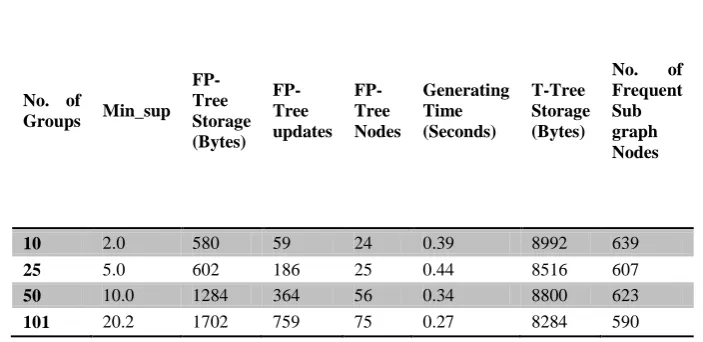
Table 1 contains some of our experimental results with the subset of 768 documents from 7 different groups of items. The avg. min_sup was kept 49.2 and we selected 568 items from the middle of the 768 documents to use them in our FP-growth approach.
Table 1- Parameters of Mining FP-Tree and Generate association rules.
No. of
Groups Min_sup FP-Tree Storage (Bytes)
FP-Tree updates
FP-Tree Nodes
Generating Time (Seconds)
T-Tree Storage (Bytes)
No. of Frequent Sub graph Nodes
10 2.0 580 59 24 0.39 8992 639
25 5.0 602 186 25 0.44 8516 607
50 10.0 1284 364 56 0.34 8800 623
ISSN: 2349-7300
ISO 9001:2008 Certified
International Journal of Innovative Research in Engineering & Multidisciplinary Physical Sciences (IJIRMPS)
Volume 1, Issue 2, December 2013
27
200 40.0 2516 1534 112 0.33 8816 629
568 113.6 3770 4473 169 0.3 8360 596
768 153.6 4386 6090 197 0.3 8460 604
The Table 1 shows the outputs of FP-Growth algorithm in which taken a combination of groups like 10, 25, 50, 101, 200, 568, 768, and so on. This table shows the variation of minimum support, FP-Tree Storage in bytes, FP-tree updates after pruning nodes in the header table, No. of FP-Tree Nodes, time for generating association rules in seconds, T-Tree storage in Bytes and last No. of frequent Sub graph Nodes. Here take an experimental result of table 1 and plot a graph of minimum support value of all the no. of groups which show the efficiency of minimum support of FP-Growth algorithm.
B. Experimental Results of Document Clustering
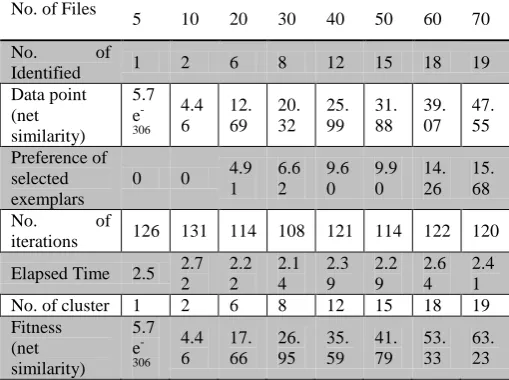
We used the frequent sub graphs find by the FP-growth approach in the earlier section to cluster the corresponding documents took dissimilar numbers of keywords from each dataset for the clustering. To examine the accuracy of our clustering, we analyse the results with the commonly used frequency-based clustering technique. Table 2 contains our experimental results of document clustering with affinity propagation for different documents. Here table shows 8 different data files clustering outputs of documents.
Table 2 - Parameters of document files generated in clustering.
Table 2 shows the overall parameters of document clustering which shows that when clustering method apply on the document file, the number of iteration and elapsed time in this method will be constant and overall process take average iteration for all clustering is 119.5 and average time is 2.41375 second for every clustering. Now consider result with respect to files and elapsed time, graph of elapsed time and documents is shown below.
No. of Files
5 10 20 30 40 50 60 70
No. of
Identified 1 2 6 8 12 15 18 19
Data point (net similarity) 5.7 e -306 4.4 6 12. 69 20. 32 25. 99 31. 88 39. 07 47. 55 Preference of selected exemplars
0 0 4.9
1 6.6 2 9.6 0 9.9 0 14. 26 15. 68
No. of
iterations 126 131 114 108 121 114 122 120
Elapsed Time 2.5 2.7
2 2.2 2 2.1 4 2.3 9 2.2 9 2.6 4 2.4 1
No. of cluster 1 2 6 8 12 15 18 19
ISSN: 2349-7300
ISO 9001:2008 Certified
International Journal of Innovative Research in Engineering & Multidisciplinary Physical Sciences (IJIRMPS)
Volume 1, Issue 2, December 2013
28
00.5 1 1.5 2 2.5 3
0 10 20 30 40 50 60 70
Elapse
d
T
im
e(Sec
onds)
No. of files
Fig 1 - Elapsed time in second for documents in clustering.
Now consider result with respect to files and no of iteration, graph of no. of iteration and document files is shown below.
100 105 110 115 120 125 130 135
0 10 20 30 40 50 60 70
No.
of
it
era
ti
ons
No. of files
Fig 2 - No. of iterations for documents in clustering
For the number of documents, if we raise the number of keywords, the MDGph has the affinity to contain more edges. More keywords better illuminate the concept of the documents. In such case, the edges in the mid-level of the MDGph will have more relations between them. As a result, more sub graphs will appear in the middle of the MDGph. So, our methodology has the affinity to take the advantage of attachment of keywords by determining more sub graphs and using them in the clustering. It requires inclusion of thousands of keywords for better clustering.
V. CONCLUSION
ISSN: 2349-7300
ISO 9001:2008 Certified
International Journal of Innovative Research in Engineering & Multidisciplinary Physical Sciences (IJIRMPS)
Volume 1, Issue 2, December 2013
29
REFERENCES
[1] Renchu Gaun, XiaohuShi, Maurizio Marchese, Chen yang and Yanchun Liang, “Text Clustering with seeds Affinity Propagation” European Commission under grant No. 155776-EM-1-2009-1-IT-ERAMUNDUS-ECW-L12, 2009.
[2] ABM Rezbaul Islam, Tae-Sun Chung, “an improved frequent pattern tree based association rule mining tree”, IEEE, 2011.
[3] Jiawei Han, Jian Pei, and Yiwen Yin, “Mining Frequent Patterns without Candidate Generation”, SIGMOD Paper ID: 196, 2000.
[4] Han, J., and Kamber, M., “Data Mining: Concepts and Techniques”, 2nd edition, ISBN, 2006.
[5] Agrawal, R. and Srikant, R., “Fast Algorithms for Mining AssociationRules”,Proc.ofthe20th Int'l Conference on Very Large Databases, Santiago, Chile, pp.487-499, (September 1994).
[6] Monika Akbar, Rafal A. Angryk, “Frequent Pattern-Growth Approach for Document Organization”, Napa Valley, California, USA, 2008.
[7] Kuramochi, M., and Karypis, G., “An efficient algorithm for discovering frequent sub graphs”, IEEE Trans. on KDE, pp.1038-1051, 16, 9 (2004).
[8] Yan, X., and Han, J., “gSpan, Graph–Based Substructure Pattern Mining”, Proc. IEEE Int’l Conf. on Data Mining ICDM, Maebashi City, Japan, pp.721–723, (November 2002).
[9] Cohen, M., and Gudes, E., “Diagonally sub graphs pattern mining”, Workshop on Research Issues on Data Mining and Knowledge Discovery proceedings, pp.51–58, (2004).
[10]Ketkar, N., Holder, L., Cook, D., Shah, R., and Coble, J. “Subdue: Compression-based Frequent Pattern Discovery in Graph Data”, ACM KDD Workshop on Open-Source Data Mining, pp.71-76, (August 2005).
[11]http://www.wordnet.princeton.edu.
[12]Hossain, M. S., and Angryk, R. A., “GDClust: A Graph-Based Document Clustering Technique”, IEEE ICDM Workshop on Mining Graphs and Complex Structures, USA, pp.417-422, (2007).
[13]Xiaojin Zhu, [email protected], “Clustering”, CS769 Spring Advanced Natural Language Processing, 2010.