IMPROVING ATM SECURITY CHECKS USING NEURAL
NETWORK
IGWE, AGU FELIX
ABIA STATE POLYTECHNIC, ABA,ABIA STATE,NIGERIA
EKE,JAMES
ENUGU STATE UNIVERSITY OF SCIEN. AND TECHNOLOGY,ENUGU,ENUGU
STATE ,NIGERIA
1.
INTRODUCTION
Security, as it relates to ATMs and credit card, has several dimensions. ATMs also provide a practical demonstration of a number of security systems and concepts operating together and how various security concerns are dealt with.
There have also been a number of incidents of fraud by Man-in-the-middle attacks, where criminals have attached fake keypads or card readers to existing machines. These have then been used to record customers' Pins and bank card information in order to gain unauthorized access to their accounts. Various ATM manufacturers have put in place counter measures to protect the equipment they manufacture from these threats.
Alternate methods to verify cardholder identities have been tested and deployed in some countries, such as finger and palm vein patterns iris, and facial recognition technologies. However, recently, cheaper mass production equipment has been developed and is being installed in machines globally that detect the presence of foreign objects on the front of ATMs, current tests have shown 99% detection success for all types of skimming devices. ATMs that are exposed to the outside must be vandal and weather resistant openings on the customer-side of ATMs are often covered by mechanical shutters to prevent tampering with the mechanisms when they are not in use. Alarm sensors are placed inside the ATM and in ATM servicing areas to alert their operators when doors have been opened by unauthorized personnel.
Rules are usually set by the government or ATM operating body that dictate what happens when integrity systems fail. Depending on the jurisdiction, a bank may or may not be liable when an attempt is made to dispense a customer's money from an ATM and the money either gets outside of the ATM's vault, or was exposed in a non-secure fashion, or they are unable to determine the state of the money after a failed transaction. Bank customers often complain that banks have made it difficult to recover money lost in this way, but this is often complicated by the bank's own internal policies regarding suspicious activities typical of the criminal element.
Dunbar Armored ATM Techs watching over ATMs that have been installed in a van
Abstract:
This paper exposes how neural network helps in improving ATM security checks .This was achieved by training the network to recognize patterns. When bank account is opened, the data are collected and stored in the system’s database. When any withdrawal is to be made, the customer sends data to the neural network, it processes the data in order to ascertain whether customer is the rightful owner or not. This was achieved by comparing the data generated from the customer with that of database, if it matches with the one stored in the database, access is granted to the customer, if it does not match, access is denied from the customer.In some countries, multiple security cameras and security guards are a common feature.In the United States, The New York State Comptroller's Office has criticized the New York State Department of Banking for not following through on safety inspections of ATMs in high crime areas.
Critics of ATM operators assert that the issue of customer security appears to have been abandoned by the banking industry it has been suggested that efforts are now more concentrated on deterrent legislation than on solving the problem of forced withdrawals.
At least as far back as July 30, 1986, critics of the industry have called for the adoption of an emergency PIN system for ATMs, where the user is able to send a silent alarm in response to a threat. Legislative efforts to require an emergency PIN system have appeared in Illinois, Kansas and Georgia, but none have succeeded as of yet. In January 2009, Senate Bill 1355 was proposed in the Illinois Senate that revisits the issue of the reverse emergency PIN system. The bill is again resisted by the banking lobby and supported by the police.
In 1998 three towns outside of Cleveland Ohio, in response to an ATM crime wave, adopted ATM Consumer Security Legislation requiring that a 9-1-1 switch be installed at all outside ATMs within their jurisdiction. Since the passing of these laws 11 years ago, there have been no repeat crimes. In the wake of an ATM Murder in Sharon Hill, Pennsylvania, The City Council of Sharon Hill passed an ATM Consumer Security Bill as well, with the same result. As of July 2009, ATM Consumer Security Legislation is currently pending in New York, New Jersey, and Washington D.C.
In China, many efforts to promote security have been made. On-premises ATMs are often located inside the bank's lobby which may be accessible 24 hours a day. These lobbies have extensive CCTV coverage, an emergency telephone and a security guard on the premises. Bank lobbies that aren't guarded 24 hours a day may also have secure doors that can only be opened from outside by swiping your bank card against a wall-mounted scanner, allowing the bank to identify who enters the building. Most ATMs will also display on-screen safety warnings and may also be fitted with convex mirrors above the display allowing the user to see what is happening behind them.
2.
HISTORY OF ATM
The idea of self-service in retail banking developed through independent and simultaneous efforts in Japan, Sweden, the United States and the United Kingdom. In the USA, Luther George Simjian has been credited with developing and building the first cash dispenser machine. There is strong evidence to suggest that Simjian worked on this device before 1959 while his 132nd patent (US3079603) was first filed on 30 June 1960 (and granted 26 February 1963). The rollout of this machine, called Bankograph, was delayed a couple of years. This was due in part to Simjian's Reflectone Electronics Inc. being acquired by Universal Match Corporation. An experimental Bankograph was installed in New York City in 1961 by the City Bank of New York, but removed after 6 months due to the lack of customer acceptance. The Bankograph was an automated envelope deposit machine (accepting coins, cash and cheques) and it did not have cash dispensing features. The Bankograph, however, embodied the preoccupation by US banks in finding alternative means to capture core deposits, while the concern of European and Asian banks was cash distribution.
A first cash dispensing device was used in Tokyo in 1966. Although little is known of this first device, it seems to have been activated with a credit card rather than accessing current account balances. This technology had no immediate consequence in the international market.
Other engineers at De La Rue Instruments contributed to the design and development of Shepherd-Barron's machine. The Barclays-De La Rue machine (called De La Rue Automatic Cash System or DACS) beat the Swedish saving banks' and a company called Metior's (a device called Bankomat) by nine days and Westminster Bank’s-Smith Industries-Chubb system (called Chubb MD2) by a month. The collaboration of a small start-up called Speytec and Midland Bank developed a third machine which was marketed after 2002 in Europe and the USA by the Burroughs Corporation. The patent for this device (GB1329964) was filed [2].
Both the DACS and MD2 accepted only a single-use token or voucher which was retained by the machine while the Speytec worked with a card with a magnetic stripe at the back. Hence all this these worked on various principles including Carbon-14 and low-coercivity magnetism in order to make fraud more difficult. The idea of a PIN stored on the card was developed by a British engineer working in the MD2 named Richard (1987) (patent GB1197183 filed on 2 May 1966 with Anthony Davies). The essence of this system was that is it enabled the verification of the customer with the debited account without human intervention. This patent is also the earliest instance of a complete “currency dispenser system” in the patent record. This patent was filled on 5 March 1968 in the USA (US 3543904) and granted on 1 December 1970. It had a profound influence on the industry as a whole. Not only did future entrants into the cash dispenser market such as NCR Corporation and IBM licence Goodfellow’s PIN system, but a number of later patents references this patent as “Prior Art Device”.
After looking first hand at the experiences in Europe, in 1968 the networked ATM was pioneered in the US, in Dallas, Texas, Klimasauskas(1989), who was a department head at an automated baggage-handling company called Docutel. On September 2, 1969, Chemical Bank installed the first ATM in the U.S. at its branch in Rockville Centre, New York. The first ATMs were designed to dispense a fixed amount of cash when a user inserted a specially coded card. A Chemical Bank advertisement boasted "On Sept. 2 our bank will open at 9:00 and never close again." Chemicals' ATM, initially known as a Docuteller was designed and his company Docutel. Chemical executives were initially hesitant about the electronic banking transition given the high cost of the early machines. Additionally, executives were concerned that customers would resist having machines handling their money. In 2002, the Smithsonian National Museum of American History recognized Marshal(2002) as the inventors of the networked ATM. ATMs first came into use in December 1972 in the UK; the IBM 2984 was designed at the request of Lloyds Bank. The 2984 CIT (Cash Issuing Terminal) was the first true Cashpoint, similar in function to today's machines; Cashpoint is still a registered trademark of Lloyds TSB in the UK. All were online and issued a variable amount which was immediately deducted from the account. A small number of 2984s were supplied to a US bank. Notable historical models of ATMs include the IBM 3624 and 473x series, Diebold 10xx and TABS 9000 series, and NCR 50xx series.Location
An ATM Encrypting PIN Pad (EPP) with German markings
ATMs are placed not only near or inside the premises of banks, but also in locations such as shopping centers/malls, airports, grocery stores, petrol/gas stations, restaurants, or any place large numbers of people may gather. These represent two types of ATM installations: on and off premise. On premise ATMs are typically more advanced, multi-function machines that complement an actual bank branch's capabilities and thus more expensive. Off premise machines are deployed by financial institutions and also ISOs (or Independent Sales Organizations) where there is usually just a straight need for cash, so they typically are the cheaper mono-function devices. In Canada, when an ATM is not operated by a financial institution it is known as a "White Label ATM".
In North America, banks often have drive-thru lanes providing access to ATMs.
Many ATMs have a sign above them indicating the name of the bank or organization owning the ATM, and possibly including the list of ATM networks to which that machine is connected. This type of sign is called a
topper.
What is a Neural Network?
The key element of this paradigm is the novel structure of the information processing system. It is composed of a large number of highly interconnected processing elements (neurones) working in unison to solve specific problems. ANNs, like people, learn by example. An ANN is configured for a specific application, such as pattern recognition or data classification, through a learning process. Learning in biological systems involves adjustments to the synaptic connections that exist between the neurones. This is true of ANNs as well.
2.1 The Biological Inspiration of Neural Network
Neural networks grew out of research in Artificial Intelligence; specifically, attempts to mimic the fault-tolerance and capacity to learn of biological neural systems by modeling the low-level structure of the brain [4]. The main branch of Artificial Intelligence research in the 1960s -1980s produced Expert Systems. These are based supon a high-level model of reasoning processes (specifically, the concept that our reasoning processes are built upon manipulation of symbol). It became rapidly apparent that these systems, although very useful in some domains, failed to capture certain key aspects of human intelligence. According to one line of speculation, this was due to their failure to mimic the underlying structure of the brain.
In order to reproduce intelligence, it would be necessary to build systems with a similar architecture.
The brain is principally composed of a very large number (circa 10,000,000,000) of neurons, massively interconnected (with an average of several thousand interconnects per neuron, although this varies enormously). Each neuron is a specialized cell which can propagate an electrochemical signal. The neuron has a branching input structure (the dendrites), a cell body, and a branching output structure (the axon). The axons of one cell connect to the dendrites of another via a synapse. When a neuron is activated, it fires an electrochemical signal along the axon. This signal crosses the synapses to other neurons, which may in turn fire. A neuron fires only if the total signal received at the cell body from the dendrites exceeds a certain level (the firing threshold).
The strength of the signal received by a neuron (and therefore its chances of firing) critically depends on the efficacy of the synapses. Each synapse actually contains a gap,
with neurotransmitter chemicals poised to transmit a signal across the gap. One of the most influential researchers into neurological systems (Donald Hebb) postulated that learning consisted principally in altering the "strength" of synaptic connections.
For example, in the classic Pavlovian conditioning experiment, where a bell is rung just before dinner is delivered to a dog, the dog rapidly learns to associate the ringing of a bell with the eating of food. The synaptic connections between the appropriate part of the auditory cortex and the salivation glands are strengthened, so that when the auditory cortex is stimulated by the sound of the bell the dog starts to salivate. Recent research in cognitive science, in particular in the area of nonconscious information processing, have further demonstrated the enormous capacity of the human mind to infer ("learn") simple input-output covariations from extremely complex stimuli [5].
Thus, from a very large number of extremely simple processing units (each performing a weighted sum of its inputs, and then firing a binary signal if the total input exceeds a certain level) the brain manages to perform extremely complex tasks. Of course, there is a great deal of complexity in the brain which has not been discussed here, but it is interesting that artificial neural networks can achieve some remarkable results using a model not much more complex than this.
2.2 The Basic Artificial Model
It receives a number of inputs (either from original data, or from the output of other neurons in the neural network). Each input comes via a connection that has a strength (or weight); these weights correspond to synaptic efficacy in a biological neuron. Each neuron also has a single threshold value. The weighted sum of the inputs is formed, and the threshold subtracted, to compose the activation of the neuron (also known as the post-synaptic potential, or PSP, of the neuron).
The activation signal is passed through an activation function (also known as a transfer function) to produce the output of the neuron.
If the step activation function is used (i.e., the neuron's output is 0 if the input is less than zero, and 1 if the input is greater than or equal to 0) then the neuron acts just like the biological neuron described earlier (subtracting the threshold from the weighted sum and comparing with zero is equivalent to comparing the weighted sum to the threshold).
Actually, the step function is rarely used in artificial neural networks, as will be discussed. Note also that weights can be negative, which implies that the synapse has an inhibitory rather than excitatory effect on the neuron: inhibitory neurons are found in the brain.
This describes an individual neuron. The next question is: how should neurons be connected together? I.f a network is to be of any use, there must be inputs (which carry the values of variables of interest in the outside world) and outputs (which form predictions, or control signals). Inputs and outputs correspond to sensory and motor nerves such as those coming from the eyes and leading to the hands. However, there also can be hidden neurons that play an internal role in the network. The input, hidden and output neurons need to be connected together.
The key issue here is feedback [6]. A simple network has a feedforward structure: signals flow from inputs, forwards through any hidden units, eventually reaching the output units. Such a structure has stable behavior. However, if the network is recurrent (contains connections back from later to earlier neurons) it can be unstable, and has very complex dynamics. Recurrent networks are very interesting to researchers in neural networks, but so far it is the feedforward structures that have proved most useful in solving real problems.
A typical feedforward network has neurons arranged in a distinct layered topology. The input layer is not really neural at all: these units simply serve to introduce the values of the input variables. The hidden and output layer neurons are each connected to all of the units in the preceding layer. Again, it is possible to define networks that are partially-connected to only some units in the preceding layer; however, for most applications fully-connected networks are better.
When the network is executed (used), the input variable values are placed in the input units, and then the hidden and output layer units are progressively executed. Each of them calculates its activation value by taking the weighted sum of the outputs of the units in the preceding layer, and subtracting the threshold. The activation value is passed through the activation function to produce the output of the neuron. When the entire network has been executed, the outputs of the output layer act as the output of the entire network.
2.3 Supervised Learning
Supervised learning, the network user assembles a set of training data. The training data contains examples of inputs together with the corresponding outputs, and the network learns to infer the relationship between the two. Training data is usually taken from historical records. In the above examples, this might include previous stock prices and DOW, NASDAQ, or FTSE indices, records of previous successful loan applicants, including questionnaires and a record of whether they defaulted or not, or sample robot positions and the correct reaction.
learned to model the (unknown) function that relates the input variables to the output variables, and can subsequently be used to make predictions where the output is not
3.0 METHOD OF TRAINING OF FEED FORWARD NEURAL NETWORK
Send input x ,x can be discrete or continuous value
X passes through synaptic weight w
The network multiplies x and w resulting to xw
The sum of xw is stored in s
S passes through output through the activation function F(S)
The activation function can be a step or threshold type that passes
Through logical 1
. If S > 0 or S<0 , A positive or negative bias can be introduced to alter
Threshold value
9. If the threshold is strong enough, it fires
The essence of the above method is to emulate how human brain works as shown in fig.3.1(b) to forestall fraud in ATM centres. The networks can be classified as feed-forward network which involves signal from neuron to neuron flow only in forward direction/
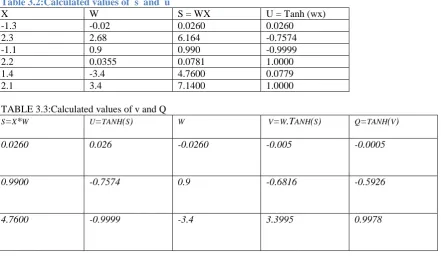
Table 3.2:Calculated values of s and u
X W S = WX U = Tanh (wx)
-1.3 -0.02 0.0260 0.0260
2.3 2.68 6.164 -0.7574
-1.1 0.9 0.990 -0.9999
2.2 0.0355 0.0781 1.0000
1.4 -3.4 4.7600 0.0779
2.1 3.4 7.1400 1.0000
TABLE 3.3:Calculated values of v and Q
S=X*W U=TANH(S) W V=W.TANH(S) Q=TANH(V) 0.0260 0.026 -0.0260 -0.005 -0.0005
0.9900 -0.7574 0.9 -0.6816 -0.5926
Fig.4.0:Graph x and v
4 .ANALYSIS OF DATA
The graph of fig.4.0 that the output v varies inversely with x at v=0 to 0.8 but saturates at -0.79.This means that the slope is zero and patterns can be recognized at point. The graph later moves v from -0.79 to -1 which means that y increases as input x increases
.At this point v varies linearly with x from v=-1 to 1 ,later v decreases from 1 to 0 as input x increases 1.75 to 2.25 and finally increases from 0.08 to1 as x increases 2.25 to 2.35.It should noted that at v=1 the slope is very high ,with this high slope it means the linear function approaches threshold function.
5.0
CONCLUSION
Neural networks have a lot of solutions to Atm problems . Their ability to learn by example makes them very flexible and powerful. Neural networks are also very well suited for real time systems because of their fast response and computational times which are due to their parallel architecture.
6.0
RECOMMENDATION
Having gone through rigourous research , the following are recommended:
1. That government should make enough fund available to other researchers who may be provoked to expand this scope.
2. There should be uninterruptible power for future researchers.
3. Every ATM that does not have these new features added in this researcher should be added with these new features.
-1.5 -1 -0.5 0 0.5 1 1.5 2 2.5
-1 -0.8 -0.6 -0.4 -0.2 0 0.2 0.4 0.6 0.8 1
x values
v
v
a
lu
e
s
REFERENCES
[1]. Aleksander, I: “An introduction to neural computing” 2nd edition, : National Laboratory: Pacific Northwest :2008 PP.34-45
[2]. Brain, Marshall Marshall:” Brain's More How Stuff Works”, John and Sons Ltd: New York.:2009 PP.23-27
[3]. Croall, I.F(:”Industrial Applications of Neural Networks”: John and Son:New York:2002 pp.8-10 [4]. Donley: “Fireside Books”: Simon & Schuster press: , New Jercey .2010 PP.63-67
[5]. Guile,U.S: Brian Managing Innovation Cases from the Services Industries, National Academy Press, Washington (D.C.) 2013 PP.23-25
[6]. Hammerstrom, D. . A Connectionist/Neural Networ ::Abc press: London 2011 PP.3-5