3(1), Spring 2011, Ser. 62/4
(Previously Journal of Social Sciences & Humanities)
METADISCOURSE STRATEGIES IN RESEARCH ARTICLES: A STUDY OF THE DIFFERENCES ACROSS
SUBSECTIONS
R. Abdi
Assistant Professor
Mohaghegh Ardabili University, Ardabil email: [email protected]
Abstract
The implicit rhetorical features of academic writing which has so far eluded a comprehensive systematic characterization have made teaching it a challenging task for a large group of practitioners in academic setting. One such feature of academic writing susceptible to cultural mentalities is metadiscourse marking, which is supposed to be one of the important rhetorical aspects in the writing process. Therefore, through analyzing interactive and interactional metadiscourse strategies use, this study makes an attempt to find out the normal metadiscursive distribution in the various cognitive-generic structures within the socio-genreic structure of research articles (RAs). For the purpose of this study, a small corpus of 54 research articles from social and natural sciences was selected for a close manual qualitative analysis. It appeared that, though globally similar in many ways, different IMRD sections (i.e. Introduction, Method, Results and Discussion) of RAs which follow different cognitive genre types (i.e. conviction, description, argumentation, etc.) use interactive and interactional strategies differently. The findings are analyzed and implications are drawn for the teachers and learners of writing research articles in English for Academic Purposes (EAP) classes. It is argued that without such characterizations the writers from different nationalities might generalize the norms of their own culture, which are in most cases inconsistent with the conventions of English language.
Keywords: research articles, metadiscourse, rhetorical structure, academic writing
1. Introduction
The disadvantage experienced by those who use English as a foreign language in writing for publication is well documented both in the fields of applied linguistics (e.g. Flowerdew, 1999; Kaplan & Baldauf, 2005; St. John, 1987) and science (e.g. Benfield & Feak, 2006; Benfield & Howard, 2000). Attributing part of such a disadvantage to differing mentalities, van Dijk et al. (1997) maintain that the social and cultural trends of human societies are realized in language, discourse and communication, and that every speech community may have its own norms, values and ways of communication. Moreover, Dahl (2004) observes that academic writers leave traces of themselves in their writing which may be linked to their national culture. Interestingly enough, the rhetorically-loaded aspects of discourse are better candidates to carry such diverse identities.
A study of all possible genres of written communication across various discourse communities, which use several ritualized ways of communication (Swales, 1990), is beyond the scope of single studies. However, from among several genres, research article (RA) is a widely practiced genre of communication among members of academic discourse community for the introduction of new findings and claims (Koutsantoni, 2006) and for receiving peer feedback. Communication through writing for publication in academic journals is supposed to be both a prestigious and a highly structured form of communication. Writing RAs has proved to be a very specialized activity with many visible and invisible layers. However, teaching writing for such advanced purposes has usually lacked any treatment of higher and less visible levels of discourse. In addition, culture-specific mentalities have always added to the intricacy of the challenge.
to the patterns and conventions of academic discourse while, at the same time, helping them to express their own voice through writing. If students do not learn to operate the conventions to which their readers are accustomed, the readers may find their writing difficult to process and evaluate it negatively. A balance must therefore be found between, at the one extreme, dull conformity to external norms and, at the other, unconstrained self-expression (Littlewood, 1996).
A significant amount of contribution to teaching academic writing comes from genre analysis. Genre analysis, which has gained momentum in recent EAP models, provides a useful framework for the analysis of language use for a variety of linguistic and teaching purposes (Bhatia, 2006). In other words, genre analysis is an attempt to extract explicit and implicit conventions in order to contribute to genre theory and also provide a tangible framework for the new members.
Researchers who analyze RAs for applied linguistics purposes attend to a wide variety of focuses from moves and strategies (Bhatia, 1999) to rhetorical features (Hyland, 2005). Persuasion, as an important objective in authoring RAs, is arguably partly achieved by employing metadiscourse. In simple words, metadiscourse, as defined by Hyland (2005), refers to an array of self-reflective expressions used to negotiate interactional meaning in a text, assisting the writer to express a viewpoint and engage with readers as members of a particular community. According to him, rhetoricians, applied linguists and composition theorists agree on using metadiscourse to refer to various linguistic tokens employed to guide or direct a reader through a text so that both the text and the writer’s stance is understood.
However, despite a wide interest in such analyses, no effort is made so far to compare and contrast different sections of the popular social genre of RAs which allegedly have different cognitive genre (see Bruce, 2003). Thus, for a genre-specific characterization of academic writing, it is quite helpful to investigate different sections of research articles to find out how certain metadiscursive strategies associate with certain cognitive genres. To capture yet more finesse, an attempt is also made to study a variety of disciplines which apparently follow the tenets of different research paradigms.
In view of the above, on the whole, finding out about the currently practiced norms of employing metadiscourse in different sections of RAs across sciences can provide insight into the rhetorical structure and, hence, can be used in academic writing classes. Therefore, this study sets out to analyze RAs to discover how authors take advantage of metadiscourse strategies to help them reach their audience in the canonical sections of RAs across sciences, and then compares and contrasts the use of different strategies in an attempt to provide a pedagogically useful picture of RAs’ internal structure.
2. Method
The RAs dealing with so-called natural sciences (NS) and social sciences (SS) were taken to be the corpus of the study. It should be noted that since NS and SS are generally associated with different research paradigms (Guba & Lincoln, 1994), it was thought that a sort of paradigmatic identity could prompt different rhetorical choices and, hence, different ways of metadiscourse marking.
Since this study was interested to find answers to the questions relating to the distribution of metadiscourse in the canonical divisions of RAs, namely Introductions, Methods and Results and discussions (Swales, 1990), the journals that did not follow this format in one way or another were discarded and replaced by random alternatives.
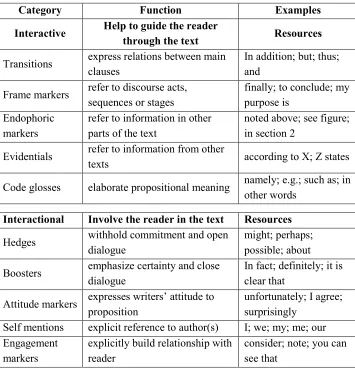
A recent taxonomy of metadiscourse formulated by Hyland (2005), which appears in Table 1 below, was taken as the model. It should be noted that Hyland’s model was preferred for being recent, simple, clear and comprehensive (Abdi, Tavangar & Tavakkoli, 2010).
Table 1: An interpersonal model of metadiscourse (Hyland, 2005: 49)
Category Function Examples
Interactive Help to guide the reader
through the text Resources
Transitions express relations between main
clauses
In addition; but; thus; and
Frame markers refer to discourse acts,
sequences or stages
finally; to conclude; my purpose is
Endophoric markers
refer to information in other parts of the text
noted above; see figure; in section 2
Evidentials refer to information from other
texts according to X; Z states
Code glosses elaborate propositional meaning namely; e.g.; such as; in
other words
Interactional Involve the reader in the text Resources
Hedges withhold commitment and open
dialogue
might; perhaps; possible; about
Boosters emphasize certainty and close
dialogue
In fact; definitely; it is clear that
Attitude markers expresses writers’ attitude to
proposition
unfortunately; I agree; surprisingly
Self mentions explicit reference to author(s) I; we; my; me; our
Engagement markers
explicitly build relationship with reader
The list of about 400 lexical items appearing in Hyland (2005, pp. 218-224) was used for analysis. However, since no comprehensive list exists, as admitted by some scholars (Ädel, 2006; Vassileva, 2001), in keeping with the main criteria of metadiscourse forms (Hyland, 2005), some forms not mentioned in the list were also recognized in the process of analysis through a discussion with colleagues.
The manual frequency count was used following the Systemic-Functional Grammar (SFG) of Halliday (1978, 1994), as opposed to the machine-supported concordancing strategies recently used on a wide scale in corpus linguistics. In computer-assisted analysis, there is a risk of assuming external reference items as metadiscourse, which could damage the validity of research. However, in order to achieve a higher reliability in our manual analysis, three colleagues examined the corpus and the final data is the average of three independent data.
In the corpus of this study, some RAs were shorter than others. Thus, an average of 56000 words for every nine articles from each discipline, estimated from average length, was taken as the criterion length. The Introduction and Method sections each constituted 14000 words of the average (a small difference in the original corpus was ignored to have a round number) and the Results and discussions (RD) sections constituted the remaining half. The raw frequency counts of all metadiscourse strategies were adjusted to the above criterion length and the calculations were carried out on the adjusted data in order to ensure more validity.
3. Results
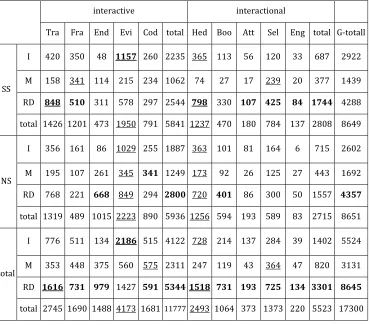
Table 2: Distribution of metadiscourse markers in different parts of research articles across sciences
interactive interactional
Tra Fra End Evi Cod total Hed Boo Att Sel Eng total G-totall
SS
I 420 350 48 1157 260 2235 365 113 56 120 33 687 2922
M 158 341 114 215 234 1062 74 27 17 239 20 377 1439
RD 848 510 311 578 297 2544 798 330 107 425 84 1744 4288
total 1426 1201 473 1950 791 5841 1237 470 180 784 137 2808 8649
NS
I 356 161 86 1029 255 1887 363 101 81 164 6 715 2602
M 195 107 261 345 341 1249 173 92 26 125 27 443 1692
RD 768 221 668 849 294 2800 720 401 86 300 50 1557 4357
total 1319 489 1015 2223 890 5936 1256 594 193 589 83 2715 8651
total
I 776 511 134 2186 515 4122 728 214 137 284 39 1402 5524
M 353 448 375 560 575 2311 247 119 43 364 47 820 3131
RD 1616 731 979 1427 591 5344 1518 731 193 725 134 3301 8645
total 2745 1690 1488 4173 1681117772493 1064 373 1373 220 5523 17300
Interestingly, Table 2 reveals that the NS and SS, on the whole, have a very small difference in terms of interactive (5841 versus 5936), interactional (2808 versus 2715) and total (8649 versus 8651) metadiscourse markers. This could mean that metadiscourse marking is widely recognized as a useful rhetorical instrument in the process of persuasion in RA writing among the practitioners of both NS and SS. However, as appears in Table 2, the interactive metadiscourse was employed about two times more than the interactional metadiscourse (11777 versus 5523).
2. That is, the most frequently employed strategy in any section is underlined, and any section which attracted the highest number of a certain strategy is shown by boldfacing the relevant row.
Meanwhile, different IMRD sections of the RAs are separately compared across sciences taking into consideration the interactive, interactional and all types of metadiscourse the results of which appear in Table 3 below.
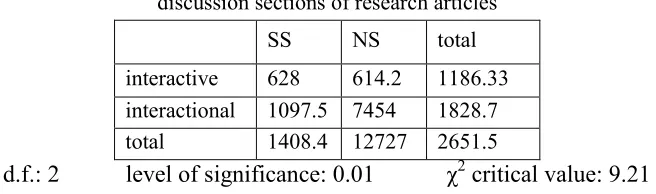
Table 3: Chi-square values of comparing introduction, method and results and discussion sections of research articles
SS NS total
interactive 628 614.2 1186.33
interactional 1097.5 7454 1828.7
total 1408.4 12727 2651.5
d.f.: 2 level of significance: 0.01 H2critical value: 9.21
As shown in Table 3, there is a significant and quite meaningful difference in the use of metadiscourse strategies in the canonical subsections of research articles considering both interactive and interactional groups of strategies across sciences.
4. Discussion
other strategies are most frequently seen in RD section of the total corpus, where the expected authority and scholarship from the researchers motivates more generous use of metadiscursive forms in an effort to project an academically plausible face.
Transitions and frame markers are highly employed by SS writers (in RD section), while NS writers most frequently took advantage of endophoric markers (in RD section) and code glosses (in Method section). It could be argued that, due to the nature of the science, SS writers need more signposting, as claimed by Hyland (2005) and Taboada (2006) to ensure that the audience is on the right track and appropriately follows the discussion, and more frame marking to display what they are doing in the discussion. Meanwhile, NS writers feel they need more reference to other parts of their prose to avoid prolixity. This could be attributed to overall more information density and more figures, tables and formulas in the RD section of research articles (Abdi, et al, 2010). Furthermore, they need more glossing in that the extent of concepts requiring explanation well outnumbers SS while introducing their M section.
The case of interactional metadiscourse looks more intriguing. Except for boosters which are most frequently employed by NS writers in RD section, probably attributable to the objectivity of the data, hedges, attitude markers, self-mentions and engagement markers are all most frequently used by SS writers in RD section. It turned out that SS writers feel more need for interactional involvement in composing the RD section of their articles (Abdi, 2002). They most frequently (contingently) evaluate the propositions, communicate their emotional thoughts and expose participants (i.e. writer and audience) within the prose (Thompson, 2001). This is expected on the grounds that SS deals with people in the first place and interactional options are critical in dealing with human issues.
interactive strategies, and more hedges from among interactional strategies. As mentioned above, evidentials are necessary to build a new study on and prove that you are aware of the mainstream research. Hedges, on the other hand, are critical strategies in establishing the need for a study in that, admittedly, research areas are for the most part uncharted lands that require cautious handling.
In the Method section, however, social sciences took advantage of frame markers more to clarify the methodical steps and procedures, while NS writers employed the highest number of evidentials. This is expected as SS writers try to report their methodological options as clearly as possible due to the fuzzier nature of their methods as compared to NS writers (Smagorinsky, 2008). However, it appears that authority plays a more notable role in designing the method of research in NS.
Yet, in the RD section, transitions are the most prevalent strategies in SS and total, while evidentials are highly employed in NS. This signifies that, as noted earlier, SS writers try to make sure that the flow of arguments is rightly signposted to ensure successful communication. In NS, on the other hand, although transitions are also abundantly employed to materialize the above goal, evidentials prevail due to the nature of NS, which requires more authority.
As displayed in Total row, evidentials are the highly employed interactive strategy and hedges are the highly used interactional strategy. Transitions, frame markers, code glosses and endophoric markers follow evidentials in interactive, and self-mentions, boosters, attitude markers and engagement markers follow hedges in interactional category, respectively.
In terms of significance testing, it is worth noting that as appears in Table 3 above, H2values in all cells exceed critical value, as expected. If any value was below the critical value, it could be said that the difference was due to chance. However, this finding confidently shows that the different sections of RAs follow a different rationale and argument structure in terms of metadiscourse employment across sciences. However, although such a result could be attributed to the difference in length2, attributing it to the varying nature of the RAs’ subsections seems also quite plausible (Swales, 1990).
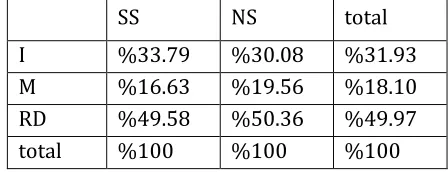
A quite interesting result was seen in the pattern of metadiscourse distribution across sections of RAs which appears in Table 4 below. The almost similar distribution of the markers throughout groups of disciplines is surprising. Although, as discussed above, the types of employed strategies vary significantly, this can be attributed to the universal functions of different parts of RAs among all academics. Also, this finding shows that there is a conventionally, though implicitly, agreed proportion of metadiscourse which writers inadvertently follow.
Table 4: Distribution of metadiscourse in different sections of research articles
SS NS total
I %33.79 %30.08 %31.93
M %16.63 %19.56 %18.10
RD %49.58 %50.36 %49.97
total %100 %100 %100
In contrast to the Method section, in the Introduction, writers challenge the present situation and make an endeavor to convince the community as to the necessity of their studies, hence requiring more metadiscursive intrusion.
5. Conclusion
This study set out to investigate the distribution of Hyland’s (2005) metadiscourse strategies within the canonical divisions of research articles across sciences. It appeared that though globally similar in many ways, NS and SS writers of research articles favored different strategies in different sections. Therefore, based on this findings, it can be concluded that due to the differences in cognitive-generic structure of different sections and also the nature of NS and SS branches of science, authors of RAs build metadiscourse strategies into their diction quite differently essentially in an attempt to fulfill the conventionally-expected rhetorical function.
Integrating the conclusions with implications, it could be said that the findings of this study provide the following implications for academic writing classes. The most important point is that metadiscourse marking is a widely-used rhetorical strategy in writing RAs (Hyland, 1998), and that it should be attended to in one way or another in any writing syllabus. Secondly, the prevalence of certain strategies across certain sections or sciences provides that different sections require specific focus which emanates from different rhetorical orientations.
research articles, and ensuring the audience that the writer is well aware of the mainstream literature and the areas requiring attention. Of course, transitions were the next highly employed in Introduction section as they are necessary for any eloquent argumentation. Hedging is also used to mitigate propositions as they are most of the time lacking ideal evidence.
It was also found that Methods favor frame marking and evidentials and also code glossing (as shown in Total row) to clarify procedures and concepts and build on authority, and hedges and self-mentions to cater for probabilities and expose researchers. RD sections, on the other hand, which host about %50 of all metadiscourse markers, drew on evidentials, transitions and hedges, which have proved useful in constructing effective arguments.
It is hoped that this characterization would offer a rough image of metadiscursive structure of different sections of research articles. Coupled with other studies in the future, this study could help develop a more plausible academic writing syllabus, which brings less visible rhetorical features of research articles under the spotlight to help avoid possible overgeneralizations from native culture.
References
Abdi, R. (2002). Interpersonal metadiscourse: An indicator of interaction and identity. Discourse Studies, 4(2), 139-145.
Abdi, R. Tavangar Rizi, M., & Tavakoli, M. (2010). The cooperative principle in discourse communities and genres: A framework for the use of metadiscourse, Journal of Pragmatics, 42(6),1669-1679. Ädel, A. (2006). Metadiscourse in L1 and L2 English. Philadelphia: John
Benjamins.
Barton, E. 1993. Evidentials, argumentation and epistemological Stance. College English, 55(7), 745–769.
Benfield, J. R., & Feak, C. B. (2006). How authors can cope with the burden of English as an international language. Chest, 129, 1728-1730.
Benfield, J. R., & Howard, K. M. (2000). The language of science. European Journal of Cardio-thoracic Surgery, 18, 642-648.
Bhatia, V. K. (1999). Integrating products, processes and participants in professional writing. In C. N. Candlin & K. Hyland (Eds.), Writing: Texts, processes and practices (pp. 21-39). London: Longman.
Bhatia, V. K. (2006). Analyzing genre: Some conceptual issues. In M. Hewings (Ed.), Academic writing in context: Implications and applications (pp. 79-92). London: Continuum.
Bruce, I. (2003). Cognitive genre prototype modeling and its implications for the teaching of academic writing to learners of English as a second language. Unpublished doctoral dissertation, University of Waikato, Hamilton, New Zealand.
Bruce, I. (2005). Syllabus design for general EAP writing courses: A cognitive approach. English for Academic Purposes, 4, 239-256. Dahl, T. (2004). Textual metadiscourse in research articles: A marker of
national culture or of academic discipline. Journal of Pragmatics, 36(10),1807-1825.
Flowerdew, J. (1999). Writing for scholarly publication in English: The case of Hong Kong. Journal of Second Language Writing, 8, 123-145.
Guba, E. G., & Lincoln, Y. S. (1994). Competing paradigms in qualitative research. In N. K. Denzin & Y. S. Lincoln (Eds.), Handbook of qualitative research (pp. 105-117). Thousand Oaks, CA: Sage Publications.
Halliday, M. A. K. (1978). The sociosemantic nature of discourse. Language as social semiotics. London: Edward Arnold.
Halliday, M. A. K. (1994). An introduction to functional grammar (2nd ed.). London: Edward Arnold.
Hyland, K. (2005). Metadiscourse: Exploring interaction in writing. Continuum: London.
Kaplan, R., & Baldauf, R. B. (2005). Editing contributed scholarly articles from a language management perspective. Journal of Second Language Writing, 14, 47-62.
Koutsantoni, D. (2006). Rhetorical strategies in engineering research articles and research theses: Advanced academic literacy and relations of power. Journal of English for Academic Purposes, 5, 19-36.
Littlewood, W. (1996). Academic writing in intercultural contexts: Integrating conventions and personal voice. Hong Kong Journal of Applied Linguistics, 1, 1-18.
Smagorinsky, P. (2008). The method section as conceptual epicenter in constructing social science research reports. Written Communication, 25(3), 389-411.
St. John, M. (1987). Writing processes of Spanish scientists publishing in English. English for Specific Purposes, 6, 113-120.
Swales, J. (1990). Genre analysis: English for specific purposes in academic and research setting. New York: Cambridge University Press.
Swales, J. (2004). Research genres: Exploration and applications. Cambridge: Cambridge University Press.
Taboada, M. (2006). Discourse markers as signals (or not) of rhetorical relations. Journal of Pragmatics, 38, 567-592.
Thompson, G. (2001). Interaction in academic writing: Learning to argue with the reader. Applied Linguistics,22(1),58-78.
van Dijk, T., Ting Toomy, S., Smitherman, G., & Troutman, D. (1997). Discourse, ethnicity, culture, and racism. In T. van Dijk (Ed.), Discourse as social action. London: Sage Publications.
Notes
1 It should be noted that it was the search process that was qualitative (as
opposed to mechanical) rather than the final data.
2 Although not appearing here, it was also the case even when the number of