Effectiveness and cost-effectiveness of
telephone-based support versus usual
care for treatment of pressure ulcers in
people with spinal cord injury in
low-income and middle-income
countries: study protocol for a 12-week
randomised controlled trial
Mohit Arora,1,2Lisa Anne Harvey,1Alison Joy Hayes,3Harvinder Singh Chhabra,2 Joanne Valentina Glinsky,1Ian Douglas Cameron,1Lucija Lavrencic,4
Narkeesh Arumugam,5Sohrab Hossain,6Parneet Kaur Bedi5
To cite:Arora M, Harvey LA,
Hayes AJ,et al. Effectiveness
and cost-effectiveness of telephone-based support versus usual care for treatment of pressure ulcers in people with spinal cord injury in low-income and middle-income countries: study protocol for a 12-week randomised controlled trial. BMJ Open2015;5:e008369. doi:10.1136/bmjopen-2015-008369
▸ Prepublication history for
this paper is available online. To view these files please visit the journal online (http://dx.doi.org/10.1136/ bmjopen-2015-008369).
Received 31 March 2015 Revised 18 June 2015 Accepted 8 July 2015
For numbered affiliations see end of article.
Correspondence to Dr Lisa A Harvey; [email protected]
ABSTRACT
Introduction:Pressure ulcers are a common and severe complication of spinal cord injury, particularly in low-income and middle-income countries where people often need to manage pressure ulcers alone and at home. Telephone-based support may help people in these situations to manage their pressure ulcers. The aim of this study is to determine the effectiveness and cost-effectiveness of telephone-based support to help people with spinal cord injury manage pressure ulcers at home in India and Bangladesh.
Methods and analysis:A multicentre (3 sites), prospective, assessor-blinded, parallel, randomised controlled trial will be undertaken. 120 participants with pressure ulcers on the sacrum, ischial tuberosity or greater trochanter of the femur secondary to spinal cord injury will be randomly assigned to a Control or Intervention group. Participants in the Control group will receive usual community care. That is, they will manage their pressure ulcers on their own at home but will be free to access whatever healthcare support they can. Participants in the Intervention group will also manage their pressure ulcers at home and will also be free to access whatever healthcare support they can, but in addition they will receive weekly telephone-based support and advice for 12 weeks (15–25 min/week). The primary outcome is the size of the pressure ulcer at 12 weeks. 13 secondary outcomes will be measured reflecting other aspects of pressure ulcer resolution, depression, quality of life, participation and satisfaction with healthcare provision. An economic evaluation will be run in parallel and will include a cost-effectiveness and a cost-utility analysis.
Ethics and dissemination:Ethical approval was obtained from the Institutional Ethics Committee at each site. The results of this study will be disseminated through publications and presented at national and international conferences.
Trial registration number:ACTRN12613001225707.
INTRODUCTION
Pressure ulcers are a common and severe com-plication of spinal cord injury (SCI).1 2 They have many deleterious consequences, includ-ing permanent scarrinclud-ing, osteomyelitis, amputa-tion and sepsis, often requiring hospital admissions.3 4 In addition, they affect a person’s family and social life, and are costly and difficult to manage. Pressure ulcers can also lead to death. It is estimated that pressure ulcers are responsible for approximately 8% of deaths in people with SCI in high-income countries.5 This figure is probably much higher in low-income and middle-income countries (LMIC). One small study from
Strengths and limitations of this study
▪ This randomised controlled trial will examine a potentially simple and inexpensive approach to the management of pressure ulcers secondary to spinal cord injury (SCI) in low-income and middle-income countries (LMIC).
▪ This will be one of the first and largest non-pharmacological studies of this type involving people with SCI from LMIC.
▪ This is a multicentre study increasing the study’s external validity.
▪ Assessors will be blinded, but it is not possible to blind participants or the clinicians.
on September 22, 2020 by guest. Protected by copyright.
Nepal6found that 25% of patients from a local SCI hos-pital had pressure ulcers within a year of discharge. A larger study from Bangladesh7 reported that 70% of people with paraplegia and 90% of people with tetraplegia were dead within 5 years of injury, most from pressure ulcers. While there are methodological limitations with these studies, there is general consensus that pressure ulcers are a major and life-threatening problem.8Pressure ulcers can not only adversely affect quality of life, depres-sion, anxiety and other psychological disorders but can also limit a person’s ability to participate in meaningful community activities.
Pressure ulcers are most common around the sacrum, ischial tuberosity and greater trochanter of the femur.9 They progress through different stages of severity if left untreated. They are scored from stage 1 to stage 4.9 10 Stage 4 pressure ulcers are severe and invariably require hospitalisation and surgery. Stage 1–stage 3 pressure ulcers vary from superficial red areas to full skin thick-ness injuries. In high-income countries, pressure ulcers are either managed with hospitalisation or regular home nursing, and pressure relieving devices such as alternat-ing pressure air mattresses. However, these levels of service and resources are often not available in LMIC because hospitals and community healthcare services are under-resourced and most people cannot afford to self-fund these services or access costly equipment.11 Instead, usual care in these countries typically involves people managing their pressure ulcers alone and at home. Often, they become life-threatening. However, with early advice, most people can be taught self-help strategies to manage less severe pressure ulcers at home.12This includes education about appropriate pres-sure relief, bed overlays, diet and wound dressings. It also includes education about bladder and bowel man-agement to minimise incontinence that often contri-butes to further deterioration of pressure ulcers.13
Telephone-based support may provide a low cost way of helping people with SCI manage pressure ulcers at home in LMIC.14 This is a feasible way to provide support because mobile phones15 are popular in most LMIC. A small number of studies have looked at the pos-sible use of telephone-based support for the treatment of pressure ulcers.16 17 However, these studies have only had small numbers of participants and were conducted in high-income countries. There is presently no strong evidence indicating that telephone-based support is effective for the treatment of pressure ulcers, especially in LMIC such as India and Bangladesh.
AIM
The aim of this study is to determine the effectiveness
METHODS AND ANALYSIS Design
A multicentre, prospective, assessor-blinded, parallel, pragmatic randomised controlled trial will be under-taken, in which people with pressure ulcers secondary to SCI will be randomised to usual community care or to usual community care plus telephone-based support over 12 weeks.
Participants
Participants will be included if they: 1. Are over 18 years of age;
2. Have sustained complete or incomplete SCI more than 3 months prior to recruitment;
3. Have at least one pressure ulcer on the sacrum, ischial tuberosity or greater trochanter of the femur which is unlikely to require hospitalisation within the next 12 weeks;
4. Are living in the community;
5. Are able to speak either sufficient Hindi (for the 2 Indian sites) or Bengali (for the Bangladesh site) to allow them to participate in the study without the assistance of a translator;
6. Have access to a phone and will be able to comply with regular phone interviews as specified by the protocol;
7. Have the potential to benefit from the telephone-based support.
Participants will be excluded if they: 1. Have cognitive or verbal impairments;
2. Have any clinically significant medical condition that would compromise participation in the study;
3. Are unable to be assessed at 12 weeks.
Potential participants will be recruited from outpatient clinics or the hospitals’databases.
Recruitment strategy and time frame
A study researcher will contact potential participants in person during outpatient clinics or via telephone (using the hospitals’ databases to identify people). Those recruited through outpatient clinics will be provided with a participant information sheet and screened for inclusion. Those recruited via telephone will be invited to participate. At a subsequent appointment, they will be provided with a participant information sheet and screened for inclusion.
Participant recruitment started on 25 November 2013. The study will be conducted at three sites. The three sites are (1) Indian Spinal Injuries Centre (tertiary centre) at New Delhi, India, (2) Punjabi University-Patiala (university clinic) at Punjab, India and (3) Centre for the Rehabilitation of the Paralysed (tertiary
on September 22, 2020 by guest. Protected by copyright.
Assignment of intervention
A computer-generated random allocation schedule will be formulated prior to the starting of the study by an independent person located in Australia who is not involved in recruitment. The rand() function in Excel will be used to generate the schedule.18 A blocked allo-cation (1:1) schedule will be used. Alloallo-cation will not be stratified by site. Participants’ allocations will be placed in opaque, sequentially numbered and sealed envelopes which will be kept in Australia. After the participant passes the screening process and completes the baseline assessment, an envelope will be opened and allocation will be revealed by an independent person (figure 1). The participant will be considered to have entered the study at this point. The assessor will be blinded to treat-ment allocation throughout the course of the study. The statistician conducting the data analysis will also be blinded to group allocation. It is not possible to blind participants or the clinicians delivering the intervention.
Intervention
Participants in the Control group will receive usual com-munity care. That is, they will be given a pamphlet con-taining information about pressure ulcer management. They will otherwise be left to manage their pressure ulcers at home and without assistance. They will, however, be free to seek any type of help or medical assistance that they deem appropriate and can access.
Participants in the Intervention group will also receive usual community care. That is they will also be given a pamphlet and are free to seek any type of help or medical assistance that they deem appropriate and can access. In addition, they will receive weekly telephone-based support over 12 weeks from an experienced nurse or physiotherapist trained in the management of pressure
ulcers in people with SCI. The telephone-based support will be equivalent to 15–25 min/week. The clinicians pro-viding the telephone-based support will be formally trained in pressure ulcer management in Australia and India, or Bangladesh as appropriate. Each time clinicians ring participants, they will reinforce self-help strategies important for managing pressure ulcers, minimising psy-chological distress and enhancing engagement with life. Specifically, participants and their families will receive education and advice about appropriate seating, bed overlays, cushions, diet, nutrition, wound care and self-care activities. The clinicians will also advise participants about when to seek further medical or nursing attention, how to relieve pressure and when to take bed rest as well as advice on any other related issues which may be con-tributing to the pressure ulcer (eg, bladder or bowel incontinence, spasticity, depression). Participants will be given goals for each week that will be reviewed, moni-tored and updated. For example, a goal might include staying on strict bed rest for the next week.
The participants in both groups will be given diaries to record any costs related to the treatment of their pres-sure ulcers. In addition, they will be contacted once every fortnight to take a verbal transcript from their diaries. The phone calls will also be used to assess costs from those unable to keep diaries because of illiteracy or limited hand function. The following costs will be captured: costs associated with mattresses, pressure-relieving cushions, lost income, medications, dressings, high-protein food, lotions, hospitalisation, travel, incon-tinence aids and nursing care.
Outcome measures
All assessments will be conducted at the beginning and end of the 12-week study period by an independent,
Figure 1 Flow diagram of the study.
on September 22, 2020 by guest. Protected by copyright.
trained nurse who is blinded to the intervention. The assessments will be done at one of the three sites or at the participants’homes. Participants will be asked not to discuss their group allocation with assessors. The success of blinding will be verified at the end of each partici-pant’s assessment by asking assessors to reveal whether they have been unblinded. Any inadvertent unblinding of assessors will be reported.
Primary outcome
The primary outcome is the size of the pressure ulcer at 12 weeks. This will be assessed using commercially avail-able grid paper designed for this purpose. Length and width will be measured and expressed as cm2. If a par-ticipant has more than one pressure ulcer, the pressure ulcer with the most potential to benefit from telephone-based support will be assessed. This will be determined by the assessor at baseline and the same pressure ulcer will be assessed at 12 weeks.
Secondary outcomes
There will be thirteen secondary outcomes. The details of each are as follows:
Severity of the pressure ulcer at 12 weeks will be assessed using the Pressure Ulcer Scale for Healing (PUSH) Score V.3.0. The PUSH is the most widely-used tool for assessment of pressure ulcers.19 The PUSH rates pres-sure ulcers according to the area of the prespres-sure ulcer, amount and type of exudates, and extent of tissue damage. The total scores range from 0 to 17 points with higher scores indicating a severe pressure ulcer.
Undermining distance of the pressure ulcer at 12 weeks will
be assessed using a sterile and commercially available scaled probe. The measurements will be taken in four directions, that is, 12:00, 15:00, 18:00 and 21:00.20 All measurements will be recorded in centimetres and then added to derive one tallied score.
Depth of the pressure ulcer at 12 weeks will be measured using a sterile and commercially available scaled probe. Depth will be measured at the centre of the pressure ulcer and recorded in centimetres.21
Pressure ulcer risk factors at 12 weeks will be assessed using the Braden Scale for Predicting Pressure Sore Risk.22 23This outcome has been included to determine whether the telephone-based support influences any of the factors commonly associated with high risk of pres-sure ulcers in people with SCI. It assesses risk over six domains such as sensory perception, moisture, activity, mobility, nutrition, and friction and shear. The total scores range from 6 to 23 points, with lower scores indi-cating a higher risk for pressure ulcers.
Health-related quality of life at 12 weeks will be assessed using the EuroQol (EQ-5D 5L) Health Survey.24 25The
cost-utility analysis. The second component (called the Health Thermometer) captures participants’ overall rating of health. Participants are asked to rate their health on a vertical visual analogue scale numbered from 0 (worst imaginable health state) to 100 (best imaginable health state). The two components will be analysed separately.
Depression at 12 weeks will beassessed using the seven depression items of the Hospital Anxiety and Depression Scale.26 The Hospital Anxiety and Depression Scale is a widely used self-report questionnaire. The depression items of the Hospital Anxiety and Depression Scale are designed to measure current depression. Scores will be interpreted as indicative of normal or mild, moderate or severe depression. The total scores range from 0 to 21 points, with higher scores indicating severe depression.
Participation at 12 weeks will be assessed using the par-ticipation items of the WHO Disability Assessment Scale (WHODAS) 2.0 questionnaire.27 The participant will be asked how much of a problem they have experienced with each item over the past 30 days. Each item is scored on a five-point scale ranging from none (1 point) to extreme/cannot do (5 points). The total scores range from 8 to 40 points, with higher scores reflecting poor participation.
Self-report time for pressure ulcer resolution will be assessed on a weekly basis through one question, namely—‘Is your pressure ulcer healed?’These data will be collected fortnightly over the telephone and reported as ‘yes’ or
‘no’.
Participants’impression of pressure ulcer status at 12 weeks
will beassessed with one question, namely—‘How would you rate the quality of your wound and skin over the affected area?’. Participants will be asked to respond to this question using a 10-point Numeric Rating Scale (NRS)28anchored at one end with ‘extremely poor’and at the other end with‘extremely good’.
Clinicians’ impression of pressure ulcer status at 12 weeks
will be assessed with one question namely—‘How would you rate the quality of the wound and skin over the affected area?’. The blinded assessor will be asked to respond to this question using a 10-point NRS anchored at one end with ‘extremely poor’ and at the other end with‘extremely good’.
Participant confidence to manage the pressure ulcer at 12 weeks will be assessed with one question, namely
—‘how confident are you in managing your pressure ulcer at home each day?’. Participants will be asked to respond to this question using a 10-point NRS anchored at one end with ‘not very confident’ and at the other end with‘very confident’.
Participant satisfaction for healthcare provision at 12 weeks will be assessed with one question, namely
on September 22, 2020 by guest. Protected by copyright.
All questionnaires will be administered to participants in English, Hindi or Bengali.
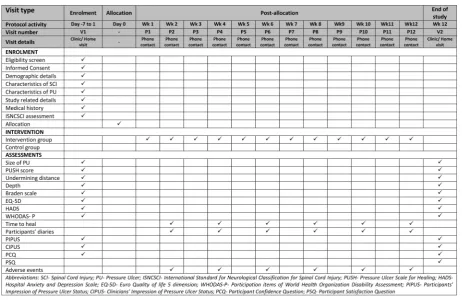
The details of the time schedule of enrolment, inter-vention, assessments, participants’ visit and phone con-tacts are shown infigure 2.
Theeconomic evaluationwill be conducted from a soci-etal perspective and will include costs incurred by indi-viduals and healthcare providers. This perspective will be taken because the cost consequences of this inter-vention may extend beyond the domain of healthcare. The intervention and participants’ healthcare cost will be captured as outlined intable 1. The cost of deliver-ing the intervention will include costs associated with employing clinicians, administration, telephone calls and travel cost where applicable. The costs to the parti-cipants for healthcare and other items related to the management of their pressure ulcers will be captured through participant diaries. These will include
out-of-pocket expenses associated with specifically pur-chasing equipment and resources to manage the pres-sure ulcer such as beds, mattresses, wheelchairs, pressure-relieving cushions, medications, medical sup-plies, dressings, special high-protein food, lotions and incontinence aids. It will also include costs associated with hospitalisation, travel, nursing care and lost income. Costs associated with insurers’or governments’ contributions to participants’ healthcare will also be captured through the diaries.
The economic analyses will include the following: A. A within-study cost-effectiveness analysis of
telephone-based support for pressure ulcer management com-pared with usual community care. Incremental cost-effectiveness ratios (ICER) will be determined for the incremental cost per additional cm2of ulcer healing in the Intervention (telephone-based support) group compared with the Control group. Figure 2 Time schedule of enrolment, intervention, assessments, participants’visit and phone contacts during the study.
Table 1 Costs that will be captured for the Control and Intervention groups
Number Cost
Control (usual community care)
Intervention
(telephone-based support)
1 Telephone-based support × ✓
2 Participants’healthcare facility ✓ ✓
3 Medical equipment ✓ ✓
4 Medical supplies ✓ ✓
5 Participants and their family members’time ✓ ✓
6 Carers’time ✓ ✓
on September 22, 2020 by guest. Protected by copyright.
B. A cost-utility analysis to present incremental cost per QALYs gained. The ‘cross walk’ from EQ-5D 5L to EQ-5D 3L and Sri Lankan valuation29 of the EQ-5D 3L will be used to get utility weights on a 0–1 scale where 1 represents perfect health and 0 represents death. QALYs will be determined by multiplying utility by duration.
Resources will be valued using standard economic evaluation guidelines.30 Discounting will not be incorpo-rated into the model because the intervention is less than 1 year.
Sample size
A sample size of 120 will be used. This assumes an SD of 30 cm2, loss to follow-up of 15%, correlation with a base-line of 0.6, an α of 0.05 and a minimally worthwhile treatment effect of 10 cm2. The minimally worthwhile treatment effect is based on the assumption that the mean initial size of participants’ pressure ulcers will be 100 cm2. If this is the case, the minimally worthwhile treatment effect will be equivalent to 10% of the mean initial size. If, however, the mean initial size of partici-pants’ pressure ulcers is not 100 cm2, the absolute min-imally worthwhile treatment effect will be adjusted post hoc to correspond with 10% of mean initial values.
Quality assurance
To ensure that the interventions are of a high standard and are delivered in accordance with the study protocol, two clinicians who will be providing the intervention will be trained in Australia and India or Bangladesh. They will follow the Canadian Best Practice 9 and National Pressure Ulcers Advisory Panel10 guidelines for the pre-vention and management of pressure ulcers in people with SCI appropriately modified for LMIC. The two clini-cians will contact each other once every month to coord-inate and monitor the advice they are providing. In addition, a specialist nurse skilled in pressure manage-ment from Australia will provide ongoing support and advice by telephone or in person to the two clinicians.
Data integrity and management
The data will remain confidential throughout the course of the study. Initially, data will be collected on paper-based case report forms (CRFs). The paper-paper-based CRFs will be compiled in participant-specific folders. The designated place will be secured from the public or other staff members of the involved organisations. The local sites will send the CRFs to the University of Sydney in Australia via email. Any information capable of identi-fying participants will be removed. Data will be managed and transcribed into electronic format in Australia using
manipulation and export procedures; (3) automated export procedures for seamless data downloads to common statistical packages and (4) procedures for importing data from external sources.31
All data will be double entered with automated checks for errors. Data queries will be emailed to the site coord-inator and stored on the database. After completion or discontinuation of the study, all records will be kept for a minimum of 15 years at local sites. Access to data during and after the study will only be granted to the designated research team member.
Withdrawal
The study will have the following categories of partici-pant withdrawals:
▸ Withdrawn from study intervention but remain in the study until the 12-week assessment (end of study). ▸ Withdrawn from the entire study with revocation of
consent. No further follow-up or data collection will occur.
▸ Lost to follow-up. The participant is lost to follow-up after baseline assessment. This may occur due to death or failure of the study staff to locate the partici-pant. No further follow-up or data collection will occur.
The details of participant withdrawal will be recorded.
Data analysis
All data will be analysed using Stata software V.13 at the University of Sydney, Australia. A separate analysis will be done for all outcomes. Dichotomous data will be ana-lysed using logistic regression and continuous data will be analysed using linear regression. Baseline scores will be included in the models to increase statistical preci-sion.32 The primary analysis will compare the size of pressure ulcers in the Control (usual community care) and Intervention (telephone-based support) groups at 12 weeks. All other analyses will be secondary, including the time for resolution of pressure ulcer, which will be analysed using survival analysis. If more than 5% of data are missing for a particular analysis, multiple imputation will be used to account for missing data, provided the assumption of missing at random appears plausible. The multiple imputation procedure will use all available base-line and follow-up observations.33
For cost-effectiveness, descriptive statistics will be used to summarise the costs and QALYs. The robustness of our costing data will be tested through sensitivity ana-lyses. As in all economic evaluations, the costs captured in this study will most likely be skewed, so non-parametric bootstrap methods will be used for hypoth-esis tests and interval estimation. A threshold ICER of
on September 22, 2020 by guest. Protected by copyright.
incremental cost per QALY gained in the intervention compared to control.
ICER¼ Cost of InterventionCost of Control Outcome of InterventionOutcome of Control
ð1Þ
Non-parametric bootstrapping will be applied to esti-mate uncertainty around the ICER and the results will be plotted on an incremental cost-effectiveness plane. We will use 2015 US$ as the nominated currency, and will derive ICERs and cost-effectiveness acceptability curves separately for India and Bangladesh.
ETHICS AND DISSEMINATION
Ethical approvals have been obtained from the Institutional Ethics Committee at each site. Participants will be provided with a participant’s information sheet and written informed consent will be obtained prior to recruitment and baseline assessment. These documents will be provided in participants’ local language. Each participant will be informed about the study aims, proce-dures and risks and/or expected benefits. The partici-pants will be informed that their participation is voluntary and that they may leave the study at any time without this having any influence on future treatments provided by their site, clinicians and research team. Participants will be encouraged to discuss the study with family members before making a decision about their participation. They will not be coerced to complete the study.
The result of this study will be submitted for publica-tion to peer-reviewed journals and be presented at national and international conferences.
Monitoring
The study will be overseen and monitored by the research staff who will examine study procedures, ensure data quality and monitor compliance with the study protocol. Adverse events regardless of the seriousness or relationship to the study will be recorded in both groups. All protocol violations will also be recorded. An independent Data Safety Monitoring Board will not be used for this trial because the intervention is unlikely to cause harm and the trial is not sufficiently large enough to warrant stopping it early on the grounds of futility.
TRIAL STATUS
The first participant was randomised on 28 November 2013, and it is anticipated that the last participant will be recruited at the end of July 2016. The most recent version of the protocol is V.1.3 dated 29 August 2014.
Author affiliations
1John Walsh Centre for Rehabilitation Research, Kolling Institute of Medical
Research, Royal North Shore Hospital, Sydney Medical School Northern, The University of Sydney, St Leonards, New South Wales, Australia
2Department of Spine Service, Indian Spinal Injuries Centre, Delhi, India
3School of Public Health, The University of Sydney, Sydney, New South
Wales, Australia
4Spinal Cord Injury Unit, Royal North Shore Hospital, St Leonards, New South
Wales, Australia
5Department of Physiotherapy, Punjabi University, Patiala, Punjab, India
6Centre for Rehabilitation of the Paralysed, Savar, Dhaka, Bangladesh.
Acknowledgements The authors would like to acknowledge the support of each of the sites.
Contributors MA contributed to the conception of the study, the detailed design of the study, all manuscript writing, critical revision and final approval of the manuscript. LAH contributed to the conception of the study, the overall design of the study, critical revision and final approval of the manuscript. AJH contributed to the conception and detailed design of cost-effectiveness analysis, critical revision and final approval of the manuscript. HSC, JVG, IDC and LL contributed to the overall design of the study, critical revision and final approval of the manuscript. NA, SH and PKB contributed to the critical revision and final approval of the manuscript.
Competing interests None declared.
Ethics approval Institutional Ethics Committees of the Indian Spinal injuries Centre, Punjabi University and Centre for Rehabilitation of the Paralysed.
Provenance and peer review Not commissioned; externally peer reviewed.
Open Access This is an Open Access article distributed in accordance with the Creative Commons Attribution Non Commercial (CC BY-NC 4.0) license, which permits others to distribute, remix, adapt, build upon this work non-commercially, and license their derivative works on different terms, provided the original work is properly cited and the use is non-commercial. See: http:// creativecommons.org/licenses/by-nc/4.0/
REFERENCES
1. Kovindha A, Kammuang-Lue P, Prakongsai P,et al. Prevalence of pressure ulcers in Thai wheelchair users with chronic spinal cord injuries.Spinal Cord2015. [epub ahead of print 5 May 2015]. doi:10.1038/sc.2015.77
2. Consortium for Spinal Cord Medicine.Pressure ulcer prevention and treatment following spinal cord injury: a clinical practice guideline for health care professionals. Washington DC: Paralyzed Veterans of America, 2014.
3. Allman RM. Epidemiology of pressure sores in different populations. Decubitus1989;2:30–3.
4. Rodriguez GP, Garber SL. Prospective study of pressure ulcer risk in spinal cord injury patients.Paraplegia1994;32:150–8.
5. Byrne DW, Salzberg CA. Major risk factors for pressure ulcers in the spinal cord disabled: a literature review.Spinal Cord
1996;34:255–63.
6. Scovil CY, Ranabhat MK, Craighead IB,et al. Follow-up study of spinal cord injured patients after discharge from inpatient rehabilitation in Nepal in 2007.Spinal Cord2012;50:232–7. 7. Hoque MF, Grangeon C, Reed K. Spinal cord lesions in Bangladesh:
an epidemiological study 1994–1995.Spinal Cord1999;37:858–61. 8. Garber SL, Rintala DH, Holmes SA,et al. A structured educational
model to improve pressure ulcer prevention knowledge in veterans with spinal cord dysfunction.J Rehabil Res Dev2002;39:575–88. 9. Houghton PE, Campbell KE, CPG Panel.Canadian Best Practice Guidelines for the Prevention and Management of Pressure Ulcers in People with Spinal Cord Injury: a resource handbook for Clinicians. Ontario Neurotrauma Foundation 2013.
10. National Pressure Ulcers Advisory Panel (NPUAP).Prevention and treatment of pressure wlcers: clinical practice guidelines. Washington DC: NPUAP, 2009.
11. Dam A, Datta N, Mohanty UR,et al. Managing pressures ulcers in a resource constrained situation: a holistic approach.Indian J Palliat Care2011;17:255–9.
12. Clark F, Pyatak EA, Carlson M,et al. Implementing trials of complex interventions in community settings: the USC-Rancho Los Amigos pressure ulcer prevention study (PUPS).Clin Trials2014;11:218–29. 13. Schubart JR, Hilgart M, Lyder C. Pressure ulcer prevention and
management in spinal cord-injured adults: analysis of educational needs.Adv Skin Wound Care2008;21:322–9.
14. Russell TG. Physical rehabilitation using telemedicine.J Telemed Telecare2007;13:217–20.
on September 22, 2020 by guest. Protected by copyright.
15. Swapna N, ed. Telecommunication sector in India—an analysis. MPGI National Multi Conference. International Journal of Computer Applications, 2012.
16. Halstead LS, Dang T, Elrod M,et al. Teleassessment compared with live assessment of pressure ulcers in a wound clinic: a pilot study. Adv Skin Wound Care2003;16:91–6.
17. Vesmarovich S, Walker T, Hauber RP,et al. Use of telerehabilitation to manage pressure ulcers in persons with spinal cord injuries. Adv Wound Care1999;12:264–9.
18. Kim J, Shin W. How to do random allocation (randomization). Clin Orthop Surg2014;6:103–9.
19. Hon J, Lagden K, McLaren AM,et al. A prospective, multicenter study to validate use of the PUSH in patients with diabetic, venous, and pressure ulcers.Ostomy Wound Manage2010;56:26–36. 20. Sussman C, Swanson G. Utility of the sussman wound healing tool
in predicting wound healing outcomes in physical therapy.Adv Wound Care1997;10:74–7.
21. Van Lis MS, Van Asbeck FWA, Post MWM. Monitoring healing of pressure ulcers: a review of assessment instruments for use in the spinal cord unit.Spinal Cord2010;48:92–9.
22. Braden BJ. The braden scale for predicting pressure sore risk: reflections after 25 years.Adv Skin Wound Care 2012;25:61.
23. Braden BJ, Bergstrom N. Clinical utility of the Braden Scale for Predicting Pressure Sore Risk.Decubitus1989;2:44–6, 50-1. 24. Brooks R, De Charro F. EuroQol: the current state of play.Health
Policy1996;37:53–72.
25. Whitehurst DGT, Noonan VK, Dvorak MFS,et al. A review of preference-based health-related quality of life questionnaires in spinal cord injury research.Spinal Cord2012;50:646–54. 26. Woolrich RA, Kennedy P, Tasiemski T. A preliminary psychometric
evaluation of the Hospital Anxiety and Depression Scale (HADS) in 963 people living with a spinal cord injury.Psychol Health Med 2006;11:80–90.
27. Üstün TB, Kostanjsek N, Chatterji S,et al.Measuring health and disability: manual for WHO Disability Assessment Schedule (WHODAS 2.0). Geneva: WHO Press, 2010.
28. Ferreira-Valente MA, Pais-Ribeiro JL, Jensen MP. Validity of four pain intensity rating scales.Pain2011;152:2399–404.
29. Dolan P. Modeling valuations for EuroQol health states.Med Care 1997;35:195–8.
30. Husereau D, Drummond M, Petrou S,et al. Consolidated Health Economic Evaluation Reporting Standards (CHEERS)—explanation and elaboration: a report of the ISPOR Health Economic Evaluation Publication Guidelines Good Reporting Practices Task Force. Value Health2013;16:231–50.
31. Harris PA, Taylor R, Thielke R,et al. Research electronic data capture (REDCap)—a metadata-driven methodology and workflow process for providing translational research informatics support. J Biomed Inform2009;42:377–81.
32. Vickers AJ, Altman DG. Statistics notes: analysing controlled trials with baseline and follow up measurements.BMJ2001;323:1123–4. 33. Kenward MG, Carpenter J. Multiple imputation: current perspectives.
Stat Methods Med Res2007;16:199–218.
on September 22, 2020 by guest. Protected by copyright.