
Formulation and evaluation of multiparticulate pellets containing glibenclamide solid dispersion
9
0
0
Full text
(2) Kondam Samatha. et al., Int. J. Pharm & Ind. Res., Vol.–04 (01) 2014 [8 - 16]. one of the most challenging aspects of drug development process especially for oral-drug delivery system. Oral bioavailability of a drug depends on its solubility and dissolution rate, therefore efforts to increase dissolution of drugs with limited water solubility is often needed. Improvement in the dissolution rate of the poorly soluble drugs after oral administration is one of the most crucial challenges in modern pharmaceutics. Many methods are available to improve these characteristics including salt formation, Micronization and addition of solvent or surfaceactive agents and solid dispersion method2,3. Glibenclamide4 is an anti-diabetic drug belonging to class II which has poor water solubility there by posing problems in their formulations in absorption leads to poor bioavailability. Therefore enhancement of the solubility of drug is very important in those cases. Usually Initial dose of Glibenclamide is 2.5 to 5mg once daily. Glibenclamide appears to lower the blood glucose acutely in healthy individuals and patients with type 2 diabetes by stimulating the release of insulin from the pancreas, an effect dependent upon functioning beta cells. Glibenclamide is nearly completely absorbed (84 ± 9%) after oral administration and is extensively bound (99%) to serum proteins. The peak serum concentration is reached in 2-6 hours after taking a 5 mg tablet of drug and falls within 24 hours to less than 5% of the peak value. Multiple-dose studies with glibenclamide5 in diabetic patients demonstrate drug level concentration-time curves similar to single-dose studies, indicating no build-up of drug in tissue depots. In non-fasting diabetic patients, the hypoglycaemic action of a single morning dose of glibenclamide persists for 24 hours. Solid dispersion6 refers to a group of solid products consisting of at least two different components, generally a hydrophilic matrix and a hydrophobic drug. The matrix can be either crystalline or amorphous. The drug can be dispersed molecularly, in amorphous particles (clusters) or in crystalline particles. Different carriers like PEG 6000 and PVP K 30 can be used to enhance the bioavailability. Both polymers show excellent water solubility and vary significantly in molecular weight, ranging from 200 to >300,000 for polyethylene glycol and. 9. from 10,000 to 700,000 for polyvinylpyrrolidone. Both polymers are often employed as vehicles due to their low toxicity, low melting point, rapid solidification rate, high aqueous solubility, availability in various molecular weights, economic cost, and physiological tolerance. Pellets are spherical or nearly spherical, freeflowing granules with a narrow size distribution, typically varying between 500 and 1500 µm for pharmaceutical applications7. They are generally produced via a pelletization process, whereby a powder blend consisting of an API and excipient particles is agglomerated into spherical granules. After being produced, pellets are usually filled into hard gelatin capsules or compressed into tablets. Furthermore, they can be formulated as immediaterelease dosage forms or coated in order to sustain drug release over a longer period of time or to deliver a drug to a specific site of action in the gastrointestinal tract. Multiparticulate solid dosage forms derives from several important advantages of those multi-unit forms over conventional, single-unit solid dosage forms (tablets)8. Extrusion/ Spheronisation is one of the most established techniques for production of pellets with high quality.. Materials and methods Glibenclamide was obtained as a gift sample from Hetero drugs limited, Hyderabad, India. PVP-K30 and PEG-6000, Microcrystalline cellulose, Crosspovidone, Mannitol, Lactose and all other chemicals and solvents used were of analytical grade. Preparation of solid dispersions by solvent evaporation method Drug and carrier was taken in a ratio of 1:9. In case of Glibenclamide solid dispersion (G-SD1), the drug and the polymer was dissolved in adequate quantity of solvent (chloroform) and stirred continuously for about 30 mins at room temperature to obtain a clear solution .To this solution, 10 mg of aerosil was added and stirred at room temperature until two thirds of the solvent has evaporated. The stirring was stopped and the balance solvent was removed by drying under vaccum at room temperature. In case of Glibenclamide solid dispersion (G-SD2) containing a combination of PVP K-30 was first melted with. www.ijpir.com.
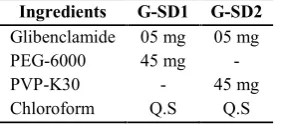
(3) 10. Kondam Samatha. et al., Int. J. Pharm & Ind. Res., Vol.–04 (01) 2014 [8 - 16]. the aid of heat and the drug dissolved in chloroform was added. The rest of the preparation of solid dispersion was same as that of G-SD1. The dried powder was collected and passed through mesh no.60 and stored for further use2.. Table No. 01: Composition of solid dispersion Ingredients Glibenclamide PEG-6000 PVP-K30 Chloroform. G-SD1 05 mg 45 mg Q.S. G-SD2 05 mg 45 mg Q.S. Table No. 02: Formulation chart for preparation of pellets Ingredients(mg) G-SD1 G-SD2 MCC Cross povidone SSG Lactose Mannitol Aerosil Talc Magnesium stearate. F1 50 81 06 50 07 02 02 02. Preparation and Characterization of pellets Glibenclamide solid dispersions in PEG-6000 and PVP K-30 at a drug to carrier ratio of 1:9 were formulated into pellets. The pellets containing 5mg of Glibenclamide equivalent solid dispersion in each formula was prepared by extrusionspheronization pelletization technique. Required amount of solid dispersion equivalent to 5mg of drug, MCC, lactose, crosspovidone and mannitol in 4 formulations F1-F8 were passed through sieve no.40 prior to pelletization and mixed uniformly in a double cone blender9. Double distilled water of required quantity was used to bind the mass to obtain a dove mass which was extruded using a piston extruder (1mm orifice), Kalweka,(Karnavati, Banglore) India. The extrudates were immediately spheronized at varying time of 2,4,10 min. with varying rotation speed of 400, 700, 1000 rpm with an air velocity of 1kg/cm2 .The pellets were dried at 40OC for 2hrs.in the hot air oven10 (BIO:26, Biotechnics India). Evaluation parameters of pellets Particle size analysis11 The particle size of drug loaded formulations was measured by an optical microscope fitted with an ocular and stage micrometer and particle size distribution was calculated. The Olympus model (SZX-12) having resolution of 40x was used for this purpose. The instrument was calibrated at 1 unit of eyepiece micrometer was equal to 1/30 mm (33.33μm).. F2 50 79 08 50 07 02 02 02. F3 50 81 06 50 07 02 02 02. F4 50 79 08 50 07 02 02 02. F5 50 81 06 50 07 02 02 02. F6 50 79 08 50 07 02 02 02. F7 50 81 06 50 07 02 02 02. F8 50 79 08 50 07 02 02 02. Drug content Estimation12 Accurately weighed 200mg of pellets dissolved in acetone and suspended in 100ml of phosphate buffer (6.8pH).The resulting solution was kept for 24hrs after it was stirred for 15-20 min. The solution was filtered, Glibenclamide content in filtrate was analyzed at 227nm using Shimatzu UV Spectrophotometer (UV-1800 Shimadzu corporation, Japan). The experiments were carried out in triplicate for the pellets of all formulations and average values were recorded. Friability13 The friability test was performed on the pellets to ensure their mechanical strength. Lower friability values indicate good mechanical strength. Pellets of known mass (200mg) were placed in a Roche Friability tester (Electro lab Friability tester, EF -2) and subjected to impact testing at 25 RPM for 5 min. Fines were removed using a suitable sieve and the pellets were weighed and percentage friability was calculated using the following formula.. Pellet sphericity14 Pellet shape was also determined using an image analysis system. The magnification was set such that 1 pixel corresponding to 5.7µm and pellets for all the batches were analyzed. Each individual pellet was characterized by mean feret diameter. www.ijpir.com.
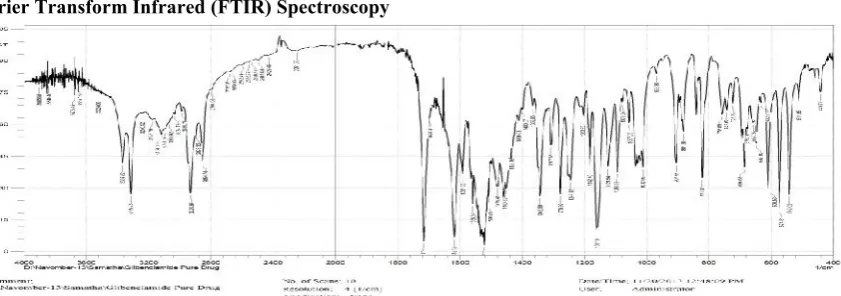
(4) Kondam Samatha. et al., Int. J. Pharm & Ind. Res., Vol.–04 (01) 2014 [8 - 16]. (FD) (average of calliper measurements with an angle of rotation of 1o). Next to the mean feret diameter, each individual pellet was characterized by aspect ratio (AR) (ratio of the longest feret diameter and its longest perpendicular diameter) and two dimensional shape factor, as described by following equation.. Where r is the pellet radius, Pm is the perimeter; l is the pellet length (longest Feret Diameter) and b is the pellet width (longest diameter perpendicular to the longest Feret Diameter). Scanning electron microscopy (SEM)15,16 Morphology and surface topography of the core and the coated pellets were studied by scanning electron Microscopy. (SEM‐JEOL, JSM‐840A, Japan). The samples were mounted on the SEM sample stab, using a double‐sided sticking tape and coated with gold (200A0) under reduced pressure (0.001 torr) for 5 min using an Ion sputtering device (JEOL, JFC‐1100 E, Japan). Fourier transform- infrared spectroscopic analysis (FT- IR)17,18 Drug-excipient compatability study was performed by Fourier transform infrared (FTIR) Spectroscopy. In the preparation of formulation, the drug and polymers were in close contact with each other, which could leads to instability of drug. Thus preformulation studies regarding drug-polymer interaction is very important in selecting appropriate polymers. Thus FTIR spectroscopy study was performed to determine the compatibility between the selected drug and polymer.. Results and discussion. 11. In vitro Disintegration time Studies19 The disintegration time is the time when a film starts to break or disintegrate. The in vitro disintegration time of pellets was determined visually in a glass dish of 25 ml distilled water with swirling every 10 sec. In-vitro drug release studies20,21 The release profile of Glibenclamide from prepared pellets in phosphate buffer pH 6.8. The media of pH 6.8 simulates the pH of the oral salivary secretions. The dissolution process was carried out by USP Type II (Electro lab TDT-08L USP, Mumbai, India) rotating paddle apparatus. The drug loaded pellets (equivalent to 5mg of Glibenclamide) were placed into the dissolution media (900ml) and the paddle was kept at a constant speed 50rpm and temperature 37±0.5oC. The test was carried out for 1hr at regular intervals of 5, 10, 15, 30min. The sample 5ml was withdrawn and replaced with same volume of fresh media. The withdrawn samples were filtered through a 0.4µm membrane filter. Glibenclamide concentration was estimated spectrophotometrically using UV Spectrophotometer at λmax 227nm. Stability studies of pellets The drug loaded pellets equivalent to 5mg of Glibenclamide were taken in a glass vial and it was sealed using aluminium packaging coated inside with polyethylene. The study was carried out as per ICH guidelines at 40oC and 75% RH for three months. The pellets were withdrawn periodically and evaluated for the friability, disintegration, drug content and in-vitro drug release studies. The values for in vitro drug release from the pellets were calculated and were compared for change in the dissolution profile.. Fourier Transform Infrared (FTIR) Spectroscopy. Fig. No. 01: FTIR spectra of pure drug Glibenclamide www.ijpir.com.
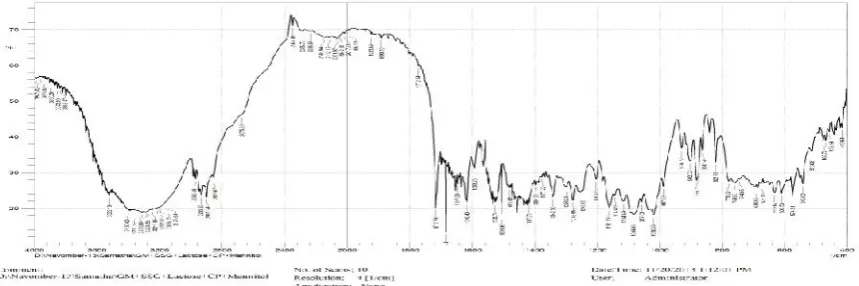
(5) 12. Kondam Samatha. et al., Int. J. Pharm & Ind. Res., Vol.–04 (01) 2014 [8 - 16]. Fig. No. 02: FTIR spectra of optimum formulation F2 FTIR studies was carried out for the pure drug – Glibenclamide, optimum formulation F2 and their spectra are as shown in fig 1& fig 2 respectively. Fig. No. 03: Structure of Glibenclamide The characteristic peaks of the pure drug – Glibenclamide was assigned from standard literature. These included N-H stretching (hydrogen-bonded), C-N stretching in primary aromatic amine, C-Cl stretching, symmetric SO2 stretching and are as shown below. 1. 3178.79: N-H stretching(hydrogen-bonded) 2. 1697.41: C=O stretching 3. 1307.78: C-N stretching in primary aromatic amine 4. 1182.40: symmetric SO2 stretching 5. 742.62: C-Cl stretching As seen in fig 1, the spectra for Glibenclamide exhibits a peak at 3178.79 due to primary and secondary amine (N-H) stretching vibration, 1697.41 due to C=O stretching vibration, 1307.78 due to C-N stretching in primary aromatic amine. The FTIR results from optimum formulation (F2) exhibited peaks at 3174.94 due to primary and secondary amine(N-H) stretching vibration, 1663.66 due to C=O stretching vibration, 1417.73 due to C-N stretching in primary aromatic amine. The intensity and position of these characteristic peaks permits easy interpretation of any possible. interaction between the drug and the excipients in the formulation. The results clearly showed that there was no interaction between the drug and the excipients in the prepared formulation F2. The drug Glibenclamide was intact and there was no sign of any degradation due to preparative processes adopted during the loading of the drug into oral fast disintegrating pellets. Pellet size analysis The pellet size of the drug loaded formulations was measured by optical microscope which showed for formulations (F1-F8) of 3 different sizes of pellets of which the minimum size ranges from 1.011.16mm and of the maximum size ranges from 1.20-1.41mm. The maximum size of the pellet of 1.41mm for the formulation F2 was considered as the optimum required size of the pellets. Friability Friability of the pellet formulations was in the range 0.606 to 0.848 and it lies in the expected range less than 1% as per FDA specifications. Friability is measure to assess the mechanical strength of the pellets interms of fragmentation or powder during handling and transit. From the data it was concluded that amount of MCC found to influences the friability. Less moisture content helps to produce pellets with good mechanical strength. As the curing temperature was increased (45oC for 24hrs), friability of the pellets was found to decrease and pellets having shrunken porosities due to loss of moisture. When the pellets were cured below 40oC dumbbell shaped pellets were obtained with protruding surfaces. Due to presence of more moisture content, these pellets were considered not suitable for pharmaceutical purpose.. www.ijpir.com.
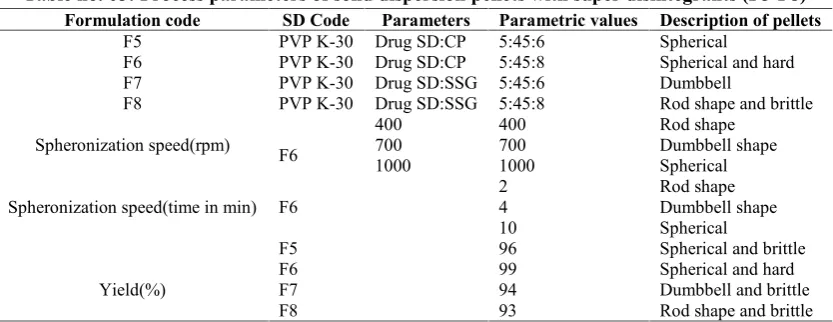
(6) Kondam Samatha. et al., Int. J. Pharm & Ind. Res., Vol.–04 (01) 2014 [8 - 16]. Content Uniformity The content uniformity test was performed to ensure uniform distribution of drug. The content uniformity was performed for all the formulations and was tabulated in table no. 3. Obtained results indicate that in the all the formulations drug. 13. content was uniform and ranged between 92.82 % to 96.08 %. The cumulative percent drug released by each film in the in vitro release studies was based on the mean content of drug present in the respective pellets.. Table no. 03: Evaluation parameters of Glibenclamide pellets Formulation F1 F2 F3 F4 F5 F6 F7 F8. Particle size(mm) 1.35 1.41 1.20 1.29 1.36 1.39 1.32 1.32. Pellet sphericity The results of the sphericity (aspect ratio) showed a reduction of pellet sphericity when using the higher spheronization load. This might be due to higher pellet agglomeration incase of higher spheronization load. The influence of spheronization load on the sphericity of MCC. Drug content(%) 94.56 96.08 93.06 94.06 94.42 95.86 92.82 94.56. Friability(%) 0.66 0.60 0.90 0.78 0.84 0.72 0.75 0.80. based pellets and concluded that a longer spheronization load. In our case prolonged spheronization was not possible. Since it would lead to excessive agglomeration. The calculated sphericity value of the optimized pellets F2 was found nearer to 1 which confirms the pellets of F2 were spherical in nature.. Table no. 04: Process parameters of solid dispersion pellets with super disintegrants (F1-F4) Formulation code F1 F2 F3 F4 Spheronization speed(rpm) Spheronization speed(time in min). Yield(%). SD Code PEG PEG PEG PEG F2. Parameters Drug SD:CP Drug SD:CP Drug SD: SSG Drug SD:SSG 400 700 1000. F2 F1 F2 F3 F4. Parametric values 5:45:6 5:45:8 5:45:6 5:45:8 400 700 1000 2 4 10 97 99.2 95 92. Description of pellets Spherical Spherical and hard Dumbbell Rod shape and brittle Rod shape Dumbbell shape Spherical Rod shape Dumbbell shape Spherical Spherical and brittle Spherical and hard Dumbbell and brittle Rod shape and brittle. Table no. 05: Process parameters of solid dispersion pellets with super disintegrants (F5-F8) Formulation code F5 F6 F7 F8 Spheronization speed(rpm) Spheronization speed(time in min). Yield(%). SD Code PVP K-30 PVP K-30 PVP K-30 PVP K-30 F6. Parameters Drug SD:CP Drug SD:CP Drug SD:SSG Drug SD:SSG 400 700 1000. F6 F5 F6 F7 F8. www.ijpir.com. Parametric values 5:45:6 5:45:8 5:45:6 5:45:8 400 700 1000 2 4 10 96 99 94 93. Description of pellets Spherical Spherical and hard Dumbbell Rod shape and brittle Rod shape Dumbbell shape Spherical Rod shape Dumbbell shape Spherical Spherical and brittle Spherical and hard Dumbbell and brittle Rod shape and brittle.
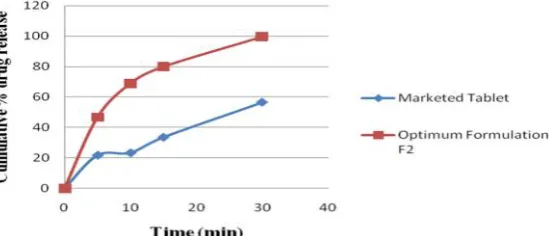
(7) 14. Kondam Samatha. et al., Int. J. Pharm & Ind. Res., Vol.–04 (01) 2014 [8 - 16]. Scanning electron microscopy (SEM) SEM photograph of the pellets (optimized formulation F2) showed spherical nature and smooth surface of pellets as they were cured at 2hrs at 40oC. SEM photo micrograph of the pellets revealed. The uniform distribution of the drug in the pellets. In-vitro disintegration study Disintegration test of the pellets were performed by dissolving the pellets in a glass beaker containing 25 ml of water with occasional gentle swirling and shaking for every 10 sec. The disintegration time is the time when the pellets start to break or disintegrate and time was noted. Results of disintegration time of all the formulations were tabulated in table no6. The disintegration time of all the formulations were in a range of 194 ± 2 sec to 655 ± 1.9 sec. In-vitro dissolution study The dissolution profile of prepared pellets for the formulations (F1-F4) which contains PEG 6000 SD (solid dispersion) with two different concentrations of crosspovidone and sodium starch glycolate. The minimum drug release of (91.9%) at the end of 30min.for the formulation F4 was obtained which contains Sodium starch glycolate as the super disintegrant. The release (99.7%) for more in case. of pellets (F2) loaded with PEG 6000 SD (solid dispersion) along with crosspovidone as superdisintegrant. The dissolution profile of prepared pellets for the formulations (F5-F8) which contains PVP K-30 with two different concentrations of crosspovidone and sodium starch glycolate. The minimum drug release of (93.39%) at the end of 30min. For the formulation F7 was obtained which contains Sodium starch glycolate as the super disintegrant. The release (96.76%) for more in case of pellets (F6) loaded with PVP K-30 SD (solid dispersion) along with crosspovidone as superdisintegrant. The optimised formulation (F2) was selected based on the highest drug release of 99.7% at the end of 30min.Which was considered as desired drug release from the pellet formulation. This highest drug release was obtained due to the solid dispersion formulation of the drug with PEG 6000 which ultimately enhanced the poorly soluble Glibenclamide. Further loading of this Solid dispersion into the pellet formulation along with crosspovidone provided maximum drug release with in 30min. This in-vitro drug release profile of optimized formulation F2 was compared with the marketed formulation of Glibenclamide tablet (5mg) which showed 56.5% of drug release at the end of the 30min.. Fig. No. 04: In-vitro Dissolution profile of formulations F1-F8. Fig. No. 05: Comparative drug release study for marketed tablet and optimized formulation. www.ijpir.com.
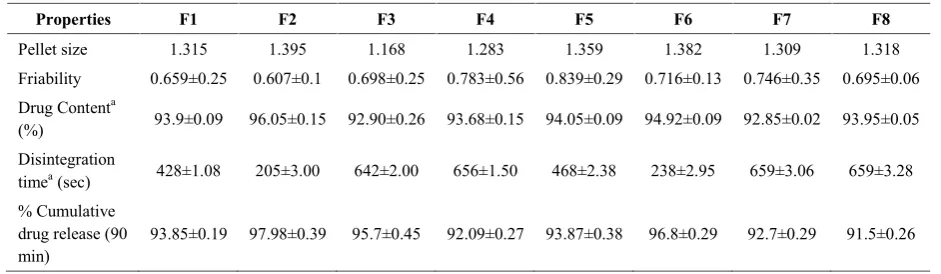
(8) 15. Kondam Samatha. et al., Int. J. Pharm & Ind. Res., Vol.–04 (01) 2014 [8 - 16]. Table no. 06: Evaluation parameters of Glibenclamide pellets: Properties Pellet size. F1. F2. F3. F4. F5. F6. F7. F8. 1.352. 1.417. 1.202. 1.293. 1.361. 1.395. 1.329. 1.324. 0.666±0.31. 0.606±0.12. 0.709±0.13. 0.787±0.33. 0.848±0.14. 0.727±0.17. 0.757±0.11. 0.703±0.09. Drug Content (%). 94.56±0.05. 96.08±0.26. 93.06±0.16. 94.09±0.13. 94.42±0.07. 95.86±0.10. 92.82±0.04. 94.56±0.06. Disintegration timea (sec). 426±1.318. 194±1.00. 630±1.90. 646±1.00. 465±2.20. 223±1.80. 642±2.10. 655±1.50. % Cumulative drug release (90 min). 94.91±0.27. 98.5±0.42. 96.2±0.29. 92.9±0.46. 95.6±0.25. 97.1±0.17. 93.1±0.66. 92.71±0.40. Friability a. Table no. 07: Stability studies of Glibenclamide pellets Properties. F1. F2. F3. F4. F5. F6. F7. F8. Pellet size. 1.315. 1.395. 1.168. 1.283. 1.359. 1.382. 1.309. 1.318. Friability. 0.659±0.25. 0.607±0.1. 0.698±0.25. 0.783±0.56. 0.839±0.29. 0.716±0.13. 0.746±0.35. 0.695±0.06. Drug Contenta (%). 93.9±0.09. 96.05±0.15. 92.90±0.26. 93.68±0.15. 94.05±0.09. 94.92±0.09. 92.85±0.02. 93.95±0.05. Disintegration timea (sec). 428±1.08. 205±3.00. 642±2.00. 656±1.50. 468±2.38. 238±2.95. 659±3.06. 659±3.28. 93.85±0.19. 97.98±0.39. 95.7±0.45. 92.09±0.27. 93.87±0.38. 96.8±0.29. 92.7±0.29. 91.5±0.26. % Cumulative drug release (90 min). Conclusion Glibenclamide pellets were formulated by Extrusion- spheronization method by using solid dispersion drug, microcrystalline cellulose as spheronization aid, crosspovidone and sodium starch glycolate as super disintegrants. The drug excipient compatibility studies were performed by using IR spectroscopy and found that they were compatible. All formulations were prepared into the pellets and analysed for the parameters such as % friability, pellet size, pellet sphericity, drug content, SEM and % drug release. Drug loaded pellets exhibited spherical nature as evidenced by SEM photomicrographs and sphericity studies. Invitro dissolution studies for all formulations were carried out and % drug release was calculated. Stability studies were conducted for optimized formulation (F2) as per ICH guidelines at 40oC and 75%RH for three months and no changes were observed. Finally it was concluded that the optimised formulation F2 pellets had maximum drug release within a shorter period of time rather than the marketed formulation. Hence better absorption and bioavailability of the drug can be achieved.. References 1.. Tejas B Patel et.al 2010 formulation and characterization of solid dispersions containing Glibenclamide.. V.Manimaran et.al 2010 Enhancement Of Dissolution Rate Of Glibenclamide By Solid Dispersion Technology. 3. Mogal S. A,et.al,2012, Solid Dispersion Technique For Improving Solubility Of Some Poorly Soluble Drugs 4. .Karim D. Khalaf, et.al 2012, Spectrofluorimetric method for the determination of glibenclamide in pharmaceutical formulations 5. Patil Sudarshan S. 2009 development and validation of analytical method for simultaneous estimation of glibenclamide and metformin hcl in bulk and tablets using uv – visible spectroscopy 6. V.N.L.Sirisha et.al,2012 Preparation and Invitro Evaluation of Liquid solid compacts of Glibenclamide. 7. Gandhi Bipin et.al 2012 Development And In Vitro Evaluation Of Multiparticulate Controlled Drug Delivery System 8. V V N Haritha et.al 2012 Multiparticulate drug delivery system: Pelletization 9. Nagasamy Venkatesh Dhandapani et.al, 2012 Pelletization by Extrusion-Spheronization:A detailed review. 10. Punia Supriya et.al 2012, Pelletization Techniques: A Literature Review. 2.. www.ijpir.com.
(9) 16. Kondam Samatha. et al., Int. J. Pharm & Ind. Res., Vol.–04 (01) 2014 [8 - 16]. 11. shailesh l. et.al, 2012, controlled release approach to novel multiparticulate drug delivery system 12. Chun-Woong Park et.al 2012 Preparation and in vivo evaluation of immediate-release pellet containing celecoxib solid dispersion. 13. M. Srujan Kumar et.al 2012, Formulation and Evaluation of Multiunit Pellet System of Venlafaxine Hydrochloride 14. Juhong Guo et.al 2011, Sodium bicarbonatecoated omeprazole immediate-release pellets to improve bioavailability by improving stability in gastric acid. 15. Raju Nuka et.al ,2012, Formulation Development And In-Vitro Evaluation Of Ramipril Micropellets. 16. Vikash Dash Et.al 2012 pelletization technique in drug delivery system.. 17. Udayakumar T et.al 2013 formulation and evaluation of immediate and sustained release bilayered Tablet with glibenclamide and metformin hydrochloride 18. Cicy Eapen et.al 2012 Development of UV Spectrometric method of Glibenclamide in Bulk and pharmaceutical formulations. 19. Hiten A Panchal et.al 2012 Formulation Develoment and in-vitro Evaluation of Bilayer tablets of Glibenclamide immediate release and Metformin HCL as Sustained release. 20. Rakesh Pahwa1 et.al 2011 Formulation and Evaluation of Floating Multiparticulate Drug Delivery System of Glipizide. 21. Hindustan Abdul Ahad, Development and in Vitro Evaluation of Glibenclamide Aloe barbadensis Miller leaves Mucilage Controlled Release Matrix Tablets.. www.ijpir.com.
(10)
Figure
+3
Related documents
Keith Mann, the academic dean at Stanford, wrote to the Duke Dean Walter Dellinger that Jim’s teaching had earned him.. Copyright © 2016
The regression result indicate the education attainment of the household head, gender, household size, age square of household head, household assets, income of
This study aims to examine the test-retest reliability and relative validity of the New Zealand Adolescent FFQ (NZAFFQ) to assess food group intake in adolescents aged 14 to 18
Even in the new product development process through open innovation, firms also try to make unique products with different resources outside.. Considering that open innovation is
Mice were monitored before the treatment to get the baseline and at 4, 24 and 48 h post treatment by in vivo image analysis drawing a region of interest (ROI) over the chest and
The results also show that the optimal spacing remains constant with change of the tube position at constant Rayleigh number, and the agreement between the
The created an Value Stream Mapping to analyze the waste of time and time travel will reduce through the map at an values provided like cycle time, value added
In all the proposed algorithms and also in the "Cuckoo" algorithm, first in the formation of cluster phase, an experimental clustering is done based on LEACH
