SHIV SHAKTI
International Journal of in Multidisciplinary and
Academic Research (SSIJMAR)
Vol. 5, No. 2, April 2016 (ISSN 2278 – 5973)
Cluster Based Routing Protocol in
MANETs
Ms. Deepika
M. Tech Student,
Department of Computer Science & Engineering MDU University Rohtak (Haryana)
Anjali Namdev HOD, S.I.T.M., Rewari
Abstract: In Mobile Ad-hoc Networks (MANETs), many clustering schemes are proposed. The systematic classification is used. Theseschemes provides the better understanding and for better improvements. The Cluster Based Routing Protocol (CBRP) which is robust and scalable. The CBRP provides the functionality for better efficiency than other routing protocol such as Proactive and Reactive protocols. In CBRP clustering process is used to divides the network into groups of nodes. It is based on rules that nodes are allocated to different sub -network. The clustering scheme achieves high scalability in presence of large no. of networks and high mobility. The CBRP used for Reusability and coordination of resources to increase system capacity, reduce transmission and collision. In the CBRP enhance Performance and Energy efficiency. This paper represents clustering algorithm, routing algorithm.
Keywords: MANETs, Clustering, Routing, CBRP
Impact Factor = 3.133 (Scientific Journal Impact Factor Value for 2012 by Inno Space Scientific Journal
Impact Factor)
Global Impact Factor (2013)= 0.326 (By GIF)
Indexing:
Cluster Based Routing Protocol in
MANETs
Abstract: In Mobile Ad-hoc Networks (MANETs), many clustering schemes are proposed. The systematic classification is used. Theseschemes provides the better understanding and for better improvements. The Cluster Based Routing Protocol (CBRP) which is robust and scalable. The CBRP provides the functionality for better efficiency than other routing protocol such as Proactive and Reactive protocols. In CBRP clustering process is used to divides the network into groups of nodes. It is based on rules that nodes are allocated to different sub -network. The clustering scheme achieves high scalability in presence of large no. of networks and high mobility. The CBRP used for Reusability and coordination of resources to increase system capacity, reduce transmission and collision. In the CBRP enhance Performance and Energy efficiency. This paper represents clustering algorithm, routing algorithm.
Keywords: MANETs, Clustering, Routing, CBRP
1.
Introduction
The basic principle behind ad hoc networking is multi-hop, in
which messages are sent from the source to the destination through the nodes. The communication between two ends of nodes is carried out through the number of intermediate nodes whose function is to relay the information from one point to another. In the last few years in multi hop ad hoc networks in which relaying nodes in general mobile, communication needs are primarily between nodes within the same network. It is peer to peer network without any
centralized server.
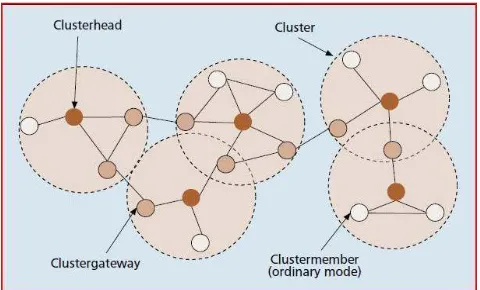
MANETs represent complex distributed system. The wireless Figure 1: Cluster Structure
mobile nodes can freely and dynamically self-organize in ad- A typical cluster structure has shown in figure. It can be seen
hoc network topologies. that different nodes are grouped to form a structure called as
Applications of MANETs
cluster on the basis of closeness and other factors. In any cluster structure there every mobile node is assigned with a 1. Military applications status or function .on the basis of their work and status nodes 2. Collaborative and Distributed Computing in any structure can be divided into three categories.
3. Emergency Operations
Issues in MANETs 2.1 Cluster Head
1. Distributed operation It is a co-coordinator of a cluster it performs intra-cluster 2. Hidden terminals routing packet forwarding. A Cluster head is use to resource 3. Access delay management for its member nodes and perform inter-cluster
and intra-cluster communication. It works as base station. A
2.
Literature Survey
cluster is shown in the above figure with dark-filled circles.Clustering: Division of network into different virtual groups, 2.2 Gateway Node
based on certain rules in order to differentiate the nodes
A cluster gateway is anon cluster head node with inter-allocated to other sub-network. In simple words we can say
clusters links. It can access neighboring clusters and that clustering in MANET is done by virtual partitioning of
exchanges cluster-related information between two clusters. nodes into sub-networks according to geographical area.
It acts as a common or distributed access point between two cluster head. Gateway nodes are of two types:
transmission between them then this node is called as ordinary gateway node for those two clusters.
(b) Distributed gateway node:- When a node is a one-hop neighbor of a cluster head and it is connected to other node that is also immediate neighbor of other cluster head so that both cluster head can communicate with each other via 2-hop neighbors then those two nodes are termed as Distributed gateway node.
Ordinary node: These are the nodes that exist as immediate neighbor of cluster head. They are cluster member but take part in topology and can act as cluster head or cluster gateway when there is a requirement.
Cluster control architecture: There are two kind of cluster control architecture one-hop and d-hop depending upon the diameter of the cluster in one-hop control architecture every ordinary node remain at maximum of one hop distance to its cluster head and in d-hop the distribution of ordinary node may be greater than one and at maximum of d-hop distance from central coordinator.
Structure of a cluster: Nodes in MANET can either be in flat structure or hierarchical structure.
In flat structure every node beers equal responsibility to perform any task. It works fine for small networks but for large networks there has been high communication overhead a network will be flooded through data packets.
In Hierarchical structure every node is assigned with certain task or nodes are divided to act efficiently. Like gateway node is responsible for inter or intra cluster communication, cluster head act as central co-coordinator etc.
3. Implementation to the Cluster-Based Routing
Protocol
In hierarchical structure nodes in a network are organized into partitions called clusters. The nodes are in geographical area & close to each other to form a cluster. Then each cluster elects a centralize node called the cluster head. The cluster head which acts as a coordinator for that cluster. Dividing a network into clusters helps to maintain network table topology. Clustering in ad-hoc network is more manageable. Size of any cluster can be controlled with the help of transmission power of its dynamic node.
There are certain rules and algorithm in order to divide a network into clusters and select a cluster head among them. Any clustering algorithm partitions the network in an optimize way. Several clustering algorithms have been proposed some of them are very plain and simple and some of them are utilizing different parameters of ad-hoc network (i.e. mobility, transmission power, closeness etc).
3.1 Cluster Formation
3.1.1Identifier Based Clustering
• Nodes itself consider as cluster head when it has the lowest
• Every node broadcasts its own ID to all other neighboring node periodically and in form of any “HELLO” message.
• Nodes that receive messages from its neighboring node compare their Ids and the node with lowest ID has been selected as a cluster head.
If a node here broadcast message from two of its neighboring nodes has become a Gateway node.
3.1.2 Connectivity Based Clustering
The node which contains more neighbor nodes is itself considered as the cluster head.
Each node broadcasts value of its degree i.e. no. Of neighbors connected to that node.
A node with highest value of degree in the neighborhood is selected as cluster head and all other neighboring nodes join as a cluster member. The procedure is continuously repeated until each node is assigned a cluster head.
The CBRP uses lowest-ID algorithm, which is an identifier-based algorithm. Each node uses a neighbor table. Information stored in a neighbor table is:
• Unique Node IDs in the cluster i.e. Cluster head / Member node.
• Status of the link of that particular node i.e. Unidirectional or Bidirectional.
The neighbor table is maintained sending HELLO messages periodically. HELLO message which contains information about a node‟s state, neighbor table and cluster adjacency table. CBRP uses two types of data structures for routing process:
1)The Cluster Adjacency Table - It stores information about neighboring clusters, in which the links are bi-directional or unibi-directional.
2)The Two-Hop Topology Database - It contains all nodes that are at most two hops away.
a.Discover the route from a source node „S‟ to destination node „D‟.
b.Actual transmission of the data packet from source to destination.
4. Routing Mechanism
4.1 Route Discovery
4.2 Route Reply
References
When RREQ request packet reaches to the destination then it contains the path called as “Loose Source Route” i.e. [S,C1,C2,…Ck,D].
Destination D sends RREP i.e. Route Reply message to the Source S with “Reverse Loose Source Route” i..e. [D,Ck,….C1,S].
Each time cluster head receives Route Reply Message and compute “Strict Source Route” which then computes shortest path to the destination.
4.3 Route Error Detection
When determining the route, source routing is used for actual packet transmission from source to destination. When next hop is unreachable then it sends Route Error Message (ERR).
4.4 Local Route Repair
Objective:
a) It is used to increase packet delivery ratio. b) It prevents from Route Rediscovery traffic. c) Reduce delay for overall route.
d) The Broken Route can be repair using 2 hop topology & modifies source route.
e) When modifies the route, destination node sends “Gratuitous Route Reply” message.
5. Features of CBRP
5.1Advantages:
a)Minimize route discovery traffic and routing overhead. b)Uses “local repair” mechanism to reduce delay and new
route discovery traffic.
c)Increases the packet delivery ratio.
5.2Disadvantages
a)When increases cluster size, overhead on packet must be increases.
b)The transmission time increases when cluster size increases.
c)Communication complexity is increased.
6. Conclusion
Ad hoc network plays critical role in wireless connection network than wired network. The CBRP is a robust and scalable routing protocol. CBRP provides better efficiency. The simplification for addressing is providing in CBRP. Stability and Localization is providing to the network. The CBRP Update and Maintain the information that stored in the cluster. Allows the application to define the own clustering objectives in network. In CBRP limited energy consumption can be done. Balance the traffic in clustering.
[1] Tim Daniel Hollerung. The Cluster-Based Routing Protocol,PP.5-8,WinterSemester2003/2004. hollerung.org/daniel/en/studies/the-cluster-based-routing-protocol/pdf
[2] M. Rezaee, M. Yaghmaee. Cluster based Routing Protocol for Mobile Ad Hoc Networks. www.dcc.ufla.br/infocomp/artigos/v8.1/art05.pdf [3] Mainak Chatterjee, Sajal K. Das & Damla Turgut.
WCA: A Weighted Clustering Algorithm for Mobile Ad Hoc Networks. Published in Cluster Computing, Vol-5,
PP.193–204, Year-2002
http://citeseerx.ist.psu.edu/viewdoc/download?doi=10.1. 1.8.5353&rep=rep1&t ype=pdf
[4] http://en.wikipedia.org/wiki/List_of_ad_hoc_routing_pr otocols
[5] Mingliang Jiang. CBRP: A cluster-based routing protocol for mobile ad hoc networks. www.comp.nus.edu.sg/˜tayyc/cbrp/hon.ppt.
[6] Mukesh Kumar, Rahul Rishi, D.K. Madan. Comparative Analysis of CBRP, DSR, AODV Routing Protocol in MANET. Published in (IJCSE) International Journal on Computer Science and Engineering Vol. 02, No. 09, Year-2010, PP.2853-28581
[7] B. Williams, D. P. Mehta, T. Camp, and W. Navidi, “Predictive models to rebroadcast in mobile ad-hoc networks,” IEEE Trans. Mobile Comput.,vol. 3, no. 3, pp. 295–303, Jul.–Sep. 2004.
[8] H. Zhang and Z. P. Jiang, “Performance analysis of broadcasting schemes in mobile ad hoc networks,” IEEE Commun. Lett., vol. 8, no. 12, pp. 718– 720, Dec. 2004.
[9] K. Viswanath and K. Obraczka, “Modeling the
performance of flooding in wireless multi-hop ad hoc networks,” Comput. Commun., Int. J. Perform. Eval. Wireless Netw. Commun., vol. 29, no. 8, pp. 949–956, 2006.
[10]H. Shah-Mansouri and M. R. Pakravan, “An upper bound on the performance of non-repetitive flooding over CSMA in wireless ad-hoc networks,” in Proc. IEEEICC, Dresden, Germany, Jun. 2009, pp. 1–5. [11]H. Shah-Mansouri and M. R. Pakravan, “Performance
analysis of flooding over CSMA in wireless ad-hoc networks,” in Proc. IEEE PIMRC, Cannes, France, Sep. 2008, pp. 1–5.
[12]J. Sucec and I. Marsic, “Clustering overhead for hierarchical routing in mobile ad hoc networks,” in IEEE Infocom ,2002.
[13]Jane Y. Yu And Peter H. J. Chong, Nanyang Technological University: A Survey Of Clustering Schemes For Mobile Ad Hoc Networks.
[14]R. Agarwal and M. Motwani, “Survey of Clustering Algorithms for MANET,” International Journal on Com-puter Science and Engineering ,Vol. 1, No. 2, 2009.
[16]A.S.Salunkhe , Dr.S.V.Sankpal” Performance Evaluation Using Cluster Based Routing Protocol for MANET”, Volume 2, Issue 1, January 2013
[17]Dang Nguyen, Pascale Minet, Thomas Kunz and Louise Lamont” On the Selection of Cluster Heads in MANETs”, IJCSI International Journal of Computer Science Issues, Vol. 8, Issue 2, March 2011