© 2013, IJCSMA All Rights Reserved, www.ijcsma.com 27
Implementing Asymmetric-Key
Cryptography using Parallel-Key
Cryptographic Algorithm (PCA)
Archana B.Kadga
Assistant Professor at SMSMPITR, Akluj Dist.Solapur (Maharastra) [email protected]; [email protected]
Abstract
In this day, the necessity of security and protection of computer information on network has become more and more important. In cryptography, asymmetric-key is the framework with high flexibility which can be applied to most of cryptographic systems using today. To reduce the encryption and decryption time which is the main drawback of asymmetric-key cryptography, we have proposed a new mechanism called “Parallel-key Cryptographic Algorithm (PCA)” which accelerates the cryptographic system in encryption and decryption process and strengthens the system against Brute force attack. We have shown that, in our practical experiment results, our proposed algorithm can perform faster in encrypting and decrypting message than other asymmetric-key cryptographic algorithm; RSA (Rivest, Shamir and Adleman). In our theoretical analysis, we have shown that PCA can provide the security against Brute force attack better than other algorithms. Furthermore, PCA can be applied to parallel computing and cryptographic mode such as Cipher Block Chaining (CBC) and Interleaved Cipher Block Chaining (ICBC) for higher efficiency.
Keywords: PCA; RSA; Brute force attack; Cipher block Chaining
1.
Introduction
In the field of computer security, there is a large quantity of papers discussing on cryptography. In cryptography, there are two types of mechanisms based on key usage : symmetric key, and asymmetric-key. In symmetric-key cryptography, the same key is used for both encryption and decryption. This mechanism requires a sender and a receiver agree on a secret key before they can communicate securely. From this requirement, there is a big disadvantage on a key exchanging and a limitation on the number of keys which is up to n2, where n is a number of participants in a group. As we will see, a large number of keys needs to be maintained in group . While in asymmetric-key cryptography, a number of keys which need maintaining in group is only 2n. Asymmetric-key mechanism, however, has a big disadvantage over symmetric-key in terms of encryption and decryption process. Our proposed mechanism will come over this issue.
© 2013, IJCSMA All Rights Reserved, www.ijcsma.com 28
plaintext block is exclusive-ored with the previous ciphertext block. This method can prevent an algorithm from replay attack which is the main method in attacking of traditional Electronic Code Book (ECB).
This paper has proposed a new cryptographic algorithm using the feature of asymmetric-key cryptography, and the advantage of adding a couple of a key pair to accelerate the algorithm. Our proposed algorithm is strengthen against the problem of Factorization attack and Brute force attack, as well as it allows users to communicate faster and more secure through public
insecure channel, such as internet. This makes our proposed mechanism more attractive. This paper is organized as follows: The proposed algorithm of our scheme is described in section 2. Section 3 shows the results of our experiment. The experiment result analysis is given in section 4. Section 5 shows how our scheme can improve of prevention on attacking. At the end, we conclude our paper in section 5.
2. Proposed algorithm
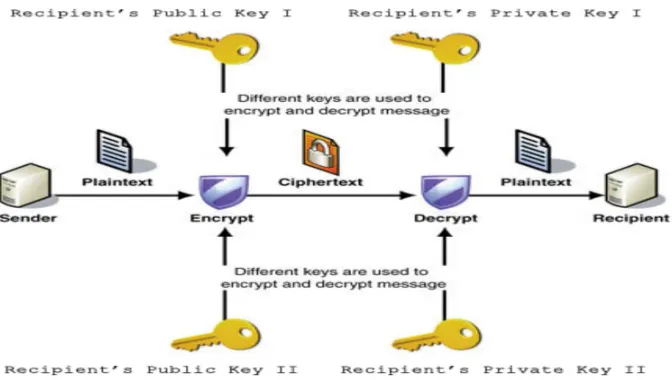
Figure 1. Parallel-key Cryptographic Algorithm (PCA)
Figure 1 shows the main process of our proposed algorithm, so called Parallel-key Cryptographic Algorithm (PCA). The protocol in sending plaintext from a sender to a recipient contains a few methods which can be classified as follows:
- Key generating process: This is a method of generating a couple of key pair. The first key pair has a key length more than the second one.
© 2013, IJCSMA All Rights Reserved, www.ijcsma.com 29
Figure 2. Encryption process of Parallel-key Cryptographic Algorithm
Figure 2 shows the encryption process of two Public-keys (called Parallel-key) which each key will encrypt plaintext randomly, and the process of two keys is independent. Key length of each key pair is not equal to each other. Firstly, key pair has a long term key same as RSA (called “Major key”), so we use the length of
Major key as the representative key length of this algorithm. Another one has a short term of key (called “Minor key”), this key is the key to accelerate encryption and decryption process by using cryptographic method mentioned above. Only true recipient can decrypt cipher text correctly by using the Extension which is sent to recipient as attachment following the cipher text. At the end of encryption process, the Extension
mentioned above has to be encrypted by both public keys (from Major and Minor key). From this idea of encrypting plaintext with two public-keys (as shown in Figure 2), now the attackers must do much more than only to break equations of two asymmetric-key pairs and to get the original plaintext correctly.
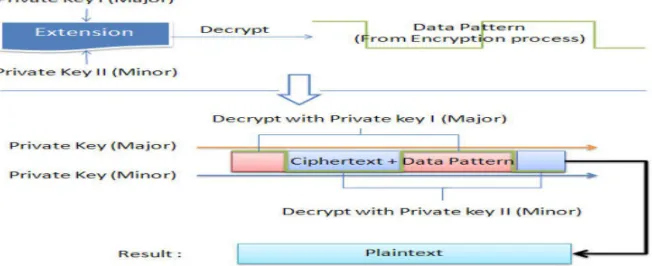
- Decryption: First, decryption process has to decrypt the Extension with two private-keys (from Major and Minor key). After the Extension decrypted with two private-keys, now we have to decrypt the cipher text by following to the extension which already decrypted, just like the encryption process. The reason for adding Minor key in encryption and decryption process is to accelerate the algorithm without reducing the level of security. A speed of algorithm depends on key lengths. Obviously, using two pairs of keys with a shorter key length of one key pair will accelerate thisalgorithm. By this principle, now PCA is able to encrypt and decrypt messages confidentially just like other cryptographic algorithms. The decryption process of PCA is shown in Figure 3 below:
Figure 3. Decryption process of Parallel-key Cryptographic Algorithm
© 2013, IJCSMA All Rights Reserved, www.ijcsma.com 30
In our experiments, the proposed algorithm was tested on a PC equipped with a dual-core processor at 2.4 GHz and 3 GB of RAM on MS-Windows OS. In this experiment, we used Major key to encrypt 50% of plaintext blocks. The length of Major key is 1024 bits which equal to the key length of RSA used in this experiment. We have found that, our algorithm used encryption and decryption time less than RSA, as shown in the table below.
In practical experiment result, the key length of PCA is represented by Major key length which is the main key pair in preventing algorithm from Brute force attack. From the experiment result, it shows that PCA can encrypt and decrypt messages faster than RSA. In practical, Minor key length should longer or equal to 512 bits to prevent the Factorization Attack. By using the feature of parallel-key mechanism, for more speed, PCA can be applied to parallel computing and some cryptographic mode e.g. Interleaved Cipher Block Chaining (ICBC) for more efficiency.
4. Attacks analysis
There is a number of attacks on Asymmetric-key cryptography which PCA based on. Hence, attacks on Asymmetric key are the same types on PCA. The important types of attack on PCA can be categorized as follows:
Factorization Attack Brute force attack
Factorization Attack: a type of attack which tries to find the factors of a large number (called “Public Modulus”, n) with the polynomial time complexity in a short possible period of time. By using the parallel-key pair (two key pairs), PCA can prevent the message, from attacker in more secure because PCA has two key pairs. Then, attacker has to do much more work in breaking two asymmetric-key pair with PublicModulus of their own.
Brute force attack: a type of attack which tries to find all possible private-key for complete decryption. In practical, the small private-key d, would make the decryption faster. But, from the study of key size, Wiener showed that a small size of d is easy to break with the special type of attack based of continuous fraction.
Then, for RSA, the recommendation is to haveto prevent low decryption exponent attack, where n is a Public Modulus. By using a benefit of parallel-key mechanism, PCA can fight against Brute force attack better than common asymmetric-key cryptographic algorithm. In theoretical calculation of Bruteforce attack, we assume that Major key and Minor key length are 1024 and 512 bits, respectively. In this calculation, PCA will be compared with RSA (1024 bits) by assuming that the attack on both algorithms operated on the same computer which can perform 1 million operations per second.
© 2013, IJCSMA All Rights Reserved, www.ijcsma.com 31
still prevent algorithm from low decryption exponent attack. The time of Brute force on RSA 1024 bits is shown as follows:
time of selecting two corresponding messages mentioned above is shown as follow:
Where h and k are a number of Major and Mino key respectively. After the process of selection, the next step to complete Brute force attack on PCA is to find a reliable plaintext by combining two corresponding decrypted messages mentioned above. In this theoretical calculation, we assume that the RSA and PCA operate on l
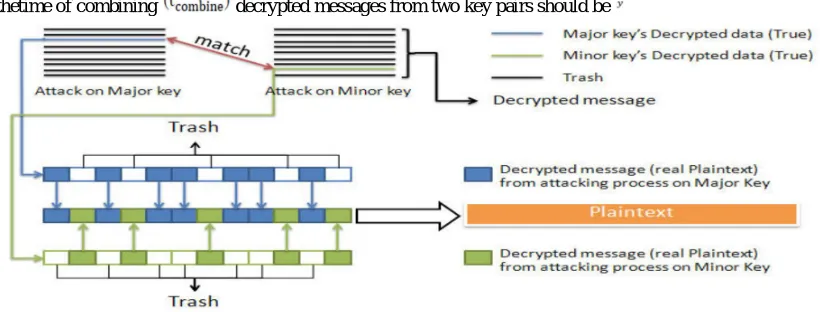
blocks of plaintext. The method of selecting and combining two corresponding messages is shown in Figure 3. As we will see, the number of possibility in combining two blocks of messages is up to Thus, thetime of combining decrypted messages from two key pairs should be
Figure 4. the method of selecting and combining two decrypted messages From processes of Brute force attack on PCA, the summation of time is shown as follow:
Hence
© 2013, IJCSMA All Rights Reserved, www.ijcsma.com 32
From the difference of time in Brute force attack on RSA and PCA, it shows that PCA can provide better security againstBrute force attack. As we will see, in the calculation of Bruteforce attack on PCA and RSA, PCA can provide security of aplaintext longer approximately than RSA 1.497x 10^126 yearsby attacking with 1 million operations /second computer.
5. Results analysis
From the practical experiment result on encryption and decryption of PCA, it shows that PCA can perform better result in both encryption and decryption process without lacking of security. The acceleration over RSA in encryption and decryption processes of PCA is calculated as follow:
Following to (4), the accelerations of PCA over RSA are shown in table below:
© 2013, IJCSMA All Rights Reserved, www.ijcsma.com 33 Chaining (ICBC) mode for higher speed and security.
6. Conclusion and further work
This paper has proposed a new cryptographic algorithm, so called “Parallel-key Cryptographic Algorithm (PCA)”, based on Asymmetric-key cryptography. By using parallel-key (a couple of key pairs), instead of using a single key pair, the algorithm is strengthened against the problem of Factorization Attack and Brute force attack which is main types of attacks on asymmetric-key cryptography. As a result, PCA can encrypts and decrypts message faster than RSA (which is one of the well known algorithm) about 53.98% and 72.44% respectively. In our simulation of Brute force attack on both algorithms (PCA and RSA), it shows that the time used by Brute force attack on PCA is longer than RSA for 1.497x10^126 years. Moreover, this algorithm is more flexible of sending or transferring data through communication networks or insecure channels without any problems of key agreements and limitation of the number of key which need to be maintained in group.
References
[1] Atul Kahate, CRYPTOGRAHY and NETWORK SECURITY, Tata McGraw-Hill Publishing Company Limited, 2003 [2] Behrouz A. Forouzan, Cryptography and Network Security, McGraw- Hill International Edition, 2008
[3] Schneier, Bruce, Applied Cryptography Second Edition: protocols, algorithms, and source code in C, John 1996. [4] David Pointcheval, Jacques Stern, “Security Proofs for Signature Schemes”, E’cole Normale Supe’rieure 2005.
[5] Benoˆıt Libert, Jean-Jacques Quisquater, and Moti Yung, “Parallel Key- Insulated Public Key Encryption Without Random Oracles”, UCL, Micorelectronics Laboratory, Crypto Group (Belgium) and RSA Labs and Columbia University
(USA)
[6] Ying Wang, Chunyan Han and Yuanyi Liu, “A Parallel Encryption Algorithm for Color Images Based on Lorenz
Chaotic Sequences”, IEEEtransaction on information Theory, 1-4244-0332-4/06, pp.9744- 9747,2006
[7] Yun Chen, Xin Chen, YiMu,“A Parallel Key Generation Algorithm for Efficient Diffie-Hellman Key Agreement”,
IEEE Transactions oninformation Theory, 1-4244-0605-6/06, pp.1393– 1395, 2006
[8] Praveen Dongara and T. N. Vijaykumar, “Accelerating Private-Key Cryptography via Multithreading on Symmetric
Multiprocessors”, Proceeding of IEEE Int'l Symp. Performance Analysis of Systems and Software (ISPASS 03), IEEE Press, 2003.
[9] R. M. Dansereau, S. Jin, R. A. Goubran, “Reducing Packet Loss in CBC Secured VoIP using Interleaved Encryption”,
Proceeding of IEEECCECE/CCGEI, Ottawa, May, 1-4244-0038-4 , 2006
[10] Dan Boneh and Ramarathnam Venkatesan, Breaking RSA may be easier t2005han factoring, Advances in Cryptology EUROCRYPT ’98 (KaisaNyberg, ed.), LNCS, no. 1403, IACR, Springer, May 1998, pp. 59–71.
A Brief Author Biography
Myself Archana B. Kadga from Bidar Karnataka state(INDIA). I have completed my B.E.(CSE) in Basavakalyan
Engineering College,Basavakalyan and M.Tech(CSE) in Visvesvarayya Technological University “JNANA SANGAM”
Belgaum. Now I am working as Assistant Professor in Computer Science Department at Sahakar Maharshi Shankarrao
Mohite Patil Institute of Technology and Research Center,Akluj Solapur District (Maharastra).My area of interest are