Greedy Algorithms for Classification – Consistency,
Convergence Rates, and Adaptivity
Shie Mannor [email protected]
Laboratory for Information and Decision Systems Massachusetts Institute of Technology
Cambridge, MA 02139
Ron Meir [email protected]
Department of Electrical Engineering Technion, Haifa 32000, Israel
Tong Zhang [email protected]
IBM T.J. Watson Research Center Yorktown Heights, NY 10598
Editor: Yoram Singer
Abstract
Many regression and classification algorithms proposed over the years can be described as greedy procedures for the stagewise minimization of an appropriate cost function. Some examples include additive models, matching pursuit, and boosting. In this work we focus on the classification prob-lem, for which many recent algorithms have been proposed and applied successfully. For a specific regularized form of greedy stagewise optimization, we prove consistency of the approach under rather general conditions. Focusing on specific classes of problems we provide conditions under which our greedy procedure achieves the (nearly) minimax rate of convergence, implying that the procedure cannot be improved in a worst case setting. We also construct a fully adaptive procedure, which, without knowing the smoothness parameter of the decision boundary, converges at the same rate as if the smoothness parameter were known.
1. Introduction
have been addressed. For example, the notion of the margin and its impact on performance (Vapnik, 1998, Schapire et al., 1998), the derivation of sophisticated finite sample bounds (e.g., Bartlett et al., 2002, Bousquet and Chapelle, 2002, Koltchinksii and Panchenko, 2002, Zhang, 2002, Antos et al., 2002), the utilization of a range of different cost functions (Mason et al., 2000, Friedman et al., 2000, Lugosi and Vayatis, 2001, Zhang, 2002, Mannor et al., 2002a) are but a few of the recent contributions to this field.
Boosting algorithms have been demonstrated to be very effective in many applications, a success which led to some initial hopes that boosting does not overfit. However, it became clear very quickly that boosting may in fact overfit badly (e.g., Dietterich, 1999, Schapire and Singer, 1999) if applied without regularization. In order to address the issue of overfitting, several authors have recently addressed the question of statistical consistency. Roughly speaking, consistency of an algorithm with respect to a class of distributions implies that the loss incurred by the procedure ultimately converges to the lowest loss possible as the size of the sample increases without limit (a precise definition is provided in Section 2.1). Given that an algorithm is consistent, a question arises as to the rates of convergence to the minimal loss. In this context, a classic approach looks at the so-called minimax criterion, which essentially measures the performance of the best estimator for the worst possible distribution in a class. Ideally, we would like to show that an algorithm achieves the minimax (or close to minimax) rate. Finally, we address the issue of adaptivity. In computing minimax rates one usually assumes that there is a certain parameterθcharacterizing the smoothness of the target distribution. This parameter is usually assumed to be known in order to compute the minimax rates. For example, the parameterθmay correspond to the Lipschitz constant of a decision boundary. In practice, however, one usually does not know the value ofθ. In this context one would like to construct algorithms which are able to achieve the minimax rates without knowing the value ofθin advance. Such procedures have been termed adaptive in the minimax sense by Barron et al. (1999). Using a boosting model that is somewhat different from ours, it was shown by B ¨uhlmann and Yu (2003) that boosting with early stopping achieves the exact minimax rates of Sobolev classes with a linear smoothing spline weak learner, and the procedure adapts to the unknown smoothness of the Sobolev class.
The stagewise greedy minimization algorithm that is considered in this work is natural and closer to algorithms that are used in practice. This is in contrast to the standard approach of selecting a hypothesis from a particular hypothesis class. Thus, our approach provides a bridge between theory and practice since we use theoretical tools to analyze a widely used practical approach.
2. Background and Preliminary Results
We begin with the standard formal setup for supervised learning. Let(
Z,A
,P) be a probabilityspace and let
F
be a class ofA
measurable functions fromZ
to R. In the context oflearn-ing one takes
Z
=X
×Y
whereX
is the input space andY
is the output space. We let S={(X1,Y1), . . . ,(Xm,Ym)}denote a sample generated independently at random according to the
proba-bility distribution P=PX,Y; in the sequel we drop subscripts (such as X,Y ) from P, as the argument
of P will suffice to specify the particular probability. In this paper we consider the problem of clas-sification where
Y
={−1,+1}andX
=Rd, and where the decision is made by taking the sign of a real-valued function f(x). Consider the 0−1 loss function given by`(y,f(x)) =I[y f(x)≤0], (1)
where I[E]is the indicator function of the event E, and the expected loss is given by
L(f) =E`(Y,f(X)). (2) Using the notationη(x)=4P(Y =1|X =x), it is well known that L∗, the minimum of L(f), can be achieved by setting f(x) =2η(x)−1 (e.g., Devroye et al., 1996). Note that the decision choice at the point f(x) =0 is not essential in the analysis. In this paper we simply assume that`(y,0) =1/2, so that the decision rule 2η(x)−1 is Bayes optimal atη(x) =1/2.
2.1 Consistency, Minimaxity and Adaptivity
Based on a sample S, we wish to construct a rule f which assigns to each new input x a (soft) la-bel f(S,x), for which the expected loss L(f,S) =E`(Y,f(S,X))is minimal. Since S is a random variable so is L(f,S), so that one can only expect to make probabilistic statements about this ran-dom variable. In this paper, we follow standard notation within the statistics literature, and denote sample-dependent quantities by a hat above the variable. Thus, we replace f(S,x)by ˆf(x). In gen-eral, one has at one’s disposal only the sample S, and perhaps some very general knowledge about the problem at hand, often in the form of some regularity assumptions about the probability distri-bution P. Within the PAC setting (e.g., Kearns and Vazirani, 1994), one makes the very stringent assumption that Yi=g(Xi)and that g belongs to some known function class. Later work considered
the so-called agnostic setting (e.g., Anthony and Bartlett, 1999), where nothing is assumed about g, and one compares the performance of ˆf to that of the best hypothesis f∗ within a given model class
F
, namely f∗=argminf∈F L(f)(in order to avoid unnecessary complications, we assume f∗ exists). However, in general one is interested in comparing the behavior of the empirical estimatorˆ
f to that of the optimal Bayes estimator, which minimizes the probability of error. The difficulty, of course, is that the determination of the Bayes classifier gB(x) =2η(x)−1, requires knowledge
of the underlying probability distribution. In many situations, one possesses some general knowl-edge about the underlying class of distributions P, usually in the form of some kind of smoothness assumption. For example, one may assume thatη(x) =P(Y =1|x)is a Lipschitz function, namely
|η(x)−η(x0)| ≤Kkx−x0kfor all x and x0. Let us denote the class of possible distributions by
P
, and an empirical estimator based on a sample of size m by ˆfm. Next, we introduce the notion ofconsistency. Roughly, a classification procedure leading to a classifier ˆfnis consistent with respect
Definition 1 A classification algorithm leading to a classifier ˆfmis strongly consistent with respect
to a class of distributions
P
if for every P∈P
lim
m→∞L(
ˆ
fm) =L∗, P almost surely.
If
X
⊆Rd andP
contains all Borel probability measures, we say that the algorithm is universally consistent.In this work we show that algorithms based on stagewise greedy minimization of a convex upper bound on the 0−1 loss are consistent with respect to the class of distributions
P
, where certain regularity assumptions will be made concerning the class conditional distributionη(x).Consistency is clearly an important property for any learning algorithm, as it guarantees that the algorithm ultimately performs well, in the sense of asymptotically achieving the minimal loss pos-sible. One should keep in mind though, that consistent algorithms are not necessarily optimal when only a finite amount of data is available. A classic example of the lack of finite-sample optimality of consistent algorithms is the James-Stein effect (see, for example, Robert, 2001, Section 2.8.2).
In order to quantify the performance more precisely, we need to be able to say something about the speed at which convergence to L∗ takes place. In order to do so, we need to determine a yard-stick by which to measure distance. A classic measure which we use here is the so-called minimax rate of convergence, which essentially measures the performance of the best empirical estimator on the most difficult distribution in
P
. Let the class of possible distributions be characterized by a parameterθ, namelyP
=P
θ. For example, assuming thatη(x)is Lipschitz,θcould represent the Lipschitz constant. Formally, the minimax risk is given byrm(θ) =inf
ˆ
fm
sup
P∈Pθ
E`(Y,fˆm(X))−L∗,
where ˆfmis any estimator based on a sample S of size m, and the expectation is taken with respect to
X,Y and the m-sample S. The rate at which the minimax risk converges to zero has been computed in the context of binary classification for several classes of distributions by Yang (1999).
So far we have characterized the smoothness of the distribution P by a parameterθ. However, in general one does not possess any prior information aboutθ, except perhaps that it is finite. The question then arises as to whether one can design an adaptive scheme which constructs an estimator
ˆ
fm without any knowledge of θ, and for which convergence to L∗ at the minimax rates (which
assumes knowledge of θ) can be guaranteed. Following Barron et al. (1999) we refer to such a
procedure as adaptive in the minimax sense.
2.2 Some Technical Tools
We begin with a few useful results. Let{σi}mi=1be a sequence of binary random variables such that σi=±1 with probability 1/2. The Rademacher complexity of
F
(e.g., van der Vaart and Wellner,1996) is given by
Rm(
F
)=4E sup f∈F
1 m
m
∑
i=1
σif(Xi)
,
where the expectation is over{σi}and{Xi}. See Bartlett and Mendelson (2002) for some properties
of Rm(
F
).Theorem 2 (Adapted from Theorem 1 in Koltchinksii and Panchenko, 2002)
Let{X1,X2, . . . ,Xm} ∈
X
be a sequence of points generated independently at random according to aprobability distribution P, and let
F
be a class of measurable functions fromX
toR. Furthermore, letφbe a non-negative Lipschitz function with Lipschitz constantκ, such that supx∈X|φ(f(x))| ≤M for all f ∈F
. Then with probability at least 1−δEφ(f(X))−1 m
m
∑
i=1
φ(f(Xi))≤4κRm(
F
) +M rlog(1/δ) 2m
for all f ∈
F
.For many function classes, the Rademacher complexity can be estimated directly. Results sum-marized by Bartlett and Mendelson (2002) are useful for bounding this quantity for algebraic com-position of function classes. We recall the relation between Rademacher complexity and covering numbers. For completeness we repeat the standard definition of covering numbers and entropy (e.g., van der Vaart and Wellner, 1996), which are related to the Rademacher complexity.
Definition 3 Let
F
be a class of functions, and letρbe a distance measure between functions inF
. The covering numberN
(ε,F
,ρ)is the minimal number of balls{g :ρ(g,f)≤ε}of radiusε needed to cover the set. The entropy ofF
is the logarithm of the covering number.Let X ={X1, . . . ,Xm}be a set of points and let Qmbe a probability measure over these points. We
define the`p(Qm)distance between any two functions f and g as
`p(Qm)(f,g) = m
∑
i=1
Qm|f(xi)−g(xi)|p !1/p
.
In this case we denote the (empirical) covering number of
F
byN
(ε,F
, `p(Qm)). The uniform`pcovering number and the uniform entropy are given respectively by
N
p(ε,F
,m) =sup QmN
(ε,F
, `p(Qm)) ; Hp(ε,F
,m) =logN
p(ε,F
,m),where the supremum is over all probability distributions Qmover sets of m points sampled from
X
.In the special case p=2, we will abbreviate the notation, setting H(ε,
F
,m)≡H2(ε,F,m). Let`m2 denote the empirical`2norm with respect to the uniform measure on the points{X1,X2, . . . ,Xm},
namely`m
2(f,g) = m1∑ m
i=1|f(Xi)−g(Xi)|2 1/2
. If
F
contains 0, then there exists a constant C such that (see Corollary 2.2.8 in van der Vaart and Wellner, 1996)Rm(
F
)≤E Z ∞
0
q
log
N
(ε,F
, `m2)dε
C
√
m, (3)
where the expectation is taken with respect to the choice of m points. We note that the approach of
using Rademacher complexity and the`m
2 covering number of a function class can often result in tighter bounds than some of the earlier studies that employed the`m
1 covering number (for example,
2.3 Related Results
We discuss some previous work related to the issues studied in this work. The question of the consistency of boosting algorithms has attracted some attention in recent years. Jiang, following Breiman (2000), raised the questions of whether AdaBoost is consistent and whether regularization is needed. It was shown in Jiang (2000b) that AdaBoost is consistent at some point in the process of boosting. Since no stopping conditions were provided, this result essentially does not determine whether boosting forever is consistent or not. A one dimensional example was provided by Jiang (2000a), where it was shown that AdaBoost is not consistent in general since it tends to a nearest neighbor rule. Furthermore, it was shown in the example that for noiseless situations AdaBoost is in fact consistent. The conclusion from this series of papers is that boosting forever for AdaBoost is not consistent and that sometimes along the boosting process a good classifier may be found.
In a recent paper Lugosi and Vayatis (2001) also presented an approach to establishing con-sistency based on the minimization of a convex upper bound on the 0−1 loss. According to this approach the convex cost function, is modified depending on the sample size. By making the con-vex cost function sharper as the number of samples increases, it was shown that the solution to the convex optimization problem yields a consistent classifier. Finite sample bounds are also provided by Lugosi and Vayatis (2001, 2002). The major differences between our work and (Lugosi and Vayatis, 2001, 2002) are the following: (i) The precise nature of the algorithms used is different; in particular the approach to regularization is different. (ii) We establish convergence rates and pro-vide conditions for establishing adaptive minimaxity. (iii) We consider stagewise procedures based on greedily adding on a single base hypothesis at a time. The work of Lugosi and Vayatis (2002) focused on the effect of using a convex upper bound on the 0−1 loss.
A different kind of consistency result was established by Mannor and Meir (2001, 2002). In this work geometric conditions needed to establish the consistency of boosting with linear weak learners were established. It was shown that if the Bayes error is zero (and the oppositely labelled points are well separated) then AdaBoost is consistent.
Zhang (2002) studied an approximation-estimation decomposition of binary classification meth-ods based on minimizing some convex cost functions. The focus there was on approximation error analysis as well as behaviors of different convex cost functions. The author also studied estimation errors for kernel methods including support vector machines, and established universal consistency results. However, the paper does not contain any specific result for boosting algorithms.
All of the work discussed above deals with the issue of consistency. This paper extends our earlier results (Mannor et al., 2002a) where we proved consistency for certain regularized greedy boosting algorithms. Here we go beyond consistency and consider rates of convergence and inves-tigate the adaptivity of the approach.
3. Consistency of Methods Based on Greedy Minimization of a Convex Upper Bound
Consider a class of so-called base hypotheses
H
, and assume that it is closed under negation. We define the order t convex hull ofH
asCOt(
H
) = (f : f(x) =
t
∑
i=1
αihi(x),αi≥0, t
∑
i=1
αi≤1,hi∈
H
)The convex hull of
H
, denoted by CO(H
), is given by taking the limit t→∞. The algorithms considered in this paper construct a composite hypothesis by choosing a function f fromβCO(H
), where for any classG
,βG
={f : f =βg,g∈G
}. The parameterβwill be specified at a later stage. We assume throughout that functions inH
take values in[−1,1]. This implies that functions in βCO(H
)take values in[−β,β]. Since the spaceβCO(H
)may be huge, we consider algorithms that sequentially and greedily select a hypothesis fromβH
. Moreover, since minimizing the 0−1 loss is often intractable, we consider approaches which are based on minimizing a convex upper bound on the 0−1 loss. The main contribution of this section is the demonstration of the consistency of such a procedure.To describe the algorithm, let φ(x) be a convex function, which upper bounds the 0−1 loss, namely
φ(y f(x))≥I[y f(x)≤0], φ(u)convex.
Specific examples forφare given in Section 3.3. Consider the empirical and true losses incurred by a function f based on the lossφ,
ˆ
A(f)=4 1 m
m
∑
i=1
φ(yif(xi)),
A(f)=4EX,Yφ(Y f(X)),
=EX{η(X)φ(f(X)) + (1−η(X))φ(−f(X))} .
Here EX,Y is the expectation operator with respect to the measure P and EX is the expectation with
respect to the marginal on X .
3.1 Approximation by Convex Hulls of Small Classes
In order to achieve consistency with respect to a large class of distributions, one must demand that the classβCO(
H
)is ‘large’ in some well-defined sense. For example, if the classH
consists only of polynomials of a fixed order, then we cannot hope to approximate arbitrary continuous functions, since CO(H
) also consists solely of polynomials of a fixed order. However, there are classes of non-polynomial functions for whichβCO(H
)is large.As an example, consider a univariate (i.e., one-dimensional) functionσ:R→[0,1]. The class of symmetric ridge functions overRd is defined as:
H
σ=4{±σ(a>x+b),a∈Rd,b∈R}.Recall that for a class of functions
F
, SPAN(F
)consists of all linear combinations of functions fromF
. It is known from Leshno et al. (1993) that the span ofH
σis dense in the set of continuous functions over a compact set. Since SPAN(H
σ) =∪β≥0βCO(H
), it follows that every continuous function mapping from a compact setΩtoRcan be approximated with arbitrary precision by some g inβCO(H
)for a large enoughβ.For the case where h(x) =sgn(w>x+b)Barron (1992) defines the class
SPANC(
H
) = (f : f(x) =
∑
i
cisgn(w>i x+bi),ci,bi∈R,wi∈Rd,
∑
i|ci| ≤C )
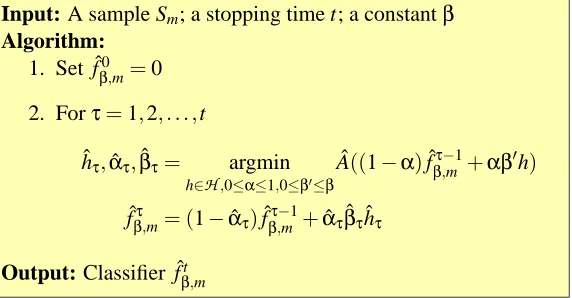
Input: A sample Sm; a stopping time t; a constantβ
Algorithm: 1. Set ˆfβ0,m=0 2. Forτ=1,2, . . . ,t
ˆhτ,αˆτ,βˆτ= argmin
h∈H,0≤α≤1,0≤β0≤β ˆ
A((1−α)fˆτ−1
β,m +αβ0h)
ˆ
fβτ,m= (1−αˆτ)fˆτ−1
β,m +αˆτβˆτˆhτ
Output: Classifier ˆfβt,m
Figure 1: A sequential greedy algorithm based on the convex empirical loss function ˆA.
and refers to it as the class of functions with bounded variation with respect to half-spaces. In one dimension, this is simply the class of functions with bounded variation. Note that there are several extensions to the notion of bounded variation to multiple dimensions. We return to this class of functions in Section 4.2. Other classes of base functions which generate rich nonparametric sets of functions are free-knot splines (see Agarwal and Studden, 1980, for asymototic properties) and radial basis functions (e.g., Schaback, 2000).
3.2 A Greedy Stagewise Algorithm and Finite Sample Bounds
Based on a finite sample Sm, we cannot hope to minimize A(f), but rather minimize its empirical
counterpart ˆA(f). Instead of minimizing ˆA(f)directly, we consider a stagewise greedy algorithm, which is described in Figure 1. The algorithm proposed is related to the AdaBoost algorithm in incrementally minimizing a given convex loss function. In opposition to AdaBoost, we restrict the size of the weights α andβ, which serves to regularize the algorithm, a procedure that will play an important role in the sequel. We also observe that many of the additive models introduced in the statistical literature (e.g., Hastie et al., 2001), operate very similarly to Figure 1. It is clear from the description of the algorithm that ˆfβt,m, the hypothesis generated by the procedure, belongs to βCOt(
H
) for every t. Note also that, by the definition of φ, for fixed α and β the functionˆ
A((1−α)fˆβτ,−m1+αβh)is convex in h.
We observe that many recent approaches to boosting-type algorithms (e.g., Breiman, 1998, Hastie et al., 2001, Mason et al., 2000, Schapire and Singer, 1999) are based on algorithms sim-ilar to the one presented in Figure 1. Two points are worth noting. First, at each stepτ, the value of the previous composite hypothesis ˆfβτ−,m1is multiplied by(1−α), a procedure which is usually not followed in other boosting-type algorithms; this ensures that the composite function at every step remains inβCO(
H
). Second, the parametersαandβare constrained at every stage; this serves as a regularization measure and prevents overfitting.In order to analyze the behavior of the algorithm, we need several definitions. Forη∈[0,1]and f ∈Rlet
Let R∗ denote the extended real line (R∗ =R∪ {−∞,+∞}). We extend a convex function g :R→Rto a function g :R∗→R∗by defining g(∞) =limx→∞g(x)and g(−∞) =limx→−∞g(x).
Note that this extension is merely for notational convenience. It ensures that, fG(η), the minimizer
of G(η,f), is well-defined atη=0 or 1 for appropriate loss functions. For every value ofη∈[0,1] let
fG(η)=4argmin
f∈R∗ G(η,f) ; G
∗(η)=4G(η,f
G(η)) = inf
f∈R∗G(η,f).
It can be shown (Zhang, 2002) that for many choices ofφ, including the examples given in Section 3.3, fG(η)>0 whenη>1/2. We begin with a result from Zhang (2002). Let fβ∗minimize A(f)
overβCO(
H
), and denote by foptthe minimizer of A(f)over all Borel measurable functions f . For simplicity we assume that foptexists. In other wordsA(fopt)≤A(f) (for all measurable f ).
Our definition implies that fopt(x) = fG(η(x)).
Theorem 4 (Zhang, 2002, Theorem 2.1) Assume that fG(η)>0 whenη>1/2, and that there exist
c>0 and s≥1 such that for allη∈[0,1],
|η−1/2|s≤cs(G(η,0)−G∗(η)).
Then for all Borel measurable functions f(x)
L(f)−L∗≤2c A(f)−A(fopt)1/s, (4) where the Bayes error is given by L∗=L(2η(·)−1).
The condition that fG(η)>0 whenη>1/2 in Theorem 4 ensures that the optimal minimizer
fopt achieves the Bayes error. This condition can be satisfied by assuming thatφ(f)<φ(−f)for all f >0. The parameters c and s in Theorem 4 depend only on the lossφ. In general, if φis second order differentiable, then one can take s=2. Examples of the values of c and s are given in Section 3.3. The bound (4) allows one to work directly with the function A(·)rather than with the less wieldy 0−1 loss L(·).
We are interested in bounding the loss L(f) of the empirical estimator ˆfβt,m obtained after t
steps of the stagewise greedy algorithm described in Figure 1. Substitute ˆfβt,min (4), and consider bounding the r.h.s. as follows (ignoring the 1/s exponent for the moment):
A(fˆt
β,m)−A(fopt) = h
A(fˆt
β,m)−Aˆ(fˆβt,m) i
+hAˆ(fˆt
β,m)−Aˆ(fβ∗) i
+hAˆ(fβ∗)−A(fβ∗)i+hA(fβ∗)−A(fopt)
i
. (5)
Next, we bound each of the terms separately.
The first term can be bounded using Theorem 2. In particular, since A(f) =Eφ(Y f(X)), where φis assumed to be convex, and since ˆfβt,m∈βCO(H)then f(x)∈[−β,β]for every x. It follows that
on its (bounded) domain the Lipschitz constant ofφis finite and can be written asκβ(see explicit examples in Section 3.3). From Theorem 2 we have that with probability at least 1−δ,
A(fˆt
β,m)−Aˆ(fˆ t
β,m)≤4βκβRm(
H
) +φβ rlog(1/δ)
whereφβ=4supf∈[−β,β]φ(f). Recall that ˆfβt,m∈βCO(
H
), and note that we have used the fact that Rm(βCO(H
)) =βRm(H
) (e.g., Bartlett and Mendelson, 2002). The third term on the r.h.s. of (5)can be estimated directly from the Chernoff bound. We have with probability at least 1−δ:
ˆ
A(fβ∗)−A(fβ∗)≤φβ
r
log(1/δ)
2m .
Note that f∗is fixed (independent of the sample), and therefore a simple Chernoff bound suffices here. In order to bound the second term in (5) we assume that
sup
v∈[−β,β]
φ00(v)≤M
β<∞, (6)
whereφ00(u)is the second derivative ofφ(u).
From Theorem 4.2 by Zhang (2003) we know that for a fixed sample
ˆ
A(fˆβt,m)−Aˆ(fβ∗)≤8β 2M
β
t . (7)
This result holds for every convexφand fixedβ.
The fourth term in (5) is a purely approximation theoretic term. An appropriate assumption will need to be made concerning the Bayes boundary for this term to vanish.
In summary, for every t, with probability at least 1−2δ,
A(fˆt
β,m)−A(fopt)≤4βκβRm(
H
) +8β2Mβ t +φβ
r
2 log(1/δ) m + (A(f
∗
β)−A(fopt)). (8)
The final term in (8) can be bounded using the Lipschitz property ofφ. In particular,
A(fβ∗)−A(fopt) =EX n
η(X)φ(fβ∗(X)) + (1−η(X))φ(−fβ∗(X))o
−EX
η(X)φ(fopt(X)) + (1−η(X))φ(−fopt(X))
=EX n
η(X)[φ(fβ∗(X))−φ(fopt(X))]
o
+EX n
(1−η(X))[φ(−fβ∗(X))−φ(−fopt(X))]
o
≤κβEX n
η(X)|fβ∗(X)−fopt(X)|+ (1−η(X))|fβ∗(X)−fopt(X)|
o
≤κβEX|fβ∗(X)−fβ,opt(X)|+∆β, (9)
where the Lipschitz property and the triangle inequality were used in the final two steps. Here fβ,opt(X) =max(−β,min(β,fopt(X)))is the projection of foptonto[−β,β], and
∆β=4 sup
η∈[1/2,1]{
I(fG(η)>β)[G(η,β)−G(η,fG(η))]}.
3.3 Examples forφ
We consider three commonly used choices for the convex functionφ. Other examples are presented by Zhang (2002).
exp(−x) Exponential
log(1+exp(−x))/log(2) Logistic loss
(x−1)2 Squared loss
It is easy to see that all losses are non-negative and upper bound the 0−1 loss I(x≤0), where I(·) is the indicator function. The exponential loss function was previously shown to lead to the AdaBoost algorithm (Schapire and Singer, 1999), while the other losses were proposed by Friedman et al. (2000), and shown to lead to other interesting stagewise algorithms. The essential differences between the loss functions relate to their behavior for x→ ±∞.
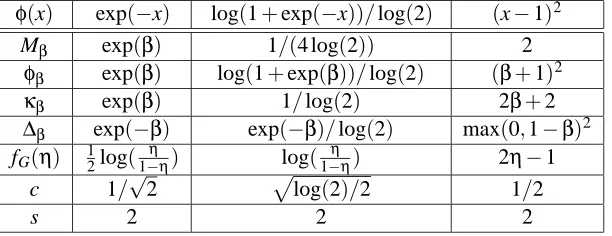
In this paper, the natural logarithm is used in the definition of logistic loss. The division by log(2) sets the scale so that the loss function equals 1 at x=0. For each one of these cases we provide in Table 1 the values of the constants Mβ,φβ,κβ, and∆β defined above. We also include the values of c and s from Theorem 4, as well as the optimal minimizer fG(η). Note that the values
of∆βandκβlisted in Table 1 are upper bounds (see Zhang, 2002).
φ(x) exp(−x) log(1+exp(−x))/log(2) (x−1)2
Mβ exp(β) 1/(4 log(2)) 2
φβ exp(β) log(1+exp(β))/log(2) (β+1)2 κβ exp(β) 1/log(2) 2β+2 ∆β exp(−β) exp(−β)/log(2) max(0,1−β)2 fG(η) 12log(1−ηη) log(1−ηη) 2η−1
c 1/√2 plog(2)/2 1/2
s 2 2 2
Table 1: Parameter values for several popular choices ofφ.
3.4 Universal Consistency
We assume that h∈
H
implies−h∈H
, which in turn implies that 0∈CO(H
). This implies that β1CO(H
)⊆β2CO(H
)whenβ1≤β2. Therefore, using a larger value ofβimplies searching within a larger space. We defineSPAN(H
) =∪β>0βCO(H
), which is the largest function class that can be reached in the greedy algorithm by increasingβ.In order to establish universal consistency, we may assume initially that the class of functions
SPAN(
H
) is dense in C(K) - the class of continuous functions over a domain K ⊆Rd under theuniform norm topology. From Theorem 4.1 by Zhang (2002), we know that for allφconsidered in
this paper, and all Borel measures, inff∈SPAN(H)A(f) =A(fopt). SinceSPAN(
H
) =∪β>0βCO(H
), we obtain limβ→∞A(fβ∗)−A(fopt) =0, leading to the vanishing of the final term in (8) whenβ→∞. Using this observation we are able to establish sufficient conditions for consistency.m→∞, we haveβ→∞,φ2βlog m/m→0, andβκβRm(
H
)→0. Then the greedy algorithm of Figure1, applied for t steps where(β2M
β)/t→0 as m→∞, is strongly universally consistent.
Proof The basic idea of the proof is the selection ofβ=β(m)in such a way that it balances the estimation and approximation error terms. In particular, βshould increase to infinity so that the approximation error vanishes. However, the rate at whichβincreases should be sufficiently slow to guarantee convergence of the estimation error to zero as m→∞. Letδm= m12. It follows from (8)
that with probability smaller than 2δm
A(fˆtm
β,m)−A(fopt)>4βmκβmRm(
H
) +8β2mMβm tm
+2φβ
r
log m
m +∆Aβ,
where∆Aβ=A(fβ∗)−A(fopt)→0 asβ→∞. Using the Borel Cantelli Lemma this happens finitely many times, so there is a (random) number of samples m1after which the above inequality is always reversed. Since all terms in (8) converge to 0, it follows that for every ε>0 from some time on A(fˆt
β,m)−A(fopt)<εwith probability 1. Using (4) concludes the proof.
As a simple example for the choice ofβ=β(m), consider the logistic loss. From Table 1 we conclude that selectingβ=opm/log msuffices to guarantee consistency.
Unfortunately, no convergence rate can be established in the general setting of universal consis-tency. Convergence rates for particular functional classes can be derived by applying appropriate assumptions on the class
H
and the posterior probabilityη(x). We noted elsewhere (Mannor et al., 2002a) we used (8) in order to establish convergence rates for the three loss functions described above, when certain smoothness conditions were assumed concerning the class conditional distri-butionη(x). The procedure described in Mannor et al. (2002a) also established appropriate (non-adaptive) choices forβas a function of the sample size m. In the next section we use a different approach for the squared loss in order to derive faster, nearly optimal, convergence rates.4. Rates of Convergence and Adaptivity – the Case of Squared Loss
We have shown that under reasonable conditions on the functionφ, universal consistency can be established as long as the base class
H
is sufficiently rich. We now move on to discuss rates of convergence and the issue of adaptivity, as described in Section 2. In this section we focus on the squared loss, as particularly tight bounds are available for this case, using techniques from the em-pirical process literature (e.g., van de Geer, 2000). This allows us to demonstrate nearly minimax rates of convergence. Since we are concerned with establishing convergence rates in a nonparamet-ric setting, we will not be concerned with constants which do not affect rates of convergence. We will denote generic constants by c,c0,c1,c01, etc.We begin by bounding the difference between A(f) and A(fopt) in the non adaptive setting, where we consider the case of a fixed value ofβwhich defines the classβCO(
H
). In Section 4.2 weuse the multiple testing Lemma to derive an adaptive procedure that leads to a uniform bound over
4.1 Empirical Ratio Bounds for the Squared Loss
In this section we restrict attention to the squared loss function,
A(f) =E(f(X)−Y)2. Since in this case
fopt(x) =E(Y|x), we have the following identity for any function f :
EY|x(f(x)−Y)2−EY|x(fopt(x)−Y)2= (f(x)−fopt(x))2. Therefore
A(f)−A(fopt) =E(f(X)−fopt(X))2. (10) We assume that f belongs to some function class
F
, but we do not assume that foptbelongs toF
. Furthermore, since for any real numbers a,b,c, we have that(a−b)2−(c−b)2= (a−c)2+2(a− c)(c−b)the following is true:ˆ
A(f)−Aˆ(fopt) = 1 m
m
∑
i=1
(f(xi)−yi)2−
1 m
m
∑
i=1
(fopt(xi)−yi)2
= 2 m
m
∑
i=1
(fopt(xi)−yi)(f(xi)−fopt(xi)) +
1 m
m
∑
i=1
(f(xi)−fopt(xi))2. (11)
Our goal at this point is to assess the expected deviation of[A(f)−A(fopt)]from its empirical counterpart, [Aˆ(f)−Aˆ(fopt)]. In particular, we want to show that with probability at least 1−δ, δ∈(0,1), for all f∈
F
we haveA(f)−A(fopt)≤c(Aˆ(f)−Aˆ(fopt)) +ρm(δ),
for appropriately chosen c andρm(δ).
For any f it will be convenient to use the notation ˆE f =4 m1∑im=1f(xi).
We now relate the expected and empirical values of the deviation terms A(f)−A(fopt). The following result is based on the symmetrization technique and the so-called peeling method in statis-tics (e.g., Section 5.3 in van de Geer, 2000). The peeling method is a general method for bounding suprema of stochastic processes over some class of functions. The basic idea is to transform the task into a sequence of simpler bounds, each defined over an element in a nested sequence of subsets of the class (see (5.17) in van de Geer, 2000). Since the proof is rather technical, it is presented in the appendix.
Lemma 6 Let
F
be a class of uniformly bounded functions, and let X ={X1, . . . ,Xm} be a setof points drawn independently at random according to some law P. Assume that for all f ∈
F
, supx|f(x)−fopt(x)| ≤M. Then there exists a positive constant c such that for all q≥c, with probability at least 1−exp(−q), for all f ∈F
E f(X)−fopt(X)2≤4 ˆE f(X)−fopt(X)2+
100qM2
m +
∆2
m
6
where∆mis any number such that
m∆2m≥32M2max(H(∆m,
F
,m),1). (12)Observe that∆mis well-defined since the l.h.s. is monotonically increasing and unbounded, while
the r.h.s. is monotonically decreasing.
We use the following bound from van de Geer (2000):
Lemma 7 (van de Geer, 2000, Lemma 8.4) Let
F
be a class of functions such that for all positive δ, H(δ,F
,m)≤Kδ−2ξ, for some constants 0<ξ<1 and K. Let X,Y be random variables defined over some domain. Let W(x,y)be a real-valued function such that|W(x,y)| ≤M for all x,y, and EY|xW(x,Y) =0 for all x. Then there exists a constant c, depending onξ,K and M only, such thatfor allε≥c/√m:
P
(
sup
g∈F
|Eˆ{W(X,Y)g(X)}| (Egˆ (X)2)(1−ξ)/2 ≥ε
)
≤c exp(−mε2/c2).
In order to apply this bound, it is useful to introduce the following assumption.
Assumption 1 Assume that∃M≥1 such that supx|f(x)−fopt(x)| ≤M for all f ∈
F
. Moreover, for all positiveε, H(ε,F
,m)≤K(ε/M)−2ξwhere 0<ξ<1.We will now rewrite Lemma 7 in a somewhat different form using the notation of this section.
Lemma 8 Let Assumption 1 hold. Then there exist positive constants c0and c1 that depend onξ and K only, such that∀q≥c0, with probability at least 1−exp(−q), for all f ∈
F
Eˆ
(fopt(X)−Y)(f(X)−fopt(X)) ≤
1−ξ
2 Eˆ(f−fopt)
2+c1M2q m
1/(1+ξ)
.
Proof Let
W(X,Y) = (fopt(X)−Y)/M ; g(X) = (f(X)−fopt(X))/M.
Using Lemma 7 we find that there exist constants c and c0 that depend onξand K only, such that
∀ε≥c/√m
P
∃g∈
G
:|Eˆ{W(X,Y)g(X)}|> 1−ξ2 Egˆ (X)
2+1+ξ
2 ε
2/(1+ξ)
(a)
≤ Pn∃g∈
G
:|Eˆ{W(X,Y)g(X)}|>(Egˆ (X)2)(1−ξ)/2εo= P
(
sup
g∈G
|Eˆ{W(X,Y)g(X)}| (Egˆ (X)2)(1−ξ)/2 >ε
)
(b)
≤ c exp(−mε2/c2).
where(a)used the inequality|ab| ≤1−2ξ|a|2/(1−ξ)+1+ξ
2 |b|2/(1+ξ), and(b)follows using Lemma 7.
The claim follows by settingε=pq/m and choosing c0and c1appropriately.
Theorem 9 Suppose Assumption 1 holds. Then there exist constants c0,c1>0 that depend on ξ and K only, such that∀q≥c0, with probability at least 1−exp(−q), for all f ∈
F
A(f)−A(fopt)≤4ξAˆ(f)−Aˆ(fopt)+c1M 2 ξ
q
m
1/(1+ξ)
.
Proof By (10) it follows that A(f)−A(fopt) =E(f−fopt)2. There exists a constant c00depending on K only such that in Lemma 6, we can let∆2m=c00M2m−1/(1+ξ)to obtain
A(f)−A(fopt) =E(f−fopt)2≤4 ˆE(f−fopt)2+M2(100q/m+c00m−1/(1+ξ)) (13) with probability at least 1−exp(−q)where q≥1. By (11) we have that
[Aˆ(f)−Aˆ(fopt)] =2 ˆE(fopt(X)−Y)(f(X)−fopt(X)) +Eˆ(f(X)−fopt(X))2.
Using Lemma 8 we have that there exist constants c01≥1 and c02that depend on K andξonly, such that for all q≥c01, with probability at least 1−exp(−q):
Eˆ
(fopt(X)−Y)(f(X)−fopt(X)) ≤
1−ξ
2 Eˆ(f−fopt) 2+c0
2M2
q
m
1/(1+ξ)
.
Combining these results we have that with probability at least 1−e−q:
[Aˆ(f)−Aˆ(fopt)] = 2 ˆE
(fopt(X)−Y)(f(X)−fopt(X)) +Eˆ(f(X)−fopt(X))2
≥ ξEˆ(f−fopt)2−2c02M2
q
m
1/(1+ξ)
. (14)
From (13) and (14) we obtain with probability at least 1−2 exp(−q):
A(f)−A(fopt)≤ 4ξ[Aˆ(f)−Aˆ(fopt)] +8ξc02M2
q
m
1/(1+ξ)
+M2(100q/m+c00m−1/(1+ξ)).
Note that Assumption 1 was used when invoking Lemma 6. The theorem follows from this
inequal-ity with appropriately chosen c0and c1.
4.2 Adaptivity
In this section we let f be chosen from βCO(
H
)≡βF
, where β will be determined adaptively based on the data in order to achieve an optimal balance between approximation and estimation errors. In this case, supx|f(x)| ≤βM where h∈H
are assumed to obey supx|h(x)| ≤M. We first need to determine the preciseβ-dependence of the bound of Theorem 9. We begin with a definition followed by a simple Lemma, the so-called multiple testing Lemma (e.g., Lemma 4.14 in Herbrich, 2002).Definition 10 A testΓis a mapping from the sample S and a confidence levelδto the logical values
Lemma 11 Suppose we are given a set of testsΓ={Γ1, . . . ,Γr}. Assume further that a discrete
probability measure P ={pi}ri=1 over Γ is given. If for every i∈ {1,2, . . . ,r} and δ∈(0,1),
P{Γi(S,δ)} ≥1−δ, then
P{Γ1(S,δp1)∧ ··· ∧Γr(S,δpr)} ≥1−δ.
We use Lemma 11 in order to extend Theorem 9 so that it holds for allβ. The proof again relies on the peeling technique.
Theorem 12 Let Assumption 1 hold. Then there exist constants c0,c1>0 that depend onξand K only, such that∀q≥c0, with probability at least 1−exp(−q), for allβ≥1 and for all f ∈β
F
we haveA(f)−A(fopt)≤4ξAˆ(f)−Aˆ(fopt)+c1β2M2
q+log log(3β) m
1/(1+ξ)
.
Proof For all s=1,2,3, . . ., let
F
s=2sF
. Let us define the testΓs(S,δ)to be TRUE ifA(f)−A(fopt)≤ 4ξAˆ(f)−Aˆ(fopt)+ξc22sM2
log(1/δ) m
1+1ξ
for all f ∈
F
s and FALSE otherwise. Using Theorem 9 we have that P(Γs(S,δ))≥1−δ. Letps= s(s1+1), noting that∑∞s=1ps=1 and by Lemma 11 we have that
P{Γs(S,δps)for all s} ≥1−δ.
Consider f ∈β
F
for someβ≥1. Let s=blog2βc+1, we have that Pn
∀s : Γs(S,s(sδ+1)) o
≥1−δ
so that with probability at least 1−δwe have that:
A(f)−A(fopt)≤4ξAˆ(f)−Aˆ(fopt)+c
0
ξ22sM2
log(s2δ+s) m
!1/(1+ξ)
≤4ξˆ
A(f)−Aˆ(fopt)+c1ξβ2M2
log log(3β) +q m
1/(1+ξ)
,
where we set q=log(1/δ)and used the fact that 2s−1≤β≤2s.
Theorem 12 bounds A(f)−A(fopt)in terms of ˆA(f)−Aˆ(fopt). However, in order to determine overall convergence rates of A(f)to A(fopt)we need to eliminate the empirical term ˆA(f)−Aˆ(fopt). To do so, we first recall a simple version of the Bernstein inequality (e.g., Devroye et al., 1996) together with a straightforward consequence.
Lemma 13 Let{X1,X2, . . . ,Xm}be real-valued i.i.d. random variables such that|Xi| ≤b with
prob-ability one. Letσ2=Var[X1]. Then, for anyε>0
P
(
1 m
m
∑
i=1
Xi−E[X1]>ε )
≤exp
− mε
2 2σ2+2bε/3
Moreover, ifσ2≤c0bE[X1], then for all positive q, there exists a constant c that depends only on c0 such that with probability at least 1−exp(−q)
1 m
m
∑
i=1
Xi≤cE[X1] +
bq m ,
where c is independent of b.
Proof The first part of the Lemma is just the Bernstein inequality (e.g., Devroye et al., 1996). To show the second part we need to bound from above the probability that(1/m)∑m
i=1Xi>cE[X1] + bq/m. Setε= (c−1)E[X1] +bq/m. Using Bernstein’s inequality we have that
P
(
1 m
m
∑
i=1
Xi−E[X1]>(c−1)E[X1] +
bq m
)
≤exp
− mε
2 2σ2+2bε/3
≤exp
− mε
2 2c0bE[X1] +2bε/3
(a)
≤exp
−mbε ≤exp(−q),
where(a) follows by choosing c large enough so that 2c0 < 1
3(c−1), implying that 2c0bE[X1]<
bε/3.
Next, we use Bernstein’s inequality in order to bound ˆA(f)−Aˆ(fopt).
Lemma 14 Let Assumption 1 hold. Given anyβ≥1 and f ∈β
F
, there exists a constant c0>0 (independent ofβ) such that∀q, with probability at least 1−exp(−q):ˆ
A(f)−Aˆ(fopt)≤c0
(A(f)−A(fopt)) +(βM) 2q m
.
Proof Fix f ∈β
F
. We will use Lemma 13 to bound the probability of a large difference be-tween ˆA(f)and ˆA(fopt). Instead of working with ˆA(f) we will use Z=42[(fopt(X)−Y)(f(X)− fopt(X))] + (f(X)−fopt(X))2. According to (11), ˆA(f)−Aˆ(fopt) =Eˆ[Z]. The expectation of Z satisfies that E[Z] =E[Aˆ(f)−Aˆ(fopt)], so using (10) we have that E[Z] =A(f)−A(fopt) = E(f(X)−fopt(X))2. Bounding the variance we obtain thatVar[Z]≤E[Z2] ≤ E4(fopt(X)−Y)2(f(X)−fopt(X))2+
4(fopt(X)−Y)(f(X)−fopt(X))3+ (f(X)−fopt(X))4
≤ sup
x,y
4(fopt(x)−y)2+4(fopt(x)−y)(f(x)−fopt(x)) +
(f(x)−fopt(x))2E[Z]. (15)
By Assumption 1 for every f ∈
F
we have that supx|f(x)−fopt(x)| ≤M, which implies that for f ∈βF
we have thatsup
x |
f(x)−fopt(x)|=sup
x |
We conclude that supx|f(x)−fopt(x)| ≤2βM. Recall that fopt(x) =E(Y|x), Y∈ {−1,1}, so we can bound|(fopt(X)−Y)| ≤2. Sinceβ≥1 and by the assumption on M we have that|fopt(X)−Y| ≤ 2βM. Plugging these upper bounds into (15) we obtain Var[Z]≤c0β2M2E[Z], with c0 =36. A similar argument shows that |Z| is not larger than c00βM (with probability 1, and c00=12). The
claim then follows from a direct application of Lemma 13.
We now consider a procedure for determiningβadaptively from the data. Define a penalty term
γq(β) =β2M2
log log(3β) +q m
1/(1+ξ)
,
which penalizes large values ofβ, corresponding to large classes with good approximation proper-ties.
The procedure then is to find ˆβqand ˆfq∈βˆq
F
such thatˆ
A(fˆq) +γq(βˆ
q)≤inf
β≥1
inf
f∈βF
ˆ
A(f) +2γq(β)
. (16)
This procedure is similar to the so-called structural risk minimization method (Vapnik, 1982), except that the minimization is performed over the continuous parameterβrather than a discrete hypothesis class counter. Observe that ˆβqand ˆfqare non unique, but this poses no problem.
We can now establish a bound on the loss incurred by this procedure.
Theorem 15 Let Assumption 1 hold. Choose q0>0 and assume we compute ˆfq0 using (16). Then
there exist constants c0,q0>0 that depend onξand K only, such that∀m≥q≥max(q0,c0), with probability at least 1−exp(−q),
A(fˆq
0)≤A(fopt) +c1
q q0
1/(1+ξ)
inf
β≥1
inf
f∈βFA(f)−A(fopt) +γq(β)
.
Note that since for any q, γq(β) =O((1/m)1/(1+ξ)), Theorem 15 provides rates of convergence
in terms of the sample size m. Observe also that the main distinction between Theorem 15 and Theorem 12 is that the latter provides a data-dependent bound, while the former establishes a so-called oracle inequality, which compares the performance of the empirical estimator ˆfq0 to that
of the optimal estimator within a (continuously parameterized) hierarchy of classes. This optimal estimator cannot be computed since the underlying probability distribution is unknown, but serves as a performance yard-stick.
Proof (of Theorem 15) Considerβq≥1 and fq∈βq
F
such thatA(fq)−A(fopt) +2γq(βq)≤inf
β≥1
inf
f∈βFA(f)−A(fopt) +4γq(β)
. (17)
Note thatβq and fq determined by (17), as opposed to ˆβq and ˆfq in (16), are independent of the
data. Using Lemma 14, we know that there exists a constant c02 such that with probability at least 1−exp(−q):
ˆ
A(fq)−Aˆ(fopt) +2γq(βq)≤c02inf
β≥1
inf
f∈βFA(f)−A(fopt) +γq(β)
From (16) we have
ˆ
A(fˆq0)−Aˆ(fopt) +γq0(βˆq0)
(a)
≤ Aˆ(fq)−Aˆ(fopt) +2γq0(βq)
(b)
≤ Aˆ(fq)−Aˆ(fopt) +2γq(βq)
(c)
≤ c02inf
β≥1
inf
f∈βFA(f)−A(fopt) +γq(β)
. (19)
Here (a) results from the definition of ˆfq0, (b) uses q≥q0, and (c) is based on (18). We then
conclude that there exist constants c00,c01>0 that depend onξand K only, such that∀q≥c00, with probability at least 1−exp(−q):
A(fˆq0)−A(fopt)
(a)
≤ c01[Aˆ(fˆq0)−Aˆ(fopt) +γq(βˆq0)]
(b)
≤ c01
q q0
1/(1+ξ)
[Aˆ(fˆq
0)−Aˆ(fopt) +γq0(βˆq0)]
(c)
≤ c01c02
q q0
1/(1+ξ)
inf
β≥1[finf∈βFA(f)−A(fopt) +γq(β)].
Here(a) is based on Theorem 12,(b) follows from the definition ofγq(β) and(c) follows from
(19).
4.3 Classification Error Bounds
Theorem 15 established rates of convergence of A(fˆ)to A(fopt). However, for binary classification problems, the main focus of this work, we wish to determine the rate at which L(fˆ)converges to the Bayes error L∗. However, from the work of Zhang (2002), reproduced as Theorem 4 above, we immediately obtain a bound on the classification error.
Corollary 16 Let Assumption 1 holds. Then there exist constants c0,c1>0 that depend onξand K only, such that∀m≥q≥max(q0,c0), with probability at least 1−exp(−q),
L(fˆq0)≤L∗+c0
q q0
1/2(1+ξ)
inf
β≥1
inf
f∈βF A(f)−A(fopt)
+γq(β) 1/2
. (20)
Moreover, if the conditional probabilityη(x)is uniformly bounded away from 0.5, namely|η(x)− 1/2| ≥δ>0 for all x, then with probability at least 1−exp(−q),
L(fˆq0)≤L∗+c1
q q0
1/(1+ξ)
inf
β≥1
inf
f∈βF(A(f)−A(fopt)) +γq(β)
.
Proof The first inequality follows directly from Theorems 4 and 15, noticing the s=2 for the least squares loss. The second inequality follows from Corollary 2.1 of Zhang (2002). According to this corollary
L(fˆq0)≤L∗+2c inf
δ>0
E|η(x)−1
2|<δ(
ˆ
fq0−fopt)
21/2+c01
δ(A(fˆq0)−A(fopt))
The claim follows since by assumption the first term inside the infimum on the r.h.s. vanishes.
In order to proceed to the derivation of complete convergence rates we need to assess the parameter ξand the approximation theoretic term inff∈βFA(f)−A(fopt), where we assume that
F
=CO(H
). In order to do so we make the following assumption.Assumption 2 For all h∈
H
, supx|h(x)| ≤M. Moreover,N
2(ε,H,m)≤C(M/ε)V, for some con-stants C and V .Note that Assumption 2 holds for VC classes (e.g., van der Vaart and Wellner, 1996). The entropy of the classβCO(
H
)can be estimated using the following result.Lemma 17 (van der Vaart and Wellner, 1996, Theorem 2.6.9) Let Assumption 2 hold for
H
. Then there exists a constant K that depends on C and V only such thatlog
N
2(ε,βCO(H
),m)≤Kβ
M ε
V2V+2
. (21)
We use Lemma 17 to establish precise convergence rates for the classification error. In particu-lar, Lemma 17 implies thatξin Assumption 1 is equal to V/(V+2), and indeed obeys the required conditions. We consider two situations, namely the non-adaptive and the adaptive settings. First, assume that fopt∈β
F
=βCO(H
)whereβ<∞is known.In this case, inff∈βF A(f)−A(fopt) =0, so that from (20) we find that for sufficiently large m, with high probability
L(fˆq
0)−L∗≤O
m−(V+2)/(4V+4).
where we selected ˆfq0 based on (16) with q=q0.
In general, we assume that fopt∈BCO(
H
)for some unknown but finite B. In view of the dis-cussion in Section 2, this is a rather generic situation for sufficiently rich base classesH
(e.g., non-polynomial ridge functions). Consider the adaptive procedure (16). In this case we maysimply replace the infimum over β in (20) by the choice β=B. The approximation error term
inff∈βFA(f)−A(fopt)vanishes, and we are left with the termγ(B), which yields the rate
L(fˆq
0)−L∗≤O
m−(V+2)/(4V+4)
. (22)
We thus conclude that the adaptive procedure described above yields the same rates of convergence as the non-adaptive case, which uses prior knowledge about the value ofβ.
In order to assess the quality of the rates obtained, we need to consider specific classes of functions
H
. For any function f(x), denote by ˜f(ω)its Fourier transform. Consider the class of functions introduced by Barron (1993) and defined as,N(B) =
f : Z
Rdkωk1|
˜
f(ω)|dω≤B
,
consisting of all functions with a Fourier transform which decays sufficiently rapidly. Define the approximating class composed of neural networks with a single hidden layer,
H
n= (f : f(x) =c0+
n
∑
i=1
ciφ(v>i x+bi), |c0|+ n
∑
i=1
|ci| ≤B )