ISSN 2373-7662 (Print) 2373-7670 (Online) Copyright © The Author(s). All Rights Reserved. Published by American Research Institute for Policy Development DOI: 10.15640/ijn.v3n2a6 URL: https://doi.org/DOI: 10.15640/ijn.v3n2a6
Emotional Intelligence Scores of Diverse First Year Advanced Practice Nursing
Students
Meriam Caboral-Stevens, PhD, RN, NP-C1; Laila Sedhom, PhD, RN2; & Maria Rosario-Sim, EdD, PPCNP-RNC-OB33
Abstract
There is a growing interest among schools and universities to look beyond traditional cognitive measures in screening and predicting academic success. Guided by the Four Branches of Emotional Intelligence (EI) by Mayer and Salovey, a prospective and descriptive survey study design is conducted on all first year students enrolled in the advanced practice nursing (APN) programs. Students were to complete the SSEIT in their first year and again at the last semester of their programs. This paper will describe the results of Phase One data on the EI scores of first year APN students. Preliminary findings showed that the mean baseline EI scores of the first year APN students was 134.2±12, indicating high EI. Students in the nurse anesthesia program have then highest EI scores among all the programs. There was no correlation noted between EI scores, and prerequisite and cumulative grade point averages of first year APN students
Keywords: non-cognitive measures, emotional intelligence, advanced practice nursing students, academic success
1. Background
In addition to cognitive measures, schools and universities began to explore the role of emotions and emotional intelligence as predictors of academic success and performance. Collins (2013) posited that for a person to take maximum advantage of their cognitive intelligence, they need emotional intelligence first. Emotional intelligence (EI) was described by Salovey & Mayers (1990) as a social intelligence subset involving a person’s ability to monitor one’s or others’ emotions and feelings, discriminate among them and be able to use these information to guide one’s thinking and actions. It is an essential characteristic that may have an effect on the quality of student’s learning ability.
1. Review of the literature
Previous studies have established a positive relationship between EI and academic performance among medical students (Mohan, Hassan, & Halil, 2013; Joshi, Srivastava & Raychaudhuri, 2012) and dental students (Kumar, Puranik & Sowmya, 2016; Victoroff & Boyatzis, 2013). Studies of EI among nursing students were limited to undergraduate students and in relation to GPA, self-concept, self-compassion, caring, clinical performance, academic success and retention (Roso-Bas, Padez-Jimenez & Garcia-Buades, 2016; Snowden, Stenhourse, Young, Carver, & Brown, 2015; Codier & Odell, 2014; Jones-Schenk & Harper, 2014; Senyuva, Kaya, Isik & Bodur, 2014; Rankin, 2013; Fernandez, Salamonson & Griffiths, 2012; Beauvais, Brady, O’Shea & Griffin, 2011; Por, Barriball, Fitzpatrick & Roberts, 2011; Benson, Ploeg & Brown, 2010;Landa, Lopez-Zafra, Aguilar-Luzon, 2009).
1 Assistant Professor, Eastern Michigan University, Ypsilanti, MI, USA.
2 Associate Dean Graduate Program, SUN Downstate Medical Center, Brooklyn, NY, USA.
To date, besides the study by Beauvais et al (2011), which included both undergraduate and graduate nursing students, only two other published studies were found that looked at EI scores of graduate nursing anesthesia students (SNA) (Collins, 2013), and nursing and midwifery students (Farshi, 2015). Collins et al (2013) reported that several EI variables were predictive of success in the national certification exam, however, none of the EI variables were predictive of the SNA’s GPA. The other study by Farshi and colleagues (2015) found a significant correlation between EI and clinical competence among nursing and midwifery students from Tabriz.
1.1. Purpose
Based on this identified gap in the literature, a two-phase study is being conducted aimed to examine the EI scores of first year students enrolled in advanced practice nursing (APN)programs and to determine relationship between EI scores, and demographic and admission cumulative and pre requisite grade-point average. The purpose of this paper is to present Phase One results of the study.
2. Conceptual framework
The conceptual framework underlying the study was based on the Four Branch Model by Mayer (2012). The Four Branch Model defined four areas of EI capabilities and skills: accurate perceive emotions in oneself and others, use emotions to facilitate thoughts, understand emotional meanings, and manage emotions (Mayer, 2012). Guided by these four branches, this study assumed that in order for students to succeed in their nursing program they must have the capacity to accurately perceive their emotions, and allow for the emotions to enter and to guide their thinking process. Students should also be able to know the meaning of these emotions as well as identify methods of regulating their emotions based on current events.
3. Methods
3.1.Design and sample
This study is a quantitative, prospective and descriptive design using a purposive sample of all first year students enrolled in the advanced practice nursing program at a large university hospital in New York. The study has two phases: Phase One is during the student’s first year in the programs and Phase Two will be conducted during the student’s last semester into the program.
3.2.Instrument
The Schutte Self-Report Emotional Intelligence Test (SSEIT) wasused to measure the EIscores of the first year advanced practice nursing students (Schutte, Malouf, Hall, Haggerty, Cooper, Golden & Dornheim, 1998). The SSEIT is a 33-item, three of which are reverse scored. It is a self-report on a 5-point Likert scale, scored as 1= strongly
disagree, 2= disagree, 3= neutral, 4= agree, and 5= strongly agree. The score ranged from 33 to 165, with the higher scores
indicating more characteristic EI (Schutte et al., 1998). The mean EI score is 124; scores below 111 or above 137 are considered unusually low or high (Malouf, 2014). The EI scale was reported to have a good two-week test-retest reliability and an internal consistency of Cronbach‘s alpha .90 (Schutte et al., 1998). The scale also showed evidence of predictive and discriminant validity (Schutte et al., 998). The survey can be completed in 15-20 minutes.
3.3.Data collection
3.3.1. Phase One. After receiving Institutional Review Board approval, the principal investigators (PIs)
Study packets were given to one faculty member who was not teaching graduate students to distribute. Students were then asked to return the completed survey to one of the professional staffs at the College of Nursing. Students who returned their study packet served as their willingness to participate in this study.
3.3.2. Phase Two. Data for Phase Two will be collected during the student’s last semester into their
program. Students who participated in Phase One of the study will be sent the study packet, which includes some the demographic information update and SSEIT. Students who do not progress into their programs, such as dismissed or withdrew from the program will be given the study packet prior to leaving the university.
3.4.Data analysis
SPSS Version 22 was used to perform statistical analysis. Means, range, percentages, frequencies were used to determine EI scores and demographic variables. Pearson moment- correlation was used to assess continuous variables and Spearman’s rho for non-parametric variables.
3.5.Ethical consideration
Institutional Review Board was obtained prior to data collection. Students were told that participation is voluntary and non-participation will not affect their grades in the program. Since two of the investigators are the programs administrators (Associate Dean and Nurse Practitioner Program Director), they were not allowed to discuss or interact with any of the students related to the study.
4. Results
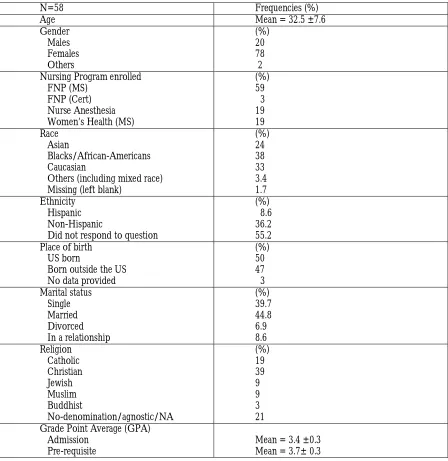
Table 1: Baseline characteristics of study participants
4.1.Admission Grade Point Averages (GPAs)
The first year students’ overall mean GPA at admission was 3.43±3. Their calculated overall pre-requisites GPA, based on undergraduate courses in statistics, research and health assessment, was 3.7± .3. The admission GPAs between genders were not different (3.34 ± .3and 3.45 ± .3, males and females, respectively). Male students, however, were found to have significantly higher pre-requisite GPAs compared to female students (3.8 ± .16, 3.7 ±.28, p=0.045). The admission mean GPA by program were as follows: FNP/MS/Certificate students - 3.5 ±.2; NA – 3.3 ±.3, and women’s health nurse practitioner/master of science (WHNP/MS) – 3.4 ± .4; whereas the pre-requisite GPAs were 3.7 ± .3, 3.8 ± .1 and 3.6 ± .3 (FNP/MS/Cert; Nurse Anesthesia (NA)and WHNP/MS, respectively).
N=58 Frequencies (%)
Age Mean = 32.5 ±7.6
Gender Males Females Others (%) 20 78 2 Nursing Program enrolled
FNP (MS) FNP (Cert) Nurse Anesthesia Women’s Health (MS)
(%) 59 3 19 19 Race Asian Blacks/African-Americans Caucasian
Others (including mixed race) Missing (left blank)
(%) 24 38 33 3.4 1.7 Ethnicity Hispanic Non-Hispanic
Did not respond to question
(%) 8.6 36.2 55.2 Place of birth
US born
Born outside the US No data provided
(%) 50 47 3 Marital status Single Married Divorced In a relationship
(%) 39.7 44.8 6.9 8.6 Religion Catholic Christian Jewish Muslim Buddhist No-denomination/agnostic/NA (%) 19 39 9 9 3 21 Grade Point Average (GPA)
Admission Pre-requisite
4.2.Emotional intelligence scores
The mean baseline EI score of the student participants was 134.2±12, indicating high EI. The EI scores ranged from 110 to 159. There was a trend towards difference in mean EI scores between genders; with male students found to have higher EI score than female students (140±10.2, 132.4 ± 12, p=0.61). Students in the nurse anesthesia program were noted to have highest mean EI score (139±15) among all the nursing programs, although not statistically significant.
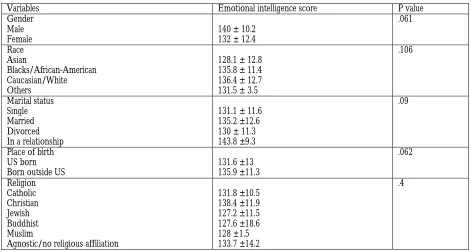
Using Pearson product-moment correlation, no correlation was noted between admission EI scores and age at admission (r=.151, p=.281). Similar findings were noted with socio-demographic variables, including marital status, race, birthplace, and religion (Table 2). Data was analyzed using Spearman rho correlation, which indicated no correlation was noted between the EI scores and admission GPA (r= -.178, p=.202) (Fig 1), and prerequisite GPA (r=179, p=.124).
Table 2: EI scores and socio-demographic variables
Variables Emotional intelligence score P value
Gender Male Female
140 ± 10.2 132 ± 12.4
.061
Race Asian
Blacks/African-American Caucasian/White Others
128.1 ± 12.8 135.8 ± 11.4 136.4 ± 12.7 131.5 ± 3.5
.106
Marital status Single Married Divorced In a relationship
131.1 ± 11.6 135.2 ±12.6 130 ± 11.3 143.8 ±9.3
.09
Place of birth US born Born outside US
131.6 ±13 135.9 ±11.3
.062
Religion Catholic Christian Jewish Buddhist Muslim
Agnostic/no religious affiliation
131.8 ±10.5 138.4 ±11.9 127.2 ±11.5 127.6 ±18.6 128 ±1.5 133.7 ±14.2
.4
5. Discussion and conclusion
This paper presented the results from Phase One of the study. The students enrolled in the university were noted to be from diverse backgrounds. Results showed no correlation between EI score, and cumulative and prerequisite GPAs among the first year APN students. This finding was consistent with the previous studies of undergraduate students (Sullivan, 2010) and student NA who reported that none of the EI variables were predictive of the student NAs GPA (Collins, Covrig&Neman, 2014). However, this finding was inconsistent with the study by Codier and Odell (2014), which showed some relationship between GPA and EI ability among first year undergraduate students.
The data also did not find any association between the student’s baseline EI scores and some demographic characteristics, including age, gender, race, place of birth, marital status and religion. This finding is similar to other studies who found zero correlations between EI, age, and gender among healthcare students including nursing (Birks, McKendree & Watt, 2009), and between EI, demographic, education and age variables among undergraduate nursing students (Codier & Odell, 2014). This, however, is in contrast with the study by Snowden and colleagues (2015), who reported that EI increases with age. In addition, although not statistically different, the present study found that male students have higher EI scores than female students, which is inconsistent with previous studies of dental and nursing students who reported the reverse (Codier, et al., 2015; Kumar et al, 2016; Snowden et al., 2015). This suggests further research is needed in these areas. Phase Two of the study is still ongoing.
6. Limitations
The study was limited by small sample size, sampling plan and geographic location. Students were recruited from one college in NY using purposive sampling. Only enrolled advanced practice nursing students were studied. Phase one of the study did not compare EI with behavioral outcomes.
7. Relevance to Nursing
The concept of EI is central to future nurses who will practice in the clinical settings. Nursing is a discipline that demands interaction with patients, their families or caregivers, and various members of the health care team. This interaction is not always verbal but it involves complex emotions as well. Therefore, nurses need to know how to deal with their emotions as they work with diverse patients, families and the healthcare team.
As an institution educating future nurses, educators are responsible to prepare students to the emotional demands of the different nursing roles so that they can better carry out their responsibilities competently, confidently and safely. Enhancing nursing student’s EI skills will better prepare them to deal with the emotional demands of clinical practice particularly in providing physical and emotional support to the patients and families. At the same time, developing their EI skills will prepare them to become transformational nurse leaders who are capable of critical thinking, communicating, networking, and collaborating in an inter professional environment that is constantly changing.
References
Beauvais, A. M, Brady, N., O’Shea, E. R.& Griffin, M. T. Q (2011). Emotional intelligence and nursing performance among nursing students. Nurse Education Today, 31; 396-401. DOI:10.1016/j.nedt.2010.07.013
Benson, G., Ploeg, J. & Brown, B. (2010). A cross-sectional study of emotional intelligence in baccalaureate nursing students. Nurse Education Today, 30; 49-53
Codier, E. E., Kofoed, E. & Peters, J. M. (2015). Graduate-entry non-nursing students: Is emotional intelligence different? Nursing Education Perspectives, 36(1), 46-47. DOI: 10.5480/12-874.1
Codier, E.& Odell, E. (2014). Measured emotional intelligence and grade point average in nursing students. Nurse
Education Today, 34; 608-612.
Collins, S. B., Covrig, D.& Newman, I. (2014). Q-factor EI profiles as an area of development in graduate nurse anesthesia students. Journal of Nursing Education, 53; 501-510. DOI:10.3928/01484834-20140821-13
Collins, S. (2013). Emotional intelligence as a noncognitive factor in student registered nurse anesthetists. AANA Journal, 81(6); 465-75
Farshi, M. R., Vahidi, M. & Mahnaz, J. (2015). Relationship between emotional intelligence and clinical competencies of nursing students in Tabriz Nursing and Midwifery School. Research & Development in Medical Education. 4 (1), 91-95. Accessed at: http://journals.tbzmed.ac.ir/rdme
Fernandez, R., Salamonson, Y., & Griffith, R. (2012). Emotional intelligence as predictor ofacademic performance in first year accelerated graduate entry nursing. Journal of Clinical Nursing, 21,3485-3492.
Jones-Schenk J & Harper MG (2014). Emotional intelligence: an admission criterion alternative to cumulative grade point averages for prelicensure students. Nurse Education Today, 34;413-420
Joshi SV, Srivastava K &Raychaudhauri A (2012). A descriptive study of emotional intelligence and academic performance of MBBS students. Procedia: Social & Behavioral Sciences, 69; 2061-2067. DOI: 10.1016/j.sbspro.2012.12.165
Kumar, A, Puranik, M. P. &Sowmyah, K. R. (2016). Association between dental students’emotional intelligence and academic performance: A study of six dental colleges in India. Journal of Dental Education, 80(5), 526-532. Landa, J. M. A, Lopez-Zafra, E. & Aguilar-Luzon, M. C. (2009). Predictive validity of perceived emotional intelligence
on nursing students’ self-concept. Nurse Education Today, 29,801-808. DOI: 10.1016/j.nedt.2009.04.004 Malouf, J.(2014). How can we measure emotional intelligence? Accessed
at:https://blog.une.edu.au/usingpsychology/2014/04/27/how-can-we-measure-emotional-intelligence/ comment-page-1/, April 27, 2016.
Mayer J. D (2012). Emotional intelligence information. Accessed at:
http://www.unh.edu/emotional_intelligence/index.html, January 5, 2016
Mohzan, M. A. M., Hassan, N. &Halil, N. A. (2013). The influence of EI on academic achievement. Procedia: Social &
Behavioral Sciences, 90; 303-312. DOI:10.1016/j.sbspro.2013.07.095
Por, J., Barriball, L., Fitzpatrick, J. & Roberts, J. (2011). Emotional intelligence: Its relationship to stress, coping, well-being and professional performance in nursing students. Nurse Education Today, 31; 855-860.
DOI:10.1016/j.nedt.2010.12.023
Rankin, B. (2013). Emotional intelligence: enhancing value-based practice and compassionate care in nursing. Journal of
Advanced Nursing, 69; 2717-2725. DOI: 10.1111/jan.12161
Roso-Bas, F., Pades-Jimenez, A. & Garcia-Buades, E. (2016). Emotional variables, dropout and academic performance in Spanish nursing students. Nurse Education Today, 37, 53-58
Salovey, P.& Mayer, J. (1990). Emotional intelligence. Imagination, Cognition & Personality, 9; 185 – 211.
Senyuva, E., Kaya, H., Isik, B &Bodur, S. (2014). Relationship between self-compassion and emotional intelligence in nursing students. International Journal of Nursing Practice, 20, 588-596. DOI: 10.1111/ijn.12204
Schuette, N., Malouff, J., Hall, L., Haggerty, D., Cooper, J., Golden, C., Dornheim, L. (1998). Development and validation of a measure of emotional intelligence. Personality and Individual Differences, 25; 167-77. DOI:10.1016/S0191-8869(98)00001-4
Snowden, A. Stenhouse, R., Young, J., Carver, H., Carver, F. & Brown. N. (2015). The relationship between emotional intelligence, previous caring experience, and mindfulness in student nurses and midwives: A cross sectional analysis. Nurse Education Today, 35, 152-158