Shilpa Sadanand, Prafulla Shivakumar, N Girish, Santosh Loganathan, Bhavani Shankara Bagepally, Lakshmi Narayanan Kota, Nalini Narayana Reddy, Palanimuthu Thangaraju Sivakumar, Srikala Bharath, Mathew Varghese
Geriatric Clinic and Services, National Institute of Mental Health and Neurosciences, Bangalore, India
Identifying elders with neuropsychiatric problems
in a clinical setting
Original Article
Introduction
More than 85 million people are aged above 60 in India and this number is estimated to reach 325 million by the year 2050.[1] Nearly half the health burden in India is expected to be borne by older adults in another 20 years.[2] In India, the neuro‑psychiatric component in
service delivery is glaringly deficient. Chronic diseases
of the brain and mind have not received the desired
priorities.[3] However, the health of the elderly is getting
greater attention with the Government of India bringing
out the guidelines toward establishing a National
Program for Health Care of the Elderly (NPHCE).[4] The guidelines aim at enhancing the health care of the
elderly using multiple strategies (geriatric clinic, memory clinics, geriatric wards, domicile visits, etc.) and is
being undertaken in phases. Notwithstanding this, neuropsychiatric problems remain relegated to the back. Ignorance, lack of appropriate tools and/or established protocols for managing the neuro‑psychiatric problems of the elderly are possible reasons for this disparity in service provision.
While older adults are at high risk of developing multiple comorbid medical conditions,[5] psychiatric morbidity in old age is associated with increased
Address for correspondence:
Dr. Girish N, Additional Professor of Epidemiology, National Institute of Mental Health and Neurosciences, Bangalore ‑ 560 029, Karnataka, India. E‑mail: [email protected]
ABSTRACT
Objective: Multiple health problems among the elderly necessitate a comprehensive enquiry to detect problems early and also initiate treatment. We utilized available validated instruments to comprehensively identify older persons with neuro‑psychiatric problems including dementia and comorbid medical ailments in the screening desk of the geriatric clinic. Materials and Methods: Individuals aged 60 years and above seeking outpatient care at NIMHANS during a 2‑year period (October 2008‑September 2010) participated. We used General Health Questionnaire (12‑item), AD8, questions to identify psychoses and neurological problems and a checklist of common medical ailments. A probable clinical diagnosis was made at the end by medical personnel based on ICD‑10. Results: Atotal of 5,260 individuals were screened and more than one‑third (36.7%) were women. About 50% had psychological distress (≥2 on GHQ‑12), 20.1% had probable cognitive impairment (≥2 on AD8) and about 17% had symptoms suggestive of psychoses (≥1 on Psychoses screener). More than 65% had either a neurological or neurosurgical problems (≥1 on Neurological screener) and headache was the commonest complaint. At probable diagnosis, more than 50% had a neurological problem and over 30% had psychiatric disorders. Of these the most common psychiatric illnesses were psychotic disorders (22.0%), mood disorders (21.4%) and dementia (14.4%). The most common medical comorbidity included hypertension (36.4%), visual impairment (31.8%) and joint pains (30.5%). Nearly 80% had one or more medical comorbidity in addition to psychiatric illness. The overall set of instruments took about 15‑20 minutes. It systematically and comprehensively guided in evaluating the elderly for neuropsychiatric problems and hence was collated to constitute the Instruments for Comprehensive Evaluation of the Elderly (ICE‑E). Conclusions: ICE‑E was brief, easy to administer and improved decision making even by personnel from a non‑medical background. The instrument aided in systematically detecting neuro‑psychiatric problems among the elderly (including psychological distress and cognitive changes) and other medical comorbidities.
Key words: Comorbidity, elderly, instruments screening, mental health, neuro‑psychiatric problems
Access this article online
Quick Response Code:
Website:
www.ruralneuropractice.com
DOI:
risk of hospitalization[6] and high levels of functional dependency, behavioral problems and cognitive
impairment are observed in older adults admitted in
general hospitals.[7] Therefore, evaluating older adults for mental health problems and cognitive status is essential.[8] Early detection of these problems confers an advantage to the individual, the health system and the society. However, the challenge is to choose one or more instruments/tools which comprehensively and systematically detects problems and facilitates treatment.
This paper attempts to address these issues and discusses
our experience in systematically identifying elderly with neuropsychiatric and medical problems.
Theoretically, a combination of validated specific instruments should work well. However, addition of each instrument would increase the time for administration
and also make it difficult to administer. The desirable
instrument should be concise, easy to administer, serve other purposes such as monitor treatment response and have a reasonably quick scoring time.[9] There are
specific screeners for mental health problems such as
depression[10,11] or cognitive impairment[12] but none that comprehensively identifies neuropsychiatric problems along with medical ailments. In this study we used existing instruments/tools which could help us comprehensively evaluate adults aged 60 years and above for neuropsychiatric and medical problems at the
screening desk in the Geriatric clinic.
Materials and Methods
Individuals aged 60 years and above registered at the out‑patient screening services in National Institute
of Mental Health and Neurosciences (NIMHANS) Bangalore, India, were screened by research staff of Geriatric services. Through consultative meetings the
frequently and widely used screening instruments, primarily those which systematically detect mental health problems, cognitive impairment, neurological and medical problems among older adults were listed. Those
identified in the process [Table 1] were reviewed, based on the brevity (less than 5 minutes to administer), easy to use and feasibility in routine clinical setup. The final set
of instruments consisted of four screening instruments, a brief description of which is given below.
The General Health Questionnaire: The General Health Questionnaire[13] is one of the most widely used screening instruments to detect common mental health problems among individuals across ages. The
shorter version (GHQ‑12) is translated to many local
languages[14,15] and is a good clinical screening tool for psychiatric morbidity.[11,16] GHQ‑12 has four options for each item, the two less favorable answers are combined and coded 1 and the two more favorable coded as 0, with
total scores ranging from 0 to 12.With a cut‑off score of ≥2
it has good sensitivity and specificity.[15,17]
The AD8: The AD8[18] is a brief 8‑item measure to identify cognitive impairment among older adults. The total
scores range from 0 to 8, with a cut‑off score of ≥ 2. It has
good sensitivity (74%) and specificity (86%) for detecting
dementia.[18]
The Neurological screener: The 12‑item questionnaire
developed for the Bangalore Urban and Rural
Neuroepidemiological (BURN) survey detects symptoms
related to major neurological disorders.[19] With a
Table 1: Widely used screening instruments to detect mental health problems and cognitive impairment among elderly
Screening instruments Remarks
Mental health problems Self‑reporting questionnaire SRQ‑20/24 20‑item, self administered
General health questionnaire GHQ‑12 12‑item, self administered, 5 minutes Geriatric depression scale GDS‑15 15‑item, self administered, 5‑10 minutes Primary health questionnaire 9‑item, self administered,
Cognitive impairment Mini mental state examination‑MMSE By trained interviewer, 10 minutes
Hindi mental status examination‑HMSE Hindi adaptation of MMSE, For illiterate rural elderly
Clock drawing tests For literates, standardized interpretation of drawing by clinician, 2 minutes,
Seven minute neurocognitive screening battery 4‑subtests‑memory, verbal fluency, visuo‑construction and orientation, by trained interviewer, 6‑11 minutes
Mini cog For literates; by interviewer, 3‑word recall+clock drawing test,
3 minutes
AD8 8‑item, patient administered and/or informant interview, <3 minutes
Memory impairment screen 4‑item, by interviewer, 4 minutes
Cognitive impairment test (6‑CIT) 6‑item, by interviewer, 3‑4 minutes General practitioner assessment of
sensitivity of 95%, specificity of 98% and a positive predictive value of 68%, the symptom checklist includes
headache, speech abnormality, paralysis of limbs,
seizures, gait difficulty and memory deficits. The total
scores range from 0 to 12.[19]
The Psychoses screener: The 4‑item screener for detecting psychoses (non‑validated) is based on key symptom parameters of psychoses: Delusions, hallucinations, talking/muttering to self and any other strange behaviors. Depending on the presence or absence of the above
symptoms, the total scores ranges from 0 to 4.
Medical Illness Screener: A checklist for common medical ailments, adapted from the Cumulative Illness Rating Scale – Geriatrics,[20] completed the set of instruments along with questions to document the socio‑demographic details.
All individuals screened were provisionally diagnosed by medical personnel among the research staff, before
being referred to concerned departments for detailed evaluation and treatment as per routine clinical services
of the hospital [Figure 1]. Diagnoses such as dementia,
mood disorders and other psychiatric illness were made
according to ICD‑10 criteria.[21] EpiInfo[22] was utilized to develop the database of screened individuals.
Results
Socio‑demographics
We screened 5,260 individuals aged 60 and above during
a 2‑year period (October 2008‑September 2010). The mean age of respondents was 66.3 years (±6.24), with a majority (71%) belonging to the 60‑69 year age group [Figure 2] and more than one‑third were women (36.7%).
Burden of morbidity
Mental and neurological problems
GHQ‑12 was complete on 4,890 individuals (92.9%) [Table 2]. Half of them (50.0%) had a score ≥ 2 indicating
possible psychological distress and this was significantly higher among women (P < 0.001). The AD8 could be administered to 5,231 individuals (99.4%) and one‑fifth (20.1%) had probable cognitive impairment
with no significant gender differences. Nearly
one‑fifth (16.8%) had one or more symptoms suggestive of psychoses (talking/muttering/laughing to self: 72.9%; strange behaviors: 69.3%; delusions: 55.8%; hallucinations: 40%). Nearly two‑thirds with psychoses (61.3%)
were positive for cognitive impairment. Psychotic symptoms were more common among women than
men and was statistically significant (P = 0.001). More than two‑thirds (65.8%) of those screened had at least one neurological symptom; common ones being headache (26.3%), difficulty in walking (16%), speech abnormalities (12.6%) and paralysis of arms or legs (12.1%). Significant gender differences were observed: Headache was more common among women, whereas walking difficulty, speech abnormality and
Table 2: Gender differences across ICE‑E instruments
Male (%) Female (%) P value
Ghq‑12 (score≥2) 1410 (45.2) 1032 (58.2) <0.001
AD8 (score≥2) 632 (19.1) 418 (21.8) 0.022
Psychoses screener (score≥1) 481 (14.5) 403 (20.9) <0.001 Presence of both psychotic
symptoms and cognitive
impairment 298 (8.9) 244 (12.6) 0.001
Neurological screener
(score≥1) 2197 (66) 1264 (65.5) 0.714
Headache 683 (20.5) 702 (36.4) <0.001
Walking difficulty 647 (19.4) 196 (10.2) <0.001 Speech abnormality 502 (15.1) 160 (8.3) <0.001 Paralysis of arms or legs 504 (15.1) 132 (6.8) <0.001
Neurological screener, Highest frequency of symptoms mentioned
Figure 1: Flow chart depicting screening services for older adults in
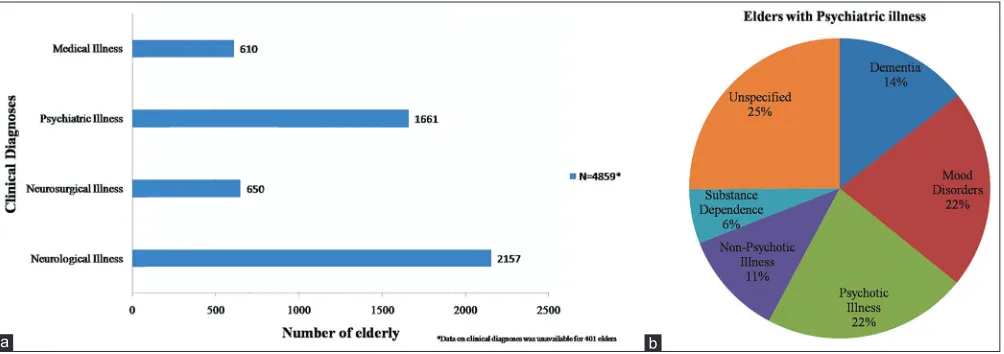
paralysis of arms or legs was frequent among men. The provisional clinical diagnosis arrived at is depicted in Figure 3. The data on clinical diagnoses was unavailable
for about 8% of older adults.
Provisional diagnoses among those screened positive Individuals with a provisional diagnosis of mood disorder, other non‑psychotic illness such as anxiety, somatoform disorders and with either a neurological
or neurosurgical illness were positive (≥2) on the GHQ (87.9%, 86.1% and 40%, respectively) [Table 3]. The psychoses screener identified 95.9% individuals diagnosed with psychotic illness (N = 365), 50% of persons with dementia (N = 239) and more than 25% among individuals with substance dependence (N = 97). The AD8 identified cognitive impairment among 98.7% individuals with dementia, 53.9% with psychotic illness and about 35% with mood disorders. The neurological screener identified neurological symptoms among 87% individuals with neurological illness and 69% with
neurosurgical illness.
Medical comorbidity
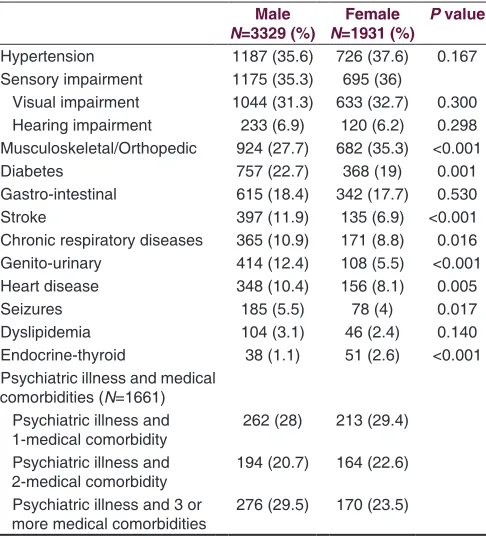
Hypertension (36.4%), visual impairment (31.8%), musculoskeletal ailments (30.5%), diabetes mellitus
(21.4%) and gastro‑intestinal disorders (18.2%) were the common medical illness reported [Table 4]. Diabetes and hypertension were reported by 722 individuals (13.7%).
Musculoskeletal ailments and thyroid disorders were more frequent among women, whereas, stroke and
genito‑urinary complaints were common in men. Among psychiatrically ill older adults, 77% had at least one
medical comorbidity.
Discussion
This is a large hospital‑based study that enquired into the neuropsychiatric and medical problems among the elderly. The set of individual validated instruments which was put together, assisted the clinician to be systematic and comprehensive. While the focus was on neuropsychiatric problems, medical problems were also included as mental health is integral component of health problems.
Many instruments have been utilized to detect common mental health problems and psychological distress,[10,11,23]
but the General health questionnaire[13] is widely used.
The shorter version (GHQ‑12) works as well as the longer
Table 3: Comparison of screening instruments and provisional diagnoses
Neurological
illness Neurosurgical illness Mood Psychiatric illness Medical illness
disorder Psychotic illness non‑psychotic Other illness
Dementia Substance
dependence Unspecified
N# 2157 650 356 365 187 239 97 417 610
Ghq‑12* (score≥2) (%) 42.8 40.9 87.9 76.6 86.1 48.4 45.9 68.2 34.5
P‑4 (score≥1) (%) 4.8 3.7 27.2 95.9 9.1 50.2 25.7 39.5 0.8
AD8** (score≥2) (%) 11.5 8.7 35.4 53.9 9.1 98.7 18.5 36.9 3.4
N‑12 (score≥1) (%) 87.8 68.9 51.9 38.6 47.1 69 64.9 47.2 39.8
*Ghq‑12 could be administered on 4890 individuals, Neurological illness‑2045, Neurosurgical illness‑610, mood disorders‑333, psychotic illness‑295,
non‑psychotic illness‑187, Dementia‑159, Substance dependence‑87, Unspecified‑378, medical illness‑602, no diagnosis‑388, **AD8 could not be administered on 29 individuals (0.5%), #Out of 5260, for 401 individuals, clinical diagnoses data was unavailable
Figure 3: (a and b) Provisional diagnoses among the screened population
version (GHQ‑28)[13] and is useful in detecting anxiety,
depression, social dysfunction and loss of confidence
among older adults.[24] The four questions to identify
psychotic symptoms complemented the GHQ‑12 in
identifying both severe and common mental health
disorders. Memory deficit seen in dementia is often overlooked as age‑related memory loss; hence evaluation
of cognitive status among elderly is important. Mini
Mental Status Examination (MMSE), Hindi Mental State Examination (HMSE), clock drawing tests, memory impairment screen andAD8 identify cognitive
impairment.[12,23,25‑27] Of these, MMSE is widely used
while AD8 is a new addition that is not frequently used in the Indian setting. However, AD8 is quick, informant
based, is sensitive for cognitive change among elderly
and reliably differentiates demented from non‑demented
individuals.[28] Thus, AD8 can be used as a common screening tool to identify cognitive change regardless of the etiology.[18,28] The screener from the BURN survey[19] helped to identify a large proportion of individuals with neurological problems and is simple, comprehensive and brief.
Utilizing the validated screening instruments as a
combination has given us unique insights: It aided in
picking up a substantial number of psychiatric and neurological cases which would otherwise have gone
undetected. GHQ reveals the frequent sleep disturbances
amongst older people,[29] and also identify the hidden burden of psychological distress among elders with neurological illness. The psychoses screener besides identifying severe mental health problems complemented
the AD8 in identifying psychotic symptoms frequently
seen in persons with dementia.[30] In addition, the set of instruments was easy to use and did not pose any major problems in administration. The provisional diagnosis
was made by a trained medical doctor. However, a final confirmation by a psychiatrist using standard measures
would have been ideal.
Burden of morbidity Psychological distress
Nearly half of the elderly screened by GHQ scored above the cutoff indicating psychological distress and the gender difference were significant (more women than men). Earlier studies reports greater distress
with increasing medical morbidity and that women experience greater distress than men.[31]
Mental and neurological problem
Psychotic symptoms in older persons have various
causes: Progressive dementing illness, late‑onset
schizophrenia, delusional disorders, early onset psychotic illness extending in late life, late onset mood disorders, psychotic disorders caused by medical conditions or medications and delirium.[30,32,33] In the present study, psychotic symptoms were more commonly observed as a result of late‑onset psychosis, dementia with psychotic symptoms and also amongst those with late‑onset mood disorders. The psychotic symptoms were more commonly observed among older women than men which corresponds to previous literature.[34]
Depression is the most common mental health problem
among the elderly in India,[35] followed by anxiety disorders, dementia and substance dependence.[36‑38] In our study we found preponderance of psychotic illness
and mood disorders (including depression), possibly
due to use of separate instruments. Headache was the most common symptom among individuals positive on the neurological screener and was reported mostly by older adults with depression, dysthymia or somatoform
disorders. Our study supports finding by Drayer and
colleagues that older adults with somatic complaints such as headache or fatigue may actually be depressed and rating scales should consider these symptoms for an accurate measure of depression severity.[39]
Medical morbidity
Hypertension, sensory impairment (vision and hearing),
musculoskeletal ailments, diabetes and gastro‑intestinal complaints in that order, were the common medical
Table 4: Reported medical comorbidities among those screened
Male
N=3329 (%) N=1931 (%)Female P value
Hypertension 1187 (35.6) 726 (37.6) 0.167
Sensory impairment 1175 (35.3) 695 (36)
Visual impairment 1044 (31.3) 633 (32.7) 0.300
Hearing impairment 233 (6.9) 120 (6.2) 0.298
Musculoskeletal/Orthopedic 924 (27.7) 682 (35.3) <0.001
Diabetes 757 (22.7) 368 (19) 0.001
Gastro‑intestinal 615 (18.4) 342 (17.7) 0.530
Stroke 397 (11.9) 135 (6.9) <0.001
Chronic respiratory diseases 365 (10.9) 171 (8.8) 0.016
Genito‑urinary 414 (12.4) 108 (5.5) <0.001
Heart disease 348 (10.4) 156 (8.1) 0.005
Seizures 185 (5.5) 78 (4) 0.017
Dyslipidemia 104 (3.1) 46 (2.4) 0.140
Endocrine‑thyroid 38 (1.1) 51 (2.6) <0.001
Psychiatric illness and medical comorbidities (N=1661)
Psychiatric illness and
1‑medical comorbidity 262 (28) 213 (29.4) Psychiatric illness and
2‑medical comorbidity 194 (20.7) 164 (22.6) Psychiatric illness and 3 or
conditions detected. These are comparable to other Indian studies,[36,40‑44] including, the observed significant differences between women and men.[5,40,44] and the proportion of other medical conditions common among the elderly such as stroke, chronic respiratory diseases, genitourinary complaints, heart diseases and seizures.[45,46] Stroke and genitourinary complaints are common among men than women.[46,47] Among elders with psychiatric illness, a majority had one or more co‑morbid medical conditions which is comparable to earlier studies.[5,48]
Healthcare seeking
Majority of the individuals screened were aged between 60‑69 years and almost two‑thirds were men. While there are similar reports,[36,44,49] the gender differences in
seeking care (more men than women) is noteworthy. That
a greater proportion of male elderly in 60‑69 year age
group seek care presents a two‑fold challenge: The need
to develop appropriate services for the visiting group and importantly as there are multiple comorbidities and particularly chronic ones then the greater need for follow‑up care.
Conclusions
This is the first large study which has comprehensively
screened and reported neuropsychiatric and medical problems among the elderly who seek health care. Neuropsychiatric problems among geriatric group are highly prevalent.[37] Depression, the most common disorder[48,50] along with memory impairment among elderly patients go undetected as age‑related changes and thus are not counted as treatable conditions. The substantial burden of neuro‑psychiatric problems is overlooked and presence of psychological distress among persons with neurological and neurosurgical patients are neglected.
Our study adopted four commonly used screening
instruments to comprehensively evaluate the elderly for a wide array of neuro‑psychiatric problems which could be
referred to as Instruments for Comprehensive Evaluation of the Elderly (ICE‑E). The experience using ICE‑E was
that it was comprehensive brief, easy to administer, not personnel intensive and could be used by non‑medical
personnel with adequate training. Apart from aiding the
diagnostician, the instrument assists clinician in planning
better management strategies.
References
1. World Health Organization. World Population Ageing 1950‑2050. 2002. Available from: http://www.un.org/esa/population/publications/ worldageing 19502050/ [Last accessed on 2011 Jan 21].
2. Chatterji S, Kowal P, Mathers C, Naidoo N, Verdes E, Smith JP, et al. The health of aging populations in China and India. Health Aff 2008;27:1052‑63.
3. Sousa RM, Ferri CP, Acosta D, Albanese E, Guerra M, Huang Y, et al. Contribution of chronic diseases to disability in elderly people in countries with low and middle incomes: A 10/66 Dementia Research Group population‑based survey. Lancet 2009;374:1821‑30.
4. Ministry of Health and Family Welfare, Government of India, Operational Guidelines, National Programme for the Health Care of the
Elderly (NPHCE). 2011. Available from: http://mohfw.nic.in/showfile.
php?lid=1145 [Last accessed on 2012 Aug 07].
5. Joshi K, Kumar R, Avasthi A. Morbidity profile and its relationship with
disability and psychological distress among elderly people in Northern India. Int J Epidemiol 2003;32:978‑87.
6. Ng TP, Feng L, Chiam PC, Kua EH. Psychiatric morbidity and acute hospitalization in elderly people. Int Psychogeriatr 2006;18:701‑11. 7. Goldberg SE, Whittamore KH, Harwood RH, Bradshaw LE, Gladman JR,
Jones RG. The prevalence of mental health problems among older adults admitted as an emergency to a general hospital. Age Ageing 2012;41:80‑6. 8. Wray LO, Mavandadi S, Klaus JR, Tew JD Jr, Oslin DW, Sweet RA. The
association between mental health and cognitive screening scores in older veterans. Am J Geriatr Psychiatry. 2012;20:215‑27.
9. Mulrow CD, Williams JW, Gerety MB, Ramirez G, Montiel OM, Kerber C.
Case‑finding instruments for depression in primary care settings. Ann
Intern Med 1995;122:913‑21.
10. Ganguli M, Dube S, Johnston JM, Pandav R, Chandra V, Dodge HH. Depressive symptoms, cognitive impairment and functional impairment in a rural elderly population in India: A Hindi version of the geriatric depression scale (GDS‑H). Int J Geriatr Psychiatry 1999;14:807‑20. 11. Patel V, Araya R, Chowdhary N, King M, Kirkwood B, Nayak S,
et al. Detecting common mental disorders in primary care in India:
A comparison of five screening questionnaires. Psychol Med
2008;38:221‑8.
12. Ganguli M, Ratcliff G, Chandra V, Sharma S, Gilby J, Pandav R, et al. A Hindi Version of the MMSE: The Development of a cognitive screening instrument for a largely illiterate rural elderly population in india. Int J Geriatr Psychiatry 1995;10:367‑77.
13. Goldberg DP, Gater R, Sartorius N, Ustun TB, Piccinelli M, Gureje O,
et al. The validity of two versions of the GHQ in the WHO study of mental illness in general health care. Psychol Med 1997;27:191‑7. 14. Sriram TG, Chandrashekar CR, Isaac MK, Shanmugham V. The General
Health Questionnaire (GHQ) Comparison of the English version and a translated Indian version. Soc Psychiatry Psychiatr Epidemiol 1989;24:317‑20.
15. Kuruvilla A, Pothen M, Philip K, Braganza D, Joseph A, Jacob KS. The validation of the Tamil version of the 12 item general health
questionnaire. Indian J Psychiatry 1999;41:217‑21.
16. Patel V, Pereira J, Mann AH. Somatic and psychological models of common mental disorder in primary care in India. Psychol Med 1998;28:135‑43.
17. Jacob KS, Bhugra D, Mann AH. The validation of the 12‑item General Health Questionnaire among ethnic Indian women living in the United Kingdom. Psychol Med 1997;27:1215‑7.
18. Galvin JE, Roe CM, Powlishta KK, Coats MA, Muich SJ, Grant E, et al. The AD8 A brief informant interview to detect dementia. Neurology 2005;36:559‑64.
19. Gourie‑Devi M, Gururaj G, Satishchandra P, Subbakrishna DK. Prevalence of neurological disorders in Bangalore, India: A community‑based study with a comparison between urban and rural areas. Neuroepidemiology 2004;23:261‑8.
20. Miller MD, Paradis CF, Houck PR, Mazumdar S, Stack JA, Rifai AH, et al. Rating chronic medical illness burden in geropsychiatric practice and research: Application of the Cumulative Illness Rating Scale. Psychiatry Res 1992;41:237‑48.
21. World Health Organization. The ICD‑10 Classification of Mental
and Behavioural Disorders. New Delhi, India: AITBS Publishers and Distributors; 2007.
22. Centers for Disease Control and Prevention (CDC). Epi Info[TM] 3.5.1. 2008.
24. Cheung YB. A confirmatory factor analysis of the 12‑item General Health
Questionnaire among older people. Int J Geriatr Psychiatry 2002;17:739‑44. 25. Lorentz WJ, Scanlan JM, Borson S. Brief screening tests for dementia.
Can J Psychiatry 2002;47:723‑33.
26. Ganguli M, Hendrie HC. Screening for cognitive impairment and depression in ethnically diverse older populations. Alzheimer Dis Assoc Disord 2005;19:275‑8.
27. Ismail Z, Rajji TK, Shulman KI. Brief cognitive screening instruments: An update. Int J Geriatr Psychiatry 2010;25:111‑20.
28. Galvin JE, Roe CM, Xiong C, Morris JC. Validity and reliability of the AD8 informant interview in dementia. Neurology 2006;67:1942‑8.
29. Mazzotti DR, Guindalini C, Sosa AL, Ferri CP, Tufik S. Prevalence
and correlates for sleep complaints in older adults in low and middle income countries: A 10/66 Dementia Research Group study. Sleep Med 2012;13:697‑702.
30. Brown FW. Late‑life psychosis: Making the diagnosis and controlling symptoms. Geriatrics 1998;53:26‑8, 37‑8, 41‑2.
31. Prakash IJ. Women and ageing. Indian J Med Res 1997;106:396‑408. 32. Soares JC, Gershon S. Therapeutic targets in late‑life psychoses: Review
of concepts and critical issues. Schizophr Res 1997;27:227‑39. 33. Lacro JP, Jeste DV. Geriatric psychosis. Psychiatr Q 1997;68:247‑60.
34. Hassett A. A descriptive study of first presentation psychosis in old age.
Aust N Z J Psychiatry 1999;33:814‑24.
35. Shaji KS, Jithu VP, Jyothi KS. Indian research on aging and dementia. Indian J Psychiatry 2010;52(Suppl 1):148‑52.
36. Silva Pereira YD, Estibeiro A, Dhume R, Fernandes J. Geriatric patients attending tertiary care psychiatric hospital. Indian J Psychiatry 2002;44:326‑31.
37. Sood A, Singh P, Gargi PD. Psychiatric morbidity in non‑psychiatric geriatric inpatients. Indian J Psychiatry 2006;48:56‑61.
38. Tiwari SC. Geriatric psychiatric morbidity in rural northern India: Implications for the future. Int Psychogeriatr 2000;12:35‑48.
39. Drayer RA, Mulsant BH, Lenze EJ, Rollman BL, Dew MA, Kelleher K,
et al. Somatic symptoms of depression in elderly patients with medical comorbidities. Int J Geriatr Psychiatry 2005;20:973‑82.
40. Prakash O, Gupta LN, Singh VB, Singhal AK, Verma KK. Profile of
psychiatric disorders and life events in medically ill elderly: Experiences from geriatric clinic in Northern India. Int J Geriatr Psychiatry 2007;22:1101‑5.
41. Tiple P, Sharma SN, Srivastava AS. Psychiatric morbidity in geriatric people. Dement Geriatr Cogn Disord 2006;48:88‑94.
42. Singh GP, Chavan BS, Kaur P, Bhatia S. Physical illnesses among psychiatric outpatients in a tertiary care health institution: A prospective study. Indian J Psychiatry 2006;48:52‑5.
43. Shah B, Prabhakar AK. Chronic morbidity profile among elderly. Indian J
Med Res 1997;106:265‑72.
44. Purty AJ, Bazroy J, Kar M, Vasudevan K, Veliath A, Panda P. Morbidity pattern among the elderly population in the rural area of Tamil Nadu, India. Turk J Med Sci2006;36:45‑50.
45. Krishnaswamy B, Sein UT, Munodawafa D, Varghese C, Venkataraman K, Anand L. Ageing in India. Ageing Int 2008;32:258‑68.
46. Das SK, Biswas A, Roy J, Bose P, Roy T, Banerjee TK, et al. Prevalence of major neurological disorders among geriatric population in the metropolitan city of Kolkata. J Assoc Physicians India 2008;56:175‑81. 47. Dhar HL. Gender, aging, health and society. J Assoc Physicians India
2001;49:1012‑20.
48. Chaudhury S, Chakraborty R, Seby K. Prevalence of psychiatric and physical morbidity in an urban geriatric population. Indian J Psychiatry 2011;53:121‑7.
49. Singh N, Chopra H, Singh JV, Bhatnagar M, Garg SK, Bajpai SK. The
psycho‑social profile of the elderly people in urban area of Meerut city.
J Indian Acad Geriatr 2009;5:165‑70.
50. Varghese M, Patel V. The Graying of India. In: Agarwal SP, Goel DS, Ichhpujani RL, Salhan RN, Shrivastava S, editor. Mental Health: An Indian Perspective 1946‑2000. New Delhi, India: Directorate General of Health Services, Ministry of Health and Family Welfare; 2004. p. 240‑8.
How to cite this article: Sadanand S, Shivakumar P, Girish N,
Loganathan S, Bagepally BS, Kota LN, et al. Identifying elders with neuropsychiatric problems in a clinical setting. J Neurosci Rural Pract 2013, 4(Suppl 1):s24‑30.