International Journal of Applied And Pure Science and
Agriculture
www.ijapsa.com
Effect of different carbon and nitrogen sources on the vegetative growth of
Shiitake mushroom (
Lentinula edodes
(Berk.) Pegler).
Deepa Rani C. V1 and Dr. Lulu Das2 1,2
Department of Plant Pathology, College of Agriculture, Vellayani, Thiruvananthapuram
Abstract
Study was conducted to optimize the effect of different carbon and nitrogen sources for the vegetative growth of Lentinula edodes in both solid and liquid media. Out of six different carbon sources viz. sucrose, lactose, galactose, fructose, dextrose and mannitol tested, fastest growth was obtained with dextrose as carbon source in solid media. In the broth, mannitol supported maximum mycelial dry weight of Lentinula edodes. Peptone when used as nitrogen source gave best result in solid media. Maximum mycelial dry weight was obtained in liquid media when ammonium nitrate was used as nutrient source.
Keywords:Lentinula edodes, carbon, nitrogen, solid media and broth
I. INTRODUCTION
Mushrooms are one of the most promising sources of functional food , drug, dietary supplements, healthy beverages etc. Lentinula edodes or Shiitake is a white rot wood decay fungus which produces brown basidiocarps with exotic flavor. It is extensively grown in China, Korea, Japan and other Asian countries because of suitability of the climate. In India, successful cultivation of Shiitake mushroom has been reported on sawdust, wheat straw and wood chips of hard wood tress. It is well known, not only for its delicious flavor and nutritional value but also for potential use in medicinal applications. The aim of this study was to determine the effect of various carbon and nitrogen sources on vegetative growth of Lentinula edodes.
II. MATERIALS AND METHODS
Lentinula edodes was grown in media with different carbon sources viz. sucrose, lactose,
galactose, mannitol and inositol. These were substituted for dextrose, in malt extract peptone dextrose agar medium. The media were prepared and sterilized by autoclaving at 15 lbs pressure for 15-20 min. After cooling it was poured into sterile petri dishes of nine centimetre diameter and allowed to solidify. The culture disc of five mm diameter from fresh culture of fungus was used for inoculation. The culture disc of the mushroom was inoculated into petri dish which was incubated at room temperature (28 ± 2ºC). Three replications were maintained for each treatment and colony diameter, nature of mycelia growth etc. were measured at intervals of 7, 9 and 12 days.
The liquid media with different carbon and nitrogen sources were prepared, the composition was same used in previous experiments except elimination of agar . Fifty ml of medium was taken in each 100 ml conical flask sterilized in an autoclave inoculated with five mm culture disc of actively growing culture which was incubated at room temperature for 30 days. The mycelial mat was filtered through Whatman No: 1 filter paper and dry weights taken after drying at 70 ºC until constant weight was obtained.
III. RESULTS AND DISCUSSION
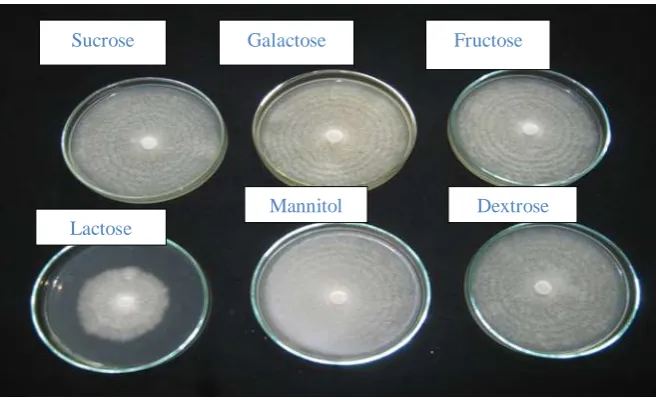
Fig. 1 and Fig. 2 revealed the effect of different carbon sources in solid media on the growth of
Lentinula edodes. Observations taken at 7th , 9th and 12th day showed that the best carbon source
was dextrose ( 9 cm) which was followed by sucrose (8.93 cm), mannitol ( 8.90 ), galactose ( 8.87 ) and fructose ( 8.63).
Fig. 1 Growth of Shiitake culture in various carbon sources
Fig. 2 Growth of Shiitake culture in different carbon sources
Average diameter (cm)
Sucrose Galactose Fructose
Lactose
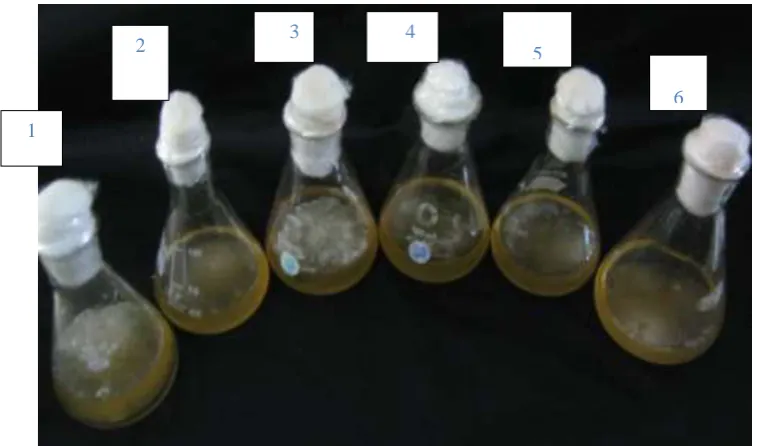
Fig. 3 Growth of Shiitake culture in various liquid carbon sources
Fig. 4 Mycelial dry weight of Shiitake culture in various liquid carbon sources
Fig. 3 and Fig. 4 revealed that maximum mycelial dry weight ( 87 mg/ 50 ml) was obtained in medium containing mannitol as carbon source followed by fructose ( 77 mg ), galactose ( 72 mg), sucrose ( 65.20 mg ) and dextrose ( 61.60 mg). Peter and Teodorescu (2008) suggested that out of the carbon sources like glucose, maltose, sucrose and xylose tested, maltose proved to be the best source in increasing the mycelial growth and fungal biomass synthesis for Lentinula edodes.
1
2 3 4 5
Fig. 5 Growth of Shiitake culture in different nitrogen sources
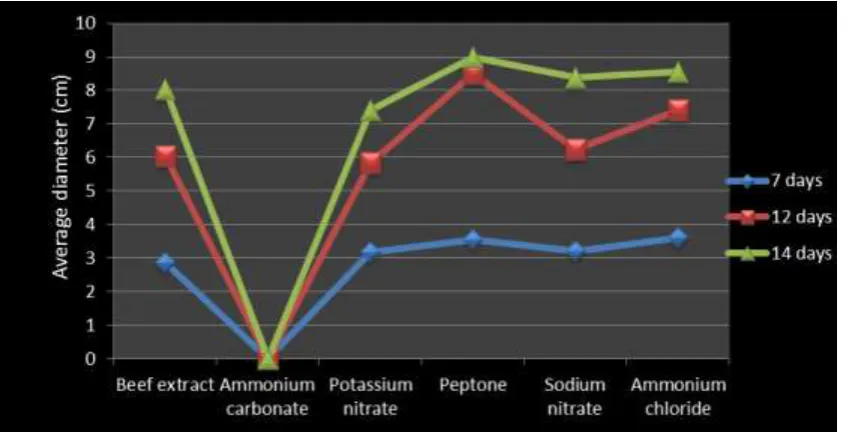
Studies conducted revealed that the best nitrogen source in solid media was peptone ( 9 cm) which was followed by ammonium chloride ( 8.57 cm) , sodium nitrate ( 8.40 cm) and beef extract (8.03 cm) (Fig. 5 and Fig. 6). There was not any significant growth with ammonium carbonate. This is in accordance with the results of Kaur and Lakhanpal (1995) ,as peptone @ 0.3 % increased the mycelial growth of Lentinula edodes.
Fig. 6 Growth of Shiitake culture in different nitrogen sources
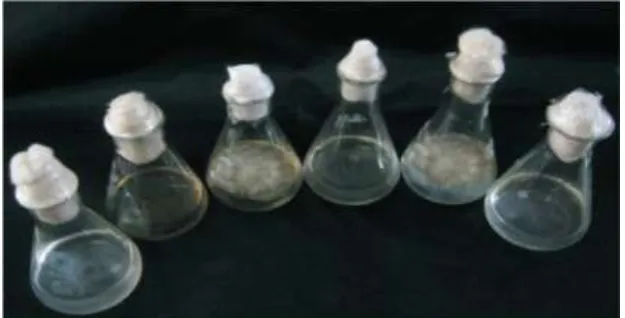
Fig. 7 and Fig. 8 revealed that in liquid media maximum mycelial dry weight ( 2.24 mg/ 50 ml) was obtained in medium containing sodium nitrate as nitrogen source followed by peptone ( 2.10 mg ), beef extract ( 1.21 mg) and potassium nitrate ( 1.08 mg).
Peptone NH4Cl KNO3
Fig.7 Growth of Shiitake culture in various liquid nitrogen source
Fig. 8 Growth of Shiitake culture in various liquid nitrogen sources
IV. CONCLUSION
In this study on the effect of carbon and nitrogen sources on Shiitake culture the best carbon source for its growth was dextrose in case of solid media and mannitol in case of liquid media. The best nitrogen source was found to be peptone in solid media and sodium nitrate in liquid media.
Average mycelial dry weight ( mg/ 50 ml
BIBLIOGRAPHY
1. Jung, H.H., Lee, J.Y., Kim, G.Y., Park, H.S., Nam, G.H., An, W.G., Lee, S.J. and Lee, D.L. 2001. Availability of sikhae factory waste water as a submerged culture medium for Lentinula edodes. Mycobiol., 29(3): 160-163. 2. Kannan, C. and Easwaran, A. 2010. Evaluation of different media and additives for the cultivation of Lentinus
edodes (Berk.). J. Plant Dis. Sci., 5(1): 8 – 9.
3. Kaur, M. J. and Lakhanpal, T.N. 1995. Effect of nutrient elements , vitamins and growth regulators on the vegetative growth of Lentinula edodes. Mush. Res., 4 (1) : 11-14.
4. Khan, S.M., Anwar, W. and Imtiaz, A. 1995. Physiological studies on Shiitake mushroom (Lentinula edodes
(Berk.) Sing. Pakistan J. of Phytopathol., 7(2) : 132-134.