_____________________________________________________________________________________________________
*Corresponding author: Email: [email protected];
Performance Evaluation of a Refrigeration System
for Fresh Maize Storage
O. O. Caleb
1, N. G. Olaiya
2*and M. A. Akintunde
11
Department of Mechanical Engineering, Federal University of Technology, Akure, Nigeria.
2Department of Industrial and Production Engineering, Federal University of Technology, Akure,
Nigeria.
Authors’ contributions
This work was carried out in collaboration among all authors. Author OOC designed the study, performed the statistical analysis, wrote the protocol and wrote the first draft of the manuscript. Author NGO managed the write up of the study and the literature searches. All authors read and approved the final manuscript.
Article Information
DOI: 10.9734/JERR/2019/v9i417025 Editor(s): (1) Dr. Qing Li, College of Mechanical Engineering, Donghua University, Shanghai, China and Department of Mechanical Engineering, University of Alberta, Edmonton, Canada. Reviewers: (1) Gavali Pankaj, Sanjay Ghodawat Institute, India. (2)Pedro Dinis Gaspar, University of Beira Interior, Portugal. (3)Coldea Teodora Emilia, University of Agricultural Sciences and Veterinary Medicine of Cluj-Napoca, Romania. Complete Peer review History:http://www.sdiarticle4.com/review-history/53880
Received 10 November 2019 Accepted 12 January 2020 Published 20 January 2020
ABSTRACT
Aims: In this research project, a refrigeration system that will preserve the quality of fresh maize was developed.
Study Design: Design of refrigeration system.
Place and Duration of Study: Department of Industrial and Production Engineering, Federal University of Technology, Akure, Ondo State, Nigeria, between August 2017 and February 2018.
Methodology: The designed system consists of a cooling cabinet, compressor, condenser and an evaporator. The cabinet was designed to store up to 15 kg of maize and a compressor of 1/6 hp was used. The equivalent condenser and evaporator were selected with an equivalent expansion valve. R134a was used as the refrigerant. The cabinet walls were fabricated from mild steel (outside wall), stainless steel (inner wall) and glass wool (insulator).
Results: The fabricated system stores fresh maize above its freezing temperature of -1ºC. The system operating temperature ranges from -4 to 2.5ºC with a relative humidity of 90 to 95% for eight hours.
Conclusion: The fresh maize was stored for ten days without noticeable changes in the physical appearance and taste of the maize.
Keywords: Maize; refrigeration; storage; temperature; quality.
1. INTRODUCTION
Maize (Zea mays L.) known in some English-speaking countries as corn is the third most important cereal crop in Africa [1]. It occupies less land area than either wheat or rice but has a greater average yield per unit area of about 5.5 tonnes per hectare [2]. According to Baributsa, et al. [3] maize reaches physiological maturity between 130 and 160 days after planting, depending on the variety. At this stage, the crop has a moisture content of about 30 percent and can be harvested provided that adequate storage facilities are available.
Maize is a good source of starch (65-70%), protein (8-10%), fat (3-4%) and some of the important vitamins and minerals (Shobha, et al. 2011). IITA (2007) established maize as an important source of oils, vitamin B and minerals. According to Dasbak, et al. [4] maize kennel is also rich in vitamins and fats.
Storage requirements for maize have changed significantly from the days when the farmer only had to worry about storing food and some seed for the following planting season [5]. However, maize is now mainly hybrid maize which, because of its shorter and looser husks, should ideally be stored shelled in a closed store if dry.
Preservation of quality during long term storage is a problem in many parts of the world
[6,7].
Maize grown by subsistence farmers is a staple food for millions of people around the world, especially in Sub-Saharan Africa and Central America. Maize has been in the diet of Nigerian’s for centuries. Fresh maize is a living organism and continues to respire after harvest. Its sweetness and quality can rapidly deteriorate after harvest if not maintained at low temperatures. The losses of maize amount to millions of tonnes per year which could be available with no additional inputs of land, seed, fertilizer, and water [8].
Fresh-cut fresh corn kernels are extremely perishable because their respiration rate is very high; several times that of intact ears [1]. Therefore, there is a need to find appropriate post-harvest handling methods to preserve fresh maize, as well as to retard the deterioration processes [9]. Isik and Unal [6] explained the importance of the knowledge of physical
properties of maize as essential engineering data in the design of machines, storage structure and processes for it. Also, Sobukola and Onwuka [10] emphasized that the determination of physical properties as a function of moisture content is important to design equipment for handling, storing and processing of fresh maize. The optimum storage temperature of most fruits and vegetables is about 0.5 to 1ºC above their freezing point to maintain their freshness.
Grains have a shelf life just like any food product. Shelf life is primarily determined by moisture content and temperature. Akintunde and Obadina [11] revealed that the shelf life of agricultural produce is mostly affected by environmental factors such as temperature, relative humidity, respiration, water loss, air movement, and atmospheric pressure.
Several methods have been used in the preservation of maize [12-16] some of which are drying and storage crib; mud or cement-plastered basket; brick bin; ferrocements bin (Ferrumba); postcosecha galvanized steel silos; in the modern-day technology, refrigeration system also can be used because it can be manipulated to give various conditions.
insects in less than three days of storage in ambient conditions.
The project aims at storing and preserving the quality of fresh maize for ten days. The specific objectives of this study are to develop a refrigeration system to meet preserve fresh maize and evaluate the performance of the system constructed.
2. METHODOLOGY
In the design of the refrigeration system for maize preservation, some parameters were considered in the determination of total refrigeration load. These parameters include the incoming temperature of the product, the incoming relative humidity of the product, the temperature and humidity of the environment. The refrigeration system designed to accommodate fifteen kilograms (15 kg) of freshly harvested maize. It was designed to have three pallets on which the maize ears were arranged for proper air circulation to each of the maize ears stored.
2.1 Design Analysis of Machine
Components
2.1.1 Determination of bulk density of maize at harvest
In other to design the refrigeration system for the storage of fresh maize, the needed volume was determined using an empirical formula developed by Bakker, et al. (1999), which relates bulk density and moisture content of maize as stated in Equation (1).
TWm = 0.7019 + 0.01676 Mwb – 0.0011598 Mwb2 +0.00001824 Mwb3 (1)
Where TWm= bulk density and Mwb= moisture content of maize.
Maize harvested at maturity normally has an average moisture content range between 30 and 32% (wb) [2,21]. The bulk density of the maize ears was calculated to be 648.3 kg/m3. For the purpose of better air circulation in the system, the dimension of the refrigeration system was taken as 0.65 m by 0.65 m by 0.70 m. The wall thickness was taken to be 12 mm to accommodate the insulating material.
2.2 Determination of Cooling Load
Capacity
The cooling load and refrigeration hardware required for an application are determined by several factors. These include field heat removal, respiration heat removal from the product, and the heat gained from outside the cold space. Accurate determination of the cooling load is necessary for the selection of equipment having adequate capacity to efficiently cool and maintain the proper temperature and humidity levels in the storage. The heat which usually evolves from different sources was summed up. The heat sources to be considered in this design.
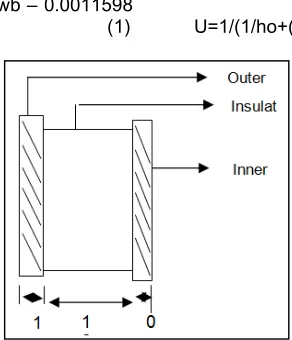
Transmission Load (TL) is the heat transferred into the refrigerated space through the surface of the refrigerated space. Heat is gained and lost through the refrigerator’s floor, walls, and ceiling by conduction. Conductive heat gain or loss is computed from equation (2) and (3) and Fig. 1 shows the cross-section of the refrigeration wall.
Q = UA (∆T) (2)
U=1/(1/ho+( LA)/( kA)+LB/kB+LC/( kC)+1/hi) (3)
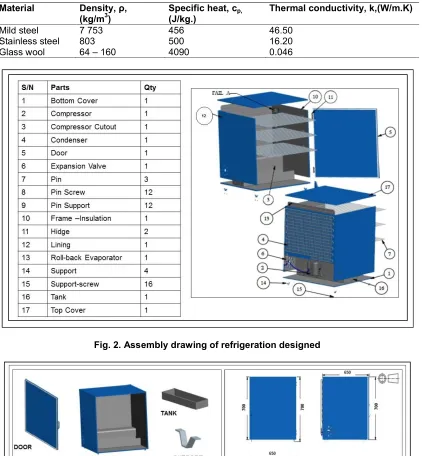
The material used for wall, lagging and inside surface of the refrigerated space is mild steel, glass wool and stainless steel respectively. Their properties are shown in Table 1.
Q is sensible heat gain (watts), U is overall heat transfer coefficient (W/m2K), A is the surface area of the cooled space = 2.05 m2, ∆T = cooling load temperature difference in ºC Ti= inside
temperature (ºC); To=outside or ambient temperature 30ºC; ho=11.6 W/m2K; hi=14.5 W/m2K; LA=0.001 m; LB=0.012 m; LC=0.0006 m;
kA= 46.5 W/mK; kB= 0.046 W/mK; kC=16.20
W/mK; To= 0 - 2.5ºC; Ti=27ºC.
Putting these values in equations 3 and then equation 2, the value of Q was estimated to be 113.3 W.
Product Load (PL) which varies with location and harvesting time. The initial product temperature and the final product temperature were considered for estimating the refrigeration requirement. Heat gains associated with air entering the refrigerated space as a result of opening (infiltration air). Field heat represents the cooling necessary to reduce the product from harvest temperature down to the safe storage level. The product load is the summation of field heat load and respiration load which was computed from Equation (4) and (5) respectively.
= ∆ (4)
= (5)
Where
Q1 = field heat load, kJ; m = mass of product
cooled per 24 hours, kg,; c = specific heat of maize = 1.8 kJ/kgºC;∆ = − (temperature drop of product in 24 hours), °C; Q2 = respiration heat load, W; M = mass of product cooled per 24 hours, tons; and K = rate of respiratory heat production, kW/ton. day = 15.87 kW/ton.day
Q1 = 6.09 W and Q2= 8.60 W
= + = 14.69
Infiltration Load (IL) which is the heat transferred by the mixture of outside air with the inside environment. These convection heat gains are high during summertime loading and minimal when the cabinet is closed and calculated using equations (6) and (7).
Door infiltration (m3/min) qd = (door openings/hr x factor from table)/60 (6)
= ρh (7)
Where ρ = density of air and h = enthalpy of air = (cpat)
Assuming the door opens 10 times per hour and a factor of a light door is 2.0 per maize
IL = 3.84 W
Total Cooling Load (Qt) is a function of TL, PL, and IL. The individual heat gains are added and computed from equation 8 and 9 to find the total heat gain for a cold storage.
= × (8)
where Qt = calculated total heat gain, W,
= + + = 117.64 (9)
The factor of safety is between 5 % and 10%, taking a 10% factor of safety
SF = service factor = 1.1
Capacity = 129.40 W=1⁄6 hp
Plant capacity is 1⁄6 hp.
2.3 Refrigeration System and Equipment Selection
Vapour Compression refrigeration system was used because it is widely used in
commercial and industrial applications. The
vapor-compression uses a circulating liquid refrigerant as the medium which absorbs
and removes heat from the space to be cooled and subsequently rejects the heat
elsewhere. All such systems have four major components: A compressor, a condenser, a thermal expansion valve and an evaporator. Circulating refrigerant enters the compressor in the thermodynamic state known as a saturated
vapour and is compressed to a higher pressure, resulting in a higher temperature as well. The hot, compressed vapour is then in
the thermodynamic state known as a
superheated vapour and it is at a temperature and pressure at which it can be
Table 1. Properties of materials for the refrigeration wall design
Material Density, ρ, (kg/m3)
Specific heat, cp,
(J/kg.)
Thermal conductivity, k,(W/m.K)
Mild steel 7 753 456 46.50
Stainless steel 803 500 16.20
Glass wool 64 – 160 4090 0.046
Fig. 2. Assembly drawing of refrigeration designed
Fig. 3. Component view of the system design
In this work, R134a was used as the working. R134a (Tetrafluoroethane) was used because of its availability, friendliness to the ecosystem.
2.4 Assembly of Refrigeration System
The various parts of the refrigeration system assembled viz: the inner wall, the outer wall, the upper and bottom plates. The insulation material was held in place between the two walls with the aid of the chemical gum. After proper installation of the insulation material, the bottom and the upper plates were fixed in place. The compressor, condenser, and dryer were installed at the rear side of the system wall.
The refrigeration door seal was installed on the door using the chemical gum to hold it in place and the door hinges were riveted to the door and to the wall of the refrigeration system hence making the system hermetic. The pallets were arranged in their respective positions on the pallet stands which had been riveted to the inner wall of the system. The outer wall was painted. Then refrigerant R134a was charged into the
system and the system was tested again for any leakages and all leakage detected were corrected. Loading and offloading can be done easily on any pallet of choice. The machine can be operated by a single person.
3. RESULTS AND DISCUSSION
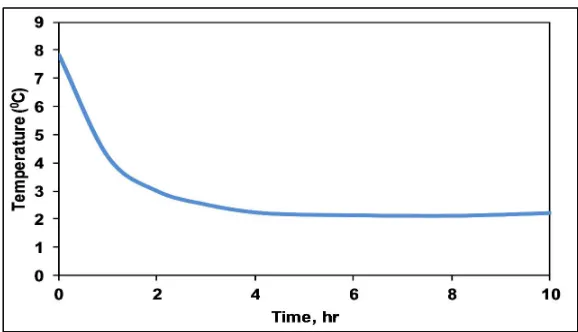
The designed refrigerating system was constructed and tested under two conditions; no-load and load conditions. During the experimentation, both the temperature in the system and the relative humidity were measured. The measured data were used for further evaluation of the system in a no-load condition attained a temperature of 0ºC after eight hours. This temperature was relatively maintained by the system. A little fluctuation between ±10ºC was experienced due to varying atmospheric conditions. The average of the daily test performed for 5 days is shown in Figs. 4 and 5.
Fig. 4. Daily variation of evaporator temperature with time on no load (Te1, Te2, Te3, Te4 and Te5 are evaporator temperature for day 1, 2, 3, 4 and 5 respectively)
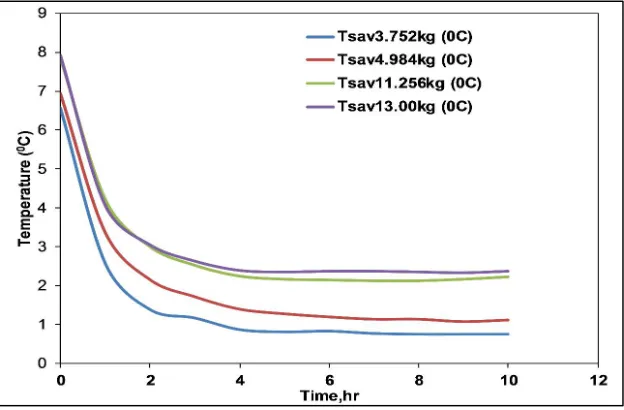
Fig. 6. Variation of average cold space temperature with time on loading conditions
The system was also tested with 3.752 kg, 4.984 kg 11.256 and 13.00 kg load of fresh maize. The system's relative humidity and temperatures were observed and recorded (appendix 1). The system attained a temperature between 2 and 2.5ºC after five hours; this is less than the design range of 8 to 10 hours. When loaded with 13.00 kg of fresh maize the system maintained a relatively constant temperature of 2.5ºC and it maintained this temperature throughout the experiment. In each case, the system was run for ten days. Within the period of experimentation, there was no noticeable significant change in the colour, texture and taste of the fresh maize kept in the system. This shows that the system can be used to store fresh maize up to 13 kg for a minimum of ten days. This can be justified by the added factors as indicated in equation (8).
4. CONCLUSION
In this work, the storage conditions of the fresh maize were identified as: temperature ranges between 0°C and 2.5°C and a relative humidity range between 90 and 95%. Based on these storage conditions a refrigeration system was designed using the vapour compression refrigeration cycle and refrigerant 134a as the working fluid. A compressor of 1/6 hp was selected using design results and other major components which include an evaporator, condenser, and control system. The load estimation was based on many factors which include transmission load, product load and infiltration load. The fabricated system was
achieved based on the design calculations. The refrigeration system developed is a simple technology that can easily be operated. The system constructed is capable of preserving fresh maize ears for ten days. The system was designed to accommodate 13 kg of fresh maize and to maintain it at the temperature range between 0ºC and 2.5ºC and relative humidity ranges between 90 and 95%. The test result indicated that on “no-load” the system is capable of maintaining a temperature between ±1ºC after eight hours of operation. Also, the system can store up to 13 kg of fresh maize for 10 days based on the experiment carried out in this work.
ACKNOWLEDGEMENT
A brief acknowledgment section may be given after the conclusion section just before the references. The acknowledgments of people who provided assistance in manuscript preparation, funding for research, etc. should be listed in this section. All sources of funding should be declared as an acknowledgment. Authors should declare the role of the funding agency, if any, in the study design, collection, analysis and interpretation of data; in the writing of the manuscript. If the study sponsors had no such involvement, the authors should so state.
COMPETING INTERESTS
REFERENCES
1. QU CM, Sun Y, JI WX. Research on heat transfer process of the quick freezing of the fresh unripe maize [J]. Food Science. 2006;10.
2. Ofori E, Kyei-Baffour N, Agodzo S. Developing effective climate information for managing rain fed crop production in some selected farming Centers in Ghana.
proceedings of the School of Engineering Research (KNUST) held at Holland; 2004.
3. Baributsa D, Lowenberg-Deboer J, Murdock L, Moussa B. Profitable chemical-free cowpea storage technology for smallholder farmers in Africa: Opportunities and challenges. In Stored products conference 10th International Working Conference on Stored Product Protection; 2010.
4. Dasbak M, Echezona B, Asiegbu J. Post-harvest bruchid richness and residual activity of pirimiphos-methyl on Callosobruchus maculatus F. infested pigeon pea (Cajanus cajan L. Millsp.) in storage. African Journal of Biotechnology. 2009;8(2).
5. Luo H, Wang R, Dai Y, Wu J, Shen J, Zhang B. An efficient solar-powered adsorption chiller and its application in low-temperature grain storage. Solar Energy. 2007;81(5):607-613.
6. Eşref I, Halil Ü. Moisture-dependent physical properties of white speckled red kidney bean grains. Journal of Food Engineering. 2007;82(2):209-216.
7. Akintunde M, Adetoro K, Abioye T. Development of refrigeration system for storage and preservation of yam tubers.
Futa Journal of Engineering and Engineering Technology. 2019;13(2):213-220.
8. Bern CJ, Yakubu A, Brumm TJ, Rosentrater KA. Hermetic storage systems for maize stored on subsistence farms. in 2013 Kansas City, Missouri, July 21-July 24, 2013. American society of Agricultural and Biological Engineers; 2013.
9. García‐Rosas M, Bello‐Pérez A, Yee‐Madeira H, Ramos G, Flores‐Morales A, Mora‐Escobedo R. Resistant starch content and structural changes in maize (Zea mays) tortillas during storage.
Starch‐Stärke. 2009;61(7):414-421.
10. Sobukola O, Onwuka V. Effect of moisture content on some physical properties of l°Cust bean seed (Parkia fillicoidea L.).
Journal of Food Pr°Cess Engineering. 2011;34(6):1946-1964.
11. Akintunde M, Obadina R. Development of a refrigeration system for storage of pepper and tomatoes. International Journal of Applied Engineering Research, India. 2011;6(23-24):2561-2574.
12. Inglett G. Maize: Recent Progress in Chemistry and Technology; 2012. Elsevier. 13. Issa U, Afun J, Mochiah M, Owusu-Akyaw M, Braimah H. Resistance status of some maize lines and varieties to the maize weevil, Sitophilus zeamais (Motschulsky) (Coleoptera: Curculionidae). Journal of Animal and Plant Sciences. 2011;11(3): 1466-1473.
14. Darfour B, Rosentrater KA. Maize in Ghana: An overview of cultivation to processing. In 2016 ASABE Annual International Meeting. American Society of Agricultural and Biological Engineers; 2016.
15. Anankware P, Fatunbi A, Afreh-Nuamah K, Obeng-Ofori D, Ansah A. Efficacy of the multiple-layer hermetic storage bag for biorational management of primary beetle pests of stored maize. Academic Journal of Entomology. 2012;5(1):47-53.
16. Ogiehor I, Ekundayo A, Okwu G. Shelf stability of agidi produced from maize (Zea mays) and the effects of sodium benzoate treatment in combination with low temperature storage. African Journal of Biotechnology. 2005;4(7):738-743.
17. Hurburgh CR, Elmore R. Corn quality issues; 2009.
18. Ajayi IS. Development of air blast freezer for the storage of some fruits. Federal University of Technology, Akure;. 2011. 19. Mogaji TS, Fapetu OP. Development of an
evaporative cooling system for the preservation of fresh vegetables. African Journal of Food Science. 2011;5(4):255-266.
20. Murcia MA, Jiménez AM, Martínez-Tomé M. Vegetables antioxidant losses during industrial Processing and refrigerated storage. Food Research International. 2009;42(8):1046-1052.
APPENDIX 1
Temperature and relative humidity measuring for 2 days with loading and no loading
Day 1
Time, t (hr) Te (0C) Ts (0C) Tc (0C) Ta(0C) Rha (%) Rhs(%)
0 0 30 50 27 70 92
1 0 12 63.2 27 68 92
2 -0.5 6 61.6 27 68 92
3 0 4 60.9 28 66 92
4 -1 2.5 62.3 28.5 69 93
5 0 2 66 29 68 93
6 0 1.6 64 30 68 92
7 0 1.5 63.5 28.8 63 90
8 0 1.5 64.8 28 55 90
9 0.1 1.5 66.7 27 58 91
10 0.2 1.5 68.4 27 54 91
Day 2
Time, t (hr) Te (0C) Ts (0C) Tc (0C) Ta(0C) Rha (%) Rhs(%)
0 0 1.2 63.2 28 63 92
1 0 1.4 61.6 28.5 55 92
2 0.9 1.3 60.9 29 58 92
3 0 1.3 62.3 30 54 92
4 -1 1.2 66 28.8 70 93
5 0 1.2 64 28 68 93
6 0 1.2 63.8 27 68 92
7 0 1.1 54.8 27 66 90
8 0 1.1 56.7 27 69 90
9 0.1 1.1 58.3 27 68 91
10 0.6 1.1 53 27 68 91
© 2019 Caleb et al.; This is an Open Access article distributed under the terms of the Creative Commons Attribution License (http://creativecommons.org/licenses/by/4.0), which permits unrestricted use, distribution, and reproduction in any medium, provided the original work is properly cited.
Peer-review history: