T E C H N I C A L N O T E
Open Access
Sm-Nd isotopic analysis of mixed standard
solutions by multi-collector inductively coupled
plasma mass spectrometry: evaluations on
isobaric interference correction of Nd isotopic
composition and external calibration of
Sm/Nd ratio
Jong-Sik Ryu, Min Seok Choi, Youn-Joong Jeong and Chang-sik Cheong
*Abstract
Background:The Sm-Nd isotope system has long been used to provide information on the age and geochemical evolution of terrestrial rocks and extraterrestrial objects. Traditional thermal ionization mass spectrometry requires a refined chemical separation of Sm and Nd. Here, we present multi-collector inductively coupled plasma mass
spectrometry (MC-ICP-MS) Sm-Nd isotopic results for a series of mixed standard solutions with different Sm/Nd ratios to test the validity of isobaric interference corrections of Nd isotopic composition and external calibration of Sm/Nd inter-elemental ratio.
Findings:Reliable143Nd/144Nd and145Nd/144Nd ratios of the mixed solutions were obtained by using the exponential law and selected Sm isotopic compositions. The Sm/Nd ratios of the mixed solutions corrected by the standard bracketing method were consistent with the gravimetric values mostly within 1% difference.
Conclusions:This study provides a simple and high-throughput technique that can simultaneously measure Nd isotopic composition and Sm/Nd ratio without chemical separation between Sm and Nd.
Keywords:Sm-Nd, MC-ICP-MS, Isobaric interference, Isotopic composition, Inter-elemental ratio
Introduction
Sm and Nd are rare earth elements presenting in only small amounts in most rock-forming minerals. Sm and Nd each have seven naturally occurring isotopes (144Sm, 147
Sm,148Sm,149Sm,150Sm,152Sm,154Sm;142Nd,143Nd, 144
Nd, 145Nd, 146Nd, 148Nd, 150Nd). One isotope of Sm (147Sm) decays by α-emission to one isotope of Nd (143Nd) with a half-life of 106 Ga (Lugmair & Marti 1978; Begemann et al. 2001). The Sm-Nd decay system has been efficiently used for determining the timing of major events occurred during the chemical evolution of planets and probing into the earth's interior (DePaolo
1988). The application of this system demands highly accurate Sm-Nd isotope data because its half-life is very long and natural variations in Sm/Nd inter-elemental ratio are typically quite limited.
Although the traditional thermal ionization mass spec-trometry (TIMS) is still regarded as the benchmark tech-nique for Sm-Nd isotopic measurement (Chu et al. 2009; Harvey & Baxter 2009; Ali & Srinivasan 2011), more recent multi collector-inductively coupled plasma-mass spectrometry (MC-ICP-MS) has also become a routine technique with high sample throughput and comparable precision to TIMS (Walder et al. 1993; Vance & Thirlwall 2002; Yang et al. 2010; Yang et al. 2011). The classic Sm-Nd isotope analysis requires a separation of two elements from the sample matrix by refined chemical * Correspondence:[email protected]
Division of Earth and Environmental Sciences, Korea Basic Science Institute, Chungbuk 363-883, South Korea
procedures. Recently, however, it was reported that the 143
Nd/144Nd ratio of geological samples could be mea-sured accurately by MC-ICP-MS without Sm and Nd sep-aration (Yang et al. 2010). This study further evaluates the validity of Nd isotopic and Sm/Nd elemental ratio mea-surements for a series of Sm + Nd mixed standard solu-tions by MC-ICP-MS technique, and revisited various sets of reported Sm isotopic composition.
Instrumentation
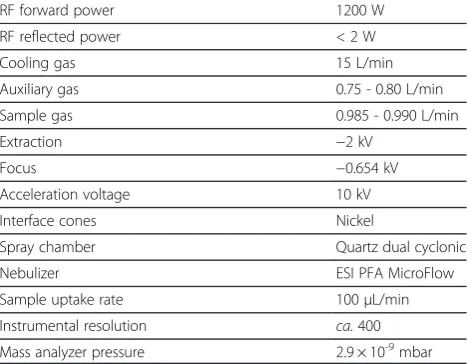
The Sm-Nd isotopic analysis of this study was con-ducted by using a Neptune MC-ICP-MS installed at the Korea Basic Science Institute (KBSI) in Ochang. This double focusing high-resolution ICP-MS is equipped with eight movable Faraday collectors and one fixed axial channel where the ion beam intensities can be measured with either a Faraday collector or an ion counting electron multiplier. The Faraday collectors were statically set to simultaneously detect the required isotopes:140Ce (L4),142Nd (L3),143Sm (L2),144(Sm + Nd) (L1),145Nd (axial), 146Nd (H1),147Sm (H2),148(Sm + Nd) (H3), and 149Sm (H4). The sensitivity on 145Nd was typically around 5 V/Nd ppm (1011Ω resistors) in a low-resolution mode. Details of the other operational parameters are summarized in Table 1.
Measurement of Nd standard solutions
The basic performance of KBSI Neptune was tested by using the JNdi standard solution with Nd concentration of 100 μg/L. The mass bias was exponentially normal-ized to146Nd/144Nd = 0.7219. One measurement consists of 9 blocks of 10 cycles with an integration time of 4.194 s. The average 143Nd/144Nd ratio was 0.512100 ± 0.000004 (n = 10, 2σ S.E.), in reasonable agreement with the recommended value (0.512115 ± 0.000007) (Tanaka et al. 2000).
The in-house Nd standard solution of 100 μg/L was prepared from the AccuTrace
™
Nd Reference Standard (lot no. B9035110, plasma emission standard). It yielded an average 143Nd/144Nd ratio of 0.512204 ± 0.000005 (n = 9, 2σ S.E.) with the same analytical design as above (9 blocks of 10 cycles with an integration time of 4.194 s). Two diluted in-house Nd solutions of 50 and 10 μg/L also yielded comparable results of 143Nd/144Nd = 0.512212 ± 0.000006 (n = 5, 2σ S.E.) and 0.512207 ± 0.000004 (n = 5, 2σS.E.), respectively.
Isobaric interference correction
The contribution of 144Sm imposed on the 144Nd peak should be carefully corrected for accurate determination of143Nd/144Nd ratio. The first step of correction in this study was to calculate the Sm mass bias factor, β(Sm), for which the exponential law (Russel et al. 1978) was applied as the following.
βðSmÞ ¼ln 147Sm=149Smtrue=147Sm=149Smmeasured
h i
lnðM147=M149Þ; ð1Þ
whereMdenotes the mass of the isotope.
The exponential law also yields an equation for (144Sm/149Sm)measured:
144Sm=149
Sm
measured¼
144Sm=149
Sm
true
ðM149=M144ÞβðSmÞ ð2Þ
The 144Sm intensity was calculated as multiplying Eq (2) by measured149Sm intensity. Then,144Nd intensity
Table 1 Instrumental setting and operational parameters
RF forward power 1200 W
RF reflected power < 2 W
Cooling gas 15 L/min
Auxiliary gas 0.75 - 0.80 L/min
Sample gas 0.985 - 0.990 L/min
Extraction −2 kV
Focus −0.654 kV
Acceleration voltage 10 kV
Interface cones Nickel
Spray chamber Quartz dual cyclonic
Nebulizer ESI PFA MicroFlow
Sample uptake rate 100μL/min
Instrumental resolution ca.400
Mass analyzer pressure 2.9 × 10⁻⁹mbar
Figure 1The143Nd/144Nd ratios of a Sm-doped Nd standard
was calculated by subtracting the144Sm intensity from the intensity on mass 144 using the equation.
144Nd
measured¼144ðSmþNdÞmeasured
– 149Sm
measured 144Sm=149Sm
true
h
ðM149=M144ÞβðSmÞ
i
ð3Þ
Finally, the144Sm-corrected143Nd/144Nd ratio was ex-ponentially normalized to146Nd/144Nd = 0.7219.
The Sm isotope ratios (147Sm/149Sm and144Sm/149Sm) have not been uniformly reported. The following sets of reported Sm isotopic composition were evaluated in this study.
147Sm=149Sm¼1:0868 Yang et alð :2010Þ;
1:0851 Wasserburg et alð :1981Þ; 1:06119 MCFarlane McCulloch 2007ð Þ; 1:0847 Berglund Wieser 2011ð Þ
ð4Þ
144Sm=149
Sm¼0:22332 Yang et alð :2010Þ; 0:22249 Wasserburg et alð :1981Þ; 0:2103 McFarlane McCulloch 2007ð Þ; 0:22214 Berglund Wieser 2011ð Þ;
ð5Þ
To evaluate these Sm isotopic compositions, the in-house Nd standard solution of 100μg/L was doped with AccuTraceTMSm Reference Standard (lot no. B8085072, plasma emission standard), in which the concentration ratio of Sm to Nd was 0.2041. As depicted in Figure 1, analytical results (7 measurements, 1 block of 20 cycles with an integration time of 4.194 s) of this solution were different according to the employed Sm isotopic compositions (Yang et al. 2010; Wasserburg et al. 1981; McFarlane & McCulloch 2007; Berglund & Wieser 2011). Sm isotopic compositions reported in (Yang et al. 2010; Wasserburg et al. 1981; McFarlane & McCulloch 2007) yielded the 143Nd/144Nd ratios comparable with the unspiked value, which were 0.512190 ± 0.000014 (2σS.E.), 0.512195 ± 0.000014 (2σ S.E.), and 0.512194 ± 0.000014 (2σS.E.), respectively.
Table 2 Nd isotope ratios of the Sm-doped Nd standard solutions with the Sm/Nd ratio of 0.2
Gravimetric Sm/Nd 143Nd/144Nd 2σS.E. 145Nd/144Nd 2σS.E. n
100μg/L Nd 0.2041 0.512195 0.000011 0.348415 0.000005 140
200μg/L Nd 0.2022 0.512195 0.000022 0.348419 0.000010 20
50μg/L Nd 0.2036 0.512208 0.000038 0.348420 0.000031 20
Figure 2The correlation between the Sm and Nd mass bias factors (β(Sm) andβ(Nd)) measured for Sm-doped Nd standard solutions with the Sm/Nd ratio of 0.2041.
Sm isotopic compositions were iteratively solved to minimize the residual sum of squares between corrected 143
Nd/144Nd ratio of Sm-doped Nd standard solution and the unspiked value using the Excel Solver. The result suggests that the ratios of 147Sm to 149Sm and 144
Sm to 149Sm would be 1.0844 and 0.22233, respect-ively. Because these values are the closest to the recommended values in (Wasserburg et al. 1981), we hereafter use 1.0851 and 0.22249 as the (147Sm/149Sm)true and (144Sm/149Sm)true ratios for correcting mass frac-tionation of Sm and calculating its isobaric contribution to144Nd.
The 143Nd/144Nd ratios of the Sm-doped Nd standard solutions with similar Sm/Nd ratio of around 0.20 but different Nd concentrations (200 and 50 μg/L) were 0.512195 ± 0.000022 and 0.512208 ± 0.000038, respect-ively, corroborating the validity of this correction design (Table 2). Furthermore, the corrected145Nd/144Nd ratios of the mixed solutions were well consistent with a con-stant value of 0.348417 obtained by TIMS (Wasserburg et al. 1981). The correlation between β(Sm) and β(Nd) values indicates that the two factors are not identical and are roughly positively correlated with each other (β(Sm) = 0.516 ×β(Nd)-0.997) (Figure 2).
We further analyzed a series of Sm-doped Nd standard solutions of 100 μg/L Nd with different Sm/Nd ratios (Sm/Nd = ca. 0.1, 0.3, 0.4, and 0.5) to test the validity of correction scheme described above. The results show that the correction protocol is reasonable (Table 3). However, there is a systematic increasing trend in the corrected 143
Nd/144Nd ratio with increasing Sm/Nd ratios, implying that the mass bias may not be perfectly corrected by the exponential law for high-Sm/Nd (> 0.5) samples.
Calibration of Sm/Nd ratio
The instrumental mass bias on isotope measurements could be corrected by using either double-spike or standard bracketing methods. The latter method consists in interpolating the mass bias of an unknown sample between the biases inferred from two standard runs, one preceding and one following the sample analysis (Albarede & Beard 2004).
In order to correct the inter-elemental mass bias on the measurement, this study considered the Sm-doped
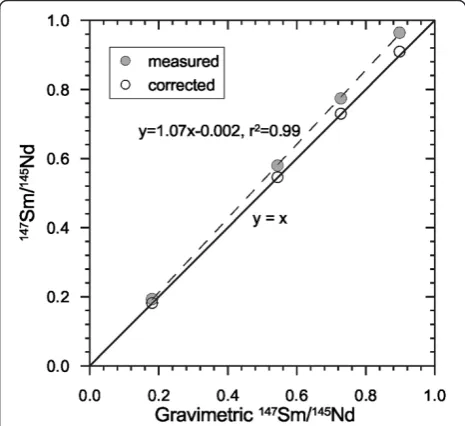
Nd standard solution with the Sm/Nd of 0.2 as the bracketing standard and various mixed solutions with different Sm/Nd values (Sm/Nd = ca. 0.1, 0.3, 0.4, and 0.5) as unknown samples. During the measurements, the average correlation factor in the instrumental mass bias inferred from the standard runs was 0.943 ± 0.002 (n = 7, 2σ S.E.), which yielded consistent Sm/Nd ratios with gravimetric Sm/Nd values mostly within 1% difference (Table 3; Figure 3). This result indicates that the mass bias in the measurement of the Sm/Nd ratio can be rea-sonably corrected by the standard bracketing method.
The Nd concentrations of the mixed solutions were cal-culated based on the intensity of the bracketing standard of 100-101μg/L. Calculated Nd concentrations were consist-ent with gravimetric values within 3% difference (Table 3).
Conclusions
We evaluated the capability of a Neptune MC-ICP-MS to obtain accurate Nd isotopic composition and Sm/Nd elemental ratio using a series of Sm + Nd mixed standard solutions with different Sm/Nd ratios. The isobaric inter-ference correction using the exponential law and selected Sm isotopic composition yielded accurate 143Nd/144Nd and 145Nd/144Nd ratios for the mixed solutions, although there is a systematic increasing trend in the corrected 143
Nd/144Nd ratios with increasing Sm/Nd ratios. The Sm/Nd ratios of the Sm-doped Nd standard solutions could be reliably calibrated by the standard bracketing method mostly within 1% difference from the gravimetric values. These results indicate that accurate Nd isotopic composition and Sm/Nd ratio can be simultaneously mea-sured by a simple and high-throughput technique without chemical separation of Sm and Nd.
Competing interests
The authors declare that they have no competing interests.
Authors’contributions
CSC, JSR and YJJ designed the study. JSR and MSC made the sample solutions and carried out isotope measurements. CSC and JSR drafted the manuscript. All authors read and approved the final manuscript.
Acknowledgements
This study was supported by the KBSI grants (G33200 and C33710). Table 3 Sm-Nd isotopic data of the Sm-doped Nd standard solutions of 100μg/L Nd
143
Nd/144Nd 2σS.E. n 147Sm/145Nd Nd (μg/L)
Gravimetric Measured Corrected Gravimetric Calculated
0.512185 0.000022 20 0.1805 0.1934 0.1818 100 101
0.512191 0.000026 20 0.5441 0.5796 0.5457 100 103
0.512214 0.000028 20 0.7275 0.7744 0.7302 100 103
Received: 12 March 2013 Accepted: 12 March 2013 Published: 18 April 2013
References
Albarede F, Beard B (2004) Analytical methods for Non-traditional isotopes. Rev Mineral Geochem 55:113–152
Ali A, Srinivasan G (2011) Precise thermal ionization mass spectrometric measurements of142Nd/144Nd and143Nd/144Nd isotopic ratios of Nd separated from geological standards by chromatographic methods. Int J Mass Spectrom 299:27–34
Begemann F, Ludwig KR, Lugmair GW, Min K, Nyquist LE, Patchett PJ, Renne PR, Shin C-Y, Villa IM, Walker RJ (2001) Call for an improved set of decay constants for geochronological use. Geochim Cosmochim Acta 65:111–121 Berglund M, Wieser ME (2011) Isotopic compositions of the elements 2009
(IUPAC Technical Report). Pure Appl Chem 83:397–410 Chu Z, Chen F, Yang Y, Guo J (2009) Precise determination of Sm, Nd
concentrations and Nd isotopic compositions at the nanogram level in geological samples by thermal ionization mass spectrometry. J Anal At Spectrom 24:1534–1544
DePaolo DJ (1988) Neodymium isotope geochemistry. Springer-Verlag, Berlin, Heidelberg
Harvey J, Baxter EF (2009) An improved method for TIMS high precision neodymium isotope analysis of very small aliquots (1–10 ng). Chem Geol 258:251–257
Lugmair GW, Marti K (1978) Lunar initial143Nd/144Nd: Differential evolution of the lunar crust and mantle. Earth Planet Sci Lett 39:349–357
McFarlane CRM, McCulloch MT (2007) Coupling of in-situ Sm-Nd systematics and U-Pb dating of monazite and allanite with applications to crustal evolution studies. Chem Geol 245:45–60
Russel WA, Papanastassiou DA, Tombrello TA (1978) Ca isotope fractionation on the earth and other solar system materials. Geochim Cosmochim Acta 42:1075–1090
Tanaka T, Togashi S, Kamioka H, Amakawa H, Kagami H, Hamamoto T, Yuhara M, Orihashi Y, Yoneda S, Shimizu H, Kunimaru T, Takahashi K, Yanagi T, Nakano T, Fujimaki H, Shinjo R, Asahara Y, Tanimizu M, Dragusanu C (2000) JNdi-1: a new neodymium isotopic reference in consistency with LaJolla neodymium. Chem Geol 168:279–281
Vance D, Thirlwall M (2002) An assessment of mass discrimination in MC-ICPMS using Nd isotopes. Chem Geol 185:227–240
Walder A, Platzner I, Freedman PA (1993) Isotope ratio measurement of lead, neodymium and neodymium-samarium mixtures, hafnium and hafnium-lutetium mixtures with a double focusing multiple collector inductively coupled plasma mass spectrometer. J Anal At Spectrom 8:19–23 Wasserburg GJ, Jacobsen SB, DePaolo DJ, McCulloch MT, Wen T (1981) Precise
determination of Sm/Nd ratios, Sm and Nd isotopic abundances in standard solutions. Geochim Cosmochim Acta 45:2311–2323
Yang Y, Wu F, Xie L, Zhang Y (2010) High-precision measurements of the143Nd/ 144
Nd isotope ratio in certified reference materials without Nd and Sm separation by multiple collector inductively coupled plasma mass spectrometry. Anal Lett 43:142–150
Yang Y-H, Chu Z-Y, Wu F-Y, Xie L-W, Yang J-H (2011) Precise and accurate determination of Sm, Nd concentrations and Nd isotopic compositions in geological samples by MC-ICP-MS. J Anal At Spectrom 26:1237–1244
doi:10.1186/2093-3371-4-8
Cite this article as:Ryuet al.:Sm-Nd isotopic analysis of mixed standard solutions by multi-collector inductively coupled plasma mass
spectrometry: evaluations on isobaric interference correction of Nd isotopic composition and external calibration of Sm/Nd ratio.Journal of Analytical Science and Technology20134:8.
Submit your manuscript to a
journal and benefi t from:
7Convenient online submission 7Rigorous peer review
7Immediate publication on acceptance 7Open access: articles freely available online 7High visibility within the fi eld
7Retaining the copyright to your article