O R I G I N A L A R T I C L E
Open Access
Attentional profiles linked to event
segmentation are robust to missing
information
Jessica E. Kosie
*and Dare Baldwin
Abstract
Everyday experience consists of rapidly unfolding sensory information that humans redescribe as discrete events. Quick and efficient redescription facilitates remembering, responding to, and learning from the ongoing sensory flux. Segmentation seems key to successful redescription: the extent to which viewers can identify boundaries between event units within continuously unfolding activities predicts both memory and action performance. However, what happens to processing when boundary content is missing? Events occurring in naturalistic situations seldom receive continuous undivided attention. As a consequence, information, including boundary content, is likely sometimes missed. In this research, we systematically explored the influence of missing information by asking participants to advance at their own pace through a series of slideshows. Some slideshows, while otherwise matched in content, contained just half of the slides present in other slideshows. Missing content sometimes occurred at boundaries. As it turned out, patterns of attention during slideshow viewing were strikingly similar across matched slideshows despite missing content, even when missing content occurred at boundaries. Moreover, to the extent that viewers compensated with increased attention, missing content did not significantly undercut event recall. These findings seem to further confirm aninformation optimizationaccount of event processing: event boundaries receive heightened attention because they forecast unpredictability and thus, optimize the uptake of new information. Missing boundary content sparks little change in patterns of attentional modulation, presumably because the underlying predictability parameters of the unfolding activity itself are unchanged by missing content. Optimizing information, thus, enables event processing and recall to be impressively resilient to missing content.
Keywords:Event cognition, Event segmentation, Action processing, Predictability monitoring
Significance
In everyday circumstances, people often are unable to give events their undivided attention, due to basic in-attentiveness, distractions, or complicated circumstances that obscure access to event information. What happens
to one’s processing of events in the face of the resulting
missed information? This question seems especially ur-gent for occupations such as air traffic controllers that hinge upon vigilance to unfolding events. In this re-search, we examined the impact of missing event
con-tent on viewers’unfolding processing and on their recall
of event content. Viewers advanced through slideshows of activity sequences at their own pace, and we
measured the time they spent dwelling on slides as an index of their attention. We examined the impact of missing content on event processing by creating a sec-ond set of slideshows in which every other slide was deleted. Half of the total content was, thus, deleted in the low-resolution slideshows. Although viewers spent longer on average dwelling on each slide in the context of reduced resolution, their dwell-time patterns were scarcely affected, indicating that event processing is strikingly resilient to missing information. To the extent that viewers compensated for reduced resolution with increased attention to slides, their recall of event content was also relatively unaffected. These findings advance our understanding of the mechanisms underlying event processing, and may help in real-world situations where event-processing integrity is essential. For example, * Correspondence:[email protected]
Department of Psychology, University of Oregon, 1227 University of Oregon, Eugene, OR 97403, USA
algorithms could be designed that detect when viewers’ inattentiveness is acute enough that their apprehension of event content is seriously compromised.
Event segmentation is robust to missing information
Events that form the basis of ongoing experience are rapid, continuous, and dynamic. To understand what oc-curs, predict what might happen next, respond in appro-priate ways, and learn from new occurrences, the events require swift and efficient processing in real time. Though events unfold continuously, human experiencers of those events cannot, and do not, give their undivided attention to the streaming activity. Gaps in attentiveness occur for a variety of reasons: objects and actors frequently occlude
observers’ access to event information, distance or poor
lighting conditions degrade observers’ access, and
ob-servers’ attention is inherently mercurial, both because
they are frequently distracted or are trying to process mul-tiple events in parallel. However, intuitively, it seems that undivided attentiveness to activity streams is often not ne-cessary for observers to derive the meaning and signifi-cance of events. However, precisely how do gaps in access to unfolding information impact event processing?
In recent years, considerable research has focused on one particular component of event processing:
segmen-tation—the processes by which dynamically streaming
sensory information is redescribed in terms of discrete event units bookended by event boundaries. Detecting segmental structure within activity streams appears to be a key aspect of fluent event processing that occurs auto-matically and predicts recall of events (e.g., Baldwin &
Baird, 2001; Kurby & Zacks, 2008). In the present
re-search, we specifically investigated how gaps in viewers’
access to event content impacts their sensitivity to the segmental structure of events. To set the stage for this research, we briefly review existing work on event segmentation.
Corporeal existence involves being forever immersed in a continuous sensory flux, but humans somehow de-rive discrete event experiences from this dynamic
sen-sory flow. Newtson and colleagues (e.g., Newtson,1973;
Newtson & Engquist, 1976) discovered some years ago
that human viewers show considerable agreement about the event units they discern within continuously unfold-ing activity streams, and even largely agree on break-points within the temporal flow at which event units begin and end. To offer an everyday example, a typical coffee-making activity stream would be segmented as opening the coffee maker, inserting a filter, adding coffee grounds, pouring in water, and turning the machine on, with event boundaries identified at the initiation and completion of each of these sub-activities. Observers also readily scale their segmentation up or down in
terms of the level at which they are asked to identify boundaries. At a coarse level, for example, viewers would likely identify a boundary at the beginning and end of
the entire making a pot of coffee sequence. At a fine
level, an observer could break down adding coffee
groundsinto opening a bag of coffee, picking up a scoop, inserting the scoop into the bag, and so on. Thus, the
making a pot of coffee sequence can be segmented at
various levels of structure. Viewers’ judgments at these
different levels of generality are aligned, such that coarse boundaries tend to align with boundaries at the fine level, suggesting that viewers organize event segments hierarchically in their processing (Zacks & Swallow, 2007). Importantly, the extent to which viewers’ judg-ments of event boundary locations correlate with group agreement is positively associated with event memory
(Kurby & Zacks, 2011; Sargent et al., 2013). Individuals
who cannot efficiently segment events into discrete units are at risk of having deficits in both memory and the ability to perform everyday activities (e.g., Bailey, Kurby,
Giovannetti, & Zacks, 2013; Zacks, Kurby, Landazabal,
Krueger, & Grafman, 2016; Zacks, Speer, Vettel, &
Jacoby,2006). Relatedly, explicitly instructing individuals
to engage in segmentation enhances their memory of
events (Flores, Bailey, Eisenberg, & Zacks,2017), further
underscoring the cognitive importance of the skill at identifying segmental structure within dynamic activity.
One might question whether viewers’ explicit
judg-ments about event boundaries—of the kind just
de-scribed—are informative about the actual segmentation
processes operating as they make sense of events. A var-iety of tasks providing implicit probes suggest that they are. That is, there is considerable evidence that segmen-tation processes are indeed operating implicitly when viewers are engaged in observing unfolding activity.
While use of the term “implicit” has been debated, we
use it here in a non-technical sense to convey that seg-mentation operates largely outside of conscious intent or awareness. For example, when content is systematically deleted from a film, viewers are faster to detect deletions at event boundaries than deletions occurring within
event units (Newtson & Engquist,1976). During the
im-plicit processing of a film, recall for videos that show only event boundaries is equivalent to that of fully intact videos, while recall for videos that show only within-unit content is significantly worse (Schwan & Garsoffky, 2004). As well, objects that happen to be encountered at event boundaries are better remembered than objects that occur in non-boundary regions, further demonstrat-ing that event boundary content is privileged in memory
(Swallow, Zacks, & Abrams, 2009). Neurophysiological
participants’ later conscious, explicit segmentation
judg-ments of the same event streams (Zacks et al., 2001).
Reaction times also reveal evidence of implicit
segmenta-tion. Participants tacitly process an event’s segmental
structure as they engage in a change-detection task,
sug-gesting event boundaries intrude on participants’
process-ing as they carry out unrelated tasks (e.g., Baldwin &
Pederson,2016; Huff, Papenmeier, & Zacks,2012). Lastly,
when viewers advance at their own pace through slide-shows depicting unfolding activity streams, they systema-tically (but unknowingly) dwell longer on slides depicting boundary content relative to slides depicting within-unit content. Moreover, boundary dwelling is extended longer the higher the position a given boundary holds within the
event hierarchy (Hard, Recchia, & Tversky,2011).
Event boundaries clearly are important and influential for overall processing. The precise reason remains a mat-ter of debate. One currently influential account is that event boundaries offer high information value, in the sense that they are points within an unfolding activity at which observers have difficulty predicting what will
hap-pen next (Kurby & Zacks, 2008; Ross & Baldwin, 2015;
Zacks, Kurby, Eisenberg, & Haroutunian, 2011). As one
watches an event unfold, within-segment regions of the
action stream are highly predictable. In a making coffee
event, for example, predictability is high during an actor’s
approach toward the kitchen counter; however, once the actor reaches the counter, predictability drops. At this juncture, several possible actions might ensue, even if one is aware that coffee-making is the actor’s goal. Possibilities include opening a cabinet to retrieve a mug, grasping the lid of the coffee can to begin opening it, lifting the top of the coffee pot to insert a filter, or picking up the pot itself to fill it with water. Given the host of possibilities, this is a point within the activity stream where it is important for viewers to pay attention so that they can glean which among these possibilities occurs. Once the next activity is well underway, however, predictability is again high, until the next event boundary occurs. Selectively increasing
attention to event boundaries—points within the sensory
stream where predictability predictably plummets—
en-ables observers to optimize the efficiency of their event processing. This is important given the rapid pace at which events relentlessly unfold, a processing challenge that Christiansen and Chater (2016) eloquently refer to as
the“now-or-never bottleneck.”
Given the evident importance of event boundaries to fluent processing, it seems plausible that missing boun-dary content would undercut processing. Indeed, there is some existing evidence that supports this hypothesis. For example, Newtson and Engquist (1976) found that viewers had particular difficulty interpreting events when shown a series of images depicting only unfolding within-unit content (i.e., lacking images of boundary
content). Additionally, Schwan and Garsoffky (2004) demonstrated that when viewers were shown a video containing only within-unit content, their recall was much worse than their recall for fully intact videos or videos depicting only event boundaries. Do such difficul-ties occur, at least in part, because missing boundary
content undercuts viewers’ability to segment the activity
stream as events unfold?
One of the earlier-described tasks designed as an
impli-cit probe for event segmentation— Hard et al.’s (2011)
dwell-time paradigm—seems particularly well suited to
answering this question. With this method, viewers use a computer mouse to advance at their own pace through sli-deshows of images extracted at regular intervals (e.g., one every 500 ms) from videos of ongoing activity. The looking time (aka dwell time) for each slide is derived from the la-tency between clicks of the mouse. Among other things, dwell-time patterns that emerge with this method appear
to be very revealing about observers’sensitivity to
segmen-tal structure as they view activity streams. As described earlier, viewers dwell longer on slides depicting boundary than within-segment content, indicating enhanced atten-tion to event boundaries. As well, dwelling tends to be longer for slides depicting coarse- rather than fine-grained
boundary content, reflecting viewers’ sensitivity to
hier-archical organization of event segments within the strea-ming activity. These findings have been replicated across a variety of event types, including full-body activities such
as cleaning a room (e.g., Hard et al., 2011), small-scale
manual activities such as sleight-of-hand tricks and shoe-lace tying (Kosie & Baldwin,2016; Sage & Baldwin,2014), and even facial displays of emotion (Garrison & Bald-win: Finding emo: Segmenting dynamic emotional
dis-plays, under revision). The same systematic dwell-time
patterns emerge when preschool-aged children are asked to advance through videos of child-friendly activity se-quences such as stacking nesting cups (Kosie & Baldwin, 2017; Meyer, Baldwin, & Sage,2011; Ross & Baldwin: The
role of executive function skills in preschoolers’event
pro-cessing and event recall, in preparation ). Dwell-time
pat-terns also predict viewers’ memory for events, such that
longer dwelling is positively associated with recall for
event content (Hard et al.,2011; Kosie & Baldwin,2019).
This systematic relationship between dwell time and memory provides support for the interpretation that dwell times reflect the amount of attention viewers are devoting to images as they advance through a sequence.
Specific-ally, we suggest that increases in viewers’ dwell times at
event boundaries reflect enhanced attention or“increased
intensity of information processing” (Hard et al., 2011),
which in turn facilitates their memory of the event content.
linked with viewers’ event segmentation when they are immersed in making sense of an unfolding activity. Moreover, the dwell-time paradigm seems particularly well suited to investigating the consequences of missing
information on participants’processing of events. For one
thing, in previous research the influence of missing event
content was assessed onlyafterparticipants had viewed an
activity sequence (e.g., Newtson & Engquist,1976; Schwan
& Garsoffky, 2004), whereas the dwell-time paradigm
enables an assessment of such impacts as viewers’
pro-cessing unfolds across time. In fact, the dwell-time para-digm inherently involves presenting viewers with activity streams that are missing substantial content; that is, only a subset of images from a given activity stream (extracted at regular intervals, such as one every half second) are pre-sented to viewers in the slideshow format. Thus, on the face of it, findings from the dwell-time paradigm would seem to suggest that event segmentation is robust to miss-ing information, even missmiss-ing boundary content (since extraction at regular intervals randomly deletes some boundary content and some within-unit content). Given that no direct comparison of dwell-time patterns for one-and-the-same event with and without given event content has ever been undertaken, however, it becomes clear with further thought that at present we simply do not know how missing content might affect dwell-time patterns. That is, it is entirely possible that segmentation processes indexed by dwell-time patterns are impacted by the missing content in local, systematic ways. In fact, the dwell-time paradigm provides an ideal way to address di-rectly questions about the consequences of missing infor-mation on implicit segmentation. With this paradigm, it is
possible to compare the dynamics of viewers’attention as
a given activity unfolds when specific content—whether
boundary or within-unit—is present versus absent.
Thus, in the current research, we employed the dwell-time paradigm, inviting viewers to advance at their own pace through a series of slideshows, extracted at 2 frames per second (fps) from digitized videos depicting four different everyday activities (tidying a room, polish-ing boots, makpolish-ing a cup of coffee, and re-pottpolish-ing a plant). In a second set of nearly identical slideshows, we made one simple change: we systematically removed half of the event content by the simple expedient of deleting every other slide from the 2-fps slideshows to create 1-fps slideshows. Some deleted slides happened to depict boundary content, while others happened to depict within-unit content. This design enabled a number of comparisons of interest.
First, we examined the effect of slideshow resolution
on viewers’ dwell times as well as the extent to which
typical dwell-time patterns such as a boundary advan-tage (greater dwelling on slides depicting boundary rela-tive to within-unit content) and a hierarchical advantage
(greater dwelling on boundary slides coarse- relative to fine-grained content) were robust to the reduction in sli-deshow resolution (from 2 fps to 1 fps). We predicted that, overall, dwell times would be longer for 1-fps slide-shows but that boundary and hierarchical advantage pat-terns would be relatively unaffected by the resolution difference. We explain the basis for this prediction in some detail below.
Second, the 1 versus 2 fps design offered a unique op-portunity to examine the effects of missing content on the local dynamics of dwell-time patterns. Of central interest was the consequence of missing boundary content. Di-verse perspectives seemed plausible regarding the impact of missing content on dwell-time patterns, generating al-ternative predictions. As described, typically observers dis-play enhanced attention at event boundaries (the so-called boundary advantage) as activity streams past (Hard et al., 2011). One possible account is that this enhancement is a direct response to the event information depicted within the slides themselves. Thus, missing slides (regardless of whether they are boundary or within-unit slides) would have little or no impact on dwell times. In particular, dwelling on slides following missed content would simply
reflect viewers’ response to the event information they
contain, regardless of whether or not prior event
informa-tion was available for viewing. As well, for this simple
content-tracking account, overall, average per-slide dwell times would not be expected to differ for 1-fps relative to 2-fps slideshows. Hard et al. (2011) provided some evi-dence against this account, in that they found that dwell-time patterns for randomly scrambled slideshows and slideshows viewed backwards do not display a boundary ad-vantage to the same degree as slideshows viewed in chrono-logical order. Based on this evidence, we did not predict this set of outcomes. In any case, however, the present
study provided another test of thesimple content-tracking
account within a novel methodological context.
A second possible account is that viewers’attention
re-sponds to physical changes in the motion stream as an ac-tivity unfolds, with event boundaries reflecting higher levels of such change than within-unit portions of the activity stream. Newtson, Engquist, and Bois (1977) suggested something like this, proposing that boundaries represent points within a streaming activity where physical change is heightened. In this account, the degree of physical change in the content depicted from one slide to the next would predict the degree of attention devoted to any given slide. To the extent that slide-to-slide physical change is height-ened for 1-fps slideshows compared to 2-fps slideshows, the physical change account would predict that, overall, average per-slide dwell times should correspondingly be
greater for 1-fps than 2-fps slideshows. Likewise, this
change is impacted by that missing content. We examined this prediction directly via an objective analysis of pixel changes from each slide to the next in the 1-fps versus 2-fps slideshows. In fact, existing evidence from Hard et al.
(2011) militated against thephysical changeaccount as the
sole generator of dwell-time patterns. They found, on the one hand, that physical change was heightened at boundar-ies, and particularly at coarse boundaries; interestingly,
however, boundary and hierarchical advantages in
dwell-time patterns persisted even when the physical change was statistically controlled. Thus, the present
study provided a valuable opportunity to test the
phys-ical change account in a novel manner, but we
pre-dicted that physical change alone would not account for the pattern of dwell-time findings.
Another contrasting account explains enhanced attention to event boundaries as arising from uniquely informative content right at boundaries. This account seems to be reflected in Hard et al.’s (2011) idea that boundaries may rep-resent conceptual bridges from one event unit to the next.
On thisboundaries are conceptually specialaccount, when a
boundary is missing, viewers must infer the important, but lacking, conceptual content, which would seem to be trig-gered by encountering the next slide following the missed boundary slide. The resulting prediction is that dwell times for within-unit slides following a missed boundary slide (in 1-fps slideshows) should be elevated relative to the identical within-unit slides when the relevant boundary is present (in the corresponding 2-fps slideshows). Put more simply, in-creased attention that targets boundary slides in the 2-fps sli-deshows would be transferred to the closest subsequent slides in the 1-fps slideshows.
The final account we considered is the
information-opti-mizationaccount we outlined earlier, which presumes that observers increase attention to boundary content to optimize their information uptake just after the boundary, because: (a) predictability seems to plummet directly fol-lowing event boundaries; hence, (b) information predict-ably increases at these junctures. In other words, elevated attention at event boundaries in dwell-time slideshows might be due to what boundary slides presage (i.e., a high amount of immediately subsequent information) rather
than to what they actually depict. On this
information-op-timization account, missing content would impact dwell
times in relation to the degree to which it affects viewers’
ability to identify boundaries within the activity stream. From this perspective, to the extent that boundary identi-fication remains intact despite missing content, the miss-ing content will have little impact on dwell times for slides depicting post-boundary content. Of course, this predic-tion (no appreciable difference in the boundary-advantage pattern in dwell times for 1-fps vs. 2-fps slideshows) is the same as that made by the first account we considered, the
simple content-tracking account. Fortunately, however,
these two accounts are distinguishable in a different way.
As mentioned earlier, thesimple content-trackingaccount
predicts that, overall, average per-slide dwell times will not differ between 1-fps and 2-fps slideshows. In contrast,
theinformation-optimizationaccount would seem to
pre-dict longer average per-slide dwelling for low- compared to high-resolution slideshows, given that predictability from each slide to the next would be lower in 1-fps than 2-fps slideshows (and thus, the information value of each slide in a 1-fps slideshow would be heightened).
All in all, a comparison between viewers’dwelling
pat-terns in relation to slideshows differing in resolution but otherwise matched in content offered a valuable method for distinguishing among distinct accounts of the mech-anisms subserving event segmentation. As well, we took the opportunity to examine the extent to which
reso-lution differences impacted participants’ memory of
event content. In line with previous research (e.g.,
New-tson & Engquist, 1976; Schwan & Garsoffky, 2004), we
predicted that reducing event content (including event boundaries) would negatively impact recall. Finally, we explored the degree to which dwell-time patterns pre-dicted event memory. In this analysis, we expected to find that participants who displayed longer dwell times at event boundaries would have a better memory of
event content (replicating Hard et al.,2011).
Method
Participants
The participants were 124 undergraduates (70% female;
Mage= 19 years) from a large university in the
northwest-ern United States. This sample size reflects the amount of data collection that is accomplishable in one term at the University of Oregon. Additionally, in previous research we found that approximately 60 participants are necessary to reveal stable dwell-time patterns. Our sample size is more than twice that number. The ethnic composition of the sample was: 2% American Indian/Alaskan Native, 18% Asian, 3% Native Hawaiian or other Pacific Islander, 2% Black or African American, 80% White, and 4% chose not to respond (participants were allowed to mark more than one category). This ethnic composition was like the
ge-neral student population at the university. The study’s
protocol was approved by the university’s Office of
Re-search Compliance, and all participants received a partial course credit for their participation.
Stimuli
112 s. To create slideshows, we extracted still frames from each of the videos at a rate of 2 fps. The resulting slide-shows had from 114 to 224 slides. We then created a corre-sponding set of 1-fps slideshows by systematically deleting all even-numbered (or every other) slides from the 2-fps
sli-deshows.1 The length of the resulting 1-fps slideshows
ranged from 57 to 112 slides. The resulting set of eight sli-deshows varied in both the activity they depicted (boot pol-ishing, coffee making, plant potting, and room tidying) and the rate at which frames were extracted (1 fps vs. 2 fps;
henceforth resolution; Fig. 1). The natural variation in
length across the four activities provided a rough method of controlling for a potential confound between slideshow length and slideshow resolution. The longest 1-fps slide-show contained a similar number of slides to the shortest
2-fps slideshow (Table1).
For each of the 1-fps and 2-fps activity sequences, we also created an inverted version of each slideshow by sim-ply flipping images across the horizontal axis. With these inverted slideshows, we hoped to explore the effects of a different viewing format while otherwise equating for slide content, including physical change. Unfortunately, we be-latedly discovered that, for non-obvious technical reasons, the inversion process altered the pixelation properties of the inverted slideshows. Upon recognizing this confound, we discarded all data from the inverted slideshows from our analyses.
All participants viewed all four activities with the reso-lution (1 fps vs. 2 fps) and format (upright vs. inverted) of each slideshow counter-balanced between subjects. Unfor-tunately, due to the earlier described issue with the inver-sion process, the data for inverted slideshows were removed from all analyses. Therefore, the data for each participant consisted of dwell times for two slideshows viewed in upright format, one at 1 fps and one at 2 fps.
Slide classification
We first classified slides from the 2-fps resolution slide-shows, as these more densely sampled slideshows con-tained all possible slides that participants could view.
Two expert adult coders first classified slides as occurring at event boundaries or at within-unit junctures of the ac-tivity sequences. These coders further defined boundary slides as being coarse- or fine-grained event boundaries. We chose to rely on expert judgments for several reasons. Although prior research documents that participants can reliably identify the approximate location of event
bound-aries (e.g., Hard et al., 2011; Zacks, Tversky, and Iyer,
2001), variability arises in these judgments for a variety of reasons, including individual differences in understanding the task and in devotion to detail. Expert judgments avoid some of this extraneous variability. Fortunately, partici-pant judgments are typically highly correlated with expert judgments. For example, Kosie and Baldwin (2019)
dir-ectly compared expert (N= 2) and participant (N= 22)
judgments, finding a point-biserial correlation of .46 be-tween the proportion of participants classifying a given
slide as an event boundary and experts’classification of
that same slide (this correlation was .43 when only coarse boundaries were considered and .41 for only fine boundar-ies). Thus, expert judgments have the benefit of providing boundary judgments that are both representative and pre-cise, which offers a better basis from which to time-lock dwell-time patterns.
Experts defined event boundaries as slides occurring at the earliest moment at which it was obvious a boundary was underway. In the current study, boundaries typically
coincided with a change in the actor’s goal state or the
objects with which the actor was interacting. For ex-ample, the earliest moment at which it became apparent
that the actor had finished closing a cabinet in thecoffee
makingslideshow was classified as a boundary.
Boundar-ies were classified as coarse if they demarcated large units of structure (e.g., removing coffee grounds from the cabinet and replacing them after they had been added to the coffee maker). Fine boundaries demarcated smaller units of structure that occurred during the activ-ity content between coarse boundaries, such as the mo-ment at which the actor finished twisting the lid on the coffee grounds.
Fig. 1Selected images from the boot polishing slideshow classified as boundary and within-unit slides. This sequence of images illustrates the
Initial disagreements between expert coders were re-vised via discussion. Some data suggest that transitions between action units may not be the only cue that sig-nals a boundary to viewers (e.g., 2012; Newtson et al., 1977; Kurby & Zacks,2012; Zacks,2004). However, with
this in mind, we opt to retain the term“event boundary”
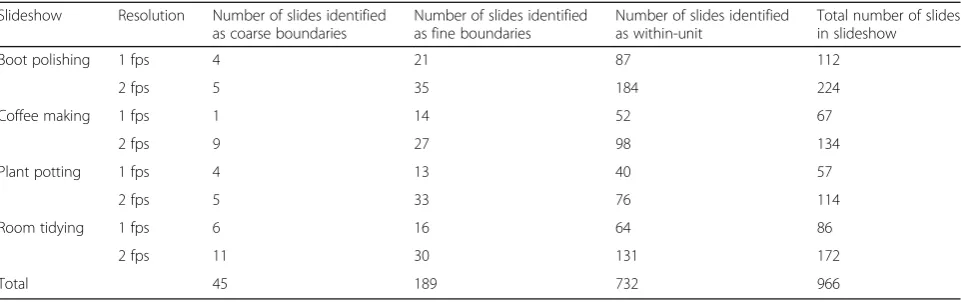
in the current study to capture the general phenomenon under investigation. Of the 644 total slides across the four 2-fps slideshows, 155 were classified as event boundaries (30 coarse and 125 fine) and 489 were classi-fied as within-unit slides. As would be expected with varying naturalistic activity sequences, the precise num-ber of event boundaries differed across each of the four
slideshows (Table1).
We next turned to slides in the four slideshows at the 1-fps resolution. Because we were interested in directly comparing responses to slides in the 1-fps slideshows to slides that were present in the 2-fps slideshows, we opted to rely on classifications made at the 2-fps reso-lution. Therefore, slides classified as boundaries in the 2-fps slideshows that were still present in the 1-fps slide-shows were again classified as boundaries (and further classified at coarse and fine levels, corresponding to the identical slide in the 2-fps resolution version). All other slides were classified as within-unit slides. Of the 322 slides across the 1-fps slideshows, 79 slides were classi-fied as event boundaries (15 coarse and 64 fine) and 243 as within-unit slides.
Pixel change
To assess the physical changes from slide to slide, we used the algorithm described in Loucks and Baldwin
(2009).2 This algorithm compares the amount of pixel
change between any two frames of interest. Here, the frames of interest were individual slides in the slideshow. For the current study, we analyzed the slide-to-slide pixel change separately for each of the four slideshows and across both resolution rates (for a total of eight pixel-change analyses). In these analyses, each individual
slide was aligned with the slide immediately following it in the slideshow sequence (e.g., Slide 1 in the boot acti-vity at 1-fps resolution was aligned with Slide 2 in the boot activity at 1-fps resolution, and so on), and the average amount of pixel change across all pixels between these aligned slides was calculated. The resulting value for each slide is a measure of the average amount of pixel change from the immediately preceding slide to the current slide.
Memory measures
Immediately after viewing each slideshow, participants’
recall memory was assessed using a procedure common
in event-processing research (e.g., Hard et al., 2011;
Zacks et al., 2006). Participants were asked to list as
many actions as they could remember from the slide-show that they had just viewed and to be as accurate as possible. As a guideline, they were informed that they should be able to finish this task in less than 5 minutes and were asked to type their answers. To assess accur-acy, we selected a method that has been used to assess recall in previous studies of event processing (e.g., Flores
et al.,2017; Sargent et al., 2013). First, we created a list
of basic action units, informed by the criteria for A-1 units outlined in Schwartz, Reed, Montgomery, Palmer,
and Mayer (1991). Participants’ free-recall responses
were scored by a set of three coders, who were instructed to indicate whether participants reported each of the listed actions across the four slideshows. We cal-culated recall scores by first summing the number of correctly recalled actions for each participant and each slideshow. Next, to account for differences in the num-ber of basic action units across the four slideshows (boot polishing = 50, coffee making = 28, plant potting = 26, and room tidying = 28), we calculated the percentage of correctly reported units by dividing the number of ac-tions correctly recalled by the number of basic action units defined in each slideshow. Approximately 20% of
participants’ responses were independently scored by
Table 1Number of coarse and fine boundaries and within-unit slides for 1-fps and 2-fps versions of each slideshow
Slideshow Resolution Number of slides identified as coarse boundaries
Number of slides identified as fine boundaries
Number of slides identified as within-unit
Total number of slides in slideshow
Boot polishing 1 fps 4 21 87 112
2 fps 5 35 184 224
Coffee making 1 fps 1 14 52 67
2 fps 9 27 98 134
Plant potting 1 fps 4 13 40 57
2 fps 5 33 76 114
Room tidying 1 fps 6 16 64 86
2 fps 11 30 131 172
Total 45 189 732 966
two coders. Coders’scores were highly correlated,r(95) = .98,p< .001, 95% CI [.96, .98].
After participants viewed all slideshows and completed the corresponding recall tasks, they completed two other memory tasks. In one task, participants were handed a set of eight still pictures taken from the slideshows they had viewed and were asked to lay out the pictures in the order that they had occurred in the slideshow. In the other task, participants were asked to type out responses to a set of short-answer questions (24 in total, 6 from each slide-show) that pertained to the content of the slideshows they had viewed. Unfortunately, both tasks were subject to
ceil-ing effects; 28–30% of participants in both tasks displayed
100% accuracy on the measures. We, thus, did not explore these memory measures further, though the data are avail-able at the OSF project page associated with this manu-script (https://osf.io/rqmnd/).
Procedure
After completing the consenting process, participants were informed that they would see action taking place on the computer screen, that the action would be pre-sented in the form of still images, and that they could advance through the images at their own pace by click-ing a computer mouse. To familiarize participants with the dwell-time procedure, all participants first advanced at their own pace through a practice slideshow depicting
an actor wrapping a present (N= 69 slides). After the
practice slideshow, participants were informed that they would see more action presented in the form of still im-ages and that they could again advance at their own pace by clicking the mouse. In addition to the instructions given for the practice task, participants were instructed to pay attention to the events, since immediately after the slideshow they would be asked to list as many ac-tions as they could recall and later, they would be asked additional questions about the activities they had viewed. After completing the slideshow and recall tasks, partici-pants completed the order memory task, questions memory tasks, and finally a demographics questionnaire.
Dwell-time data processing
Participants’ dwell times were recorded using PsychoPy
(Peirce, 2007), a user-friendly experimental control
sys-tem written in Python. Participants’dwell times indexed
the length of time that a given slide was visible on the screen, operationalized as a measure of the latency be-tween mouse clicks. Like most reaction-time data, dwell
times were positively skewed and were, thus, first log10
transformed to normalize the distribution. Dwell times
that were greater than 3 standard deviations (SD) above
the overall dwell-time log10mean were considered to be
outliers, as is typical in analyzing dwell-time data (e.g., Garrison & Baldwin: Finding emo: Segmenting
dynamic emotional displays, under revision; Kosie &
Baldwin, 2016). In our data, 0.05% of the values were
greater than 3SD above the mean. These values were
then Winsorized (Tukey, 1977), which is the process of
replacing outliers with the log10dwell-time value
repre-senting 3SD above the overall mean. Typically, when
more than 10% of an individual’s dwell times were
classi-fied as outliers, all data for that participant are removed from the analyses. In the current study, however, no par-ticipant met this criterion for exclusion and thus, the dwell-time data for all participants were used in all analyses.
An additional feature of most dwell-time data is the tendency for dwell times to get progressively smaller; that is, observers speed up their dwelling through the slideshow as the activities proceed across time. As a con-sequence, dwell times for slides at the beginning of slide-shows are inflated. To correct for such inflation, which might affect analyses comparing differing slide types (e.g., boundary vs. within; coarse vs. fine vs. within), data were transformed using a residualization procedure. This
involved fitting a power curve to participants’ data for
each of the four activity slideshows they viewed (signifi-cant power curves were observed in 77% of slideshows viewed). The proportion of slideshows fitting a signifi-cant power curve did not differ across 1-fps slideshows (73% of slideshows fitting a significant power curve) and 2-fps slideshows (74% of slideshows fitting a significant
power curve), χ2(1, N= 248) = 0.02, p= .88. We
calcu-lated residuals in relation to the power curve for all sli-deshows across all participants, resulting in dwell-time scores that were sometimes negative. The interpretation
remains, however, that longer log10 residualized dwell
times (henceforth, residualized dwell times) are indica-tive of longer looking.
Results
For analyses estimating linear mixed-effects models, we used the lme4 package (Bates, Mächler, Bolker, & Walker, 2015) in R (R Core Team, 2015) with type III sums of squares. Significance for these models was assessed using the lmerTest package (Kuznetsova, Brockhoff, &
Chris-tiansen,2015; Luke,2017) with Satterthwaite’s
approxima-tion for degrees of freedom. To account for variance across subjects and slideshows, all dwell-time analyses in-cluded random intercepts for these two variables. Where applicable, linear mixed-effects models included ortho-gonal contrasts to explore effects of interest.
Slideshow resolution influences overall dwell time
In a first set of analyses, we examined the extent to
which slideshow resolution impacted viewers’ per-slide
log10 dwell times (i.e., prior to residualization but with
correct for positive skew) as they advanced at their own
pace through the slideshows. Average log10 per-slide
dwell times for 1-fps slideshows (M= 2.70, SD= 0.24)
were significantly higher than those for 2-fps slideshows
(M= 2.63, SD= 0.24), β= 0.03, t(5.64) = 5.96, p= .001.
Because the additional content in 2-fps slideshow ver-sions might uniquely influence the observed dwell-time differences related to resolution, we also performed this analysis using only the subset of slides that occurred in
both the 1-fps and 2-fps slideshows and thus, depicted
identical content (henceforth, matched slides; this in-cluded all slides in 1-fps slideshows and odd-numbered slides in the 2-fps slideshows). As in our previous ana-lysis, when only matched slides were considered, average
log10 per-slide dwell times were still longer for
slide-shows at 1-fps resolution (M= 2.70, SD= 0.24) relative
to slideshows at 2-fps resolution (M= 2.63, SD= 0.24),
β= 0.03, t(5.51) = 6.02, p= .001. In fact, the difference
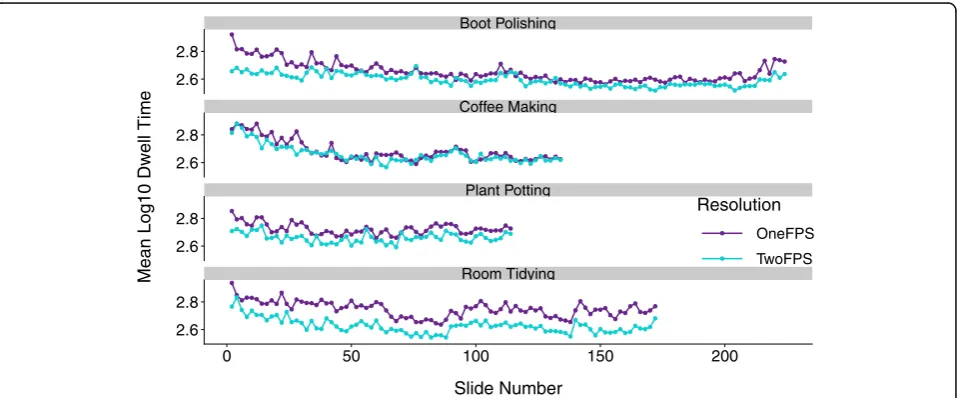
in means for only the matched slides at the 2-fps resolution versus across all slides at 2-fps resolution was extremely small. Despite the overall resolution-related dif-ference in per-slide dwell times, dwell-time patterns were strikingly aligned across 1-fps versus 2-fps versions of a
given activity sequence, as can be seen in Fig.2. As a test
of the extent to which dwell-time patterns are aligned across rates of resolution, if we consider only matched
slides across the 1-fps and 2-fps slideshows, observers’
log10 per-slide dwell times were highly positively
corre-lated,r(320) = .72,p< .001, 95% CI [.67, .77]. That is, slides that elicited increased dwelling in the 1-fps slideshows were also likely to elicit increased dwelling in the 2-fps slideshows.
These results counter the simple content-tracking
ac-count: if attention to a given slide simply reflected that
slide’s content, we would not expect average per-slide
dwell times to differ across 1-fps and 2-fps resolutions, yet they did. These findings also seem inconsistent with
the boundaries are conceptually special account, which
predicts that missing boundaries in the 1-fps slideshows should elicit higher dwelling to subsequent within-unit
slides. In particular, boundaries are conceptually special
predicts that dwell times to a subset of within-unit slides in a given 1-fps slideshow would be high while dwell times to the corresponding within-unit slides in the
rele-vant 2-fps slideshow (e.g., when the boundary was
present) would be low. Because of this discrepancy, dwell times across the two slideshows would not be expected to correlate strongly, yet they did. In contrast, the strong posi-tive correlation in dwell times across 1-fps and 2-fps
ver-sions is consistent with both the physical change and
information-optimization accounts. It is likely that slide-to-slide pixel change (i.e., physical change) is greater in the 1-fps over the 2-fps slideshows, thus predicting longer dwell
times. Under the information-optimization account,
pre-dictability from one slide to the next should be lower for 1-fps versus 2-fps slideshows, with the consequent predic-tion of longer average per-slide dwell times.
Dwell-time patterns replicated
In our next set of analyses, we asked whether our results replicated prior research using the dwell-time paradigm. Specifically, we tested for (1) a boundary advantage (lon-ger dwelling on a boundary relative to within-unit slides) and (2) a hierarchical advantage (longest dwell times for coarse boundaries, shorter for fine boundaries, and shortest for within-unit slides). We also explored the ex-tent to which these effects differed across slideshow
resolution. This linear mixed-effects model thus
Room Tidying Plant Potting Coffee Making Boot Polishing
0 50 100 150 200
2.6 2.8
2.6 2.8
2.6 2.8
2.6 2.8
Slide Number
Mean Log10 Dwell Tim
e
Resolution
OneFPS
TwoFPS
Fig. 2Alignment of dwell-time patterns across 1-fps and 2-fps slideshow versions. Only matched slides, depicting identical content across the
included slide type (coarse, fine, and within) and reso-lution as fixed effects and random intercepts for subjects and slideshows. Additionally, it is relevant to note that in these analyses we considered all slides that were present in 1-fps and 2-fps slideshow versions. That is, slideshows filmed at 2 fps had additional content (in-cluding boundaries at both levels of structure as well as within-unit content) relative to 1-fps slideshows. There-fore, in the tests of boundary and hierarchical advantage, we asked about the extent to which such effects were ro-bust to slideshow resolution given all slides that were present in the slideshow (not just matched slides).
This analysis of residualized dwell times yielded a
sig-nificant boundary advantage (M= 0.009, SD= 0.12)
relative to within-unit content (M= 0.001,SD= 0.12),β=
0.008, t(29865) = 6.16, p< .001, replicating prior research. Also replicating prior research, average residualized dwell
times were greater for: (1) coarse (M= 0.017, SD= 0.13)
over fine-level slides (M= 0.007, SD= 0.12), β=−0.010,
t(29865) =−3.18, p= .001; (2) coarse over within-unit
slides (M= 0.001,SD= 0.12),β=−0.018,t(29865) =−5.36,
p< .001; and (3) fine over within-unit slides, β=−0.006,
t(29865) =−3.64,p< .001. No significant main effect of
resolution emerged in the analysis, β= 0.002, t(29865)
= 1.75, p= .08. However, because residualization involves
fitting a power curve and calculating deviations from that curve for each participant individually, the process tends to remove differences between individuals, and hence, also group-level differences (which is where resolution differ-ences would occur). Therefore, this discrepancy from the initial set of analyses reported earlier (examining raw dwell times) is not unexpected. As well, no significant interaction
emerged in the analysis, p= .16, suggesting the boundary
advantage persisted across both 1-fps and 2-fps resolutions. All in all, boundary and hierarchical advantage patterns were replicated in these activity sequences, and they were robust to slideshow resolution differences. Regardless of the presence or absence of information (i.e., 1-fps vs. 2-fps reso-lution), boundaries that remained in the slideshow garnered enhanced attention and did so to a higher degree the greater the granularity of the boundary content.
Effect of missing boundary content
Thus far, the reported findings appear to rule out the
simple content-tracking account. Examining the effect of missing boundary content was particularly useful for
test-ing the predictions of the boundaries are conceptually
specialaccount, as described earlier. Of particular interest was the extent to which missed boundary content might spark enhanced dwelling on the slide depicting content immediately subsequent to the missed boundary. Recall
that under the boundaries are conceptually special
ac-count, when a boundary is missed (as occurs in the 1-fps resolution slideshows), viewers would need to infer the
missed content, leading to increased attention to the slide immediately following the missed boundary. Further, we would expect that when that same boundary is present (i.e., in the 2-fps slideshows), dwell times for the boundary slide would be high, but dwell times for the within slide immediately following the (present) boundary would be like other within-unit slides in the event sequence, and hence, relatively low.
Specifically, theconceptually specialaccount predicts an
interaction between resolution (1 fps vs. 2 fps) and slide type (boundary, within, and within-after-missed-boundary). That is, dwell times should be high for boundaries and low for within-unit slides across both 1-fps and 2-fps resolu-tions. The locus of the effect, however, should be the differ-ence in dwell times for within-unit slides immediately following boundaries that are missed in the 1-fps slide-shows relative to those same within-unit slides following boundaries that are present in 2-fps slideshows. At 1-fps resolution, dwell times on within-unit slides following missed boundaries should be high (as these within slides after missing boundaries are essentially functioning as the opportunity to infer missed boundary content). At 2-fps resolution, on the other hand, the relevant boundary con-tent is present; thus, the very same within slides (that followed missed boundaries in the corresponding 1-fps sli-deshows) should elicit the reduced dwelling that is charac-teristic of within-unit content.
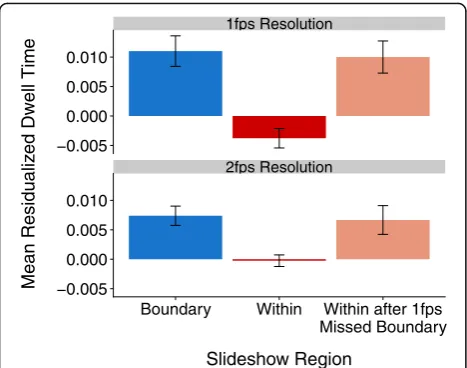
To explore the influence of missing boundary content, we ran a linear mixed-effects model with fixed effects of slide type (boundary, within, and within after 1-fps missed boundary) and resolution (1 fps vs. 2 fps) and random in-tercepts for subjects and slideshows. Residualized dwell
times on boundaries (M= 0.009, SD= 0.12) and
within-after-missed boundaries (M= 0.008, SD= 0.12) did
not differ, β=−0.001, t(29859) =−0.38, p= .71. However,
consistent with the prediction of the boundaries are
conceptually special account, residualized dwell times for both boundaries and within-after-missed-boundaries were significantly higher than residualized dwell times for
withi-n-unit slides (M=−0.001, SD= 0.12), β= 0.011,
t(29859) = 6.50, p< .001 and β= 0.010, t(29859) = 5.12,
p< .001, respectively (Fig. 3). The main effect of
reso-lution (1 vs. 2 fps) was not significant,p= .49, nor was the
interaction between slide type and resolution,p= .06.
As an additional test of theboundaries are conceptually
specialaccount, and despite the non-significant resolution-related effects, we opted also to explore the extent to which residualized dwell times on boundary slides, within-unit slides, and within-after-missed-boundaries differed across the 1-fps and 2-fps resolutions. This analysis tested a key
prediction made by theboundaries are conceptually special
slides in 2-fps slideshows (i.e., where that same boundary slide is present), since dwell times for a within slide after a 1-fps missed boundary would be expected to be simi-lar to other within-unit slides in the sequence. In
con-trast to what the boundaries are conceptually special
account would predict, there was no significant differ-ence in residualized for
within-after-missed-boundar-ies across 1-fps resolution (M= 0.010, SD= 0.13) and
2-fps resolution (M= 0.007, SD= 0.11), β= 0.002,
t(6.43) = 0.61, p= .56. Additionally, residualized dwell
times for boundary slides did not significantly differ across
slideshows viewed at 1-fps resolution (M= 0.011, SD=
0.13) and 2-fps resolution (M= 0.007, SD= 0.11), β=
0.002, t(4.63) = 0.63, p= .56, nor did residualized dwell
times for within-unit slides (M1fps=−0.004, SD1fps= 0.12;
M2fps=−0.0002, SD2fps= 0.11), β=−0.001, t(4.39) =−0.99,
p= .37. This pattern of results held when boundaries were
considered separately at the coarse and fine levels of hier-archical structure.
In summary, residualized dwell times to within slides following a missed boundary were elevated relative to
other within slides, as the conceptually special account
predicts. However, a second result clearly militates against the account: when that boundary was actually present (i.e., in the 2-fps slideshows), residualized dwell times for the same within slide were equivalently elevated. This
discon-firms the conceptually special account’s prediction that
dwell times for within slides following missed boundaries will be higher than those for the same slides when the
pre-ceding boundary slide is present. The
information-optimi-zation account, in contrast, is consistent with both these findings, and all findings thus far reported. First, the gen-eral difficulty of predicting from one slide to the next
would increase as resolution decreases, engendering over-all per-slide increases in dwell time for 1-fps compared to
2-fps slideshows. Second, for theinformation-optimization
account, boundary slides would be expected to garner increased attention simply because they forecast immedi-ately upcoming low predictability. Given that the predict-ability structure of the activity depicted in 1-fps and 2-fps slideshows is identical, the account predicts a comparable
patternof dwelling on slides across resolution differences (at least, as long as the resolution is high enough that the nature of the activity is discernible). That is, the account
predicts—for both 1-fps and 2-fps slideshows—that
atten-tion will ramp up in anticipaatten-tion of boundaries and con-tinue to stay high immediately following boundaries, but will reduce for within-unit slides that occur further away from boundary regions (where predictability correspon-dingly increases). Our next analyses directly investigated this idea.
Dwell times reflect boundary regions
In this set of exploratory analyses, we further investigated
the information-optimization account by examining the
time course of residualized dwell times before and after event boundaries. Pre-boundary slides were classified as slides occurring one or two slides before an event bound-ary, while post-boundary slides were classified as slides oc-curring one or two slides after the boundary. Thus, the region factor had a total of five levels: (1) two pre-bound-ary, (2) one pre-boundpre-bound-ary, (2) boundpre-bound-ary, (4) one post-boundary, and (5) two post-boundary. We explored these region effects separately across the coarse and fine levels of hierarchical structure in a set of two linear mixed-effects models. As in the boundary and hierarchical advantage analyses reported earlier, we included all bound-ary slides in the slideshows; therefore, slideshows filmed at 2 fps had additional content (including boundaries at both levels of structure as well as within-unit content) relative to 1-fps slideshows.
Overall, we predicted that slides closer to boundaries would elicit increased dwelling while slides further from event boundaries would have reduced dwell times,
replicat-ing Hard et al.’s (2011) previous findings that dwell times
ramp up as event boundaries approach, and that they
decrease thereafter. Under the information-optimization
account, we might predict that these effects would differ across slide type and rate of resolution. The regions sur-rounding coarse boundaries are likely less predictable than regions surrounding fine boundaries. Therefore, we might expect that increased dwell times for slideshow regions would persist longer when boundaries fall at the coarse level of hierarchical structure and be more focused at the fine level of structure. Further, we might also predict that it would take longer to resolve unpredictability at the lower 1-fps resolution and therefore, dwell times would remain
2fps Resolution 1fps Resolution
Boundary Within Within after 1fps Missed Boundary −0.005
0.000 0.005 0.010
−0.005 0.000 0.005 0.010
Slideshow Region
Mean Residualiz
ed Dwell Tim
e
Fig. 3Mean residualized dwell times (± standard error) to boundary
high for longer after a boundary in these 1-fps slideshow versions. Because of their exploratory nature, the goal of the next set of analyses was simply to characterize the pat-tern of dwell times before and after event boundaries across 1-fps and 2-fps resolution and coarse- and fine-level slides.
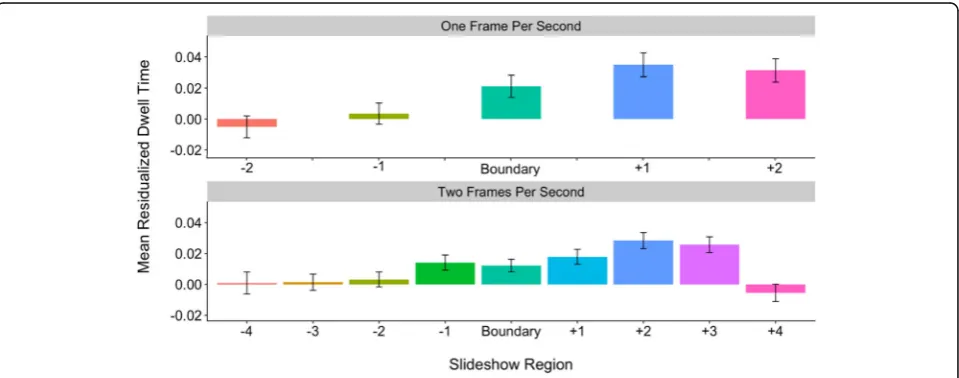
The first linear mixed-effects model included bound-ary region (two pre-coarse, one pre-coarse, coarse, one post-coarse, and two post-coarse) and resolution (1 fps vs. 2 fps) as fixed effects and subjects and slideshows as random effects (intercepts). For coarse-level event boundaries, the effect of region was best characterized
by a linear trend, β= 0.02, t(5151.11) = 5.37, p< .001.
While the effect of resolution was not significant, β=
−0.004, t(5.18) =−0.54, p= .61, we did find a significant
interaction between resolution and the observed linear
trend, β= 0.008, t(5151.10) = 1.92, p= .05. Follow-up
tests (separate mixed-effects models for 1-fps and 2-fps resolutions) revealed that this interaction was synergistic in nature. While the linear trend was present across both the 1-fps resolution, β= 0.03, t(1609.47) = 4.18, p< .001,
and 2-fps resolution,β= 0.01,t(3425.02) = 3.16,p= .002,
the effect appeared stronger for slideshows viewed at a
rate of 1 fps. As depicted in Fig. 4, for coarse-level
boundaries at both 1-fps and 2-fps resolutions, dwell times increased across the two pre-boundary slides, but then remained relatively high across the coarse-level event boundary and the two post-boundary slides.
The next linear mixed-effects models focused on fine-level boundaries across slideshows viewed at 1-fps and 2-fps resolutions. We again included fixed effects of bound-ary region (two pre-fine, one pre-fine, fine, one post-fine, and two post-fine) and resolution and random intercepts for subjects and slideshows. For fine-level event boundaries, the boundary region effect was best characterized by a
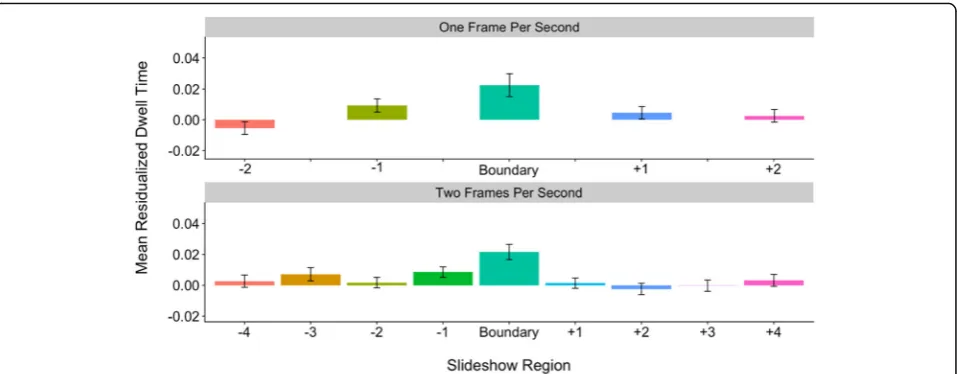
quadratic trend, β=−0.02, t(10,249.32) =−5.24, p< .001.
The effect of resolution was not significant, β= 0.001,
t(5.15) = 0.19,p= .86, nor did it interact with boundary
re-gion (p= .71). As depicted in Fig.5, dwell times for both
1-fps and 2-fps resolutions increased across the two pre-boundary slides, peaking around the fine-level event boundary, and they began to decline thereafter.
Taken together, these findings largely replicate the re-sults of Hard et al. (2011) and seem to provide further
support for theinformation-optimizationaccount of event
processing. As predicted under this account, we observed that dwell times ramped up in advance of boundary slides at both coarse- and fine-levels of hierarchical structure. In some cases, especially at the coarse level of structure, dwell times remained high after event boundaries. This, perhaps, reflects the relatively lower predictability junc-tures represented by coarse-level boundaries. As can be
seen in Fig. 4, which includes additional pre- and
post-boundary slides, dwell times did begin to decline at about four slides after the coarse-level boundary; perhaps, this is the point at which event sequences become rela-tively more predictable and thus, requires less attention. For fine-level boundaries, dwell times ramped up before boundaries and began to decline not long after, perhaps because it takes less time to resolve the unpredictability that occurs at fine-level boundaries. Under this account, and as we observed, dwell times should begin declining shortly after the fine-level boundary occurs. While our
re-sults thus far generally favor theinformation-optimization
account of event processing, we have not yet ruled out
the physical change account. We next directly tested
the extent to which physical change (operationalized here as slide-to-slide pixel change) was related to dwell-time patterns.
Fig. 4Average residualized dwell times (± standard error) by region, resolution, and slide type for coarse-level boundaries. Slides occurring one
Physical change and dwell-time patterns
Across all slides in 1-fps and 2-fps slideshow versions, we calculated slide-to-slide pixel change using the algo-rithm outlined in Loucks and Baldwin (2009). Briefly, for each slide, this algorithm compares the RGB values of each pixel to the RGB values of the corresponding pixel in the immediately preceding slide and generates a change value. It was not possible to calculate the pixel change for the first slide in all slideshows (because there was no immediately previous slide); therefore, the first slide was dropped from these analyses.
It seems likely that the slide-to-slide physical change would be heightened for 1-fps over 2-fps slideshows simply due to differences in the rate at which information unfolds across these two levels of resolution. Our first pixel-change analysis directly tested the extent to which physical change differed across 1-fps and 2-fps slideshows. In this analysis, we ran a regression predicting the pixel change from the resolution (1 fps vs. 2 fps). As predicted, the slide-to-slide
pixel change for 1-fps slideshows (M= 1.11 × 10⁷, SD=
4.92 × 10⁶) was significantly larger than for slides in the
2-fps slideshows (M= 8.84 × 10⁶,SD= 4.14 × 10⁶),β= 1.11 × 10⁶,t(956) = 7.32,p< .001. To ensure that the additional content present in 2-fps slideshow versions was not the sole reason for this difference in pixel change, we next asked whether these results held when we considered only matched slides (i.e., those identical across 1-fps and 2-fps slideshows). We again found that the average slide-to-slide
pixel change was larger for 1-fps slideshow versions (M=
1.11 × 10⁷,SD= 4.92 × 10⁶) than 2-fps versions (M= 8.95 × 10⁶,SD= 4.25 × 10⁶),β= 1.06 × 10⁶,t(638) = 5.82,p< .001.
Additionally, under the physical change account, the
degree to which physical changeis enhanced for a given
slide should be directly related to the degree to which
attentionis enhanced for that slide. To explore the rela-tion between physical change and enhanced attenrela-tion, we ran a regression predicting the mean per-slide resi-dualized dwell time from pixel change. As predicted by
the physical changeaccount, the pixel change was
posi-tively related to the mean per-slide residualized dwell time,β= 2.35 × 10⁻⁹,t(956) = 9.83,p< .001.
Finally, to explore further the plausibility of a physical
changeaccount, we tested the extent to which the effects of slideshow resolution and boundary advantage held when controlling for pixel change. We ran another regression analysis predicting the mean residualized dwell time for all matched slides from slideshow resolution, whether the slide was a boundary or within-unit slide, and pixel change. Together, these predictors explained a significant amount
of variance (12%) in the residualized dwell time,R2= .12,
F(7, 632) = 12.78, p< .001. In a model that included pixel
change and interactions with resolution, the boundary
ad-vantage effect remained significant,β= 0.012,t(632) = 3.12,
p= .002, as did the effect of pixel change, β= 2.04 × 10⁻⁹,
t(632) = 5.44,p< .001. The effect of resolution was not
sig-nificant, β=−0.001, t(632) =−0.32, p= .75. Thus, in
con-trast to the physical change account, the boundary
advantage effect accounted for the variance in resi-dualized dwell time above and beyond the effects of resolution and pixel change. However, there was a significant interaction between the boundary
advan-tage effect and pixel change, β=−7.7261 × 10⁻¹⁰,
t(632) =−2.06, p= .04. Further exploration revealed
that pixel change was not strongly related to dwell
times for boundary slides in general r(154) = .15, p= .06,
95% CI [−.01, .30] nor at the coarse, r(26) = .19, p= .33,
95% CI [−.19, .53], and fine,r(126) = .15, p= .09, 95% CI
[−.02, .32], levels of structure, but it was positively
Fig. 5Average residualized dwell times (± standard error) by region, resolution, and slide type for fine-level boundaries. Slides occurring one and
correlated with within-unit slides, r(482) = .36, p< .001, 95% CI [.28, .44]. None of the additional two- or three-way interactions were significant (p’s > .06). Thus, it appears that pixel change does contribute to dwell-time patterns to some extent, but is more predictive of dwell times for within-unit slides. On the one hand, these
ana-lyses provide support for thephysical changeaccount. On
the other hand, they yielded doubt that physical change alone provides a complete account of attentional patterns in event processing. All in all, the outcome of the pixel-change analyses generally replicated the findings from Hard et al. (2011) described earlier.
Overall dwell times predict recall of slideshow content
Immediately after viewing each of the slideshows, partic-ipants were given a free recall task: they were asked to list all the actions that they remembered from the slide-shows they had just viewed. Because it has previously been demonstrated that removing boundary content negatively impacts event memory (e.g., Newtson &
Eng-quist, 1976; Schwan & Garsoffky, 2004), we first
ex-plored the extent to which these results were replicated when activity was viewed via the novel dwell-time
pro-cedure. For all participants (N= 124), we compared their
recall score for the slideshow they viewed at 1-fps reso-lution to their recall score for the slideshow viewed at 2-fps resolution. Four participants were missing recall data from one slideshow each due to their failure to fol-low the instructions (these participants reported actions that had occurred in the practice slideshow rather than the coffee (2), boot (1), or tidying (1) slideshow). We ran a linear mixed-effects model including a fixed effect of resolution (1 fps vs. 2 fps) and random intercepts for
subjects and slideshows. On average, participants
recalled 47% (SD= 22%) of the listed actions from each
of the slideshows. In contrast to our predictions,
how-ever, participants’ recall for items from slideshows they
viewed at 2 fps (M= 50%,SD= 22%) did not significantly
differ from slideshows they viewed at 1 fps (M= 44%,
SD= 22%),β=−0.03,t(5.93) =−0.55,p= .61.
Additionally, previous research suggests that observers’
skill in explicit segmentation tasks (e.g., Zacks et al.,2006)
and the extent to which they implicitly increase attention
to event boundaries (e.g., Hard et al.,2011) positively
pre-dicts event memory. In light of such findings, we
antici-pated that viewers’ log10 dwell times, specifically dwell
times for event boundaries, would positively predict the number of activities they were able to recall. This
predic-tion was confirmed; viewers’average log10dwell time for
boundary slides in a given slideshow was significantly positively correlated with the number of activities recalled
from that slideshow, r(242) = .37, p< .001, 95% CI [.26,
.47]. However, the log10 dwell time to within-unit slides
was also predictive of the number of actions recalled,
r(242) = .37,p< .001, 95% CI [.26, .48], suggesting that this relation was not unique to boundary slides. As well, when
controlling for log10 dwell time to within-unit slides, the
correlation between boundary slides and number of
ac-tions recalled was no longer observed,r(242) = .01,p= .88.
Therefore, this package of findings seems best described
as a correlation between average per-slide log10dwell time
and recall,r(242) = .37,p< .001, 95% CI [.26, .48]. Perhaps unsurprisingly, participants who, on average, displayed longer per-slide attention to a given slideshow were able to recall more actions from the activity stream depicted in that slideshow.
Of interest in our final analysis was the degree to which dwell time was predictive of event memory above and be-yond the effects of resolution. In this regression analysis,
we predicted participants’ memory score for each
slide-show that they viewed from their average log10dwell time,
the resolution at which they viewed that slideshow, and their interaction. We found that these predictors together explained a significant amount of variance (18%) in recall scores, R2= .18,F(3, 240) = 18.01,p< .001. Again,
partici-pants’ log10 dwell times were predictive of free recall
scores, β= 0.43, t(240) = 6.90, p< .001. As in our earlier analysis comparing recall for 1-fps versus 2-fps slideshows, we found that resolution was not a significant predictor of
recall scores, β=−0.14, t(240) =−0.81,p= .42. There was
also no interaction between log10 dwell time and
reso-lution,β= 0.03,t(240) = 0.54,p= .59, suggesting that log10 dwell time was a positive predictor of recall across both
levels of resolution. In sum, participants’average per-slide
log10 dwell time for a given slideshow appears to have
been uniquely predictive of the number of actions they recalled and, again, this effect was robust to differences in resolution.
Discussion
The primary goal of the present research was to examine the impact of missing content on event processing. To do so, we adopted the simple expedient of asking viewers to advance through slideshows depicting con-tinuous everyday intentional activity sequences at their own pace, with some slideshows (1 fps) including only half the slides (every other slide was deleted) of their matched counterpart slideshows (2 fps). Among other things, this design enabled us to examine the efficacy of several different theoretical accounts for why event pro-cessing seems to involve viewers selectively targeting event boundaries with enhanced attention.
First, our results replicated key findings reported in
other research employing Hard et al.’s (2011) dwell-time