The Thirty-Third AAAI Conference on Artificial Intelligence (AAAI-19)
A SAT+CAS Approach to Finding Good
Matrices: New Examples and Counterexamples
Curtis Bright
University of WaterlooDragomir Ž. Ðokovi´c
University of WaterlooIlias Kotsireas
Wilfrid Laurier UniversityVijay Ganesh
University of WaterlooAbstract
We enumerate all circulant good matrices with odd orders di-visible by3up to order70. As a consequence of this we find a previously overlooked set of good matrices of order27and a new set of good matrices of order57. We also find that cir-culant good matrices do not exist in the orders51,63, and69, thereby finding three new counterexamples to the conjecture that such matrices exist in all odd orders. Additionally, we prove a new relationship between the entries of good matrices and exploit this relationship in our enumeration algorithm. Our method applies the SAT+CAS paradigm of combining computer algebra functionality with modern SAT solvers to efficiently search large spaces which are specified by both al-gebraic and logical constraints.
1
Introduction
In 2002, circulant “good” matrices were searched for in all odd ordersn with n < 40 (Georgiou, Koukouvinos, and Stylianou 2002) and were found to exist in all such orders. This gave evidence to the conjecture that such matrices actu-ally exist inallodd orders. The mathematician George Szek-eres studied circulant good matrices in terms of an equiva-lent type of object which he termedE-sequences and in his classic paper (Szekeres 1988) he mentioned this hypothesis as being worthwhile to study using computers:
. . . it is conceivable thatE-sequences exist for alln= 2m+ 1,m≥1and it is worth testing this hypothesis at least for those orders which are accessible to present day computers. . .
Unfortunately, this conjecture was recently shown to be false in (Ðokovi´c and Kotsireas 2018) where it was shown that the ordersn= 41,47, and49are counterexamples, i.e., no circulant good matrices of orders41,47, and49exist.
In this paper we find the additional three larger counterex-amplesn= 51,63, and69. In addition, we verify the claim of Ðokovi´c and Kotsireas that there are exactly four inequiv-alent sets of circulant good matrices of order45and deter-mine that there is a single set of inequivalent circulant good matrices of order57. We also find a previously undiscov-ered set of good matrices of order 27 demonstrating that
Copyright c2019, Association for the Advancement of Artificial Intelligence (www.aaai.org). All rights reserved.
Szekeres’ claimed exhaustive search (Szekeres 1988) was incomplete.
The matrices that are now known as good matrices were first used in the PhD thesis of Jennifer Seberry Wallis (Wal-lis 1970); we give their formal definition in Section 2. She gave a construction using good matrices that enabled the construction ofHadamard matrices—square matrices with
±1entries and whose rows are pairwise orthogonal. In her thesis she gave examples of good matrices in all odd orders up to15 as well as order19and shortly later gave an ex-ample in order23(Wallis 1971). Subsequently, (Hunt 1972) ran a complete search in the odd orders up to21and gave ex-amples in order25, (Szekeres 1988) ran a complete search up to order31, (Ðokovi´c 1993) gave examples in orders33 and35, (Georgiou, Koukouvinos, and Stylianou 2002) ran a complete search up to order39and most recently (Ðokovi´c and Kotsireas 2018) ran a complete search up to order49. The result of these searches have shown that good matrices exist in all odd orders up to39as well as43and45. Addi-tionally, (Ðokovi´c 1993) gave a construction showing they exist in order127.
In this paper we extend the search to all odd orders divisi-ble by3up to order69. Note that increasingnby2increases the size of the search space (at least to a first approxima-tion) by a factor of16, meaning that the size of the search space in order69is an enormous240 times larger than the search space in order 49, the largest order which has pre-viously been exhaustively searched. There are two primary reasons our approach is able to scale to such orders:
1. We use a number of theoretical mathematical results to cut down the search space, including filtering theorems, recently proven compression theorems, and a new product theorem given in this paper.
2. We use state-of-the-art programmatic SAT solvers, com-puter algebra systems, and mathematical libraries to very efficiently search spaces specified by both logical and al-gebraic constraints.
al. 2018; Zulkoski et al. 2017) and is the aim of the SC2 project (Ábrahám et al. 2016). In particular, the SAT+CAS method in this paper is an adaption of one presented at AAAI (Bright, Kotsireas, and Ganesh 2018).
Furthermore, we employ a SAT solver which can learn clausesprogrammatically, through a piece of code compiled with the SAT solver and which makes calls to an exter-nal mathematical library. This approach permits one to effi-ciently encode constraints that would be much too cumber-some to encode with native SAT clauses, as we will see in Section 3. For example, it is much faster and easier to com-pute a discrete Fourier transform using a numerical library or computer algebra system than it would be to encode a DFT circuit using logical clauses, the format normally accepted by SAT solvers.
A detailed description of our enumeration algorithm will be given in Section 4, followed by our results in Section 5. In particular, we explicitly give two new examples of good matrices, one in order27which has gone undetected since 1988 and one in order57, an order which had previously been out of reach of exhaustive search algorithms; the largest order searched prior to our work was49. We also provide a table enumerating the number of sets of good matrices in all odd orders divisible by3up to69. These counts are given up to an equivalence which is described, along with the required background on good matrices, in Section 2.
2
Background
In this section we define good matrices and review the prop-erties and theorems of good matrices that we use in our enu-meration algorithm.
To begin, we recall the definitions of symmetric, skew, and circulant matrices. LetX be a square matrix of ordern
with entries xi,j with 0 ≤ i, j < n. We say that X is
symmetricif all entries satisfy xi,j = xj,i, thatX isskew
if diagonal entries are 1 and non-diagonal entries satisfy
xi,j = −xj,i, and that X iscirculant if all entries satisfy xi,j=xi−1,j−1with indices taken modnas necessary.
Good matrices
Definition 1. Four matricesA,B,C,D ∈ {±1}n×n are known asgood matrices if they have the following proper-ties.
(a) They are pairwise amicable (XYT is symmetric for X, Y ∈ {A, B, C, D}).
(b) Ais skew andB,C,Dare symmetric.
(c) AAT+B2+C2+D2is the identity matrix scaled by4n. The primary reason that good matrices have attracted sus-tained interest for almost 50 years is because of the follow-ing theorem of (Wallis 1970) which provides a construction for skew Hadamard matrices.
Theorem 1. LetA,B,C,D be good matrices of ordern. Then
A B C D
−B A D −C
−C −D A B
−D C −B A
is a skew Hadamard matrix of order4n.
Skew Hadamard matrices are conjectured to exist in all or-ders4nwithn≥1and much effort has gone into construct-ing them in as many orders as possible; the current small-est unknown order isn= 69and the previous smallest un-known ordern= 47was solved ten years ago by (Ðokovi´c 2008).
From a computational perspective the issue with good matrices is that the search space is too large to effectively search. The standard remedy for this is to focus oncirculant
matrices for which the search can be performed more effec-tively. For example, in (Awyzio and Seberry 2015) good ma-trices are defined as in Definition 1 except that condition (a) is replaced with the strictly stronger condition
(a0) A,B,C,Dare circulant.
Technically matrices which satisfy conditions (a0), (b), and (c) are not good matrices but one can recover good ma-trices from them simply by reversing the order of the rows of
B,C, andD(thereby making them amicable withA). Since using (a0) is convenient to state our results we will employ it for the remainder of this paper.
We often consider good matrices in terms of their first rows (a0, . . . , an−1), (b0, . . . , bn−1), (c0, . . . , cn−1), and
(d0, . . . , dn−1)which we call theirdefining rows. SinceA is skew andB,C, andDare symmetric, the defining rows of a set of good matrices must satisfya0= 1and
ai=−an−i, bi=bn−i, ci=cn−i, di=dn−i
for1≤i < n/2. Furthermore, we often useA,B,C, andD
to denote the defining rows themselves, in which case we say that A is a skew sequence and that B, C, and D are symmetric sequences.
Equivalence operations
The following three invertible operations are well-known and can be applied to a set of good matrices A,B,C,D
to produce another set of good matrices we consider equiv-alenttoA,B,C,D.
1. ReorderB,C,Din any way.
2. Negate any ofB,C,D.
3. Apply an automorphism ofZn = {0, . . . , n−1}to the
indices of the defining rows of each ofA,B,C, andD.
For example, the negation equivalence operation implies that any set of good matrices is equivalent to one withb0= c0=d0= 1.
Filtering theorems
The search space for good matrices of ordernis enormous. Even if one takes into account the symmetry properties of the defining rows and fixes the first entries to be positive, each defining row containsbn/2cunspecified entries. Since each unspecified entry can be one of two values, there are a total of24bn/2c= 4n−1possibilities in the search space.
Theorem 2. LetA,B,C,Dbe sequences of lengthnwith Askew andB,C,Dsymmetric. ThenA,B,C,D are the defining rows of a set of good matrices if and only if for all integerskwe have
PSDA(k) + PSDB(k) + PSDC(k) + PSDD(k) = 4n.
HerePSDX(k) :=
Pn−1 j=0 xjωjk
2
withω := exp(2πi/n)
is the power spectral density ofX = [x0, . . . , xn−1]. This is important because of the following well-known corollary:
Corollary 3. LetA,B,C,Dbe the defining rows of a set of good matrices of ordern. If Sis a subset of {A, B, C, D}
thenP
X∈SPSDX(k)≤4nfor all integersk.
For example, this corollary says that ifPSDA(k) > 4n
for somekthenAcannot be part of a set of good matrices. In other words, we can filterAand ignore it in our enumer-ation method. A second well-known corollary of Theorem 2 comes from settingk= 0in the statement of the theorem:
Corollary 4. LetA,B,C,Dbe the defining rows of a set of good matrices of odd ordern. Then
sum(B)2+ sum(C)2+ sum(D)2= 4n−1
wheresum(X)denotes the sum of entries inX.
Sincesum(X)is an integer whenX has integer entries this corollary tells us that every set of good matrices gives a decomposition of4n−1into a sum of three integer squares which is a rather restrictive condition. For example, whenn
is69there are only three ways to write4n−1as a sum of exactly three squares of nonnegative integers, namely,
12+ 72+ 152, 52+ 52+ 152, and 52+ 92+ 132.
One must also consider decompositions with squares of neg-ative integers but the negneg-ative integers can be found with the following simple (often unstated) lemma. It gives a criterion to determine the signs ofsum(B),sum(C), andsum(D). Lemma 5. Let (a0, . . . , an−1), (b0, . . . , bn−1),
(c0, . . . , cn−1), (d0, . . . , dn−1) be the defining rows of a set of good matrices A, B, C, D of odd order n with b0=c0=d0= 1. Then
sum(B)≡sum(C)≡sum(D)≡n (mod 4).
Compression
Although the filtering theorems greatly decrease the num-ber of possibilities for the defining rows of good matrices there are still typically a large number of possibilities which are not filtered by Corollaries 3 and 4. An effective way of shrinking the search space even farther is to apply proper-ties that “compressions” of good matrices must satisfy. Such theorems are only applicable in composite orders; we will assume that the ordernis a multiple of 3. To our knowl-edge this is the first time compression has been used in the search for good matrices and it allows us to search larger orders than other methods. For example, (Ðokovi´c and Kot-sireas 2018) use the aforementioned filtering corollaries but do not apply compression and are only able to search orders up to49.
The3-compressionof a sequenceX= (x0, . . . , xn−1)of lengthnis the sequenceX0of lengthm:=n/3whosekth entry isxk+xk+m+xk+2m. Since we are concerned with
the case where the entries ofXare±1the entries ofX0are either±1 or±3. Compression is useful because (Ðokovi´c and Kotsireas 2015) showed that Theorem 2 holds for com-pressions of the defining rows of good matrices.
Theorem 6. LetA,B,C,Dbe the defining rows of a set of good matrices of ordernand letA0,B0,C0,D0be compres-sions of those rows. Then for all integerskwe have
PSDA0(k) + PSDB0(k) + PSDC0(k) + PSDD0(k) = 4n.
A new product theorem
Our study of good matrices uncovered the following rela-tionship that the entries of good matrices must satisfy. This is an analog of the product theorem that was proven by John Williamson for Williamson matrices (Williamson 1944).
Theorem 7. Let (a0, . . . , an−1), (b0, . . . , bn−1),
(c0, . . . , cn−1), (d0, . . . , dn−1) be the defining rows of a set of good matrices A, B,C,D of odd order n. Then akbkckdk=−a2kmodnb0c0d0for all1≤k < n.
Letx¯:= (1−x)/2, i.e., the mappingx7→x¯is the group isomorphism between Z∗4 = {±1}andZ2 = {0,1}. Our enumeration method uses Theorem 7 in the following form.
Corollary 8. Let (a0, . . . , an−1), (b0, . . . , bn−1),
(c0, . . . , cn−1), (d0, . . . , dn−1) be the defining rows of a set of good matrices A, B, C, D of odd order n with b0=c0=d0= 1. Then for1≤k < n/2we have inZ2
¯
ak+ ¯a2k+ ¯bk+ ¯ck+ ¯dk = 1
and whenn= 3mwe have¯bm+ ¯cm+ ¯dm= 1.
Proofs of Lemma 5, Theorem 7, and Corollaries 3, 4, and 8 are published at uwaterloo.ca/mathcheck.
3
The SAT+CAS paradigm
The SAT+CAS paradigm is a new method of solving certain kinds of computational problems which harnesses the power of two fields of computer science: satisfiability checking and symbolic computation. The paradigm is particularly useful for problems that have a significant search component and a rich mathematical component.
Briefly, this is due to the fact that modern SAT solvers have extremely efficient search procedures but lack the do-main knowledge to effectively deal with rich mathemati-cal concepts. On the other hand, computer algebra systems like MAPLE, MATHEMATICA, and SAGEMATHas well as special-purpose numerical libraries can very effectively deal with rich mathematics.
conjectures in graph theory and was later extended to solve open cases in combinatorial conjectures (Zulkoski et al. 2017). Since then, the SC2 project (Ábrahám et al. 2016) has organized an annual workshop on this topic for the last three years.
To illustrate the usefulness of the SAT+CAS paradigm in the search for good matrices specifically, consider Corollar-ies 3, 4, and 8 from Section 2. These corollarCorollar-ies all state vari-ous properties that good matrices must satisfy but each prop-erty arises from a different branch of mathematics. Conse-quently, each property is best dealt with using systems which have been optimized to deal with that particular branch:
• Corollary 3 is a statement in Fourier analysis and is best checked using a system which has been designed to effi-ciently compute Fourier transforms.
• Corollary 4 (and Lemma 5) are number theoretic state-ments and possibilities for the valuessum(B),sum(C), andsum(D)can be found by using a system which has been designed to solve quadratic Diophantine systems.
• Corollary 8 is a statement using arithmetic inZ2and can efficiently be encoded directly in a SAT instance.
The programmatic SAT paradigm
A programmatic SAT solver, introduced in (Ganesh et al. 2012), is a new kind of SAT solver which allows solving satisfiability problems with more expressiveness than the kinds of problems that can be solved with a standard SAT solver. Briefly, a programmatic SAT solver will use some custom code to examine the current partial assignment and if it cannot be extended into a full assignment (based on some known theorem from the problem domain) a clause will be learned encoding that fact. Because one can think of “call-ing” the programmatic SAT solver with the custom code this code is known as a “callback” function.
Programmatic SAT solvers are conceptually similar to SMT (SAT modulo theories) solvers and in some ways could be considered a “poor man’s SMT”. However, they also dif-fer from SMT solvers in some key ways:
Simplicity. SMT solvers are necessarily more compli-cated than SAT solvers because they solve problems in first-order logic instead of problems in propositional logic. This increase in complexity is justifiable for many problems but some problems contain mostly just propositional logic with a handful of “theory lemmas” that are cumbersome to state in propositional logic but can be given to a programmatic SAT solver as necessary to help guide its search.
Flexibility. Typically SMT solvers only support theories which are fixed in advance; for example, the SMT-LIB stan-dard (Barrett, Fontaine, and Tinelli 2016) specifies a fixed number of theories and a common input and output language for those theories. However, not all problems can naturally be expressed in those theories; e.g., the current SMT-LIB standard does not include theories involving Fourier trans-forms (or transcendental functions or complex numbers). In contrast, a programmatic SAT solver can learn theory lem-mas derived using Fourier transforms so long as an appro-priate CAS or library can be called.
Tailored solving. Programmatic SAT solvers can be tai-lored to solve specific classes of problems (in addition to us-ing the same state-of-the-art techniques which make modern SAT solving so efficient). For example, in this paper we de-velop a SAT solver tailored to searching for good matrices. In principle SMT solvers could work in the same way but we are not aware of any SMT solvers that offer a programmatic interface like this.
A programmatic SAT encoding of good matrices
We now describe how our programmatic SAT solver encod-ing of good matrices works in detail. We encode the entries of the defining rows of a set of good matricesA,B,C,Dof ordernusing4nBoolean variables where we let true values denote1and false values denote−1. By abuse of notation we use the same names for the Boolean variables and the
±1entries that they represent but it will be clear from the context if we are referring to a Boolean or integer value.
In fact, using the symmetry constraints from Section 2 we only need to define the2(n+ 1)variablesai,bi,ci,di
that have indicesiwith0 ≤i < n/2. In what follows we implicitly use this whenever necessary; i.e., any variables with indices larger thann/2are used for clarity only.
A programmatic SAT solver includes a callback function that is run whenever the SAT solver’s usual conflict analy-sis fails to find a conflict. The callback function examines the current partial assignment and learns clauses that block the current assignment (and extensions of the current assign-ment) from the search in the future.
Ifxis a variable that appears in the current partial assign-ment we letxcurdenote either the literalxor¬x, whichever is true under the current assignment. The callback function used in our encoding of good matrices works by encoding the property given in Corollary 3 and its steps are described in detail below.
1. LetSbe a list containing the sequences(a0, . . . , an−1),
(b0, . . . , bn−1),(c0, . . . , cn−1),(d0, . . . , dn−1)that have all their variables currently assigned.
2. IfSis empty then return control to the SAT solver.
3. LetX be the first sequence inSand compute the power spectral density ofX. IfPSDX(k)>4nfor somekthen
learn a clause blocking the sequenceXfrom the search in the future. Explicitly, learn the clause
¬xcur0 ∨ ¬xcur1 ∨ · · · ∨ ¬xcurn−1
and return control to the SAT solver.
4. IfScontains at least two sequences then letY be the sec-ond sequence inS and compute the power spectral den-sity ofY. IfPSDX(k) + PSDY(k)>4nfor somekthen
learn a clause blocking the sequencesX andY from oc-curring together again in the future. Explicitly, learn the clause
¬xcur0 ∨ · · · ∨ ¬xcurn−1∨ ¬y0cur∨ · · · ∨ ¬ycurn−1
5. IfS contains at least three sequences then letZ be the third sequence inSand compute the power spectral den-sity ofZ. IfPSDX(k) + PSDY(k) + PSDZ(k) > 4n
for somekthen learn a clause blocking the sequencesX,
Y, andZfrom occurring together again in the future and return control to the SAT solver.
6. IfScontains four sequences then we know every entry of
A,B,C, andD. If the relationship in Theorem 2 holds then recordA,B,C, andDas rows that define good ma-trices. Whether or not the sequences define good matrices learn a clause blocking these sequences from occurring together again in the future.
If only a single instance of good matrices is desired then one can stop searching in Step 6 if a satisfyingA,B,C,D
is found. However, we learn a blocking clause and continue the search because we want to provide an exhaustive search. The programmatic approach was essential to our algo-rithm because it allowed us to easily and efficiently apply Corollary 3 which would otherwise be difficult to apply in a SAT instance. Corollary 3 was also extremely effective; the SAT solver was usually able to learn a clause in Step 3 when enough variables were assigned. This enormously cut down the search space—the SAT solver could often learn conflicts with justn variables instead of conflicts with all 4n vari-ables and in practice this appeared to give us an exponential speedup inn.
However, using this method alone was not sufficient for us to derive results beyond order 21and a more efficient enumeration method (using the programmatic encoding as a subroutine) was required to scale to order69. We describe this method in the next section.
4
Enumeration algorithm
Although SAT solvers are useful tools for searching large spaces they have their limits and the main reason that we were not able to derive any new results only using SAT solvers is because the search space is too large, even using the programmatic filtering encoding.
One way that the performance of SAT solvers can be im-proved on instances with large search spaces is by splitting the instance into many smaller instances of approximately equal difficulty. The cube-and-conquer paradigm (Heule, Kullmann, and Biere 2018) does this and has achieved some impressive successes such as solving the Boolean Pythagorean triples problem (Heule, Kullmann, and Marek 2016) and determining the fifth Schur number (Heule 2018). Our enumeration algorithm will use a similar paradigm to cube-and-conquer except that instead of splitting the search space intocubeswe split the search space intocompressions. Not only does splitting via compressions increase the per-formance of the SAT solver it also allows for easy paral-lelization because instances generated in this way are inde-pendent. Additionally, we use Theorem 6 to apply filtering to the compressions which also has the effect of further de-creasing the size of the search space.
We now describe our algorithm in four steps followed by some postprocessing. Given an odd order ndivisible by3 our algorithm enumerates all inequivalent circulant good
matrices of ordernwith positive first entries. Each step is designed to search through a larger subspace than the previ-ous step: step 1 finds every possible rowsum of a good ma-trix, step 2 finds every possible3-compressed row of a good matrix, step 3 finds every possible3-compressed quadruple of good matrices, and step 4 finds all good matrices up to equivalence.
Step 1: Find possible rowsums
IfA,B,C,Dare good matrices then from Corollary 4 and Lemma 5 the rowsums of the matrices B,C, and D must satisfy the quadratic Diophantine system
x2+y2+z2= 4n−1
x≡y≡z≡n (mod 4)
wherex,y, andzare the rowsums ofB,C, andD.
Many computer algebra systems contain number the-oretic functions that allow this Diophantine system to be easily solved. For example, the MATHEMATICA func-tion PowersRepresentations or the MAPLE script NSOKS(Riel 2006).
Step 2: Find possible compressed rows
In this step we will generate setsSskandSsywhereSskwill contain all possible3-compressions of skew defining rows andSsywill contain all possible3-compressions of symmet-ric defining rows. These sets will be generated by an essen-tially brute-force enumeration through all skew or symmet-ric{±1}-sequences of lengthn, using Corollaries 3 and 4 to filter sequences which cannot be a defining row.
Letd:=bn/2c. In detail, we do the following:
1. For allX ∈ {±1}d:
(a) Let A be the skew sequence whose first entry is 1 and next d entries are given by X, i.e., A := (1, x0, . . . , xd−1,−xd−1, . . . ,−x0).
(b) IfPSDA(k)≤4nfor allkthen add the3-compression
ofAtoSsk.
(c) Let B be the symmetric sequence whose first entry is 1 and next d entries are given by X, i.e., B := (1, x0, . . . , xd−1, xd−1, . . . , x0).
(d) If PSDB(k) ≤ 4n for all k and sum(B) is one of
the solutions x, y, z from step 1 then add the 3 -compression ofBtoSsy.
Step 3: Find possible compressed quadruples
Step 4: Uncompress via programmatic SAT
In step 3 we generated all 3-compressed quadruples (A0, B0, C0, D0)that satisfy the relationship in Theorem 6. Given such a quadruple we need to determine if it is possi-ble touncompressthe quadruple. In other words, we want to find all quadruples(A, B, C, D)of defining rows of good matrices (if any) whose3-compression is(A0, B0, C0, D0). To do this we formulate the uncompression problem as a programmatic SAT problem.
We already discussed our programmatic encoding of the constraint saying thatA,B,C,Ddefine rows of good matri-ces of ordern= 3m. The remaining constraints can easily be expressed in the standard format accepted by SAT solvers (conjunctive normal form). We now discuss how to encode the constraint that they are 3-compressions of A0, B0,C0, andD0. (For simplicity we only consider the compression constraints ofA0= (a00, . . . , a0m−1)but the other constraints are analogous.)
Consider the entrya0k =ak+ak+m+ak+2m. There are
four possible cases:
1. a0k = 3. In this caseak =ak+m=ak+2m= 1which is
encoded as the three unit clauses
ak, ak+m, ak+2m.
2. a0k = 1. In this case two of{ak, ak+m, ak+2m} are true
and one is false. This is encoded as the four clauses
¬ak∨ ¬ak+m∨ ¬ak+2m,
ak∨ak+m, ak∨ak+2m, ak+m∨ak+2m.
3. a0k =−1. In this case one of{ak, ak+m, ak+2m}is true
and two are false. This is encoded as the four clauses
ak∨ak+m∨ak+2m,
¬ak∨ ¬ak+m, ¬ak∨ ¬ak+2m, ¬ak+m∨ ¬ak+2m.
4. a0k=−3. In this caseak =ak+m=ak+2m=−1which
is encoded as the three unit clauses
¬ak, ¬ak+m, ¬ak+2m.
Finally, we discuss how to encode Corollary 8. The sim-plest case of Corollary 8 tells us that an even number of
{bm, cm, dm}are true. This is encoded as the four clauses
bm∨cm∨dm, ¬bm∨ ¬cm∨dm,
¬bm∨cm∨ ¬dm, bm∨ ¬cm∨ ¬dm.
The general case of Corollary 8 is an XOR constraint of length 5. While SAT solvers are not good with arbitrary XOR constraints we found that these constraints were short enough that they could be effectively encoded as the sixteen clauses with an even number of negated literals, i.e.,
ak∨a2k∨bk∨ck∨dk, . . . , ak∨ ¬a2k∨ ¬bk∨ ¬ck∨ ¬dk.
Postprocessing: Remove equivalent good matrices
After all the SAT instances generated in step 4 are solved we will have a list of all circulant good matrices of ordernup to equivalence. However, some of them may be equivalent toeach other since we have not encoded all of the equivalence operations of Section 2. In order to provide a list which con-tains only inequivalent good matrices it is necessary to test the matrices for equivalence and remove any that are found to be equivalent to one which has previously been found.
To do this, we define a canonical representative of each equivalence class of defining rows of good matrices. This way, to check if two good matrices are equivalent we com-pute the canonical representative of each and check if they are equal.
First, consider the first two equivalence operations (re-order and negate). Given a quadruple of defining rows (A, B, C, D)we apply the negation operation to set the first entry of each defining row to be positive. Then we apply the reorder operation to sortB, C,D in lexicographically in-creasing order. This gives us a canonical representative of each equivalence class formed by the first two equivalence operations which we denote byMA,B,C,D.
Next, consider the third equivalence operation (permute indices). Letσbe an automorphism ofZn and letσact on
(A, B, C, D)by permuting the indices of the defining rows. This operation commutes with the first two operations, so the lexicographic minimum of the set
S:={Mσ(A,B,C,D):σ∈Aut(Zn)}
is the lexicographic minimum of all quadruples equivalent to(A, B, C, D)and is therefore canonical. We compute this by explicitly generating all elements ofSand selecting the lexicographic minimum.
Optimizations
For the benefit of those who would like to implement our algorithm we now discuss some optimizations that we found useful.
In the programmatic encoding and in step 2 of our enu-meration algorithm we need to check if there exists an in-tegerksuch thatPSDX(k) >4nfor a given sequenceX.
We only need to check kwith0 ≤ k < n/2because the symmetries of the Fourier transform on real input X im-ply thatPSDX(k) = PSDX(±kmodn). In fact, checking k = 0is also unnecessary becausePSDX(0) = sum(X)2
and step 1 will filter any sequencesXwithsum(X)2>4n. Also, when checking the PSD criterion for eachkwe sort the elements ofSso that the sequences with the largest PSD values appear first, making it easier to learn short clauses.
In step 3, the matching procedure can be done very efficiently by a string sorting technique similar to the method used in (Kotsireas, Koukouvinos, and Pardalos 2010). First we enumerate all (A0, B0) ∈ Ssk ×Ssy that satisfy PSDA0(k) + PSDB0(k) ≤ 4n for all k and all
(C0, D0) ∈ S2
sy that satisfyPSDC0(k) + PSDD0(k) ≤ 4n
for allk. At this point we form one list that contains strings that contain the values ofPSDA0(k) + PSDB0(k)and
an-other list that contains strings that contain the values of 4n−(PSDC0(k) + PSDD0(k))and look for strings which
Fourier transform to the PSD values; this produces integer values known as PAF values and the relationship given in Theorem 6 becomes (for0< k < n)
PAFA0(k) + PAFB0(k) + PAFC0(k) + PAFD0(k) = 0.
In fact, since this step was not a bottleneck we computed the PAF values using the slower but more straightforward relationshipPAFX(k) =
Pn−1
j=0xjxj+kmodn.
In step 4, before calling the SAT solver we partition the compressed quadruples into equivalence classes using the reorder and automorphism equivalence operations from Sec-tion 2 and keep one quadruple from each equivalence class. If any satisfiable SAT instances are removed by this process they will have equivalent solutions (also with positive first entries) in the instance that was kept.
5
Results
In this section we discuss our implementation of our enu-meration algorithm, the software and hardware we used to run it, and the results that we achieved. Our code is avail-able from our website uwaterloo.ca/mathcheck.
Step 1 of our algorithm was done using NSOKS in MAPLE(Riel 2006). Steps 2 and 3 were done with custom C++ code and the string sorting was done with the GNU core utilitySORT. Step 4 was done with the programmatic SAT solver MAPLESAT (Liang et al. 2016) and the PSD values were computed using the library FFTW (Frigo and John-son 2005). Because FFTW uses floating point values which are inherently inaccurate all comparisons were checked to a tolerance of = 10−2which is small but larger than the precision of the FFT used. The computations were run on a cluster of 64-bit Opteron 2.2GHz and Xeon 2.6GHz proces-sors running CentOS 6.9 and using 500MB of memory. By far the most computationally expensive step of our algorithm was running the SAT solver. This accounted for 99.9% of the total running time, underscoring the importance of using a state-of-the-art SAT solver such as MAPLESAT. This step was parallelized across 250 cores and completed in about two weeks. Despite step 4 being the bottleneck the other steps were found to be essential could not be removed with-out significantly increasing the computation time.
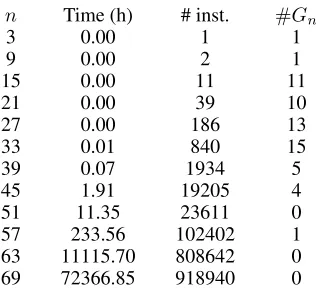
The timings for running our implementation in each odd order divisible by 3 up to order 70 are given in Table 1. This table also contains the number of SAT instances gen-erated in each order and the number of inequivalent good matrices found (denoted by#Gn). Our exhaustive search
in order 27 produced 13 sets of inequivalent good matri-ces, though Szekeres’ classic paper (Szekeres 1988) con-tains only 12 sets of such matrices and Seberry reports that this was checked by at least one other researcher (Seberry 1999). Comparing the matrices generated using our method with those in his paper shows that Szekeres missed a set of good matrices. Furthermore, we found a new set of good matrices of order57; the two new sets of good matrices pro-duced by our method are given in Figure 1.
6
Conclusion
In this paper we have demonstrated the applicability of the SAT+CAS and programmatic SAT paradigms to the
prob-n Time (h) # inst. #Gn
3 0.00 1 1
9 0.00 2 1
15 0.00 11 11
21 0.00 39 10
27 0.00 186 13
33 0.01 840 15
39 0.07 1934 5
45 1.91 19205 4
51 11.35 23611 0
57 233.56 102402 1
63 11115.70 808642 0
69 72366.85 918940 0
Table 1: The running time in hours, number of SAT in-stances used, and number of inequivalent good matrices found (#Gn) in each odd ordern <70divisible by3.
lem of finding good matrices in combinatorics. This prob-lem has been well-studied for almost 50 years and the algo-rithm we’ve developed using SAT solvers coupled with com-puter algebra systems and mathematical libraries is a practi-cal method of enumerating circulant good matrices (at least those with orders divisible by3). This is evidenced by the large gap between the prior state-of-the-art and the results of this paper—prior to this year the largest order enumer-ated was39and the orders up to49were only enumerated this year, while our algorithm was able to enumerate circu-lant good matrices of order69. Since the search space grows exponentially in the order (approximately like4n) this is a much larger search space than the order49search space.
Additionally, we’ve demonstrated the effectiveness of our algorithm by constructing two new sets of good matrices, including one that escaped detection in a 1988 search (Szek-eres 1988) and a double-check by Koukouvinos in 1999 (Se-berry 1999). It is surprising that this set of good matrices was overlooked for so long though the fact that the double-check also failed to produce it likely dissuaded researchers from spending more computational resources to triple-check the same search in order27.
Unfortunately, the fact that there are no known certificates for an exhaustive search means that it is difficult to verify that a search completed successfully. In our case, we relied on multiple pieces of software including MAPLE, MAPLE-SAT, FFTW, GNUSORT, and custom-written C++ code. A bug in any one of these programs could cause a good matrix to be overlooked. The fact that our code confirms (and even corrects) the results of previous searches gives some assur-ance that it is working as intended. However, verification of our nonexistence results from multiple independent sources would be ideal.
Acknowledgments
+++++++--+++-+-+---++--- +-+---++--+--+-+-+++---++--+++++++---+-+-++-++--+++-+
+-++-+---+--++++--+---+-++- +++-+--++---+---+--+-+-++++----++++-+-+--+---+---++--+-++
+-+++---+--+----+--+---+++- ++++---+--+--+--+-+-+----+++--+++----+-+-+--+--+--+---+++
+----++-+---+--+---+-++---- +++-++++++--+-+++-+-++----++--++----++-+-+++-+--++++++-++
Figure 1: The defining rows of new good matrices of order 27 and order 57 where+encodes1and-encodes−1.
References
Ábrahám, E.; Abbott, J.; Becker, B.; Bigatti, A. M.; Brain, M.; Buchberger, B.; Cimatti, A.; Davenport, J. H.; Eng-land, M.; Fontaine, P.; Forrest, S.; Griggio, A.; Kroening, D.; Seiler, W. M.; and Sturm, T. 2016. SC2: Satisfiability check-ing meets symbolic computation. InIntelligent Computer Mathematics: 9th International Conference, CICM 2016, Bialystok, Poland, July 25–29, 2016, Proceedings, 28–43.
Ábrahám, E. 2015. Building bridges between symbolic computation and satisfiability checking. InProceedings of the 2015 ACM on International Symposium on Symbolic and Algebraic Computation, 1–6. New York: ACM.
Awyzio, G., and Seberry, J. 2015. On good matrices and skew Hadamard matrices. In Colbourn, C. J., ed.,Algebraic Design Theory and Hadamard Matrices, 13–28.
Barrett, C.; Fontaine, P.; and Tinelli, C. 2016. The Satisfia-bility Modulo Theories Library (SMT-LIB).
Bright, C.; Kotsireas, I.; Heinle, A.; and Ganesh, V. 2018. Enumeration of complex Golay pairs via programmatic SAT. InProceedings of the 2018 ACM International Sym-posium on Symbolic and Algebraic Computation, 111–118. Bright, C.; Kotsireas, I.; and Ganesh, V. 2018. A SAT+CAS method for enumerating Williamson matrices of even order. In Proceedings of the Thirty-Second AAAI Conference on Artificial Intelligence, New Orleans, Louisiana, USA, Febru-ary 2–7, 2018, 6573–6580.
Ðokovi´c, D. Ž., and Kotsireas, I. S. 2015. Compression of periodic complementary sequences and applications. De-signs, Codes and Cryptography74(2):365–377.
Ðokovi´c, D. Ž., and Kotsireas, I. S. 2018. Goethals–Seidel difference families with symmetric or skew base blocks.
Mathematics in Computer Science12(4):373–388.
Ðokovi´c, D. Ž. 1993. Good matrices of order 33, 35 and 127 exist.J. Combin. Math. Combin. Comput14:145–152.
Ðokovi´c, D. Ž. 2008. Skew-Hadamard matrices of or-ders 188 and 388 exist. International Mathematical Forum
3(22):1063–1068.
Frigo, M., and Johnson, S. G. 2005. The design and imple-mentation of FFTW3. Proceedings of the IEEE93(2):216– 231.
Ganesh, V.; O’Donnell, C. W.; Soos, M.; Devadas, S.; Ri-nard, M. C.; and Solar-Lezama, A. 2012. Lynx: A program-matic SAT solver for the RNA-folding problem. In Interna-tional Conference on Theory and Applications of Satisfiabil-ity Testing, 143–156. Springer.
Georgiou, S.; Koukouvinos, C.; and Stylianou, S. 2002. On good matrices, skew Hadamard matrices and optimal de-signs. Comput. Statist. Data Anal.41(1):171–184.
Heule, M. J.; Kullmann, O.; and Biere, A. 2018. Cube-and-conquer for satisfiability. InHandbook of Parallel Con-straint Reasoning. 31–59.
Heule, M. J.; Kullmann, O.; and Marek, V. W. 2016. Solving and verifying the Boolean Pythagorean triples problem via cube-and-conquer. InInternational Conference on Theory and Applications of Satisfiability Testing, 228–245.
Heule, M. J. 2018. Schur number five. In Proceedings of the Thirty-Second AAAI Conference on Artificial Intelli-gence, New Orleans, Louisiana, USA, February 2–7, 2018, 6598–6606.
Hunt, D. C. 1972. Skew-Hadamard matrices of order less than 100. InProceedings of the First Australian Conference on Combinatorial Mathematics, 23–27.
Kotsireas, I. S.; Koukouvinos, C.; and Pardalos, P. M. 2010. An efficient string sorting algorithm for weighing matrices of small weight.Optimization Letters4(1):29–36.
Liang, J. H.; Ganesh, V.; Poupart, P.; and Czarnecki, K. 2016. Exponential Recency Weighted Average Branching Heuristic for SAT Solvers. InProceedings of the Thirtieth AAAI Conference on Artificial Intelligence, 3434–3440. Riel, J. 2006. NSOKS: A MAPLE script for writingnas a sum ofksquares.
Seberry, J. 1999. Library of good matrices. www.uow.edu. au/~jennie/good.html.
Szekeres, G. 1988. A note on skew type orthogonal±1 ma-trices. InCombinatorics, Colloquia Mathematica Societatis, Janos Bolyai, volume 52, 489–498.
Wallis, J. S. 1970.Combinatorial matrices. Ph.D. Disserta-tion, La Trobe University.
Wallis, J. S. 1971. A skew-Hadamard matrix of order 92.
Bulletin of the Australian Mathematical Society5:203–204. Williamson, J. 1944. Hadamard’s determinant theorem and the sum of four squares. Duke Mathematical Journal
11(1):65–81.
Zulkoski, E.; Bright, C.; Heinle, A.; Kotsireas, I. S.; Czar-necki, K.; and Ganesh, V. 2017. Combining SAT solvers with computer algebra systems to verify combinatorial con-jectures. J. Autom. Reasoning58(3):313–339.