R E S E A R C H
Open Access
Do the diversity of plants and sulphur
application influence the population
fluctuation of insect predator?
Mohamed Ahmed Gesraha
*, Amany Ramadan Ebeid and Atef Abd El-Rahman Ali
Abstract
Background:Numerous predatory insects were recorded on different plants; some were fed on the floral nectar
and others as visitors. Other insects used any plant as a shelter or associated with their prey. Pollinators and beneficial arthropods suffering from a wide range of chemical pesticides are used. So, seeking for safer alternatives is mandatory to conserve such beneficial arthropods. Sorell-98% is a sulphur formulation which was examined against some insect predators with minimal adverse impacts.
Method:Agricultural Sorell-98% (commercial Sulphur formulation) was applied to protect many crops against some
plant diseases and sucking insect pests (aphis, whiteflies, thrips) and mite pests as well. This formulation was applied at a rate of 30 kg/Feddan after 30 days of plantation. Two rectangular areas (ca. 700 m2each) were chosen to execute experiments. The first area was in a field which was sown with marrow plant, while the second was in an okra field. Each area was partitioned into four equal plots (ca. 75 m2). Similar plots (third area) were done but received no treatments (second control area). Examination of the mean numbers of the natural enemies was recorded at several intervals and was achieved at 7 am. Samples of 50 plants were inspected—on spot—per plot/ time interval in the three experimental zones. The mean number of each predator/time interval and percentage of increase and/or decrease was calculated.
Results:Results reveal that the abundance of the target predators was affected indirectly in different cultivated
plants after sulphur application, as a result of different plant nature and consequently the population of pests invaded. At all inspection periods, it was observed that the mean numbers and abundance of adult predators on marrow plants was more than that reported in an okra field. Under all inspection times, there was a significant difference between the mean numbers of recorded predators, whereCoccinellaadults recorded the highest mean numbers, followed byChrysoperlaadults.Stethorusadults recorded the least mean number, either before or after sulphur application.
Conclusion:The abundance of any arthropod predators is closely related with their favourable insect prey and did
not relate to a certain plant by itself. The three tested adult predators were—to some extent—affliction from the sulphur application.
Keywords:Sulphur formulation, Okra, Marrow,Chrysoperla carnea,Coccinella undicempunctata,Stethorus punctillium
© The Author(s). 2019Open AccessThis article is distributed under the terms of the Creative Commons Attribution 4.0 International License (http://creativecommons.org/licenses/by/4.0/), which permits unrestricted use, distribution, and reproduction in any medium, provided you give appropriate credit to the original author(s) and the source, provide a link to the Creative Commons license, and indicate if changes were made.
* Correspondence:[email protected]
Background
The application of synthetic pesticides has caused a threat to non-target organisms and the environment due to their overuse (Savary et al.2006). Since the release of xenobiotic results in the increase of environmental risk, the goal should be to use such compounds carefully so that they cause the least negative impact on the environ-ment (Savary et al. 2012) into which they are released. To remove harmful effects on the non-target organisms, encapsulation of the active ingredient with other mate-rials such as a polymer can allow sensitive ingredients to be physically enveloped into a protective matrix in order to protect core materials from adverse reactions due to factors like air or light (Madhuban et al.2012).
Several studies have shown negative effects of sulphur on natural enemies including predators, parasitoids, and predatory mites. Sulphur as a natural material and its commercial formulations are now using to control many plant diseases and some piercing-sucking insect pests
Numerous predatory and parasitoid insects were re-corded on different plants, and many of them fed on the exposed floral nectar; others used any plant as a shelter or were associated with their prey (Bugg et al. 1987, Finch and Collier2000, Sunderland and Samu2000).
Pollinators and beneficial arthropods suffering from the wide range of chemical pesticides are used (Cohen et al. 1996; Araya et al. 1997b; Kumar and Singh 2002; Newman et al.2004; Linda2012). Seeking for safer alter-natives is mandatory to conserve these beneficial arthro-pods. Several studies have shown the negative effects of sulphur application on natural enemies including para-sitoids, predatory mites, and spiders (Martinson et al. 2001; Gent et al.2009; Nash et al.2010).
Sulphur as a natural material and its commercial for-mulations as well are now used to control many plant diseases, insect pests, and some piercing-sucking insect pests (Cohen et al. 1996; Araya et al. 1997a, b; Kumar and Singh2002, Biondi et al.,2012).
Many sulphur formulations were applied to protect plants and to control some insect pests (Wetzel and Dickler 1994; Newman et al.2004). Sorell-98% is one of the sulphur formulation which was applied according to the Egyptian Ministry of Agriculture recommendations. This formulation was examined against some insect predators with minimal adverse impacts toward these tested natural enemies (Matter et al. 2018 and Matter et al.2019, Gesraha and Ebeid2019).
This work is to investigate the following: (1) Do diversity of plants influence the population fluctuation of the three tested insect predators? (2) How far are these two different tested factors in combination with the tested formulation induced adverse effects on the density and abundance of the three natural enemies, Coccinella undecimpunctata,
Chrysoperla carnae, and Stethorus punctillium naturally
existing in fields of okra (Hibiscus esculentus L.) and marrow (Cucurbita pepoL.)?
Methods
1- Randomized complete block design was applied for this experiment.
2- Sorell-98% (trade name of Sulphur formulation) was manufactured by Kafr El-Zayat Co. and was applied in okra and marrow fields at the rate of 30 kg/Fed-dan 30 days post plantation against some plant dis-eases (rusts, mildew, powdery mildew, etc) and sucking insect pests (whiteflies, leafhoppers, aphids, plant bugs) and mites.
3- Dusting of sulphur was carried out using Chapin 5000 16-Ounce Hand Rose and Plant Duster Sprayer - Model #5000 duster 30 days post sowing. 4- Field experiments were carried out (as described by
Gesraha and Ebeid2019and Matter et al.2018,
2019) in two separate fields already planted, one for marrow and the other for okra plants in Manawat village, at Giza Governorate. All agricultural practices were carried out as usual. Just before sulphur formulation was applied (as Ministry of Agriculture recommendations), two rectangular sections (ca. 700 m2each) were chosen in each field. Each section was divided longitudinally into two equivalent parts (first part of them for
treatment and the second part as a control adjacent to the treated one), each of them comprises six rows, and each part was partitioned into four plots about 75 m2each. Similar plots (third area) were prepared, but no treatments were made (second control area). Surveying the mean numbers of the objective natural enemies in the target territories was recorded at several intervals (just before dusting, 2, 12, 24, 48, and 72 hours and 7 days post application) was accomplished early in the morning (7 am). Samples of 50 plants were inspected—on spot—per plot per time interval in the three tested zones. The average number of each natural enemy/ time interval and the percentage of increase and/or decrease were calculated.
Statistical analysis
MSTAT-C Statistical Package (Freed, 1985) Computer program was used. Analysis of variance (ANOVA) F-test was applied. Randomized complete block design for factor A, with factor B as a split plot on A and factor C as a split plot on B. Least significant difference test (LSD) was carried out for mean differentiation.
Factorial ANOVA for the factors is as follows:
– Factor B (Var 2: predators) with values from 1 to 3
– Factor C (Var 3: treatment) with values from 1 to 3
– Replication (Var 4: replicates) with values from 1 to 4
Results
Data in Table 1 reveal that—in case of tested factor A (tested plants)—the abundance of the target predators was affected with different cultivated plants after sulphur application (0 h), that is a direct result of the idea of the plant and consequently the population of pests invaded. At all inspection times, it was observed that the abun-dance of adult predators on Marrow plants was more than that reported in the okra field. The same result was observed at all inspection times (Table1).
In the case of time effect post application, the tar-get predators were affected with sulphur application (Table 1) factor B (predators), it was observed that, under all inspection times, there was a significant dif-ference between the mean numbers of recorded pred-ators, where Stethorus predator recorded the least mean number, either before or after sulphur applica-tion, indicating that this predator was scarce or more susceptible to sulphur application than the others.
Chrysoperla adults’ mean numbers were ranked the
second. Lastly, Coccinella adults recorded the highest mean number of adults, almost at all inspection intervals (Table 1).
As for factor C (plot treatments), examining the reac-tion of adult predators towards sulphur applicareac-tion, the mean number of adults recorded at treated plots was significantly lower than that for control plots, except that recoded at 0 h. Statistically, there was insignificant difference between them (Table 1). In addition, it was observed that at 2 and 168 h post application, a signifi-cant difference between the mean numbers of recorded adults for the three treatments was occurred, where the other inspection intervals clarify that insignificant differ-ence exists between untreated plots of the first and second area (Table1).
Regarding to the interaction (Plants*Predators) effects of the chosen plants upon the tested predator’s abundance after sulphur application (Table2), significant differences were observed at all inspection periods between the mean numbers of the target predators. Generally, marrow field attains the highest mean number of adult predators than that of okra. The higher mean number of adults lacewing achieved in marrow field across all inspection time followed by Coccinellaadults either in Marrow or Okra
Table 1Mean numbers of the abundance of the tested adult predators related to three examined factors
Post treatment intervals (hours)
0 h 2 h 12 h 24 h 48 h 72 h 168 h
Mean number of predators ± SE
Plant
Okra 7.42 ± 0.73b 4.14 ± 0.53b 7.58 ± 1.16b 7.33 ± 1.09b 8.81 ± 1.02b 8.58 ± 0.94b 9.69 ± 0.93b
Marrow 13.36 ± 1.06a 12.50 ± 1.71a 14.56 ± 1.86a 15.64 ± 2.03a 14.83 ± 1.57a 13.44 ± 1.25a 13.50 ± 1.44a
Fvalue 141.346** 338.484** 77.619** 2506.570** 29.315** 18.161* 45.593**
Pvalue 0.0013 0.0004 0.0031 0.0000 0.0124 0.0237 0.0066
Predators (B)
Coccinella 13.58 ± 0.95a 10.29 ± 1.59a 15.46 ± 1.72a 15.79 ± 1.83a 16.25 ± 1.63a 15.63 ± 1.03a 16.46 ± 1.17a
Chrysoperla 11.46 ± 1.55b 11.38 ± 2.26a 12.71 ± 2.53b 14.38 ± 2.64a 13.25 ± 1.89b 12.04 ± 1.57b 12.58 ± 1.70b
Stethorus 6.13 ± 0.59 c 3.29 ± 0.49b 5.04 ± 0.82c 4.29 ± 0.79b 5.96 ± 0.70c 5.38 ± 0.66c 5.75 ± 0.62c
Fvalue 24.899** 100.812** 52.092** 180.713** 48.931** 132.578** 61.030**
LSD at 5% 2.373 1.346 2.305 1.437 2.332 1.392 2.138
Pvalue 0.0001 0.0000 0.0000 0.0000 0.0000 0.0000 0.0000
Treatments
Control 10.13 ± 1.25a 9.08 ± 1.33b 14.67 ± 1.80a 14.54 ± 2.01a 13.88 ± 1.79a 13.25 ± 1.56a 14.04 ± 1.81a
Sulphur treated 11.13 ± 1.29a 3.46 ± 0.76c 3.92 ± 0.80b 5.04 ± 0.92b 7.46 ± 1.04b 7.75 ± 1.05b 8.88 ± 1.21c
Untreated second area 9.92 ± 1.29a 12.42 ± 2.33a 14.63 ± 2.31a 14.88 ± 2.60a 14.13 ± 1.91a 12.04 ± 1.44a 11.88 ± 1.37b
Fvalue 1.169NS 85.637** 234.577** 101.773** 32.172** 38.261** 18.493**
LSD at 5% – 1.403 1.160 1.587 1.911 1.340 1.730
Pvalue 0.3221 0.0000 0.0000 0.0000 0.0000 0.0000 0.0000
Means in a column followed with the same letter(s) are not significantly different (Pat 5%) **Highly significant
NS
fields.Stethorus adults recorded the lowest mean number under both examined plants (Table2).
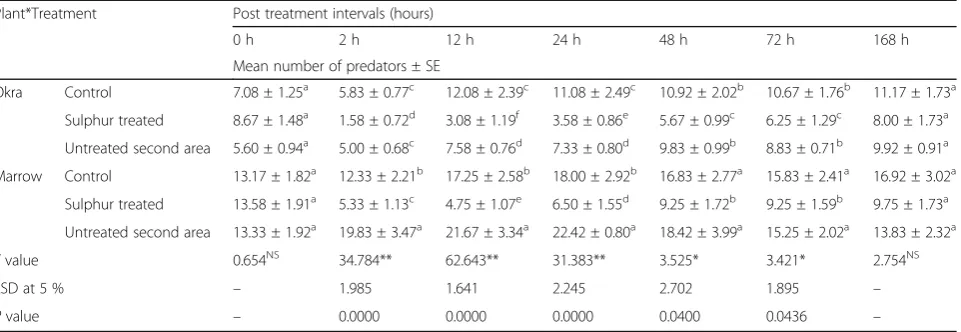
As for the interaction (Plants*Treatments) between the tested plants and treated and untreated plots on the abundance of examined predators adults, it was found that almost all inspection interval achieved significant differences except that of 0 h (before application) and 168 h (1 week post application) where insignificant dif-ferences were recorded (Table 3). On another view, the mean number of recorded adults at the untreated second zone was higher than that of others, and those recorded from the marrow fields, in general, was higher than that of okra fields across all inspection intervals (Table3).
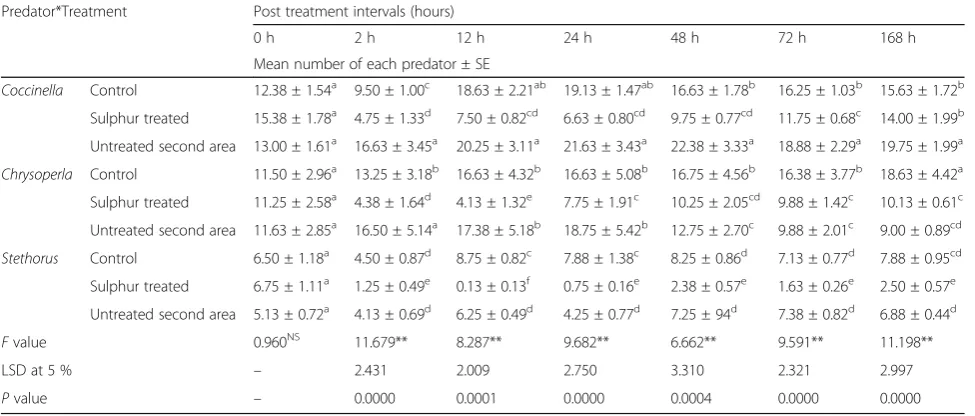
Data illustrated in Table 4 shows the impact of inter-action effects of sulphur treatments on the abundance of the tested adult predators (Predators*Treatments). It was noticed that all inspection intervals achieved significant
differences between the mean numbers of adult preda-tors, except that for 0-h interval, as usual, which was in-significant (F= 0.960). Generally,Stethorusrecorded the most minimal mean number of adults, which was statis-tically negligible, regardless of the mean numbers of the other two predators for the three assessed plots.
Almost in all inspection intervals,Coccinellaadults re-corded the highest mean numbers, pursued by lacewing adults. Moreover, the untreated second territories re-corded the most remarkable number of adults, especially in the case ofCoccinellaadults, then followed by the un-treated plots adjacent to the un-treated one (control) then treated plots, which were recorded the lowest mean numbers of adult predators (Table4).
Regarding the interaction effects between all factors to-gether (Plants*Predators*Treatments) and their impact on the adult predators’abundance, data could be summarized
Table 2Interaction of two factors (Plant*Predator) with respect to the adult predators abundance
Plant*Predator Post treatment intervals (hours)
0 h 2 h 12 h 24 h 48 h 72 h 168 h
Mean number of each predator ± SE
Okra Coccinella 11.83 ± 1.30c 6.33 ± 0.99c 14.42 ± 2.14b 13.83 ± 1.96c 15.25 ± 1.79b 14.92 ± 1.32b 15.42 ± 1.62a
Chrysoperla 4.17 ± 0.17d 2.75 ± 0.69d 3.25 ± 0.62c 3.58 ± 0.31d 5.17 ± 0.35c 5.83 ± 0.37c 7.58 ± 0.34b
Stethorus 6.25 ± 0.71d 3.33 ± 0.75d 5.08 ± 1.16c 4.58 ± 1.28d 6.00 ± 0.99c 5.00 ± 0.99c 6.08 ± 0.97b Marrow Coccinella 15.33 ± 1.23b 14.25 ± 2.59b 16.50 ± 2.75b 17.75 ± 3.08b 17.25 ± 2.79b 16.33 ± 1.61ab 17.50 ± 1.69a
Chrysoperla 18.75 ± 0.55a 20.00 ± 2.72a 22.17 ± 3.18a 25.17 ± 2.79a 21.33 ± 1.73a 18.25 ± 1.78a 17.58 ± 2.73a
Stethorus 6.00 ± 0.96d 3.25 ± 0.66d 5.00 ± 1.19c 5.92 ± 0.98d 5.92 ± 1.02c 5.75 ± 0.91c 5.42 ± 0.79b
Fvalue 25.080** 98.521** 48.343** 157.734** 34.139** 52.582** 15.918**
LSD at 5 % 3.356 1.904 3.259 2.033 3.297 1.969 3.024
Pvalue 0.0001 0.0000 0.0000 0.0000 0.0000 0.0000 0.0004
Means in a column followed with the same letter(s) are not significantly different (Pat 5%) **Highly significant
Table 3Interaction of two factors (Plant*Treatment) with respect to the adult predators’abundance
Plant*Treatment Post treatment intervals (hours)
0 h 2 h 12 h 24 h 48 h 72 h 168 h
Mean number of predators ± SE
Okra Control 7.08 ± 1.25a 5.83 ± 0.77c 12.08 ± 2.39c 11.08 ± 2.49c 10.92 ± 2.02b 10.67 ± 1.76b 11.17 ± 1.73a
Sulphur treated 8.67 ± 1.48a 1.58 ± 0.72d 3.08 ± 1.19f 3.58 ± 0.86e 5.67 ± 0.99c 6.25 ± 1.29c 8.00 ± 1.73a
Untreated second area 5.60 ± 0.94a 5.00 ± 0.68c 7.58 ± 0.76d 7.33 ± 0.80d 9.83 ± 0.99b 8.83 ± 0.71b 9.92 ± 0.91a
Marrow Control 13.17 ± 1.82a 12.33 ± 2.21b 17.25 ± 2.58b 18.00 ± 2.92b 16.83 ± 2.77a 15.83 ± 2.41a 16.92 ± 3.02a
Sulphur treated 13.58 ± 1.91a 5.33 ± 1.13c 4.75 ± 1.07e 6.50 ± 1.55d 9.25 ± 1.72b 9.25 ± 1.59b 9.75 ± 1.73a
Untreated second area 13.33 ± 1.92a 19.83 ± 3.47a 21.67 ± 3.34a 22.42 ± 0.80a 18.42 ± 3.99a 15.25 ± 2.02a 13.83 ± 2.32a
Fvalue 0.654NS 34.784** 62.643** 31.383** 3.525* 3.421* 2.754NS
LSD at 5 % – 1.985 1.641 2.245 2.702 1.895 –
Pvalue – 0.0000 0.0000 0.0000 0.0400 0.0436 –
Means in a column followed with the same letter(s) are not significantly different (Pat 5%) *Significant
**Highly significant NS
in Table5. As frequent of this experiment, 0-h interval ex-hibit insignificant differences (F = 0.668) between tested factors and mean numbers of recorded adult predators. While all other check-up intervals reflect significant differ-ences between the abundance of adult predators’ accord-ing to the tested factors.
Although there were some differences between the re-corded mean numbers of adult predators at 0-h interval, but these differences were statistically insignificant (Table5).
Otherwise, the rest of all inspection period intervals ex-hibited highly significant difference between predators abundance as a result of all examined factors together. Gen-erally, marrow fields comprised the highest mean number of adult predators, whereChrysoperlaranked the first, and
Coccinella was the second, while Stethorus was ranked
third, which record the least mean numbers (Table5). After 2, 12, and 24 h of sulphur application, the mean numbers ofChrysoperlaadults recorded was the highest in untreated second area plots. Then after 48, 72, and 168 h additionally, the recorded mean number was the most elevated at untreated plots contiguous the treated one.
Adults ofC. undicempunctatarecords the most super-ior mean numbers just at 24 and 48 h post treatment for the second untreated region of marrow field.
Generally, marrow field comprised higher mean num-bers of the target predators than okra field. The mean numbers ofChrysoperlain marrow field ranged between 15.50 and 33.00 individuals, while Coccinella ranged from 25.50 to 30.00 individuals, across all inspection pe-riods. The corresponding figure for okra field ranged from 0.25 to 8.75 and 3.25 to 22.25 individuals, for
Chrysoperla and Coccinella, respectively. Stethorus
adults’mean numbers were ranged between 0.00 to 8.75 and 0.25 to 8.75 individuals for marrow and okra fields, respectively (Table5). From the abovementioned data, it was observed that Coccinella adults were more abun-dance for either marrow or okra fields throughout our experiment, regardless of different tested factors, followed by Chrysoperla while Stethorus adults nearly were the same (Table5).
In other view, Table 5 showed that the highest re-corded mean number [“a”green colour] was recorded in untreated second area and control plots, especially in marrow field for Chrysoperla throughout almost all in-spection intervals; then followed by the recorded mean number [“b” yellow colour] for untreated second area
for Coccinella in marrow field too. Then the recorded
mean number forCoccinella(21.25 and 16.50 at 24 and 48 h post treatment, respectively). After that, most of all recorded numbers were somewhat near to each other throughout all inspection intervals.
On the other side, Stethorus recorded the least mean numbers when compared with the two other predators in all treated and/or untreated plots throughout all in-spection intervals either in okra or marrow fields.
Discussion
The present work shed light on sulphur application im-pacts upon the three important predators, which were naturally prevailing in okra and marrow fields. The dif-ferences in the recorded mean numbers of adult preda-tors not only referred to sulphur application, but also to the many other factors (Ali et al.2007; Al–Dahawi et al.
Table 4Interaction two factors (Predator*Treatment) with respect to the adult predators’abundance
Predator*Treatment Post treatment intervals (hours)
0 h 2 h 12 h 24 h 48 h 72 h 168 h
Mean number of each predator ± SE
Coccinella Control 12.38 ± 1.54a 9.50 ± 1.00c 18.63 ± 2.21ab 19.13 ± 1.47ab 16.63 ± 1.78b 16.25 ± 1.03b 15.63 ± 1.72b Sulphur treated 15.38 ± 1.78a 4.75 ± 1.33d 7.50 ± 0.82cd 6.63 ± 0.80cd 9.75 ± 0.77cd 11.75 ± 0.68c 14.00 ± 1.99b
Untreated second area 13.00 ± 1.61a 16.63 ± 3.45a 20.25 ± 3.11a 21.63 ± 3.43a 22.38 ± 3.33a 18.88 ± 2.29a 19.75 ± 1.99a
Chrysoperla Control 11.50 ± 2.96a 13.25 ± 3.18b 16.63 ± 4.32b 16.63 ± 5.08b 16.75 ± 4.56b 16.38 ± 3.77b 18.63 ± 4.42a Sulphur treated 11.25 ± 2.58a 4.38 ± 1.64d 4.13 ± 1.32e 7.75 ± 1.91c 10.25 ± 2.05cd 9.88 ± 1.42c 10.13 ± 0.61c
Untreated second area 11.63 ± 2.85a 16.50 ± 5.14a 17.38 ± 5.18b 18.75 ± 5.42b 12.75 ± 2.70c 9.88 ± 2.01c 9.00 ± 0.89cd
Stethorus Control 6.50 ± 1.18a 4.50 ± 0.87d 8.75 ± 0.82c 7.88 ± 1.38c 8.25 ± 0.86d 7.13 ± 0.77d 7.88 ± 0.95cd
Sulphur treated 6.75 ± 1.11a 1.25 ± 0.49e 0.13 ± 0.13f 0.75 ± 0.16e 2.38 ± 0.57e 1.63 ± 0.26e 2.50 ± 0.57e
Untreated second area 5.13 ± 0.72a 4.13 ± 0.69d 6.25 ± 0.49d 4.25 ± 0.77d 7.25 ± 94d 7.38 ± 0.82d 6.88 ± 0.44d
Fvalue 0.960NS 11.679** 8.287** 9.682** 6.662** 9.591** 11.198**
LSD at 5 % – 2.431 2.009 2.750 3.310 2.321 2.997
Pvalue – 0.0000 0.0001 0.0000 0.0004 0.0000 0.0000
Means in a column followed with the same letter(s) are not significantly different (Pat 5%) **Highly significant
NS
2010; Haddad et al. 2009, 2011; Johnson et al. 2006, 2009; Schmitz 2006). They reported that the develop-mental stage of insect pests and the elements of the leaf contents and its concentrations are responsible for making a certain plant more favourable than another for insect pests feeding, and these findings were in accordance with our results about the diverse predator mean numbers prevailing in okra and/or marrow plants as associated predators of different insect pests.
In addition, our results about the abundance of preda-tors adults on either okra or marrow plants were par-tially matched with that reported by Mooney and Agrawal (2008) when they work on Milkweed genotype; they mentioned that little information is known about the mechanisms by which plant genotype configure the arthropod community structure. They referred that to many different factors including pest species, climatic conditions, the associated predatory arthropods existing, the plant age, and lastly plant sap and its favourability by insect pest for feeding, consequently the abundance of its associated predatory arthropod.
Our findings matched with Chakraborty et al. (2014) and Bhatt et al. (2018) on their survey on okra fields. They men-tioned that there was a diversity of insect pests and their predators, naturally occurring. These predators are belong-ing to different Orders especially Coleopteran, Orthoptera, Neuroptera Lepidoptera, Hemiptera, and Dictyoptera.
Our results revealed that the three examined adult predators were somewhat suffering from the sulphur ap-plication. Adult predators escaping from treated plants into other clean plants are either adjacent to the treated plots or moves to other far plants. This result was in agreement with that reported by Matter et al. (2018, 2019) and Gesraha and Ebeid (2019).
In addition, results explain that the difference between the sprayed tested plants was significantly affected by the mean numbers of the recorded predatory adults. Where marrow plant was heavily invaded by different in-sect and/or mite pests consequently comprised a large number of different examined predators, these findings agreed with that reported by Matter et al. (2018, 2019) and Gesraha and Ebeid (2019).
Conclusion
It could be concluded that the abundance of any arthro-pod predators is strongly associated with their preferable insect pest (prey) and did not relate to a certain plant by itself (Tables 3 and 5). The three tested adult predators were—to some extent—suffering from the sulphur appli-cation as shown in Tables3,4, and5. It was obvious that adult predators escaping from treated plants into other clean plants are either adjacent to the treated plots or travel to other plants to avoid the adverse effect of sulphur formulation, i.e. sulphur formulation act as repellents for
the tested adult predators. In addition, sulphur formula-tion may be toxic for the adult predators if it contacts them. Adult predators start to return back again after dif-ferent periods according to its capability to resist the sulphur residues and re-established once more.
We recommended that sulphur (in any formulation) must be applied with high restrictions, either as fertilizer or as a pesticide, to preserve the wildlife of arthropod pollinators and mites and/or insect predators.
Acknowledgements
The authors are profoundly appreciative of Prof.\Dr. Matter, M.M.; Late Prof.\Dr. Farag, N.A. for their profitable exhorts, and much obliged for all schools, particularly for Mr. Hussein S.H., specialized right hand, Pests and Plant Protection Department, National Research Center, for the help they gave.
Significant statement
This study is important to keep the environment clean and free of chemical insecticide pollution as much as possible, exhibit the role of new resources from locally available materials safe, easy preparing, cheap, possible to utilize in combination with other biological control method of IPM program, and decrease build up resistance strains of the insect.
Authors’contributions
ARE collected the publications needed, shared in constructing the tables and interpreting the results, edited the manuscript, and revised the final form. AAA shared in executing field experiments, collected the specimens, and gathered data and publications needed. MAG carried out the statistical analysis, interpreted the analyzed data, obtained the results, constructed the tables, and edited the manuscript. All authors read and approved the final manuscript.
Funding
This work was personally funded by the authors.
Availability of data and materials
All datasets which were abstracted of the study have been drawn and are presented in the main manuscript. All tables have not been published anywhere else before. All data and materials are available.
Ethics approval and consent to participate
Not applicable
Consent for publication
Not applicable
Competing interests
The authors declare that they have no competing interests.
Received: 5 April 2019 Accepted: 21 September 2019
References
Al–Dahawi SSJ, Ali AA, Sameer SH (2010) The influence of some nutritional and
biochemical characters of three cotton cultivars on the two spotted spider
mitesTetranychus urticaeKoch and the predatorsStethorus gilvifrons(Muls.)
andScolothrips sexmaculatus(Pergs.). Anbar J Agric Sci 8(4):379–389 ISSN:
1992-7479. Website:http://www.ajas.uoanbar.edu.iq
Ali AA, Morad SS, Mohammed JK, Ajeel IF (2007) Response of some introduced and locally improved wheat and barley cultivars to infestation by three important insect pests in Ninava Province, North of Iraq. Anbar J. Agric. Sci,
5(1): 251-266. Website:http://www.ajas.uoanbar.edu.iq
Araya C, Arretz VP, Guerrero SMA, Lamborot CL (1997a) Observation of Polistes
buyssoni (Brethes) (Hymeniptera: Vrspidae), predator ofRachiplusia nu
(Guenee) (Lepidoptera: Noctuidae) larvae on field beans in the metropolitan
Araya JE, Arretz VP, Lamborot CL, Guerrero SMA (1997b) Natural control by predators of Rachiplusia nu (Guenee) (Lepidoptera: Noctuidae) on Phaseolus
beans in Central Chile. Z Pflanzenk Pflanzen 104:147–152
Bhatt B, Joshi S, Karnatak AK (2018) Biodiversity of insect pests and their
predators on okra agroecosystem. J Pharmacogn Phytochem 7(4):84–86
Biondi A, Urbaneja A, Zappalà L, Siscaro G, Mollá O (2012) Efficacy of sulphur on Tuta absoluta and its side effects on the predator Nesidiocoris tenuis. J Appl
Entomol 136:401–409
Bugg RL, Ehler LE, Wilson LT (1987) Effect of Common Knotweed (Polygonum
aviculare) on Abundance and Efficiency of Insect Predators of Crop Pests.
HILGARDIA 55(7):1–51
Chakraborty A, Kumar K, Rajadurai G (2014) Biodiversity of insect fauna in okra
(Abelmoschus esculentus(L.) Moench)) Ecosystem. Trends in Biosciences 7(16):
2206-2211, 2014
Cohen H, Horowrrz AR, Nestel D, Rosen D (1996) Susceptibility of the woolly apple aphid parasitoid, Aphelinus mali (Hym.: Aphelinidae), to common
pesticides used in apple orchards in Israel. Entomophaga 41(2):225–233
Finch S, Collier RH (2000) Host-plant selection by insects–a theory based on
‘appropriate/inappropriate landings’by pest insects of cruciferous plants.
Entomol Exp Appl 96:91–102
Freed RD (1985) MSTAT-C Statistical Package, Version 2.0.0. Crop and Soil Science Department, Michigan State University, East Lansing
Gent DH, James DG, Wright LC, Brooks DJ, Barbour JD, Dreves AJ, Fisher GC, Walton VM (2009) Effects of powdery mildew fungicide programs on twospotted spider mite (Acari: Tetranychidae), hop aphid (Hemiptera: Aphididae), and their natural
enemies in hop yards. Econ Entomol 102:274–286
Gesraha MA, Ebeid AR (2019) Impact of Sulphur dust application on the abundance of two important coccinellid predators in Marrow fields. Bull Nat
Res Cent Egypt 43(34):1–7
Haddad NM, Crutsinger GM, Gross K, Haarstad J, Knops JMH, Tilman D (2009) Plant species loss decreases arthropod diversity and shifts trophic structure.
Ecology Letters 12:1029–1039
Haddad NM, Crutsinger GM, Gross K, Haarstad J, Tilman D (2011) Plant diversity
and the stability of foodwebs. Ecology Letters 14:42–46
Johnson MTJ, Lajeunesse MJ, Agrawal AA (2006) Additive and interactive effects of plant genotypic diversity on arthropod communities and plant fitness.
Ecology Letters 9:24–34
Johnson MTJ, Vellend M, Stinchcombe JR (2009) Evolution in plant populations as a driver of ecological changes in arthropod communities. Phil Trans R Soc
B 364:1593–1605
Kumar PS, Singh SP (2002) Wettable sulphur is toxic toHirsutella thompsonii, the
most important natural enemy of the coconut mite. Indian Coconut Journal.
Coconut Dev Board Kochi India 33(1):1–2
Linda T (2012) Pesticide impacts on beneficial species- Fact Sheet. Available:
www.mvwi.com.au/items/511/2012-05-FS-Pesticide-Impacts2.pdf
Madhuban G, Rajesh K, Arunava G (2012) Nano-pesticides - A recent approach
for pest control. JPPS 4(2):1–7
Martinson T, Williams L III, English-Loeb G (2001) Compatibility of chemical disease and insect management practices used in New York vineyards with
biological control byAnagrusspp. (Hymenoptera: Mymaridae), parasitoids of
Erythroneuraleafhoppers. Biol Control 22:227–234
Matter MM, Ali AA, Marei SS, El-Fandary OO, Farag NA, Gesraha MA (2018) Impact of the application of sulphur formulation on the abundance and activity of
insect predators naturally existing in marrow fields. Asian J Biol 7(1):1–8
Matter MM, Ebeid AR, Marei SS, El-Fandary OO, Farag NA, Gesraha MA (2019) Effect of sulphur dust application on some insect predators naturally
occurringin Okra fields. Bioscience Research 16(2):1153–1160
Mooney KA, Agrawal AA (2008) Plant genotype shapes ant-aphid interactions: implications for community structure and indirect plant defense. Am Nat
171(6):E195–E205
Nash MA, Hoffmann AA, Thomson LJ (2010) Identifying signature of chemical applications on indigenous and invasive nontarget arthropod communities
in vineyards. Ecol Appl 20:1693–1703
Newman IC, Walker JTS, Rogers DJ (2004) Mortality of the leafroller parasitoid
Dolichogenidae tasmanica(Hym.: Braconidae) exposed to orchard pesticide
residues. N Z Plant Prot 57:8–12
Savary S, Horgan F, Willocquet L, Heong KL (2012) A review of principles for
sustainable pest management in rice. Crop Protection 32:54–63
Savary S, Teng PS, Willocquet L Nutter Jr FW. (2006) Quantification and modeling of crop losses: a review of purposes. Annual Review of
Phyto-pathology 44:89–12
Schmitz OJ (2006) Predators have large effects on ecosystem properties by
changing plant diversity, not plant biomass. Ecology 87(6):1432–1437
Sunderland K, Samu F (2000) Effects of agricultural diversification on the abundance, distribution, and pest control potential of spiders: a review.
Entomol Exp Appl 95:1–13
Wetzel C, Dickler E (1994) Side effects of sulphur and natural pyrethroid on
Trichrogramma dendrolimiMatsumura (Hym., Trichogrammatidae) in apple
orchards. Bull OILB/SROP 17(10):123–131
Publisher’s Note