O R I G I N A L A R T I C L E
Information Flow Scheduling in Concurrent Multi-Product
Development Based on DSM
Qing-Chao Sun1 • Wei-Qiang Huang1• Ying-Jie Jiang1• Wei Sun1
Received: 4 December 2016 / Revised: 5 May 2017 / Accepted: 14 June 2017 / Published online: 14 July 2017 ÓThe Author(s) 2017. This article is an open access publication
Abstract Multi-product collaborative development is adopted widely in manufacturing enterprise, while the present multi-project planning models don’t take techni-cal/data interactions of multiple products into account. To decrease the influence of technical/data interactions on project progresses, the information flow scheduling models based on the extended DSM is presented. Firstly, infor-mation dependencies are divided into four types: series, parallel, coupling and similar. Secondly, different types of dependencies are expressed as DSM units, and the exten-ded DSM model is brought forward, described as a block matrix. Furthermore, the information flow scheduling methods is proposed, which involves four types of opera-tions, where partitioning and clustering algorithm are modified from DSM for ensuring progress of high-priority project, merging and converting is the specific computation of the extended DSM. Finally, the information flow scheduling of two machine tools development is analyzed with example, and different project priorities correspond to different task sequences and total coordination cost. The proposed methodology provides a detailed instruction for information flow scheduling in multi-product development, with specially concerning technical/data interactions.
Keywords Concurrent multi-product development Information flow planningExtended DSMProject priority
1 Introduction
With market competition increasing, achieving success with new product development(PD) in mechanic products markets is becoming more and more challenging, and the capability of meeting the diversified customer demands is playing more important role [1]. Due to shortening product life cycles, businesses are also proposing a set of critical success factors to reduce product development time and respond quickly to vibrant customer demand [2].
To meet diversified customer needs while shortening product development cycle, the product developers should concentrate on development of multiple products simulta-neously and improve process efficiency and quality [3], rather than focusing on one product at-a-time. However, the resource conflict among multiple PD projects often leads to the delay of project schedules, and the number of parts, tools and materials also increases linearly with number of products. Ensuring concurrent multiple PD progress [4,5], and managing the information difference and similarity of multiple products are the key problem of concurrent multi-product development project management.
The Design Structure Matrix(DSM), also called the dependency structure matrix, has become an used modeling framework of product development management [6]. DSM is a matrix representation of a directed graph, which allows the project or engineering manager to represent important task relationships in order to determine a sensible sequence for the tasks being modeled [7,8]. As compared to Critical Supported by National Natural Science Foundation of China (Grant
Nos. 51475077, 51005038) and Science and Technology Foundation of Liaoning China (Grant Nos. 201301002, 2014028012).
& Qing-Chao Sun
1 School of Mechanical Engineering, Dalian University of Technology, Dalian 116033, China
Path Method (CPM) and Program Evaluation and Review Technique(PERT), DSM is more suitable for planning information flow in PD project [9–11]. The rows and col-umns of DSM correspond to the tasks, and the matrix reveals the inputs and outputs of tasks, by manipulating the matrix, the feedback marks can be eliminated or reduced, this process is called partitioning [12,13]. According to the input/output, the subsets of DSM elements that are mutu-ally exclusive or minimmutu-ally interacting should be deter-mined, this process is called clustering [14–16].
In recent years, some multiple project scheduling mod-els and methods based on DSM was brought forward, to ensure multi-project progress. P H Chen et al. proposed a hybrid of genetic algorithm and simulated annealing (GA-SA Hybrid) for generic multi-project scheduling problems with multiple resource constraints [17]. C Ju and T Chen developed an improved aiNet algorithm to solve a multi-mode resource-constrained scheduling problem [18]. T Gaertner et al. presented a generic project scheduling technique for functional integration projects based on DSM, to improve the planning of delivery dates and required resources and capacities, to ensure tighter syn-chronization between project teams, and prioritize tasks in parallel projects [19]. T R Browning proposed an expandable process architecture framework (PAF), which organizes all the models and diagrams into a single, rich process model with 27?new and existing views, to syn-chronize various aspects of process (activity network) information in large, complex projects [20]. The above research aims for decreasing project progress delay by arranging task sequences and allocating project resources reasonably, but the influence of task interactions on material flow or product information flow was not taken into consideration.
The product information clustering technologies based on DSM were also presented [21–23], DSM was adopted to cluster product components into modules with minimum interfaces externally and maximum internal integration, but these model aimed for information interaction in the single product, lacked the research about the information differ-ence and similarity among multiple products. Such as, E P Hong and G J Park proposed a new design method to design a modular product based on relationships among products functional requirements, to overcome the diffi-culty of modular design, with combining axiomatic design, the function-based design method and design structure matrix [21]. A H Tilstra et al. presented the high-definition design structure matrix (HDDSM) to captures a spectrum of interactions between components of a product [22]. T AlGeddawy and H ElMaraghy proposed a hierarchical clustering (cladistics) model to automatically build product hierarchical architecture from DSM [23].
Different from one PD project, information flow plan-ning in concurrent multi-product development should emphasis on two factors: first, partitioning tasks sequences according to tasks relationships and project priorities to decease influences of information feedback on project schedules. Second, clustering the similar tasks [24] of multiple PD projects to reduce number of parts and tools, decrease interaction cost and improve development efficiency.
2 Task Relationships in Multiple Projects
2.1 Relationships Among Projects and Products
The concurrent multiple PD project management is the management mode of screening, evaluating, planning, executing and controlling all the projects during a certain time period, from the enterprise or department perspective. The relationships among projects and products in multi-project environment [25] can be divided into the following three types:
(1) Multiple projects for single product development. Each project is responsible for the development of one or more subsystems, and multiple projects cooperate with each other, to complete the develop-ment of a complex product. Cars, airplanes, and other complex PD often use this kind of management mode.
(2) Multiple project for the interrelated multiple prod-ucts. Each project is responsible for the development of one or more products, and there exist the technical or information interaction among multiple products, such as the same product structure, the similar design technology, etc. The new product is often developed based on product families, so this relationship is very common, which was the main research object of the paper.
(3) One project for one product, and each product is independent. There exists no the same and similar parts or sub-systems among multiple projects, which only occurs in the process of few new product development.
2.2 Input/Output Relationships Description
relationship, output oftk as the input of ti andtj,ti andtj can be executed concurrently after the previous tasktk, the dependency between ti and tj corresponds parallel. Fig.1(c) shows the coupling relationship,o0i,o0idenotes the output ofti andtj,o0i,o0i as the input oftj andti separately. Fig.1(d) shows the similar relationship, the output oftiand tjis identical or similar, or similar technology was adopted during performti andtj. The first three types of relation-ships in Fig.1 exist both in one-project and multi-project environment, similar relationship is the special relationship in concurrent multi-product development projects.
2.3 Task Relationships in Multiple Projects
The output of PD project includes design schemes, product drawings, process files, parts, sub-systems, semi-finished parts or products, bill of material, etc., which were labeled as product information, the input/output relationships of tasks can be expressed as the dependencies of product information.
IðPiÞ ¼fe1;e2;. . .;eng;
RðPiÞ ¼
ri11 . . . ri1n
.. .
.. .
rin1 . . . rinn
0 B B @ 1 C C A; ð1Þ
whereIðPiÞandRðPiÞdenotes product information set and information dependencies set respectively, riij is depen-dency of information elementeionej,riijcan be expressed as 0*5 integer,
riij¼
15;there is information fromejtoei; 0;there is no information fromejtoei;
ð2Þ
There exist many identical or similar parts, components and development technologies, etc. in different projects. The task dependencies in multiple projects can be expres-sed as:
mrtgk¼fðrigkÞ ¼
15;there is information fromektoeg; 5 1;eg andekis indentical or similar, 0;eg andek is irrelevant:
8 < :
ð3Þ
3 Extended DSM Model
DSM represents the system, product or process by aggre-gating individual interactions among components, people, activities, or parameters. DSM is essentially anN2diagram
that is structured in such a way as to facilitate system-level analysis and process improvement. The mark in celli,jof DSM indicates that the item in rowirequires information from the item in columnjas an input. Under the diagonal corresponds to the forward information flow, and above diagonal shows the feedback.
The task relationships in multiple PD projects were described as serial, parallel, coupling and similar type, the DSM description as shown in Fig.2, Fig.2(a)*2(c) cor-responds to serial, parallel and coupling relationship sep-arately, and Fig.2(d) corresponds to similar relationship.
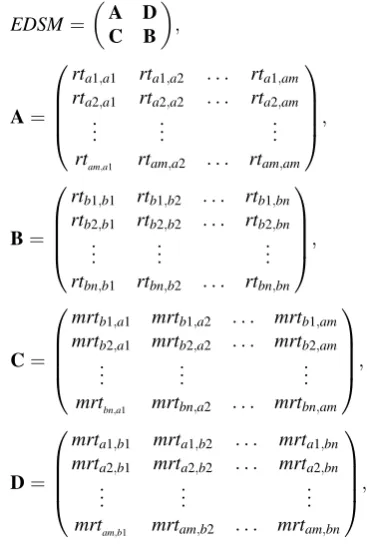
To describe tasks dependencies in multiple PD projects, one extended DSM(EDSM) was brought forward. fta1;ta2;. . .;tamg, ftb1;tb2;. . .;tbng denotes the tasks in projectPaandPbseparately, the extended DSM related to Pa andPb can be expressed as a partitioned matrix.
EDSM¼ A D
C B
;
A¼
rta1;a1 rta1;a2 . . . rta1;am rta2;a1 rta2;a2 . . . rta2;am
.. . .. . .. .
rtam;a1 rtam;a2 . . . rtam;am
0 B B B @ 1 C C C A; B¼
rtb1;b1 rtb1;b2 . . . rtb1;bn rtb2;b1 rtb2;b2 . . . rtb2;bn
.. . .. . .. .
rtbn;b1 rtbn;b2 . . . rtbn;bn
0 B B B @ 1 C C C A; C¼
mrtb1;a1 mrtb1;a2 . . . mrtb1;am mrtb2;a1 mrtb2;a2 . . . mrtb2;am
.. . .. . .. .
mrtbn;a1 mrtbn;a2 . . . mrtbn;am
0 B B B @ 1 C C C A; D¼
mrta1;b1 mrta1;b2 . . . mrta1;bn mrta2;b1 mrta2;b2 . . . mrta2;bn
.. . .. . .. .
mrtam;b1 mrtam;b2 . . . mrtam;bn
0 B B B @ 1 C C C A; i o i
t tj
i t j t k t ' i o ' j o i t j t k o i t j t i o j o
(a)Serial (b)Parallel (c)Coupling (d)Cimilar
Fig. 1 Input/output relationships in multi-project situation
i
o
i
t tj
i t j t k t ' i o ' j o i t j t k o i t j t
(a)Serial (b)Parallel (c)Coupling (d)Cimilar i
o
j
o
whereAandBindicates input/output dependencies matrix of projectPaandPbseparately,Cdenotes dependencies of PbonPa, andDcorresponds to dependencies ofPaonPb.
4 Information Planning Based on EDSM
Information flow planning based on the extended DSM is different from DSM, which involves four types of com-putation: merging, converting, partitioning and clustering.
4.1 Merging Converting and Partitioning Regardless of Project Priorities
According to the input/output relationships, mrtij¼ 5 means output of ti and tj is identical. To avoid duplicate work, ti and tj can be combined, this process is called merging. Such as ftai;tajg and ftbg;tbkg is tasks set of project Pa and Pb separately, the initial extended DSM model was expressed as
tai 3 taj 5 tbg
5 tbk
0 B B @ 1 C C A;
the work content oftaiandtbgis identical,taiandtbgcan be combined into one task, furthermore task dependencies need be to reconstructed. After merging tai and tbg, the extended DSM model can be expressed as:
tai 3 taj
5 tbk
0 @
1
Aor
tbg 3 taj
5 tbk
0 @
1
A;
in multi-project environment, 5\mrtij\0 means the output oftiandtjis similar, and 0\mrtij\5 means that the output oftjas the input ofti.
When converting computation is done, the similar relationships can be converted to 0\mwr0ij\5, so as to partitioning and clustering can be done based on the uni-form algorithm,mrt0ij¼fðmrtijÞis the converting function, the initial extended DSM is:
tai 3 taj 3 tbg
5 tbk
0 B B @ 1 C C A;
mwrbg;ai¼ 3 means the work content of tai and tbg is similar. Supposing converting function follows the linear law, mwrij0 ¼kmwrijþb. Designer can choose the dif-ferent value ofkandb, and analyze influence of numerical value k and b on partitioning and clustering results.
Adoptingmwrij0 ¼ 2mwrij3, the converted extended DSM is
tai 3 taj
3 tbg
5 tbk
0 B B @ 1 C C Aor tbg 5 tbk
3 tai
3 taj
0 B B @ 1 C C A:
Partitioning is the computation of reordering the rows and columns in the DSM with minimizing the number of marks above the diagonal, the result is the optimal tasks ordering, which reduces feedback and rework. According to the partitioned matrix, the serial, parallel and coupling relationship can be identified. Regardless of project prior-ities, partitioning algorithm of the extended DSM is iden-tical to the common DSM [24, 25]. Tasking the parallel tasks relationships as the example.
ti 0 5 0 tj 5 0 0 tk
0 @
1
A!
tk 0 0 5 ti 0 5 0 tj
0 @
1
A;
the initial tasks sequence is ti!tj!tk, and partitioned tasks sequence istk!ti!tj, the relationships betweenti andtj is parallel, can be performed concurrently.
4.2 Clustering Regardless of Project Priorities
The goal of clustering is to find subsets of the extended DSM (i.e., clusters) so that the tasks within a cluster are maximally interdependent and clusters are minimally interacting. Some researchers have proposed different clustering algorithm based on different principle, such as A Yassine presented a clustering objective function by using the minimal description length principle [26], S E Carlson and N Ter-Minassian proposed a clustering algorithm based on coordination cost [27].
This paper focuses on the information flow in multi-project situation, with the goal of minimizing the influence of information interaction on project schedule, referring the algorithm of Idicula and Fernandez, etc., the clustering object function of the extended DSM was built.
TccðMÞ ¼X n
i¼1
ccðtiÞ;
ccðtiÞ ¼
Xn
j¼1
ðmwrðti;tjÞ þmwrðtj;tiÞÞ sizeðti;tjÞ p k
;
the extended DSM, sizeðti;tjÞ is the size of minimum cluster which containstiandtj,p kis the power coefficient corresponds to thek-th level clusters, value range ofp kis integer from 1 to 5. After merging, converting and parti-tioning, one extended DSM was obtained:
A 1 2
B 4
4 2 C
D 3 2
5 E 3 3
5 1 3 F 2
4 3 4 G
0 B B B B B B B B @
1 C C C C C C C C A
:
Clustering can be done based on the previous compu-tation, according to Eq.4,p k1,p k2,p k3corresponds to
different level clusters,p k1indicates the power coefficient
of smallest cluster,p k2 corresponds to the upper level of
cluster, which consists of a series of sub-cluster and tasks, p k3 corresponds to the whole extended DSM, adopting
p k1¼1, p k2¼2, p k3¼3, the clustered extended
DSM can be obtained:
Adopting p k1¼1, p k2¼1, p k3¼2, the different
clustered extended DSM can be obtained:
which means that the lower level clusters will contain more tasks asp k2=p k1 increase, and the upper level will
contain more sub-clusters and tasks asp k3 increase.
4.3 Merging Converting and Partitioning with Regarding Project Priorities
Regarding project priorities, the duplicate work in low-priority project should be combined into the identical tasks in high-priority project, and tasks dependencies was reconstructed. Such asftai;tajgandftbg;tbkgis tasks set of projectPa andPb separately,pria andprib denotes priori-ties ofPa andPb,prib[pria, the initial extended DSM is:
tai 3 taj 5 tbg
5 tbk
0 B B @
1 C C
A;
mwrbg;ai¼ 5 means the work content of tai and tbg is identical, andtaiandtbg can be combined into one task. To guarantee schedule requirement of high-priority projectPb, tai should be combined intotbg, the merged extended DSM can be expressed as
tbg 3 taj
5 tbk
0 @
1
A;
converting aims at transforming 5\mrtij\0 into 0\mwrij0\5, so as to partitioning and clustering can be done based on the uniform algorithm,mrt0ij¼fðmrtijÞis the converting function. Different from computation regardless of project priorities, converting regarding priorities should guarantee the schedule of high-priority project firstly. Such as, project Pb with higher priority, prib[pria, the initial extended DSM is
tai 3 taj 3 tbg
5 tbk
0 B B @
1 C C
A;
means the work content of tai andtbg is similar, adopting mwr0ij¼ 2mwrij3, the transformed extended DSM as follows, becausetbg with high priority,tbgwas arranged before tai in task sequence,
tbg 5 tbk
3 tai
3 taj
0 B B @
1 C C
A:
extended DSM, secondly, moving forward high-priority tasks, or moving backward low-priority tasks. For example, fta1;ta2;ta3;ta4gandftb1;tb2;tb3;tb4gis tasks set of project
Pa andPb separately,Pa with higher priority,pria[prib, the extended DSM model before and after partitioning is
ta1
2 ta2 2 2
5 ta3 2
5 ta4 1
2 tb1
3 5 tb2
3 tb3
2 3 tb4
0 B B B B B B B B B B @ 1 C C C C C C C C C C A ; or ta1
3 tb3
5 ta3 2
5 ta4 1
3 2 tb4
2 2 2 ta2
2 tb1
3 5 tb2
0 B B B B B B B B B B @ 1 C C C C C C C C C C A ;
tasks sequenceT0 ¼ fta1;tb3;ta3;ta4;tb4;ta2;tb1;tb2g can be
obtained, adjusting tasks order based on project priorities and input/output dependencies, new tasks sequence can be obtained,T00¼ fta1;ta3;ta4;tb3;ta2;tb4;tb1;tb2g,ta2 can not
move to the front of tb3 because that ta2 depends on the
output of tb3,mwra2;b3¼2. The corresponding partitioned
extended DSM regarding project priorities is: ta1
5 ta3 2
5 ta4 1
3 tb3
2 2 2 ta2
2 3 tb4
2 tb1
3 5 tb2
0 B B B B B B B B B B @ 1 C C C C C C C C C C A :
4.4 Clustering with Regarding Project Priorities
The goal of clustering with regarding project priorities is dividing the tasks with similar priorities and high input/ output dependencies into the same subsets, to decrease information interaction cost in multi-project situation. The object function takes influence of project priorities on coordination cost into consideration,prii andprij denotes priority of project Pi and Pj respectively. The clustering object function with regarding project priorities can be expressed as:
TccðMÞ ¼X n
i¼1
ccðtiÞ;
ccðtiÞ ¼
Xn
j¼1
fij ðmwrðti;tjÞ þmwrðtj;tiÞÞ sizeðti;tjÞp k;
fij¼ ðpriðtiÞ priðtjÞ
þ1Þp pri;
ð5Þ whereTccðMÞis total coordination cost of modelM,ccðtiÞ is coordination cost of taskti,nis the number of tasks inM, rði;jÞ,rðj;iÞis the interaction betweenti andtj,p kis the power coefficient related to the k-th level clusters, fij indicates impact factor related to project priorities,priðtiÞ and priðtjÞ denotes project priorities, p pri is the power coefficient related to project priorities, value range of p k andp priis 0*1, and 0\fij1.
Different from clustering regardless of project priorities, by introducing fij, the difference in project priorities was taken into consideration, withfijincreacing, the tasks with different priorities will be divided into different clusters. Such as,priaandpribdenotes project priority of projectPa andPbrespectively, adoptingpria¼3,prib¼1,p k1¼1,
p k2¼2, p k3¼3, after merging, converting and
parti-tioning with regarding project priorities, the tasks sequence can be determined, and the clustered extended DSM with regarding project priorities can be obtained:
5 Example
Two machine tool products was developed during the same period, the worktable size of one machine tool is 6509650 mm2, the other is 125091250 mm2, two machine tools have the similar product structures.
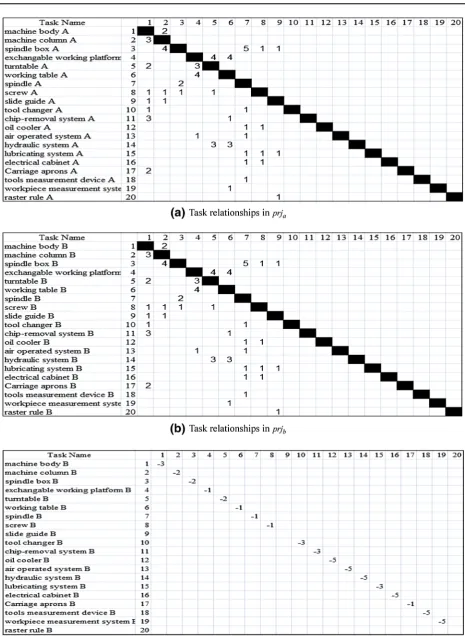
The dependencies among tasks in multiple PD projects were determined according to the input/output relation-ships, the initial extended DSM model can be built:
EDSM¼ A D
C B
Fig.3(a), Fig.3(b) corresponds to dependencies of 650 type (prja), 1250 type (prjb) horizontal machine center separately, Fig.3(c) corresponds to the identical and sim-ilar relationships between two projects,D=0.
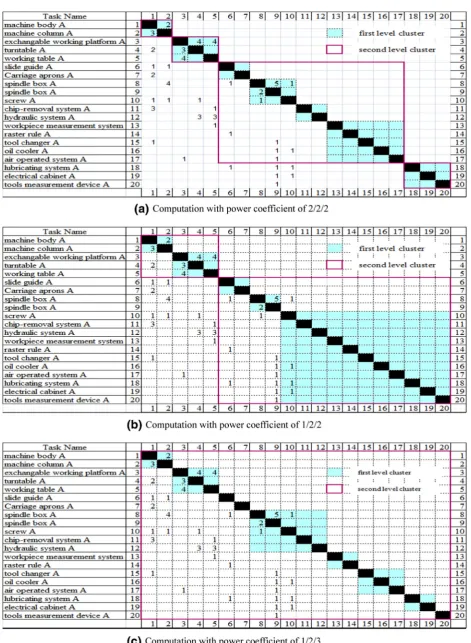
According to the information planning approach of Extended DSM, the partitioning and clustering computa-tion results related to prja can be obtained, as shown in Fig.4. The values of p k1, p k2, p k3 have significant
impact on clustering results, the size of second level clusters increases with p k3=p k2, the size of first level
clusters increases withp k2=p k1.
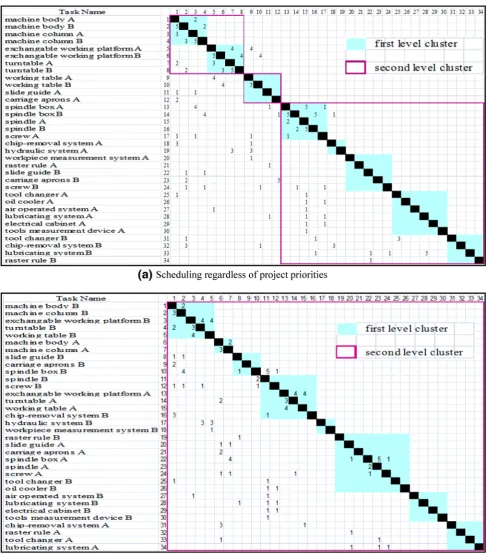
Merging the duplicate work, and adopting linear function mwr0ij¼kmwrijþb to convert the similar relationships. Partitioning and clustering extended DSM with different value of k and b, adopted mwrij0 ¼ 2 mwrij1 as the converting function, the similar tasks was divided into the same clusters. Regardless of project priorities, adopting p k1¼1, p k2¼2, p k3¼2,
merging, converting, partitioning and clustering tasks of two projects based on the extended DSM, the computa-tion result as shown in Fig.5(a). With regarding project priorities, adopting pria¼1, prib¼3, which means that prjb with high project priority, the computation result based on the extended DSM as shown in Fig.5(b).
Regardless of project priorities, the similar tasks tend to be divided into the same clusters, to reduce the influence of information interaction on project schedule. the similar tasks tend to be divided into different clusters, to reduce the influence on schedule of high-priority tasks.
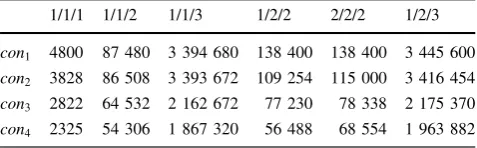
Adopting different p k1, p k2 and p k3, TccðMÞ was
computed in four types of conditions: two project was independent, each project as a clustercon1,`two project
was independent, clustering without regarding the rela-tionships between two projectscon2,´clustering based on
the extended DSM model, without regarding project pri-orities con3, ˆ clustering based on the extended DSM
model, with regarding project prioritiescon4, computation
results as shown in Table1.
The first two conditions didn’t take relationships between two projects into consideration, and the last two conditions was computed based on the extended DSM, with regarding dependencies among multiple projects. The differences of TccðMÞ show that optimizing tasks sequence based on the extended DSM can decrease influence of task interactions on project schedules, and values ofp kinfluence computation results obviously, the power coefficient should be determinded according the task relationships and PD teams.
6 Discussion
The extended DSM was built to optimizing task-sequences and task-clusters in multiple PD projects, focusing on the technical information interactions and similarities in mul-tiple projects, taking project priorities into consideration, was mainly applied to the mechanical product development projects, such as automobiles, machine tools, construction machines, etc. Although software, construction and other industries also involve multi-project management [26,28], but the task-relationships are different from mechanical product development projects.
A series of coefficients was introduced in the converting and clustering calculation, such as k and b in converting function mwr0ij¼kmwrijþb, p k in Eq. (4), p k and p pri in Eq. (5). The calculation results indicated that the value of these coefficients had a great effect on the infor-mation planning. It is necessary to determine these coef-ficients by taking the completed projects as example, changing the values, and judging the rationality of task-sequences and task clusters combined with the expert experience.
Resources sharing and conflicting was the important feature of multi-project management [17, 29], but the extended DSM model didn’t take resource allocation into consideration, therefore the information planning results based on extended DSM should not be the final task sequences, the further adjustment according to resource capabilities was needed.
7 Conclusions
(1) Describing task dependencies is the basis of infor-mation flow planning based on the extended DSM, the task relationships in multi-project is divided into four types: serial, parallel, coupling, and similar. Similar is the specific dependency relationship of the extended DSM.
(2) The initial extended DSM can be expressed as a partitioned matrix, describing task dependencies in one project and among multiple projects concurrently. (3) By adopting different power coefficients in convert-ing or clusterconvert-ing function, different task-sequences or task-clusters can be obtained. Determining the appropriate power coefficient is important for infor-mation flow scheduling based on the extended DSM.
Open Access This article is distributed under the terms of the Creative Commons Attribution 4.0 International License (http://crea tivecommons.org/licenses/by/4.0/), which permits unrestricted use, Table 1 Total coordination cost with different power coefficient
1/1/1 1/1/2 1/1/3 1/2/2 2/2/2 1/2/3
con1 4800 87 480 3 394 680 138 400 138 400 3 445 600 con2 3828 86 508 3 393 672 109 254 115 000 3 416 454 con3 2822 64 532 2 162 672 77 230 78 338 2 175 370
distribution, and reproduction in any medium, provided you give appropriate credit to the original author(s) and the source, provide a link to the Creative Commons license, and indicate if changes were made.
References
1. J Lin, Y Qian, W Cui, et al. An effective approach for scheduling coupled activities in development projects.European Journal of Operational Research, 2015, 243(1): 97–108.
2. C A G Dev, V S S Kumar. Analysis on critical success factors for agile manufacturing evaluation in original equipment manufac-turing industry-an AHP approach.Chinese Journal of Mechanical Engineering, 2016, 29(5): 880–888.
3. M Li, G Y He, Z J Song. Improved quality prediction model for multistage machining process based on geometric constraint equation. Chinese Journal of Mechanical Engineering, 2016, 29(2):430–438. 4. M S Avnet, A L Weigel. An application of the design structure
matrix to integrated concurrent engineering.Acta Astronautica, 2010, 66: 937–949.
5. A Karniel,Y Reich. Multi-level modelling and simulation of new product development processes.Journal of Engineering Design, 2013, 24(3): 185–210.
6. S Li. A matrix-based clustering approach for the decomposition of design problems. Research in Engineering Design, 2011, 22(4): 263–278.
7. A Tripathy, S D Eppinger. Structuring work distribution for global product development organizations.Prod. Oper. Manage., 2013, 22(6): 1557–1575.
8. M Danilovic, T R Browning. Managing complex product devel-opment projects with design structure matrices and domain mapping matrices.International Journal of Project Management, 2007, 25(3): 300–314.
9. D M Sharman, A A Yassine. Architectural valuation using the design structure matrix and real options theory. Concurrent Engineering, 2007, 15(2): 157–173.
10. M S Avnet,A L Weigel. An application of the design structure matrix to integrated concurrent engineering.Acta Astronautica, 2010, 66(5): 937–949.
11. D Tang, G Zhang, S Dai. Design as integration of axiomatic design and design structure matrix. Robotics and Computer-In-tegrated Manufacturing, 2009, 25(3): 610–619.
12. M Danilovic, B Sandkull. The use of dependence structure matrix and domain mapping matrix in managing uncertainty in multiple project situations.International Journal of Project Management, 2005, 23(3):193–203.
13. T R Browning. Applying the design structure matrix to system decomposition and integration problems: A review and new directions. IEEE Transactions on Engineering Management, 2001, 48(3): 292–306.
14. A Nikanjam, H Sharifi, B H Helmi, et al. A new DSM clustering algorithm for linkage groups identification. Proceedings of the 12th annual conference on Genetic and evolutionary computa-tion, 2010, New York, USA, July 7–11, 2010: 367–368. 15. J U Maheswari, K A Varghese. Structured approach to form
dependency structure matrix for construction projects. Proceed-ings of the 22nd International Symposium on Automation and Robotics in Construction, Ferrara, Italy, 2005: 1–6.
16. A Yassine, D Braha. Complex Concurrent Engineering and the Design Structure Matrix Method.Concurrent Engineering, 2003, 11(3): 165–176.
17. P H Chen, S M Shahandashti. Hybrid of genetic algorithm and simulated annealing for multiple project scheduling with multiple resource constraints. Automation in Construction, 2009, 18(4): 434–443.
18. C Ju, T Chen. Simplifying multiproject scheduling problem based on design structure matrix and its solution by an improved aiNet algorithm.Discrete Dynamics in Nature and Society, 2012, 2012: 1–2.
19. T Gaertner, S Terstegen, C M Schlick. Applying DSM method-ology to improve the scheduling of calibration tasks in functional integration projects in the automotive industry.J. Mod. Project Manage, 2015, 3(2): 46–55.
20. T R Browning. Managing complex project process models with a process architecture framework. Int. J. Project Manage., 2014, 32(2): 229–241.
21. E P Hong, G J Park. Modular design method based on simultaneous consideration of physical and functional relationships in the con-ceptual design stage.J. Mech. Sci. Technol., 2014, 28(1): 223–235. 22. A H Tilstra, C C Seepersad, K L Wood. A high-definition design structure matrix (HDDSM) for the quantitative assessment of product architecture.J. Eng. Des., 2012, 23(10–11): 767–789. 23. T AlGeddawy, H ElMaraghy. Optimum granularity level of
modular product design architecture.CIRP Ann. Manuf. Technol, 2013, 62(1): 151–154.
24. F Borjesson, K H¨ oltt¨a-Otto. A module generation algorithm for product architecture based on component interactions and strategic drivers.Res. Eng. Des., 2014, 25(1): 31–51.
25. D Mike, S Bengt. The use of dependence structure matrix and domain mapping matrix in managing uncertainty in multiple project situations.International Journal of Project Management, 2005, 23(2): 193–203.
26. A Yassine. An introduction to modeling and analyzing complex product development processes using the design structure matrix (DSM) method. Urbana, 2004, 51(9): 1–17.
27. S E Carlson, N Ter-Minassian. Planning for concurrent engi-neering.Medical Device and Diagnostic Industry, 1996, 18(5): 8 –11.
28. S Amol. Resource constrained multi-project scheduling with priority rules & analytic hierarchy process.Procedia Engineer-ing,2014, 69: 725–734.
29. E Ashraf, A Mohammad. Multiobjective evolutionary finance-based scheduling: Individual projects within a portfolio. Au-tomation in Construction, 2011, 20(7): 755–766.
Qing-Chao Sun, born in 1979, received his PhD degree in engineering from College of Mechanical Engineering, Chongqing University, China,in 2009. He is currently an associate professor of School of Mechanical Engineering, Dalian University of Technology, China. His research interests mainly include optimization of mechanical system and remanufacturing of machinery equipment. Tel:?86-411-84707435; E-mail: [email protected]
Wei-Qiang Huang,born in 1992, is currently a master candidate at School of Mechanical Engineering, Dalian University of Technology, China. E-mail: [email protected]
Ying-Jie Jiang, born in 1992, is currently a master candidate at School of Mechanical Engineering, Dalian University of Technology, China. E-mail: [email protected]