Ames Laboratory Publications
Ames Laboratory
9-2008
An Interface between the Universal Force Field and
the Effective Fragment Potential Method
Deborah Zorn
Iowa State UniversityVictor S.-Y. Lin
Iowa State UniversityMarek Pruski
Iowa State University, [email protected]
Mark S. Gordon
Iowa State University, [email protected]
Follow this and additional works at:
http://lib.dr.iastate.edu/ameslab_pubs
Part of the
Chemistry Commons
The complete bibliographic information for this item can be found at
http://lib.dr.iastate.edu/
ameslab_pubs/338
. For information on how to cite this item, please visit
http://lib.dr.iastate.edu/
howtocite.html
.
An Interface between the Universal Force Field and the Effective Fragment
Potential Method
Abstract
In order to properly describe reactions in heterogeneous catalyst systems, the reactants, solvent, and bulk
effects of the surface must be taken into account. Embedded-cluster QM (quantum mechanics)/MM
(molecular mechanics) methods can treat reactions on surfaces (the gas−surface interface), and the effective
fragment potential method (EFP) can accurately treat the solvent effects on reactions (the gas−liquid
interface). In order to create a QM/MM/EFP hybrid method for treatment of heterogeneous catalytic
systems in the presence of a solvent (the liquid−surface interface), an EFP−MM interaction potential has been
developed. Example calculations on small clusters of silica and water have been carried out.
Disciplines
Chemistry
Comments
Reprinted (adapted) with permission from
Journal of Physical Chemistry B
112 (2008): 12753, doi:
10.1021/
jp8049729
. Copyright 2008 American Chemical Society.
An Interface between the Universal Force Field and the Effective Fragment Potential
Method
Deborah Zorn, Victor S.-Y. Lin, Marek Pruski, and Mark S. Gordon*
Ames Laboratory and Department of Chemistry, Iowa State UniVersity, Ames, Iowa 50011 ReceiVed: June 5, 2008; ReVised Manuscript ReceiVed: July 29, 2008
In order to properly describe reactions in heterogeneous catalyst systems, the reactants, solvent, and bulk effects of the surface must be taken into account. Embedded-cluster QM (quantum mechanics)/MM (molecular mechanics) methods can treat reactions on surfaces (the gas-surface interface), and the effective fragment potential method (EFP) can accurately treat the solvent effects on reactions (the gas-liquid interface). In order to create a QM/MM/EFP hybrid method for treatment of heterogeneous catalytic systems in the presence of a solvent (the liquid-surface interface), an EFP-MM interaction potential has been developed. Example calculations on small clusters of silica and water have been carried out.
I. Introduction
Functionalized mesoporous silica nanoparticle (MSN) based catalysts have been found to selectively catalyze many different types of reactions.1-6In these systems, the silica is not simply
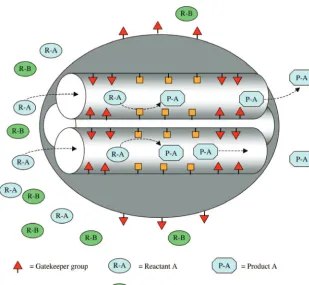
an inert support with size/shape sieving selectivity. Rather, the selectivity is determined by covalent and noncovalent interac-tions between reactants and functional groups immobilized on the inside of the silica pores. In a bifunctionalized MSN system, there are two different functional groups: the first group catalyzes the reaction and the secondary groups control the selectivity. The secondary groups are called “gate keepers” because they prevent unwanted reactants from entering the catalyst pore by noncovalent (e.g., via hydrophobic or hydro-philic) interactions. In addition to their selectivity, advantages of these new MSN catalysts include their inert stationary phase, large surface area, and tunable pore size. A schematic of a multifunctionalized system is shown in Figure 1. In this example, the gatekeeper groups only allow reactant A to enter the functionalized pore, yielding product A selectively. In a paper by Huh et al.,1a bifunctionalzed MSN system was synthesized,
characterized, and used to selectively catalyze the nitroaldol reaction, in which condensation between a nitroalkane and an aldehyde yields a nitroalcohol that can undergo dehydration to yield a nitroalkene. In this system, the catalytic group is a 3-[2-(aminoethylamino)ethylamino]propyl group, and the secondary groups are ureidopropyl, mercaptopropyl, and allyl groups. Accurate gas-phase calculations were carried out on a nitroaldol reaction by Zorn et al.7 with methylamine used as a model
catalyst. To properly treat the entire system, including the catalyst, the pore, and the solvent, a computational method must properly account for the electronic structure of the reactants, the effects of the silica, and the effects of the surrounding solvent.
To efficiently and accurately treat these MSN heterogeneous catalysis systems, a hybrid approach that employs both quantum mechanics (QM) and model potentials (for the solvent and the nonreactive part of the functionalized pore) might provide an effective model. The electronic structure of the reacting species and the immobilized catalyst groups must be treated with quantum mechanics. The important nonbonded solvent-substrate interactions can usually be reasonably accounted for using an
explicit solvent model, and the largely noninteracting bulk silica support can be treated with molecular mechanics (MM).
Several of the computational components that are needed for the study of heterogeneous catalysis in the presence of a solvent are already available in or interfaced with the GAMESS (general atomic and molecular electronic structure system)8,9computer
code. These are the surface-integrated molecular orbital mo-lecular mechanics (SIMOMM) embedded cluster method10that
was designed for QM/MM calculations on surfaces, and the effective fragment potential method (EFP)11,12method that was
developed for investigations of explicit solvent effects. The goal of this work is to combine the SIMOMM and EFP methods, thereby creating a QM/MM/EFP method. The QM/MM/EFP energy can be written as
ETOTAL)EQM+EMM+EEFP+EQM-EFP+EQM-MM+
EEFP-MM (1)
In eq 1,EQM,EMM, andEEFPare the internal energies within
the QM, MM, and EFP regions of a composite system, re-spectively, while the last three terms are the corresponding interaction energies. All except the last term in eq 1 have previously been derived and coded.10-12 The last term is the focus of the
current work.
In the SIMOMM embedded cluster method, a surface to be modeled is divided into two regions: the bulk region and the “action” region. The bulk region is a large cluster that models the surface of interest. Carved out of the center of the bulk model of the surface is a smaller cluster where the “action” (chemistry) takes place. In SIMOMM, the action region is treated with quantum mechanics and the bulk region is treated with an MM force field.
The EFP method is an explicit solvent model, which re-presents the important nonbonded interactions of solvent molecules with each other and with a QM solute. In the most general EFP model, these interactions include Coulomb, induc-tion, exchange repulsion, charge transfer, and dispersion interac-tions. In EFP, the system is divided into two regions: the quantum (solute) region and the EFP solvent region. The total energy of the QM-EFP system is
J. Phys. Chem. B2008,112,12753–12760 12753
EInteraction Total )
EQM-EFP+EEFP-EFP (2)
The interaction energy includes the interactions between the quantum and EFP regions and the interactions between the solvent molecules and other solvent molecules.
The original EFP method, called EFP1,12 was designed
specifically for water and has been implemented for three levels of theory: Hartree-Fock (HF), density functional theory (DFT), and second-order perturbation theory (MP2). In EFP1, the energy is a sum of three terms: electrostatic, polarization, and a fitted remainder term, which accounts for all interactions not included in the first two terms.
EInteractionEFP1 )EElec+EPol+ERem (3)
The electrostatic term is represented by a distributed multi-polar analysis (DMA), in which the multipoles are expanded up to octopoles. The expansion points are the atom centers and bond midpoints. A damping term is used to account for overlapping charge densities at small intermolecular distances, and a distance cutoff is used for this damping term.13,14 The
polarization of each molecule by the surrounding molecules is obtained using a finite field model and iterated to self-consistency using localized molecular orbital (LMO) polariz-ability tensors. The remainder term is fitted to a functional form,12in which the fitted parameters are obtained by subtracting
the first two terms in eq 3 from the water dimer interaction potential at many points on the water dimer potential energy surface. For the HF implementation of EFP1, ERem contains
contributions from exchange repulsionEExRepand charge transfer
ECT. For EFP1/DFT,15ERemincludes some short-range
correla-tion, and for EFP1/MP2, there is a separately fitted dispersion term.16
The general EFP method (EFP2) has no fitted parameters; its interaction energy can be expressed as
EInteraction EFP2 )
EElec+EPol+EExRep+ECT+EDisp (4)
Because there are no empirically fitted parameters, an EFP2 can be generated for any molecule. The internal geometries are fixed (no intrafragment vibrations) in both EFP1 and EFP2.
Due to the internal rigidity of molecular fragments, Nemukhin et al.17interfaced the EFP1 method with MM force field methods
in the molecular mechanics package TINKER18,19to facilitate
the modeling of conformational changes in biological molecules, represented by dipeptides, that are solvated by water. In their method, fragment-fragment interactions were replaced by force field interactions calculated by one of the molecular mechanics options in Tinker, creating a new flexible EFP/MM scheme. The force field and parameters used were from the OPLS-AA force field.20The authors took two approaches to modeling the
dipeptide water system. In the first approach, the dipeptide was treated at an ab initio level of theory and the waters were represented with the flexible EFP/MM scheme. In the second approach, the dipeptide was decomposed into 8 fragments, which were modeled with the EFP/MM scheme, and the waters were treated with an ab initio level of theory. Both of these models were able to correctly describe the conformational changes of a dipeptide in the presence of water.
[image:4.598.143.452.453.738.2]Although the approach taken in the method by Nemukhin et al. can properly account for the interactions between the dipepetide and each solvent molecule, the MM treatment of the EFPs cannot adequately account for the interactions between solvent molecules due to the lack of an accurate intermolecular potential for water and because of the inherent limitations of the MM method. Limitations of the MM method include the inability of the MM potential to reproducebothbulk and cluster behavior and the difficulty in choosing accurate parameters for solvent molecules in a general manner. The importance of the structure of the surrounding solvent molecules on the electronic structure of the solute has been demonstrated for systems such
Figure 1. Schematic of a multifunctionalized mesoporous silica system.
as solvated glycine21and alanine,22for which the structure of
the surrounding water has a significant impact on the relative stabilities of the nonionic and zwitterionic species. The EFP/ MM method by Nemukhin et al. also only has two regions: a QM region and an EFP region. Applications to reactions on surfaces surrounded by a solvent require three regions: a MM region for the bulk, a QM region for the “action” region, and an EFP region for the solvent molecules.
Currently, the implementation of SIMOMM uses an interface with the molecular mechanics packageTinker, as well. There are several choices of force field potentials in Tinker. These are mainly designed to treat biological and organic systems, so parameters are primarily limited to atoms that commonly appear in such species. In order to model metal oxide surfaces, such as silica and titania the Universal Force Field (UFF)23 was
implemented directly into GAMESS. UFF is a general all-atom force field that has been applied to organic molecules,24metallic
complexes,25 and main group compounds.26 It is therefore
applicable to a broad range of interesting problems related to heterogeneous catalysis.
In traditional force fields, large sets of parameters are necessary in order to account for all possible combinations of atoms that could be involved in a bond, angle, or torsion. UFF
replaces these large sets of parameters with a smaller set of parameters for each atom type. Currently, there are 127 atom types available in UFF, based on hybridization and oxidation state. Force field parameters can be generated for every possible Figure 2. Ab initio structures of water dimer: (a) MP2/DH(d,p), (b)
[image:5.598.359.494.45.329.2]HF/DH(d,p). Hydrogen bond lengths given in Å.
[image:5.598.46.285.218.325.2]Figure 3. Full EFP structure of water dimer. Hydrogen bond lengths given in Å.
[image:5.598.353.499.377.661.2]Figure 4. MM structures of water dimer: (a) With parameters from UFF; (b) with parameters from DREIDING and charges from DMA; (c) with parameters from DREIDING and Gasteiger charges. Hydrogen bond lengths given in Å.
Figure 5. EFP/MM structures of water dimer: (a) EFP water is the Hbond donor and MM water is the Hbond acceptor (water dimer -D) and (b) MM water is the H-bond donor and EFP water is the H-bond acceptor (water dimer - A). Hydrogen bond lengths given in Å.
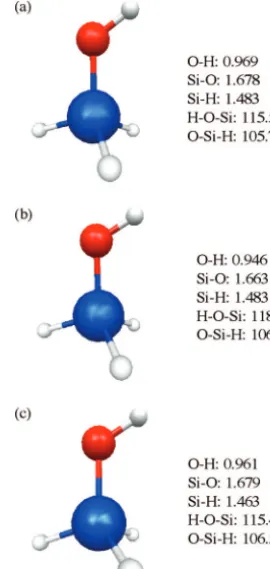
Figure 6. Structures of SiH3OH with (a) MP2/6-31(d), (b) HF/
6-31(d), and (c) UFF. Bond lengths and angles are given adjacent to each structure. Bond lengths in Å.
Figure 7. Structures of Si(OH)4(a) MP2/6-31(d), (b) HF/6-31(d),
and (c) UFF. Bond lengths and angles are given adjacent each structure. Bond lengths in Å.
[image:5.598.47.282.377.436.2]combination of atom types based on the connectivity of the atoms. The UFF energy is given in eq 5.
EUFF)Ebond+Eangle+Etors+Einvers+Eelec+Evdw (5)
The UFF describes the bond stretching term, Ebond, as a
harmonic oscillator
Ebond)kIJ(r-rIJ) 2
(6)
or a Morse function
Ebond)DIJ[e
-R(r-rIJ)2-1]2 (7)
The user may choose the functional form ofEbondthat is best
for their application.
In the bond stretching functions, kIJis the stretching force
constant in kcal mol-1Å-2,r
IJis the equilibrium bond length,
and DIJis the bond dissociation energy. The parameter R is
obtained fromkIJandDIJ R )[k
IJ⁄ 2DIJ] 1⁄2
(8)
The equilibrium bond length is the sum of bond radii para-meters of the two atoms, plus a bond order correction and an electronegativity correction. The bond stretching force constants come from Badger’s rules.27
The angle bending contribution to the energy, Eangle, is a
truncated Fourier expansion, with the equilibrium angle defined by the atom type of the central atom.
For linear, trigonal-planar, and octahedral molecules, the expression is
Eangle(θ)) KIJK
n2 [1
(cos(nθ)] (9)
wherenis determined by the geometry of atom centerJ. For the general nonlinear case,Eangleis
Eangle(θ))KIJK[C0+C1cos(θ)+C2cos(2θ)] (10)
whereθ0is the equilibrium value for the bond angle,C2)1/(4
sin2(θ
0)),C1) -4C2cos(θ0), andC0)C2(2 cos2(θ0)+1). The
angular force constantKIJKis defined by the equilibrium angle
and its connectivity.
The torsional energy contribution,Etors, is represented with
a truncated cosine Fourier expansion
Etors(φ))KIJKL
∑
n)0 mCncos(nφIJKL) (11)
wheren is determined by the geometry of theJ andKatom centers. KIJKL and the Cn coefficients are determined by a
torsional barrier parameter, the periodicity of the torsion, and the equilibrium torsion angle.
The inversion contributions are described by a one- or two-term cosine Fourier expansion
Einvers(ω))KIJKL(C0+C1cos(ωIJKL)+C2cos(2ωIJKL))
(12)
whereKIJKLis the force constant for inversion andωIJKLis the
angle between theILaxis and theIJKplane.
The last two terms in eq 5 represent nonbonded interactions. A Coulomb potential is used to describe the electrostatic interactions
Eelec)QiQj⁄εRij (13)
In this term,εis the dielectric constant (set to 1),QiandQj
are the partial charges on the atom centers, andRijis the distance
between an MM atom center and an EFP atom center or bond midpoint. A Lennard-Jones 6-12 expression is employed for the Van der Waals (vdw) interactions
Evdw)Dij
{
-2[
xij x]
6
+
[
xij x]
12
}
(14)In eq 14, x is the distance between MM atom centers and EFP atom centers, xij is the Van der Waals bond length
parameter, andDijis the well depth parameter.Dijis obtained
from geometric combination rules of atomic Van der Waals energies,Di
Dij)(DiDj) 1⁄2
(15)
xijis obtained from sums of Van der Waals radii,xi:
xij)(xixj) 1⁄2
(16)
In the UFF, the nonbonded terms are excluded for 1,3 and 1,4 interactions, but are included for 1,5 and greater interactions.
II. Interaction Terms
Electrostatics.In the combined EFP-MM method, the MM partial charges interact with partial charges on the EFP expan-sion points. This interaction term is modeled with a Coulomb potential as in the UFF
EElecEFP-MM)QiQj⁄εRij (17)
In this term,εis the dielectric constant (set to 1),Qiis the
[image:6.598.100.225.44.368.2]partial charge on the MM atom centers and Qjis the partial
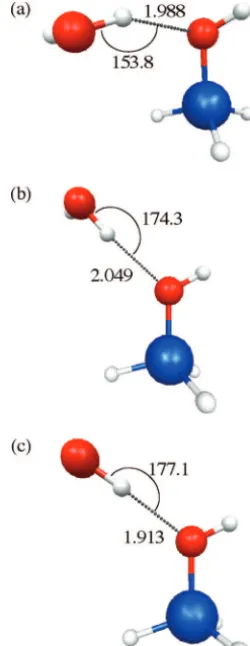
Figure 8. Structures of SiH3OH with 1 water, where the water acts as
the H-bond donor (SiH3OH - D): (a) MP2/6-31G(d), (b) HF for
Si(OH)4and EFP water, and (c) UFF for Si(OH)4 and EFP water.
Hydrogen-bond lengths in Å.
charge on the atom centers or bond midpoints of the EFP fragment, andRijis the distance between an MM atom center
and an EFP atom center or bond midpoint.
Partial charges on the EFP atom centers and bond midpoints are obtained from the DMA.28,29To maintain consistency with
EFPs, partial charges on MM atom centers are also obtained from the DMA. No distance cutoff is used between the MM atoms and the EFPs.
The UFF bond stretching, angle bending, torsion, and in-version parameters were determined without partial charges. In the original UFF implementation, partial charges were obtained using the charge equilibration (QEq) method proposed by Rappe´ and Goddard.30WhenQEqpartial charges are included in the
force field, the relative energies predicted by UFF are not in good agreement with the experimentally determined energies.31
TheQEqmethod was not implemented in GAMESS; instead, it is left up to the user to decide whether and how to obtain partial charges. Two excellent options for obtaining charges are from electrostatic fitting32or the DMA.
Dispersion. Van der Waals interactions between the EFP atoms and the MM atoms can be treated by following the approach used in the UFF force field; that is, by using a Lennard-Jones 6-12 potential, as described in eqs 14-16. For all atoms except for those involved in hydrogen bonds between the MM and EFP regions, the MM and EFP well depth parameters and vdw radii parameters for the interaction term are taken from UFF. The parameters from UFF were developed to model systems of metal oxides; consequently, they perform very poorly for hydrogen-bonded systems as will be demonstrated for the water dimer below. Hydrogen bonding parameters for the EFP-MM interaction term were obtained from the DREIDING force
field, which has same functional form as UFF for nonbonded interactions. These parameters were developed specifically for atoms involved in hydrogen bonds.
Other Terms. The two terms discussed above take into account electrostatic and dispersion interactions between the EFP solvent molecules and the MM region. Other terms to consider include polarization, charge transfer, and exchange repulsion. The most serious problem with the intermolecular interactions in typical force fields, such as UFF, is their fixed charge formalism. This formalism makes it difficult to treat the di-pole-induced-dipole (or polarization) effects of polar solvents. Polarization effects are important for an accurate description of liquids,33and polarization can contribute as much as 20% of
the interaction energy of hydrogen bonding interactions.12There
are two main possibilities for how to model polarization of the EFP atoms by the MM region. In the first, atomic partial charges are allowed to change as the geometry changes throughout the simulation, and in the second, multipoles are included and allowed to polarize each other. The first option is employed in models such as theQEqmethod30or the fluc-q method.34The
second option has been used successfully in EFP and classical force fields,12,35and this approach will be implemented in future
versions of the method discussed here.
The exchange repulsion is a purely quantum mechanical interaction that arises from the overlap of wave functions on different molecules. The short-range repulsion is taken into account to some extent by theR-12term of the Lennard-Jones
potential. Although there is no fundamental theoretical justifica-tion for this term, it does describe repulsion at short range.
III. Energy Gradients
[image:7.598.308.548.40.249.2]The combined total EFP-MM interaction energy gradient was derived with respect to the coordinates of the EFP and MM regions
Figure 9. Structures of SiH3OH with 1 water, where the water acts as
the H-bond acceptor (SiH3OH - A): (a) MP2/6-31G(d), (b) HF for
Si(OH)4and EFP water, and (c) UFF for Si(OH)4 and EFP water.
Hydrogen bond lengths in Å.
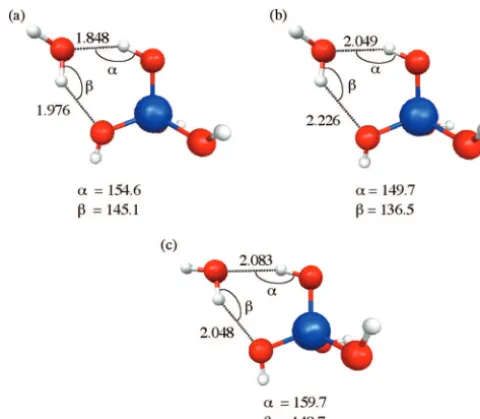
Figure 10. Structures of Si(OH)4with 1 water: (a) MP2/6-31G(d),
(b) HF for Si(OH)4and EFP water, and (c) UFF for Si(OH)4and EFP
water. Hydrogen bond angles given below each structure. Hydrogen bond lengths in Å.
[image:7.598.102.221.46.350.2]dETotal
dfRsolvent
) ∂EEFP dRbsolvent
+ ∂EMM
dfRsolvent
+ ∂EI
dRbsolvent (18)
dETotal
dfRbulk
)∂EEFP dRbbulk
+∂EMM dRbbulk
+ ∂EI
dRbbulk
(19)
whereETotalis the total energy of the combined MM and EFP
system,EEFPis the energy of the EFP region,EMMis the energy
of the MM region, andEIis the interaction energy between the
EFP region and the MM region.RsolventandRbulkrefer to the
atomic coordinates of the EFP atoms and the MM atoms, respectively. The internal geometries of the EFPs are fixed, so in a geometry optimization, the EFPs move according to a net force on the center of mass (COM) of each fragment and a net torque around the center of mass of each fragment.12Because
the internal geometry of each fragment is fixed, the internal energy of each EFP is zero, makingEEFPan interaction energy
only. The net force on each fragment is obtained by summing the forces on each expansion point. The torque on a fragment is the cross product of the position vector from the point of rotation to the COM of the fragment and the vector of the net force acting on the fragment. Optimizations described in the next section were performed using the default quadratic ap-proximation36search method in GAMESS.8
IV. EFP-MM Test Calculations
Water Dimer.The ability of the EFP-MM method to treat the water dimer was investigated by comparison with full MP2,37
HF, and EFP structures. The basis set used for the ab initio waters was the Dunning Hay basis set with d and p polarization functions.38 All EFP waters are modeled with the HF based
EFP1 method. In EFP1, the geometry of each EFP fragment is chosen to have an OH bond length of 0.9572 Å and an HOH bond angle of 104.52°.12Each EFP has five expansion points
located on the atom centers and bond midpoints.
The EFP-MM method was first tested on the water dimer to gauge the ability of the method to treat hydrogen bonding. As a baseline for comparison, full MP2/DH(d,p) and HF/DH(d,p) optimizations were performed on the water dimer. Their geometries are shown in Figure 2. The MP2 structure in Figure 2a has an H-bond length of 1.945 Å and an O-H· · ·O bond angle of 174.2°. The HF geometry in Figure 2b has an H-bond length of 2.040 Å and an O-H· · ·O bond angle of 177.8°. Figure 3 shows the structure of an all-EFP water dimer. The H-bond length for this method is 2.047 Å, and its bond angle is 176.6°, in good agreement with the HF results.
When a full MM optimization of water dimer was performed using vdw parameters from UFF, the shape of the water dimer is badly distorted (Figure 4a). The H-bond length is 2.503 Å, which is elongated by 0.558 Å relative to the MP2 value. The H-bond angle is also distorted by 62.3°. The vdw parameters for O and H in UFF were parametrized for metal oxide systems, so it is not surprising that they perform poorly for hydrogen bonding systems. The precursor to UFF was the DREIDING force field (DFF),39and the functional form for its nonbonded
terms is the same as that in the UFF. The DFF has special vdw parameters for atoms involved in hydrogen bonds, and when these are used, the UFF is able to more accurately represent the geometry of the water dimer, as shown in Figure 4b,c. While the H-bond angle of 175.4° in Figure 4b is reasonable, the hydrogen bond length is still not acceptable, as it is 0.294 Å shorter than the MP2 H-bond length. This occurs because the vdw parameters in the Dreiding FF were parametrized with
Gasteiger charges40and the structure in Figure 4b used charges
from ab initio calculations. When a more consistent set of parameters is employed, using the Gasteiger charges, the structure is shown in Figure 4c is obtained, with a reasonable H-bond length of 1.795 Å.
Since the two water molecules in the water dimer are not equivalent, the mixed EFP-MM method must be tested for two cases: In the first case, the water acting as the H-bond donor is replaced by an EFP water, and in the second case, the water acting as the H-bond acceptor is replaced by an EFP water. Charges on the MM region were obtained from the DMA in a separate calculation using the DH(d,p) basis set. The resulting geometries are shown in Figure 5. In Figure 5a, the EFP water is the H-bond donor and the MM water is the H-bond acceptor, and vice versa for Figure 5b. In both of these cases, the structure of the water dimer is qualitatively reproduced. In Figure 5a, the H-bond length is 0.062 Å shorter and the bond angle is only 3.6°larger than the MP2 values. In Figure 5b, the H-bond length is 0.096 Å shorter and the angle is 1.6° larger than the MP2 values. Not surprisingly, the EFP-MM H-bond length is the average of the H-bond lengths in the full MM structure (Figure 4b) and the full EFP structure (Figure 3).
SiH3OH and Si(OH)4.The EFP-MM method was next tested
on hydrogen-bonded complexes between water and SiH3OH and
Si(OH)4. The hydrogen-bonded SiOH-(H20)nspecies are known
to exist in mesoporous silica nanoparticles.41The silica clusters
were treated with MM, and the waters were treated with the HF-based EFP1 method. Charges on the MM atoms were obtained from the DMA in a separate calculation using the 6-311+G(d) basis set.
The EFP-MM geometries are compared to full ab initio MP2 calculations with the 6-31G(d) basis set.42-46The geometries
are also compared to ab initio HF calculations on SiH3OH and
Si(OH)4with one EFP1/HF water molecule. The basis set used
for the HF calculations was also 6-31G(d). Density functional theory (DFT) calculations by Thompson and Margey (TM),47
which used Becke’s three parameter Lee-Yang-Parr hybrid functional (B3LYP)48-50and the 6-311+G(d) basis set,51-53
were used as the starting structure for all calculations. The MP2, HF, and MM geometries of SiH3OH and Si(OH)4
are shown in Figures 6 and 7, respectively. Both HF and UFF are able to reasonably reproduce the MP2 bond lengths and angles in these molecules. The geometries of SiH3OH plus one
water molecule are shown in Figures 8 and 9. When the water molecule acts as the hydrogen bond donor, the EFP-MM hydrogen bond length for the EFP-MM method is 1.913 Å (Figure 8c), in good agreement with the MP2 values. The O-H· · ·O bond angle is 177.1°, 23.3°larger than the MP2 value (Figure 8a), but only 2.8°larger than the HF value with an EFP water (Figure 8b). The latter is a more appropriate comparison, since the EFP1/HF method is derived from HF.
[image:8.598.308.546.64.121.2]When the silanol acts as the H-bond donor (Figure 9), the H-bond for the EFP-MM length is 0.062 Å longer than the
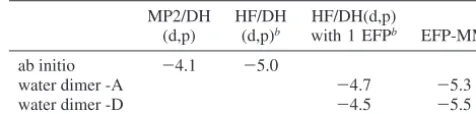
TABLE 1: Interaction Energies in Kcal/Mol for Water Dimera MP2/DH (d,p) HF/DH (d,p)b HF/DH(d,p)
with 1 EFPb EFP-MM
ab initio -4.1 -5.0
water dimer -A -4.7 -5.3 water dimer -D -4.5 -5.5
aIn water dimer - A, the EFP water is the H-bond acceptor, and
in water dimer - D, the EFP water is the H-bond donor.bFrom Day
et al.
H-bond length obtained with the HF silanolsEFP water
combination (Figure 9b). The EFP-MM H-bond angle (Figure 9c) is somewhat smaller than those predicted by HF-EFP (Figure 8b) and MP2 (Figure 8a). This is not surprising, as an all EFP2 calculation found the angle to be 127.5°, placing the EFP-MM angle in between the full EFP and the ab initio value.
The structures of Si(OH)4plus one water are shown in Figure
10. In this case, the Si(OH)4molecule acts as both a hydrogen
bond donor and a hydrogen bond acceptor forming a pseudo six-centered ring with the water molecule. Neither H-bond is close to being linear. The EFP-MM method gives H-bond distances that are somewhat elongated compared with the MP2 structures. The EFP-MM angles are within 4% of the MP2 angles; hence, they are in reasonable agreement. In general, the EFP-MM errors relative to MP2 are less than 13%. This is comparable to 12% for Hartree-Fock relative to MP2. Although the agreement between the EFP-MM and the other methods is not quantitative, it is reasonable.
Interaction Energies.The interaction energies for the two types of EFP-MM water dimers are compared in Table 1 with interaction energies from full HF12 and MP2 calculations,
as well as calculations with one HF water and one EFP water.12The first two columns give interaction energies for
fully quantum water dimers. The third column gives the interaction energy between an HF water and an EFP water, and the fourth column gives the interaction energy for an MM water with an EFP water. The EFP-MM interaction energies for water dimer are both within 0.5 kcal/mol of the HF baseline interaction energies.
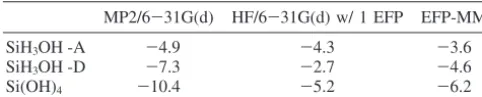
Table 2 gives the interaction energies for Si(OH)4 and
SiH3OH with an EFP water molecule at the equilibrium
geometries. For SiH3OH, with the water molecule acting as the
H-bond acceptor, the interaction energy is underestimated by 0.7 kcal/mol when compared with the HF-EFP value. For SiH3OH, with the water molecule acting as the H-bond donor,
the interaction energy is overestimated by 1.9 kcal/mol compared with the HF-EFP result. Not surprisingly, MP2 predicts much stronger binding than do the HF-based methods. In Table 2, both the fully MP2 and EFP-MM methods show that the SiH3OH - A is lower in energy than the SiH3OH - D isomer. Hence, the EFP-MM method is able to reproduce the MP2 relative energies of the two SiH3OH isomers, whereas the
HF-EFP method does not.
The last row of Table 2 gives the interaction energies of Si(OH)4 with an EFP water. The EFP-MM and HF-EFP
interaction energies are in good agreement with each other (within 1.0 kcal/mol), while MP2 again predicts much stronger binding. It is worth noting that correlated methods with a modest basis set will suffer from significant basis set superposition error (BSSE),54leading to overbinding, whereas neither MM nor EFP
is subject to BSSE problems.
V. Conclusions
A method for modeling the interaction between EFP sol-vent molecules and atoms described by a molecular
mechan-ics force field has been defined and implemented into the GAMESS electronic structure program. The interaction terms are similar to those in the universal force field, with partial charges from Stone’s DMA. This method was able to re-produce the geometry of water dimer as well as the geometry of hydrogen-bonded systems of SiH3OH and Si(OH)4with
an EFP water. Interaction energies from the EFP-MM method are within 2 kcal/mol of the interaction energies predicted by the HF-EFP method. The MP2 interaction energies are not well-reproduced, but this is due in part to MP2 overbind-ing due to an expected BSSE error. In order to improve the accuracy of the EMP-MM interaction energies, the functional form of the interaction term needs to be improved. The first step in doing this is to add polarization to the system to account for the dipole-induced-dipole effects of polar solvent molecules.
Acknowledgment.This work has been supported by a grant from the U.S. Department of Energy, administered by the Ames Laboratory. The authors also acknowledge Professor Jan Jensen and Drs. Mike Schmidt and Lyuda Slipchenko for many helpful discussions.
References and Notes
(1) Huh, S.; Chen, H.-T.; Wiench, J. W.; Pruski, M.; Lin, V.S.-Y.J. Am. Chem. Soc.2004,126, 1010.
(2) Mbaraka, I. K.; Radu, D. R.; Lin, V.S.-Y.; Shanks, B. H.J. Catal. 2003,219, 329.
(3) Lin, V.S.-Y.; Radu, D. R.; Han, Mi.-K.; Deng, W.; Kuroki, S.; Shanks, B. H.; Pruski, M.J. Am. Chem. Soc.2002,124, 9040.
(4) Chen, H.-T.; Huh, S.; Wiench, J. W.; Pruski, M.; Lin, VS.-Y.J. Am. Chem. Soc.2005,127, 13305.
(5) Lin, VS.-Y.; Nieweg, J. A.; Kern, C.; Trewyn, B. G.; Wiench, J. W.; Pruski, M.Prepr. Symp. Am. Chem. Soc., DiV. Fuel Chem.2006,51, 426. (6) Cai, Y.; Kumar, R.; Huang, W.; Trewyn, B. G.; Wiench, J. W.; Pruski, M.; Lin, V. S.-Y.J. Phys. Chem. C2007,111, 1480.
(7) Zorn, D.; Lin, V. S.-Y.; Pruski, M.; Gordon, M. in preparation. (8) Schmidt, M. W.; Baldridge, K. K.; Boatz, J. A.; Elbert, S. T.; Gordon, M. S.; Jensen, J. H.; Koseki, S.; Matsunaga, N.; Nguyen, K. A.; Su, S. J.; Windus, T. L.; Dupuis, M.; Montgomery, J. A.J. Comput. Chem. 1993,14, 1347.
(9) Schmidt, M. W.; Gordon, M. S. InTheory and Applications of Computational Chemistry: The First Forty Years; Dykstra, C. E.; Frenking, G.; Kim, K. S.; Scuseria, G. E., Eds.; Elsevier: London, 2005.
(10) Shoemaker, J. R.; Burggraf, L. W.; Gordon, M. S.J. Phys. Chem. A1999,103, 3245.
(11) Gordon, M. S.; Freitag, M.; Bandyopadhyay, P.; Jensen, J. H.; Kairys, V.; Stevens, W. J.J. Phys. Chem. A2001,105, 293.
(12) Day, P. N.; Jensen, J. H.; Gordon, M. S.; Webb, S. P.; Stevens, W. J.; Kraus, M.; Garmer, D.; Basch, H.; Cohen, D.J. Chem. Phys.1996, 105, 1968.
(13) Freitag, M. A.; Gordon, M. S.; Jensen, J. H.; Stevens, W. A. J. Chem. Phys.2000,112, 7300.
(14) Slipchenko, L. V.; Gordon, M. S.J. Comput. Chem.2007,28, 276. (15) Adamovic, I.; Freitag, M. A.; Gordon, M. S.J. Chem. Phys.2003, 118, 6725.
(16) Netzloff, H. M.; Gordon, M. S.J. Chem. Phys.2004,121, 2711. (Please note that the MP2 based EFP1 method for calculations with EFPs only is available in GAMESS, although it is not shown in the current GAMESS documentation).
(17) Nemukhin, A. V.; Grigorenko, B. L.; Bochenkova, A. V.; Topol, I. A.; Burt, S. K.THEOCHEM2002,581, 167.
(18) Kundrot, C. E.; Ponder, J. W.; Richards, F. M.J. Comput. Chem. 1991,12, 402.
(19) Ponder, J. W.; Richards, F. M.J. Comput. Chem.1987,8, 1016. (20) Kaminski, G. A.; Friesner, R. A.; Tirado-Rives, J.; Jorgensen, W. L. J. Phys. Chem. B2001,105, 6474.
(21) Aikens, C. M.; Gordon, M. S.J. Am. Chem. Soc.,2006,128, 12835. (22) Mullin, J. M.; Gordon, M. G. In preparation.
(23) Rappe, A. K.; Casewit, C. J.; Colwell, K. S.; Goddard, W. A., III.; Skiff, W. M.J. Am. Chem. Soc.1992,114, 10024.
(24) Casewit, C. J.; Colwell, K. S.; Rappe, A. K.J. Am. Chem. Soc 1992,114, 10035.
[image:9.598.43.284.74.122.2](25) Rappe, A. K.; Casewit, C. J.; Colwell, K. S.; Goddard, W. A., III.; Skiff, W. M.J. Am. Chem. Soc.1992,114, 10024.
TABLE 2: Interaction Energies in Kcal/Mol for Si(OH)4 and SiH3OH with an EFP Water Molecule at the Equilibrium Geometriesa
MP2/6-31G(d) HF/6-31G(d) w/ 1 EFP EFP-MM
SiH3OH -A -4.9 -4.3 -3.6
SiH3OH -D -7.3 -2.7 -4.6
Si(OH)4 -10.4 -5.2 -6.2
aIn water dimer - A, the EFP water is the H-bond acceptor, and
in water dimer - D, the EFP water is the H-bond donor.
(26) Casewit, C. J.; Colwell, K. S.; Rappe, A. K.J. Am. Chem. Soc. 1992,114, 10046.
(27) (a) Badger, R. M.J. Chem. Phys.1934,2, 2128. (b) Badger, R. M. J. Chem. Phys.1935,3, 710. (c) Pearson, R. G.J. Am. Chem. Soc.1977, 99, 4869. (d) Ohwada, K.J. Chem. Phys.1980,72, 1. (e) Ohwada, K. J. Chem. Phys.1980,72, 3663. (f) Ohwada, K.J. Chem. Phys.1980,72, 3663. (g) Ohwada, K.J. Chem. Phys.1981,75, 1309. (h) Chang, C.-A.J. Phys. Chem.1983,87, 1694. (i) Barbiric, D. A.; Castro, E. A.; Fernandez, F. M.J. Chem. Phys.1984,80, 289. (j) Ohwada, K.J. Chem. Phys.1984, 80, 1556. (k) Halgren, T. A.J. Am. Chem. Soc.1990,112, 4710.
(28) Stone, A. J.The Theory of Intermolecular Forces; Oxford University Press: Oxford, 1996.
(29) Stone, A.J. Chem. Phys. Lett.1981,83, 233.
(30) Rappe´, A. K.; Goddard, W. A., III.J. Phys. Chem.1991,95, 3358. (31) Gundertofte, K.; Liljefors, T.; Norrby, P.-O.; Pettersson, I.J. Com-put. Chem.1996,17, 4–429.
(32) Spackman, M. A.J. Comput. Chem.1996,17, 1.
(33) Iuchi, S.; Izvekov, S.; Voth, G. A. J. Chem. Phys.2007,126, 124505.
(34) Rick, S. W.; Stuart, S. J.; Berne, B. J.J. Chem. Phys.1994,101, 6141.
(35) Rasmussen, T. D.; Ren, P.; Ponder, J. W.; Jensen, F.Int. J. Quantum Chem.2007,107, 1390.
(36) Culot, P.; Dive, G.; Nguyen, V. H.; Ghuysen, J. M.Theor.Chim. Acta1992,82, 189.
(37) Møller, C.; Plesset, M. S.Phys. ReV.1934,46, 618.
(38) Dunning, T. H., Jr.; Hay, P. J. InMethods of Electronic Structure Theory, Shaefer, H. F., III., Ed.; Plenum: New York, 1977; pp 1-27.
(39) Mayo, S. L.; Olafson, B. D.; Goddard, W. A., III.J. Phys. Chem. 1990,94, 8897.
(40) Gasteiger, J.; Marsili, M.Tetrahedron1980,36, 3219.
(41) Trebosc, J.; Wiench, J. W.; Huh, S.; Lin, V. S.- Y.; Pruski, M. J. Am. Chem. Soc.2005,127, 3057.
(42) Hehre, W. J.; Ditchfield, R.; Pople, J. A.J. Chem. Phys.1972,56, 2257.
(43) Francl, M. M.; Pietro, W. J.; Hehre, W. J.; Binkley, J. S.; Gordon, M. S.; Defrees, D. J.; Pople, J. A.J. Chem. Phys.1982,77, 3654.
(44) Hariharan, P. C.; Pople, J. A.Theor. Chim. Acta1973,28, 213. (45) Clark, T.; Chandrasekhar, J.; Spitznagel, G. W.; Schleyer, P. v. R. J. Comput. Chem.1983,4, 294.
(46) Frisch, M. J.; Pople, J. A.; Binkley, J. S.J. Chem. Phys.1984,80, 3265.
(47) Thompson, K. C.; Margey, P.Phys. Chem. Chem. Phys.2003,5, 2970.
(48) Becke, A. D.J. Chem. Phys.1993,98, 5648.
(49) Lee, C.; Yang, W.; Parr, R. G.Phys. ReV. B1998,37, 785. (50) Vosko, S. H.; Wilk, L.; Nusair, M.Can. J. Phys.1980,58, 1200. (51) Krishnan, R.; Binkley, J. S.; Seeger, R.; Pople, J. A.J. Chem. Phys. 1980,72, 650.
(52) McLean, A. D.; Chandler, G. S.J. Chem. Phys.1980,72, 5639. (53) Clark, T.; Chandrasekhar, J.; Schleyer, P. v. R.J. Comput. Chem. 1983,4, 294.
(54) Davidson, E. R.; Feller, D.Chem. ReV.1986,86, 681. (55) Liu, B.; McLean, A. D.J. Chem. Phys.1973,59, 4557.
JP8049729