Physics and Astronomy Publications
Physics and Astronomy
7-2009
Statistical mechanical modeling of catalytic
polymerization within surface-functionalized
mesoporous materials
Da-Jiang Liu
Ames Laboratory, [email protected]
Hung-Ting Chen
Iowa State UniversityVictor S.-Y. Lin
Iowa State UniversityJames W. Evans
Iowa State University, [email protected]
Follow this and additional works at:
http://lib.dr.iastate.edu/physastro_pubs
Part of the
Mathematics Commons
, and the
Physical Chemistry Commons
The complete bibliographic information for this item can be found athttp://lib.dr.iastate.edu/physastro_pubs/196. For information on how to cite this item, please visithttp://lib.dr.iastate.edu/howtocite.html.
Statistical mechanical modeling of catalytic polymerization within
surface-functionalized mesoporous materials
Abstract
A discrete lattice model is developed to describe diffusion-mediated polymerization occurring within
mesopores, where reaction is enhanced at catalytic sites distributed within the interior of the pores. Diffusive
transport of monomers and polymers is one-dimensional, diffusion coefficients for the latter decreasing with
polymer length. Kinetic Monte Carlo simulation is utilized to analyze model behavior focusing on a "clogging"
regime, where the amount of polymer within the pores grows. We characterize the evolution of the overall and
mean length of polymers, the mean number of polymers, as well as the polymer spatial and length
distributions.
Keywords
Catalytic polymerization, catalytic sites, diffusion coefficients, diffusive transport, discrete lattices,
functionalized, kinetic Monte Carlo simulation, length distributions, mechanical modeling, mesoporous
materials, polymerization
Disciplines
Chemistry | Mathematics | Physical Chemistry
Comments
This article is from
Physical Review E
80 (2009): 011801, doi:
10.1103/PhysRevE.80.011801
. Posted with
permission.
Statistical mechanical modeling of catalytic polymerization within surface-functionalized
mesoporous materials
Da-Jiang Liu,1 Hung-Ting Chen,1,2Victor S.-Y. Lin,1,2and J. W. Evans1,3
1
Ames Laboratory-U.S. DOE, Iowa State University Ames, Iowa 50011, USA 2
Department of Chemistry, Iowa State University, Ames, Iowa 50011, USA 3
Department of Mathematics, Iowa State University, Ames, Iowa 50011, USA
共Received 28 January 2009; revised manuscript received 6 May 2009; published 6 July 2009兲 A discrete lattice model is developed to describe diffusion-mediated polymerization occurring within meso-pores, where reaction is enhanced at catalytic sites distributed within the interior of the pores. Diffusive transport of monomers and polymers is one-dimensional, diffusion coefficients for the latter decreasing with polymer length. Kinetic Monte Carlo simulation is utilized to analyze model behavior focusing on a “clogging” regime, where the amount of polymer within the pores grows. We characterize the evolution of the overall and mean length of polymers, the mean number of polymers, as well as the polymer spatial and length distributions.
DOI:10.1103/PhysRevE.80.011801 PACS number共s兲: 82.35.⫺x, 68.65.⫺k, 82.75.Qt
I. INTRODUCTION
There has been considerable interest for more than one decade in the utilization of mesoporous materials to facilitate production and processing of polymeric materials with de-sired higher-order structures 关1兴, e.g., linear “molecular wires” versus more complex cross-linked networks. Such a capability would avoid the need for post-processing steps often required for traditional polymerization approaches. Mesoporous materials composed of silica or other oxides can be fabricated with hexagonal close-packed arrays of par-allel nanopores and with typical diameters ranging from 2 to 10 nm关2兴. These materials provide supports for polymer-ization catalysts关1兴, where ideally the catalytic sites should be distributed within the pores. Previous studies have utilized mesoporous catalytic materials for the polymerization of ethylene, propylene, methylmethacrylate, lactones, alkynes, 1,4-diethynylbenzene, etc.; the latter forming poly共phenylene butadyiene兲or PPB. See, for example,关1,3–5兴.
One general issue is characterization of the possible “modes of operation” of these nanoscopic reactors or poly-mer processing machines. One might anticipate operation in either extrusion or “clogging” modes depending on the reac-tion condireac-tions, the details of the polymerizareac-tion mechanism, the distribution of catalytic sites, etc. For the polymerization of ethylene using mesoporous silica fibers共MSF兲as the cata-lyst support, polymers were extruded from adjacent pores and then spontaneously agglomerated to produce crystalline polyethylene fibers关6兴. This process is somewhat analogous to biosynthesis of crystalline cellulose through nanopores in a cellular membrane关6,7兴. At the other extreme, the poly-mers could primarily remain within the pores due to various factors such as low mobility or their intrinsic low solubility. In this regime, the polymers clog the pores of the mesopo-rous material which could lead to the fabrication of silica/ functional polymer nanocomposite materials关1兴.
The current modeling study was motivated primarily by experiments demonstrating the successful fabrication of linear molecular wires of PPB encapsulated within a Cu2+-functionalized MCM-41 silica, a mesoporous silica
nanosphere共MSN兲material关5兴. The key to this success was application of a co-condensation procedure 关8兴 which re-sulted in the copper catalyst sites being distributed “homo-geneously” within the pores. In contrast, direct grafting followed by impregnation methods led to catalytic sites dis-tributed on the exterior surface of the nanospheres and partly in the pore interiors near the channel openings. Presumably, for MCM-41 silica functionalized with the co-condensation method, alignment of monomers and the resulting polymers within the pores facilitates development of molecular wires. Under typical reaction conditions in this system, polymers tend to clog the pores rather than be extruded. These experi-ments prompt some fundamental questions and challenges with regard to understanding how the rate and extent of po-lymerization depend on: 共i兲the amount and spatial distribu-tion of catalytic sites, 共ii兲the diffusion rate and spatial dis-tribution of monomers, and共iii兲the diffusivity of polymers. Since the transport of monomers and PPB polymers oc-curs inside MCM silica mesopores with a small diameter of 2.5 nm in these experiments 关5兴, one expects that diffusion may exhibit some anomalous features associated with one-dimensional 共1D兲 or “single-file” systems. Issues pertaining to anomalous transport, particularly microporous zeolite ma-terials, have been studied extensively both from applied and from fundamental statistical mechanical perspectives关9–12兴. However, for the polymerization process of interest here, there is a broader and more substantial challenge of elucidat-ing the interplay between one-dimensional transport and the reaction kinetics 关13–15兴. To make some progress in this direction, it is appropriate to first consider somewhat ideal-ized models for the process of interest. These models must incorporate the one-dimensional transport of monomers and polymers within pores, an appropriate distribution of cata-lytic sites within pores, and the catalyzed polymerization kinetics. They should predict the resulting polymer length and location distributions and related quantities. For conve-nience, we shall implement these processes in a discretized lattice model where cooperative reaction-diffusion behavior can be readily analyzed via kinetic Monte Carlo 共KMC兲 simulation 关16–18兴.
PHYSICAL REVIEW E80, 011801共2009兲
In Sec. II, we describe in detail our discrete model for polymerization. A variety of simulation results are presented in Sec. III for the diffusion-limited polymerization regime. We focus on dependence of the total amount of polymeriza-tion on the monomer input rate in Sec.III A, the dynamics of growth of the average polymer length in Sec.III B, and on the complete polymer length distribution in Sec. III C. Se-lected results for other regimes and different model param-eters are presented in the Sec. IV. Finally, conclusions are provided in Sec.V.
II. LATTICE-GAS MODEL FOR POLYMERIZATION
A. Model spatial structure
Our selection of model parameters is partly guided by the polymerization of PPB within Cu2+-functionalized MCM-41 silica关5兴. Here, the pore diameter isd⬃2.5 nm and the pore length is of the order of L⬃200 nm. The catalytic sites are distributed along the interior of the pore with a mean sepa-ration of lc⬃10 nm. The monomer is lm⬃1.03 nm long 共and⬃0.5 nm wide兲. Given that the monomer length,lm, is
significantly smaller than the other characteristic length scales 共lc and L兲, it is natural to utilize a lattice-gas model
framework where each monomer occupies a single site on a linear one-dimensional lattice within each mesopore. Poly-mer segments within each pore occupy multiple adjacent sites on this lattice. We treat diffusion of monomers and polymer segments within the pore as one dimensional, in-volving hopping between adjacent sites on this linear lattice
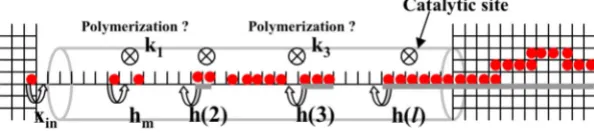
共see below兲. This lattice can be regarded as expanding to a three-dimensional共3D兲structure outside of the pore to allow description of the monomer distribution and polymer con-figurations in the surrounding fluid. However, the key model dynamics will occur on the 1D lattice within the pore. We will augment this dynamics with a simplified description of monomer input from the fluid. We could also account in a simple way for the effect of any reduced polymer solubility outside共relative to within兲the pore which would inhibit ex-trusion and for the greater configurational entropy of poly-mers outside the pore which might enhance extrusion 共see Fig.1兲.
B. Model dynamics
In this modeling, we will assume the same solubility within and outside the pore for monomer and polymer spe-cies. In this case, the key components of the model dynamics are as follows:
共i兲Monomer input to the pore. Monomers are assumed to be randomly distributed in solution outside of the meso-porous silica nanospheres including on the sites adjacent to the ends of the pore, provided that such sites are not
occu-pied by a partly extruded polymer chain 共cf. the right pore end in Fig.1兲. Population of these end sites provides a source of monomers to the interior of the pore. We assume a con-stant rate of input,xin, of monomers to empty sites just inside
the pore, where xin is proportional to the above exterior monomer population.
共ii兲 Monomer diffusion. Monomers undergo diffusive hopping to adjacent sites on the linear lattice within the pore at ratehm, provided those sites are not occupied by another
monomer or part of a polymer. The ratehmalso applies for
hopping from the end sites within the pore to the sites im-mediately outside the pore, for which the reverse process is controlled by the rate xin.
共iii兲 Polymer diffusion. Once polymers of length l are formed 共see below兲 which reside within the pore, they hop diffusively, shifting their position by one site 共to the left or right兲at rateh共l兲. In general, one expects reduced diffusivity with increasing polymer length, i.e., h共l兲 decreases with in-creasing l. This feature will significantly reduce the rate of extrusion of polymers from the pore. In the current model-ing, we will assume thath共l兲=hm/ln, where we treat共integer兲 nas a free parameter and assess how polymerization kinetics depends on its value. Furthermore, we will also apply this rate when one end of the polymer is outside the pore. How-ever, polymers completely outside the pore cannot re-enter. Analyses of polymer diffusion in random porous media
关19,20兴predict size scaling of the diffusion coefficient with a variety of values of n depending on the detailed dynamics. Results can deviate from the simple Rouse-like behavior,
h共l兲⬃l−1, orh共l兲−1.8if hydrodynamics plays a role. Polymer diffusion behavior in confined mesopore environments is not fully characterized. It is plausible that interaction with the mesopore could produce a complexldependence ofh共l兲 关21兴 and that concerted many-particle diffusive dynamics could be present关22兴. However, such possibilities are not included in our modeling.
共iv兲Polymerization. When two monomers sit on an adja-cent pair of sites directly below a catalytic site, polymeriza-tion to form a dimer occurs at rate k1. Likewise, when a
monomer and the end of a dimer or longer polymer are on adjacent sites below a catalytic site, polymerization occurs at ratek2. When the ends of two polymers are on adjacent sites
below a catalytic site, further polymerization occurs at rate
k3. In the benchmark studies in this work, we consider only
the special casek1=k2=k3共=k, say兲and focus on the regime
k→⬁, i.e., rapid polymerization occurring immediately monomers and/or the ends of polymers reach adjacent sites below catalytic sites. This corresponds to the regime of diffusion-limited polymerization.
[image:4.609.51.348.72.138.2]Finally, we offer some additional comments related to polymer nanoextrusion. Once polymers are formed within the pore, they continue to diffuse and thus can potentially
FIG. 1. 共Color online兲 Schematic of lattice-gas model for polymerization within a mesopore indicating both transport and reaction kinetics.
LIUet al. PHYSICAL REVIEW E80, 011801共2009兲
leave the pore. However, any continued polymerization for a polymer partly outside the pore would increase its length and further reduce its diffusivity. In the benchmark simulations in this work, we regard a polymer of any lengthlⱖ2 as remain-ing perfectly linear when it partly exits the pore and assign equal hop rates ofh共l兲for hopping further out of the pore or back into the pore. In fact, PPB polymers are quite stiff so that this is a reasonable assumption. Once the polymer com-pletely exits the pore, we propose that it cannot return due to orientational misalignment. When a polymer is partly out of the pore, it blocks the site adjacent to the end of the pore from being populated by a monomer and thus blocks mono-mer input to that end of the pore.
More generally, one might expect that the partly extruded portion of the polymer in the fluid has greater configurational entropy then the portion which is configurationally con-strained inside the pore. Then, there is an entropic driving force for extrusion. Rather than incorporate a detailed treat-ment of polymer configurations in the fluid, one could adopt simple Markov model, where the probability for a bend in the portion of the polymer in the fluid equals p 共per site兲. One might further assume that if such a bend occurs at the site in the fluid adjacent to the end of the pore, then diffusive hopping of the polymer back into the pore is blocked. Thus, for a partly extruded polymer, the probability of hopping back into the pore would be reduced to 1 −prelative to that for hopping further out, so its dynamics would be described by biased diffusion on a linear lattice. However, below we set p= 0 共unbiased diffusion兲. Again the justification is that PPB polymers are quite stiff. The propensity for clogging of pores in this system also indicates the lack of a strong driv-ing force for extrusion.
The model dynamics is analyzed by the lattice-gas KMC simulation approach. The algorithm is a combination of the standard method and the n-fold rejection-free method to reach a balance between algorithmic efficiency and book-keeping overhead cost. Results presented in the following sections are obtained from extensive simulation data. Typi-cally, each data point is the average over 104KMC runs, thus the statistical uncertainty is around 1%, assuming normal distributions. The quality of the data is also evidenced by the smooth curves interpolating data points.
III. DIFFUSION-LIMITED POLYMERIZATION: SIMULATION RESULTS
In this section, we consider exclusively the case of diffusion-limited polymerization with k=⬁. We set hm= 1
which in effect takes the characteristic time for monomer hopping,m= 1/hm共=1兲, as our unit of time.共This time unit
corresponds to the physical time for the mean-square dis-placement of a diffusing monomer to equal the square of length of the monomer.兲The monomer length,lm, is taken as
our unit of length and the length of the pores is chosen as
L= 200 共unless stated otherwise兲. There are on average 20 catalytic sites randomly distributed within the pore, so their average separation is lc⬇10. The exponent describing the
decrease in polymer diffusivity with increasing length is
varied from n= 1 ton= 4. Note that in the absence of poly-merization, the equilibrium concentration per site of mono-mers within the pore would equal ceq=xin/共hm+xin兲
⬇xin/hm for small xin 共so that ceq⬇xin for xinⰆ1 choosing
hm= 1兲. This result reflects a balance between the input rate
of monomers to the end site within the pore,xin共1 −ceq兲, with
the exit ratehmceq.
For the typical choices ofxinused in our study of 0.01 or
above, the polymerization process is found to operate essen-tially in a clogging regime where the amount of polymer within the pore slowly increases. Evolution with reaction time of the polymer and monomer distributions within an ensemble of pores is shown in Fig. 2 for various n= 1 – 4. Each frame in the figure is a composite plot of simulation results for 27 separate pores. These are combined into a single image representative of an array of pores within an MSN or MCM-41 material. In all cases, there is a tendency for polymers to form near the ends of the pore since initially, the monomer density is higher in that region. The formation of polymers blocks additional monomers from reaching the interior of the pore, so the monomer density in that interior region will decrease. As reaction time increases, smaller polymers aggregate into larger ones, with polymer growth continues to be fed by input of monomers at the ends of the pore. In this work, we will focus on the distribution of poly-mers within the pore rather than extrusion of polypoly-mers which tends to be minimal and transient. However, we should note that extrusion becomes more significant at least in the initial stages of the process, especially when larger polymers are more mobile 共n= 1兲and for very smallxin.
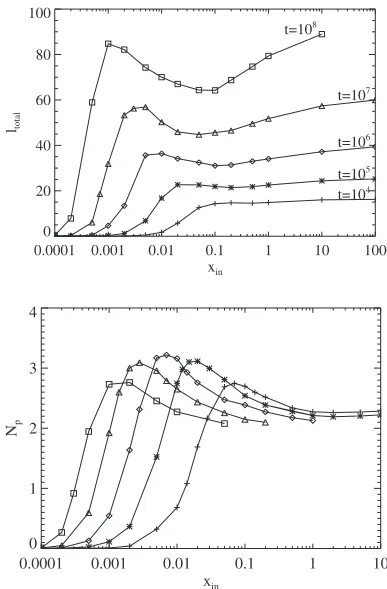
A. Dependence of polymerization on input rate Figure 3共a兲shows for n= 4 the total length共per pore兲of polymers fully or partially within the pore,ltotal, as a function ofxin. Note thatltotaleffectively measures the total amount of
polymerization. The variation with reaction time of ltotal is
also shown. At least for shorter times, the amount of poly-merization increases monotonically with increasing mono-mer input ratexin. Indeed, after a short transient, but still for early times, the rate of production of new polymers is pro-portional toxin2. However, for long reaction times, the amount of polymerization does not vary monotonically with xin. Above a critical value,xinⴱ, corresponding to the peak in the plot, the total length of polymer decreases with increasingxin
at least for a limited range. Higherxinapparently induces too
rapid clogging which inhibits further polymer growth. Lower
xin allows polymers to form and diffuse deeper inside the
pores, so that a larger number of polymers can more readily form.
Another perspective on the above behavior comes from consideration of the dependence onxinof average number of polymers that remain in each pore,Np, after certain reaction
time关see Fig.3共b兲兴. For smallxin, the number is low so that
most of the pores are unoccupied. For large xin, most of the
pores contain two polymers with locations concentrated near the two ends of the pore. The number of polymers reaches a maximal value around 3 at around xin=xinⴱ corresponding to
the maximum in the amount of polymerization in Fig.3共a兲.
STATISTICAL MECHANICAL MODELING OF CATALYTIC… PHYSICAL REVIEW E80, 011801共2009兲
Finally, we contrast behavior described above for n= 4 with that for n= 1 where longer polymers are far more mo-bile. Results in Fig. 4 show that for the latter共n= 1兲, there still appears a peak at somexinⴱ in the mean number of poly-mers per pore versus input rate共shifted to somewhat higher
xin compared to n= 4兲. However, no peak is evident in the total polymer length in the simulated range of xin共although
there appears a shoulder inltotalnearxinⴱ兲. This is not
surpris-ing as the enhanced mobility of longer monomers共relative to the casen= 4兲reduces the potential for rapid clogging.
B. Dynamics of the mean polymer length
Next, in Fig.5, we show the evolution with reaction time of the average length of polymers, lav, forxin= 0.1. We find
quite good scaling with time of the form lav⬃t␥ for nⱖ2,
where it appears that␥⬇1/共n+ 1兲. Forn= 1, i.e., more mo-bile longer polymers, time evolution is less well described by such scaling and the effective␥appears larger than the above prediction. We now elucidate this behavior.
For largernⱖ2 where longer polymers are relatively im-mobile, one anticipates that most of the increase in total polymer length is associated with monomers aggregating with polymers rather than polymer-polymer aggregation. To analyze this behavior, we consider the regime of moderatexin
and where the density of catalytic sites which is not too high
共conditions discussed further in the Appendix兲. Furthermore, we shall ignore the transient regime where monomers ini-tially enter the pore and polymerization is initiated. Instead, we shall consider the subsequent regime where共i兲a reason-ably long polymer has formed near each end of the pore,共ii兲 the monomer density in the interior region is negligible, and
共iii兲 growth of the polymer is controlled by monomers fed from the exterior reacting with the end of the polymer which is within but typically near the pore opening.
After each polymerization reaction, the end of the long polymer is shifted one site away from a reactive catalytic site. Thereafter, this end of the polymer undergoes a random walk in 1D. Thus, a key issue is how long does it take for the end of the long polymer to return to that catalytic site or to diffuse to a neighboring site共at which time a polymerization reaction will occur with finite probability which we denote byPrx兲. Due to the intrinsic nature of a 1D random walk, the
end of the polymer is actually far more likely to return to the same catalytic site 共after a number of hops satisfying nh ⬃lc兲 rather than to first reach a neighboring catalytic site 共after a number of hops satisfying nh⬃lc2兲 关23–26兴. Even
more relevant for our analysis is that the mean number of hops to reach any catalytic site for the 1D problem satisfies
具nh典⬇lc 关24兴. Next, we assess the probability of reaction,
t=103 t=104
n=1
t=105 t=106t=104 t=105
n=2
t=106 t=107t=104 t=105
n=3
t=106 t=107 [image:6.609.49.353.69.452.2]t=104 t=105
n=4
t=106 t=107FIG. 2. 共Color online兲 Snapshots of polymer distributions within mesopores after various reac-tion times 共shown兲. Blue 共narrower and darker兲 segments indicate polymers and green共wider and lighter兲 segments indicate monomers. The diffu-sion rate for a polymer of lengthlish共l兲=hm/ln, withn= 1, 2, 3, and 4 from top to bottom rows. The monomer intake rate isxin= 0.1.
LIUet al. PHYSICAL REVIEW E80, 011801共2009兲
Prx⬍1, noting that only a finite fraction of sites which are
not blocked by polymers are occupied by monomers. This fractional occupation should scale like ceq⬇xin/hm=xin
which is typically quite small. However, it is also important to recognize that the residence time of the end of the long polymer at the catalytic site, poly= 1/h共l兲, far exceeds the
characteristic time, m= 1/hm= 1, for monomer hopping.
Thus, even ifceqis small, there is usually sufficient time for monomers to reach the catalytic site and react before the polymer hops. As a result, for typical conditions, one has that
Prx⬇1 关27兴.
Since reaction of the end of the polymer chain with a monomer leads to growth of the length of the polymer by unity, based on the above analysis, one concludes that
d
dtlav⬇Prxh共lav兲/具nh典 ⬇hm/关lc共lav兲
n兴, 共1兲
so that
lav⬇ 关共n+ 1兲共Prx/lc兲共hmt兲兴1/共n+1兲⬇ 关共n+ 1兲t/lc兴1/共n+1兲, 共2兲
consistent with␥= 1/共n+ 1兲deduced from the above simula-tion results. More significantly, the result共2兲forlavrecovers the simulated values with small error for largern. One caveat is that this result is not as successful in all parameter re-gimes, an issue discussed further in the Appendix.
Forn= 1, there is significant mobility of larger polymers and thus polymer-polymer coalescence should be enhanced. In the extreme situation where growth of lav is dominated
by polymer-polymer coalescence, one would write d/dtlav
⬃lavh共lav兲/lc since each coalescence event increases the
polymer length by an amount of order lav 共rather than by
unity as for monomer-polymer coalescence兲. This would pro-duce an exponent of␥= 1/nexceeding the above value. Pre-sumably, this explains why the measured effective exponent for n= 1 exceeds␥= 1/2.
C. Polymer length distribution
Next, we consider the behavior of the polymer length dis-tribution, N共l兲, where N共l兲gives the number of polymers of lengthl per pore. Figure6shows the dependence ofN共l兲on the scaling exponent, n, for polymer diffusivity 共at reason-ably long but fixed reaction time and at fixed input rate xin
= 0.1兲. In all cases, the distribution is bimodal. At least for
nⱖ2, the large-size peak reflects the distribution of lengths of the long polymers formed near each end of the pore at least. The small-size peak reflects a distribution of smaller polymers formed mainly in the interior of the pore in the early stages of polymerization. The identification of the larger and smaller size peaks is more ambiguous for n= 1. 0.0001 0.001 0.01 0.1 1 10 100
xin
0 20 40 60 80 100
ltotal
t=104
t=105
t=106
t=107
t=108
0.0001 0.001 0.01 0.1 1 10
xin
0 1 2 3 4
[image:7.609.74.268.65.360.2]Np
FIG. 3. 共a兲 The total length of polymers per pore and 共b兲 the number of polymers per pore, as a function of monomer intake rate, xin. Behavior is shown for different reaction times t. The scaling exponent for polymer diffusivity is n= 4. Data shown are for t = 104共+兲, 105共ⴱ兲, 106共diamonds兲, 107共triangles兲, and 108共squares兲.
0.001 0.01 0.1 1
xin
0 200 400 600 800
ltotal t=10
4
t=105
t=106
t=107
0.001 0.01 0.1 1
xin
0 1 2 3 4
Np t=104
t=105
t=106
[image:7.609.339.531.67.202.2]t=107
FIG. 4. Same as Fig.3, but with polymer diffusion scaling ex-ponentn= 1. Data shown are fort= 104共+兲, 105共ⴱ兲, 106共diamonds兲, and 107共triangles兲.
104 105 106 107
t 10
100 1000
lav
n=1,γ=0.61
n=2,γ=0.37
n=3,γ=0.25
[image:7.609.64.284.562.704.2]n=4,γ=0.20
FIG. 5. Growth of average length of polymers for different size scaling exponents, n, for polymer diffusion forxin= 0.1. Symbols are simulation results and the lines are fit to power behavior t␥. Dotted lines show the predictions of the analytic theory.
STATISTICAL MECHANICAL MODELING OF CATALYTIC… PHYSICAL REVIEW E80, 011801共2009兲
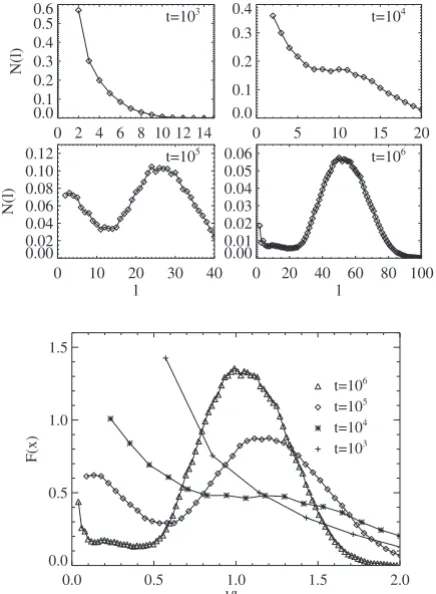
Figure 7共a兲 shows the evolution of the polymer length distribution,N共l兲, with reaction time for fixedn= 2 and fixed
xin= 0.1. One observes the relative growth of the large-size
peak with time and the diminution of the small-size peak as the smaller polymers in the interior of the pore diffuse and coalesce共cf. the discussion above兲. Given the dynamic scal-ing of the average polymer length described above, it is natu-ral to examine a rescaled form, F, of the polymer length distribution defined by N共l兲⬀F共l/lav兲. We choose the nor-malization constant so that兰F共x兲dx= 1. Then, the appropriate choice of lav will ensure that 兰xF共x兲dx= 1. The results in
Fig. 7 indicate that significant deviations from perfect dy-namic scaling, i.e., there is no perfect collapse of curves for different times. This is not surprising since the growth dy-namics of the longer polymers共associated with the large-size peak兲, which primarily control the behavior of lav, is quite distinct from that of the smaller polymers.
Extracting a refined average length from the larger poly-mers in each pore and deconvoluting the large-length peak from the full polymer length distribution produce somewhat better dynamic scaling for the single peak corresponding to the longer polymers. One could consider a simple Markovian master-equation-type description of evolution of this compo-nent of the polymer length distribution due to monomer-polymer aggregation. However, this formulation predicts a strong sharpening in time of the rescaled form of the poly-mer length distribution not observed in the simulations. Thus, a more complex non-Markovian formulation is re-quired to describe this distribution which accounts for the details of the return time distribution for the end of a poly-mer to a catalytic site. This technical analysis will be pre-sented separately.
IV. DEPENDENCE OF POLYMERIZATION KINETICS ON OTHER MODEL PARAMETERS
In this section, we briefly describe the dependence of model behavior on a few basic model parameters such as the pore length, the number or density of catalytic sites, and on a finite共rather than infinite兲microscopic rate,k, for the poly-merization reaction. Polymer length distributions with vary-ing pore lengths are plotted in Fig. 8 after a fixed reaction time. With relatively fast polymer diffusion共nⱕ2兲, behavior of polymer polymerization is somewhat sensitive to the pore length, with longer pores producing more separated bimodal distributions. Note that with longer pores, it takes longer for the system to reach the scaling regime.
One might anticipate that model behavior is relatively in-sensitive to the length of the pores fornⱖ2共keepinglc
con-stant兲since most of the polymerizations occur near the pore openings. This feature is confirmed in Fig.8共b兲which shows the dependence of the polymer length distribution on pore length forn= 4. There is an increase in the small-length peak with increasing pore length due to a larger number of small polymers in the interior of the pore. However, the distribu-tion also quickly converges to a limiting form forL→⬁.
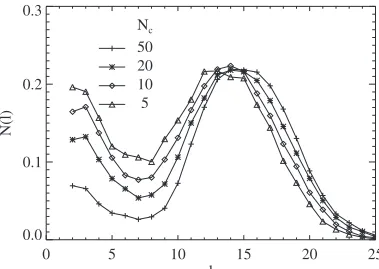
There is also some relatively mild variation of the poly-mer length distribution with the number of catalytic sites. Fewer catalytic sites results in an increase in the relative population of smaller polymers 共see Fig. 9 for the case of
n= 3兲. Typically, shorter polymers are formed in the middle of the pore, while larger polymers are formed at the ends of the pore. With less catalytic sites, more polymers are formed or can diffuse to the middle of the pores, thus increase the proportion of smaller polymers.
Finally, we consider the effect of finite 共rather than infi-nite兲 microscopic rate for polymerization, i.e., we set k1
=k2=k3=k⬍⬁. Results for different k values while fixing
other parameters are shown in Fig. 10共for n= 2; results for other n values are very similar兲. For small values of k, the
0 20 40 60 80 100
0.00 0.01 0.02 0.03 0.04 0.05 0.06 N(l) n=1
0 10 20 30 40 50
0.00 0.02 0.04 0.06 0.08 0.10 0.12 n=2
0 5 10 15 20 25 30
l 0.00 0.05 0.10 0.15 0.20 0.25 N(l) n=3
0 5 10 15 20
l 0.0 0.1 0.2 0.3 0.4 n=4
FIG. 6. Length distribution of polymers for different size scaling exponents,n, for polymer diffusion. The reaction time is 105and the input rate isxin= 0.1.
0 2 4 6 8 10 12 14 0.0 0.1 0.2 0.3 0.4 0.5 0.6 N(l) t=103
0 5 10 15 20
0.0 0.1 0.2 0.3
0.4 t=104
0 10 20 30 40
l 0.00 0.02 0.04 0.06 0.08 0.10 0.12 N(l) t=105
0 20 40 60 80 100
l 0.00 0.01 0.02 0.03 0.04 0.05
0.06 t=106
0.0 0.5 1.0 1.5 2.0
l/lav 0.0 0.5 1.0 1.5 F(x) t=10 3 t=104 t=105 t=106
FIG. 7.共a兲Length distribution of polymers for different reaction timest. The size scaling exponent for polymer diffusion isn= 2 and xin= 0.1.共b兲Scaling function,F, for the polymer length distribution.
LIUet al. PHYSICAL REVIEW E80, 011801共2009兲
[image:8.609.69.274.67.208.2] [image:8.609.64.282.404.701.2]bimodal nature of the polymer length distribution is elimi-nated. This is not surprising since reduced polymerization rate relative to diffusion rates will reduce the tendency to form large polymers, particularly near the openings of the pore. However, it should be noted that a significant change on the polymer length distribution from the case of instanta-neous reaction occurs only for the regimek⬍1.
V. SUMMARY
In this study, we have analyzed both the spatial and tem-poral aspects of polymerization reactions within mesopores.
A lattice-gas model was developed to capture the key fea-tures of this process, while allowing efficient analysis of its behavior through kinetic Monte Carlo simulation. A specific challenge was to analyze the interplay between the one-dimensional transport dynamics for monomers and polymers within the pores and the catalyzed reaction kinetics. Under typical conditions, the system operates in a clogging regime where longer polymers tend to form and grow near the ends of the pores primarily due to monomer-polymer aggregation for nⱖ2. Based on this observation, we are able to develop a successful analytic theory to describe the growth dynamics of the mean polymer length. To this end, we exploited results from the theory of 1D random walks and in particular results for random walks in the presence of traps.
This type of polymerization model is readily amenable to modification to treat a variety of different scenarios and sys-tems. For example, one could drop the constraint of “single-file” diffusion by allowing monomers and polymers to dif-fuse along a small number of parallel coupled linear lattices within the pore 关28兴. This would allow some monomers to bypass polymers and reach the interior of the pore, undoubt-edly significantly impacting the polymerization kinetics.
ACKNOWLEDGMENTS
This work was supported by the Division of Chemical Sciences, Office of Basic Energy Sciences of the U.S. De-partment of Energy 共USDOE兲. It was performed at Ames Laboratory which is operated for the USDOE by Iowa State University under Contract No. DE-AC02-07CH11358.
APPENDIX: GROWTH DYNAMICS OF THE MEAN POLYMER LENGTH
Simulations presented earlier show a t1/共n+1兲 behavior for
average length of polymers that remain inside a pore after reaction time t. Results of a more comprehensive analysis varying both xin and the mean separation between catalytic
sites, lc共but retainingn= 4兲, are shown in Fig. 11.
We now enumerate a few key observations from Fig. 11
in addition to providing some explanations of this behavior:
0 10 20 30 40 50
l 0.00
0.05 0.10 0.15 0.20
N(l)
50 100 200 500 1000 2000 L (a) n=2
0 5 10 15 20 25
l 0.0
0.1 0.2 0.3
N(l)
[image:9.609.76.268.66.353.2]50 100 200 500 1000 2000 L (b) n=4
FIG. 8. Polymer length distribution vs pore lengthL. We choose 共a兲a size scaling exponent ofn= 4, a reaction time oft= 106, and共b兲 a size scaling exponent ofn= 2, a reaction time oft= 105. For both sets of figures, we choose a reaction rate ofk=⬁, an input rate of xin= 0.1, and retain constantlc= 10.
0 5 10 15 20 25
l 0.0
0.1 0.2 0.3
N(
l)
50 20 10 5 Nc
FIG. 9. Polymer length distribution for different numbers of catalytic sites,Nc, within each pore of lengthL= 200. Other param-eters aren= 3, a reaction rate ofk=⬁, a reaction time of 105, and xin= 0.1.
0 10 20 30 40 50
l 0.00
0.05 0.10 0.15 0.20
N(l) k=0.01
k=0.1 k=1 k=10
[image:9.609.341.532.66.203.2]k=∞
FIG. 10. Polymer length distribution for various polymerization rateskof 0.01共pluses兲, 0.1共asterisks兲, 1共diamonds兲, 10共triangles兲, and⬁共squares兲. Other parameters aren= 2, reaction time 105, and xin= 0.05.
STATISTICAL MECHANICAL MODELING OF CATALYTIC… PHYSICAL REVIEW E80, 011801共2009兲
[image:9.609.77.267.557.692.2]共i兲For smallerxin, the regime of “good” temporal scaling
is delayed until much later reaction times. This is readily understood since for smallerxin, one expects that clogging of pores by a longer polymer near the ends and subsequent growth primarily by monomer-polymer aggregation occur much later.
共ii兲There is a fundamental discrepancy between the pre-diction of the analytic theory in Sec.III Cand the simulation results for higher densities of catalytic sites 共i.e., smaller separations,lc兲at least for longer reaction times. Specifically,
values oflavfor differentlcseem to converge at long times.
共iii兲This deviation from the analytic prediction is related to the feature that for high densities of catalytic sites and long times, there is a tendency for the long polymer to be-come partly extruded from the pore. Our analytic treatment did not consider this scenario. In this regime, polymer growth is limited by how often the polymer can diffuse back completely inside the pore, which is independent of the den-sity of catalytic sites.
共iv兲 The case where lc= 1 共i.e., all lattice sites are
cata-lytic兲constitutes an extreme example of the above scenario and deviates from our analytic theory even for short reaction times. Here, a long polymer grows rapidly toward the end of the pore by incorporating every monomer which reaches its end. Thus, very quickly the end of the polymer reaches the end of the pore. Again, the end of the polymer can diffuse out of the pore and one must wait for it to return inside the pore for further growth.
A more detailed analysis of the extreme case lc= 1 is
in-structive. From Fig.11forxin= 0.1, a distinct scaling behav-ior with exponent ␥⬇0.16 is observed forn= 4. To explain this behavior, we assume that Prx⬇1 共i.e., polymer growth
occurs rapidly as soon as the end of the growing polymer is inside the pore兲. Then, after each polymerization event where the end of the polymer is at the end of the pore, there are two possibilities: Either the end of the polymer can diffuse deeper within the pore leading to further polymer growth which quickly returns the end of the polymer to the end of the pore. Alternatively, it can diffuse outside of the pore in which case further growth by at least one monomer only occurs if and when the end of the polymer returns within the end of the pore.共Such return becomes increasingly likely as the polymer grows since the probability of the polymer being completely extruded is given by the reciprocal of its length
关29兴.兲
Considering the one-dimensional random walk of the end of the partly extruded polymer, the average number of re-turns to the end of the pore 共and thus the average length of the polymer兲 should scale like the square root of the total number of hops up to the current time,t 关23,24兴. Thus, one concludes that lav共t兲2should scale like 兰0
t
dt
⬘
h关lav共t⬘
兲兴. Usingh共l兲⬃l−n, we conclude that this integral relation implies the
scaling lav⬃t1/共n+2兲. This behavior is distinct from that
de-scribed in Sec. III B, but consistent with above simulation result forn= 4. We have also confirmed its validity for other
nⱖ2 whenlc= 1.
关1兴K. Tajima and T. Aida, Nanostructured Catalysts 共Plenum, New York, 2003兲.
关2兴J. S. Becket al., J. Am. Chem. Soc. 114, 10834共1992兲. 关3兴M. de Fátima V. Marques, O. F. C. da Silva, A. C. S. L. S.
Coutinho, and A. S. de Araujo, Polym. Bull.共Berlin兲 61, 415 共2008兲.
关4兴F. Márquez, R. Roque-Malherbe, J. Ducongé, and W. del Valle, Surf. Interface Anal. 36, 1060共2004兲.
关5兴V. S.-Y. Lin, D. R. Radu, M.-K. Han, W. Deng, S. Kuroki, B. H. Shanks, and M. Pruski, J. Am. Chem. Soc. 124, 9040
共2002兲.
关6兴K. Kageyama, J. Tamazawa, and T. Aida, Science 285, 2113 共1999兲.
关7兴T. P. Nevell and S. H. Zeronian, Cellulose Chemistry and Its Applications共Ellis Horwood, New York, 1985兲, Chap. 2. 关8兴S. Huh, J. W. Wiench, J.-C. Yoo, M. Pruski, and V. S.-Y. Lin,
Chem. Mater. 15, 4247共2003兲.
关9兴J. Kärger and D. Freude, Chem. Eng. Technol. 25, 769共2002兲. 关10兴L. Lizana and T. Ambjörnsson, Phys. Rev. Lett. 100, 200601
共2008兲.
104 105 106 107
t 10
100
lav
(a) xin=0.01
104 105 106 107
t 10
100
lav
[image:10.609.75.269.63.362.2](b) xin=0.1
FIG. 11. Growth of the average length of polymers that remain inside a pore with the reaction timetforn= 4. Symbols show re-sults for different concentrations of catalytic sites corresponding to average separations oflc= 20共+兲, 10共ⴱ兲, 5共diamonds兲, 2共triangles兲, and 1共squares兲. The monomer intake rates共a兲xin= 0.01 and共b兲0.1. Dotted lines in共b兲are analytic predictions from Eq.共2兲.
LIUet al. PHYSICAL REVIEW E80, 011801共2009兲
关11兴F. Marchesoni and A. Taloni, Phys. Rev. Lett. 97, 106101 共2006兲.
关12兴C. Lutz, M. Kollmann, and C. Bechinger, Phys. Rev. Lett. 93, 026001共2004兲.
关13兴S. V. Nedea, A. P. J. Jansen, J. J. Lukkien, and P. A. J. Hilbers, Phys. Rev. E 65, 066701共2002兲.
关14兴A. P. J. Jansen, S. V. Nedea, and J. J. Lukkien, Phys. Rev. E
67, 036104共2003兲.
关15兴S. V. Nedea, A. P. J. Jansen, J. J. Lukkien, and P. A. J. Hilbers, Phys. Rev. E 67, 046707共2003兲.
关16兴R. M. Ziff, E. Gulari, and Y. Barshad, Phys. Rev. Lett. 56, 2553共1986兲.
关17兴K. A. Fichthorn and W. H. Weinberg, J. Chem. Phys. 95, 1090 共1991兲.
关18兴J. W. Evans, D.-J. Liu, and M. Tammaro, Chaos 12, 131 共2002兲.
关19兴A. Baumgärtner and M. Muthukumar, J. Chem. Phys. 87, 3082共1987兲.
关20兴V. Yamakov and A. Milchev, Phys. Rev. E 55, 1704共1997兲.
关21兴D. Dubbeldam, S. Calero, T. L. M. Maesen, and B. Smit, Phys. Rev. Lett. 90, 245901共2003兲.
关22兴D. S. Sholl and K. A. Fichthorn, Phys. Rev. Lett. 79, 3569 共1997兲.
关23兴B. D. Hughes,Random Walks and Random Environments Vol. 1: Random Walks共Clarendon, Oxford, 1995兲.
关24兴E. W. Montroll and G. H. Weiss, J. Math. Phys. 6, 167共1965兲. 关25兴K. E. Shuler, H. Silver, and K. Lindenberg, J. Stat. Phys. 15,
393共1976兲.
关26兴The preference to return to the same trap in a periodic array of traps would be diminished in higher dimensions.
关27兴A more detailed analysis estimates the probability of no re-action while the end of the polymer is at the catalytic site as 1 −Prx=共1 −ceq兲poly/m.
关28兴E. B. Stukalin and A. B. Kolomeisky, J. Chem. Phys. 124, 204901共2006兲.
关29兴D.-J. Liu and J. W. Evans, Phys. Rev. B 66, 165407共2002兲. The stated result follows from the analysis in the Appendix of a 1D random walk between traps.
STATISTICAL MECHANICAL MODELING OF CATALYTIC… PHYSICAL REVIEW E80, 011801共2009兲