Abstract
In this article we discuss some of the Boost libraries that were introduced in Part I. The goal of Part I was to categorise and give a global overview of the most important Boost libraries. It was written to give some directions on the usefulness of the libraries in a given context. The goal of the current article is to focus on a number of libraries that in our opinion help promote the flexibility, functionality and performance of C++ applications. We introduce these libraries and we give some examples to illustrate their applicability.
Keywords
Boost, multi-paradigm programming, C++, option pricing, software design
1 Some Views on Software Development
We begin our discussion with remarks on some of the technical problems that confront developers when they wish to implement flexible and main-tainable software systems. The discussion is highly simplified and some-what subjective but it does discuss a number of high-level problems that most developers (and project managers) find challenging. Some of the major problems are:
• Problem 1: Modern object-oriented software systems tend to be implemented in a bottom-up manner. The resulting object network consists of tightly-coupled modules that are very difficult to modify and to extend. Furthermore, it is usually very difficult to use a sub-set of the functionality precisely because each module is directly or indirectly connected to every other module. In graph theory, we can say that the object network has approximately one connected component.
• Problem 2: C++ — in contrast to Fortran — has relatively few de-facto standard libraries and supporting software tools for scientific, finan-cial and engineering applications. This state of affairs has persisted well into the twenty-first century.
• Problem 3: C++ is a multi-paradigm language but many developers still tend to create applications based on large and deep class hierar-chies that become unstable as more functionality is added to them. Developers seem to be less comfortable with the generic programming model that C++ supports using templates. Anecdotal evidence suggests that fifty percent of quant developers are familiar with C++ but only twelve percent use the containers and algorithms from the Standard Library.
• Problem 4: C++ is a systems programming language. Of course, it is used to develop application software but the maintainability costs are rela-tively high. In particular, the fact that C++ does not support interfaces as
Daniel J. Duffy
Datasim Education BV, e-mail: [email protected]
first-class objects severely restricts our ability to design and implement loosely-coupled software based on system decomposition techniques.
We now address some of these problems and we attempt to resolve them by using C++ in combination with design patterns and appropriate Boost libraries.
2 C++ Status Report: Multi-Paradigm Programming
Language
C++ is a popular language and it allows developers to create flexible appli-cations by encapsulating domain entities in classes. Furthermore, we can create complex classes from simpler ones using the Composition, Aggregation
and Inheritance mechanisms. In general, these are client-server relationships between one class (the client) that uses the services of one or more other classes (called server classes) by calling their member functions. This situation leads to an Object Connection Architecture (OCA) because all inter-module connections are from object to object. The major disadvantage is that all modules and classes must be built before the architecture is defined and hence this approach can-not be used to lay out the plan for a software system. This is in contrast to an
Interface Connection Architecture (ICA) that defines all connections between com-ponents of a system using only the interfaces. Interfaces need to specify both
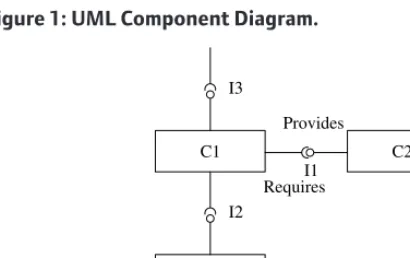
provided and required features. In general, a feature is a computational element of a component, for example a function, port or action. For a detailed intro-duction to object and interface connection architectures, see Leavens 2000. The crucial issue is to implement provides and requires interfaces in C++. To this end, we use the Boost Function library to implement provides interfaces and the Boost Signals library to implement requires interfaces. Before we go into the details we describe these interfaces using standard UML componentdiagrams, an example of which is shown in Figure 1. In this case component C1 provides the interface I3 to potential clients and it has the requires interfaces I1 and I2 from server components C2 and C3, respec-tively. In other words, C1 offers services but it also requires services from other server components.
^
TECHNICAL PAPER
{
mySignal.disconnect(&slot); }
};
We now customise this class in different ways. In particular, we can implement the data source as a global C function, a function object, a class’ member func-tion or even a lambda funcfunc-tion using the features in the new C++ standard. In general, this level of customisability is realised by the appropriate use of the Boost libraries that support higher order functions. For example, we can imple-ment the data source as a simple global function and as a function object which can be customised for various kinds of options, as the following code shows:
struct Data { // Option data double T; double K; double r; double sig;
double b; // Cost of carry };
void PlainDataSource(Data& val)
{ // Simple data source; standard stock val.T = 0.25;
val.K = 65.0; val.r = 0.08; val.sig = 0.3; val.b = val.r; }
enum OptionType {Stock, Index, Future}; struct GeneralisedDataSource
{ // Allows for different kinds of options; // this is a function object
OptionType optType;
GeneralisedDataSource() : optType(Stock) {} GeneralisedDataSource(OptionType optionType) : optType(optionType) {}
void operator () (Data& val) {
val.T = 0.25; val.K = 65.0; val.r = 0.08; val.sig = 0.3; val.b = val.r;
the precise implementation of the data source object; this decision has been delayed and it for other parts of the software system to implement it:
// One version of an implementation of ICA // A class that offers an interface and // requires another interface
struct Pricer3 {
// Embedded notifier
boost::signal<void (Data& data)> mySignal; // Entity that creates data
boost::function<void (Data& data)> slot;
Pricer3(boost::function<void (Data& data)> source) : mySignal(boost::signal<void (Data& data)> ()) {
slot = source;
mySignal.connect(slot); }
double compute(double S) {
// Define the data and slot Data data;
// Connect to slot and initialise the data mySignal(data);
double tmp = data.sig * sqrt(data.T); double d1 = ( log(S/data.K)
+ (data.b+ (data.sig*data.sig)*0.5 ) * data.T )/ tmp;
double d2 = d1 - tmp;
return (S * exp((data.b-data.r)*data.T) * N(d1)) - (data.K * exp(-data.r * data.T)* N(d2)); }
[image:2.866.76.281.101.230.2]~Pricer3()
Figure 1: UML Component Diagram.
C2 C1
C3 I3
I2
I1 Provides
};
We now use these functions in a test program which we call the major client
because it is here that we decide to use these functions. The class Pricer3
knows nothing about these functions and is policy-free in this sense:
int main()
{ // Major client {
Pricer3 pricer3(PlainDataSource); double S = 60.0;
cout << ''Stock, full generalised version: '' << pricer3.compute(S);
GeneralisedDataSource mySource; }
{
GeneralisedDataSource mySource; Pricer3 pricer3(mySource);
double S = 60.0;
cout << ''Stock, full generalised version:'' << pricer3.compute(S);
}
return 0; }
Having completed this self-contained example, we now draw some general conclusions on using C++ in a wider context than just the pure object- oriented one:
• We can create classes and code that are independent of any specific programming paradigm and developer preferences. It is even pos-sible to create code that is a mixture of object-oriented and modular programming techniques.
• Developing applications using the above two-tier approach leads to efficient, reliable and interoperable code. This separation of concerns ensures that each class has a single major responsibility, thus leading to higher maintainability levels.
• The results and ideas in the above example can be used to generalise the object-oriented design patterns that are described in Gamma 1995. In a sense, design patterns based on objects are too restrictive for cer-tain kinds of applications.
• The current methods can be used – in combination with system parti-tioning techniques – to design large systems consisting of components that communicate using provided and requires interfaces (Duffy
sis is on giving an overview of the main features in these libraries and some representative examples of use.
3 Statistics Distributions
We give an overview of the univariate statistical distributions and functions in the Math Toolkit. The emphasis is on discussing the functionality in the toolkit, in particular:
• Discrete and continuous distributions, their member functions and defining properties.
• Other non-member functions, for example the probability and cumu-lative density functions, kurtosis and skewness.
• Some examples to motivate how to use the classes in the toolkit.
All distributions use random variables which are mappings of a probability space into some other space, typically a real number. A discrete probability distribution is one in which the distribution of the random variable is dis-crete while a continuous probability distribution is one whose cumulative distribution is continuous.
The discrete probability distributions are:
• Bernoulli (a single trial whose outcome is 0 (failure) or 1 (success)). • Binomial (used to obtain the probability of observing k successes in N
trials).
• Negative Binomial (used to obtain the probability of k failures and r successes in k + r trials).
• Hypergeometric (describes the number of events k from a sample n drawn from a total population N without replacement).
• Poisson (expresses the probability of a number of events occurring in a fixed period of time).
The continuous probability distributions are:
• Beta (used in Bayesian statistics applications).
• Cauchy-Lorentz (used in physics, spectroscopy and to solve differential equations).
• Chi Squared (used in statistical tests).
• Exponential (models the time between independent events). • Extreme Value (models rare events).
• F (The Fisher F-distribution that tests if two samples have the same variance).
• Gamma (and Erlang) (used to model waiting times).
• Laplace (the distribution of differences between two independent variates with identical exponential distributions).
• Logistic (used in logistic regression and feedforward neural network applications).
• Log Normal (used when the logarithm of the random variable is normally distributed).
• Noncentral Beta (a generalisation of the Beta Distribution). • Noncentral Chi-Squared (a generalisation of the Chi Squared
^
TECHNICAL PAPER
• Noncentral F-distribution (a generalisation of the Fisher F distribution).
• Noncentral T (generalisation of Student’s t Distribution). • Normal (Gaussian) (probably the best known distribution). • Pareto (compare large and small numbers).
• Rayleigh (combine two orthogonal components having an absolute value).
• Student’s t (the ‘best’ approximate distribution to an unknown distribution).
• Triangular (used when a distribution is only vaguely known, for example in software projects).
• Weibull (used in failure analysis models).
• Uniform (also known as the rectangular distribution and it models a probability distribution with a constant probability).
Each of the above distributions is implemented by a corresponding template class with two template parameters. The first parameter is the underlying data type used by the distribution (the default type if used is double) and the second parameter is the so-called policy. In general, a policy is a fine-grained compile-time mechanism that we can use to customise the behav-iour of a library. It allows us to change error-handling mechanism or calcula-tion precision at both program level and at the client site.
The global functions are:
• cdf (cumulative distribution function). • cdf complement (this is 1 – cdf).
• hazard (the event rate at time t conditional on survival until time t or later; useful when modelling failure in mechanical systems).
• chf (cumulative hazard function that measures the accumulation of hazard over time).
• kurtosis (a measure of the ‘peakedness’ of a probability distribution). • kurtosis_excess (does a distribution have fatter tails than a normal
distribution?).
• mean (the expected value).
• median (the value separating the lower and higher halves of a distribution). • mode (the point at which the probability mass or density function
takes its maximum).
• pdf (probability density function).
• range (the length of the smallest interval which contains all the data). • quantile (points taken at regular intervals from the cdf).
• skewness (a measure of the asymmetry of a probability distribution). • support (the smallest closed interval/set whose complement has
probability zero).
• variance (how far do values differ from the mean).
We discuss a well-known case. The normal (or Gaussian) distribution is one of the most important statistical distributions because of its ability to model many kinds of phenomena in diverse areas such as economics, computation-al finance, physics and the socicomputation-al sciences. In genercomputation-al, the normcomputation-al distribu-tion is used to describe variables that tend to cluster around a mean value. We now show how to implement the normal distribution in Boost and we show how to call the member and non-member functions:
// Non-member functions
#include <boost/math/distributions.hpp>
#include <boost/math/distributions/normal.hpp>
#include <iostream> using namespace std; int main()
{
// Don’t forget to tell compiler which namespace using namespace boost::math;
// Default is ‘double’
normal_distribution<> myNormal(1.0, 10.0); cout << "Mean: " << myNormal.mean()
<< ", standard deviation: "
<< myNormal.standard_deviation() << endl; // Distributional properties
double x = 10.25;
cout << "pdf: " << pdf(myNormal, x) << endl; cout << "cdf: " << cdf(myNormal, x) << endl;
// Choose another data type and now a N(0,1) variate normal_distribution<float> myNormal2;
cout << "Mean: " << myNormal2.mean() << ", standard deviation: "
<< myNormal2.standard_deviation() << endl; cout << "pdf: " << pdf(myNormal2, x) << endl; cout << "cdf: " << cdf(myNormal2, x) << endl; // Choose precision
// Number of values behind the comma cout.precision(10);
// Other properties
cout << "\n***normal distribution: \n"; cout << "mean: " << mean(myNormal) << endl;
cout << "variance: " << variance(myNormal) << endl; cout << "median: " << median(myNormal) << endl; cout << "mode: " << mode(myNormal) << endl; cout << "kurtosis excess: "
<< kurtosis_excess(myNormal) << endl;
cout << "kurtosis: " << kurtosis(myNormal) << endl; cout << "characteristic function: "
<< chf(myNormal, x) << endl;
cout << "hazard: " << hazard(myNormal, x) << endl; return 0;
}
#include <boost/math/distributions.hpp> using namespace System;
// Wrapper for the
// boost::math::non_central_chi_squared_distribution // class. We use the .NET naming conventions
// instead of the original C++ name
public ref class NonCentralChiSquaredDistribution {
private:
// The wrapped native class
boost::math::non_central_chi_squared_distribution<>* m_distribution;
public:
// Default constructor
NonCentralChiSquaredDistribution(); // Constructor with lower and upper value
NonCentralChiSquaredDistribution(double df, double lambda);
// Finaliser (called by garbage collector // or destructor)
!NonCentralChiSquaredDistribution(); // Destructor (Dispose)
~NonCentralChiSquaredDistribution(); // Get the native object
boost::math::non_central_chi_squared_distribution<>* GetNative();
double Pdf(double x); double Cdf(double x); };
We are primarily interested in the probability density and cumulative prob-ability density functions that we have implemented as follows:
double NonCentralChiSquaredDistribution::Pdf(double x) {
return boost::math::pdf(*GetNative(), x); }
double NonCentralChiSquaredDistribution::Cdf(double x) {
return boost::math::cdf(*GetNative(), x); }
4 Special Functions
In this section we introduce a number of software modules from the Boost Math Toolkit for the so-called SpecialFunctions. Categories are:
• Gamma and beta functions.
• Factorials and binomial coefficients. • Error function.
• Orthogonal polynomials. • Bessel functions.
• Elliptic integrals. • Zeta functions.
• Other functions (exponential integrals and sinus cardinal functions).
These functions have many applications in mathematical physics, statistics and engineering. For example, a number of statistical distributions are defined in terms of gamma and beta functions. Other applications include the solution of differential equations, signal processing and eigenvalue analysis. The library supports many of the functionality that these applica-tions need. Using the library in your applicaapplica-tions is easy and an advantage is that the code is portable. You do not have to write your own library suite or use proprietary class libraries.
The Math Tookit has documented these special functions in great detail and for this reason we do not repeat the mathematical formulae here. Instead, we take the example of the error function and its variants:
#include <boost/math/special_functions/erf.hpp> #include <cmath>
#include <iostream> using namespace std; int main()
{
using namespace boost::math; // Error function
double z = 2.75;
cout << "Error function:" << erf(z) << endl; z = -3.0;
cout << "Error function: " << erf(z) << endl; // Complement of error function
z = 2.75;
cout << "Error function, complement:" << erfc(z) << endl;
z = -3.0;
^
TECHNICAL PAPER
// Inverse error function double u = 0.5;
try {
// The variable ‘u’ must be in range (-1,1) // CHECK THE ERROR MESSAGE
cout << "erf inverse: " << erf_inv(u) << endl; cout << "erf inverse: " << erf_inv(u - 1.0) << endl;
// The variable ‘u’ must be in range (0,2) // CHECK THE ERROR MESSAGE
cout << "erfc inverse: " << erfc_inv(u) << endl; cout << "erfc inverse: " << erfc_inv(1.99999) << endl;
}
catch(const std::exception& e) {
cout << e.what() << endl; }
cout << "Give a value: "; double val; cin >> val; double t; cin >> t;
cout << 0.5 * (1.0 + erf(val/sqrt(4.0*t))); return 0;
}
In general, the special functions in Boost are very easy to use and they have many applications in engineering, mathematical physics and computational finance.
5 Matrix and Vectors in uBLAS Library
The Boost uBLAS library supports vector and matrix data structures and basic linear operations on these structures. The syntax closely reflects math-ematical notation because operator overloading is used. Furthermore, the library uses expression templates to generate efficient code. The library has been influenced by a number of other libraries such as ATLAS, BLAS, Blitz++, POOMA and MTL. The main design goals are:
• Use mathematical notation.
• Efficiency (time and resource management).
• Functionality (provide features that appeal to a wide range of applica-tion areas).
• Compatibility (array-like indexing and use of STL allocators for storage allocation).
The two most important data structures represent vectors and matrices. A vector is a one-dimensional structure while a matrix is a two-dimensional structure. We can define various vector and (especially) matrix patterns
that describe how their elements are arranged in memory; examples are dense, sparse, banded, triangular, symmetric and Hermitian matrices.
These patterned matrices are needed in many kinds of applications and they can be used directly in code without you having to create them yourself. Furthermore, we can apply primitive operations on vectors and matrices:
• Addition of vectors and matrices. • Scalar multiplication.
• Computed assignments. • Transformations.
• Norms of vectors and matrices. • Inner and outer products.
We can use these operations in code and applications. Finally, we can define subvectors and submatrices as well as ranges and slices of vectors and matrices.
Vectors and matrices are fundamental to scientific and engineering applications and having a well-developed library such as uBLAS with ready-to-use modules will free up developer time. Seeing that matrix algebra con-sumes much of the effort in an application we expect that the productivity gains are appreciable in general.
uBLAS supports these different kinds of matrix structures and patterns as well as the operations that apply to them, for example:
• Patterned matrices, for example symmetric, triangular, banded and Hermitian matrices.
• Vector and matrices expressions, for example vector and matrix products and norms.
•Vector and matrix proxies, for example creating ranges and slices.
There are many applications of matrix theory. We discuss a particular application to the solution of matrix systems, namely LU decomposition. The specific problem is given a matrix we wish to decompose it into the product of a lower-triangular matrix and an upper-triangular matrix. To this end, we can use the patterned matrices in uBLAS, use the algorithm for LU decomposition and map it to C++:
void InitLU(const u::matrix<double>& A, u::triangular_matrix<double, u::lower>& L, u::triangular_matrix<double, u::upper>& U) { // LU decomposition: A -> L*U
double sum;
unsigned N = A.size1();
// Common to make all diagonal elements == 1.0 for (unsigned k = 0; k < N; ++k)
{
L(k,k) = 1.0; }
for (unsigned j = 0; j < N; ++j) // Loop over columns {
for (unsigned i= 0; i <= j; ++i) // Columns {
sum = 0.0;
// L
for (unsigned i = j+1; i < N; ++i) // Rows {
sum = 0.0;
for (unsigned k = 0; k < j; ++k) {
sum += L(i,k)*U(k,j); }
L(i,j) = (A(i,j) - sum) / U(j,j); }
} }
In general, uBLAS can be used by code that needs to deploy matrix and vector structures.
6 Conclusion
We have given an overview of some important libraries in Boost. We focused on a number of issues that promote the flexibility and applicability of C++ applications. In particular, the mathematical libraries are useful when creating C++ applications.
REFERENCES
Demming, R and Duffy, D.J. 2010. Introduction to the Boost C++ Libraries Volume I- Foundations. Datasim Press: Amsterdam.
Demming, R. and Duffy, D.J. 2011. Introductions to the Boost C++ Libraries Volume II – Advanced Libraries. Datasim Press: Amsterdam.
Duffy, D.J. 2004. Domain Architectures Models and Architectures for UML Applications
John Wiley & Sons.
Gamma, E., Helkm, R., Johnson, R. and Llissides, J. 1995. Design Patterns: Abstraction and Reuse of Object-Oriented Design. Boston: Addison-Wesley: Boston.
Leavens, G.T. and Sitaraman, M. 2000. Foundations of Component-Based Systems Cambridge University Press.
ers: software in higher layers use the software in lower layers. In the current context quant developers can use the functionality in STL and Boost and integrate it into computational finance. Since there are more than one hun-dred Boost libraries we first need to determine which libraries are suitable and second how to use these libraries in applications. By examining the cat-egories that we discussed in Part I we see that these objectives are feasible.
Daniel J. Duffy works for Datasim Education BV. His main activities are software design and prac-tice, and the application of modern numerical methods to option pricing applications. He has a PhD in numerical analysis from Trinity College, Dublin.