Plotiansky I. V., Stets N. V., Badiuk N. S. Impact of drinking water quality on the occurrence of and the development of dental diseases in seafarers of overseas navigation. Journal of Education, Health and Sport. 2018;8(1):294-299. eISSN 2391-8306. DOI http://dx.doi.org/10.5281/zenodo.1302783
http://ojs.ukw.edu.pl/index.php/johs/article/view/5619
The journal has had 7 points in Ministry of Science and Higher Education parametric evaluation. Part B item 1223 (26.01.2017). 1223 Journal of Education, Health and Sport eISSN 2391-8306 7
© The Authors 2018;
This article is published with open access at Licensee Open Journal Systems of Kazimierz Wielki University in Bydgoszcz, Poland
Open Access. This article is distributed under the terms of the Creative Commons Attribution Noncommercial License which perm its any noncommercial use, distribution, and reproduction in any medium, provided the original author(s) and source are credited. This is an open access article licensed under the terms of the Creative Commons Attribution Non Commercial License (http://creativecommons.org/licenses/by-nc/4.0/) which permits unrestricted, non commercial use, distribution and reproduction in any medium, provided the work is properly cited. This is an open access article licensed under the terms of the Creative Commons Attribution Non Commercial License (http://creativecommons.org/licenses/by-nc/4.0/) which permits unrestricted, non commercial
use, distribution and reproduction in any medium, provided the work is properly cited. The authors declare that there is no conflict of interests regarding the publication of this paper.
Received: 23.01.2018. Revised: 26.01.2018. Accepted: 31.01.2018.
IMPACT OF DRINKING WATER QUALITY ON THE OCCURRENCE OF
AND THE DEVELOPMENT OF DENTAL DISEASES IN SEAFARERS
OF OVERSEAS NAVIGATION
1I. V. Plotiansky, 2N. V. Stets, 3N. S. Badiuk
1Odessa Basin Polyclinic of the Ministry of Health of Ukraine,
Academy of Technological Sciences of Ukraine,
e-mail: [email protected] 2Dnieper State University
3Ukrainian Research Institute of Transport Medicine, Odessa
Abstract
The quality of the water consumed by the crew members of sea-going vessels on the voyages depends on many factors, in particular, on the quality of the initial water supplied on the vessel, its change during the transfer / transportation, the condition of the elements of the ship's water supply system (the water-supply network, water tanks, their anticorrosion coatings), methods of conditioning water on long-haul flights.
Consumption of high-quality drinking water in sufficient quantity can optimize the well-being and performance of crew members, especially those who perform flights and physical work in difficult climatic and geographical conditions.
The article presents the data of the dental clinic examinations of the Odessa Basin Dental Clinic with a work experience of more than 30 years and were on flights up to 10 years on ships.
Key words: dental diseases, drinking water, seamen
The quality of the water consumed by the crew members of sea-going vessels on the voyages depends on many factors, in particular, on the quality of the initial water supplied on the vessel, its change during the transfer / transportation, the condition of the elements of the ship's water supply system (the water-supply network, water tanks, their anticorrosion coatings), methods of conditioning water on long-haul flights.
Water supply of ships of water transport is carried out from hydrants of the coastal water distribution network, from vessels-waterways or as a result of reception in drinking stations of preparation of drinking water from a sea water. Water supply of ships with drinking water has its own peculiarities that are not available at stationary facilities. One of the features is the limitation of the ship's water supply, which is determined by the volume of potable water storage tanks and is different for different types of vessels. Water is stored in ship tanks from 3-5 days on vessels of the "river-sea" type to 20-25 days on bulk carriers, dry cargo vessels, fishing vessels. In conditions of long flights, transoceanic transitions, conditions for replenishing water reserves are limited. There arises the problem of limiting the choice of water, and as a result, what is used on the ship [1-3].
The main attention in the analysis of water quality indicators is often drawn on those of the indicators whose range of fluctuations is sufficiently narrow: indicators of the epidemiological safety of water and its organoleptic properties. Water safety indicators in terms of chemical composition, given the huge range of permissible values for most of them, are not monitored on vessels, the list of water chemistry indicators from the vessels is not regulated. At the same time, the role of the macro- and microelement composition of the consumed water in providing the human body with the necessary mineral salts for normal vital activity is universally recognized (the therapeutic effect of mineral waters, endemic diseases in geochemical provinces, the toxic effect of certain elements that caused the MAC for them to enter water) [4, 5].
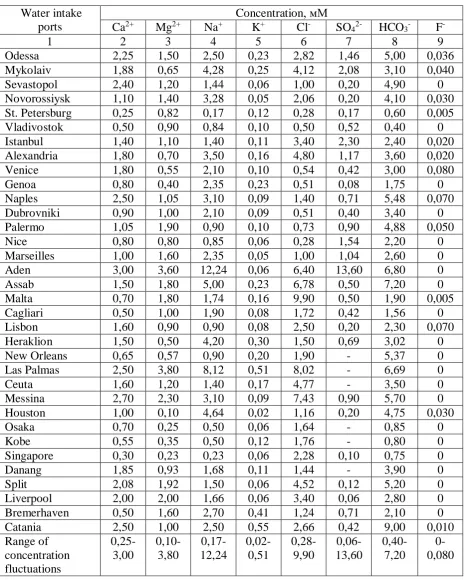
As can be seen from the presented data, water in various ports of the world differs significantly in chemical composition, the range of fluctuations in the concentration of individual anions / cations in it ranges from 12 (calcium) to 227 (sulfates).
Table 1 Mineral composition of drinking water in some ports of the world
Water intake ports
Concentration, мМ
Ca2+ Mg2+ Na+ K+ Cl- SO42- HCO3- F
-1 2 3 4 5 6 7 8 9
Odessa 2,25 1,50 2,50 0,23 2,82 1,46 5,00 0,036
Mykolaiv 1,88 0,65 4,28 0,25 4,12 2,08 3,10 0,040
Sevastopol 2,40 1,20 1,44 0,06 1,00 0,20 4,90 0
Novorossiysk 1,10 1,40 3,28 0,05 2,06 0,20 4,10 0,030 St. Petersburg 0,25 0,82 0,17 0,12 0,28 0,17 0,60 0,005
Vladivostok 0,50 0,90 0,84 0,10 0,50 0,52 0,40 0
Istanbul 1,40 1,10 1,40 0,11 3,40 2,30 2,40 0,020
Alexandria 1,80 0,70 3,50 0,16 4,80 1,17 3,60 0,020
Venice 1,80 0,55 2,10 0,10 0,54 0,42 3,00 0,080
Genoa 0,80 0,40 2,35 0,23 0,51 0,08 1,75 0
Naples 2,50 1,05 3,10 0,09 1,40 0,71 5,48 0,070
Dubrovniki 0,90 1,00 2,10 0,09 0,51 0,40 3,40 0
Palermo 1,05 1,90 0,90 0,10 0,73 0,90 4,88 0,050
Nice 0,80 0,80 0,85 0,06 0,28 1,54 2,20 0
Marseilles 1,00 1,60 2,35 0,05 1,00 1,04 2,60 0
Aden 3,00 3,60 12,24 0,06 6,40 13,60 6,80 0
Assab 1,50 1,80 5,00 0,23 6,78 0,50 7,20 0
Malta 0,70 1,80 1,74 0,16 9,90 0,50 1,90 0,005
Cagliari 0,50 1,00 1,90 0,08 1,72 0,42 1,56 0
Lisbon 1,60 0,90 0,90 0,08 2,50 0,20 2,30 0,070
Heraklion 1,50 0,50 4,20 0,30 1,50 0,69 3,02 0
New Orleans 0,65 0,57 0,90 0,20 1,90 - 5,37 0
Las Palmas 2,50 3,80 8,12 0,51 8,02 - 6,69 0
Ceuta 1,60 1,20 1,40 0,17 4,77 - 3,50 0
Messina 2,70 2,30 3,10 0,09 7,43 0,90 5,70 0
Houston 1,00 0,10 4,64 0,02 1,16 0,20 4,75 0,030
Osaka 0,70 0,25 0,50 0,06 1,64 - 0,85 0
Kobe 0,55 0,35 0,50 0,12 1,76 - 0,80 0
Singapore 0,30 0,23 0,23 0,06 2,28 0,10 0,75 0
Danang 1,85 0,93 1,68 0,11 1,44 - 3,90 0
Split 2,08 1,92 1,50 0,06 4,52 0,12 5,20 0
Liverpool 2,00 2,00 1,66 0,06 3,40 0,06 2,80 0
Bremerhaven 0,50 1,60 2,70 0,41 1,24 0,71 2,10 0
Catania 2,50 1,00 2,50 0,55 2,66 0,42 9,00 0,010
Fluoride in water 75% of the examined ports are absent.
When moving to the tropics, combined with the fence on the ship of water in a foreign port, the amount of calcium and magnesium consumed increased 3-4 times.
Consumption of high-quality drinking water in sufficient quantity can optimize the well-being and performance of crew members, especially those who perform flights and physical work in difficult climatic and geographical conditions.
The quality of drinking water affects the condition of teeth, since tooth enamel consists of 92% of inorganic substances - apatite, 2.7% - of calcium - its salts and 2.3% of magnesium salts. In the event that in drinking water these substances are not enough or they are in excess, an imbalance appears that contributes to the destruction of the enamel. An important element contained in water is fluorine. A person should consume at least 2 mg of fluoride per day, which enters our body, mainly from water.
The lack of fluoride in drinking water leads to an increased incidence of tooth decay. Disease tooth decay also depends on the presence of microelements in drinking water, in one case acting as synergists, in the other - as fluoride antagonists: copper, zinc, vanadium, manganese, strontium, titanium, chromium, molybdenum, cobalt, nickel, aluminum. On the development of tooth decay, rigidity, calcium, magnesium, and total mineralization may have a certain significance. High hardness of drinking water, due to the high content of calcium and magnesium salts, even at low fluoride concentrations in it is a factor that reduces the incidence of tooth decay. Increased water salinity is also a significant factor in the risk of periodontal disease due to rapid mineralization of plaque and further formation of tartar.
High intensity of caries and deterioration in the structure and properties of hard tissues of teeth was noted in people who consumed low-mineralized drinking water. On the other hand, rigid highly mineralized drinking water increases the incidence of stony disease and the same caries. Thus, the task is to optimize the water quality both for the salt composition itself and for the partial concentration of the individual components [6-8].
The above factors that affect the composition of drinking water on ships play a significant role in the emergence and development of dental diseases in seamen overseas.
various chemical compounds in the body leads to the imbalance of the organism, the emergence and development of many diseases, primarily dental and gastrointestinal.
Table 2 is compiled according to the data of dentists from the Odessa Basin Dental Clinic, who have worked for more than 30 years and who have been on flights for up to 10 years on ships with different crew and passengers and different duration of flights, from 3 months to 1 year. It contains statistics of observations during the voyage, indicating an increase in dental diseases, a number that exceeds the usual statistics in some cases up to 30-50%.
Table 2 Increase in the number of dental diseases during a sea voyage, %
Age group
Uncomplicated caries
Complicated caries
Disease of the mucosa
Periodontal disease
Periodontitis
22-35 years old 33 - 40 18 - 20 3 - 4 2 - 3 3 -10
35-60 years old 53 - 60 27 - 35 9 - 11 29 17 - 20
More than 60 years
2 - 3 15 - 20 1 - 2 39 3 - 4
The increase in morbidity occurs in short periods of time, as well as the fact that most of the crew on board the flight undergo a sanation.
To minimize the impact of factors of changes in the chemical composition of drinking water, taking into account the survey data of seamen, dentists from the Odessa Basin Dental Clinic consider it expedient:
- monitoring the quality of drinking water for compliance with quality standards for sanitary and hygienic indicators;
- carrying out dental sanitation before and after flights in specialized medical institutions that have experience with such a specific patient contingent. Purpose of special individual preventive measures.
References
1. Derzhavnyy standart Ukrayiny DSTU 7525; 2014 «Voda pytna. Vymohy ta metody kontrolyu yakosti». [Державний стандарт України ДСТУ 7525; 2014 «Вода питна. Вимоги та методи контролю якості»]. (in Ukrainian)
3. Derzhavni sanitarni pravyla dlya morsʹkykh suden Ukrayiny.: Kyyiv, 2000. – 97s. [Державні санітарні правила для морських суден України.: Київ, 2000. – 97с.] (in Ukrainian)
4. Lisobey, V. A.; Sidenko, V. P.; Kuznetsov, A. V.; Badyuk, N. S. Epidemiologicheskiye riski transporta. Aktual'nyye problemy transportnoy meditsiny, 2012, 2 (28), c. 21-27. [Лисобей, В. А.; Сиденко, В. П.; Кузнецов, А. В.; Бадюк, Н. С. Эпидемиологические риски транспорта. Актуальные проблемы транспортной медицины, 2012, 2 (28), c. 21-27]. (in Russian)
5. Gozhenko, A. I.; Lebedeva, T. L.; Badyuk, N. S. Fiziologicheskiye osnovy gigiyenicheskogo normirovaniya solevogo sostava pit'yevykh rezhimov cheloveka (soobshcheniye pervoye). Voda: gigiyena i ekologiya, 2013, 3 (1), s. 6-11. [Гоженко, А. И.; Лебедева, Т. Л.; Бадюк, Н. С. Физиологические основы гигиенического нормирования солевого состава питьевых режимов человека (сообщение первое). Вода: гигиена и экология, 2013, 3 (1), с. 6-11]. (in Russian)
6. Sivak, Ye. YU.; Vishnevskaya, N. L. Mineral'nyy sostav pit'yevoy vody i stomatologicheskaya zabolevayemost'. Sovremennyye problemy nauki i obrazovaniya, 2014, 6 [Сивак, Е. Ю.; Вишневская, Н. Л. Минеральный состав питьевой воды и стоматологическая заболеваемость. Современные проблемы науки и образования, 2014, 6]. (in Russian)
7. Badiuk, N. S. Treatment of water at an independent voyage. ISMN 12 : Book of abstracts : Sea, Health and Beyond : 12th International symposium on maritime health (Brest - 4>7 June 2013). – France, 2013. – Р. 158