Open Access
Research
A two-dimensional mathematical model of non-linear dual-sorption
of percutaneous drug absorption
K George*
1,2,3Address: 1School of Information Systems, Computing and Mathematics; Department of mathematical Sciences, Brunel University, Uxbridge, Middlesex, , UB8 3PH, UK, 2Aditi College, University of Delhi, Bawana, Delhi, 110039, India and 3Civil and Computational Engineering Centre, School of Engineering, Singleton Park, Swansea, SA2 8PP Wales, UK
Email: K George* - [email protected] * Corresponding author
Abstract
Background: Certain drugs, for example scopolamine and timolol, show non-linear kinetic
behavior during permeation process. This non-linear kinetic behavior is due to two mechanisms; the first mechanism being a simple dissolution producing mobile and freely diffusible molecules and the second being an adsorption process producing non-mobile molecules that do not participate in the diffusion process. When such a drug is applied on the skin surface, the concentration of the drug accumulated in the skin and the amount of the drug eliminated into the blood vessel depend on the value of a parameter, C, the donor concentration. The present paper studies the effect of the parameter value, C, when the region of the contact of the skin with drug, is a line segment on the skin surface. To confirm that dual-sorption process gives an explanation to non-linear kinetic behavior, the characteristic features that are used in one-dimensional models are (1) prolongation of half-life if the plot of flux versus time are straight lines soon after the vehicle removal, (2) the decrease in half-life with increase in donor concentration. This paper introduces another feature as a characteristic to confirm that dual-sorption model gives an explanation to the non-linear kinetic behavior of the drug. This new feature is "the prolongation of half-life is not a necessary feature if the plots of drug flux versus time is a non-linear curve, soon after the vehicle removal".
Methods: From biological point of view, a drug absorption model is said to be nonlinear if the
sorption isotherm is non-linear. When a model is non-linear the relationship between lag-time and donor concentration is non-linear and the lag time decreases with increase in donor concentration. A two-dimensional dual-sorption model is developed for percutaneous absorption of a drug, which shows non-linear kinetic behavior in the permeation process. This model may be used when the diffusion of the drug in the direction parallel to the skin surface must be examined, as well as in the direction into the skin, examined in one-dimensional models. The dual-sorption model is an initial/ boundary value problem which consists of (1) one non-linear, two-dimensional, second-order parabolic equation, (2) boundary conditions, (3) one initial condition. Note that, the number of boundary conditions are, six and four, respectively, if the permeation process under consideration is, during the application of the vehicle and during the removal of the vehicle. Adopting the approach of method of lines, the initial/boundary value problem is transformed into an initial-value problem, which consists of (1) a system of non-linear ordinary differential equations, (2) one initial condition. The system of linear ordinary differential equations contains time-dependent non-homogeneous terms, if the permeation process under consideration is, during the application of
Published: 03 July 2005
BioMedical Engineering OnLine 2005, 4:40 doi:10.1186/1475-925X-4-40
Received: 06 December 2004 Accepted: 03 July 2005
This article is available from: http://www.biomedical-engineering-online.com/content/4/1/40
© 2005 George; licensee BioMed Central Ltd.
the vehicle. To solve this initial-value problem, an eight-stage sequential algorithm which is second-order accurate, and requires only tri-diagonal solvers, is developed.
Results: Simulation of the numerical methods described is carried out with various values of the
parameter C. The illustrations are given in the form of figures. The concentration profiles are viewed as parabolas along the mesh lines parallel to x-axis or y-axis. The flow rates in different subregions of the skin-region are studied. The shapes of the concentration profiles are examined before and after the steady-state concentration is reached. The concentration reaches steady-state when the flux reaches the steady state. The plots of flux versus time and cumulative amount of drug eliminated into the receptor cell versus time are given.
Conclusion: Based on the various values of the parameter, C, conclusions are drawn about (1)
flow rate of the drug in different regions of the skin, (2) shape of the concentration profiles, (3) the time required to reach the steady-state value of the concentration, (4) concentration of the drug in different regions of the skin, when steady-state value of the concentration is reached, (5) the time required to reach the state value of the flux, (6) time required to reach the steady-state value of the concentration of the drug, (7) half-life of the concentration of the drug and (8) lag-time.
A comparison, between this two-dimensional model and the one-dimensional non-linear dual-sorption model that exists in the literature, is done based on (1) the shape of the concentration profiles at various time levels, (2) the time required to reach the steady-state value of the concentration, (3) lag-time and (4) half-life.
Background
A non-linear model takes into account the property of the skin to sorb and bind substances during the process of permeation in addition to the ordinary dissolution. Such a non-linear model can be used to explain the disparity between the steady-state diffusivity of the drug in the skin and the unsteady-state value computed from transient (time-lag) permeation experiments, see [1]. A non-linear dual-sorption model of percutaneous drug absorption is described in [2]. Another mathematical model of percuta-neous drug absorption and its exact solution is described in [3]. In [4], the non-linear percutaneous permeation
kinetics of timolol is studied in vitro with human cadaver
skin. A model for a suspension with a finite dissolution rate is solved numerically in [5]. All these non-linear mod-els are one-dimensional and the region of contact of the
skin with the drug, is a single point, say x = 0, where x
measures the distance into the skin.
To the authors' knowledge, no two-dimensional non-lin-ear mathematical model of percutaneous drug absorption exists in the literature, where the region of contact is a line
segment, say x = 0, 0 ≤y ≤Lc. The purpose of this paper is
(1) to model the above situation mathematically (2) to obtain an efficient numerical method which can use a large time step compared to spacial discretization step; and also handles discontinuities between initial and boundary conditions in the mathematical model.
Methods
Model equations(a) Concentration before the steady state is reached (Concentration during the application of the vehicle)
Let the drug be applied as an ointment on the
skin-sur-face, say, {(0, y) : 0 ≤y ≤Lc}, at time t = 0. The
two-dimen-sional model developed in [6] takes into account the drug kinetics in the skin where the ointment is not directly applied. The one-dimensional non-linear dual-sorption model given in [2] postulates the total concentration of
the drug, CT, in the skin is composed of two parts, (1) the
mobile solute concentration CD, which is due to the
mechanism of simple dissolution and is expressed as CD =
KDC, in which KD is skin/receptor cell partition coefficient
and C is donor-cell concentration, (2) the immobile
sol-ute concentration CI, which is due to the adsorption
proc-ess, and is expressed as , in which
is Langmuir's saturation constant and b is Langmuir's
affinity constant. Hence the total concentration CT, in the
skin is given by
CT = CD + CI.
Based on [6] and [2], to describe the drug kinetics at any
time t > 0, a two-dimensional non-linear dual-sorption
model is developed. Let the thickness (distance between the skin-surface and skin-capillary boundary) of the skin
be Ls. Assuming that skin is an isotropic medium, that is,
the diffusivity κ, is the same in the x and y directions, the
drug concentration CD = CD(x, y, t) in the skin is governed by
where Ls, Ld, Lu and Lc are positive real numbers. Note that,
(1) is non-singular as b > 0, > 0 and CD ≥ 0. Following
[2], the concentration along the skin-receptor cell bound-ary may be considered to have the value zero. Assuming
that the donor-cell concentration at the uppermost
epider-mis {(0, y, t) : 0 ≤y ≤Lc, t > 0} is maintained at the value
C, the boundary conditions for the model are given by
CD (0, y, t) = KDC, 0 ≤y ≤Lc, t > 0, (2b)
CD (Ls, y, t) = 0, -Ld ≤y ≤Lu, t > 0, (2f)
Assuming that there is no drug in the skin before the application, the initial distribution associated with the PDE is
CD(x, y, 0) = 0,0 ≤ × ≤Ls, -Ld ≤y ≤Lu (3)
The flux J = J(t), through the skin to the receptor site, per
unit area, is given by
The cumulative amount of drug eliminated into the
recep-tor cell per unit area at time τ(see [2]) is
The initial/boundary-value problem given by (1) to (3) is named as "problem (PA)".
(b) Concentration after the steady state is reached (Concentration after the vehicle removal)
Let Ts denote the time at which the steady-state is reached
by the problem (PA). Suppose that at time t = Ts, the
vehi-cle is removed instantaneously from the skin. Then (1) remains unchanged, but the initial conditions and bound-ary conditions changes and consequently, (2a) to (2c) dis-appear from the mathematical model, leaving the PDE's
CD (Ls, y, t) = 0, -Ld ≤y ≤Lu, t > Ts (7d)
The initial distribution associated with PDE (6) is
CD = CD (x, y, Ts), 0 ≤x ≤Ls, -Ld ≤y ≤Lu, (8)
where CD (x, y, Ts) is computed by solving problem (PA).
The initial/ boundary-value problem given by (6) to (8) is named as "problem (PB)".
Numerical methods
The approach to be adopted in obtaining a numerical solution, is the method of lines in which the initial/ boundary-value problem to be solved is transformed into
a first-order initial-value problem. At any time t > 0, the
region associated with the skin is given by Rs = {(x, y) : 0 ≤
x ≤Ls, - Ld ≤y ≤Lu}. The region of the contact Rc, of the
drug and the skin surface is defined as Rc = {(0, y) : 0 ≤y ≤
Lc}. Superimpose on Rs a rectangular grid with mesh
lengths, h > 0 and H > 0, respectively, in the x and y
direc-tions. Let k > 0 be a constant time step. Let N be a positive
integer, and h = 1/(N + 1). Also it is assumed that Lc = QcH,
Lu = QuH, Ld = QdH, where Qc, Qu and Qd are positive inte-gers. The grid points are given by (xl, ym, tj); xl = lh, l = 0(1)(N + 1), ym = mH, m = -Qd(1)Qu and tj= jk, j = 0, 1, 2, ...s, ...etc. with sk = Ts. The values tj represent the time-levels
for the problems (PA) and (PB) for j ≤s and j ≥s
respec-tively. The finite-difference solution which approximates
the solution CD (x, y, t) of the two-dimensional parabolic
equation (1), is sought at each mesh point (xl, ym, tj) in the
region [Rs- Rc - {(Ls, y), -Ld ≤y ≤Lu}] × t > 0. Note that, for
∂
∂ = + +
∂∂ + ∂ ∂
−
C t
bC bC
C x
C y
D I
D
D D
κ 1
1 2 1
1 2
2 2
2 *
( ) , ( )
0
0< <x Ls,−Ld < <y L Lu, u>L tc, >0,
CI*
∂
∂ = − ≤ < >
C
x y t L y t
D
d
( , , )0 0, 0, 0, (2a)
∂
∂ = < ≤ >
C
x y t L y L t
D
c u
( , , )0 0, , 0, ( )2c
∂
∂ − = ≤ ≤ >
C
y x L t x L t
D
d s
( , , ) 0 0, , 0, (2d)
∂
∂ = ≤ ≤ >
C
y x L t x L t
D
u s
( , , ) 0 0, , 0, (2e)
J t C
x L y t dy D
L L
s d
u
( )= − ∂ ( , , ) ( )
∂ −
∫
κ 4
Ae Ae J x L t C
x L y t y t
s L D
L s
d u
= = = = − ∂
∂
−
∫
∫
∫
( )τ τ ( )d κ τ ( , , )d d ( )5
0 0
∂
∂ = + +
∂∂ + ∂ ∂
−
C t
bC
bC
C
x
C
y
D I
D
D D
κ 1
1 2 6
1 2
2 2
2 *
( ) , ( )
0
0< <x Ls,−Ld < <y L tu, >Ts,
∂
∂ = − ≤ ≤ >
C
x y t L y L t T
D
d u s
( , , )0 0, , , (7a)
∂
∂ − = ≤ ≤ >
C
y x L t x L t T
D
d s s
( , , ) 0 0, , , (7b)
∂
∂ = ≤ ≤ >
C
y x L t x L t T
D
u s s
the initial-value problem (PB), Rc = Φ (the empty set). For the problem (PA), the differential equation (1), subject to the boundary conditions (2a) to (2f), is discretized at all grid points in the region [Rs - Rc -{(Ls, y), -Ld ≤y ≤Lu}] × [0
≤t ≤Ts]. For the problem (PB), the differential equation
(6), subject to the boundary conditions (7a) to (7d), is
discretized at all grid points in the region [Rs -{(Ls, y), -Ld
≤y ≤Lu}] × [t > Ts]. For notational simplicity, denote
Discretization for problem (PA)
At any time-level t = tj, or , the {(Qd + Qu + 1)
(N + 1) - (Qc + 1)} elements will be ordered in rows
par-allel to the x-axis and in vector form, and will be denoted
by CD(t) and Q(t), where Q(t) is due to the boundary
con-dition (2b). For W = CD and Q, and = or ,
denote
In the above notation n takes the value 0 if m ≠ 0(1)Qc and
takes the value 1 otherwise. The vector CD(t) is a vector of
unknowns and the vector Q(t) is given by
All other are zero. In the following discretizations,
(xl, ym), pl,m, ql,m and CDl,m, respectively, denote (xl, ym, tj),
, and . At any time-level t = tj, the
differen-tial equation (1) can be discretized as
If and are respectively, suitable
approximations to CDxx;l;m and CDyy;l;m, the above
discreti-zation can be written as
At an interior grid point (xl, ym), and
are given by
If (xl, ym) is a boundary point, using the boundary
condi-tions (2a) to (2f), and are given by
where
A1 = 0, B1 = 2, if l = 0, m = -Qd(1)(-1), (Qc + 1)(1)Qu,
A1 = 0, B1 = 1, if l = 1, m = 0(1)Qc,
A1 = 1, B1 = 1, if l = 1(1)N - 1, m = -Qd(1)Qu,
A1 = 1, B1 = 0, if l = N, m = -Qd(1)Qu,
A2 = 0, B2 = 2, if l = 0(1)N, m = -Qd,
A2 = 2, B2 = 0, if l = 0(1)N, m = Qu,
A2 = 1, B2 = 1, if l = 0, m = (-Qd + 1)(1)(-2), (Qc + 2)(1)(Qu
- 1),
A2 = 1, B2 = 0, if l = 0, m = -1
A2 = 0, B2 = 1, if l = 0, m = (Qc + 1).
System of ordinary differential equations
Combining the discretizations (9) together with
expres-sions for and given by (10) and (11)
respectively, a system of ordinary differential equations is formed as
where
C C x y t C C
x x y t
C C
Dl m j
D l m j Dx l m
j D
l m j
Dy l m
j D , ; , ; , ( , , ), ( , , ), = =∂ ∂ =∂
∂yy x y t etc
p C bC
bC p
l m j
D I D ( , , ),... , ( ) ( ) * = + + − κ 1 1 2 1
and ll mj I Dl m j bC bC , * , ( ) . = + + − κ 1 1 2 1
CDl mj , ql mj,
wl mj, CDl mj , ql mj,
ql mj,
q
K C p
h
l m Q
K C p
H l m
l m j
D l m j
c
D l m j , , , ( ) , ( ) , ( ) , = = = = 2 2
1 0 1
0
if and
if and == − +
1 1 0 , , , Qc otherwise.
ql mj,
pl mj, ql mj, CDl mj ,
d
dt(CDl m, )=pl m,
(
CDxx l m; , +CDyy l m; ,)
.1 2
2 h δx l mc,
1 2
2 H δy l mc,
d dt C
p
h C
p
H C q
Dl m l m x Dl m l m y Dl m l m
( , )= ,2 δ2 , + ,2δ2 , + , .
( )
9δx2CDl m, δy2CDl m,
δ δ
x Dl m Dl m Dl m Dl m
y Dl m Dl m Dl m D
C C C C
C C C C
2 1 1 2 1 2 2 , , , , , , , , = − + = − + − +
− ll m, +1.
( )
10δx2CDl m, δy2CDl m,
δ δ
x Dl m Dl m Dl m Dl m
y Dl m Dl m D
C A C C B C
C A C C
2
1 1 1 1
2 2 1 2 2 , , , , , , , = − + = − − +
− ll m, +B C2 Dl m, +1.
( )
11δx2CDl m, δy2CDl m,
d
The value of m in Ed and Fd is -Qd, and that in Eu and Fu is
Qc + 1. The abbreviations m1, m2, ... etc. represent m + 1,
m + 2, ... etc. For m ≠ 0, 1, 2, ...Qc, Em and Fm are square
matrices of order N + 1 and are given by
For m = 0, 1, 2, ..., Qc, Em and Fm are square matrices of
order N and are given by
For the values of m = -1, Qc + 1, and m = 0, Qc, the matrices
Gm are of orders (N + 1) × N and N × (N + 1), respectively,
and are given by
For the values of m = 0, 1, ..., Qc, m ≠ 0, 1, 2, ...Qc, the
matrices Om are the zero matrices of orders N and N + 1
respectively. The matrices Od and Oc are zero matrices of
orders (N + 1) × N and N × (N + 1), respectively.
Recurrence relation and its implementation via sequential algorithm
In [7], an eight stage sequential algorithm is described to solve two space linear parabolic equations. In [2], a sequential algorithm of two tridiagonal solvers is described to solve one-space non-linear dual-sorption model. To the author's knowledge, there is no sequential algorithm in the literature to solve the two-dimensional non-linear parabolic equation (1). The aim of this section is to develop an eight-stage sequential algorithm of tridi-agonal solvers, to solve the system of non-linear ordinary differential equations given by (12), which gives the solu-tion of two-space non-linear parabolic equasolu-tion (1). The main idea used is, to rewrite the system of equations (12) in such a way that, the numerical techniques described in [7] and [2] can be extended to two-space non-linear equa-tions. To achieve this, we proceed as follows.
Let Q(t) = R(t) + S(t), where the elements of the vectors
R(t) and S(t) are, respectively, denoted by and ,
and are defined by
Note that the vector, R(t), is the contribution of CDxx to the
vector Q(t). The vector, S(t), is the contribution of CDyy to
the vector Q(t). The system of non-linear ordinary
differ-ential equations given by (12) can be written as
It is known (see [2,8]) that the system of ordinary differ-ential equations given by (12), subject to the initial con-dition (3), satisfies the recurrence relation
where D* = diag{d/dt}. The exponential term in the
recur-rence relation (16) will be approximated by its (2, 0) Padé approximant to give
which, following pre-multiplication, gives
E h
E O O O E O O O E
F H
F O O O F O O O F
E = = 1 1 2 2 d c u d u d
, c ;
== = − − −
E O O O O
O E
E O
F
F F O
F
m m m d
m m
d
m m d
m
1 2 1
1
1
1
2 2
… …
, d −− − = − − − 2 2 1 1
1 1 1
0 0 1
0 1
F Fm
F F G
E
O E O O
O O E
E m c c … , c Q Q c c
Q Q Q
c O c c c
F
G F F O
F F F
F F G
= − − − , c
0 0 0
1 1 1
2 2 2 … = = , , E
O E O O
O E
E F
G
d m m Q
m m Q Q u u c u u 1 1 … ++ − − − 1
1 1 1
2 2
2 2
F F O
F F F
F F
m m Q
m m m
Q Q u u u … . E p p
p p p
p p
F m
m m
m m m
N m N m m = − − − 2 2 2 2 0 0
1 1 1
, , , , , , , , == ( ) p p p m m N m 0 1 0 0 0 0 0 0 13 , , , . E p p
p p p
p p
F m
m m
m m m
N m N m m = − − − = 2 2 2 1 1
2 2 2
, , , , , , , , pp p p m m N m 1 2 0 0 0 0 0 0 14 , , , . … … … ( ) G p p p m m m
N m N N
= + ×
0 0 0 0
0 0 0
0 0 0
0 0 0
1 2 1 … … … … , , , ( )
,for mm Q
p p p c m m N m = − + 1 1
0 0 0 0 0
0 0 0 0
0 0 0 0
0 0 0 0
1 2 and … … … … , , ,
N N× +
c Q
( )
, .
1
for m=0 and
αl m j
, βl m j ,
α
β
l m
j l m
j l m j q , , , , , =
for 1 and = 0(1)Q ,
otherwise.
and
c
l= m
0
==
ql mj, , ,
for 1, Q + 1 and = 0,
otherwise. c
l =− m
0
d
dtCD( )t =( ( )E tCD( )t +R( )) ( ( )t + F tCD( )t +S( ))t ( )15
CD(t+k)=(ekD )CD( ),t ( )
∗
16
CD(t+k)=I−kD + kD CD( ),t
∗ 1 ∗
2
1
( )2
I−kD + kD t k t
+ =
∗ 1 ∗
2( ) 17
2 C C
Using the split form (15), and following [7] and [2], a four-stage sequential algorithm is developed to obtain
, which is an approximation to CD(t + k) in (17). It is
given by
(I - r1kE) Z = CD(t) + r1kR(t), (18a) (I - r2kE) V = Z + r2kR(t), (18b)
(I - r1kF) Z = V + r1kS(t), (18c)
(I - r2kF) (t + k) = Z + r2kS (t). (18d)
where (see [8])
Another solution, , which is an approximation to CD(t
+ k) in (17), is obtained by interchanging the matrices E
and F; and the vectors R and S; in (18a) to (18d). It is
given by
(I - r1kF) Z = CD(t) + r1kS(t), (18e) (I - r2kF) V = Z + r2kS(t), (18f) (I - r1kE) Z = V + r1kR(t), (18g)
(I - r2kE) (t + k) = Z+ r2kR (t). (18h)
Note that the approximations, and , given by
(18d) and (18h), are first-order accurate in time and their linear combination defined by
is second order accurate in time. The eight-stage
algo-rithm, defined by (18a) to (18i) is, L0 stable and uses only
tridiagonal solver.
Initial/boundary value problem (PB)
The "problem (PB)" is modelled by the equations (6) to
(8). At any time-level t = tj, j ≥s, , the (Qd + Qu + 1)
× (N + 1) elements, will be ordered in rows parallel to the
x-axis and in vector form, and will be denoted as CD(t),
with
At a grid point xl, ym, the required discretization is
For l ≠ 0, m ≠ (-Qd + 1) (1) (Qu - 1); and
are given by (10) and for l = 0, m = (-Qd + 1)(1)(Qu - 1),
and
Combining the discretizations given by (19), a system of differential equations is formed as
in which
In the above matrices, the value of m is -Qd and m1 = m +
1, m2 = m + 2,... The matrices Ei and Fi, i = -Qd(1)Qu, are
square matrices of order N +1, and are given by (13).
Pro-ceeding as in problem (PA), the eight-stage algorithm to solve the system of differential equations (20), subject to the initial conditions (8), is
(I - r1kE) Z = CD(t), (21a) (I - r2kE) V = Z , (21b) (I - r1kF) Z = V, (21c)
(I - r2kF) (t + k) = Z, (21d)
(I - r1kF) Z = CD(t), (21e) (I - r2kF) V = Z, (21f)
(I - r1kE) Z = V, (21g)
CD∗∗
CD∗∗
r1=r2 =12+i
CD+
CD+
CD∗∗ CD+
CD(t+k)=1 CD t+k CD , ( )
2( ( ) + ( + )) 18i
∗∗ + t k
CDl mj ,
CD( )t C ,C ,..,C ;C ,C ,..,C ;
C D Q
j
D Q j
D j
D j
D j
DQ j
DQ
d d c
c
= − − + −
+
1 1 0 1
1
1 2
0 1
j
DQ j
DQ j
Dm j
D m j
D m j
D N m j
C C
C C C C
c u
, ,.., ,
, ,..,
, , ,
+
= where
,m= −Qd( )1Qu.
d dt C
p h
C p
H C
Dl m l m x Dl m m y Dl m
( , )= , , + , , , ( )
2 2
2
2 19
δ l δ
δx2CDl m, δy2CDl m,
δx2CD m0, = −2CD m0, +2CD m1,
δy2CD m0, =CD m0, −1−2CD m0, +CD m0, +1.
d
dtCD( )t =(E+F)CD( )t (20)
E h
E E
E F
H
F F
F F F
F m
m
Q
m m
m m m
u
=
= −
−
−
1 1
2 2
2
2
2
1
2
1 1 1
,
Q Qu 2FQu
,
(I - r2kE) (t + k) = Z, (21h)
Note that the sequential algorithm defined by (21a) to (21i) is obtained from the equations (18a) to (18i),
replacing the vectors R(t) and S(t), by the zero vector of
length (Qd + Qu+ 1) × (N + 1). This shows the efficiency of
the splitting of the vector Q(t), and the eight-stage
algo-rithm developed in problem (PA).
Stability Analysis
The stability analysis of two-stage sequential algorithm for the solution of one-space non-linear second-order para-bolic equation is described in [2]. The stability analysis of four-stage sequential algorithm for the solution of two-space second-order parabolic equation is described in [7]. In this section, following [7] and [2], it is to prove that the eight-stage sequential algorithms described by (18a) to
(18i) and (21a) to (21i) are L0 stable.
The amplification matrix R*(k(E + F)) of the method
defined by (18a) to (18d) is given by
neglecting the higher order terms O (-k3).
Hence the symbol R*(-z), of the method defined by (18a)
to (18d), to evaluate (t + k) is given by
Similarly the symbol R+(--z), of the method defined by
(18e) to (18h), to evaluate (t + k) is given by
In (22) and (23), z = -kλwhere λis an eigen value of the
matrix E + F. Hence using (22) and (23) the symbol, S(-z),
of the method (18i) is
The method is L0 stable if
| S(-z) | ≤ 1 (24)
S(-z) → 0, as z →∞
• Proof of (24):- Applying Brauer's theorem, it can be
shown that all the eigen values λof the matrix E + F are
negative. Hence, z = kλ > 0.
• Proof of
(25):-From (24) and (25), it is concluded that the numerical
method defined by (18a) to (18i) is L0 stable. Similarly
the numerical method defined by (21a) to (21i) is L0
sta-ble. Since the method is L0 stable, the discontinuities
around y = 0 and y = Lc are not propagated.
Results and discussion
In order to examine the behavior of the recurrence rela-tions (18a) to (18i) and (21a) to (21i), a series of five numerical experiments, similar to those described in [2], are carried out for two space dimensions. In these experi-ments the parameter-values used are those used in [2]. For
the experiments numbered n = 1, 2, 3, 4, and 5, the
param-eter C was given the values 4.1, 19.5, 43.1, 51.4 and 64.0
respectively. The rest of the parameter values are given by
Ls = 0.004 cm, Ld = 0.0320 cm, Lc = 0.128 cm, Lu = 0.160 cm,
k = 0.1 h, H = 0.0004, κ= 0.0000018 cm2/h, = 5.0 mg/
ml, KD = 1.1, h = 0.0002, N = 19, Qc = 320, Qu = 400, Qd =
80, b = 0.5599 ml/mg.
It was assumed in all numerical experiments that the drug was applied until steady-state concentration profile is
reached. Let denotes the time in hours, at which the
concentration profiles for the nth (n = 1, 2, 3, 4 and 5)
experiment reaches the steady-state. Suppose that at time
t = , the vehicle is removed instantaneously from the
skin. The pattern of the concentration profile is observed for fifty hours more, after the vehicle is removed at the
steady-state. For the nth (n = 1(1)5) experiment, the values
of CD are computed (1) using the sequential algorithm
(18a) to (18i), in the time interval 0 <t ≤ , (2) using
the sequential algorithm (21a) to (21i), in the time
inter-val <t ≤ + 50. Following [2], for the value of n =
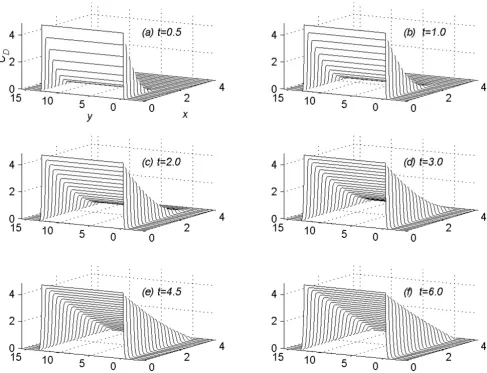
1 (C = 4.4), the profiles of concentration CD at t = 0.5. 1.0,
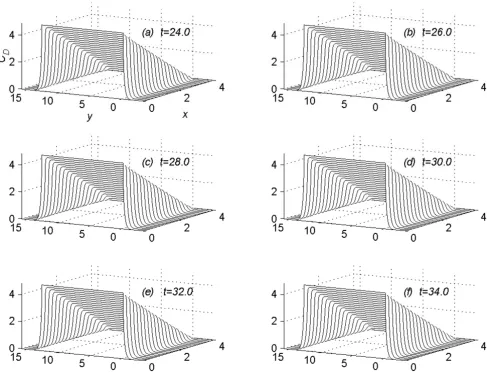
2.0, 3.0, 4.5 and 6.0 are given in figure 1. In figure 2, the
profiles of concentration CD are given at t = 24.0, 26.0,
CD+
CD(t+k)=1 CD t+k CD ( )
2( ( ) + ( + )). 21i
∗∗ + t k
R k E F I r kE I r kE I r kF I r kF
I k E F k
∗ + =
[
− − − −]
−− + +
( ( )) ( )( )( )( )
( )
1 2 1 2
1 2
2
2 1 2(E+F) ,
−
CD∗∗
R z
z z
∗ − =
+ +
( ) 1 . ( )
1
22
2
2
CD+
R z
z z
+(− =) , ( )
+ +
1
1
23
2
2
S z R z R z
z z (− =) ( (− +) (− ))=
+ +
∗ +
1 2
1
1 22
z k z
z
S z z
z
= − > ⇒ + + > ⇒
+ + < ⇒ − ≤
λ 0 1 1 1
1
1 1
2
2 2
2
| ( ) | .
S z
z
S z z
z
z
z z
(− =) ( ) , .
+ + = + + ⇒ − → → ∞
1
1
0
2
2
2
2
1 1 1 1
2
as
CI*
Ts( )n
Ts( )n
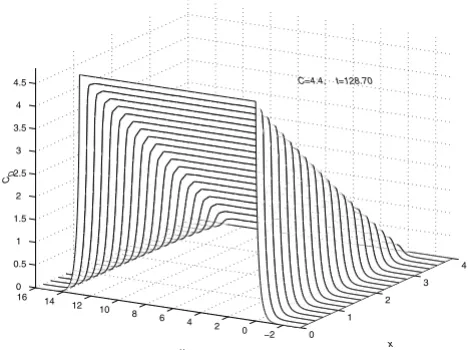
28.0, 30.0, 32.0 and 34.0. In figure 3 the profile of
con-centration CD, are given at time t = = 128.7, the time
at which concentration, CD, reaches the steady state for the
first experiment. In figures 1, 2 and 3, the concentration
profiles are viewed as parabolas along mesh lines x = xl, l
= 0(1) N. The figures 1 and 2 show the flow rate in
differ-ent subregions of the skin region Rs, before the
concentra-tion reaches the steady state. Figure 3 shows the shape of the concentration profile when the concentration reaches steady-state.
In figure 4 and figure 5, for the value of C = 4.4, the
con-centration profiles at t = 0.5 and 3.0 are viewed as
parab-olas along the mesh lines y = ym, m = -Qd(1)Qu. Figure 4
and figure 5 show the change in shape of the parabolas in the region away from the region of contact of drug and
skin. In figure 6, corresponding to the value of C = 4.4, the
concentration profiles at t = = 128.7 are shown along
the mesh lines y = ym, m = Qc(1)Qu. The figure 6 shows the
importance of two-dimensional modelling.
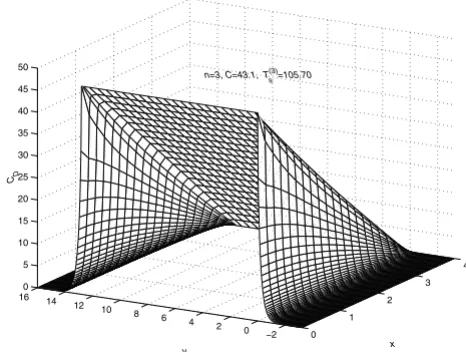
Corresponding to each value of n = 1(1)5, the
concentra-tion profiles at t = are given in figures 7, 8, 9, 10 and
11, respectively. The above figures show the effect of the
value of C on the steady-state concentration CD in
differ-ent regions of Rs.
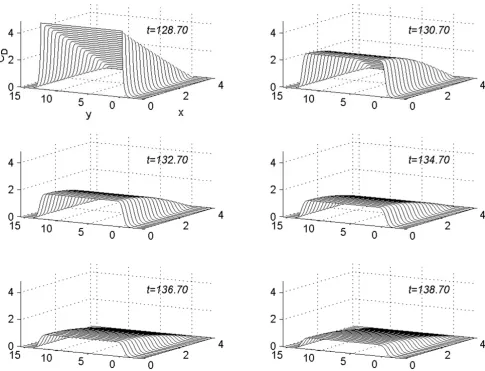
In figure 12, the concentration profiles for the value of C
= 4.4 are given at t = 128.7, 130.7, 132.7, 134.7, 136.7,
and 138.7. This graph show the rate of decreasing of the
Concentration profiles for C = 4.4, viewed as parabolas along mesh lines x = xl, l = 0(1)N; t = 0.5, 1.0, 2.0, 3.0, 4.5, 6.0
Figure 1
Concentration profiles for C = 4.4, viewed as parabolas along mesh lines x = xl, l = 0(1)N; t = 0.5, 1.0, 2.0, 3.0, 4.5, 6.0.
Ts( )1
Ts( )1
concentration in different regions of Rs after the removal of the vehicle.
The Ae versus time and J versus time profiles are monitored
for the time interval 0 ≤t ≤ + 50 in each experiment.
The values J and Ae are computed at each time step using
the trape-zoidal rule to approximate the integrals in (4)
and (5). Thus, to second-order accuracy, for j = 1, 2, 3,...
etc,
where
and
In literature see [2], the drug absorption experiments are monitored for a large time interval. Hence it is desirable to use a numerical method which gives acceptable results with larger time steps compared to spacial discretization.
Since the numerical method used in this section are L0
sta-ble, it is expected to give accurate results when a large time
Concentration profiles for C = 4.4, viewed as parabolas along mesh lines x = xl, l = 0(1)N; t = 24.0, 26.0, 28.0, 30.0, 32.0, 34.0
Figure 2
Concentration profiles for C = 4.4, viewed as parabolas along mesh lines x = xl, l = 0(1)N; t = 24.0, 26.0, 28.0, 30.0, 32.0, 34.0.
Ts( )n
J t H
h A A
j N
j
N j
( )= −κ ( − − ), ( )
4 1 4 26
Anj CDn mj C C n N N
m Q
Q
Dn Q j
Dn Q j
d u
d u
= + + = −
=− + −
−
∑
2 1
1 1
, , , with , ;
Ae tj J ti J tj i
j
( )= k ( ) ( ) . ( )
2 2 1 27
1
+
step is used. Note that the conclusions obtained from all
the five experiments are independent of the time step k. As
an illustration, with k = 0.1 and k = 0.01, J versus time
pro-files are monitored for the first experiment (C = 4.4) and
are given in figure 15. The time required to reach the
steady-state value of the flux with k = 0.1 and k = 0.01
respectively are t = 128.7 and t = 130.37. When the
numer-ical computation is done with k = 0.01, the difference in
flux during the time interval [128.7 130.37] is 10-10,
which is negligible. It is also noted that even if the drug is
Concentration profiles for C = 4.4, viewed as parabolas along
mesh lines at x = xl, l = 0(1)N; t = 128.7
Figure 3
Concentration profiles for C = 4.4, viewed as parabolas along mesh lines at x = xl, l = 0(1)N; t = 128.7.
Concentration profiles for C = 4.4, viewed as parabolas along
mesh lines at y = ym, m = -Qd(1)Qu; t = 0.5
Figure 4
Concentration profiles for C = 4.4, viewed as parabolas along mesh lines at y = ym, m = -Qd(1)Qu; t = 0.5.
0 1
2 3
4
−2 0 2 4 6 8 10 12 14 16 0 0.5 1 1.5 2 2.5 3 3.5 4 4.5
x C=4.4, t=128.70
y
C
D
0 1
2 3
4
−2 0 2 4 6 8 10 12 14 16
0 0.5 1 1.5 2 2.5 3 3.5 4 4.5
x C=4.4, t=0.5
y
C
D
Concentration profiles for C = 4.4, viewed as parabolas along
mesh lines at y = ym, m = -Qd(1)Qu; t = 3.0
Figure 5
Concentration profiles for C = 4.4, viewed as parabolas along mesh lines at y = ym, m = -Qd(1)Qu; t = 3.0.
Concentration profiles for C = 4.4, viewed as parabolas along
mesh lines at y = ym, m = 0(1)Qc; t = 128.7
Figure 6
Concentration profiles for C = 4.4, viewed as parabolas along mesh lines at y = ym, m = 0(1)Qc; t = 128.7.
0 1
2 3
4
−2 0 2 4 6 8 10 12 14 16
0 0.5 1 1.5 2 2.5 3 3.5 4 4.5
x C=4.4, t=3.0
y
C
D
0 1
2 3
4
0 2 4 6 8 10 12 14
0 0.5 1 1.5 2 2.5 3 3.5 4 4.5 5
x C=4.4, t=128.70
y
C
removed at t = 130.37 instead of t = 128.7, the conclusions drawn in next section remain valid.
Conclusion
Conclusion is presented in five parts.
Part 1:- Conclusions based on concentration profiles till steady-state concentration, CD, is reached
Concentration profiles at various time levels are examined until steady state is reached. Graphically these concentration profiles are represented as parabolas along
mesh lines x = xl, l = 0(1) N or parabolas along mesh lines
Concentration profiles for C = 4.4, when steady-state is
reached Figure 7
Concentration profiles for C = 4.4, when steady-state is reached.
Concentration profiles for C = 19.5, when steady-state is
reached Figure 8
Concentration profiles for C = 19.5, when steady-state is reached.
0 1
2 3
4
−2 0 2 4 6 8 10 12 14 16
0 0.5 1 1.5 2 2.5 3 3.5 4 4.5 5
x n=1, C=4.4, T(1)
s=128.70
y
C
D
0 1
2 3
4
−2 0 2 4 6 8 10 12 14 16
0 5 10 15 20 25
x n=2, C=19.5, T(2)
s=104.1
y
C
D
Concentration profiles for C = 43.1, when steady-state is
reached Figure 9
Concentration profiles for C = 43.1, when steady-state is reached.
Concentration profiles for C = 51.4, when steady-state is
reached Figure 10
Concentration profiles for C = 51.4, when steady-state is reached.
0 1
2 3
4
−2 0 2 4 6 8 10 12 14 16
0 5 10 15 20 25 30 35 40 45 50
x n=3, C=43.1, T(3)s=105.70
y
C
D
0 1
2 3
4
−2 0 2 4 6 8 10 12 14 16
0 10 20 30 40 50 60
x n=4, C=51.4, T(4)
s=125.30
y
C
y = ym, m = -Qd(1)Qu. Divide the region of skin, Rs, into two
mutually exclusive regions R1 and R2 as follows.
R1 = Rc × Ls and R2 = Rs - R1.
The following conclusions are drawn based on drug kinet-ics in the regions R1, R2 and Rs.
(1) In figure 1 the concentration profiles are viewed as
parabolas along mesh lines x = xl, l = 0(1)N. Consider the
flow rate of concentration of the drug in the region R1.
From the subplots (a) to (c) of figure 1, it is concluded that during the initial time levels, flow rate towards the skin surface is larger than flow rate towards the skin-cap-illary boundary. Later-on time levels (from subplots (c) to (f) of figure 1), flow rate towards the skin-capillary boundary becomes larger than flow rate near to the skin surface.
(2) In figure 2 the concentration profiles are viewed as parabolas along mesh
lines x = xl, l = 0(1)N.
From figure 1 and figure 2 it is concluded that in the
region R2, the flow rate near to the skin surface is larger
than flow rate towards the skin-capillary boundary.
(3) Consider the flow rate in the whole region Rs. From
figure 1 and figure 2 it is concluded that, during the initial
time levels, flow rate in the region R1 is larger than the
flow rate in the region R2. But later-on time levels, flow
rate in the region R2 becomes larger than the flow rate in
the region R1, leading to a steady-state concentration
file as given in figure 3. In figure 3 the concentration
pro-files are viewed as parabolas along mesh lines x = xl, l =
0(1)N.
(4) At any time level t = tj, consider the concentration of
the drug along the mesh line x = xl, l = 0(1)N. From figure
1, 2 and 3, it is concluded that the concentration of the drug at a mesh point (xl, ym, tj) ∈R1, m = 0(1)Qc is larger
than the concentration of the drug at a mesh point (xl, ym,
tj) ∈R2, m ≠ 0(1)Qc.
(5) In figure 4 and figure 5, the concentration profiles are
viewed as parabolas along mesh lines y = ym, m =
-Qd(1)Qu. From figure 4 it is concluded that, during the
ini-tial time-levels, the shape of the parabolas in the whole
region Rs retains the same shape as the shape of the
con-centration profiles given in page 97 of [2]. If a one-dimen-sional model of drug absorption was sufficient, the following results are expected from [2].
• When steady-state concentration reaches, the shape of
the concentration profiles viewed along the mesh lines y =
ym, m = -Qd(1)Qu is same as the shape of the parabolas
given in page 97 of [2].
• When steady-state concentration reaches, concentration
profiles along the mesh lines y = ym, m = 0(1)Qc are straight
lines.
Contrary to this result, the following results are obtained from two-dimensional modelling.
5.1 From figure 4 and figure 5 it is concluded that, as time
increases, the parabolas in the region R2 have a convex
shape, whereas the parabolas given in page 97 of [2] have a concave shape.
5.2 The concentration profiles along the mesh lines, y =
ym, m = 5(1) Qc - 5 are straight lines. These straight lines are
shown in figure 6.
5.3 The concentration profiles along the mesh lines, y =
ym, m = 0, 1, 2, 3, 4, Qc - 4, Qc - 3, Qc - 2, Qc - 1 and Qc are not straight lines, but they have the shape as shown in fig-ure 6.
Even though the illustration of figures is done only for
one experiment (with n = 1, C = 4.4), that is only for the
first experiment, the conclusions drawn are true for all
other experiments (that is, for all values of C).
Concentration profiles for C = 64.0, when steady-state is
reached Figure 11
Concentration profiles for C = 64.0, when steady-state is reached.
0 1
2 3
4
−2 0 0 2 4 6 8 10 12 14 16
0 10 20 30 40 50 60 70 80
x n=5, C=64, T(5)
s=115.60
y
C
Part 2:-Conclusions based on concentration profiles when steady-state value of concentration is reached
The steady-state concentration profiles for all the five experiments are given in figure 7, figure 8, figure 9, figure 10 and figure 11. From these steady-state concentration profiles, the following conclusions are drawn.
(1) As the value of C increases, the concentration at any
point (xl, ym, tj) increases.
(2) As the value of C increases, the difference between the
concentrations of the drug at mesh points (xl, ym, tj) ∈R1,
m = 0(1)Qc and (xl, ym, tj) ∈R2, m ≠ 0(1)Qc increases.
(3) As the value of C increases, the difference between the
concentrations of the drug at mesh points (x0, ym, tj) and
(xN-1, ym, tj) increases for m = -Qd(1)Qc. This increase in
dif-ference is more prominent in the region R1 than in the
region R2.
Part 3:-Conclusions based on concentration profiles after the removal of the vehicle when steady-state is reached
The vehicle is removed when the concentration reaches steady-state. The concentration profiles are examined for ten more hours, after the vehicle-removal, in an interval of two hours. In figure 12, these concentration profiles are
given for n = 1 (C = 4.4), at time levels t = = 128.7, t =
130.7, t = 132.7, t = 134.7, t = 136.7, and 138.7. From
fig-ure 12 the following conclusions are made.
Concentration profiles for C = 4.4 viewed as parabolas along mesh lines x = xl, l = 0(1)N; t = 128.7, 130.7, 132.7, 134.7, 136.7,
138.7 Figure 12
Concentration profiles for C = 4.4 viewed as parabolas along mesh lines x = xl, l = 0(1)N; t = 128.7, 130.7, 132.7, 134.7, 136.7, 138.7.
(1) After the removal of the vehicle, rate of decrease in the
region R1 is larger than that in R2.
(2) After the removal of the vehicle, rate of decrease near to the region of skin-surface is larger than that near to region of skin-capillary boundary. Even though the
illus-tration of figures is done only for one experiment (with n
= 1, C = 4.4), that is only for the first experiment, the
con-clusions drawn are true for all other experiments also.
Part 4:-Conclusions based on figure 13 (flux versus time) and figure 14 (Ae versus time)
The graphs of J versus time and Ae versus time for the time
interval 0 ≤ t ≤ ( + 50) are shown in figure 13. The
fol-lowing conclusions are drawn based on figure 13.
(1) As the value of C increases, the steady-state value of
flux increases.
(2) As the value of C increases half-life decreases, during
the time levels, soon after the vehicle-removal. There is no prolongation of half-life during later-on time, as stated in [2]. It is evident from figure 13 that, the plots of a drug
flux versus time is a non-linear curve, soon after the vehicle
removal. Hence, in experimental studies even when the prolongation of half-life is not seen, the nonlinearity of
drug flux versus time can be introduced as a characteristic
to confirm that dual-sorption model gives an explanation to non-linear kinetic behavior of the drug.
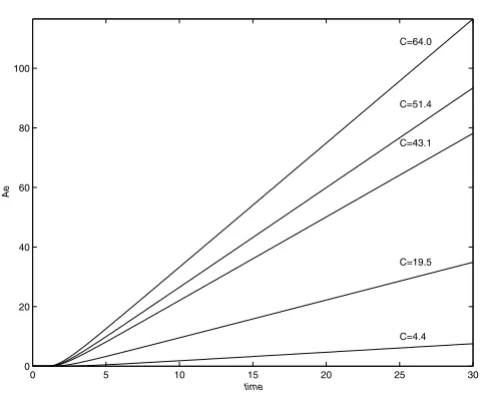
The graphs of Ae versus time for the time interval 0 ≤t ≤
+ 50 are shown in figure 14.
J versus time profiles for various values of C
Figure 13
J versus time profiles for various values of C.
Ae versus time profiles for various values of C
Figure 14
Ae versus time profiles for various values of C.
0 20 40 60 80 100 120 140 160
0 0.5 1 1.5 2 2.5 3 3.5 4 4.5
n=1, C=4.4, T(1)s=128.70 n=2, C=19.5, T(2)s=104.10 n=3, C=43.1, T(3)
s=105.70 n=4, C=51.4, T(4)s=125.30 n=5, C=64.0, T(5)
s=115.60
time
J
0 5 10 15 20 25 30
0 20 40 60 80 100
time
Ae
C=4.4 C=19.5 C=43.1 C=51.4 C=64.0
J versus time profiles for C = 4.4 with k = 0.1 and k = 0.01 Figure 15
J versus time profiles for C = 4.4 with k = 0.1 and k = 0.01.
:
C 4.4 19.5 43.1 51.4 64.0
TL1 3.44 2.29 1.99 1.93 1.84
TL2 3.67 2.52 2.16 2.11 2.04
0 20 40 60 80 100 120 140 160 180
0 0.05 0.1 0.15 0.2 0.25
time
J
K=0.1 K=0.01
Ts( )n
Publish with BioMed Central and every scientist can read your work free of charge "BioMed Central will be the most significant development for disseminating the results of biomedical researc h in our lifetime."
Sir Paul Nurse, Cancer Research UK
Your research papers will be:
available free of charge to the entire biomedical community
peer reviewed and published immediately upon acceptance
cited in PubMed and archived on PubMed Central
yours — you keep the copyright
Submit your manuscript here:
http://www.biomedcentral.com/info/publishing_adv.asp
BioMedcentral
(3) As the value of C increases, at any time level t = tj, the
value of Ae(t) increases.
(4) As the value of C increases, time decreases. The
lag-time is computed as t-intercepts of the linear portion of
graphs of Ae versus time. For various values of C, the
lag-times are compared with the lag-lag-times given in [2]. Let TL1
denotes the lag-times quoted in [2] as a result of
one-dimensional modelling of drug-absorption and TL2
denotes the lag-times obtained as a result of
two-dimen-sional modelling. Table 1 gives the values of TL1 and TL2,
corresponding to each value of C.
From Table 1 it is concluded that, for a particular value of
C, the lag-time obtained as a result of two-dimensional
modelling is greater than the lag-time obtained as a result of one-dimensional modelling. For a linear model, lag
time is independent of donor concentration C. The linear
model corresponding to (1) is obtained by substituting
= 0. Its lag time is computed as 1.56 which is greater than 1.44, the lag-time obtained from the
one-dimen-sional linear model (substitute = 0 in (8) of [2]).
It is an established fact that the drug permeation profiles of a nonlinear model is different from that of a linear model, as a non-linear model assumes that the drug molecules are either dissolved or immobile inside the skin. In this article it is shown that the drug permeation described by the two-dimensional non-linear model is different from one-dimensional non-linear model, as the two-dimensional model takes into account the drug kinetics at the site distant from the area where the oint-ment is directly applied.
Acknowledgements
The author thanks DST, Government of India, for the award of a BOY-SCAST fellowship.
References
1. Chandrasekaran SK, Michaels AS, Campbell PS, Shaw JE: Scopo-lamine permeation through human skin in vito. Am Inst Chem Eng J 1976, 22:828-832.
2. Gumel AB, Kubota K, Twizell EH: A sequential algorithm for the nonlinear dual-sorption model of percutaneous drug absorption. Mathematical Biosciences 1998, 152:87-103.
3. Kubota K, Ishizaki T: A calculation of percutaneous drug
absorption-I. Theoretical. Comput Biol Med 1986, 16:7-19. 4. Kubota K, Koyama E, Twizell EH: Dual sorption model for the
nonlinear percutaneous permeation kinetics of timolol. J Pharmaceutical Sciences 1993, 82:1205-1208.
5. Kubota K, Twizell EH, Maibach HI: Drug release from a suspen-sion with a finite dissolution rate: Theory and its application to a betamethasone 17-valerate patch. J Pharmaceutical Sciences
1994, 83:1593-1599.
6. George K, Kubota K, Twizell EH: A two-dimensional mathemat-ical model of percutaneous drug absorption. BioMedical Engi-neering OnLine 2004, 3:18.
7. Gumel AB: Parellel and sequential algorithms for
second-order parabolic equations with applications. In PhD thesis
Brunel University; 1993.
8. Twizell EH: Numerical Methods, with applications in the Biomedical Sciences Ellis Horwood, Chichester and Wiley, Newyork; 1998.
C*I