R E S E A R C H
Open Access
Limited impact of
Cntn4
mutation on
autism-related traits in developing and
adult C57BL/6J mice
Remco T. Molenhuis
1, Hilgo Bruining
1,2, Esther Remmelink
3,4,5, Leonie de Visser
1, Maarten Loos
3,
J. Peter H. Burbach
1and Martien J. H. Kas
1*Abstract
Background:Mouse models offer an essential tool to unravel the impact of genetic mutations on autism-related phenotypes. The behavioral impact of some important candidate gene models for autism spectrum disorder (ASD) has not yet been studied, and existing characterizations mostly describe behavioral phenotypes at adult ages, disregarding the developmental nature of the disorder. In this context, the behavioral influence of CNTN4, one of the strongest suggested ASD candidate genes, is unknown. Here, we used our recently established developmental test battery to characterize the consequences of disruption ofcontactin 4(Cntn4) on neurological, sensory, cognitive, and behavioral phenotypes across different developmental stages.
Methods:C57BL/6J mice with heterozygous and homozygous disruption ofCntn4were studied through an extensive, partially longitudinal, test battery at various developmental stages, including various paradigms testing social and restricted repetitive behaviors.
Results:Developmental neurological and cognitive screenings revealed no significant differences between genotypes, and ASD-related behavioral domains were also unchanged inCntn4-deficient versus wild-type mice. The impact of Cntn4-deficiency was found to be limited to increased startle responsiveness following auditory stimuli of different high amplitudes in heterozygous and homozygousCntn4-deficient mice and enhanced acquisition in a spatial learning task in homozygous mice.
Conclusions:Disruption ofCntn4in the C57BL/6J background does not affect specific autism-related phenotypes in developing or adult mice but causes subtle non-disorder specific changes in sensory behavioral responses and cognitive performance.
Keywords:CNTN4, Autism spectrum disorder, 3p deletion syndrome, Developmental trajectories, Mouse model, Behavior, Reversal learning, Negative findings, Hyperreactivity, Schizophrenia
Background
Autism spectrum disorder (ASD) is a behaviorally de-fined developmental disorder with a strong genetic com-ponent [1, 2]. The identification of genetic risk factors such as common genetic variants, rare inherited and de novomutations have lead to the implication of hundreds of different genes [3, 4]. These findings illustrate the
complexity and heterogeneity of the genetic architecture of ASD.
Subsequently, mouse models are being used to un-ravel the functional impact of implicated genes on ASD phenotypes in a controlled genetic and environmental background. However, knowledge of the impact on cognitive and behavioral development of the majority of these genes is missing or incomplete [5], and most behavioral characterizations of animal models are limited to adult phenotypes disregarding the developmental nature of ASD [6].
* Correspondence:[email protected]
1Department of Translational Neuroscience, Brain Center Rudolf Magnus,
University Medical Center Utrecht, Utrecht, The Netherlands Full list of author information is available at the end of the article
Here, we characterize the impact ofcontactin 4(Cntn4) null mutation on behavioral development, using our re-cently developed longitudinal test battery for mice that tests a wide array of neurological, cognitive, and behav-ioral parameters across development starting from 3 weeks of age [6].
CNTN4 is an axonal glycoprotein belonging to the contactin family, a six-member subgroup of the im-munoglobulin superfamily of cell adhesion molecules [7]. CNTN4 is known to act as an axon guidance mol-ecule in the establishment of olfactory neural circuitry during neural development [8] and promotes target-specific axon arborization of a subset of retinal ganglion cells onto the nucleus of the optic tract [9]. Knowledge of the neurobiological functions of CNTN4 in normal and abnormal development of brain systems are far from complete.
The CNTN4gene has been implicated in ASD due to
its presence in the genetic locus of the 3p-deletion syndrome, a mental retardation syndrome [10]. Subse-quently, evidence for a role of CNTN4 has been ac-cumulated [11–14] but has also been questioned [15, 16]. Three cases carrying a copy number variant (CNV) in the
CNTN4gene were reported by the Autism Genome
Pro-ject Consortium (AGP) [12]. Deletions and duplications in
theCNTN4gene or its promoter region were found in
10 families of the Autism Genetic Resource Exchange (AGRE) collection [13]. In the Autism Case-Control cohort (ACC), deletion in the promoter region of
CNTN4 was found in three cases but not in controls
[13]. Association of CNTN4with developmental disor-ders such as ASD further seems supported by the pro-tein’s neurobiological functions [2, 7].
Follwoing these observations, we performed a careful longitudinal functional characterization of homozygous and heterozygous disruptions of Cntn4to resolve the im-pact of this gene on behavioral and cognitive development.
Methods
Generation and breeding ofCntn4mice
Cntn4-deficient mice were kindly provided by Dr. Yoshihiro
Yoshihara (RIKEN, Japan) [8]. These mice were generated using a standard gene-targeting method as previously de-scribed. A targeting vector was designated to mutate the translation start codon (ATG) in the exon 2 of theCntn4 gene into a stop codon (TAG) and introduce a pgk-neo selection marker. Consequently, these mice were back-crossed with C57BL/6 mice more than nine times. Upon arrival in the University Medical Center Utrecht, the mice were re-derived, followed by heterozygous breeding for the use in our experiments.
All animals were born and weaned at the University Medical Center Utrecht. Average nest size of Cntn4 litters was 7.2, and the litters larger than 10 animals per litter were culled back to average 7. The minimum litter size used for behavioral experiments was four animals per litter. Detailed information on the genotyping of
Cntn4mice is provided in Additional file 1.
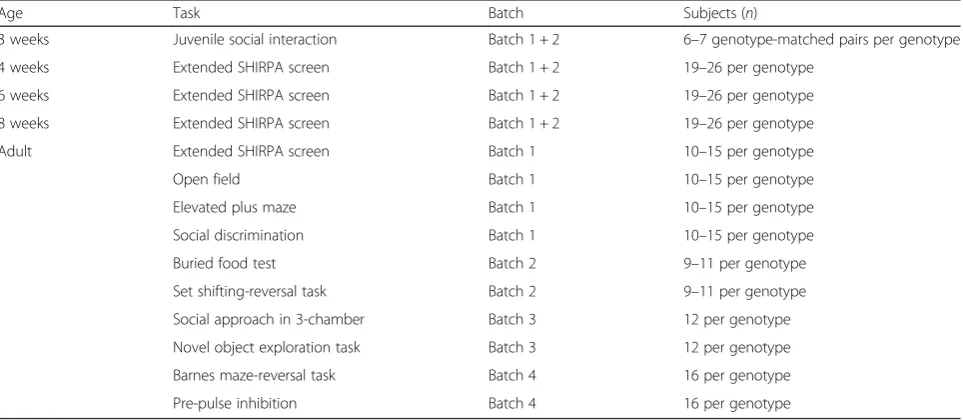
Given the extensive number of tests, the mice were spread over four different batches. Table 1 provides the order of behavioral testing and the number of animals per genotype per batch. Phenotypic assessments in batches 1, 2, and 3 were performed at the University Medical Center Utrecht. Batch 4 was transported and tested at Sylics (Synaptologics BV, Amsterdam, The Netherlands).
Table 1Overview of the behavioral tests per batch
Age Task Batch Subjects (n)
3 weeks Juvenile social interaction Batch 1 + 2 6–7 genotype-matched pairs per genotype
4 weeks Extended SHIRPA screen Batch 1 + 2 19–26 per genotype
6 weeks Extended SHIRPA screen Batch 1 + 2 19–26 per genotype
8 weeks Extended SHIRPA screen Batch 1 + 2 19–26 per genotype
Adult Extended SHIRPA screen Batch 1 10–15 per genotype
Open field Batch 1 10–15 per genotype
Elevated plus maze Batch 1 10–15 per genotype
Social discrimination Batch 1 10–15 per genotype
Buried food test Batch 2 9–11 per genotype
Set shifting-reversal task Batch 2 9–11 per genotype
Social approach in 3-chamber Batch 3 12 per genotype
Novel object exploration task Batch 3 12 per genotype
Barnes maze-reversal task Batch 4 16 per genotype
Pre-pulse inhibition Batch 4 16 per genotype
All experiments were approved by the ethical commit-tee for animal experimentation of the University Medical Center Utrecht and Free University Amsterdam and per-formed according to the institutional guidelines that are in full compliance with the European Council Directive (86/609/EEC).
Developmental neurological and behavioral screening
Cntn4−/−,Cntn4+/−, and wild-type male littermates were
subjected to our previously described longitudinal screen-ing strategy (extended SHIRPA battery) testscreen-ing an array of neurological, behavioral, and cognitive parameters at 4, 6, 8, and 11 weeks of age [6, 17]. The longitudinal test bat-tery includes the assessment of autism-related traits such as motor stereotypies (e.g., self-grooming) and sensori-motor coordination (e.g., latency to fall from the rotarod). Detailed information on behavioral testing is provided in Additional file 1.
Screening of social behaviors and restricted repetitive behaviors
Abnormalities in social interaction behaviors were assessed in the juvenile social interaction test (3 weeks of age) [18], followed by a three-chamber social approach [18], and a 2-day social discrimination paradigm in adult age animals [19]. Stereotypic movements, restricted interests, and re-petitive patterns of behavior were analyzed in the novel object investigation task during exposure to four novel toys [20]. Cognitive flexibility was assessed by multi-trial associative learning in an extensive set-shifting paradigm [6], as well as a Barnes maze spatial learning task includ-ing reversal [21]. Acoustic startle response and sensori-motor gating were assessed in the pre-pulse inhibition (PPI) test [19]. Anxiety-related behaviors were tested in the elevated plus maze and open field [6]. Statistical analyses are described in the Additional file 1.
Results eSHIRPA assays
The eSHIRPA (extended SmithKline Beecham, Harwell, Imperial College and Royal London Hospital phenotype assessment) screen did not show differences between the
Cntn4+/−mice,Cntn4−/−mice, and wild-type controls at
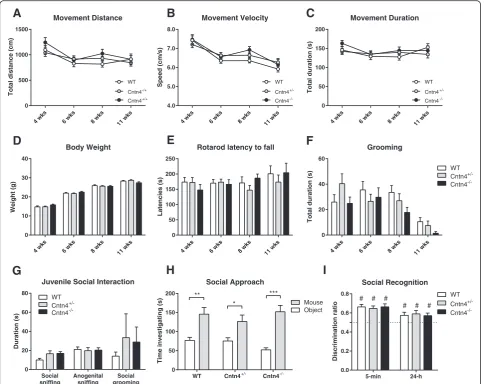
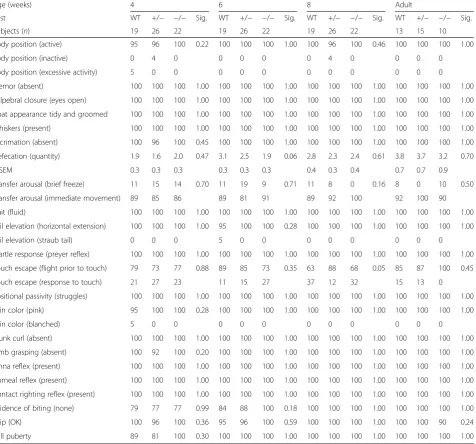
4, 6, 8, or 10 weeks of age in general health, body weight, and neurological reflexes nor in the development of various locomotor parameters including total distance moved, movement velocity, and movement duration (Figs. 1a–d, Table 2). Moreover, we found no develop-mental differences in the amount of self-grooming or sensorimotor coordination on the rotarod (Figs. 1e–f ).
Social interaction behavior
The juvenile social interaction test revealed no differences in the amount of social sniffing, anogenital sniffing, or
social grooming (Fig. 1g) between theCntn4+/−,Cntn4−/−, and wild-type control mice. In the adult three-chamber test, all genotypes showed a clear preference for explor-ation of a mouse over an object, and no genotype differ-ences in the amount of social exploration were observed (Fig. 1h). Furthermore, genotypes were equally capable to distinguish between a familiar mouse and a novel mouse in a social recognition paradigm, both at 5 min and 24 h after initial exposure (Fig. 1i).
Restricted and repetitive behaviors
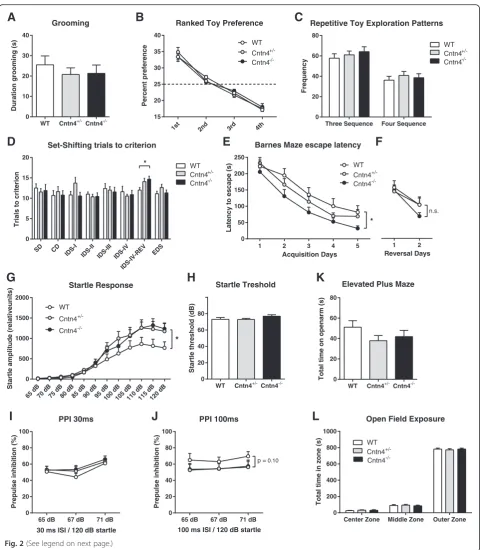
There were no differences in the grooming behavior between the Cntn4+/−, Cntn4−/−, and wild-type control mice at adult age, in line with the amount of grooming observed in the longitudinal eSHIRPA screening (Fig. 2a). We also found no genotype differences in restricted interest or in repetitive patterns of behavior in the novel object investigation task during the exploration of the four novel toys (Fig. 2b, c).
We additionally analyzed cognitive flexibility through the assessment of reversal learning in a set-shifting task. Prior to this task, we ascertained intact olfactory capacities, as we found no genotype differences in the latency to find a buried piece of food. In the set-shifting task, all genotypes were equally able to associate a food reward with a specific digging material or odor, as was evident through the performance of simple, compound discrimination and intra- and extra-dimensional shifts (Fig. 2d).
The reversal-learning phase of this test yielded an inconclusive result, as the genotype effect that we observed on reversal learning was only significant (ANOVA p= 0.04) in one of the two outcome measures (i.e., the number of trials to reach the criterion but not in errors to reach criterion). Moreover, a shift cost in wild-type mice was observed in errors to reach criterion, although not in the number of trials to reach criterion. Given this inconclusive result, we tested reversal-learning performance in a different paradigm. In this Barnes maze reversal-learning paradigm, we confirmed
that Cntn4 does not affect reversal learning, as all
genotypes needed equal amount of time as well as dis-tance before reaching the re-located escape hole (Fig. 2f). In contrast to the set-shifting test, we observed a shift cost that was observed in all genotypes in the reversal phase of the Barnes maze test (Fig. 2e, f ).
Responses to sensory stimuli and anxiety-related behaviors
The startle response was consistently increased in the
Cntn4+/−andCntn4−/−mice at different high amplitudes,
were found on pre-pulse inhibition at both inter-stimulus intervals of 30 and 100 ms (Figs. 2i, j).
The increased startle response to auditory stimuli of the different high amplitudes seemed not to result from increased anxiety levels, as Cntn4+/−, Cntn4−/− mice and wild-type controls did not differ in their el-evated plus maze (Fig. 2k) and open-field exploratory behaviors (Figs. 2l).
Discussion
We present a comprehensive assessment of the impact of the ASD candidate gene CNTN4 on a variety of neurological, behavioral, and cognitive aspects of devel-opment. We found no effect of Cntn4 deficiency on ASD-related behavioral mouse paradigms such as the ju-venile social interaction test, the three-chamber test, grooming behavior, and sensorimotor coordination. We Movement Distance 4wk s 6wk s 8wk s 11w ks 0 500 1000 1500 WT Cntn4-/+ Cntn4+/+
Total distance (cm)
Body Weight 4wk s 6wk s 8w ks 11w ks 0 10 20 30 40 Weight (g)
Rotarod latency to fall
4wk s 6w ks 8wk s 11w ks 0 50 100 150 200 250 Latencies (s) Grooming 4w ks 6wk s 8w ks 11w ks 0 20 40 60 WT Cntn4 +/-Cntn4
-/-Total duration (s)
4w ks 6w ks 8wk s 11w ks 4.0 5.0 6.0 7.0 8.0 Movement Velocity
Speed (cm/s) WT
Cntn4 +/-Cntn4 -/-4wk s 6w ks 8w ks 11w ks 0 50 100 150 200 Movement Duration
Total duration (s)
WT Cntn4 +/-Cntn4
-/-A
B
C
D
E
F
G
H
I
Social sniffing Anogenital sniffing Social grooming 0 20 40 60 80
Juvenile Social Interaction
Duration (s) WT Cntn4 +/-Cntn4 -/-Social Recognition 5-min 24-h 0.0 0.2 0.4 0.6 0.8 WT Cntn4 +/-Cntn4 -/-Discrimination ratio # # # # # #
WT Cntn4+/- Cntn4 -/-0 50 100 150 200 Social Approach
Time investigating (s)
Object Mouse
** ***
*
Fig. 1Developmental neurological and behavioral screen and analysis of social behaviors in Cntn4-deficient mice.aDistance moved (rmANOVA genotype,F(2,63)= 0.760,p= .472),bmovement velocity (rmANOVA genotype,F(2,63)= 1.256,p= .292),cmovement duration (rmANOVA genotype,F(2,63)= 0.342,p= .479),dbody weight (rmANOVA genotype,F(2,63)= 0.588,p= .558),elatency to fall of the accelerating rotarod (rmANOVA genotype,F(2,64)= 0.110,p= .896), andftime spent self-grooming (rmANOVA genotype,F(2,64)= 1.038,p= .360) at pre-adolescence (4 weeks), adolescence (6 weeks), early adulthood (8 weeks), and adulthood (10 weeks) (n= 19–26 per genotype) during the eSHIRPA test.gSocial sniffing (owANOVA,F(2,16)= 2.926,p= .083), anogenital sniffing (owANOVA,F(2,16)= 0.055,p= .946), and social grooming (owANOVA,F(2,16)= 0.334,p= .721) during the juvenile social interaction test in genotype-matched mice at post-natal day 21 (n= 6–7 pairs of genotype-matched interacting animals per genotype).hSocial exploration (owANOVA between genotypes,F(2,32)= 0.599,p= .556) as a function of exploration of the cage with the novel mouse versus the empty cage during the three-chamber task (n= 12 per genotype).iSocial exploration during the social discrimination test following a 5-min inter-trial interval (owANOVA between genotypesF(2,36)= 0.138,p= .872) and a 24-h inter-trial interval (owANOVA between genotypesF(2,36)= 0.096,
also did not observe developmental neurological, behav-ioral, or cognitive abnormalities in the extended SHIRPA screen.
The reversal-learning phase of the set-shifting task yielded an inconclusive result, as no shift cost was observed in wild-type animals for the number of trials to reach criterion. In-deed, the genotype difference that was observed in the num-ber of trials to reach the criterion in the reversal-learning phase was rather caused by lack of shift cost in wild-type
animals than a reversal-learning deficit in theCntn4−/−mice. In line with this reasoning, when we compared the outcome
ofCntn4−/−mice in the reversal-learning phase with the
re-sults obtained for C57BL/6J mice obtained in a previous study, we find no genotype difference in this phase of the set-shifting task [6]. In the Barnes maze reversal-learning paradigm, we also did not find a reversal-learning deficit. Based on the summary of these data, we conclude that
Cntn4disruption has no effect on cognitive flexibility.
Table 2Physical and neurological features during the different phases of the extended SHIRPA primary screen.
Age (weeks) 4 6 8 Adult
Test WT +/− −/− Sig. WT +/− −/− Sig. WT +/− −/− Sig. WT +/− −/− Sig.
Subjects (n) 19 26 22 19 26 22 19 26 22 13 15 10
Body position (active) 95 96 100 0.22 100 100 100 1.00 100 96 100 0.46 100 100 100 1.00
Body position (inactive) 0 4 0 0 0 0 0 4 0 0 0 0
Body position (excessive activity) 5 0 0 0 0 0 0 0 0 0 0 0
Tremor (absent) 100 100 100 1.00 100 100 100 1.00 100 100 100 1.00 100 100 100 1.00
Palpebral closure (eyes open) 100 100 100 1.00 100 100 100 1.00 100 100 100 1.00 100 100 100 1.00
Coat appearance tidy and groomed 100 100 100 1.00 100 100 100 1.00 100 100 100 1.00 100 100 100 1.00
Whiskers (present) 100 100 100 1.00 100 100 100 1.00 100 100 100 1.00 100 100 100 1.00
Lacrimation (absent) 100 96 100 0.45 100 100 100 1.00 100 100 100 1.00 100 100 100 1.00
Defecation (quantity) 1.9 1.6 2.0 0.47 3.1 2.5 1.9 0.06 2.8 2.3 2.4 0.61 3.8 3.7 3.2 0.70
± SEM 0.3 0.3 0.3 0.3 0.3 0.3 0.4 0.3 0.4 0.7 0.7 0.9
Transfer arousal (brief freeze) 11 15 14 0.70 11 19 9 0.71 11 8 0 0.16 8 0 10 0.50
Transfer arousal (immediate movement) 89 85 86 89 81 91 89 92 100 92 100 90
Gait (fluid) 100 100 100 1.00 100 100 100 1.00 100 100 100 1.00 100 100 100 1.00
Tail elevation (horizontal extension) 100 100 100 1.00 95 100 100 0.28 100 100 100 1.00 100 100 100 1.00
Tail elevation (straub tail) 0 0 0 5 0 0 0 0 0 0 0 0
Startle response (preyer reflex) 100 100 100 1.00 100 100 100 1.00 100 100 100 1.00 100 100 100 1.00
Touch escape (flight prior to touch) 79 73 77 0.88 89 85 73 0.35 63 88 68 0.05 85 87 100 0.45
Touch escape (response to touch) 21 27 23 11 15 27 37 12 32 15 13 0
Positional passivity (struggles) 100 100 100 1.00 100 100 100 1.00 100 100 100 1.00 100 100 100 1.00
Skin color (pink) 95 100 100 0.28 100 100 100 1.00 100 100 100 1.00 100 100 100 1.00
Skin color (blanched) 5 0 0 0 0 0 0 0 0 0 0 0
Trunk curl (absent) 100 100 100 1.00 100 100 100 1.00 100 100 100 1.00 100 100 100 1.00
Limb grasping (absent) 100 92 100 0.20 100 100 100 1.00 100 100 100 1.00 100 100 100 1.00
Pinna reflex (present) 100 100 100 1.00 100 100 100 1.00 100 100 100 1.00 100 100 100 1.00
Corneal reflex (present) 100 100 100 1.00 100 100 100 1.00 100 100 100 1.00 100 100 100 1.00
Contact righting reflex (present) 100 100 100 1.00 100 100 100 1.00 100 100 100 1.00 100 100 100 1.00
Evidence of biting (none) 79 77 77 0.99 84 88 100 0.18 100 100 100 1.00 100 100 100 1.00
Grip (OK) 100 96 100 0.36 95 96 100 0.59 100 100 100 1.00 100 100 90 0.24
Full puberty 89 81 100 0.30 100 100 100 1.00 100 100 100 1.00 100 100 100 1.00
Cntn4+/−,Cntn4−/−, and wild-type (WT) control mice were screened in the Perspex jar for body position (active, inactive, or excessively active), tremor (present or
Center Zone Middle Zone Outer Zone 0
200 400 600 800 1000
Open Field Exposure
Total time in zone (s)
WT Cntn4 +/-Cntn4
-/-WT Cntn4+/-Cntn4 -/-0
20 40 60 80
Elevated Plus Maze
Total time on openarm (s)
WT Cntn4+/-Cntn4 -/-0
10 20 30 40
Grooming
Duration grooming (s)
1st 2nd 3rd 4th
15 20 25 30 35 40
Ranked Toy Preference
Percent preference
WT
Cntn4 +/-Cntn4
-/-Three Sequence Four Sequence 0
20 40 60 80
Repetitive Toy Exploration Patterns
Frequency
WT Cntn4 +/-Cntn4
-/-1 2
Reversal Days
WT Cntn4 +/-Cntn4
-/-n.s.
1 2 3 4 5
0 50 100 150 200 250
Barnes Maze escape latency
Acquisition Days
Latency to escape (s)
*
SD CD IDS
-I IDS-I
I
ID S-III
ID S-IV
ID S-IV-RE
V EDS
0 5 10 15 20
Set-Shifting trials to criterion
Trials to criterion
* WT
Cntn4 +/-Cntn4
-/-65 dB 67 dB 71 dB 0
20 40 60 80 100
PPI 100ms
100 ms ISI / 120 dB startle
Prepulse inhibition (%)
p =0.10
65 dB 67 dB 71 dB 0
20 40 60 80 100
PPI 30ms
30 ms ISI / 120 dB startle
Prepulse inhibition (%)
65dB70dB75dB80dB85dB90dB95dB100dB105dB110dB115dB120dB
0 500 1000 1500 2000
Startle Response
Startle amplitude (relativeunits)
WT
Cntn4
+/-Cntn4
-/-*
A
B
C
D
E
F
G
H
I
J
K
WT Cntn4+/-Cntn4 -/-0
20 40 60 80
Startle Treshold
Startle threshold (dB)
L
Non-ASD-specific effects at adult ages were indicated by increased startle response to auditory stimuli of dif-ferent high amplitudes and by faster escape hole finding during subsequent days of acquisition in the Barnes maze.
Hyperresponsivity to acoustic stimuli is related to many neurodevelopmental disorders and has also been reported in ASD [22]. In addition, acoustic hyperrespon-sivity in patients with fragile X syndrome is known to be consistent with animal model data [23]. Similar to our findings, an increased startle response to acoustic stimuli was recently described in children with ASD [24], al-though these were in response to weak stimuli in con-trast to the high amplitudes we found. The observed hyperresponsivity inCntn4-deficient mice was unrelated to anxiety levels, as mice showed similar exploratory be-haviors in classical anxiety behavioral tests, such as the elevated plus maze and open field. Although speculative, the increased startle response together with the en-hanced acquisition in the Barnes maze could indicate
thatCntn4deficiency in the C57BL/6J background leads
to a state of increased behavioral responsiveness without overt anxiety or avoidance behavior in mice [25].
Together, the findings show that in the C57BL/6J back-ground, disruption of Cntn4 does not lead to substantial behavioral defects related to autistic development. A lim-ited behavioral penetrance ofCNTN4mutations on autistic development may be consistent with a recent study that revisited the association of contactins, including CNTN4, with ASD [16]. The behavioral phenotype ofCntn4 mice contrasts other previously studied genetic ASD models [18]. For instance,Shank3orPtenmice show extensive im-pairments in social interaction and sensorimotor pheno-types and are therefore regarded as translational models for ASD [26–28].
Although ASD-related phenotypes in Cntn4-deficient mice were observed, our findings do have relevance for neurodevelopmental disorder research. The specific pheno-types observed in Cntn4-deficient mice may be used to study the mechanisms underlying increased responsiveness or vigilance, a trait observed across many different human disorders such as attention-deficit hyperactivity disorder, post-traumatic stress disorder, and schizophrenia [29–31].
Cntn4-deficient mice may serve as a model to study the
mechanistic underpinnings of behavioral states in which vigilance is altered. Indeed, common single-nucleotide var-iants in the CNTN4locus have recently been associated with other neuropsychiatric disorders, such as schizophre-nia [32], perhaps pointing to a non-disorder specific con-tribution of this cell adhesion gene in neuropsychiatric pathogenesis. In addition, a role for Cntn4, was recently shown in target-specific arborization during development of the accessory optic system [9]. Our study shows the importance of detailed developmental neurological, behav-ioral, and cognitive characterization of genetic animal models to complement human genetic studies in ASD and related disorders.
Conclusions
In our test battery, disruption ofCntn4, a prominent ASD candidate gene,had no effect on cognitive and behavioral development or ASD-specific phenotypes. At adult age, we could detect an effect ofCntn4disruption on an adult sensory behavioral and a spatial cognitive feature.
Additional file
Additional file 1:Detailed information on genotyping, behavioral testing and statistical analyses.
(See figure on previous page.)
Fig. 2Restricted repetitive behaviors and sensory-sensitivity screening of adultCntn4mice. Restricted and repetitive behavior in the novel object investigation task.aStereotypic movements as total time spent grooming (owANOVA,F(2,33)= 0.431,p= .653).bRestricted interest as frequency-based percentage preference of exploration of each of the four novel toys (1st preference owANOVA,F(2,33)= 0.446,p= .644; 2nd preference owANOVA,F(2,33)= 1.569,p= .223; 3rd preference owANOVA,F(2,33)= 1.208,p= .312; 4th preference owANOVA,F(2,33)= 0.236,p= .791).cRepetitive toy exploration patterns based on repetitive sequences of three elements (owANOVA,F(2,33)= 0.760,p= .476) and four elements (owANOVA,
F(2,33)= 0.227,p= .798) (n= 12 per genotype).dReversal learning during the set-shifting reversal-learning task.X-axis represents the different sub-tasks.
Y-axis represents the total number of trials that were needed to reach the criterion of 8 correct digs in 10 consecutive trials (n= 9–11 per genotype).
e–fSpatial learning and reversal learning during the Barnes maze paradigm.Y-axis represents the daily mean of latency to find the escape hole during
ethe acquisition phase (rmANOVA genotype,F(2,44)= 4.151,p= .022) andfthe reversal-learning phase (rmANOVA genotype,F(2,43)= 0.830,p= .830) after replacing the escape to the other side of the maze (n= 16 per genotype). Startle and PPI results inCntn4mice, withgstartle magnitude as function of startle stimulus in all genotypes (MANOVA,F(24,70)= 1.984,p= 0.014),hstartle threshold (owANOVA,F(2,45)= 1.542,p= 0.225),i–jpre-pulse inhibition tested with different pre-pulse intensities with inter-stimulus interval (ISI) at 30 ms (two-way ANOVA,F(2,135)= 2.376,p= 0.096) and at 100 ms (two-way ANOVA,F(2,135)= 1.1927,p= 0.306;n= 16 per genotype). Anxiety behavior during the elevated plus maze test and open-field test mea-sured askelevated plus maze anxiety and as total time spent on the open arms (owANOVA,F(2,36)= 1.450,p= 0.248),ltotal time spent in the center (owANOVA,F(2,36)= 0.165,p= 0.848), middle (owANOVA,F(2,36)= 0.413,p= 0.665), and outer zones (owANOVA,F(2,36)= 0.125,
Abbreviations
ASD:autism spectrum disorder; eSHIRPA: extended SmithKline Beecham, Harwell, Imperial College and Royal London Hospital phenotype assessment; PPI: pre-pulse inhibition.
Competing interests
The authors declare that they have no competing interests.
Authors’contributions
RTM participated in the design of the study, carried out the experiments and genotyping, analyzed the data, interpreted the results, and wrote the manuscript. HB provided input into the study design, interpreted the results, and wrote the manuscript. ER and LV participated in the design of the study and coordination of the experiments. ML participated in the design of the study, data analysis, and interpretation of the results. JPHB aid in the genotyping and participated in the interpretation of the results. MJHK contributed to the design of the study, development of the methods, coordination of the statistical analyses, and interpretation of the data. All authors contributed to the reviewing of the manuscript. All authors read and approved the final manuscript.
Acknowledgements
We thank Y. Yoshihara for the generous gift ofCntn4-deficient mice, M. Brandt for the help with the three-chamber sociability test, H. Oppelaar and M. Broekhoven for the technical assistance, and A. Oguro-Ando for the discussion. This study was supported by a funding by the European Autism Interventions—A Multicentre Study for Developing New Medications (EU-AIMS) to Dr. Martien J. Kas. The research of EU-AIMS receives support from the Innovative Medicines Initiative Joint Undertaking under Grant agreement number 115300, resources of which are composed of financial contributions from the European Union’s Seventh Framework Programme (FP7/2007–2013), from the European Federation of Pharmaceutical Industries and Associations companies in-kind contributions, and from Autism Speaks.
Author details 1
Department of Translational Neuroscience, Brain Center Rudolf Magnus, University Medical Center Utrecht, Utrecht, The Netherlands.2Department of
Psychiatry, Brain Center Rudolf Magnus, University Medical Center Utrecht, Utrecht, The Netherlands.3Sylics (Synaptologics BV), Amsterdam, The
Netherlands.4Department of Molecular and Cellular Neurobiology, Center for Neurogenomics and Cognitive Research, Neuroscience Campus Amsterdam, VU University, Amsterdam, The Netherlands.5Department of Functional Genomics, Center for Neurogenomics and Cognitive Research, Neuroscience Campus Amsterdam, VU University, Amsterdam, The Netherlands.
Received: 29 October 2015 Accepted: 21 February 2016
References
1. Am. Psychiatr. Assoc.: Diagnostic and statistical manual of mental disorders. 5th ed. Washington, DC; 2013.
2. Chen JA, Peñagarikano O, Belgard TG, Swarup V, Geschwind DH. The emerging picture of autism spectrum disorder: genetics and pathology. Annu Rev Pathol: Mech Dis. 2015;10:111–44.
3. Pinto D, Delaby E, Merico D, Barbosa M, Merikangas A, Klei L, et al. Convergence of genes and cellular pathways dysregulated in autism spectrum disorders. Am J Hum Genet. 2014;94:677–94.
4. De Rubeis S, He X, Goldberg AP, Poultney CS, Samocha K, Ercument Cicek A, et al. Synaptic, transcriptional and chromatin genes disrupted in autism. Nature. 2014;515:209–15.
5. Abrahams BS, Arking DE, Campbell DB, Mefford HC, Morrow EM, Weiss LA, et al. SFARI Gene 2.0: a community-driven knowledgebase for the autism spectrum disorders (ASDs). Mol Autism. 2013;4:36.
6. Molenhuis RT, de Visser L, Bruining H, Kas MJ. Enhancing the value of psychiatric mouse models; differential expression of developmental behavioral and cognitive profiles in four inbred strains of mice. Eur Neuropsychopharmacol. 2014;24:945–54.
7. Zuko A, Kleijer KTE, Oguro-Ando A, Kas MJH, Van Daalen E, Van Der Zwaag B, et al. Contactins in the neurobiology of autism. Eur J Pharmacol. 2013; 719:63–74.
8. Kaneko-Goto T, Yoshihara S-I, Miyazaki H, Yoshihara Y. BIG-2 mediates olfactory axon convergence to target glomeruli. Neuron. 2008;57:834–46.
9. Osterhout JA, Stafford BK, Nguyen PL, Yoshihara Y, Huberman AD. Contactin-4 mediates axon-target specificity and functional development of the accessory optic system. Neuron. 2015;86:985–99.
10. Fernandez T, Morgan T, Davis N, Klin A, Morris A, Farhi A, et al. Disruption of contactin 4 (CNTN4) results in developmental delay and other features of 3p deletion syndrome. Am J Hum Genet. 2004;74:1286–93.
11. Roohi J, Montagna C, Tegay DH, Palmer LE, DeVincent C, Pomeroy JC, et al. Disruption of contactin 4 in three subjects with autism spectrum disorder. J Med Genet. 2009;46:176–82.
12. Pinto D, Pagnamenta AT, Klei L, Anney R, Merico D, Regan R, et al. Functional impact of global rare copy number variation in autism spectrum disorders. Nature. 2010;466:368–72.
13. Glessner JT, Wang K, Cai G, Korvatska O, Kim CE, Wood S, et al. Autism genome-wide copy number variation reveals ubiquitin and neuronal genes. Nature. 2009;459:569–73.
14. Guo H, Xun G, Peng Y, Xiang X, Xiong Z, Zhang L, et al. Disruption of contactin 4 in two subjects with autism in Chinese population. Gene. 2012; 505:201–5.
15. Cottrell CE, Bir N, Varga E, Alvarez CE, Bouyain S, Zernzach R, et al. Contactin 4 as an autism susceptibility locus. Autism Res. 2011;4:189–99.
16. Murdoch JD, Gupta AR, Sanders SJ, Walker MF, Keaney J, Fernandez TV, et al. No evidence for association of autism with rare heterozygous point mutations in contactin-associated protein-like 2 (CNTNAP2), or in other contactin-associated proteins or contactins. PLoS Genet. 2015;11:e1004852. 17. Rogers DC, Jones DNC, Nelson PR, Jones CM, Quilter CA, Robinson TL, et al.
Use of SHIRPA and discriminant analysis to characterise marked differences in the behavioural phenotype of six inbred mouse strains. Behav Brain Res. 1999;105:207–17.
18. Silverman JL, Yang M, Lord C, Crawley JN. Behavioural phenotyping assays for mouse models of autism. Nat Rev Neurosci. 2010;11:490–502. 19. Bruining H, Matsui A, Oguro-Ando A, Kahn RS, Spijker HM V’t, Akkermans G,
et al. Genetic mapping in mice reveals the involvement of Pcdh9 in long-term social and object recognition, and sensorimotor development. Biol Psychiatry. 2015;78:485–95.
20. Pearson BL, Pobbe RLH, Defensor EB, Oasay L, Bolivar VJ, Blanchard DC, et al. Motor and cognitive stereotypies in the BTBR T+tf/J mouse model of autism. Genes Brain Behav. 2011;10:228–35.
21. Seigers R, Loos M, Van Tellingen O, Boogerd W, Smit AB, Schagen SB. Cognitive impact of cytotoxic agents in mice. Psychopharmacology (Berl). 2015;232(1):17–37.
22. Green S, Hernandez L, Tottenham N, Krasileva K, Bookheimer S, Dapretto M: Neurobiology of sensory overresponsivity in youth with autism spectrum disorders. JAMA Psychiatry. 2015;72(8):778-786.
23. Chen L, Toth M. Fragile X mice develop sensory hyperreactivity to auditory stimuli. Neuroscience. 2001;103:1043–50.
24. Takahashi H, Nakahachi T, Komatsu S, Ogino K, Iida Y, Kamio Y. Hyperreactivity to weak acoustic stimuli and prolonged acoustic startle latency in children with autism spectrum disorders. Mol Autism. 2014;5:23. 25. Blanchard DC, Griebel G, Blanchard RJ. Mouse defensive behaviors:
pharmacological and behavioral assays for anxiety and panic. Eur J Pharmacol. 2003;463:97–116.
26. Peça J, Feliciano C, Ting JT, Wang W, Wells MF, Venkatraman TN, et al. Shank3 mutant mice display autistic-like behaviours and striatal dysfunction. Nature. 2011;472:437–42.
27. Jiang YH, Ehlers MD. Modeling autism by SHANK gene mutations in mice. Neuron. 2013;78:8–27.
28. Ey E, Leblond CS, Bourgeron T. Behavioral profiles of mouse models for autism spectrum disorders. Autism Res. 2011;4:5–16.
29. Parker JDA, Majeski SA, Collin VT. ADHD symptoms and personality: relationships with the five-factor model. Pers Individ Dif. 2004;36:977–87. 30. Dalgleish T, Moradi AR, Taghavi MR, Neshat-Doost HT, Yule W. An
experimental investigation of hypervigilance for threat in children and adolescents with post-traumatic stress disorder. Psychol Med. 2001;31:541–7. 31. Freedman R, Waldo M, Bickford-Wimer P, Nagamoto H. Elementary neuronal
dysfunctions in schizophrenia. Schizophr Res. 1991;4:233–43. 32. Schizophrenia Working Group of the Psychiatric Genomics Consortium.