53 H. Ziaei-Halimejani et al. / Journal of Chemical and Petroleum Engineering, 50 (2), Feb. 2017 / 53-60
Online Detection of Hydrodynamic Changes
in Fluidized Bed using Cross Average
Diagonal Line
Hooman Ziaei-Halimejani,
Reza Zarghami* and Navid Mostoufi
Multiphase Systems Research Lab, School of Chemical Engineering, College of Engineering, University of Tehran, P.O. Box 11155/4563, Tehran, Iran.
(Received 10 April 2016, Accepted 26 June 2016)
Abstract
Online detection of hydrodynamics of gas-solid fluidized bed was char
-acterized using pressure fluctuations by cross recurrence plot (CRP) and cross recurrence quantification analysis (CRQA). Experiments were conducted in a lab scale fluidized bed of various particle sizes 150 µm, 280 µm and 490 µm at different gas velocities. Firstly, pattern changes of cross recurrence plot were discussed and then reference
states was selected. Afterwards, cross average diagonal line (CLave) of
other states corresponding to reference states were obtained. It was found that cross average diagonal line of non-normalized data initially decreases and then increases with increasing the gas velocity. When the signal is initially normalized, cross average diagonal line does not change with the superficial gas velocity. It was concluded that cross
average diagonal line could be used for detecting small changes of par
-ticle size and if a proper reference state is chosen, it can be perceived as a powerful index for detecting changes in the size of particles in a fluidized bed.
Keywords
Cross recurrence quantifica
-tion analysis;
Fluidized bed;
Cross average diagonal line; Pressure fluctuations;
Online detection.
Introduction
1 * Corresponding Author.E-mail: [email protected] (R. Zarghami)
1. Introduction
G
as-solids fluidized beds are extensively usedin the industries owing various multiphase
flow such as petroleum, petrochemical, chem
-ical, mineral, biochem-ical, pharmaceut-ical, food, etc. The wide application of fluidized beds is due to
their high efficiency of mass and heat transfer, ther
-mal homogeneity, high mixing ability and effective contact between solid and fluid [1]. Fluidized bed
reactors are among the most complex unit opera
-tions due to nonlinear dynamics of the two-phase flow. As a result, modeling the hydrodynamics of these reactors are a challenge due to the complexity
of their governing equations [2]. Pressure fluctua
-tion of the gas inside the bed is an essay to measure
variable process that includes information about many different dynamic phenomena occurring in
the bed. These include gas turbulence, bubbles
hy-drodynamics and the effect of bed operating condi
-tions [3, 4].
Several methods can be used for analyzing the
time-series in the state space [5-10]. In these anal
54 H. Ziaei-Halimejani et al. / Journal of Chemical and Petroleum Engineering, 50 (2), Feb. 2017 / 53-60
threshold is specified and the plot is defined as:
(1)
where N is the number of measured points, , ε
is threshold distance, Θ(.) is the Heaviside function
and |.| is a norm for indicating the difference
be-tween trajectories. The Heaviside function is a tool for comparing two trajectories. If difference of each trajectories is greater than ε the Heaviside function will be equal to zero, Ri,j(ε)=0. In opposite, if the distance is less than ε, the Heaviside function will
be equal to one, Ri,j(ε)=1. For plotting this matrix, a black dot is shown where Ri,j(ε)=0 and a white
dot where Ri,j(ε)=1. According to its definition, RP
is a symmetric plot and its main diagonal is black. According to this definition, each point shows the
recurrences of dynamical system states.
2.2 Cross Recurrence Plot
CRP is an extension of RP which is capable of ana
-lyzing dependencies of two dynamical systems in all times by comparing their states [20]. The CRP investigates the dynamics of two systems in one phase space and then displays it into a plot. The cross recurrence matrix is defined as:
(2)
where N is the number of first measured variable
and M is the number of second measured vari
-able . In the CRP, the length of measured vari-ables,
and , are not to be necessarily equal. However,
in the present work, N and M were considered to
be equal and the trajectories on phase space were
constructed based on the time-series for both
sys-tems. Due to the difference in the two systems, the main diagonal of CRP is not entirely black and the plot is not symmetric. Moreover, according to this
definition a black dot in the CRP is not an indica
-tion of the recurrence of system but declares the
similarity states between the two systems.
2.3 Cross Recurrence Quantification Analysis
Quantification of CRP structures is performed by applying the CRQA. The CRQA determines how and how often the two systems show similar patterns
of change or movement. CRQA parameters are de
-fined such that they would have a physical inter
-pretation. Some of these parameters are defined
based on the diagonal structures and are used for
articulating the coordination of two systems. One [11] with the help of statistical methods such
as S-statistic [12] and Z-statistic [13]. The main drawbacks of these methods are long-term data
requirement, time-consuming calculations and
un-certainty in determination of embedding parame
-ters [14]. Recently, several researchers have utilized the recurrence plot (RP) to analyze the nonlinear time-series. The concept of the RP and recurrence quantification analysis (RQA) was introduced by Eckmann et al. [2, 15] and developed to describe
the behavior of the system in the phase space. Hy
-drodynamics of fluidized bed was also investigated by RP and RQA and it was shown that the RP is a
powerful and easy method for monitoring and de
-tecting changes of the flow patterns in a fluidized bed [16]. The online monitoring of hydrodynamic status of a fluidized bed was explored using RP and
its capability to predict sudden changes was com
-pared with the S-statistic method which revealed its high sensitivity [17]. Also, Sedighikamal et al. [18] used one of CRQA parameters to show ability of this method to investigate the velocity transition.
Tahmasebpoor et al. [19] investigated the hydro
-dynamics of fluidized beds by RP and showed its advantage in comparison to statistical and wavelet
transform techniques.
In this work, monitoring method based on the cross recurrence plot (CRP) proposed by Marwan et al. [20], as a bivariate extension of RP, is applied
to online detection of hydrodynamics of bubbling
fluidized beds through measurement of bed pres
-sure fluctuations. Effect of superficial gas velocity and particle size on the hydrodynamics of the bed is investigated with cross average diagonal line
(CLave).
2. Theory
2.1 Recurrence Plot
Recurrence plot was first introduced by Eckmann et al. [15]. This technique is a method to visualize the recurrences of a dynamical system. A RP prepares a qualitative pattern of the time-series correlations over all available time scales. This method can be used for non-stationary and short-term data. An advantage of this method is that it does not need embedding parameters and all information can be extracted from the non-embedded signal [21]. RP is a two dimensional plot extracted from a distance matrix and can visualize structures of the dynamics of the system [22]. The distance matrix
is an N×N matrix whose elements are determined based on the distance between points and in
the phase space. For construction of RP, a radius
3 Recurrence plot was first introduced by Eckmann et al. [15]. This technique is a method to visualize the recurrences of a dynamical system. A RP prepares a qualitative pattern of the time-series correlations over all available time scales. This method can be used for non-stationary and short-term data. An advantage of this method is that it does not need embedding parameters and all information can be extracted from the non-embedded signal [21].
RP is a two dimensional plot extracted from a distance matrix and can visualize structures of the dynamics of the system [22]. The distance matrix is an N×N matrix whose elements are determined based on the distance between points x⃗ i and x⃗ j in the phase space. For construction of RP, a radius threshold is specified and the plot is defined as:
𝑅𝑅𝑖𝑖.𝑗𝑗(𝜀𝜀) = 𝛩𝛩 (𝜀𝜀 − ||𝑥𝑥 𝑖𝑖− 𝑥𝑥 𝑗𝑗||) . 𝑖𝑖. 𝑗𝑗 = 1. … . 𝑁𝑁
(1)
Where N is the number of measured points, x⃗ i, ε is threshold distance, 𝛩𝛩(.) is the Heaviside function and |.| is a norm for indicating the difference between trajectories. The Heaviside function is a tool for comparing two trajectories. If difference of each trajectories is greater than ε the Heaviside function will be equal to zero,
Ri,j(ε)=0. In opposite, if the distance is less than ε, the Heaviside function will be equal to one, Ri,j(ε)=1. For plotting this matrix, a black dot is shown where Ri,j(ε)=0 and a white dot where Ri,j(ε)=1. According to its definition, RP is a symmetric plot and its main diagonal is black. According to this definition, each point shows the recurrences of dynamical system states.
2.2 Cross Recurrence Plot
CRP is an extension of RP which is capable of analyzing dependencies of two dynamical
systems in all times by comparing their states [20]. The CRP investigates the dynamics of two systems in one phase space and then displays it into a plot. The cross recurrence matrix is defined as:
𝐶𝐶𝑅𝑅𝑖𝑖.𝑗𝑗𝑥𝑥 𝑖𝑖.𝑦𝑦⃗ 𝑗𝑗(𝜀𝜀) = 𝛩𝛩 (𝜀𝜀 − ||𝑥𝑥
𝑖𝑖− 𝑦𝑦 𝑗𝑗||) . 𝑖𝑖 = 1. … . 𝑁𝑁 ; 𝑗𝑗 = 1. … . 𝑀𝑀
(2)
Where N is the number of first measured variable x⃗ i and M is the number of second measured variable y⃗ i. In the CRP, the length of measured variables, x⃗ i and y⃗ i, are not to be necessarily equal. However, in the present work, N and M were considered to be equal and the trajectories on phase space were constructed based on the time-series for both systems. Due to the difference in the two systems, the main diagonal of CRP is not entirely black and the plot is not symmetric. Moreover, according to this definition a black dot in the CRP is not an indication of the recurrence of system but declares the similarity states between the two systems.
2.3 Cross Recurrence Quantification Analysis
Quantification of CRP structures is performed by applying the CRQA. The CRQA determines how and how often the two systems show similar patterns of change or movement. CRQA parameters are defined such that they would have a physical interpretation. Some of these parameters are defined based on the diagonal structures and are used for articulating the coordination of two systems. One of these parameters is cross average diagonal line (CLave) which represents the average amount of similarity states between trajectories of the two systems and the time that both systems stay attuned. This parameter is defined as:
N l N L l l P l lP CLave1 ( ) ) (
min (3)
3 Recurrence plot was first introduced by Eckmann et al. [15]. This technique is a method to visualize the recurrences of a dynamical system. A RP prepares a qualitative pattern of the time-series correlations over all available time scales. This method can be used for non-stationary and short-term data. An advantage of this method is that it does not need embedding parameters and all information can be extracted from the non-embedded signal [21].
RP is a two dimensional plot extracted from a distance matrix and can visualize structures of the dynamics of the system [22]. The distance matrix is an N×N matrix whose elements are determined based on the distance between points x⃗ i and x⃗ j in the
phase space. For construction of RP, a radius threshold is specified and the plot is defined as:
𝑅𝑅𝑖𝑖.𝑗𝑗(𝜀𝜀) = 𝛩𝛩 (𝜀𝜀 − ||𝑥𝑥 𝑖𝑖− 𝑥𝑥 𝑗𝑗||) .
𝑖𝑖. 𝑗𝑗 = 1. … . 𝑁𝑁 (1)
Where N is the number of measured points, x⃗ i, ε is threshold distance, 𝛩𝛩(.) is the
Heaviside function and |.| is a norm for indicating the difference between trajectories. The Heaviside function is a tool for comparing two trajectories. If difference
of each trajectories is greater than ε the
Heaviside function will be equal to zero,
Ri,j(ε)=0. In opposite, if the distance is less than ε, the Heaviside function will be equal to one, Ri,j(ε)=1. For plotting this matrix, a
black dot is shown where Ri,j(ε)=0 and a
white dot where Ri,j(ε)=1. According to its
definition, RP is a symmetric plot and its main diagonal is black. According to this definition, each point shows the recurrences of dynamical system states.
2.2 Cross Recurrence Plot
CRP is an extension of RP which is capable of analyzing dependencies of two dynamical
systems in all times by comparing their states [20]. The CRP investigates the dynamics of two systems in one phase space and then displays it into a plot. The cross recurrence matrix is defined as:
𝐶𝐶𝑅𝑅𝑖𝑖.𝑗𝑗𝑥𝑥 𝑖𝑖.𝑦𝑦⃗ 𝑗𝑗(𝜀𝜀) = 𝛩𝛩 (𝜀𝜀 − ||𝑥𝑥
𝑖𝑖− 𝑦𝑦 𝑗𝑗||) .
𝑖𝑖 = 1. … . 𝑁𝑁 ; 𝑗𝑗 = 1. … . 𝑀𝑀 (2)
Where N is the number of first measured variable x⃗ i and M is the number of second
measured variable y⃗ i. In the CRP, the length
of measured variables, x⃗ i and y⃗ i, are not to
be necessarily equal. However, in the present work, N and M were considered to be equal and the trajectories on phase space were constructed based on the time-series for both systems. Due to the difference in the two systems, the main diagonal of CRP is not entirely black and the plot is not symmetric. Moreover, according to this definition a black dot in the CRP is not an indication of the recurrence of system but declares the similarity states between the two systems.
2.3 Cross Recurrence Quantification Analysis
Quantification of CRP structures is performed by applying the CRQA. The CRQA determines how and how often the two systems show similar patterns of change or movement. CRQA parameters are defined such that they would have a physical interpretation. Some of these parameters are defined based on the diagonal structures and are used for articulating the coordination of two systems. One of these parameters is cross average diagonal line (CLave) which represents the average amount of similarity states between trajectories of the two systems and the time that both systems stay attuned. This parameter is defined as:
N l N L l l P l lP CLave1 ( ) ) (
min (3)
3 Recurrence plot was first introduced by Eckmann et al. [15]. This technique is a method to visualize the recurrences of a dynamical system. A RP prepares a qualitative pattern of the time-series correlations over all available time scales. This method can be used for non-stationary and short-term data. An advantage of this method is that it does not need embedding parameters and all information can be extracted from the non-embedded signal [21].
RP is a two dimensional plot extracted from a distance matrix and can visualize structures of the dynamics of the system [22]. The distance matrix is an N×N matrix whose elements are determined based on the distance between points x⃗ i and x⃗ j in the phase space. For construction of RP, a radius threshold is specified and the plot is defined as:
𝑅𝑅𝑖𝑖.𝑗𝑗(𝜀𝜀) = 𝛩𝛩 (𝜀𝜀 − ||𝑥𝑥 𝑖𝑖− 𝑥𝑥 𝑗𝑗||) . 𝑖𝑖. 𝑗𝑗 = 1. … . 𝑁𝑁
(1)
Where N is the number of measured points, x⃗ i, ε is threshold distance, 𝛩𝛩(.) is the Heaviside function and |.| is a norm for indicating the difference between trajectories. The Heaviside function is a tool for comparing two trajectories. If difference of each trajectories is greater than ε the Heaviside function will be equal to zero,
Ri,j(ε)=0. In opposite, if the distance is less than ε, the Heaviside function will be equal to one, Ri,j(ε)=1. For plotting this matrix, a black dot is shown where Ri,j(ε)=0 and a white dot where Ri,j(ε)=1. According to its definition, RP is a symmetric plot and its main diagonal is black. According to this definition, each point shows the recurrences of dynamical system states.
2.2 Cross Recurrence Plot
CRP is an extension of RP which is capable of analyzing dependencies of two dynamical
systems in all times by comparing their states [20]. The CRP investigates the dynamics of two systems in one phase space and then displays it into a plot. The cross recurrence matrix is defined as:
𝐶𝐶𝑅𝑅𝑖𝑖.𝑗𝑗𝑥𝑥 𝑖𝑖.𝑦𝑦⃗ 𝑗𝑗(𝜀𝜀) = 𝛩𝛩 (𝜀𝜀 − ||𝑥𝑥
𝑖𝑖− 𝑦𝑦 𝑗𝑗||) . 𝑖𝑖 = 1. … . 𝑁𝑁 ; 𝑗𝑗 = 1. … . 𝑀𝑀
(2)
Where N is the number of first measured variable x⃗ i and M is the number of second measured variable y⃗ i. In the CRP, the length of measured variables, x⃗ i and y⃗ i, are not to be necessarily equal. However, in the present work, N and M were considered to be equal and the trajectories on phase space were constructed based on the time-series for both systems. Due to the difference in the two systems, the main diagonal of CRP is not entirely black and the plot is not symmetric. Moreover, according to this definition a black dot in the CRP is not an indication of the recurrence of system but declares the similarity states between the two systems.
2.3 Cross Recurrence Quantification Analysis
Quantification of CRP structures is performed by applying the CRQA. The CRQA determines how and how often the two systems show similar patterns of change or movement. CRQA parameters are defined such that they would have a physical interpretation. Some of these parameters are defined based on the diagonal structures and are used for articulating the coordination of two systems. One of these parameters is cross average diagonal line (CLave) which represents the average amount of similarity states between trajectories of the two systems and the time that both systems stay attuned. This parameter is defined as:
N l N L l l P l lP CLave1 ( ) ) (
min (3)
3 Recurrence plot was first introduced by Eckmann et al. [15]. This technique is a method to visualize the recurrences of a dynamical system. A RP prepares a qualitative pattern of the time-series correlations over all available time scales. This method can be used for non-stationary and short-term data. An advantage of this method is that it does not need embedding parameters and all information can be extracted from the non-embedded signal [21].
RP is a two dimensional plot extracted from a distance matrix and can visualize structures of the dynamics of the system [22]. The distance matrix is an N×N matrix whose elements are determined based on the distance between points x⃗ i and x⃗ j in the phase space. For construction of RP, a radius threshold is specified and the plot is defined as:
𝑅𝑅𝑖𝑖.𝑗𝑗(𝜀𝜀) = 𝛩𝛩 (𝜀𝜀 − ||𝑥𝑥 𝑖𝑖− 𝑥𝑥 𝑗𝑗||) . 𝑖𝑖. 𝑗𝑗 = 1. … . 𝑁𝑁
(1)
Where N is the number of measured points, x⃗ i, ε is threshold distance, 𝛩𝛩(.) is the Heaviside function and |.| is a norm for indicating the difference between trajectories. The Heaviside function is a tool for comparing two trajectories. If difference of each trajectories is greater than ε the Heaviside function will be equal to zero,
Ri,j(ε)=0. In opposite, if the distance is less than ε, the Heaviside function will be equal to one, Ri,j(ε)=1. For plotting this matrix, a black dot is shown where Ri,j(ε)=0 and a white dot where Ri,j(ε)=1. According to its definition, RP is a symmetric plot and its main diagonal is black. According to this definition, each point shows the recurrences of dynamical system states.
2.2 Cross Recurrence Plot
CRP is an extension of RP which is capable of analyzing dependencies of two dynamical
systems in all times by comparing their states [20]. The CRP investigates the dynamics of two systems in one phase space and then displays it into a plot. The cross recurrence matrix is defined as:
𝐶𝐶𝑅𝑅𝑖𝑖.𝑗𝑗𝑥𝑥 𝑖𝑖.𝑦𝑦⃗ 𝑗𝑗(𝜀𝜀) = 𝛩𝛩 (𝜀𝜀 − ||𝑥𝑥
𝑖𝑖− 𝑦𝑦 𝑗𝑗||) . 𝑖𝑖 = 1. … . 𝑁𝑁 ; 𝑗𝑗 = 1. … . 𝑀𝑀
(2)
Where N is the number of first measured variable x⃗ i and M is the number of second measured variable y⃗ i. In the CRP, the length of measured variables, x⃗ i and y⃗ i, are not to be necessarily equal. However, in the present work, N and M were considered to be equal and the trajectories on phase space were constructed based on the time-series for both systems. Due to the difference in the two systems, the main diagonal of CRP is not entirely black and the plot is not symmetric. Moreover, according to this definition a black dot in the CRP is not an indication of the recurrence of system but declares the similarity states between the two systems.
2.3 Cross Recurrence Quantification Analysis
Quantification of CRP structures is performed by applying the CRQA. The CRQA determines how and how often the two systems show similar patterns of change or movement. CRQA parameters are defined such that they would have a physical interpretation. Some of these parameters are defined based on the diagonal structures and are used for articulating the coordination of two systems. One of these parameters is cross average diagonal line (CLave) which represents the average amount of similarity states between trajectories of the two systems and the time that both systems stay attuned. This parameter is defined as:
N l N L l l P l lP CLave1 ( ) ) (
min (3)
3 Recurrence plot was first introduced by Eckmann et al. [15]. This technique is a method to visualize the recurrences of a dynamical system. A RP prepares a qualitative pattern of the time-series correlations over all available time scales. This method can be used for non-stationary and short-term data. An advantage of this method is that it does not need embedding parameters and all information can be extracted from the non-embedded signal [21].
RP is a two dimensional plot extracted from a distance matrix and can visualize structures of the dynamics of the system [22]. The distance matrix is an N×N matrix whose elements are determined based on the distance between points x⃗ i and x⃗ j in the phase space. For construction of RP, a radius threshold is specified and the plot is defined as:
𝑅𝑅𝑖𝑖.𝑗𝑗(𝜀𝜀) = 𝛩𝛩 (𝜀𝜀 − ||𝑥𝑥 𝑖𝑖− 𝑥𝑥 𝑗𝑗||) . 𝑖𝑖. 𝑗𝑗 = 1. … . 𝑁𝑁
(1)
Where N is the number of measured points, x⃗ i, ε is threshold distance, 𝛩𝛩(.) is the Heaviside function and |.| is a norm for indicating the difference between trajectories. The Heaviside function is a tool for comparing two trajectories. If difference of each trajectories is greater than ε the Heaviside function will be equal to zero,
Ri,j(ε)=0. In opposite, if the distance is less than ε, the Heaviside function will be equal to one, Ri,j(ε)=1. For plotting this matrix, a black dot is shown where Ri,j(ε)=0 and a white dot where Ri,j(ε)=1. According to its definition, RP is a symmetric plot and its main diagonal is black. According to this definition, each point shows the recurrences of dynamical system states.
2.2 Cross Recurrence Plot
CRP is an extension of RP which is capable of analyzing dependencies of two dynamical
systems in all times by comparing their states [20]. The CRP investigates the dynamics of two systems in one phase space and then displays it into a plot. The cross recurrence matrix is defined as:
𝐶𝐶𝑅𝑅𝑖𝑖.𝑗𝑗𝑥𝑥 𝑖𝑖.𝑦𝑦⃗ 𝑗𝑗(𝜀𝜀) = 𝛩𝛩 (𝜀𝜀 − ||𝑥𝑥
𝑖𝑖− 𝑦𝑦 𝑗𝑗||) . 𝑖𝑖 = 1. … . 𝑁𝑁 ; 𝑗𝑗 = 1. … . 𝑀𝑀
(2)
Where N is the number of first measured variable x⃗ i and M is the number of second measured variable y⃗ i. In the CRP, the length of measured variables, x⃗ i and y⃗ i, are not to be necessarily equal. However, in the present work, N and M were considered to be equal and the trajectories on phase space were constructed based on the time-series for both systems. Due to the difference in the two systems, the main diagonal of CRP is not entirely black and the plot is not symmetric. Moreover, according to this definition a black dot in the CRP is not an indication of the recurrence of system but declares the similarity states between the two systems.
2.3 Cross Recurrence Quantification Analysis
Quantification of CRP structures is performed by applying the CRQA. The CRQA determines how and how often the two systems show similar patterns of change or movement. CRQA parameters are defined such that they would have a physical interpretation. Some of these parameters are defined based on the diagonal structures and are used for articulating the coordination of two systems. One of these parameters is cross average diagonal line (CLave) which represents the average amount of similarity states between trajectories of the two systems and the time that both systems stay attuned. This parameter is defined as:
N l N L l l P l lP CLave1 ( ) ) (
min (3)
3 Recurrence plot was first introduced by Eckmann et al. [15]. This technique is a method to visualize the recurrences of a dynamical system. A RP prepares a qualitative pattern of the time-series correlations over all available time scales. This method can be used for non-stationary and short-term data. An advantage of this method is that it does not need embedding parameters and all information can be extracted from the non-embedded signal [21].
RP is a two dimensional plot extracted from a distance matrix and can visualize structures of the dynamics of the system [22]. The distance matrix is an N×N matrix whose elements are determined based on the distance between points x⃗ i and x⃗ j in the phase space. For construction of RP, a radius threshold is specified and the plot is defined as:
𝑅𝑅𝑖𝑖.𝑗𝑗(𝜀𝜀) = 𝛩𝛩 (𝜀𝜀 − ||𝑥𝑥 𝑖𝑖− 𝑥𝑥 𝑗𝑗||) . 𝑖𝑖. 𝑗𝑗 = 1. … . 𝑁𝑁
(1)
Where N is the number of measured points, x⃗ i, ε is threshold distance, 𝛩𝛩(.) is the Heaviside function and |.| is a norm for indicating the difference between trajectories. The Heaviside function is a tool for comparing two trajectories. If difference of each trajectories is greater than ε the Heaviside function will be equal to zero,
Ri,j(ε)=0. In opposite, if the distance is less than ε, the Heaviside function will be equal to one, Ri,j(ε)=1. For plotting this matrix, a black dot is shown where Ri,j(ε)=0 and a white dot where Ri,j(ε)=1. According to its definition, RP is a symmetric plot and its main diagonal is black. According to this definition, each point shows the recurrences of dynamical system states.
2.2 Cross Recurrence Plot
CRP is an extension of RP which is capable of analyzing dependencies of two dynamical
systems in all times by comparing their states [20]. The CRP investigates the dynamics of two systems in one phase space and then displays it into a plot. The cross recurrence matrix is defined as:
𝐶𝐶𝑅𝑅𝑖𝑖.𝑗𝑗𝑥𝑥 𝑖𝑖.𝑦𝑦⃗ 𝑗𝑗(𝜀𝜀) = 𝛩𝛩 (𝜀𝜀 − ||𝑥𝑥
𝑖𝑖− 𝑦𝑦 𝑗𝑗||) . 𝑖𝑖 = 1. … . 𝑁𝑁 ; 𝑗𝑗 = 1. … . 𝑀𝑀
(2)
Where N is the number of first measured variable x⃗ i and M is the number of second measured variable y⃗ i. In the CRP, the length of measured variables, x⃗ i and y⃗ i, are not to be necessarily equal. However, in the present work, N and M were considered to be equal and the trajectories on phase space were constructed based on the time-series for both systems. Due to the difference in the two systems, the main diagonal of CRP is not entirely black and the plot is not symmetric. Moreover, according to this definition a black dot in the CRP is not an indication of the recurrence of system but declares the similarity states between the two systems.
2.3 Cross Recurrence Quantification Analysis
Quantification of CRP structures is performed by applying the CRQA. The CRQA determines how and how often the two systems show similar patterns of change or movement. CRQA parameters are defined such that they would have a physical interpretation. Some of these parameters are defined based on the diagonal structures and are used for articulating the coordination of two systems. One of these parameters is cross average diagonal line (CLave) which represents the average amount of similarity states between trajectories of the two systems and the time that both systems stay attuned. This parameter is defined as:
N l N L l l P l lP CLave1 ( ) ) (
min (3)
3 Recurrence plot was first introduced by Eckmann et al. [15]. This technique is a method to visualize the recurrences of a dynamical system. A RP prepares a qualitative pattern of the time-series correlations over all available time scales. This method can be used for non-stationary and short-term data. An advantage of this method is that it does not need embedding parameters and all information can be extracted from the non-embedded signal [21].
RP is a two dimensional plot extracted from a distance matrix and can visualize structures of the dynamics of the system [22]. The distance matrix is an N×N matrix whose elements are determined based on the distance between points x⃗ i and x⃗ j in the phase space. For construction of RP, a radius threshold is specified and the plot is defined as:
𝑅𝑅𝑖𝑖.𝑗𝑗(𝜀𝜀) = 𝛩𝛩 (𝜀𝜀 − ||𝑥𝑥 𝑖𝑖− 𝑥𝑥 𝑗𝑗||) . 𝑖𝑖. 𝑗𝑗 = 1. … . 𝑁𝑁
(1)
Where N is the number of measured points, x⃗ i, ε is threshold distance, 𝛩𝛩(.) is the Heaviside function and |.| is a norm for indicating the difference between trajectories. The Heaviside function is a tool for comparing two trajectories. If difference of each trajectories is greater than ε the Heaviside function will be equal to zero,
Ri,j(ε)=0. In opposite, if the distance is less than ε, the Heaviside function will be equal to one, Ri,j(ε)=1. For plotting this matrix, a black dot is shown where Ri,j(ε)=0 and a white dot where Ri,j(ε)=1. According to its definition, RP is a symmetric plot and its main diagonal is black. According to this definition, each point shows the recurrences of dynamical system states.
2.2 Cross Recurrence Plot
CRP is an extension of RP which is capable of analyzing dependencies of two dynamical
systems in all times by comparing their states [20]. The CRP investigates the dynamics of two systems in one phase space and then displays it into a plot. The cross recurrence matrix is defined as:
𝐶𝐶𝑅𝑅𝑖𝑖.𝑗𝑗𝑥𝑥 𝑖𝑖.𝑦𝑦⃗ 𝑗𝑗(𝜀𝜀) = 𝛩𝛩 (𝜀𝜀 − ||𝑥𝑥
𝑖𝑖− 𝑦𝑦 𝑗𝑗||) . 𝑖𝑖 = 1. … . 𝑁𝑁 ; 𝑗𝑗 = 1. … . 𝑀𝑀
(2)
Where N is the number of first measured variable x⃗ i and M is the number of second measured variable y⃗ i. In the CRP, the length of measured variables, x⃗ i and y⃗ i, are not to be necessarily equal. However, in the present work, N and M were considered to be equal and the trajectories on phase space were constructed based on the time-series for both systems. Due to the difference in the two systems, the main diagonal of CRP is not entirely black and the plot is not symmetric. Moreover, according to this definition a black dot in the CRP is not an indication of the recurrence of system but declares the similarity states between the two systems.
2.3 Cross Recurrence Quantification Analysis
Quantification of CRP structures is performed by applying the CRQA. The CRQA determines how and how often the two systems show similar patterns of change or movement. CRQA parameters are defined such that they would have a physical interpretation. Some of these parameters are defined based on the diagonal structures and are used for articulating the coordination of two systems. One of these parameters is cross average diagonal line (CLave) which represents the average amount of similarity states between trajectories of the two systems and the time that both systems stay attuned. This parameter is defined as:
N l N L l l P l lP CLave1 ( ) ) (
min (3)
3
Recurrence plot was first introduced by Eckmann et al. [15]. This technique is a method to visualize the recurrences of a dynamical system. A RP prepares a qualitative pattern of the time-series correlations over all available time scales. This method can be used for non-stationary and short-term data. An advantage of this method is that it does not need embedding parameters and all information can be extracted from the non-embedded signal [21].
RP is a two dimensional plot extracted from a distance matrix and can visualize structures of the dynamics of the system [22]. The distance matrix is an N×N matrix whose elements are determined based on the distance between points x⃗ i and x⃗ j in the
phase space. For construction of RP, a radius threshold is specified and the plot is defined as:
𝑅𝑅𝑖𝑖.𝑗𝑗(𝜀𝜀) = 𝛩𝛩 (𝜀𝜀 − ||𝑥𝑥 𝑖𝑖− 𝑥𝑥 𝑗𝑗||) .
𝑖𝑖. 𝑗𝑗 = 1. … . 𝑁𝑁
(1)
Where N is the number of measured points,
x⃗ i, ε is threshold distance, 𝛩𝛩(.) is the
Heaviside function and |.| is a norm for indicating the difference between trajectories. The Heaviside function is a tool for comparing two trajectories. If difference of each trajectories is greater than ε the Heaviside function will be equal to zero,
Ri,j(ε)=0. In opposite, if the distance is less
than ε, the Heaviside function will be equal to one, Ri,j(ε)=1. For plotting this matrix, a black dot is shown where Ri,j(ε)=0 and a white dot where Ri,j(ε)=1. According to its definition, RP is a symmetric plot and its main diagonal is black. According to this definition, each point shows the recurrences of dynamical system states.
2.2 Cross Recurrence Plot
CRP is an extension of RP which is capable of analyzing dependencies of two dynamical
systems in all times by comparing their states [20]. The CRP investigates the dynamics of two systems in one phase space and then displays it into a plot. The cross recurrence matrix is defined as:
𝐶𝐶𝑅𝑅𝑖𝑖.𝑗𝑗𝑥𝑥 𝑖𝑖.𝑦𝑦⃗ 𝑗𝑗(𝜀𝜀) = 𝛩𝛩 (𝜀𝜀 − ||𝑥𝑥
𝑖𝑖− 𝑦𝑦 𝑗𝑗||) .
𝑖𝑖 = 1. … . 𝑁𝑁 ; 𝑗𝑗 = 1. … . 𝑀𝑀
(2)
Where N is the number of first measured
variable x⃗ i and M is the number of second
measured variable y⃗ i. In the CRP, the length
of measured variables, x⃗ i and y⃗ i, are not to
be necessarily equal. However, in the present work, N and M were considered to be equal and the trajectories on phase space were constructed based on the time-series
for both systems. Due to the difference in the two systems, the main diagonal of CRP is not entirely black and the plot is not symmetric. Moreover, according to this definition a black dot in the CRP is not an indication of the recurrence of system but declares the similarity states between the two systems.
2.3 Cross Recurrence Quantification Analysis
Quantification of CRP structures is performed by applying the CRQA. The CRQA determines how and how often the two systems show similar patterns of change or movement. CRQA parameters are defined such that they would have a physical interpretation. Some of these parameters are defined based on the diagonal structures and are used for articulating the coordination of two systems. One of these parameters is cross average diagonal line (CLave) which represents the average amount of similarity states between trajectories of the two systems and the time that both systems stay attuned. This parameter is defined as:
N l N L l l P l lP CLave1 ( )
) (
min (3)
3
Recurrence plot was first introduced by Eckmann et al. [15]. This technique is a method to visualize the recurrences of a dynamical system. A RP prepares a qualitative pattern of the time-series correlations over all available time scales. This method can be used for non-stationary and short-term data. An advantage of this method is that it does not need embedding parameters and all information can be extracted from the non-embedded signal [21].
RP is a two dimensional plot extracted from a distance matrix and can visualize structures of the dynamics of the system [22]. The distance matrix is an N×N matrix whose elements are determined based on the distance between points x⃗ i and x⃗ j in the
phase space. For construction of RP, a radius threshold is specified and the plot is defined as:
𝑅𝑅𝑖𝑖.𝑗𝑗(𝜀𝜀) = 𝛩𝛩 (𝜀𝜀 − ||𝑥𝑥 𝑖𝑖− 𝑥𝑥 𝑗𝑗||) .
𝑖𝑖. 𝑗𝑗 = 1. … . 𝑁𝑁
(1)
Where N is the number of measured points,
x⃗ i, ε is threshold distance, 𝛩𝛩(.) is the
Heaviside function and |.| is a norm for indicating the difference between trajectories. The Heaviside function is a tool for comparing two trajectories. If difference of each trajectories is greater than ε the Heaviside function will be equal to zero,
Ri,j(ε)=0. In opposite, if the distance is less
than ε, the Heaviside function will be equal to one, Ri,j(ε)=1. For plotting this matrix, a black dot is shown where Ri,j(ε)=0 and a white dot where Ri,j(ε)=1. According to its definition, RP is a symmetric plot and its main diagonal is black. According to this definition, each point shows the recurrences of dynamical system states.
2.2 Cross Recurrence Plot
CRP is an extension of RP which is capable of analyzing dependencies of two dynamical
systems in all times by comparing their states [20]. The CRP investigates the dynamics of two systems in one phase space and then displays it into a plot. The cross recurrence matrix is defined as:
𝐶𝐶𝑅𝑅𝑖𝑖.𝑗𝑗𝑥𝑥 𝑖𝑖.𝑦𝑦⃗ 𝑗𝑗(𝜀𝜀) = 𝛩𝛩 (𝜀𝜀 − ||𝑥𝑥
𝑖𝑖− 𝑦𝑦 𝑗𝑗||) .
𝑖𝑖 = 1. … . 𝑁𝑁 ; 𝑗𝑗 = 1. … . 𝑀𝑀
(2)
Where N is the number of first measured
variable x⃗ i and M is the number of second
measured variable y⃗ i. In the CRP, the length
of measured variables, x⃗ i and y⃗ i, are not to
be necessarily equal. However, in the present work, N and M were considered to be equal and the trajectories on phase space were constructed based on the time-series
for both systems. Due to the difference in the two systems, the main diagonal of CRP is not entirely black and the plot is not symmetric. Moreover, according to this definition a black dot in the CRP is not an indication of the recurrence of system but declares the similarity states between the two systems.
2.3 Cross Recurrence Quantification Analysis
Quantification of CRP structures is performed by applying the CRQA. The CRQA determines how and how often the two systems show similar patterns of change or movement. CRQA parameters are defined such that they would have a physical interpretation. Some of these parameters are defined based on the diagonal structures and are used for articulating the coordination of two systems. One of these parameters is cross average diagonal line (CLave) which represents the average amount of similarity states between trajectories of the two systems and the time that both systems stay attuned. This parameter is defined as:
N l N L l l P l lP CLave1 ()
) (
55 H. Ziaei-Halimejani et al. / Journal of Chemical and Petroleum Engineering, 50 (2), Feb. 2017 / 53-60
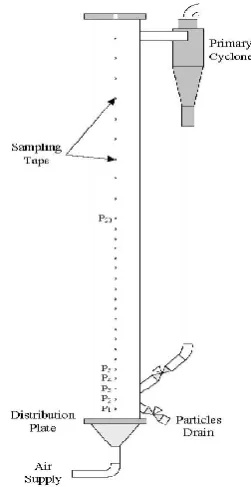
Figure 1. Schematic view of the experimental setup. P1, P2, … are sampling taps.
Table 1. Properties for particles.
of these parameters is cross average diagonal line
(CLave) which represents the average amount of similarity states between trajectories of the two
systems and the time that both systems stay
at-tuned. This parameter is defined as:
(3)
where P(l) is the number of diagonal line of
leng-th l.
Cross recurrence analysis was done for both normalized and non-normalized signals.
The signal was normalized as follows:
(4)
3. Experiments
Experiments were conducted in a column made of a Plexiglas pipe of 15 cm inner diameter and 2 m height. The experimental setup is schematically shown in Fig. 1. Air enters the column at ambient
temperature through a perforated plate distribu
-tor with 435 holes of 1.7 mm diameter arranged
in a 7 mm triangular pitch. Gas flow rate was mea
-sured and controlled by a mass flow controller (MFC). A cyclone was utilized to separate particles from air at high superficial velocities and return them back to the bed. The initial aspect ratio of solids in all experiments was one.
A pressure probe (Piezoresistive transducer,
Kobold Co., SEN-3248 B075) was used to mea
-sure pres-sure fluctuations of the bed at 10 cm above distributor. This probe had a response time of less than 1 ms. Absolute pressure fluctuations were recorded through a probe of 50 mm length and 4mm diameter with a fine mesh on its tip. The
measured signals were band-pass filtered (hard
-ware) at lower cut-off frequency of 0.1 and upper cut-off Nyquist frequency of 200 Hz. The pressure
transducer was connected to a 16-bit data acquisi
-tion board (Advantech 1712L). The filtered signals were then amplified with a gain of 100. In order to
satisfy the Nyquist criterion the sampling frequen
-cy for pressure fluctuation signals was adjusted to 400 Hz. The sampling frequency used in this work was 50 to 100 times more than the average cycle
frequency which is required for nonlinear evalua
-tion of the pressure fluctua-tions in bubbling fluid
-ized bed [23, 24].
3 Recurrence plot was first introduced by Eckmann et al. [15]. This technique is a method to visualize the recurrences of a dynamical system. A RP prepares a qualitative pattern of the time-series correlations over all available time scales. This method can be used for non-stationary and short-term data. An advantage of this method is that it does not need embedding parameters and all information can be extracted from the non-embedded signal [21].
RP is a two dimensional plot extracted from a distance matrix and can visualize structures of the dynamics of the system [22]. The distance matrix is an N×N matrix whose elements are determined based on the distance between points x⃗ i and x⃗ j in the phase space. For construction of RP, a radius threshold is specified and the plot is defined as:
𝑅𝑅𝑖𝑖.𝑗𝑗(𝜀𝜀) = 𝛩𝛩 (𝜀𝜀 − ||𝑥𝑥 𝑖𝑖− 𝑥𝑥 𝑗𝑗||) . 𝑖𝑖. 𝑗𝑗 = 1. … . 𝑁𝑁
(1)
Where N is the number of measured points, x⃗ i, ε is threshold distance, 𝛩𝛩(.) is the Heaviside function and |.| is a norm for indicating the difference between trajectories. The Heaviside function is a tool for comparing two trajectories. If difference of each trajectories is greater than ε the Heaviside function will be equal to zero,
Ri,j(ε)=0. In opposite, if the distance is less than ε, the Heaviside function will be equal to one, Ri,j(ε)=1. For plotting this matrix, a black dot is shown where Ri,j(ε)=0 and a white dot where Ri,j(ε)=1. According to its definition, RP is a symmetric plot and its main diagonal is black. According to this definition, each point shows the recurrences of dynamical system states.
2.2 Cross Recurrence Plot
CRP is an extension of RP which is capable of analyzing dependencies of two dynamical
systems in all times by comparing their states [20]. The CRP investigates the dynamics of two systems in one phase space and then displays it into a plot. The cross recurrence matrix is defined as:
𝐶𝐶𝑅𝑅𝑖𝑖.𝑗𝑗𝑥𝑥 𝑖𝑖.𝑦𝑦⃗ 𝑗𝑗(𝜀𝜀) = 𝛩𝛩 (𝜀𝜀 − ||𝑥𝑥
𝑖𝑖− 𝑦𝑦 𝑗𝑗||) . 𝑖𝑖 = 1. … . 𝑁𝑁 ; 𝑗𝑗 = 1. … . 𝑀𝑀
(2)
Where N is the number of first measured variable x⃗ i and M is the number of second measured variable y⃗ i. In the CRP, the length of measured variables, x⃗ i and y⃗ i, are not to be necessarily equal. However, in the present work, N and M were considered to be equal and the trajectories on phase space were constructed based on the time-series for both systems. Due to the difference in the two systems, the main diagonal of CRP is not entirely black and the plot is not symmetric. Moreover, according to this definition a black dot in the CRP is not an indication of the recurrence of system but declares the similarity states between the two systems.
2.3 Cross Recurrence Quantification Analysis
Quantification of CRP structures is performed by applying the CRQA. The CRQA determines how and how often the two systems show similar patterns of change or movement. CRQA parameters are defined such that they would have a physical interpretation. Some of these parameters are defined based on the diagonal structures and are used for articulating the coordination of two systems. One of these parameters is cross average diagonal line (CLave) which represents the average amount of similarity states between trajectories of the two systems and the time that both systems stay attuned. This parameter is defined as:
N
l N
L l
l P
l lP CLave
1 () ) (
min (3)
Where P(l) is the number of diagonal line of length l.
Cross recurrence analysis was done for both normalized and non-normalized signals. The signal was normalized as follows:
S S i n S
S (4)
3.
Experiments
Experiments were conducted in a column made of a Plexiglas pipe of 15 cm inner diameter and 2 m height. The experimental setup is schematically shown in Fig. 1. Air enters the column at ambient temperature through a perforated plate distributor with 435 holes of 1.7 mm diameter arranged in a 7 mm triangular pitch. Gas flow rate was measured and controlled by a mass flow controller (MFC). A cyclone was utilized to separate particles from air at high superficial velocities and return them back to the bed. The initial aspect ratio of solids in all experiments was one.
A pressure probe (Piezoresistive transducer, Kobold Co., SEN-3248 B075) was used to measure pressure fluctuations of the bed at 10 cm above distributor. This probe had a response time of less than 1 ms. Absolute pressure fluctuations were recorded through a probe of 50 mm length and 4mm diameter with a fine mesh on its tip. The measured signals were band-pass filtered (hardware) at lower cut-off frequency of 0.1 and upper cut-off Nyquist frequency of 200 Hz. The pressure transducer was connected to a 16-bit data acquisition board (Advantech 1712L). The filtered signals were then amplified with a gain of 100. In order to satisfy the Nyquist criterion the sampling frequency for pressure fluctuation signals was adjusted to 400 Hz. The sampling frequency used in this work was 50 to 100 times more than the average cycle frequency
which is required for nonlinear evaluation of the pressure fluctuations in bubbling fluidized bed [23, 24].
Experiments were carried out with different Geldart B particles. For each sample 65535 data points were recorded which corresponding to about 164 seconds of sampling time. Size, minimum fluidization velocity (calculated using Wan and Yu Equation [25]) and velocity of onset of turbulent fluidization (calculated using standard deviation) of these particles are given in Table 1. Different superficial gas velocities in the range of 0.03 m/s to 1.2 m/s were used in the tests.
4.
Result and Discussion
4.1 Cross recurrence plot
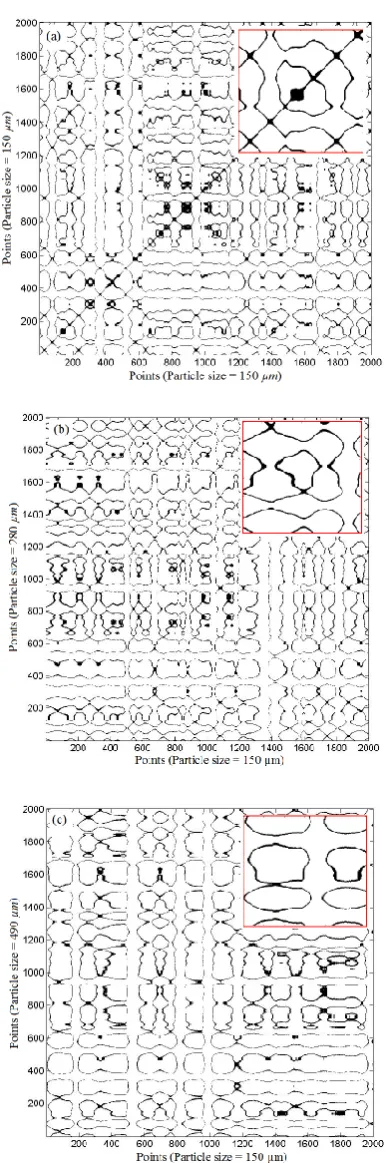
Hydrodynamics of fluidized beds could also be studied by the CRP method. The CRP of normalized pressure fluctuations of the fluidized bed considered in this work, is shown in Fig. 2 for different particle sizes at 0.3 m/s superficial gas velocity. Here, pressure fluctuation of the bed of 150 µm particles was considered as the reference signal. Radius threshold ε=0.01 and 2000 data points as the epoch length were used to construct the cross recurrence matrix. The CRP of the fluidized bed system with the same particle size (150 µm) and the same superficial gas velocity (0.3 m/s) is shown in Fig. 2(a). As mentioned previously, the CRP becomes a RP when two identical signals are used in Eq. (2). As expected, the LOI (line of identity) or main diagonal line of RP are completely seen in this figure. Fig. 2(b) demonstrates the CRP of pressure fluctuations of two different states of the bed. While the first signal is measured at particle size of 150 µm and superficial gas velocity of 0.3 m/s, the second signal is obtained from the bed of 280 µm particles and 0.3 m/s superficial gas velocity. It can be seen in this figure that the LOI is
Fig. 1 Schematic view of the experimental setup. P1, P2, … are sampling taps.
Mean particle
size (µm) (kg/mDensity 3) Umf (m/s) Uc (m/s)
150 2640 0.029 0.9
280 2640 0.059 1.1
490 2640 0.182 1.3
Experiments were carried out with different Geldart B particles. For each sample 65535 data points were recorded which corresponding to
about 164 seconds of sampling time. Size, mini
-mum fluidization velocity (calculated using Wan and Yu Equation [25]) and velocity of onset of turbulent fluidization (calculated using standard deviation) of these particles are given in Table 1. Different superficial gas velocities in the range of 0.03 m/s to 1.2 m/s were used in the tests.
4. Result and Discussion
4.1 Cross recurrence plotHydrodynamics of fluidized beds could also be
studied by the CRP method. The CRP of normal
-ized pressure fluctuations of the fluid-ized bed
considered in this work, is shown in Fig. 2 for dif
-56 H. Ziaei-Halimejani et al. / Journal of Chemical and Petroleum Engineering, 50 (2), Feb. 2017 / 53-60
13
14
15
Fig. 2 Cross recurrence plots pressure fluctuations of different states of the fluidized bed with different particle size at 0.3 m/s superficial gas velocity; (a) both 150 µm, (b) 150 µm and 280 µm, and (c) 150 µm and 490 µm. All plots were drawn using 2000 points of normalized signals and threshold of 0.08.
Figure 2. Cross recurrence plots pressure fluctuations of different states of the fluidized bed with different particle size at 0.3 m/s superficial gas velocity; (a) both 150 µm, (b) 150 µm and 280 µm, and (c) 150 µm and 490 µm. All plots were drawn using 2000 points of normalized signals and threshold of 0.08.
locity. Here, pressure fluctuation of the bed of 150
µm particles was considered as the reference sig
-nal. Radius threshold ε=0.01 and 2000 data points as the epoch length were used to construct the cross recurrence matrix. The CRP of the fluidized bed system with the same particle size (150 µm) and the same superficial gas velocity (0.3 m/s) is shown in Fig. 2(a). As mentioned previously, the CRP becomes a RP when two identical signals are
used in Eq. (2). As expected, the LOI (line of iden
-tity) or main diagonal line of RP are completely seen in this figure. Fig. 2(b) demonstrates the CRP of pressure fluctuations of two different states of
the bed. While the first signal is measured at par
-ticle size of 150 µm and superficial gas velocity of
0.3 m/s, the second signal is obtained from the bed
of 280 µm particles and 0.3 m/s superficial gas velocity. It can be seen in this figure that the LOI is disrupted and density of diagonal structures is less than in the RP. Fig. 2(c) shows the CRP of the bed with 150 µm and 490 µm particles. There is no pattern similar to the RP in this figure. Therefore,
it can be concluded that the CRP can detect hydro
-dynamic similarities and differences between two states of the bed. It can be seen in Fig. 2 that single dots are rarely present in the CRP of the fluidized
bed which demonstrates their non-stochastic na
-ture. Therefore, the fluidized bed behaves between
stochastic (chaotic) and predictable (periodic sys
-tem as a regular one) sys-tems. This result has also
been proven by recurrence analysis and it has been confirmed that dynamical behavior of fluidized beds is placed between stochastic and predictable systems [16].
4.2 Cross Recurrence Quantification Analysis
Input parameters (i.e., embedding dimension, time
delay, minimum length of diagonal line and radius
threshold) and length of epoch should be specified for analyzing the pressure signals of fluidized beds by CRQA. Prior to parameter selection, the length of epoch (N) for the CRQA calculations should be discussed. The effect of number of data points has been investigated in Fig. 3 and it was concluded that CRQA variable studied in this work do not change considerably for N bigger than 2000. This shows that CRP method gives useful information with low amounts of data, concluding that it is a
powerful and easy method for fluidized bed analy
-sis. Effect of changes in Embedding dimension and
time delay parameters were studied in this work but there were not radical differences in the re -sults. Therefore, embedding dimension of 2 and
57 H. Ziaei-Halimejani et al. / Journal of Chemical and Petroleum Engineering, 50 (2), Feb. 2017 / 53-60
quantitative parameters that can reveal changes
in particle size and superficial gas velocity was ex
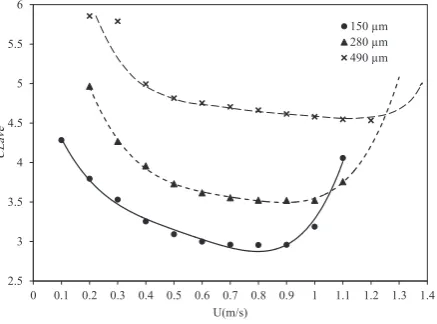
-ploited. Cross average diagonal line of CRP of two time series with different superficial gas veloci
-ties is shown in Fig. 4. As can be seen in this figure, when data are not normalized, CLave changes with changing in the superficial gas velocity. In fact,
CLave decreases with increasing the superficial gas velocity since decreasing the attunement time
of two time series results in smaller CLave. Never
-theless, the CLave increases at higher gas veloci -ties. This change in the trend occurs at 0.8-0.9 m/s,
1.0-1.1 m/s and 1.2-1.3 m/s, respectively, for 150
µm, 280 µm and 490 µm particles. These veloci
-ties coincide with the transition from bubbling to turbulent fluidization regime. In fact, by increasing the superficial gas velocity in the bubbling regime,
bubbles (macro-structures) increase in the bed
(i.e., more heterogeneity) which results in decreas
-ing similarities of the two time series. This trend continues until the largest possible bubbles are formed in the bed, i.e., at the onset of turbulent flu
-idization. On the other words, CLave decreases
be-cause of decreasing attunement time of the system
state with reference signal. Beyond this velocity, bubbles (macro structures) transform into voids
(meso structures) and the share of macro struc-tures decreases in the hydrodynamics of the bed after transition to turbulent regime. On the other
words, dynamics of system changes and CLave
in-creases while velocity transition is occurred. In fact, the fluidized bed in the turbulent regime is
more homogeneous than in the bubbling regime.
Sensitivity of CRQA parameters to change in the superficial gas velocity can be decreased by nor
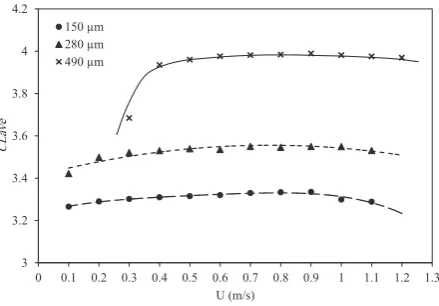
-malizing the signals. Fig. 5 shows CLave of CRP be
-tween two states of the fluidized bed as a function
of superficial gas velocity using normalized pres
-sure fluctuations. In this figure, pres-sure fluctua -tions signal at U=0.9 m/s (as specified with dash line) was considered as the reference. It can be seen
in Fig. 5 that CLave of normalized signals change very gradually against superficial gas velocity. This demonstrates that this parameter is not sensitive to small variations of superficial gas velocity.
Effect of particle size on CRQA of pressure fluc
-tuations of fluidized bed was also investigated in
this work. Fig. 6 shows the variation of CLave as a
function of particle size at various gas velocities. Normalized pressure fluctuations of the bed of 150 µm particles were considered as the reference
signal. It can be seen in this figure that CLave
de-creases with increasing the particle size. The CLave
at 150 µm particle size is related to attunement
time of the system (obtained from the RP). CLave
16
Fig. 3 Cross average diagonal line of cross recurrence plot of different states within the fluidized bed as a function of epoch length. Pressure fluctuations of the fluidized bed of size 150 µm
particles were considered as the reference. U=0.5 m/s; ε=0.08 and ε=0.01 are considered for
normalized signal and non-normalized signal respectively. 3
3.1 3.2 3.3 3.4 3.5 3.6 3.7 3.8 3.9 4
0 400 800 1200 1600 2000 2400 2800 3200
CLa
ve
Epoch Length
280 µm-Normalized 280 µm-Non-normalized
Figure 3. Cross average diagonal line of cross recurrence plot of different states within the fluidized bed as a function of epoch length. Pressure fluctuations of the fluidized bed of size 150 µm particles were considered as the reference. U=0.5 m/s; ε=0.08 and ε=0.01 are considered for normal -ized signal and non-normal-ized signal respectively.
17
Fig. 4 Cross average diagonal line of cross recurrence plot of two states of the bed as a function of superficial gas velocity. Pressure fluctuations at U/Umf=1.5 is considered as the
reference signal. Epoch length= 2000 points, ε=0.01, and total length of time series= 65535 points. Signal is non-normalized.
2.5 3 3.5 4 4.5 5 5.5 6
0 0.1 0.2 0.3 0.4 0.5 0.6 0.7 0.8 0.9 1 1.1 1.2 1.3 1.4
CLa
ve
U(m/s)
150 µm 280 µm 490 µm
Figure 4. Cross average diagonal line of cross recurrence plot of two states of the bed as a function of superficial gas velocity. Pressure fluctuations at U/Umf=1.5 is considered as the reference signal. Epoch length=2000 points, ε=0.01, and total length of time series=65535 points. Signal is non-normalized.
length of diagonal line is (Lmin) 2 [19, 26, 27]. Ac
-cordingly, the optimum values of minimal length of diagonal lines have been chosen to be 2. The last input parameter is the radius threshold (ε), which determines the number of points appeared in the
cross recurrence plot. In this work, the suitable ra
-dius threshold, based on the method proposed by Webber and Zbilut [28], was obtained ε=0.01 for non-normalized and ε=0.08 for normalized signal.
To explore the ability of CRQA in detecting
58 H. Ziaei-Halimejani et al. / Journal of Chemical and Petroleum Engineering, 50 (2), Feb. 2017 / 53-60
5. Conclusion
CRQA method is a powerful tool to online detection of hydrodynamic status of a gas-solid fluidized bed. CRP of pressure fluctuation of the fluidized bed at various experimental conditions was obtained and the bed hydrodynamics changes were detected by cross average diagonal line. It was concluded that in the bubbling regime of fluidization, average
similarities of the systems decrease with increas
-ing the superficial gas velocity. However, cross av
-erage diagonal line increases in the turbulent
re-gime which indicates that the bed becomes more homogeneous in this condition. It was shown that cross average diagonal line of normalized signal is
not sensitive to changes in the superficial gas ve
-locity which is beneficial to detect the changes in particle size. Also, it was shown that cross average
diagonal line can detect the change of mean par
-ticle size in the bed and it varies significantly even if the signal is normalized.
Nomenclature
18
Fig. 5 Cross average diagonal line of cross recurrence plot of two systems as a function of superficial gas velocity. Pressure fluctuations at superficial gas velocity 0.9 m/s is considered as the reference signal. Epoch length= 2000 points, ε=0.08, total length of time series= 65535 points. Signal is normalized.
3 3.2 3.4 3.6 3.8 4 4.2
0 0.1 0.2 0.3 0.4 0.5 0.6 0.7 0.8 0.9 1 1.1 1.2 1.3
CLa
ve
U (m/s)
150 µm 280 µm 490 µm
Figure 5. Cross average diagonal line of cross recurrence plot of two systems as a function of superficial gas veloc -ity. Pressure fluctuations at superficial gas velocity 0.9 m/s is considered as the reference signal. Epoch length=2000 points, ε=0.08, total length of time series=65535 points. Signal is normalized.
Figure 6. Cross average diagonal line of CRP between two states as a function of particle size. In all cases, state with particle size 150 µm is considered as the reference. Epoch Length=2000 points, total length of time series=65535, ε=0.08. Signal is normalized.
19
Fig. 6 Cross average diagonal line of CRP between two states as a function of particle size. In all cases, state with particle size 150 µm is considered as the reference. Epoch Length= 2000 points, total length of time series=65535, ε=0.08. Signal is normalized.
2.9 2.95 3 3.05 3.1 3.15 3.2 3.25 3.3 3.35 3.4
150 280 490
CLa
ve
Particle size of second signal 0.5 m/s
0.9 m/s
of the system with 280 µm particle size is related to attunement time of CRP between two states of the system with different particle sizes (150 µm as reference state and 280 µm as the evaluating one) and the same superficial gas velocity. It can be seen
that CLave at 280 µm is slightly less than that one at 150 µm, but the difference is not meaningful.
When particle size increases to 600 µm, change of
CLave is considerable. This shows that CLave can
detect particle size changes in fluidized bed.
CR Cross recurrence matrix between two phase space trajectories
CRij Cross recurrence point CRP Cross recurrence plot
CRQA Cross recurrence quantification analysis Clave Cross average diagonal line
DM Distance matrix between phase space vectors i,j Indices
Lmin Minimum diagonal line length L Diagonal line length
M Embedding dimension
M Number of data points for second signal
N Number of data points for first signal or refer -ence signal
Nl Number of diagonal line
P(l) Number of diagonal line of length l
R Recurrence matrix between two phase space trajectories
Rij Recurrence point Sn Normalized signal Si Non-normalized signal U Superficial gas velocity (m/s)