in the population sciences published by the Max Planck Institute for Demographic Research Konrad-Zuse Str. 1, D-18057 Rostock · GERMANY www.demographic-research.org
DEMOGRAPHIC RESEARCH
VOLUME 19, ARTICLE 20, PAGES 705-742
PUBLISHED 01 JULY 2008
http://www.demographic-research.org/Volumes/Vol19/20/ DOI: 10.4054/DemRes.2008.19.20
Research Article
Lithuania:
Fertility decline and its determinants
Vlada Stankuniene
Aiva Jasilioniene
This publication is part of Special Collection 7: Childbearing Trends and Policies in Europe (http://www.demographic-research.org/special/7/)
© 2008 Stankuniene & Jasilioniene.
1 Introduction 706
2 Fertility trends: period and cohort analysis 707
2.1 Period fertility trends 707
2.1.1 Period total fertility rate 707
2.1.2 Age pattern of fertility: signs of postponement 708
2.1.3 Tempo effects in the fertility decline 709
2.2 Cohort fertility trends 713
2.2.1 Completed cohort fertility 713
2.2.2 Changing age pattern of cohort fertility 713
2.2.3 Family size and composition 716
3 Determinants of the shifting fertility level and pattern 718
3.1 Economic determinants of the transformational period 719
3.1.1 Economic instability: swings in GDP, unemployment and inflation 720
3.1.2 Economy by sectors 721
3.1.3 Income, poverty 722
3.2 Transformation effect factors 723
3.3 Determinants inherited from the Soviet system 727
3.4 Demographic determinants 727
3.5 Determinants of the second demographic transition in the transformational environment
730
3.5.1 Individualisation 730
3.5.2 Female emancipation 731
3.5.3 Modern methods of contraception 733
4 The development of family policy in Lithuania: problem of priorities
734
5 Concluding remarks 738
Lithuania:
Fertility decline and its determinants
Vlada Stankuniene1
Aiva Jasilioniene2
Abstract
Since the beginning of the 1990s, Lithuania has been undergoing significant transformations in family life and has experienced a precipitous decline in fertility. The determinants of the changes are diverse in character and are associated with socioeconomic transformations, economic difficulties faced by the post-Soviet society, inadequate social and family policies and changing value orientations and life styles. This article traces the fertility trends in Lithuania from the period and cohort perspective, providing adjusted TFR estimates that reveal the significance of the tempo effect on the recent decline in fertility. Furthermore, the main factors leading to the recently observed changes in family and fertility are identified and analysed. Finally, the characteristic features and necessary improvements of current Lithuanian family policy and its possible effects on individual behaviour and fertility trends are discussed.
1 Demographic Research Center, Institute for Social Research, Saltoniskiu str. 58, 08105 Vilnius, Lithuania. E-mail: [email protected]
1. Introduction
In Lithuania, as in all the former socialist countries of Central and Eastern Europe, rapid family transformation started at the beginning of the 1990s. The set of changes that have been taking place since 1990 strongly resemble the ones that the northern and western European countries experienced about four decades ago, followed by the southern European countries somewhat later. These changes are summarized under the label of the second demographic transition (van de Kaa, 1987). Throughout this period, fertility has been rapidly and steadily declining in Lithuania, reaching a level far below that required for population replacement. At present, fertility in Lithuania is one of the lowest in the EU.
The factors that provoked these dramatic changes in family and fertility are numerous and diverse in their character, origin and significance. Some seem long lasting and some were rather short lived. Overall, it is evident that the initial stimulus for family transformation and fertility decline in Lithuania was the rapid change in the social and economic environment, resulting from difficulty in adapting to changing living conditions. Decreased living standards, the spread of unemployment, the loss of secure income and the shortage and increasing price of accommodation have caused the postponement of marriage, a decrease in fertility and have encouraged the spread of new patterns of family and fertility behaviour. The influence of social and economic factors on the demographic behaviour of the population is still being experienced. Yet, with the strengthening of the market economy and stabilisation of the socio-economic situation, the demographic behaviour of the Lithuanian population is becoming more affected by the fundamental factors identified by van de Kaa (1987), the author of the theory of the second demographic transition. These include deepening individualisation, emancipation, growing individual freedoms and rights, and technological progress (the availability of modern methods of family planning). Changes in family and childbearing dynamics have also been accelerated by intensifying short term migration flows between Lithuania and Western countries. Lithuanian society has been absorbing and adopting the lifestyles, value orientations, and norms of behaviour prevailing in more advanced Western countries.
parties in the majority each time, the basic motives underpinning family policy development also change rather cardinally. Due to the inconsistency of the ideology, and the mixture of political motives, family policy measures have been developed in a rather fragmented manner, without regard to available conceptual and strategic outlines or international practice. The main focus is still financial measures, ignoring other non-financial forms of family support and their significance for the independent and autonomous functioning of the family.
This article is a country case study discussing recent childbearing trends, their determinants and current family policy in Lithuania. The study refers to several sources of data; vital statistics, the 2001 census of Lithuania, Fertility and Family Survey3 (1994-1995), the European Comparative Population-Related Policy Acceptance Survey4 (2001), and data from the most recently conducted Lithuanian Family Survey5 (2005).
2. Fertility trends: period and cohort analysis
2.1 Period fertility trends
2.1.1 Period total fertility rate
For many years before the 1990s, the period total fertility rate (TFR) of Lithuania stood close to a level sufficient to ensure population replacement, i.e. it was close to 2.0 (see Figure 1). Even in the period 1990 to 1992, it ranged between 2.03 and 1.97. Soon afterwards, however, a major break occurred and a rapid decline started. The sharpest drop in the TFR was recorded in 1993 and 1994, when the fertility level fell (from 1.97 in 1992) to 1.57 in 1994. Since the mid 1990s, the TFR has been continuously decreasing with a short slowdown in the period 1995 to 1998 and an acceleration in the period 1999 to 2000. In 2002, to use the term introduced by Kohler, Billari and Ortega (2002), period fertility reached its lowest-low level in Lithuania. The TFR fell below 1.3 and stayed in the range of 1.24 to 1.27 throughout the period 2002 to 2005.
3 The Fertility and Family Survey was carried out in Lithuania by the Demographic Research Centre of the Institute for Social Research in 1994-1995. 2000 males and 3000 females aged 18 to 49 years were interviewed.
4 European Comparative Population-Related Policy Acceptance Survey was carried out in Lithuania by the Demographic Research Centre of the Institute for Social Research in 2001. The sample consisted of 613 males and 787 females aged 18 to 75 years.
Figure 1: Period total fertility rate, 1960-2005
1.0 1.2 1.4 1.6 1.8 2.0 2.2 2.4 2.6 2.8
1960 1965 1970 1975 1980 1985 1990 1995 2000 2005
Source: Statistics Lithuania 2006.
2.1.2 Age pattern of fertility: signs of postponement
Figure 2: Period age specific fertility rates by age group, 1980–2005
0.00 0.02 0.04 0.06 0.08 0.10 0.12 0.14 0.16 0.18
1980 1985 1990 1995 2000 2005
30-34 25-29
35-39
15-19 40-44 20-24
Source: Statistics Lithuania 2006.
2.1.3 Tempo effects in the fertility decline
One of the significant shortcomings of the period fertility indicators, which, currently, is well recognized and widely discussed among demographic researchers, is their sensitivity to changes in the timing of childbearing. The postponement of births, though only very recently observed and still rather modest in Lithuania, distorts the period fertility measures. It is therefore difficult to identify to what extent the recent decline in the TFR is an outcome of a timing change and to what extent it is due to a “real” (quantum) reduction in fertility.
fertility than the period TFR does (Philipov and Kohler 2001, Philipov and Dorbritz 2003, Sobotka 2003 and, 2004, Lesthaeghe and Willems 1999, and others). Nevertheless, even given all its advantages, the adjusted TFR remains a period measure and its interpretations should be treated with caution.
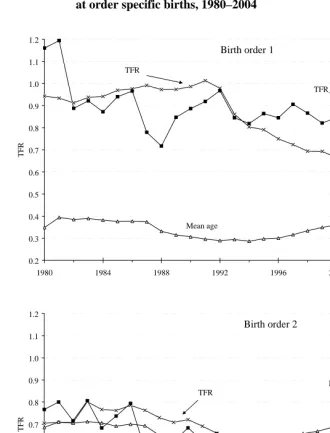
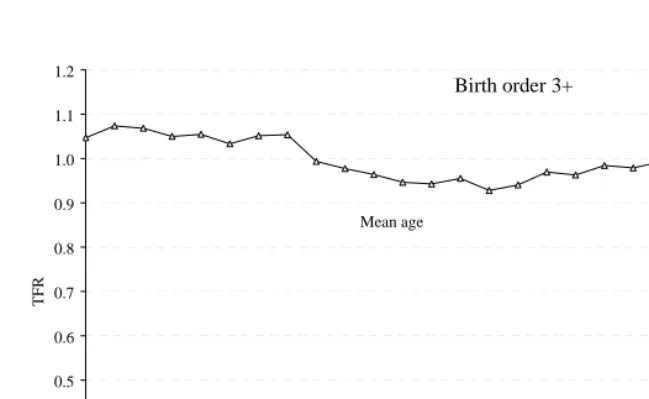
Using the BF formula, the adjusted TFRs for Lithuania were calculated for the period 1980 to 2003. The observed and adjusted TFRs, for different birth orders separately, all births together and mean ages at childbearing, are presented in Figures 3 and 4. The adjusted TFR demonstrates that both the decrease and increase in mean age at childbearing have a significant impact on fertility trends. The effect of the former dominated in Lithuania in the period before 1990, while the latter has been gaining influence since 1995. The adjusted TFR and observed TFR exhibit quite similar patterns of change, but the adjusted TFR is higher than its period equivalent in regards to both all births and order specific births after 1994, confirming the importance of tempo effects in the persistent downward fertility trends. The quantum effect was primarily responsible for fertility decline during the first years of the 1990s (until 1995). Later, with the intensifying postponement effect, its influence decreases, but still remains relatively noticeable.
Figure 3: Observed and adjusted TFR and mean age of women at all births,
1980-2004
TFR
TFR_adj
Mean age
0.0 0.5 1.0 1.5 2.0 2.5 3.0
1980 1984 1988 1992 1996 2000 2004
TF
R
22 24 26 28 30 32 34
M
ean ag
e at
al
l bi
rt
hs
All births
Figure 4: Observed and adjusted TFR and mean age of women at order specific births, 1980–2004
TFR TFR_adj Mean age 0.2 0.3 0.4 0.5 0.6 0.7 0.8 0.9 1.0 1.1 1.2
1980 1984 1988 1992 1996 2000 2004
TFR 22 24 26 28 30 32 34 M ean a g e a
t 1st bi
rt
h
Birth order 1
TFR TFR_adj Mean age 0.2 0.3 0.4 0.5 0.6 0.7 0.8 0.9 1.0 1.1 1.2
1980 1984 1988 1992 1996 2000 2004
TF R 22.0 24.4 26.8 29.2 31.6 34.0 Me an a g e a
t 2nd bir
th
Figure 4: (continued) Observed and adjusted TFR and mean age of women at order specific births, 1980–2004
TFR_adj TFR
Mean age
0.2 0.3 0.4 0.5 0.6 0.7 0.8 0.9 1.0 1.1 1.2
1980 1984 1988 1992 1996 2000 2004
TFR
22.0 24.4 26.8 29.2 31.6 34.0
Me
an
age
at 3r
d bir
th
Birth order 3+
Sources:Statistics Lithuania 2005, Statistics Lithuania 2007, Eurostat New Cronos Database, HMDdatabase.
The effect of postponement of births is particularly evident for the first and second order TFRs. The graphs in Figure 4 show that the decline in the period TFR observed from the mid 1990s has been mainly brought about by the postponement and decline of first and second births. The timing and quantum of third and subsequent births have changed to a much lesser extent, and their contribution to the difference between the observed and adjusted TFRs is less substantial.
2.2 Cohort fertility trends
2.2.1 Completed cohort fertility
Completed cohort fertility rates are the best indicators of the actual fertility level. However, they can be calculated only after women of the particular birth cohort have reached the end of their reproductive life span. In Lithuania, the fertility rates for women over 40 years of age are very low. Taking this into account, the youngest cohort of women that we have included in the analysis is that for the year 1960. Women born in 1960 were about 41 years old at the time of the population census in 2001 (a source of data for our analysis) and, therefore, can be considered as having essentially completed their childbearing years.
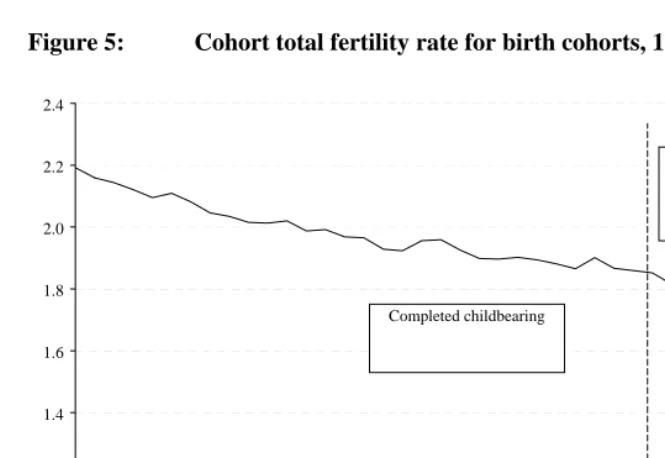
The cohort fertility curve, which is depicted in Figure 5, reflects a rather smooth and gradual decline in fertility from 2.19 to 1.85 children in the birth cohorts, 1930 through 1960. It is worth noting that, despite the observed downward trend, the completed cohort fertility among women born before the 1960s is still very close to the replacement level.
2.2.2 Changing age pattern of cohort fertility
Figure 5: Cohort total fertility rate for birth cohorts, 1930-19706
1.0 1.2 1.4 1.6 1.8 2.0 2.2 2.4
1930 1935 1940 1945 1950 1955 1960 1965 1970
Year of birth Completed childbearing
Not yet completed childbearing
Source: Statistics Lithuania 2004 (2001 population census data).
Figure 7). The curve presenting the age specific, fertility rates for the 1980/81 birth cohort illustrates that there might be a return to one fertility peak in the future, but it would be at considerably higher ages than before.
Figure 7 shows the changes in the shapes of the age specific, fertility curves cohort by cohort for the birth cohorts that have been particularly receptive to the profound societal changes. The 1970/71 and 1971/72 birth cohorts are the last ones with a very pronounced fertility peak at an early age and constitute break points in the shift of the age pattern of cohort fertility. It is noteworthy that women belonging to these cohorts came of age around 1989 to 1990 when there were highly specific circumstances in Lithuania. First, important family policy measures encouraging childbearing were adopted in 1989. Second, those were years of national revival. Family and children were exalted as the highest value of the nation and as a guarantee of its survival, which
Figure 6: Cohort age specific fertility rates among women born in 1950/51 to 1980/81
0.00 0.05 0.10 0.15 0.20
15 20 25 30 35 40 45
Age
1950-51 1960-61 1970-71 1975-76 1980-81
Source: Statistics Lithuania 2005.
also contributed to the creation of an atmosphere favourable to childbearing. Third, in order to escape military service in the Soviet army, right before Lithuania’s declaration of independence and for some time after it, young men (mostly born in the period 1970 to 1972) started families earlier than usual. Marriage and having small children was one of the legal ways to avoid conscription or to postpone it. All these specific factors fostered high fertility rates at early ages among many women born in the period 1970 to 1972 (for a more extensive description, see the FFS findings in Stankuniene et al. 2000). Women born from 1973 onwards exhibit a different age pattern of childbearing, characterized by a shift away from early motherhood.
Figure 7: Cohort age specific fertility rates for most recent birth cohorts from
1970/71 to 1980/81
0.00 0.05 0.10 0.15 0.20
15 16 17 18 19 20 21 22 23 24 25 26 27 28 29 30 31 32 33 34
Age
1970-71 1971-72 1972-73 1974-75 1976-77 1978-79 1980-81
Source: Statistics Lithuania 2005.
2.2.3 Family size and composition
Figure 8: Cohort parity progression ratios for birth cohorts 1930–1960; probability of having a child or another child by current parity
0 10 20 30 40 50 60 70 80 90 100
1930 1935 1940 1945 1950 1955 1960
Year of birth
Pe
rce
n
t
parity 0 parity 1 parity 2 parity 3 parity 4
Source: Statistics Lithuania 2004 (2001 census data).
Figure 9: Parity distribution, birth cohorts, 1930–1960
0 10 20 30 40 50 60
1930 1935 1940 1945 1950 1955 1960
Year of birth
Pe
rce
n
ta
ge
Childless 1 child 2 children 3 children 4+ children
Source: Statistics Lithuania 2004 (2001 population census data).
3. Determinants of the shifting fertility level and pattern
• macro (societal level) — economic, social, cultural and political conditions; and • micro (individual, family level) — psychological, demographic and other factors.
During the period of recent transformations, all spheres of public and private life have been changing fundamentally and rapidly, and all these changes have had an effect on childbearing behaviour and fertility patterns.
Thus, the variety of determinants is great. Some of them are short lived, and the estimation of their strength on the changes in fertility is far from easy. Nevertheless, the theoretical, empirical and practical information available makes it possible to identify some of the determinants and assess their impact, at least on a hypothetical level.
This section provides an overview of the key determinants that have affected the decline in fertility in Lithuania. The determinants, it is necessary to say, are closely interrelated and it is therefore not possible to avoid some overlap. They have been grouped as follows:
• economic determinants of the transformational period: economic transformations, economic crises, unemployment, low income, poverty, etc.;
• transformation effect factors: deprivation, anomy, etc., (also discussed by Philipov 2001 and 2002);
• determinants inherited from the Soviet system: lack of dwelling, orientation towards paternalistic state policy, conflict between patriarchal attitudes and emancipation and specifics of female employment;
• demographic determinants: emigration of youth, family de-institutionalisation and changes in family formation;
• determinants of the second demographic transition in the transformational environment: individualisation, emancipation, increasing freedom of choice, secularisation, modern methods of contraception, etc., (van de Kaa 1987, Lesthaeghe 1995, Surkyn and Lesthaeghe 2004, and others).
3.1 Economic determinants of the transformational period
enterprises which were producing for the military industry of the USSR. The reorganisation and privatisation of the entire economic chain, which took place simultaneously, also had a destabilising effect on the economy of the country.
3.1.1 Economic instability: swings in GDP, unemployment and inflation
At the beginning of the 1990s, an economic crisis, that dragged on until 1995, erupted in Lithuania. During this period, GDP dropped sharply (Figure 10). Between 1992 and 1993 it lost more than 15 per cent a year. The inflation rate was very high, in fact at the hyperinflation level (1163 per cent) in 1992, which had a pauperising effect on a large portion of the population and increased income inequality in the society. Significant changes were taking place in the sphere of employment. A western type labour market was just emerging, alongside which unemployment appeared and was rising. For a society, which had had no previous experience of functioning under labour market conditions, not to mention in the environment of a deep crisis, the blow was tremendous. Furthermore, the institutional labour market system was forming slowly. At the beginning of the 1990s, Lithuanian society experienced a nearly five year long, extreme economic decline.
Figure 10: Changes in gross domestic product (per cent) and TFR in Lithuania
-25 -20 -15 -10 -5 0 5 10 15
1990 1992 1994 1996 1998 2000 2002 2004
1.0 1.3 1.6 1.9 2.2 Gross Domestic Product TFR
Sources: Statistics Lithuania 2005; Statistics Lithuania 2007.
3.1.2 Economy by sectors
During the 1990s, production by sectors changed greatly in Lithuania. The share of GDP produced by industry fell significantly, but that contributed by the service sector rose. In 1992, 49 per cent of GDP was contributed by industry and construction, 39 per cent by services, and 12 per cent by agriculture (Statistics Lithuania 1997). In 2000 these sectors produced 30, 62 and 8 per cent of GDP, respectively (Statistics Lithuania 2000), and in 2004 these figures amounted to 34, 60 and 6 per cent (Statistics Lithuania 2007).
that, despite the marked increase of employment in the service sector, social services are still rather poorly developed.
3.1.3 Income, poverty
Although the economy of Lithuania was very unstable in the 1990s, it was, on the whole growing. GDP per capita increased from US$ 487 in 1992 to approximately € 2600 in 1996, to € 3800 in 2000, and to € 6030 in 2005 (Statistics Lithuania 2007).
Nevertheless, the level of poverty remains rather high. The relative poverty rate was 18 per cent in1995 and 16 to 17 per cent in the period 1998 to 2005 (Statistics Lithuania 2007). The share of expenditures on food has been declining, but continues to be rather high, especially in rural areas. In 1997 the rate was 52 per cent, in 2005 it was 39 per cent, and in rural areas in 2005 it was 49 per cent (Statistics Lithuania 2007).
The economic decline in the first years of transformation caused deterioration in standards of living, and pushed various social and economic groups into poverty. According to data from Statistics Lithuania, a social stratum of young families with a considerably low standard of living emerged. They are young families having more than one child, living apart from their parents, and having at least one breadwinner employed in the public sector, industry, or construction, and families living in rural areas. In addition, data show that living standards are directly related to the number of children in the family, and for almost a decade this situation has not changed. Compared to households with no children, in 1997 the average consumption expenditure per capita per month in households with one child under 18 was 14 per cent lower, and in households with three or more children under 18 this figure was 49 percent lower (UNICEF 1998). In 2005, these figures were, respectively, 15 and 51 per cent lower (Statistics Lithuania 2006c). Poverty is most prevalent in families with children under 18 years of age, and is especially so in households with several children (three and more). The relative poverty level among such families in 1997 and in 2005 was 37 per cent (UNICEF 1998, Statistics Lithuania 2006b).
other determinants. Although the economy of Lithuania has been growing rapidly since the beginning of the 21st century, fertility remains very low.
Economicdeterminants evidently had a strong effect on the decline in fertility at the beginning of the economic transformations and during the crises. In fact, they served as the impetus for the change in family formation, renouncement and postponement of marriage, avoidance of long term matrimonial obligations, etc., and fertility, postponement of childbearing, or having fewer children. However, in the second half of the 1990s, the effect of these economic determinants started to weaken and was increasingly overwhelmed by determinants related to ideational changes that were taking place in the society.
3.2 Transformation effect factors
Some determinants that were forceful at the initial stage, that is, the beginning of the 1990s, of the recent changes in fertility and family might be called the transformation effect factors. Some of them are highly specific determinants and are typical in post-communist countries acquiring the principles of a market economy and a democratic society. They are the determinants that produce a sense of social loss after some of the Soviet era guarantees, such as employment and income, free education and health care. It is worth noting that, in Lithuania, the determinants of the first years of transformation were rather different from those of the later period of transformation.
300,000 or 18 per cent of the total labour force in 1996 (Gruzevskis, 1997). Employment in the shadow economy became a source of income, sometimes even larger than that obtained from official employment, but it could not assure any social guarantees or stability.
Thus, during the first years of the transformations, the establishing of new labour market rules, the lowering of income, and the weakening of social guarantees were taking place in parallel with an economic decline. The changes were rapid and drastic and had significant consequences on marriage and fertility.
In later years, when the Lithuanian national economy had recovered, for the passive segment of the population the loss of social guarantees was still painful and caused deprivation or even poverty, produced doubt about the future and modified childbearing behaviour. Part of the population still has difficulty adapting to the new conditions of the market economy.
A dying away of the centralized and regulated system of housing supply, and transition to an open housing market, accompanied by a great shortage of accommodation, the absence of an alternative system for acquiring a home, and large increases in prices for accommodation have been, and still are, very painful for residents, especially those from the lower social strata. The absence of a favourable loan system for the purchase of a home is a very sensitive issue, particularly for young people, and has had a serious effect on their matrimonial and childbearing behaviour. According to the Population-Related Policy Acceptance Survey (PPAS) (carried out in Lithuania in 2001) data, 95 per cent of respondents in Lithuania indicated that the difficulties young people experience while trying to acquire housing are a very important or important cause for the postponement or renouncement of marriage (Stankuniene et al. 2003).
enrolment rules for universities and vocational schools, the growing proportion of paid studies and rapidly rising costs for professional training.
In the transformational period, major irregularities were also observed in the changing childcare services. In the Soviet period, the network of childcare centres in Lithuania, covering nurseries for children below three years of age and kindergartens for children aged three to six years, was rather more advanced than in the other republics of the Soviet Union. In 1987 about 64 per cent of Lithuanian children aged from one to six years were attending nurseries and kindergartens (Statistics Lithuania 1991, Statistics Lithuania 1992, Statistics Lithuania 1993 and Statistics Lithuania 1994, Socialnoie 1991) (see Figure 11). This was one of the highest levels of participation in the USSR.
Figure 11: Proportion of children attending nurseries and kindergartens from all children of respective age (per cent)
0 10 20 30 40 50 60 70 80
1960 1965 1970 1975 1980 1985 1990 1995 2000 2005
Year
Pe
rc
en
t
Under 3 years 3-6 years
At the beginning of the 1990s, the system of pre-school institutions began vanishing in Lithuania. In this field, the ideology and actions of the government were highly inconsistent. During the first five years of independence, the number of childcare centres in rural areas dropped 72 per cent and in urban areas it fell 38 per cent (Lietuvos gyventoju 2004). The number of children attending childcare centres also fell significantly. Elimination of these services reached a zenith in the period 1990 to 1993. By 1993 just 21 per cent of children from one to six years of age were attending childcare centres. Since the mid 1990s, childcare services in Lithuania have been expanded again (Figure 11), but they still do not meet the requirements of families for quantity, quality, or availability of the services.
Rapid societal transformations also brought about anxiety and confusion in the values and norms of the society. Attitudes to, and assessments of, the observed family changes, obtained during the PPAS, reflect rather well the uncertainty that society has been living through. The survey results show that, although, in general, the new family features (a decrease in the number of marriages, an increase in the number of cohabitations and children born out of wedlock, etc.) are becoming more tolerated, society is not confident in, and rather cautious about, many of them. A more liberal attitude to some family changes is intertwined with conservatism and an unwillingness to give up traditional moral standards and behaviours. Therefore, attitudes towards many new social phenomena are more neutral than positive. For example, the increasing number of cohabiting couples and the children born to these couples most frequently are assessed neutrally, i.e. “neither good nor bad” (46 and 48 percent of respondents), but only 15 and 10 percent of respondents give a positive assessment to these trends. A deeper analysis of the responses has shown that age is the strongest differentiating factor for attitudes. The older generation is clearly more conservative than the younger. Even in this younger generation, however, the respondents, in fact, seldom voice approval of all the family changes (by giving “good” or “excellent” evaluations). In this respect, some inconsistencies might be observed. That, at the beginning of the changes, economic hardship and instability were prevalent, forcing young people to adopt new forms of matrimonial behaviour, allows one to assume that society was simply pushed into the new conditions, while the value-cultural surroundings for this type of behaviour were not yet ready to the extent required.
3.3 Determinants inherited from the Soviet system
The economic and cultural determinants inherited from Soviet times are also very important factors limiting matrimonial and childbearing behaviour. The issue is that paternalistic orientations and expectations regarding the social policy of the state (including family policy) still persist in society. For example, the findings of the PPAS show that people still basically view the growth of financial support or extension of other economic forms of support as a priority in the further development of family policy in Lithuania (Stankuniene et al. 2003). These priorities reveal not only the urgency of economic problems to families, but also the vitality of paternalistic orientations; the concept that somebody, primarily the government, must take care of everyone and of each family is still very much alive. The legacies of paternalistic thinking can be found in almost all segments of society, from policymakers to the family, the consumers of family policy. Here it is useful to note once again the serious shortage of housing, which was inherited from the Soviet regime and has persisted, as a crucial determinant, seriously restricting matrimonial and procreative behaviour.
3.4 Demographic determinants (emigration of youth, family transformation; postponement of marriage and childbearing, family de-institutionalisation, etc.)
In Lithuania, the migration flows of the population and the ongoing family transformation are important demographic determinants of decreased fertility. Since the middle of the previous decade, matrimonial and childbearing behaviour in Lithuania has been significantly altered by the greatly expanded mobility of young people. Family transformation was initially accelerated by the intensive, short term migration flows that emerged in the mid 1990s between Lithuania and Western countries. Then high unemployment in Lithuania pushed people (mostly the young) into a large scale exodus to search for jobs (often illegal) and incomes. These were additional factors for postponing family formation and childbearing, destabilising existing families, weakening ties between family members (between partners and between migrating parents and children) and adopting (or imitating) a new lifestyle. According to data from Statistics Lithuania, more than 300,000 people have left Lithuania over the past fifteen years, and most of them are young people 20 to 34 years of age (Statistics Lithuania 2005).
In Lithuania, childbearing has traditionally been related with marriage. Until the late 1980s, family formation, through its official registration, was universal in character and marriage was still rejuvenating. Consensual unions and childbirth outside marriage were poorly tolerated by society and quite uncommon. Since the early 1990s, however, attitudes towards the institution of marriage and marital behaviour have experienced considerable changes. In 1991 marriages started decreasing rapidly (see Figure 12). It is noteworthy that directly before the decrease, marriage rates had suddenly risen, especially among people of the youngest marriageable age. This rise, as explained earlier in Section 2.2 Cohort fertility trends, was largely caused by the attempts of young men to escape service in the Soviet army in the politically complicated years just before and after Lithuania’s declaration of independence. Soon afterwards the marriage rate decreased. The total first marriage rate (TFMR) for women fell to 0.53 in 2000. Thereafter, marriage rates began rising again, but the increase was rather moderate compared to the pre-transformational period. In 2004 the TFMR was 0.62, implying that almost two-fifths of all women would never marry. Furthermore, marriages, which had been rejuvenating in Lithuania throughout the whole post war period, began to be delayed to an older age in the 1990s. The mean age of women at first marriage increased from 22.1 years in 1992 to 24.8 years in 2004 (for men it increased from 23.8 years to 26.9 years) (Statistics Lithuania 2005).
Figure 12: Female observed and adjusted TFMR, mean age at first marriage and at first birth
0.2 0.4 0.6 0.8 1.0 1.2
1970 1974 1978 1982 1986 1990 1994 1998 2002
21 23 25 27 29 31 TFMR
TFMR_adj
Mean age at 1st marriage Mean age at 1st birth
Sources: Statistics Lithuania 2005; Statistics Lithuania 2007; Eurostat New Cronos Database.
3.5 Determinants of the second demographic transition in the transformational environment (individualisation, emancipation, increasing freedom of choice, modern methods of contraception, etc.)
The effect of the determinants typical of all post-communist countries experiencing transformational challenges was strongest in Lithuania in the 1990s, especially in the first half of the decade. Later, however, they became kind of supplementary determinants and gave way to other types of determinants. Second demographic transition factors, cultural factors (shifting values) and new technology (availability of modern methods of contraception), have an increasingly stronger effect on the fundamental family changes and low fertility. Among these factors, the most important are diffusion of individualisation due to the consolidation of market relations, increasing freedom of choice due to the democratisation of the society, and the liberalisation of value-orientations and lifestyles.
3.5.1 Individualisation
professional responsibilities, are much more frequently mentioned than before (Gedvilaite et al. 2005).
3.5.2 Female emancipation
Female emancipation during the years of transformation progressed in a highly controversial way in Lithuania. It was, and still is, developing, along with the preservation of the traditional/patriarchal attitudes towards gender roles. During the transformations, the conflict between traditional/patriarchal gender role expectations and actual female roles became more visible. Lithuania is notable for its high employment rate of women (Figure 13). Furthermore, the educational level of women exceeds that of men and during the transformational period the difference increased even more (because of the devaluation of higher education in the early-1990s, when it yielded a lower income and consequently attracted fewer male students to universities). According to data from the 2001 census, the proportion of women with a higher education is almost 1.5 times higher than that of men in all age groups before 50 (Figure 14). Meanwhile, during the transformational period, particularly at the beginning, attitudes about the primary role of women as the tender of hearth and home became stronger. Although in recent years these attitudes have become less pronounced, they still remain popular. At present, nearly half the men and women (55 per cent of men and 49 per cent of women according to PPAS data (2001) and 48 and 45 per cent according to Lithuanian Family Survey data (2005)) agree that “a man's job is to earn money; a woman's job is to look after the home and family”. Besides, in many Lithuanian families an asymmetrical distribution of responsibilities between the spouses (partners) has survived; household chores and caring for and looking after the children are mostly the responsibility of the woman (Stankuniene et al. 2003).
and Schippers 1999). Against such a background in Lithuania, are clearly voiced the ideas of McDonald (2000) that alongside the modernising, public gender system (female employment, education), the private gender system (in the family) remains traditional, preserving the asymmetries (in distribution of functions, partner relations, etc.). It is natural that fertility falls to the lowest low level under such circumstances.
Figure 13: Employment level by sex and age in 2004 (per cent)
0 10 20 30 40 50 60 70 80 90
15-19 20-24 25-29 30-34 35-39 40-44 45-49 50-54 55-59 60-64 65+
Pe
rc
ent
Men
Women
Average: men, 15-65+ Average: women, 15-65+
Figure 14: Women and men with higher education by age in 2001 (per 1000 men and women)
0 50 100 150 200 250 300
20–24 25–29 30–34 35–39 40–44 45–49 50–54 55–59 60–64 65-69 70-74 75-79 80-84
P
er
thousa
n
d
Men
Women
Sources: Statistics Lithuania 2002b (2001 census data); Statistics Lithuania 2007.
3.5.3 Modern methods of contraception
It is very difficult to estimate the usage of modern methods of contraception in Lithuania. The available data are very poor and unreliable. The number of studies conducted in this field is rather insufficient. We would argue that one of the most reliable sources of information about the contraceptive behaviour of the Lithuanian population is the Lithuanian FFS (Stankuniene et al. 2000). However, the survey data reflect the situation in 1994/95, and at that time modern contraceptives were not yet in common use in the country. About 4 per cent of females and males aged between 25 and 34 years indicated that the couples were using the pill, and about 17 per cent of females and 14 per cent of males indicated use of an intrauterine device (IUD) (Stankuniene et al. 2000). On the basis of the 2005 survey, “Use of contraceptives”,7
which was rather limited in scope (in terms of the number of questions included), but representative, it could be maintained that the pill is presently much more popular, 29 per cent of 25 to 34 year old males and females mentioned using it as against 4 per cent of females and males of this age who indicated use of an IUD (RAIT 2005).
The significant decline in the abortion rate could also be considered an indicator, although indirect, of the increasing use of modern methods of contraception. Over the past 15 years, the abortion rate (number of abortions per 1000 women aged 15 to 49 years) has decreased to approximately one-quarter of the 1991 level (Table 1).
Table 1: Legally induced abortions
Per 1000 women aged 15–49
1991 43.5 1995 34.6 2000 18.4 2005 11.2
Sources: Statistics Lithuania 2002; Statistics Lithuania 2006.
4. The development of family policy in Lithuania: problem of
priorities
The development of modern family policy in Lithuania started after the country entered a new stage of historic development; after independence was regained and the country stepped onto the paths of implementing a market economy and democratisation. Understanding the essence of family policy and working out the conceptual foundations and strategy was even more important than the development of a system of measures. However, the activities of the government in this field were inconsistent from the very beginning, and, not infrequently, policies were adopted and implemented in the absence of a strategy and clearly defined goals.
foreseen. In 1990, the Programme of the Lithuanian Population, containing three sub-programmes addressing family policy issues (Fertility and Family, Occupational and Home Conditions of Women, and Social Care of and Provision for the Elderly and Disabled), was submitted to the government. The basic ideas of the Programme of the Lithuanian Population concerning the development of family policy were to assist families with children (with the objective of extending the possibilities for parents to combine parental duties with professional activities) and to provide an opportunity to choose between different types of care for small children (at home or in pre-school institutions). The development of a system of family benefits and an improvement of family planning services was also foreseen.
The Programme was never implemented, however. As early as 1990, on the initiative of the ruling Conservative Party, family policy took a different turn. In pursuit of the patriarchal ideology of preserving the traditional family, a policy of granting various benefits to families to encourage mothers to stay at home with the children was launched. Running parallel to that, pre-school institutions were closed down. In the period 1990 to 1992, a lot of different benefits were provided and received by numerous families, and a considerable amount of money was allocated for the purpose. In accordance with the predominant patriarchal ideology of the time, women were supposed to go back home and become “nurturers of the family hearth”, while men had the obligation to work and serve as breadwinners for the family. But the ideas of such a family policy had few prospects of taking root in a society engulfed by deep economic crises, and they were at variance with the pattern of a two-salary-family, which had been consolidated in Soviet times. Meanwhile, setting up small benefits was, all in all, a policy of “providing a morsel” and had no perceivable effect upon family welfare. The realities of life also proved the importance of childcare institutions in the general system of family policy.
In 1993, with the coming to power of the Lithuanian Democratic Labour Party (which later merged with the Social Democratic Party), the priorities for family policy were changed. The government’s attitude towards pre-school institutions started changing and the renaissance of those institutions began. In 1994, the benefit system for families was considerably rationalised. Multiple, small benefits were eliminated. In 1994, national and international initiatives (International Year of the Family, the Action programme of the ICPD conference in Cairo, etc.) gave rise to a new stage in the development of Lithuanian family policy. The elaboration of the Concept of Family Policy began and was later approved by the government in 1996. The main ideas and patterns of the Concept were close to the family policies of social, democratic, welfare states.
the consolidation of equal rights for men and women, the development of care facilities for young children, family planning, maternal and infant health, child protection, the welfare of the elderly and the integration of the disabled into society (Family Policy 1996, UNICEF 1998).
But in the autumn of 1996, the Conservative Party again came to power in Lithuania and formed a new government. The Concept of Family Policy, which was closer to social democratic ideas, therefore no longer served as the basis for subsequent decisions on family policy. No new strategy for family policy was adopted either. The development of family policy became inconsistent and slack. Furthermore, its development was mostly oriented towards the expansion of the benefit system (for example, a benefit for families fostering children was introduced), while other schemes were given inadequate treatment.
In 2000, just before the new election to the Seimas (Lithuanian parliament), the Programme of Support to Families with Children was prepared, but no consistent implementation followed. In the period 2003 to 2005, the improvement of the system of conceptual bases and measures of family policy again intensified in Lithuania. The Concept of the State Child Welfare Policy (2003) and the Strategy for the National Population Policy (2004) were approved and the Law on Benefits to Children of the Republic of Lithuania (2004), introducing child benefits in Lithuania, was passed. Nevertheless, inconsistencies and the lack of coordinated actions still persist. To date the strategic goals that were formulated have not been systematically implemented.
The main measures of work/family reconciliation available in Lithuania are maternity leave, parental leave, childcare leave and public childcare facilities for pre-school children. The system of maternity leave, parental leave and childcare leave is fairly well developed and corresponds to international recommendations and EU directives. However, the network of childcare facilities for pre-school children, as already mentioned, clearly requires more attention. Problems of the availability, quality, and variety of the service are still present. Besides, there is a lack of initiatives aimed at promoting private and other alternatives to the childcare services provided by the state. Flexible working patterns are also poorly developed; in essence they cannot be considered as a functioning means of family support.
The work/family reconciliation depends not only on favourable structural, but also on cultural conditions, that is, on the prevailing values, norms and expectations regarding gender roles in a society (Liefbroer and Corijn 1999). Some modified gender equality ideas were promoted in Lithuania during the Soviet era, but they were basically directed to the stimulation of women’s employment. The role of females was widened in scope by adding some more responsibilities and obligations, while the role of males remained the same. In other words, in Lithuania the basics of gender equity in individual oriented institutions (education and employment), a term introduced by McDonald (2000), were created in Soviet times, but the family was not the object of gender equality policy, and parallel changes in gender relations did not occur. Thus, filling this gap and seeking higher gender equity in both individual oriented and family related (including the family itself) institutions (McDonald 2000) should be an important part of the family policy of Lithuania in the sphere of work/family reconciliation.
5. Concluding remarks
In Lithuania since the beginning of the 1990s, fertility has dropped significantly and the institution of the family has been experiencing essential changes, such as destabilization, the weakening of family bonds and an increase in the variety of family types. The prerequisites for the emergence and spread of the problems are related to basic, socioeconomic transformations. There is a lack of social adaptation to the market economy. The population faces economic difficulties, particularly its younger segment (in seeking education, entering the labour market and acquiring a dwelling). Problems have arisen caused by inadequate social and family policies, coupled with changing value-orientations, lifestyles and matrimonial and procreative behaviour. All these have been advancing against the background of growing individualism and a liberalising environment. Families lack the external and internal strengths required for them to adapt to the new conditions and to rise to the new challenges confronting them. The rapidly changing family is one of the most topical social problems of today and will continue to be into the future, the more so in that it is interrelated with all spheres of life. Additionally, the market economy has forced families to become more self-reliant in an attempt to safeguard their welfare. Society has been experiencing difficulty reorienting itself from a paternalistic environment to one regulated by market relations, where the success of the family is increasingly more dependent on the active position of each individual and as well as the family as a whole. Furthermore, specific social problems are topical since a rather high proportion of families with children are poor and have been shifting into social exclusion. With no external support, socially disadvantaged families are losing their autonomous state because they are unable to perform their natural functions of bringing up, educating and socializing their children. At the same time, the insufficiency of social security guarantees may further aggravate the problems and the social exclusion. All this necessitates the improvement of current family policy.
References
Bongaarts, J., and G. Feeney. 1998. On the Quantum and Tempo of Fertility, Population and
Development Review 24(2): 271–291.
Castles, F. G. 2003. The World Turned Upside Down: Below Replacement Fertility, Changing
Preferences and Family-Friendly Public Policy in 21 OECD countries, Journal of
European Social Policy 13(3): 209–227.
Daly, M. 2005. Changing Family Life in Europe: Significance for State and Society, European
Societies 7(3): 379–398.
Eurostat New CronosDatabase. (retrieved 2007). http://epp.eurostat.cec.eu.int/portal/page?_
pageid=1996,45323734&_dad=portal&_schema=PORTAL&screen=welcomeref&open=/ &product=EU_MAIN_TREE&depth=1.
Gauthier, A. H. 2002. Family Policies in Industrialized Countries: Is There Convergence?,
Population (English Edition) 57(3): 447–474.
Gauthier A. H. 2004. Choices, Opportunities and Constrains on Partnership, Childbearing and
Parenting: the Policy Responses. Paper presented at the European Population Forum 2004: Population Challenges and Policy Responses. Geneva 12-14 January 2004.
Gedvilaite M., V. Tretjakova, A. A. Mitrikas, and V. Stankuniene. 2005. Subjektyvus
gimstamumo pokyciu vertinimas, in V. Stankuniene (Ed.), Seima, vaikai, seimos politika:
modernejimo priestaros [Family, children, family policy: modernization in conflict]. Vilnius: ISR, pp. 64-82
Gruzevskis, B. 1997. Recent employment developments, in Lithuanian Human Development
Report 1997. Vilnius: UNDP, pp. 64-69.
HMD database (retrieved 2007 ) http://www.mortality.org.
Kohler, H.-P., F. C. Billari, and J. A. Ortega. 2002. The Emergence of Lowest-low Fertility in
Europe during the 1990s, Population and Development Review 28(4): 641–680.
Labour Exchange of Lithuania. (2001). Lietuvos darbo rinka skaiciais 1991 – 2000. Vilnius.
Labour Exchange of Lithuania. (retrieved 2007). http://www.ldb.lt.
Lesthaeghe, R. 1995. The Second Demographic Transition in Western Countries: An
Interpretation, in: K. O. Mason and A. Jensen (Eds.), Gender and Family Change in
Industrialized Countries. Oxford: Clarendon Press, pp. 17–62.
Lesthaeghe, R., and P. Willems. 1999. Is Low Fertility a Temporary Phenomenon in the
European Union? Population and Development Review 25(2): 211–228.
Liefbroer, A. C., and M. Corijn. 1999. Who, What, Where, and When? Specifying the Impact of
Educational Attainment and Labour Force Participation on Family Formation, European
Journal of Population 15: 45–75.
McDonald, P. 2000. Gender Equity, Social Institutions and the Future of Fertility, Journal of
Population Research 17(1): 1–16.
McDonald, P. 2002. Sustaining Fertility through Public Policy: The Range of Options,
Population (English Edition) 57(3): 417–445.
Mitrikas, A. A. 2000a. Seimos vertybiu pokyciai pastaruoju desimtmeciu Filosofija. Sociologija
4: 66–73.
Mitrikas, A. A. 2000b. Seimos vertybiu pokyciai, Kulturologija 6: 215–223.
Neyer, G. 2003. Family Policies and Low Fertility in Western Europe. MPIDR Working Paper
Neyer, G. 2005. Family Policies in Europe. Fertility Policies at the Intersection of Gender,
Employment and Care Policies, Österreichische Zeitschrift für Politikwissenschaft (ÖZP)
34: 91–102.
Philipov, D. 2001. Low Fertility in Central and Eastern Europe: Culture or Economy? Paper
presented at the IUSSP seminar on “International Perspectives on Low Fertility: Trends, Theories and Policies”, Tokyo, 21-23 March 2001.
Philipov, D. 2002. Fertility in times of discontinuous societal change: the case of Central and
Eastern Europe. MPIDR Working Paper WP 2002-024. Rostock: Max Planck Institute for Demographic Research.
Philipov, D., and J. Dorbritz. 2003. Demographic Consequences of Economic Transition in
Countries of Central and Eastern Europe, Population Studies 39. Strasbourg: Council of
Europe Publishing.
Philipov, D., and H.-P. Kohler. 2001. Tempo Effects in the Fertility Decline in Eastern Europe: Evidence from Bulgaria, the Czech Republic, Hungary, Poland, and Russia, European Journal of Population 17: 37–60.
RAIT. 2005. Kontraceptiniu priemoniu naudojimas. Apklausos duomenu analize. Report commissioned by the Lithuanian Family Planning and Sexual Health Association. Vilnius.
Rossier, C. 2005. Sociability and Fertility: Two Expressions of an Underlying Orientation Towards Social Cohesion? Results from a Longitudinal Survey on Fertility Intentions. France, 1998–2003, XV International Population Conference, Tours.
Sobotka, T. 2003. Tempo-Quantum and Period-Cohort Interplay in Fertility Changes in Europe.
Evidence from the Czech Republic, Italy, the Netherlands and Sweden, Demographic
Research 8(6): 151–213. http://www.demographic-research.org/volumes/vol8/6/
Sobotka, T. 2004. Postponement of Childbearing and Low Fertility in Europe. Amsterdam:
Dutch University Press.
Socialnoie razvitie SSSR. 1989. 1991. Statisticheskij sbornik. Goskomstat SSSR. Moskva: Finansi
i statistika.
Stankuniene, V. (Ed.) 1996. Family Policy in Lithuania: Principles and Actions. Vilnius: LIPS.
Stankuniene, V. 2000. Recent Population Development in Lithuania, in: T. Kucera, O. Kucerova,
O. B. Opara and E. Schaich (Eds.), New Demographic Faces in Europe. Berlin: Springer,
pp. 199–220.
Stankuniene, V. (Ed.) 2004. Lietuvos gyventoju politikos strategijos metmenys. [Guidelines of the
Lithuanian Population Policy] Vilnius: ISR.
Stankuniene, V. 2005.Specific preconditions of family changesin the new market economy
countries. Paper presented at the IUSSP XV International Population Conference 2005, France, Tours.
Stankuniene, V., M. Baublyte, V. Kanopiene, and S. Mikulioniene. 2000. Fertility and Family
Surveys in Countries of the ECE Region. Standard Country Report: Lithuania. New York, Geneva: United Nations Publications.
Stankuniene, V., A. Jonkaryte, S. Mikulioniene, A. A. Mitrikas, and A. Maslauskaite. 2003.
Seimos revoliucija? Issūkiai seimos politikai. [Family revolution? Challenges to the family policy]. Vilnius: ISR.
Statistics Lithuania. 1991. Lietuvos ikimokyklines ir kitos istaigos. Statistikos biuleteniai. Vilnius.
Statistics Lithuania. 1992. Lietuvos ikimokyklines ir kitos istaigos. Statistikos biuleteniai. Vilnius.
Statistics Lithuania. 1994. Lietuvos ikimokyklines ir kitos istaigos. Statistikos biuleteniai. Vilnius.
Statistics Lithuania. 1997. Main Macroeconomic Indicators of Lithuania 1996. Vilnius.
Statistics Lithuania. 1999. Svietimas. Vilnius.
Statistics Lithuania. 2000. Statistical Yearbook of Lithuania. Vilnius.
Statistics Lithuania. 2002. Demographic Yearbook 2001.Vilnius.
Statistics Lithuania. 2002a. Darbo jega, uzimtumas ir nedarbas 1998-2001. Vilnius.
Statistics Lithuania. 2002b. Population by Education, Mother Tongue and Command of Other
Languages. Population Census 2001. Vilnius.
Statistics Lithuania. 2003. Darbo rinka ir gyventoju uzimtumas 2002. No 4.Vilnius.
Statistics Lithuania. 2004. Fertility. Vilnius.
Statistics Lithuania. 2005. Demographic Yearbook 2004. Vilnius.
Statistics Lithuania. 2006. Demographic Yearbook 2005. Vilnius.
Statistics Lithuania. 2006a. Svietimas 2005. Vilnius.
Statistics Lithuania. 2006b. Living Standard and Poverty 2005. Vilnius.
Statistics Lithuania. 2006c. Household Income and Expenditure 2006. Vilnius.
Statistics Lithuania. (retrieved 2007). http://www.stat.gov.lt/lt.
Surkyn, J., and R. Lesthaeghe. 2004. Value Orientations and the Second Demographic Transition
(STD) in Northern, Western and Southern Europe: An Update. Demographic Research
Special collection 3(3): 45–86. http://www.demographic-research.org/special/3/3/
UNICEF. 1998. Children and Family. Lithuania ’98. Vilnius.
Van de Kaa, D. J. 1987. Europe’s Second Demographic Transition, Population Bulletin 42(1): 3–
55.
van Doorne-Huiskes, A., L. den Dulk, and J. Schippers. 1999. Work-Family Arrangements in the Context of Welfare States, in: L. den Dulk, A. van Doorne-Huiskes and J. Schippers
(Eds.), Work–Family Arrangements in Europe. Amsterdam: Thela–Thesis, pp. 1–20.
van Imhoff, E. 2001. On the Impossibility of Inferring Cohort Fertility Measures from Period
Fertility Measures, Demographic Research 5(2): 22–64.
http://www.demographic-research.org/volumes/vol5/2/
Winkler-Dworak, M., and M. Engelhardt. 2004. On the Tempo and Quantum of First Marriages in Austria, Germany, and Switzerland: Changes in Mean Age and Variance,